
Specs are compiled from manufacturer listings and verified buyer reviews and can change over time — please confirm the key details on the product page before buying.
Most colored mulches are just wood scraps sprayed with dye — and that dye can leach into your soil, harm beneficial microbes, and stain your hands and pathways. If you are here, you already know you want something cleaner: a natural, dye-free layer that feeds your garden instead of just painting it. This guide cuts through the options to find the nine best dye-free mulches that actually break down into healthy soil, hold moisture without the chemicals, and look great doing it.
I’m Rikta — the founder and writer behind Lawn Gear Lab. This guide is built by comparing the manufacturers’ published specifications and the patterns across verified customer reviews, so you get each pick’s real strengths and trade-offs instead of marketing spin.
The right dye-free ground cover can cut watering frequency from daily to weekly, whether you’re mulching vegetables, orchids, or a front yard. Here is everything you need to confidently choose the best dye-free mulch for your exact situation.
Our Picks at a Glance
How To Choose The Best Dye-Free Mulch
A dye-free mulch suppresses weeds, retains moisture, and moderates soil temperature without synthetic colorants that can stain your garden and disrupt soil life.
Compressed or Ready-to-Spread
Many natural mulches arrive as a compressed brick or bale — especially coconut husk and straw. You add water and watch it expand 10 to 16 times its dry volume. That means a lightweight 10-pound block can fill a wheelbarrow once hydrated. The trade-off is you need a large bucket or container and about 20 minutes of patience. Ready-to-spread bags of cocoa shells or pine bark are heavier upfront but work straight out of the bag.
Speed of Decomposition
Fast-rotting mulches (like cocoa bean shells or straw) enrich your soil with organic matter in about one year, but they need annual reapplication. Slower-decomposing options (coconut husk chips and pine bark nuggets) last longer — often two to three seasons — making them better for permanent beds where you do not want to re-mulch every spring. Choose based on how often you’re willing to reapply.
Texture and Particle Size
Mulch particle size determines how well it stays put and how it interacts with your plants. Fine mulches like straw or small pine bark nuggets (roughly half an inch) snuggle around stems and work well in vegetable beds. Large coconut husk chips or long pine needles create a chunky, airy layer that lets water pass through easily — ideal for orchids, succulents, and plants that need excellent drainage at the root zone.
Quick Comparison
| Model | Best For | Material | Expanded Volume | Weight | Amazon |
|---|---|---|---|---|---|
| Gro-Med Coco Husk Chips★ Best Overall | All-purpose garden & potting mix | Coconut Husk | 16 gallons | 10 lbs | Amazon |
| Plantonix Coco ChipsTop Performer | Orchids & container plants | Coconut Husk | 15 gallons | 10 lbs | Amazon |
| Back to the Roots Coco MulchBest Value | Raised vegetable beds | Coconut Husk | 2 cubic feet | 10 lbs | Amazon |
| Hull Farm Cocoa Bean Shell | Fragrant garden beds | Cocoa Bean Shells | 2 cubic feet | — | Amazon |
| Garden Elements Cocoa Mulch | Decorative flower beds | Cocoa Bean Shells | 2 cubic feet | 30 lbs | Amazon |
| HealthiStraw GardenStraw | Vegetable gardens & lawns | Wheat Straw | 3 cubic feet | 20 lbs | Amazon |
| Soil Sunrise Pine Bark Nuggets | Potted plants & terrariums | Pine Bark | 1 cubic foot | — | Amazon |
| USA PINESTRAW Pine Straw | Small garden beds & trees | Pine Straw | 65-80 sq ft coverage | — | Amazon |
| Longleaf Pine Straw Roll | Large landscaping projects | Pine Straw | 125 sq ft coverage | — | Amazon |
In‑Depth Reviews
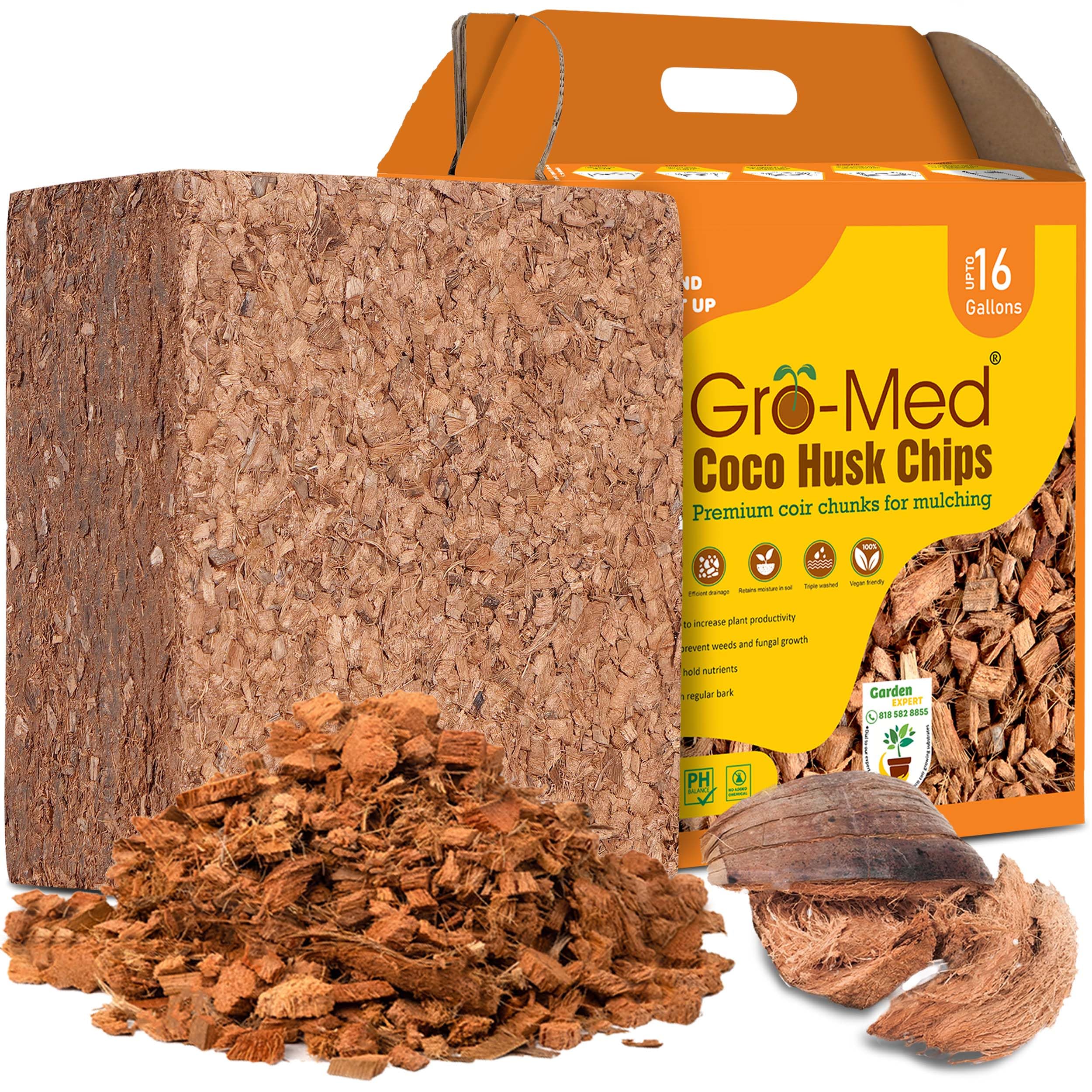
1. Gro-Med Coco Husk Chips for Plants (10lb)
Our pick — over 4.5★ from 500+ verified ratings; the strongest balance of quality and price.
The all-rounder that expands 16 gallons from a single lightweight block.
This is the mulch that quietly won over nearly 500 reviewers with one simple trick: you add three gallons of warm water, wait 20 minutes, and that 10-pound brick turns into a wheelbarrow-full 16 gallons of chunky, airy husk chips. The thing owners rave about most is the quality — 33 people call it out unprompted — and the way it stays loose without matting down like some wood mulches do.
The Gro-Med chips are triple-washed for a low EC (electrical conductivity) and a balanced pH, which means they won’t mess with your soil chemistry or burn delicate roots. They hold up to three times more water than regular bark, so you water less often. And unlike the Plantonix chips below, these feel chunkier and cleaner right out of the block — buyers describe them as “consistent” and “clean,” with no dust or fine particles.
A few owners note uneven water absorption if the brick isn’t soaked thoroughly. Give it a full 20 minutes and break it apart by hand — the phrase buyers use is “expanded quickly with a little help” — and you will get that full volume.
Chunky Texture
- Low EC and balanced pH — won’t mess with your soil chemistry — so roots are safe
- Holds triple the water of bark, meaning less frequent watering in garden beds
- Versatile enough for orchids, vegetables, raised beds, and even reptile bedding
Needs Soaking
- The block needs proper soaking time and hand-breaking to reach its full 16-gallon volume
Orchid Lovers: you want one bag to do everything — mulch a flower bed, mix a custom potting soil, or line a raised veggie bed — all without a trip to separate stores.
Quick Fix: you need a ready-to-spread mulch with zero prep time; this block demands 20 minutes and a bucket of water.
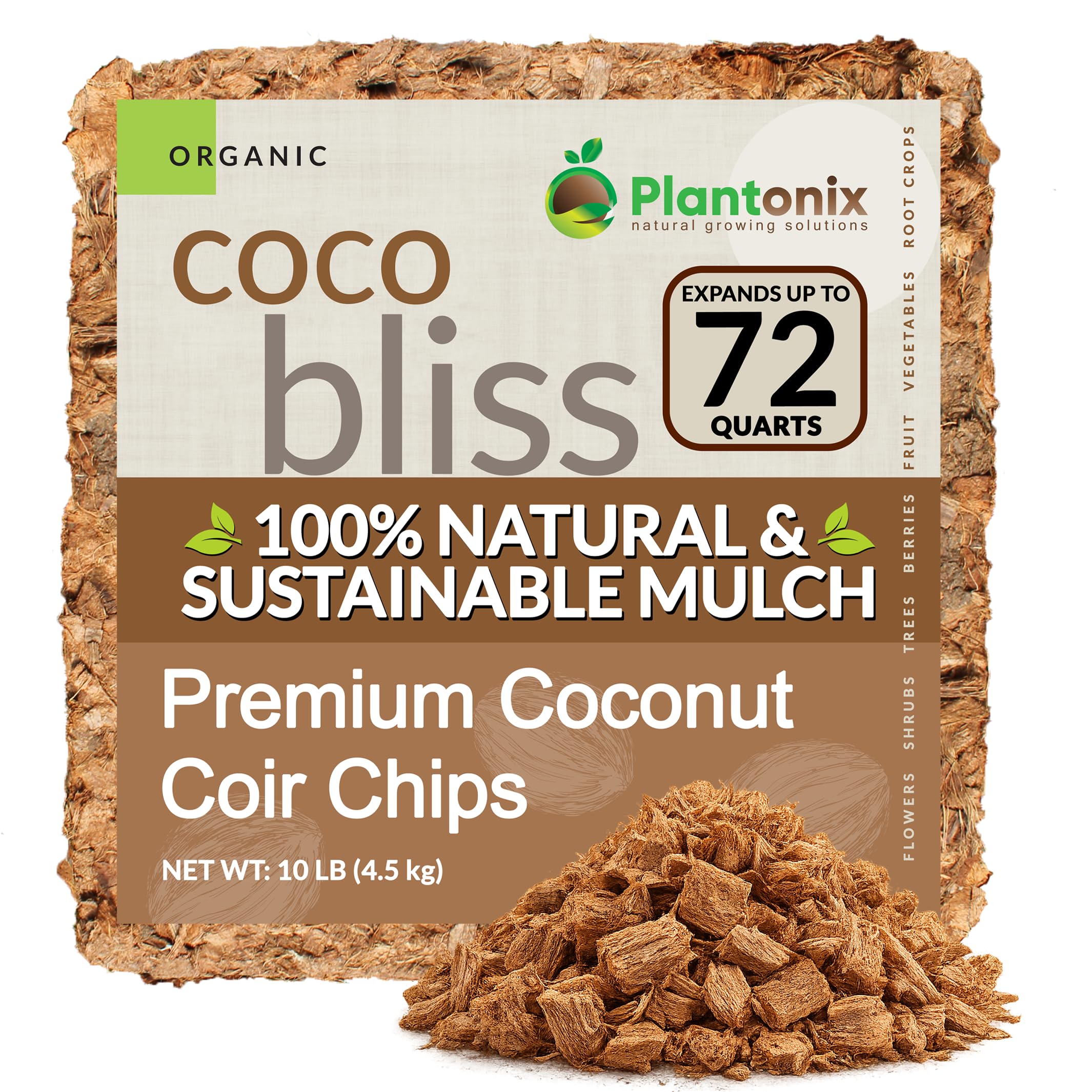
2. Plantonix Coco Chips Mulch Brick (10lbs)
The orchid lover’s choice with bigger chips and less dust.
Plantonix takes a different approach to the same coconut husk idea. The pieces here are noticeably bigger than standard coco coir — one owner sums it up: “the pieces are much bigger than the coco-coir. The brick expands nicely. Creates a lot less dust.” That matters if you are mixing a chunky aroid or orchid blend, where you want air pockets around the roots rather than a dense slurry. The 10-pound brick expands to 15 gallons of mulch medium, just a gallon shy of the Gro-Med.
What sets this one apart is how it handles in containers. Buyers consistently praise its drainage — the #2 most-discussed positive after quality. It keeps soil from compacting while still holding enough moisture that herbs, flowers, and tropical plants thrive. A fair warning from the reviews: un-buffered coco products can absorb nutrients your plants need. Plantonix does not explicitly say theirs is buffered, so a cautious grower would pre-soak and consider adding a light calmag supplement.
It is also a go-to for reptile owners looking for a natural, absorbent substrate that holds humidity without smelling musty — a bonus versatility point many coconut mulches share.
Compact Brick
- Large chip size creates excellent air pockets for orchids and aroids — less dust than finer coco coir
- Clean, natural color that looks good in beds and doesn’t stain
- Lightweight brick is easy to store and transport before hydration
Expands Slowly
- Not explicitly labelled as buffered — may absorb nutrients from your soil if you don’t pre-treat
Space Savers: indoor container gardeners, orchid enthusiasts, and reptile keepers who want a chunky, low-dust substrate.
Impatient: you need guaranteed buffered coco for a high-nutrient feeding schedule; you may need to add your own buffer.
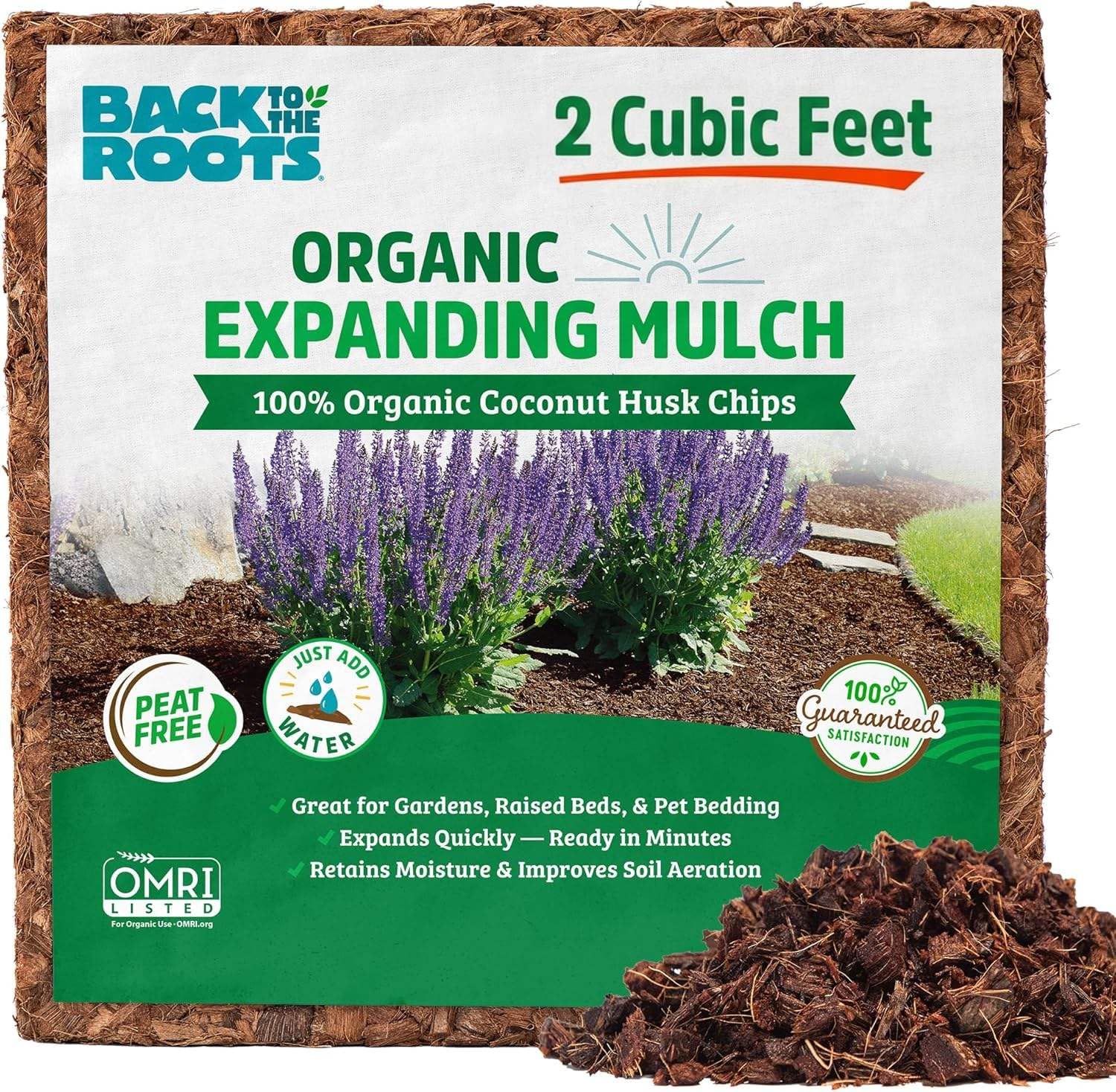
3. Back to the Roots 100% Organic Mulch (2 cu ft)
The organic pick that fills a wheelbarrow from a single compact brick.
Back to the Roots is a name you see in big-box garden aisles, but their compressed coconut husk mulch holds its own against the specialty brands. The 10-pound block expands to over 2 cubic feet — enough to cover a raised vegetable bed with a 2-3 inch layer. What buyers rave about is the sheer volume: “added water & it filled my wheelbarrow” and “filled my kiddie pool” are the kind of quotes that tell you this thing expands dramatically. It is also OMRI Listed (organic), so you can use it confidently around edible plants.
Compared to the Gro-Med, this one is slightly smaller at 2 cubic feet vs 16 gallons (roughly 2.1 cubic feet), so the difference is marginal. The real edge here is the 100% satisfaction guarantee and the GrowOneGiveOne program, where sharing a photo of your garden triggers a donation of a classroom curriculum kit. That feels good in a way a plain bag of mulch does not. The texture is slightly finer than the Gro-Med chips, making it a great topdress for vegetable gardens where you want a more uniform appearance.
One reviewer noted it “saved my back” compared to carrying a heavy wet bag of traditional mulch — a real perk if you garden solo or have mobility concerns.
Organic Blend
- OMRI Listed for organic gardening — safe for vegetables and herbs
- Expands hugely — one brick fills a wheelbarrow, making application fast
- Back-friendly — light dry weight before hydration beats dragging a 40-lb bag
Fades Fast
- Fine texture means it decomposes a bit faster than chunkier husk chips — expect to top up annually in a bed
Eco-Gardeners: you want certified organic mulch for a vegetable garden and appreciate a brand that gives back.
Long-Term: you need coarse chips for orchids or a long-lasting permanent bed mulch; finer texture breaks down faster.
4. Hull Farm Cocoa Bean Shell Mulch (2 cu ft)

The garden-topper that smells like a chocolate bar for a week.
Nothing signals “no artificial anything” quite like cocoa bean shells. This Hull Farm bag is pure dark cocoa hulls with an approximate fertilizer value of 2.5-1-3 — so it feeds as it rots. The scent is the headline: 76 owners single it out above anything else. They call it “heavenly” and note that the strong chocolate aroma lasts roughly a week before fading to a subtle background note. It is lightweight, dark brown, and gives flower beds a rich, finished look that dyed mulches try and fail to copy.
The catch is genuine and worth reading carefully: the same chocolate smell that delights you is attractive to dogs. Theobromine in cocoa can be toxic to them, so this is a skip if your dog roams the yard. Owners also note that light rain can cause a harmless white mold on the surface (normal for organic material) and that the mulch is light enough to blow around before the first watering locks it down. The value for money gets a negative verdict from some buyers — the price has risen sharply over the years — but the quality and scent are consistently praised.
One clever use from a reviewer: it worked as a squirrel deterrent when pecan mulch attracted them, because the scent is different enough to send them elsewhere.
Chocolate Scent
- Intense natural chocolate scent that makes gardening more pleasant — the #1 praised aspect
- Adds a mild fertilizer boost (2.5-1-3 NPK) as it decomposes in your soil
- Dark natural color looks rich and decorative without any added dye
Attracts Pests
- Contains theobromine — toxic to dogs if ingested in quantity; not safe for pet-accessible yards
Sensory Appeal: you have no dogs, you love the smell of chocolate, and you want a decorative mulch that feeds the soil as it breaks down.
Pest-Free: your dog spends time in the garden — the scent attracts them, and the theobromine is a real risk.
5. Garden Elements Cocoa Bean Shell Mulch (2 cu ft)

Expensive but effective — the natural alternative to dyed mulch that actually feeds your soil.
Garden Elements takes the cocoa bean concept a step further with a 30-pound bag (the heaviest in this list) that covers ground immediately with no rehydration step. It carries the same 2.5-1-3 NPK fertilizer value and the same dog-related caution as the Hull Farm mulch above. The difference is in scale and density: this is a heftier, more substantial bag that feels like a traditional mulch in your hands. Buyers call it “easy to spread” and note it “stays in place” once watered in, with a warm brown color that resists fading.
Owners consistently call this “expensive but effective.” It suppresses weeds thickly, does not blow away easily after the first watering, and — unlike many dyed mulches — does not stunt plant growth or deplete soil nitrogen as it decomposes. One owner sums it up: “unlike dyed mulch, doesn’t stunt plants or deplete nutrients.” The main negative is that the same harmless white mold that appears on organic mulch in damp conditions can be off-putting if you do not expect it.
If the price of the Hull Farm bag feels high, this one is in the same range but gives you more physical weight per cubic foot — a denser, more soil-feeding option.
Rich Color
- Easy to spread from the bag with no mixing or soaking required
- Natural dark brown color that resists fading and adds a finished look to beds
- Enriches soil as it decomposes rather than depleting nitrogen like some bark mulches
Molds Easily
- Still toxic to dogs due to theobromine and caffeine — must be kept away from pets
Aesthetic Focus: you want a ready-to-spread cocoa mulch with no prep and a thicker, more traditional feel underfoot.
Dry Climates: you have dogs that roam the garden — this is not safe for pet households.
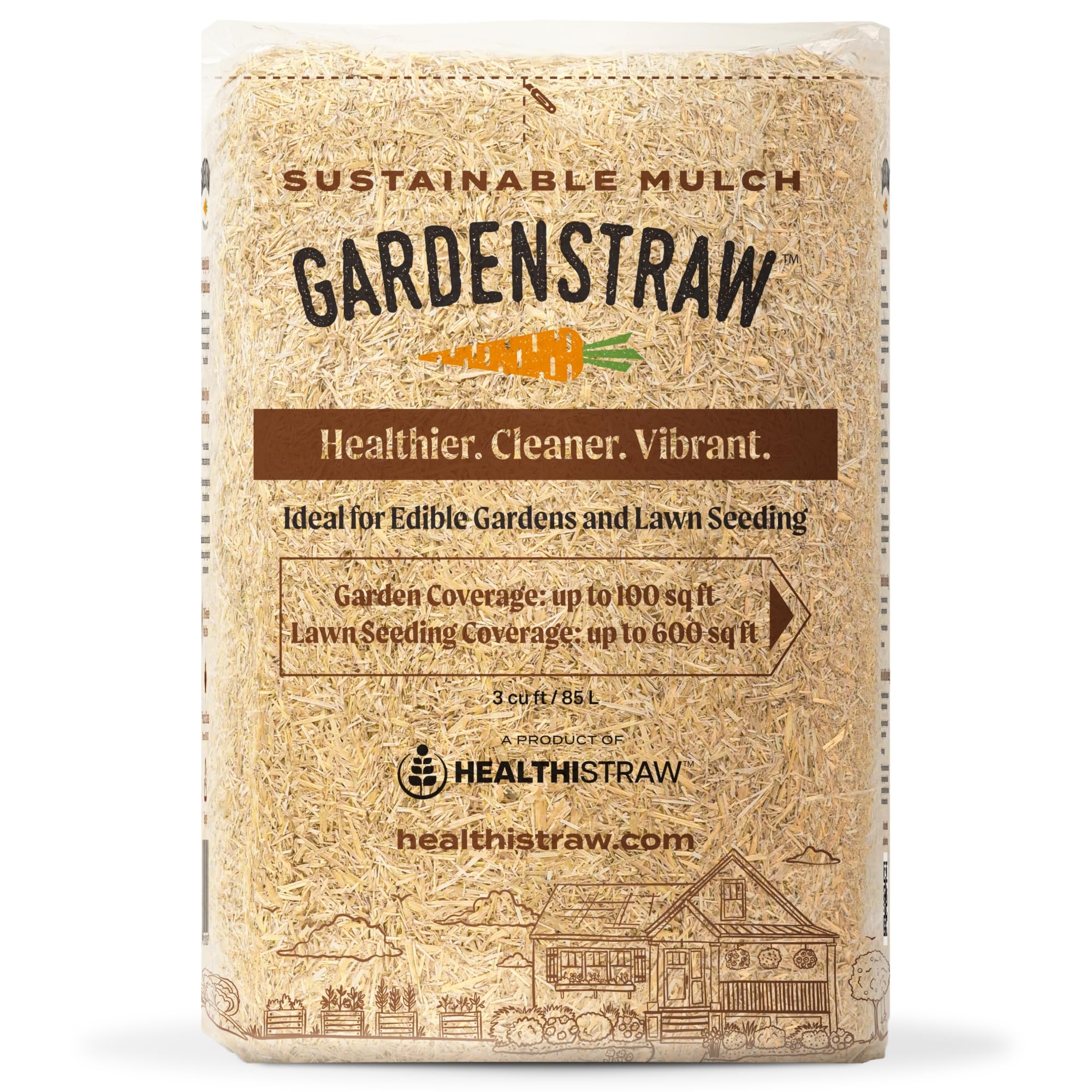
6. HealthiStraw GardenStraw (3 cu ft)
The market leader that cuts watering by half without a single chemical.
HealthiStraw is the most-reviewed product in this guide — with a huge owner base — and it earns that popularity honestly. This is not typical hay from a feed store. It is 100% non-GMO wheat straw that has been “naturally filtered” to remove dust, dirt, and as many seeds as possible. The manufacturer claims it reduces watering needs by up to 50%, and owners confirm the moisture retention is excellent — “exceptional” is the word that comes up repeatedly. The 3 cubic foot compressed bale covers up to 100 square feet at a 2-3 inch layer for beds, or 600 square feet at a thin quarter-inch layer for lawn seeding.
The main point of debate is seed content. Some buyers report “no wheat seed germination” and call it the best straw they have ever used. Others received bales with “way too many seeds” that sprouted into grass they had to pull. The manufacturer filters aggressively, but it is impossible to remove every seed from a natural agricultural product. If you are using this in a pristine bed where every weed matters, that is something to factor in. For most gardeners, the occasional wheat grass sprout is a minor pull compared to the water savings and soil health benefits.
It is also compost-friendly — the used straw breaks down quickly and adds carbon to your compost pile, closing the loop beautifully.
Lightweight
- Reduces watering significantly — owners call moisture retention “exceptional” in hot weather
- Specially cut straw fibers interlock when watered, staying in place against wind and rain
- Breaks down into compost-friendly organic matter that enriches soil over time
Blows Away
- Seed content varies between batches — some bales sprout wheat grass that needs pulling
Windless Beds: you want the top-tier straw for moisture retention in vegetable beds and don’t mind picking the occasional sprout.
Open Areas: every single seed must be eliminated from your garden; a fine-tooth filtered straw may still contain a few viable seeds.
7. Soil Sunrise Pine Bark Mulch Nuggets (30 Quarts)
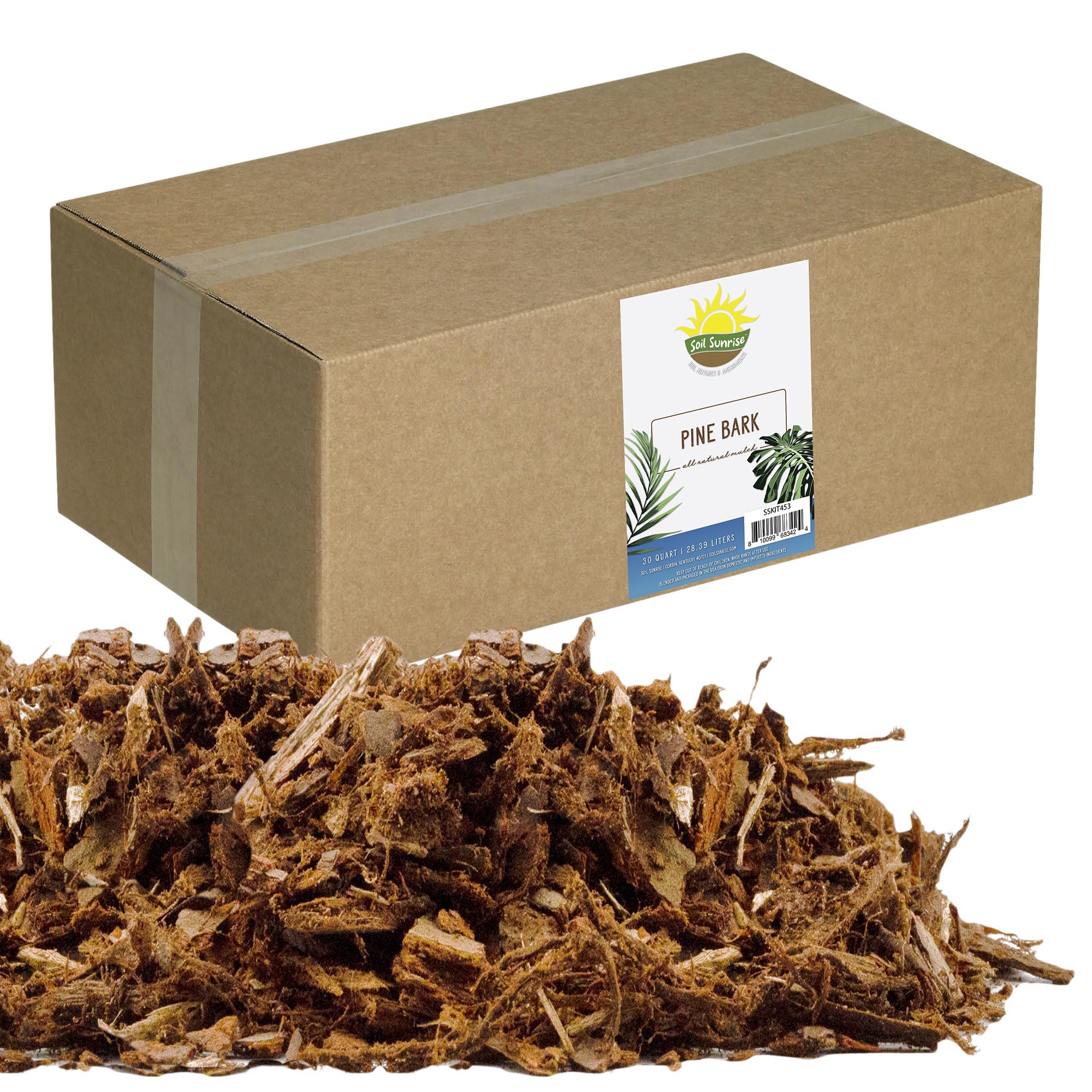
The mini nugget that turns a pot into a showpiece.
Soil Sunrise packs 30 quarts (1 cubic foot) of pure pine bark nuggets into a clear bag — and the clear bag is a deliberate touch. Owners love being able to see exactly what they are getting: no mold, no insects, no surprises. The nuggets average half an inch, which is the balance for container gardening. They are small enough to tuck around a citrus tree or succulent without looking oversized, yet chunky enough to create air channels in the soil that prevent root rot. There are no added fertilizers or pesticides, so it is safe for edibles.
Where this mulch shines is in pots and terrariums. Several owners mention using it specifically for dwarf citrus trees and succulents, where drainage is everything. The pine bark creates a mix that allows water to flow through freely while still holding enough moisture to keep the root zone from drying out completely. It also smells clean and natural — “beautiful mulch, nice and clean smelling” is a direct owner quote. Use it for containers and decorative pots rather than sprawling in-ground beds.
Natural Nuggets
- Consistent 1/2-inch nuggets — perfect for mixing into potting soil for citrus and succulents
- Clear bag lets you inspect for mold or insects before opening
- All-natural with no added chemicals — safe for vegetable pots
Acidic Over Time
- At 1 cubic foot, it covers less ground than the compressed coconut bricks — better value for pots than whole beds
Acid-Lovers: you want a clean, inspectable pine bark for container plants, citrus, or succulents.
Alkaline Soil: you need to cover a large in-ground bed on a tight budget — the volume-per-dollar is lower than other options.
8. USA PINESTRAW Long Needle Pine Straw (65-80 sq ft)
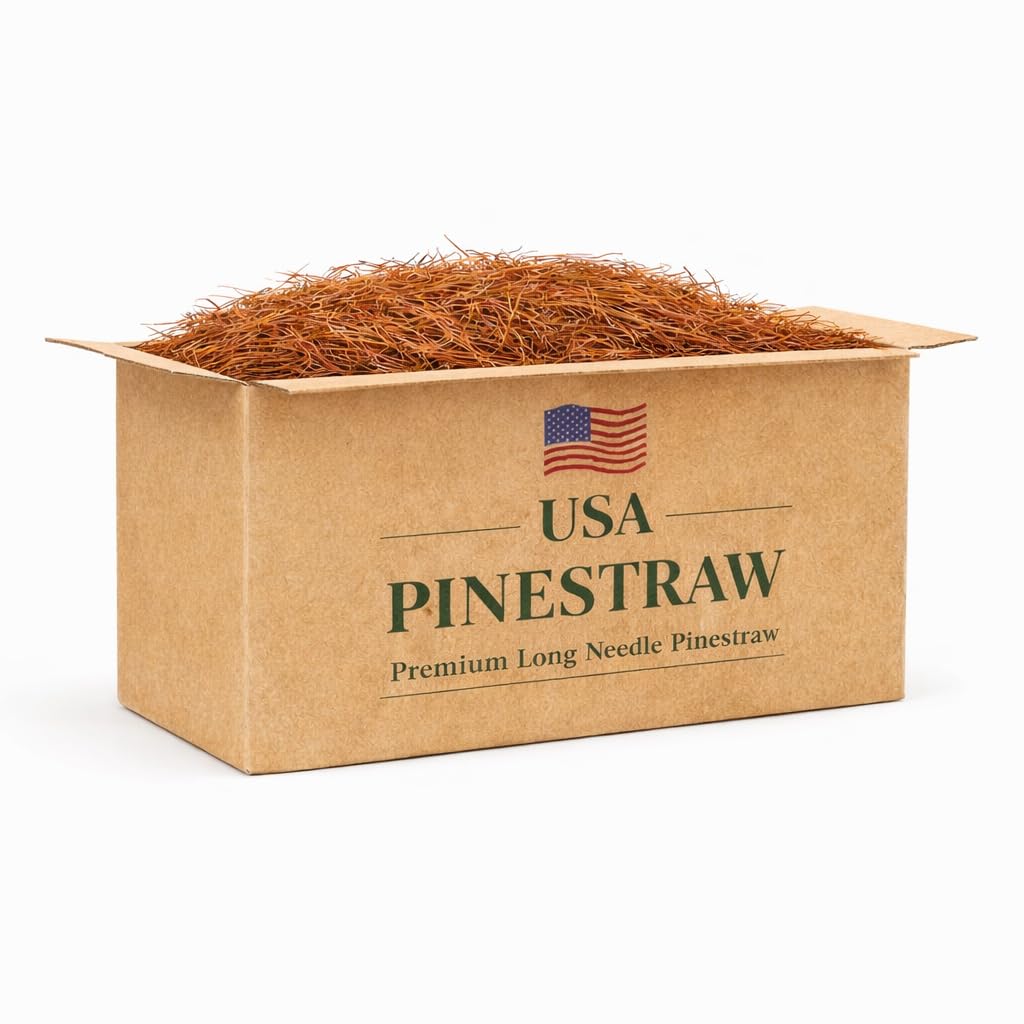
The grab-and-go bale for a single bed or tree ring.
Pine straw is a Southern landscaping staple, and this USA PINESTRAW bale brings it online in a manageable square package. The needles are long and red-toned, making for a neat, uniform ground cover that stays in place on slopes better than bark. Owners praise the appearance — it makes flower beds and tree rings look clean and intentional — and the ease of use. It comes well-packaged and can be removed from the box in sections, which makes application less messy than loose straw from a truck bed.
The main tension in the reviews is about coverage. The bale claims 65-80 square feet, but multiple owners say it is closer to 40-50 square feet at a typical 2-3 inch depth. If you are doing a big project, buy expecting a bit less coverage than advertised. It is also pricey per square foot — that is the trade-off for a premium, clean, harvested pine straw product. For a small garden bed, a tree ring, or a light post base, it is ideal. For a full yard, you would want the larger roll below.
Long Needles
- Easy to unbox and apply in sections — less mess than bulk pine straw
- Natural red-toned needles look neat on slopes and around trees
- Good quality needles with minimal debris, per owner feedback
Sheds Needles
- Coverage falls short of the 65-80 sq ft claim for most users — budget for less area
Pine Lovers: you need a small, easy-to-handle pine straw bale for a tree ring, a single raised bed, or a light post.
Tidy Yards: you are covering a large area — the per-square-foot cost makes a bigger roll more economical.
9. Longleaf Pine Straw Roll for Landscaping (125 sq ft)

The landscaper’s preferred format — a clean roll that covers more ground with less fuss.
Longleaf pine needles are the gold standard in the South — and this Colored Pine Straw roll brings that standard to your door. The needles are roughly 14 inches long, making them the longest in this category, and they interlock beautifully to resist wind and rain. Owners consistently say this is the cleanest pine straw they have found: “98% needles, no sticks or thorns” and “does not have sticks in it and things don’t stab you” are direct quotes. It is easy to unroll, lay down, and shape around plants. The roll covers up to 125 square feet, giving you the best coverage-per-box of any pine straw here.
Compared to the USA PINESTRAW bale, this roll is the smarter buy for any project over 50 square feet. The cost per square foot drops significantly, and the longleaf variety holds up better over time — it does not mat down as fast as shorter-needle straws. The value-for-money rating is mixed among owners, but the quality scores are the highest in the pine straw category at 60 positive mentions. If you have a medium to large garden, a slope that needs erosion control, or a decorative bed you want to look pristine, this is the one.
Roll Format
- Long 14-inch needles lock together naturally, resisting wind and rain better than short straw
- 98% pure needles with almost no sticks or debris — clean to handle and lay
- Covers 125 sq ft per roll — the best value-per-box in the pine straw category
Heavy Roll
- Not the cheapest option per roll — the upfront cost is premium, but the coverage is proportionally better
Large Areas: you have a medium-to-large garden bed or slope and want the cleanest, longest-lasting pine straw in a single easy roll.
Small Gardens: you only need a tiny patch of mulch; a smaller bale or bag of bark will suit better at lower cost.
Understanding the Specs
Expanded Volume
Compressed mulches — especially coconut husk bricks — are sold dry and expand dramatically when you add water. A 10-pound block can turn into 16 gallons or 2 cubic feet of mulch. That is the number that tells you how much ground you can actually cover. Always compare the expanded volume, not the dry weight, when deciding between blocks. Ready-to-spread mulches (bagged cocoa shells or pine bark) are sold by their final volume, so no math is needed.
Speed of Decomposition
All organic mulches break down over time, but at different rates. Wheat straw and cocoa shells decompose in roughly a year, enriching your soil as they go — you will need to top them up each season. Pine bark and coconut husk chips are slower, often lasting two to three seasons before they need replenishing. Pine straw sits in the middle, breaking down a bit slower than straw but faster than bark. Choose based on how much annual maintenance you want.
FAQ
Is dye-free mulch really better for my garden?
How much dye-free mulch do I need to cover my garden?
Can I use cocoa bean mulch if I have a dog?
Does dye-free coconut husk mulch contain salt?
How long does pine straw mulch last before I need to replace it?
Will wheat straw mulch introduce weeds to my garden?
Is pine bark mulch acidic? Will it lower my soil pH?
Which dye-free mulch is best for sloping or windy areas?
Can I mix dye-free mulches together?
Final Thoughts: The Verdict
Across the board, the best dye-free mulch winner is the Gro-Med Coco Husk Chips because it does everything at once — expands massively, holds three times the water of bark, stays pH-balanced, and works in beds, pots, and even reptile enclosures. If you want the fragrance of a chocolate bar in your garden, grab the Hull Farm Cocoa Bean Shell. And for the best water conservation in a vegetable bed, the HealthiStraw GardenStraw is the one to reach for — despite the occasional seed sprout, it is the crowd favorite among serious growers who want to cut watering in half.
How We Picked
We do not accept paid placement. Every pick is matched to a real buyer and a real use-case; we do not hands-on test units.
Sources & Methodology
Specifications: manufacturer listings and product documentation. Review insights: verified customer reviews, as of July 2026. Pricing: not shown on this page (it changes often); check the current price via the retailer link.
As an Amazon Associate, Lawn Gear Lab earns from qualifying purchases. This does not affect which products we feature.