
Specs are compiled from manufacturer listings and verified buyer reviews and can change over time — please confirm the key details on the product page before buying.
Duckweed can turn a clear pond into a solid green carpet in a matter of weeks. It blocks sunlight, starves the oxygen out of the water, and can kill fish if you use the wrong treatment. The trick is picking the right active ingredient for how fast you need results and if you want to spray the surface or pour a dose in once.
I’m Rikta — the founder and writer behind Lawn Gear Lab. This guide is built by comparing the manufacturers’ published specifications and the patterns across verified customer reviews, so you get each pick’s real strengths and trade-offs instead of marketing spin.
Whether you are fighting duckweed in a small koi pond or a half-acre water feature, these three treatments are the most effective options for a duckweed killer that actually works without harming your fish.
Our Picks at a Glance
How To Choose The Best Duckweed Killer
The first decision is speed versus longevity. A contact herbicide like Diquat kills duckweed within hours or days by damaging the plant cells it touches. A systemic herbicide like Fluridone moves through the whole plant and kills the roots, which takes weeks but prevents regrowth for an entire season.
Know your pond volume and surface area
Every duckweed killer is dosed by either fluid ounces per acre or milliliters per gallon. You need a rough estimate of your pond’s surface area and average depth to avoid under-dosing (which wastes money) or overdosing (which can stress fish). A contact killer treats the surface you spray; a systemic killer treats the entire water column.
Check fish, swimming, and irrigation restrictions
Many duckweed killers carry water-use restrictions — you may not be allowed to swim, water livestock, or irrigate for a set period after treatment. Some products are restricted in certain states entirely. Fish safety varies: Diquat can kill fish if applied too heavily, while Fluridone is generally non-toxic to fish at label rates.
Quick Comparison
| Model | Best For | Active Ingredient | Volume | Coverage | Amazon |
|---|---|---|---|---|---|
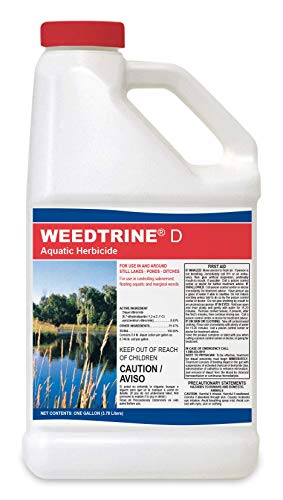
| Weedtrine D★ Best Overall | Fast spot treatment | Diquat dibromide | 128 fl oz | ~½ acre | Amazon |
| Sonar RTU | Season-long systemic control | Fluridone | 32 fl oz | ⅛ acre | Amazon |
| Airmax WipeOut | Large pond all-season treatment | Fluridone | 3.8 fl oz | Entire water body | Amazon |
In‑Depth Reviews
1. Weedtrine D Aquatic Herbicide
Our pick — 4.5★ from 250+ verified ratings; the strongest balance of quality and price.
The fastest-acting contact killer that drops duckweed within hours of hitting the water.
You see results the same day with this Diquat dibromide (a contact herbicide that damages plant tissue on direct contact) product. The 128-fluid-ounce gallon treats about half an acre of duckweed. One reviewer noted “weed begins to die within hours” after spraying the pond edges. Another owner wrote: “I tried several products to rid my pond of duckweed. I even caused a big fish kill with one of the products. This product actually works as advertised.”
But Diquat kills only plant tissue it directly touches. Any duckweed floating in untreated areas survives and needs a follow-up spray. You also need a surfactant (a wetting agent that helps the spray stick to surface leaves) for weeds above the water line. The product cannot ship to CA, NY, or WA, among other states.
Why owners reach for it
- Visible results within hours of spraying — fastest acting option in this guide
- 128-ounce gallon treats a large area (~½ acre) at a mid-range price point
- Reported safe for fish and wildlife when label instructions are followed
The honest limits
- Contact-only formula means regrowth is likely without follow-up applications
- Requires a surfactant (a wetting agent) for treating weeds floating on the surface
- Restricted shipping to multiple states and Canada
Best suited for: people with moderate duckweed coverage who want fast, visible results and do not mind a second application later in the season.
Look elsewhere if: you want a single-dose all-season treatment or live in one of the restricted states for shipping.
2. Sonar RTU Aquatic Herbicide

The pour-and-forget systemic that kills duckweed from the roots for a full season.
You pour the 32-fluid-ounce quart bottle directly into the pond at the correct dose — no mixing or sprayer needed. The active ingredient is Fluridone, a systemic herbicide that algae and duckweed absorb through their leaves and roots. It stops the plant from making chlorophyll (the green pigment used in photosynthesis), so the duckweed gradually starves and dies over several weeks. One quart treats one-eighth of an acre for the entire season.
A koi pond owner measured exactly 3ml into an 800-gallon pond and reported: “duckweed turned light and died within a week, no longer spreading.” They said it did not harm their koi. Another owner of five years wrote their first Amazon review ever for this product after struggling with algae and duckweed: “this product WORKS!! Have patience with it, clean your pond while it does its thing.”
The catch is patience — several buyers report it took 40 days or more for full results, and a small number say it did not work at all. Sonar RTU’s Fluridone is less concentrated per ounce than the Airmax WipeOut, so it is better suited to smaller ponds where you can measure exact doses. Unlike the Weedtrine D, you will not see dead plants within hours.
What owners love
- Extremely simple application — no sprayer, just pour the right dose directly into the pond
- Systemic action kills the whole plant, preventing regrowth for the season
- EPA-approved and non-toxic to fish, pets, and wildlife at label rates
The slower side
- Works slowly — full results can take 40 days or more
- Some owners mention no effect even after following directions exactly
- Cannot ship to several states including CT, NJ, NY, and WA
Reach for this if: you have a small to medium pond and want a low-maintenance systemic treatment that won’t harm your fish.
Think twice if: you need instant results or your pond is larger than a quarter acre (you would need multiple quarts).
3. Airmax WipeOut Pond Weed Defense

The concentrated systemic that treats an entire pond in one pour from the shoreline.
Airmax WipeOut uses the same Fluridone active ingredient as Sonar RTU, but it is far more concentrated per ounce. The bottle holds just 3.8 fluid ounces yet treats a full pond with a single application. You mix the small liquid volume with pond water and pour it in several spots around the edge — no sprayer or boat needed. The systemic Fluridone spreads through the water column, reducing chlorophyll until the weeds starve.
Buyers on ponds between half an acre and two acres report great success. One saw lily pads and coontail clear completely, noting it “worked better than aquatic glyphosate and diquat.” Another cleared a half-acre pond of duckweed in about a month. But the product is slow by design. A small group report it did not work at all — one wrote: “It’s been a month and my pond looks worse than it did before. No duck weed died.” Full results often take 4 to 8 weeks. Unlike the Sonar RTU, which needs precise dosing for small ponds, Airmax WipeOut is simpler for large water bodies.
Airmax WipeOut has no swimming, boating, fishing, or livestock watering restrictions after treatment. You can also apply it early in the season before weeds emerge as a preventative. At 3.8 fluid ounces, it costs more per ounce than Sonar RTU, but the convenience for large ponds is the real trade-off — the Sonar RTU’s 32-ounce bottle is easier to dose on small ponds, while this 3.8-ounce version treats the whole water body.
Why it stands out
- Treats the entire water body with one easy shoreline application
- No swimming, fishing, or livestock restrictions after application
- Long-term systemic control that prevents regrowth all season
Where it trips up
- Extremely slow — expect 4 to 8 weeks before noticeable results
- Higher cost per ounce than other Fluridone options
- Some customers note it did not control duckweed at all
Best for: owners of larger ponds and lakes who want a single-season treatment without repeat applications.
Get the Sonar RTU instead if you have a small pond (under a quarter acre) where you need to measure exact milliliter doses — the Sonar’s 32-ounce bottle is easier to portion for tiny water volumes.
Understanding the Specs
Contact vs Systemic Herbicides
A contact herbicide like Diquat kills the plant cells it directly touches. It works within hours to days and is great for spot treatment, but it does not kill the roots or seeds — duckweed often grows back. A systemic herbicide like Fluridone is absorbed into the plant’s vascular system and kills the entire plant from root to leaf. It takes weeks to work but offers season-long control in one dose.
Active Ingredients (Diquat vs Fluridone)
Diquat dibromide is a fast-acting contact killer. It works on contact but requires a surfactant for surface weeds and can cause oxygen depletion if too much plant matter dies at once. Fluridone is a slow systemic that prevents chlorophyll production. It is non-toxic to fish at label rates, has no swimming restrictions, and works on both floating and submerged weeds including duckweed, lily pads, and hydrilla.
Coverage Area and Pond Size
Duckweed killer coverage is measured in acres or fractions of an acre. The Weedtrine D treats ~½ acre with one gallon. The Sonar RTU covers ⅛ acre per quart. The Airmax WipeOut is designed to treat an entire pond regardless of size, but you need to calculate the right dose based on surface area and average depth. Under-dosing is the most common reason for failure.
State Restrictions and Water Use
Both the Weedtrine D and Sonar RTU have shipping restrictions that include CA, CT, HI, ME, NJ, NY, WA, and Canada. Some products also restrict water use for irrigation, drinking, and swimming for a set period after application. Always check the label’s water-use restrictions before buying — they vary by active ingredient and concentration.
FAQ
Which duckweed killer works the fastest?
Are duckweed killers safe for fish?
How is Sonar RTU different from Airmax WipeOut?
How long does Fluridone take to kill duckweed?
Can I swim in my pond after using a duckweed killer?
What is a surfactant and do I need one?
How do I calculate the right dose for my pond?
Why do some users report the product did not work?
Can I use a duckweed killer with a pond fountain or aerator?
Will these products kill algae too?
Final Thoughts: The Verdict
For most buyers, the duckweed killer winner is the Weedtrine D because it delivers visible results in hours rather than weeks and the gallon jug covers half an acre at a mid-range price. If you want season-long control with a single pour, grab the Sonar RTU — just be patient for the 40-day timeline. And for a large pond or lake where you cannot spray the whole surface, the Airmax WipeOut is the one to reach for, with no swimming or fishing restrictions after use.
How We Picked
We do not accept paid placement. Every pick is matched to a real buyer and a real use-case; we do not hands-on test units.
Sources & Methodology
Specifications: manufacturer listings and product documentation. Review insights: verified customer reviews, as of July 2026. Pricing: not shown on this page (it changes often); check the current price via the retailer link.
As an Amazon Associate, Lawn Gear Lab earns from qualifying purchases. This does not affect which products we feature.