
Specs are compiled from manufacturer listings and verified buyer reviews and can change over time — please confirm the key details on the product page before buying.
Setting up a watering system for tomato plants sounds simple — until you are battling cracked fruit, dry soil pockets, and a sad-looking patch where the water never seems to reach. The trick is getting a slow, steady dose right at the roots, not a drench-and-run cycle that wastes water and stresses the plants.. That is what a drip system does, and the right kit makes the difference between endless manual watering and a low-maintenance harvest..
I’m Rikta — the founder and writer behind Lawn Gear Lab. This guide is built by comparing the manufacturers’ published specifications and the patterns across verified customer reviews, so you get each pick’s real strengths and trade-offs instead of marketing spin.
We have lined up nine complete kits that cover everything from tiny patio pots to sprawling raised beds, so you can find the best drip system for tomatoes without wading through a hundred listings.
Our Picks at a Glance


How To Choose The Best Drip System For Tomatoes
Tomatoes are heavy feeders that need consistent moisture at the root zone, but the leaves should stay dry to avoid fungal diseases like blight. A drip system solves that by delivering water slowly right where the roots grow, so you use less water and get healthier plants. Here is what to check before you buy.
Pressure Compensation — the secret to even watering
If your garden slopes or runs long, plain emitters at the far end of the hose will drip less than the ones near the faucet. Pressure-compensating (PC) emitters self-regulate, so every plant gets the same amount of water regardless of distance or elevation. Kits labeled “pressure-compensating” are worth the small premium for a row of tomatoes.
Tubing diameter — 1/2″ vs 1/4″
The main line should be 1/2-inch tubing to carry water far without losing pressure. From that main line, 1/4-inch branch tubing runs to individual plants. A kit with a 50-foot 1/2-inch main line can cover a longer garden than one with a 33-foot main line, so measure your bed length before buying.
Number and type of emitters
A single tomato plant needs roughly one gallon of water every few days in hot weather, delivered slowly.. Adjustable emitters — those you can turn from a drip to a spray — let you fine-tune the flow as the plant grows. Kits that include at least 15-20 emitters give you enough heads to water a typical 4×8 raised bed without buying extra parts immediately.
Quick Comparison
| Model | Best For | Total Tubing | Main Line Diameter | Emitters Included | Amazon |
|---|---|---|---|---|---|
| Rain Bird LNDDRIPKIT★ Best Overall | Small gardens looking for variety | 50 ft | 1/4″ dripper lines | Drippers, micro-bubblers, micro-sprays | Amazon |
| Rafow 240FTBudget Champion | Budget-conscious, large coverage | 240 ft | 1/2 inch | Adjustable ejectors | Amazon |
| Maotong 240FTQuick-Connect King | Quick connect ease + value | 240 ft | 1/2 inch | Stream + vortex drip emitters | Amazon |
| GGAQHLK 230FT | Adjustable copper nozzles | 230 ft | 1/2 inch | 38 (stream, vortex, misting, copper) | Amazon |
| Landtouch 250FT | Large garden coverage | 250 ft | 1/2 inch | 16 drip + 16 fountain sprayers | Amazon |
| Spalolen Push-to-Connect | No-heat, secure connections | 150 ft | 1/2 inch | 30 (stream + vortex) | Amazon |
| Abakuku 230FT | Budget-friendly automation | 230 ft | 1/2 inch | 4 types (drip, vortex, mist, stream) | Amazon |
| MIXC 200FT | Flexible copper nozzle positioning | 200 ft | 1/4 inch | 32 adjustable copper nozzles | Amazon |
| Rain Bird GARDENKIT | Exact fit for a 4×8 raised bed | 35 ft | Emitter tubing (1/4″) | 70 built-in emitters (6″ spaced) | Amazon |
In‑Depth Reviews
1. Rain Bird LNDDRIPKIT
Our pick — 4.5★ from 900+ verified ratings; the strongest balance of quality and price.
The undisputed starter champ with three device types in one box.
This 108-piece kit from Rain Bird is the crowd favorite — 4.5 stars across 900+ ratings — and the reason is the variety. You get drippers for slow root feeding, micro-bubblers for wider soaking, and micro-sprays for gentle overhead misting, all in one package. That means you can water a row of tomatoes with drippers and the surrounding flower bed with bubblers, all off the same faucet. Pressure-compensating technology (PC) keeps every emitter delivering the same flow, even at the far end of the 50-foot main hose. Buyers report that a 61-year-old gardener had the whole thing set up in 20 minutes, so the ease factor is real.
The kit claims up to 80% water savings compared to a hose. — and the clog-resistant design means you are not cleaning emitters every weekend. The only thing missing is a timer; you will need to grab a Rain Bird hose-end timer (sold separately) to automate it. Durability gets mixed feedback in reviews: the plastic parts hold up well for seasonal use, but a few owners find the thin 1/4-inch tubing delicate in rough soil.
Easy DIY setup
- Three watering device types in one kit — drippers, bubblers, and micro-sprays
- Pressure-compensating design for even watering across the whole run
- Clog-resistant emitters mean less maintenance over the season
Basic emitter design
- No timer included, so you need to buy one separately for automation
Beginner friendly: you want a single box that covers multiple watering styles — drippers for roots, bubblers for flowers, sprays for groundcover — without buying extra parts.
Limited customization: your garden is larger than a typical suburban bed; the 50-foot main hose is great for small-to-medium spaces but may need a second kit for sprawling plots.
2. Rafow 240FT Drip Irrigation System
240 feet of tubing at a price that undercuts nearly everything else.
Three hundred ratings and a 4.3-star average tell a simple story: this kit delivers good quality and easy setup for very little money. The Rafow system gives you 207 feet of 1/4-inch branch tubing plus 33 feet of 1/2-inch main line, so even a long row of tomatoes has plenty of reach. The quick-connect fittings are a genuine time-saver — owners mention the system goes from box to fully operational in about 10 minutes, which is almost unheard of in this category. The three adjustable nozzle types (stop, micro-drop, spray) let you dial in the right water volume for each plant without swapping parts.
The value-for-money aspect is the standout — owners consider it excellent. But the quality of the fittings is not quite premium: a few owners note that the 1/4-inch tees run short for larger layouts and that the blue sprayers have lower flow than the red ones. The kit uses 1/2-inch pipe as the main line, which helps maintain pressure across the full 240 feet — a solid engineering choice at this price point.
Budget friendly: If you are covering a large area on a strict budget, this kit gives you the most tubing per dollar with quick-connect convenience. The trade-off is that you may need to buy a few extra tees or swap a sprayer or two to get your perfect layout.
Smart buy for: the gardener who wants full coverage of a long bed or greenhouse without spending much — and who is comfortable buying a handful of extra fittings down the road.
Not ideal if: you prefer a system with zero fuss from day one; a kit with slightly more consistent emitter quality may suit you better.
3. Maotong 240FT Quick-Connect Drip Kit
270 pieces and a plug-and-play connector that skips the heating step.
Rated 4.4 out of 5 stars across 300+ ratings, the Maotong kit is built around a truly tool-free experience — the upgraded 4-way connectors push directly into 1/4-inch tubing without heating or softening the plastic. That makes layout adjustments fast: you can reposition an emitter in seconds as your tomato plants grow and sprawl. The kit splits into two 120-square-foot zones, which is handy if your garden has separate beds with different sun exposure. The 40-foot 1/2-inch main tube can be divided into two shorter mains, and you get two faucet connectors in the box.
Buyers consistently call out the hose quality as impressive — thicker and easier to straighten than the tubing in other kits at this price. The emitters come in two types: 15 stream emitters for targeted root watering and 15 vortex emitters for a wider, soaking pattern. Some owners noted that they bought a second kit because they liked the first one so much. The 1/4-inch tubing is 200 feet long, which is generous for a hobby garden.
Quick connect: The push-fit connectors eliminate the single biggest frustration of drip installation — the struggle to get barbed fittings into hard plastic tubing. For anyone who does not want to boil water or wrestle with pliers, this is the kit.
Ideal for: a gardener setting up two separate beds who wants the flexibility to adjust layout on the fly without special tools.
One caveat: the 40-foot main tube is shorter than some competing kits, so if you need a really long single run, you will need to check your measurements first.
4. GGAQHLK 230FT with Copper Nozzles
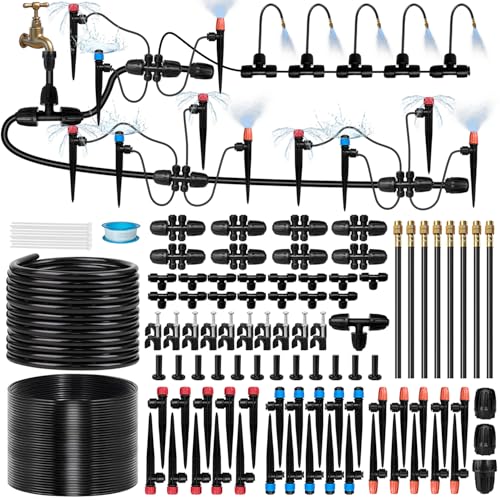
Copper nozzles that bend 360 degrees — and a 4.7-star owner rating.
This kit scores the highest rating in the lineup — 4.7 stars — and the praise centers on ease of use and functionality. The headline feature is the 38 adjustable nozzles, including 8 bendable copper sprinklers that rotate a full 360 degrees so you can aim the spray precisely at a tomato’s root zone or angle it away from the leaves. The three other nozzle types (vortex, stream, misting) cover every watering style from deep soak to fine mist. The 1/2-inch main line and 4-way connectors let you split the system into two independent zones, which is a thoughtful touch for gardeners who want different schedules for different beds. Owners note that the tubing is durable and that the push-in 1/4-inch connections are easy to adjust if you make a mistake during layout. The 33-foot main line is on the shorter side, so this kit fits best in a medium-sized garden rather than a sprawling plot.
Durability gets a mixed note in reviews: some owners find the copper nozzles sturdy and long-lasting, while others describe some plastic parts as flimsy for repeated seasonal use. A few buyers treat the system as an annual purchase — they buy a new kit each spring rather than storing the tubing over winter.
Perfect for: the gardener who values precision — the 360-degree copper nozzles make it easy to point water exactly where each tomato plant needs it, keeping foliage dry and fruit healthy.
Think twice if: you expect a system to last several seasons without part replacements; the mixed durability feedback suggests some components may need refreshing each year.
5. Landtouch 250FT Drip Irrigation System

A brass splitter that outlasts the cheap plastic ones and 250 feet of hose.
The Landtouch kit offers the most tubing in the lineup — 250 feet total, with a 50-foot 1/2-inch main line and 200 feet of 1/4-inch branch tubing. That extra main-line length (50 feet vs. the common 33 feet) means better water pressure to the far end of a long garden bed. The brass splitter is a practical upgrade: it resists cracking and UV damage much longer than the plastic splitters found in cheaper kits. Owners give it 4.4 stars across 240+ ratings, with ease of setup and effectiveness being the top praise. The quick-connect design lives up to its name; customers note the system works perfectly when paired with a hose timer, even holding up through 100-degree heat. The kit includes 16 drip emitters and 16 fountain sprayers — enough heads for a densely planted garden.
The customer voice notes a mixed experience with the included accessories: some sprayers fail to shut off completely, and one 4-way connector leaked on arrival. The return policy requires sending the whole kit back, which is a hassle if only one part is defective. Overall, the brass splitter and generous tubing length make this a compelling choice for large gardens where plastic connectors would not survive the season.
Best for: a large raised bed or greenhouse where a long main line is critical to maintain pressure, and where a brass splitter adds durability over the long term.
Check before buying: test the sprayers and connectors as soon as the kit arrives, since a few faulty heads have been reported and returns are not part-specific.
6. Spalolen Push-to-Connect Drip Irrigation System
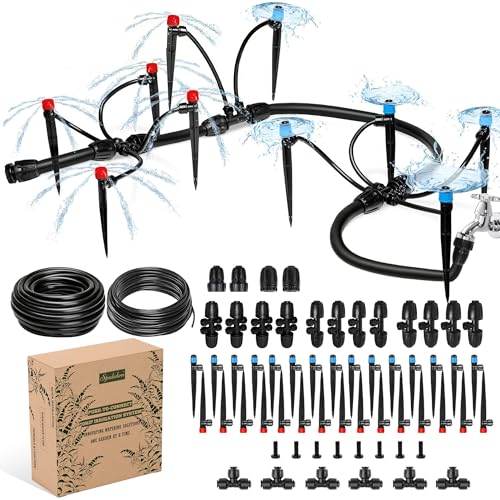
No heating, no glue — just push the tube in and it locks.
Spalolen’s kit solves the two biggest frustrations of drip irrigation: getting barbed fittings into cold tubing and dealing with pop-offs when water pressure changes. The push-to-connect fittings use locking clips and inner sealing O-rings to stay put, and the tube inserts in about one second. The 50-foot 1/2-inch mainline is longer than most kits at this price (many use 33 feet), which helps carry water farther with stable flow for a long row of tomato plants. The kit includes 30 emitters (stream for targeted root watering and vortex for wider coverage), plus 100 feet of 1/4-inch branch tubing. Owners give it 4.5 stars across 210 ratings, and many call the overall quality and water pressure “amazing.” One buyer irrigated four 2×4 raised beds plus four pots and reported excellent tomato and pepper growth after three months.
A few reviewers point out that some blue sprayers delivered slow trickles instead of a spray pattern. The spigot attachment does not rotate, so you may need to adjust the whole connector orientation when attaching to a faucet. The end plug is also hard to remove for winter flushing. Still, for the push-to-connect convenience alone, this kit stands out as among the most user-friendly systems available.
Great for: anyone who has struggled with traditional barbed fittings and wants a system that feels more like assembling a toy than a plumbing project.
Keep in mind: a small number of emitters may need swapping, so test all of them during initial setup to avoid surprises later.
7. Abakuku 230FT Quick-Connect Drip Irrigation Kit
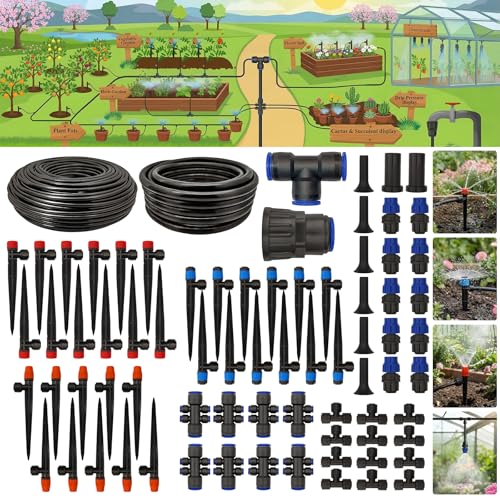
239 pieces, four emitter patterns, and customer service that ships free replacements.
This kit from Abakuku covers 230 feet with a 33-foot 1/2-inch main line and 197 feet of 1/4-inch branch tubing. The range of emitters is broad — drip stream, vortex, blue mist nozzle, and adjustable heads — so you can test different watering patterns to find what your tomatoes respond to best. The quick-connect design is genuinely tool-free: the 4-way connectors, tees, and nozzles push directly into the 1/4-inch tubing. At 4.2 stars across 550+ ratings, the consensus is that the system works well and is easy to assemble, with customer service being a highlight — shoppers say that the seller responds quickly and ships missing parts at no cost. Owners describe the setup as “super easy” and note that it worked perfectly on the first try.
The catch is that the main line uses 16mm tubing, which is slightly larger than the standard 1/2-inch (12.7mm) used by most hardware-store fittings. That means replacement connectors from a local store may not fit. A few buyers also found that kits arrived missing a handful of stakes or connectors. If you are okay ordering replacement parts from the seller, the system itself functions well and the customer support is proactive.
Best for: a budget-conscious first-time user who wants maximum flexibility in emitter types and a seller that stands behind the product.
Watch out for: the non-standard mainline diameter — plan to get replacement fittings from the seller rather than a local hardware store.
8. MIXC 200FT 1/4″ Drip Irrigation System
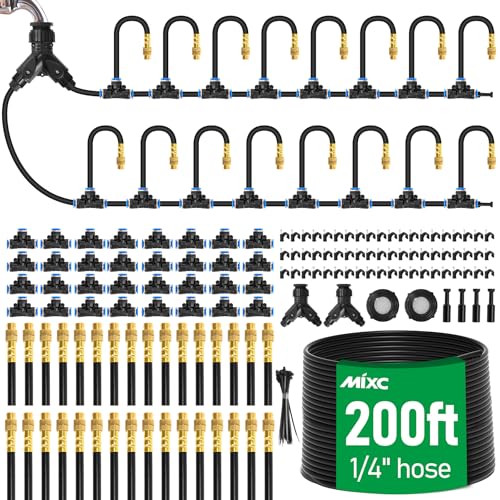
32 bendable copper nozzles that each twist 360 degrees for pinpoint watering.
The MIXC kit focuses on nozzle flexibility: 32 adjustable copper nozzles with aluminum interiors that bend into any shape and rotate a full 360 degrees. Each nozzle stands 20 cm tall, which is tall enough to reach a tomato cage without pulling the stake out. The nozzles can produce anything from a thin stream to a heavy mist, so you can dial in a slow drip for deep root watering. The entire system runs on 1/4-inch tubing (200 feet), and it uses quick-connect push fittings. Owners give it 4.2 stars across 575+ ratings and highlight that the setup is easy, the parts fit together securely, and the adjustable flow is genuinely useful — one reviewer noted that 10 minutes of watering via a timer was enough for tomatoes in a greenhouse. The kit also works with Ring smart outlets, making it smart-home compatible if you want app-based control.
Since there is no 1/2-inch main line in this kit, the water pressure is distributed through 1/4-inch tubing the whole way. That is fine for a small-to-medium bed, but a very long run may lose pressure before reaching the last nozzle. The manufacturer suggests connecting no more than 8 copper rods per 50 feet of tubing, so you may need extra tubing for a dense layout. A few buyers report leaking connections if the push fittings are not fully seated.
Perfect for: a gardener who wants to precisely aim water at each tomato plant’s base using bendable nozzles, especially in a greenhouse or window box where overhead watering can cause disease.
Not for: a large, sprawling garden where a 1/2-inch main line is needed to maintain pressure across long distances.
9. Rain Bird GARDENKIT Raised Bed Drip Kit

The fastest path to a perfectly watered 4×8 raised bed — no measuring required.
This kit is engineered for a single, specific job: watering a standard 4×8-foot raised bed. The 35-foot coil of emitter tubing has 70 emitters built in at 6-inch intervals, so there is no guesswork about where to place drippers — every spot along the bed gets even coverage. The pressure-compensating emitters (PC) keep water delivery uniform from one end to the other, and the included regulator limits pressure to 25 psi, so the system will not burst on a high-pressure spigot. At 4.3 stars across 125 ratings, the consensus is that it is easy to install with just a pair of scissors and that it “works great” for keeping a raised bed healthy without wasting water. The kit uses professional-grade resin components and includes a detailed manual with illustrated layouts.
The trade-off is a hard one: the drip line is non-expandable. The manual explicitly warns against adding extra 1/4-inch tubing because it will reduce water flow. If your bed is smaller than 4×8, you simply loop the excess tubing inside the bed. If your garden is larger than this size, you need a second kit. The instructions are also a weak point — several customers describe them as very vague, though the simplicity of the kit makes it easy to figure out visually.
Best for: the gardener with one or two standard raised beds who wants a complete, ready-to-run system that waters evenly with zero customization.
Think twice if: your garden is larger than a 4×8 bed or you want the flexibility to expand the system next year — this kit is designed as a self-contained solution, not a modular one.
Understanding the Specs
Pressure-Compensating (PC) Emitters
This feature keeps every dripper delivering the same amount of water, even if the hose runs uphill or stretches 50 feet from the faucet. A tomato plant at the far end of the bed gets the same treatment as the one nearest the spigot. Kits that are labeled as pressure-compensating are worth choosing for any garden longer than a few feet.
Main Line Diameter
The 1/2-inch main hose carries water from your faucet to the 1/4-inch branch lines that go to each plant. A longer main line (50 feet vs. 33 feet) maintains better pressure over distance. If your garden runs longer than 30 feet, look for a kit with a 50-foot 1/2-inch main line to avoid weak drips at the far end.
Emitter Type and Count
Drip emitters deliver water in a slow, targeted stream — perfect for a single tomato stem. Vortex and stream emitters spread water over a wider area, good for multiple plants or shrubs. A kit with 15-20 emitters is usually enough for a typical raised bed, but count your plants first. More emitters mean more precise coverage, but also more potential points of failure.
Quick-Connect vs. Barbed Fittings
Barbed fittings require heating the tubing in hot water or using pliers to force the connection, which can leak if not done perfectly. Quick-connect fittings push directly into the tube and lock in place. They are easier to install and adjust, but make sure the kit uses standard diameters (1/2-inch or 1/4-inch) so you can find replacement parts later.
FAQ
How many emitters do I need per tomato plant?
Can I bury the drip tubing under mulch or soil?
Will a drip system work with a rain barrel or low water pressure?
How do I winterize a drip system so the tubing does not crack?
Is a drip system better than a soaker hose for tomatoes?
Can I connect a drip system to a timer for automatic watering?
How much water does a drip system save compared to a sprinkler?
Why do some emitters clog and how do I prevent it?
Can I split one kit into two separate zones?
What is the difference between a drip emitter and a micro-bubbler?
Final Thoughts: The Verdict
For most people, the drip system for tomatoes that balances versatility, ease of setup, and proven owner satisfaction is the Rain Bird LNDDRIPKIT, because it packs drippers, bubblers, and micro-sprays into one well-supported 108-piece kit with pressure-compensating reliability. And if you prefer a push-to-connect system that eliminates the heating and wrestling step, the Spalolen Push-to-Connect Kit is the one to reach for.
How We Picked
We do not accept paid placement. Every pick is matched to a real buyer and a real use-case; we do not hands-on test units.
Sources & Methodology
Specifications: manufacturer listings and product documentation. Review insights: verified customer reviews, as of July 2026. Pricing: not shown on this page (it changes often); check the current price via the retailer link.
As an Amazon Associate, Lawn Gear Lab earns from qualifying purchases. This does not affect which products we feature.