
Specs are compiled from manufacturer listings and verified buyer reviews and can change over time — please confirm the key details on the product page before buying.
Dragging a hose around the garden every evening gets old fast—especially when the spray misses the roots and the weeds get the drink instead. Drip line irrigation changes that by delivering water straight to the soil at a slow, steady pace. The right system saves hours of work and keeps your plants healthier without the runoff or evaporation that sprinklers waste.. This guide cuts through the options so you can pick the setup that fits your beds, your budget, and your schedule..
I’m Rikta — the founder and writer behind Lawn Gear Lab. This guide is built by comparing the manufacturers’ published specifications and the patterns across verified customer reviews, so you get each pick’s real strengths and trade-offs instead of marketing spin.
Whether you are outfitting a raised vegetable bed, a row of thirsty shrubs, or a greenhouse full of seedlings,, the best drip line irrigation kit is the one that matches your layout without leaking, clogging, or costing a fortune in replacement parts.
Our Picks at a Glance


How To Choose The Best Drip Line Irrigation System
Drip irrigation sounds simple—just a tube with holes—but picking the wrong one can mean uneven watering, burst lines, or a system that is impossible to expand later. Here are the three specs that matter most.
Pressure Compensation (PC) vs Non-PC
A pressure-compensating (PC) emitter keeps the flow rate the same no matter where you are along the line—the first plant gets the same 0.5 GPH as the last plant 50 feet away. Non-PC lines let the last few plants run dry if your pressure drops. If your garden is on a slope or runs longer than 30 feet, you want PC tubing.
Emitter Spacing (6-inch vs 12-inch)
Six-inch spacing is for dense planting: rows of carrots, lettuce, or flowers where every few inches needs water. Twelve-inch spacing suits wider plants like tomatoes, peppers, or shrubs. Match the spacing to your crop layout so you are not wasting water on bare dirt or starving a plant between emitters.
Tube Diameter (1/4-inch vs 1/2-inch)
Quarter-inch dripline is flexible and easy to snake through a raised bed, but its maximum run length is shorter—about 19 feet before the pressure drops off. Half-inch mainline tubing is the backbone of a larger system; you run it along the edge of the garden then branch off with 1/4-inch lines. If your garden is bigger than a few beds, plan on using both sizes.
Quick Comparison
| Model | Best For | Tubing Length | Emitter Spacing | Max Pressure (PSI) | Amazon |
|---|---|---|---|---|---|
| Rain Bird ET256-50S★ Best Overall | Even watering for rows & beds | 50 ft | 6 in | 60 psi | Amazon |
| HIRALIY 59FT KitBest Value Kit | Quick-connect greenhouse setup | 59 ft | Adjustable nozzles | 50 psi | Amazon |
| Cokacot 49.21Ft KitMost Versatile Nozzles | 360° bendable mist nozzles | 49.21 ft | Adjustable nozzles | — | Amazon |
| DIG ML-056 | Low-pressure, dense planting | 50 ft | 6 in | 25 psi | Amazon |
| Vatony 250FT System | Large-area coverage kit | 250 ft total | Adjustable emitters | — | Amazon |
| Habitech 100 Ft Dripline | Long runs, built-in emitters | 100 ft | 6 in | 50 psi | Amazon |
| Thiswing 50 FT System | High-flow 5/16″ tubing kit | 50 ft | 360° nozzles | — | Amazon |
| Maotong 40 FT 1/2″ Tubing | Extra-thick mainline hose | 40 ft | — | 33 psi | Amazon |
| Rain Bird LNDDRIPKIT | Complete starter kit, 108 pieces | 50 in main hose | Mix of drippers, bubblers, sprays | 50 psi | Amazon |
In‑Depth Reviews
1. Rain Bird ET256-50S Drip Irrigation Pressure Compensating 1/4″ Emitter Tubing
Our pick — over 4.5★ from 900+ verified ratings; the strongest balance of quality and price.
The crowd favorite that waters every plant the same, first to last.
This 50-foot roll of 1/4-inch brown tubing has 0.8 GPH (gallons per hour) pressure-compensating emitters spaced every 6 inches, each with two outlet holes 180° apart—so water seeps out on both sides of the tube. That design eliminates the uneven soggy spots you get with a soaker hose. The real brain of this system is the pressure-compensating technology: as long as the water pressure stays between 8.5 and 60 psi, every single emitter along the run delivers the exact same drip rate. A 15-minute run, as one owner puts it, perfectly moistens a 2×4-foot bed without puddling.
The trade-off is the tubing itself—it is notably stiff, especially when cold. Some find the barbed fittings hard to push in, but warming the line in the sun for a few minutes solves it. Once it is laid out and staked down, it works better than a soaker hose because it simply does not clog and requires zero maintenance. There is no need to poke individual drippers into the line: the emitters are already built in at the factory.
The thing owners praise most is the even, reliable watering, backed by the highest star rating and review volume in this guide. The catch is the installation—you will need 6 to 8 stakes per square foot to hold stiff tubing in place if you are running grids. But for a durable, no-fuss setup that waters row crops and flower beds evenly season after season, this is the one to start with.
Why It Wins
- Pressure-compensating emitters keep flow even across the full 50-ft run
- Built-in 0.8 GPH emitters at 6-inch spacing need zero assembly
- Withstands up to 60 psi without bursting
The Installation Hurdle
- Stiff tubing is tough to lay; warming in direct sun helps
- Barbed fittings can be hard to insert until the line softens
Reach for this if: you want a set-and-forget dripline for vegetable rows, raised beds, or flower borders where even watering matters more than fast layout.
Look elsewhere if: you need a complete kit with spray nozzles and quick-connect fittings—this is just the tubing roll.
2. HIRALIY 59FT Drip Irrigation Kit, Quick-Connect Garden Watering System
A ready-to-run kit that clicks together without tools.
The HIRALIY kit is the shortest path from box to watering: 59 feet of 1/4-inch tubing, 15 adjustable misting nozzles, 15 support stakes, a two-way connector, and four end plugs. The quick-connect fittings snap together without any glue or threading, and the sealed locking design keeps leaks to a minimum. Each nozzle adjusts individually and detaches for cleaning, so you can give hanging baskets a soft mist while vegetables get a steadier drip. The kit handles up to 50 psi, and buyers report it is reliable even after two years of daily use.
Where it scores highest is ease of setup—it is tough to top when you want a system running in under an hour. The trade-off is that this is not pressure-compensating dripline; the coverage depends on the nozzle adjustments you make by hand. Some find the fine mist perfect for seedling humidity, while others prefer the drip mode for established plants. It is also a smaller kit, best for greenhouse shelves, patio containers, and compact raised beds rather than a full vegetable plot.
What wins people over is the combination of quick-connect convenience and adjustable spray heads at a budget-friendly price point. The catch is that the included tubing is 1/4-inch, so the maximum run per line is limited; think of it as a modular starter kit that you can expand later with HIRALIY-compatible parts.
Quick-start winner: snaps together in minutes, adjusts from mist to stream, and stays leak-free for years at 50 psi.
3. Cokacot 49.21Ft Drip Irrigation Kit, 360° Bendable System
Point every nozzle exactly where you want it.
This 49.21-foot kit from Cokacot stands out for its 360° bendable brass misting nozzles. Each nozzle can be twisted and aimed in any direction, so you can target the base of a tomato plant, angle a spray up into a hanging fern, or run a fine mist over seedlings—all from the same line. The nozzles also have three adjustable modes (small, medium, large spray) to control water pressure without swapping parts. The tubing is 8mm (5/16-inch), which is slightly wider than standard 1/4-inch and helps maintain pressure at the far end of the run.
Installation is straightforward: cut the tube with scissors or the included cutter, push on the fittings, and stake down the line. The system comes with 45 pieces including a tube cutter, 10 fixing stems, and plenty of adapters. The thing owners praise most is how easy it is to set up—173 individual mentions of “easy to use” put that aspect far ahead of any other. That said, a minority of owners mention occasional leakage at the hose connections, so tightening the quick-connects by hand is worth the extra second.
One buyer calls it their second system, saying it is “so much better than the Rain Bird System” they had before. The 360° adjustability is the standout feature here, letting you micro-manage water placement without buying separate sprayers.
Pinpoint-watering specialist: brass nozzles bend in every direction and switch between three spray volumes without tools.
4. DIG ML-056, 50′, ¼” Microline Dripline
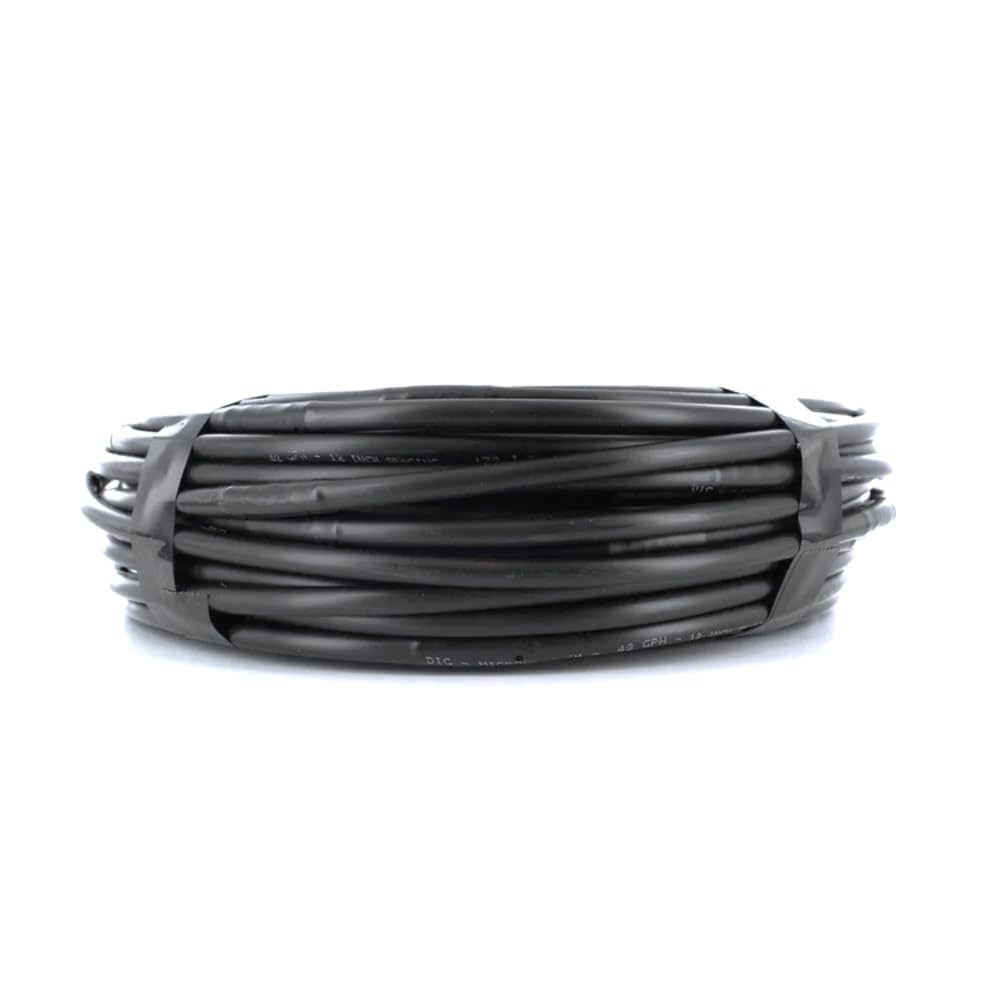
Designed for low pressure—ideal when you are not on city mains.
DIG’s 50-foot dripline operates in a narrower pressure window: 15 to 25 psi. That is a deliberate choice—it is built for systems with a pressure regulator, not a straight hose-bib hookup. The emitters use a twin-outlet design to resist clogging, and because the line is made from UV-protected polyethylene, it holds up to full sun exposure without turning brittle. It is also safe for edible plants, so you can run it through the vegetable garden without worry.
The spacing is 6 inches, which makes it a strong match for dense planting rows, flower beds, and looping around trees or hedges. The intended use case is sandy to loamy soil where water soaks downward quickly rather than puddling. Owners praise the build quality and note it is cost-effective for large projects—some have bought 300-plus feet worth across multiple rolls. The downside is that the tubing is stiff, and connectors require some force to push in (a quick dip in hot water softens it).
Value for money draws mixed feedback: some feel it is expensive for a bare roll without fittings, but the quality justifies the cost for those installing a permanent low-pressure grid. This is not a kit—it is the tubing component for an existing or planned system.
Pressure-regulated workhorse: best when paired with a 25-psi regulator for even, clog-resistant watering in dense beds.
5. Vatony 250FT Drip Irrigation System Kit
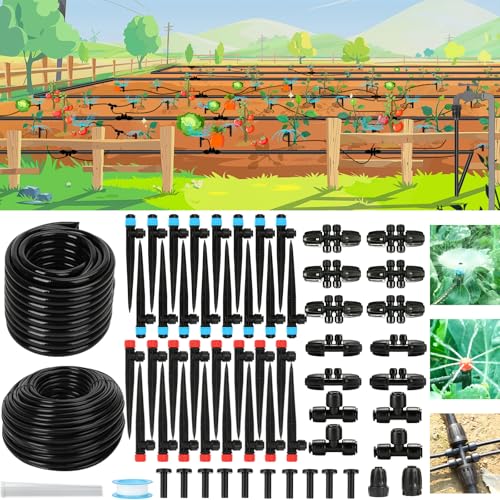
Covers up to 300 square feet straight from the box.
The Vatony kit supplies 250 feet of tubing in two sizes: 50 feet of 1/2-inch mainline and 200 feet of 1/4-inch branch tubing. That split lets you run a heavy-duty trunk line along the edge of the garden, then tap into it for individual beds. The quick-connect fittings (four-way, two-way, and one-way couplers) eliminate the need for a separate tool kit, and a brass splitter handles the main connection. The adjustable emitters allow you to dial in off, micro drip, or spray for each plant—so a thirsty squash gets a steady drip while delicate flowers get a light mist.
Owners find the system saves significant watering time—one buyer went from an hour daily to a simple turn of the faucet. The “shark bite” style connectors are easier to use than traditional barbed fittings, and the tubing is UV-resistant to prevent cracking in full sun. The drawback is that the spray head screw tops are delicate; they can pop off during adjustment if you overtighten. A few units also arrive with minor connection issues, but the kit is generous enough with spare parts to cover replacements.
What puts this ahead of smaller kits is the sheer coverage area. With both 1/2-inch and 1/4-inch tubing, you can water four 8-foot-long raised beds without pressure drop-offs, and the included instruction manual walks through the layout step by step.
Best for large layouts: 250 total feet with a brass splitter, adjustable spray/drip heads, and UV-resistant tubing that handles full-sun gardens.
6. Habitech 1/4″ Irrigation Dripline Tubing, 100 Ft Roll

100 feet of dripline versus typical 50-foot rolls, with built-in emitters every six inches.
Habitech delivers a full 100-foot roll of 1/4-inch dripline—double the length of most competitors’ rolls—with 0.5 GPH emitters already built in at 6-inch intervals. That means you can water a long, narrow bed or divide the roll into multiple shorter runs without buying extra tubing. The maximum recommended run length per line is 19 feet, so you will likely cut this into several sections, each fed from a 1/2-inch mainline. The kit includes 5 barbed couplings and 10 goof plugs to get started.
The material is UV-resistant polyethylene with a wall thickness of 0.040 inches, which holds up to foot traffic and weather better than thin drip tape or soaker hoses. Owners note the 6-inch spacing works particularly well for dense planters and vegetable rows—one buyer specifically favors it over 12-inch spacing. The drawback is that inserting barbed connectors can be difficult without softening the tubing first (hot water is the common trick), and a handful of customers note minor leakage at connection points if the barbs are not seated fully.
The price per foot here is competitive, making this a smart buy for anyone covering multiple beds with a single purchase. The catch is that this is a bare roll with only basic fittings—you will need a 1/2-inch mainline, a pressure regulator, and a filter to complete the system.
Best for multiple-bed setups: 100 feet of pre-emitter tubing with a 50 psi rating, ideal for cutting into several 19-foot runs.
7. Thiswing 360° Adjustable Drip Irrigation System, 50 FT

Wider tubing means stronger flow to every nozzle.
The Thiswing kit uses 5/16-inch tubing instead of the standard 1/4-inch. That larger inner diameter increases water flow significantly, ensuring that nozzles at the far end of a 50-foot run still get enough pressure to mist or spray. The 16 nozzles are made from solid copper (not plastic) with a metal tubing core that bends to a 360° angle and holds the position you set. The quick-connect fittings use a pneumatic tee system that snaps together and can be disconnected if you make a mistake—handy for adjusting the layout on the fly.
It is ready to use from the start: 50 feet of 5/16-inch tubing, nozzles, tees, a quick connector, end plugs, a replacement core, a pipe cutter, fixing nails, and cable ties. Owners describe the setup as “ridiculously easy,” and the adjustable sprayers range from a narrow stream to a wide-angle mist. The kit works well with low well pressure, and buyers with irregular-shaped gardens appreciate how easily the tubing bends around corners without kinking. The one weak point is the plastic hose-bib connection, which some find too shallow—it can leak if not carefully tightened or replaced with a metal fitting.
The 5/16-inch diameter is the defining advantage here. If you have a medium-sized garden and want strong water delivery to every head without upgrading tubing later, this kit delivers.
What Stands Out
- 5/16″ tubing delivers more water than standard 1/4″ systems
- Solid copper nozzles bend 360° and hold their position
- Quick-connect tee system allows easy disassembly and reconfiguration
The Weak Point
- Plastic hose-bib connection is shallow and prone to leaking
- Terminal plug can be difficult to seat; some fuse it with heat
Best if: you need high water flow at the end of the line or have an irregular-shaped garden that demands flexible routing.
Consider instead: if you must have a metal hose-bib from the start, plan to buy an adapter.
8. Maotong 40 FT 1/2 Inch Drip Irrigation Tubing

Extra-thick walls to survive accidental bursts.
Maotong’s tubing is built as mainline hose: the inner diameter is 13mm, the outer diameter is 16mm, and the wall is a burly 3mm thick. That is about twice the wall thickness of standard drip tubing, giving it what they call double explosion-proof protection against pressure spikes. It handles up to 33 psi and withstands temperatures from -20°C to 70°C, so it stays flexible in winter and does not go soft in summer heat. The material is polyethylene blended with a flexible fabric that passed ROSH certification and is odorless.
The 40-foot length comes with one straight coupling and one T-shaped 3-way connector, so you can create a simple loop or a T-junction right out of the package. Owners note it is very pliable—connectors push in with less effort than stiffer brands. The catch is that this is purely the distribution hose; you cannot run this as a dripline because it has no emitters. You need to pair it with 1/4-inch dripline or individual drippers to actually water plants. It works perfectly as the backbone for a larger setup, and the included connectors mean you do not need to buy fittings separately for a basic layout.
If you are building a drip system from scratch and want a mainline that will not split under pressure or crack after a freeze, this thick-wall tubing is a reliable foundation piece.
Backbone tubing: 3mm walls prevent burst leaks at up to 33 psi; pairs easily with any 1/4-inch branch lines.
9. Rain Bird LNDDRIPKIT Drip Irrigation Landscape/Garden Watering Kit

A full toolbox of watering devices—no second trip needed.
Rain Bird’s 108-piece kit is designed so you open the box and have everything to water a small landscape: drippers for individual plants, micro-bubblers for annuals, and micro-sprays for covering wider areas. The pressure-compensating technology ensures every device gets the same flow regardless of elevation change or distance from the faucet. Rain Bird claims up to 80% water savings compared to hand watering., and the components are clog-resistant and claim zero maintenance..
The 3-step installation is simple: connect to the faucet, insert fittings into the 50-foot main hose (1/2-inch), and push in the watering devices. The kit is comprehensive enough for nine large potted plants or a small garden bed, and it connects directly to an outdoor faucet—no separate timer required unless you want one. Owners call it a perfect starter kit and note it survives freezing winters without cracking. The minor gripes are that a few emitters can arrive non-functional (though the kit is generous enough that spares cover it), and the instructions are sparse—most buyers turn to YouTube for layout ideas.
The defining strength here is choice: you get three distinct watering styles in one box, letting you match drippers to shrubs, bubblers to flowers, and sprays to ground cover without buying separate kits. It is the most complete “everything included” option on this list.
One-box solution: 108 pieces with drippers, bubblers, and sprays, plus pressure-compensating technology for even watering across the entire landscape.
Understanding the Specs
Pressure-Compensating (PC) Emitters
A pressure-compensating emitter delivers the same volume of water from every hole in the line—you get 0.5 or 0.8 GPH (gallons per hour) whether you measure at the first emitter or the last. This matters most on slopes, long runs, or low-pressure systems because non-PC lines let the flow drop toward the far end, leaving plants thirsty. If your garden is flat and short, non-PC is fine; for everything else, PC is worth the upgrade.
Emitter Spacing (6-inch vs 12-inch)
The distance between water outlets determines how evenly the soil gets wet. Six-inch spacing works for tight plantings like carrots, lettuce rows, or flower beds where every few inches holds a plant. Twelve-inch spacing fits wider crops such as tomatoes, peppers, or shrubs. A mismatch wastes water (too-frequent spacing on bare soil) or starves plants (wide spacing in a dense bed). Match spacing to your garden’s planting density.
Maximum Operating Pressure (PSI)
Every dripline has a rated max PSI (pounds per square inch) it can handle before leaking or bursting. Standard household water pressure runs between 40 and 60 psi. Many drip kits require a pressure regulator to drop it below 25 or 50 psi. Pushing a line past its rating damages the emitters and causes misting instead of dripping. Always check the kit’s max PSI against your home’s pressure, and add a regulator if needed.
GPH Flow Rate
Gallons per hour tells you how much water each emitter releases. A 0.5 GPH dripline delivers a slow, deep soak ideal for loamy soil. A 0.8 or 1.0 GPH line waters faster and suits sandier soil that drains quickly. The total GPH across all emitters determines how long you need to run the system. You can roughly calculate: add up all emitter GPH (number of emitters × GPH per emitter), then divide your garden’s water need by that number to find run time.
FAQ
Can I bury drip line underground?
How long can a single drip line run?
Does drip irrigation work with low water pressure?
How do I connect dripline to a hose faucet?
Can I add a timer to my drip system?
Will drip irrigation save water compared to a sprinkler?
How do I clean clogged emitters?
Can I bury the 1/4-inch dripline or does it have to sit on top?
Final Thoughts: The Verdict
Across the board, the best drip line irrigation winner is the Rain Bird ET256-50S because its pressure-compensating emitters deliver even, clog-free watering across the entire 50-foot run—the single most important trait for a healthy garden. If you want a complete kit that snaps together without tools, grab the HIRALIY 59FT. And for a larger layout with adjustable mist and spray heads, the Vatony 250FT System is the one to reach for.
How We Picked
We do not accept paid placement. Every pick is matched to a real buyer and a real use-case; we do not hands-on test units.
Sources & Methodology
Specifications: manufacturer listings and product documentation. Review insights: verified customer reviews, as of July 2026. Pricing: not shown on this page (it changes often); check the current price via the retailer link.
As an Amazon Associate, Lawn Gear Lab earns from qualifying purchases. This does not affect which products we feature.