
Specs are compiled from manufacturer listings and verified buyer reviews and can change over time — please confirm the key details on the product page before buying.
Every gardener hits the same wall: hauling hoses around the yard, hand-watering each plant, or watching a sprinkler drench the leaves while the roots stay dry. A drip irrigation kit is the upgrade that changes that — a direct-to-root watering system (meaning water drips slowly onto the soil right at the base of the plant) that saves time and water once it is set up. The challenge is choosing from kits that look alike but differ in coverage, build quality, and installation ease.
I’m Rikta — the founder and writer behind Lawn Gear Lab. This guide is built by comparing the manufacturers’ published specifications and the patterns across verified customer reviews, so you get each pick’s real strengths and trade-offs instead of marketing spin.
Whether you have a few raised beds or a greenhouse full of tomatoes, this breakdown of the best drip irrigation kit options will help you match a system to your garden size and watering style without guesswork.
Our Picks at a Glance
How To Choose The Best Drip Irrigation Kit
Your choice hinges on garden size, plant types, and your tolerance for DIY assembly. Here are the key factors to weigh before you buy.
Total Hose Length and Mainline Diameter
The length of tubing in the kit sets the maximum area you can cover. A kit with 230 feet of total hose handles a larger garden or multiple raised beds, while a 50-foot kit is better for a smaller patio setup. The mainline diameter — usually 1/2 inch vs. 1/4 inch — also matters. A 1/2-inch mainline carries water farther with more stable pressure, which is important for longer runs or for running multiple watering heads at once.
Nozzle Types and Adjustability
The kind of watering head matters for different plants. Drip emitters (small devices that release a slow, steady trickle) deliver a slow, targeted trickle to individual plants. Vortex nozzles (which spin water into a fine, wide mist) and mist nozzles spread a finer spray over a wider area. Adjustable nozzles let you dial in the flow from a drip to a mist, giving you one setup that works for both pots and beds.
Ease of Installation: Quick-Connect vs. Push-to-Connect
Traditional barbed fittings (pointed connectors that force tubing over a ridge) require soaking tubing in hot water to soften it, then forcing the pieces together. Quick-connect fittings snap together without any heating or tools. Push-to-connect fittings go a step further with a locking clip and internal O-ring (a rubber ring that seals the connection) to reduce leaks and pop-offs under pressure. For beginners, a kit with these tool-free fittings cuts setup time drastically.
Quick Comparison
| Model | Best For | Total Tubing Length | Number of Pieces | Fitting Type | Amazon |
|---|---|---|---|---|---|
| Cokacot 98.4Ft★ Best Overall | Greenhouse Misting | 98.4 Feet | 24 | Quick-Connect | Amazon |
| GGAQHLK 230FTAlso Great | Best Overall | 230 Feet | 38 | Quick-Connect | Amazon |
| Spalolen Push-to-ConnectLeak Resistant | Leak Resistance | 150 Feet | 30 | Push-to-Connect | Amazon |
| Abakuku 230FT | Budget Value | 230 Feet | 239 | Quick-Connect | Amazon |
| MIXC 200Ft | Copper Nozzles | 200 Feet | 324 | Quick-Connect | Amazon |
| Rain Bird LNDDRIPKIT | Brand Reliability | 50 Feet | 108 | Barbed/Threaded | Amazon |
| Rain Bird DRIPKITBAG | Repair & Expansion | 100 Feet | 102 | Barbed | Amazon |
| Garden Grid 3×6 | Pre-Assembled Speed | 66 Inches | 12 | Pre-Assembled | Amazon |
In‑Depth Reviews
1. Cokacot 98.4Ft Bendable Drip Irrigation System
Our pick — over 4.5★ from 650+ verified ratings; the strongest balance of quality and price.
The bendable misting system owners prefer over Rain Bird for greenhouse use.
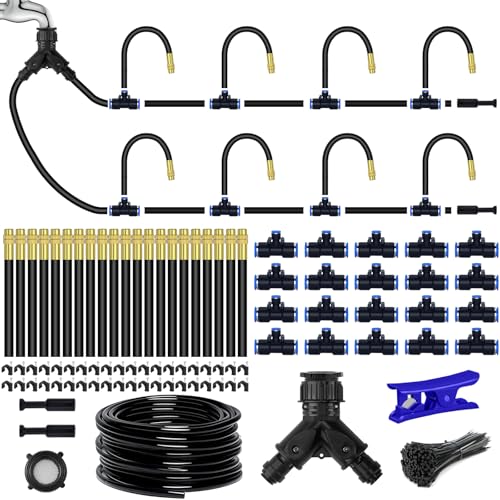
This is the kit for greenhouse and small-garden owners who want fine mist coverage rather than drips. The brass nozzles rotate 360 degrees and can be bent in any direction, which is great for hanging overhead or positioning to hit the base of tomatoes in pots. Each nozzle has three pressure modes — small, medium, and large — so you can dial in the spray width per plant.
The seller claims over 70% water savings versus traditional sprinklers., and owners agree that the adjustable heads “direct water precisely” and cut waste. One owner who bought a second unit for their greenhouse says it is “so much better than the Rain Bird System we bought a couple years back,” specifically praising the movable heads and good water pressure. The kit includes 24 pieces and 98.4 feet of 8mm tubing (about 3/8 inch), along with fix stems for ground or above-ground mounting.
The catch is that the zip ties included are short and thin, and some owners note there are no instructions in the box. Once you figure out the layout, the system works with no leaks — but expect a small learning curve on your first setup.
Where It Shines
- 360° bendable brass nozzles that lock into position for targeted misting
- Three adjustable water pressure modes for different plant types
- Cost-effective enough that owners buy a second unit for expansion
Know Before You Buy
- No printed instructions included — you may need to watch a video or figure it out
- Zip ties and tube cutter are basic quality; have your own on hand
Reach for it when: You have a greenhouse, a patio with potted plants, or a small garden where misting nozzles will reach every plant.
Look elsewhere for: A traditional emitter-based system if you prefer slow, targeted root watering over overhead mist.
2. GGAQHLK 230FT Drip Irrigation System
The complete package that balances reach, pressure, and nozzle variety for medium gardens.
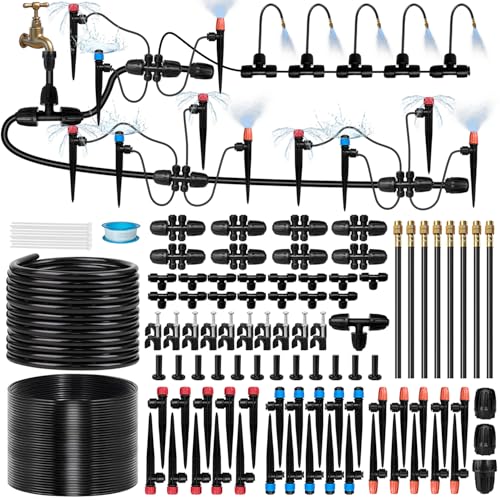
This kit goes straight for the biggest problem with cheaper systems: pressure drop across long runs (where water flow weakens at the far end of the hose). It uses a 1/2-inch mainline (33 feet of it) paired with 197 feet of 1/4-inch drip line, so water reaches the far end of a raised bed without petering out. The 1/2-inch tee connector (a T-shaped piece that splits one line into two) lets you split into two independent zones, which is a rare feature in a kit at this level.
The nozzle selection is where it pulls ahead. You get 38 pieces total: 10 drip vortex emitters (which spin water into a fine mist), 10 drip stream emitters (which send a steady stream), 10 misting nozzles, and 8 copper nozzles that bend 360 degrees (allowing you to aim the spray in any direction) to aim the spray exactly where you want it. Each sprinkler head adjusts by rotating the cap. The copper nozzles are a real upgrade over all-plastic heads — they hold their position without drooping. Owners note that the kit provides “even hydration” and that their plants look healthier after switching.
The honest trade-off here is the seasonal lifespan. Several buyers report that it works so well for a full growing season that they simply buy a new kit each spring rather than try to store and reinstall the tubing. That is a cost to think about year after year. Durability gets mixed feedback — some call it durable, others find it flimsy — so treat the tubing gently when removing it in fall.
Why It Won
- 1/2-inch mainline and dual-zone splitting for stable pressure across longer runs
- 38 nozzles including 8 bendable copper heads for targeted watering
- Tool-free push-to-connect fittings (they snap together without heating or tools) make setup quick
The Trade-Off
- Mixed feedback on long-term durability beyond one season
- Emitters are not labeled for flow rate (gallons per hour, or GPH, which tells you how much water each emitter releases), so figuring out GPH requires testing
Your garden’s match: If you have a raised bed or greenhouse setup and want a kit that can cover multiple zones with different spray patterns right from the start, this is the one.
Heads up: If you want a system you can store and reinstall for several years, look at the Rain Bird kits designed for long-term use instead.
3. Spalolen Push-to-Connect Drip Irrigation Kit
Push-and-lock fittings that resist popping off when water pressure changes.
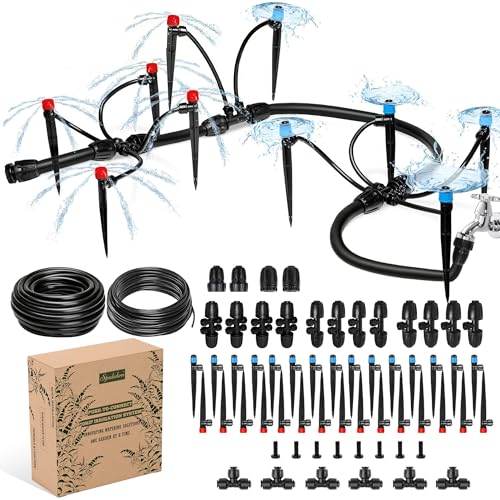
This kit solves the most annoying drip irrigation problem: fittings that slip off. Instead of standard barbed connectors that require muscle or hot water, this one uses a push-to-connect system with locking clips and inner sealing O-rings (rubber rings that create a tight seal). You push the tubing in, it locks, and it stays locked even when pressure fluctuates. The upgrade is not just convenience — it fixes the leak path that frustrates owners of traditional systems.
The mainline is 50 feet of 1/2-inch tubing, which is longer than the typical 33-foot mainline in many kits. That extra length means you can push water farther into a large raised bed layout or a greenhouse without losing pressure. It comes with 100 feet of 1/4-inch tubing and 30 emitters (stream and vortex types), giving you enough coverage for four 2×4 raised beds plus a few pots — which owners confirm takes about an hour to install.
A few owners mention that some of the blue sprayer emitters arrived faulty, but the consensus is that the rest of the kit performs well. The materials feel sturdy, and the 1/2-inch hose delivers strong pressure even when connected to a soaker hose at the far end.
Lock-down edge: The push-to-connect fittings with O-rings are a genuine improvement over barbed connections for anyone who has dealt with pop-offs.
Build around this if: You have a medium-sized garden and want a system that installs fast without leaking, especially across longer mainline runs.
Check first: A small number of emitters may be faulty; test each one during setup so you can request replacements early.
4. Abakuku 230FT Quick-Connect Drip Irrigation Kit
The highest piece-count kit at the lowest entry price — 239 pieces for a small investment.
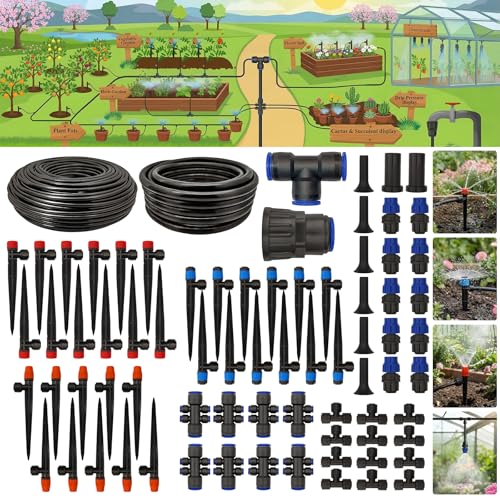
For the price of a pizza dinner, you get enough tubing and fittings to cover a substantial vegetable garden. The kit includes 197 feet of 1/4-inch tubing and 33 feet of 1/2-inch tubing, plus four types of emitters: drip emitter flow, vortex emitter, blue mist nozzle, and more. The quick-connect fittings snap together without heating or tools, which owners say makes installation “super easy” — one buyer who calls themselves a home improvement failure reports it worked perfectly on the first try.
At 239 pieces, this is the densest kit here by component count. The mix includes 1/2-inch locking barbed tee connectors, quick-connect tees, and a faucet connector. You can create micro-drip, spray, and watering modes from the same set. For a first-time buyer or someone covering a modest raised bed layout, this eliminates the need to buy extra parts.
The durability receives mixed marks from owners. Some report that the 1/2-inch hosing does not fit existing hoses, making it hard to integrate with an existing system. A smaller number of owners describe the fittings blowing off under pressure — a point to watch if you have high water pressure at your spigot. The large hose connectors are easy to connect but some find the connections hard to manage overall.
Piece-count value: 239 components for the price is tough to top, and the quick-connect design gets beginners running fast.
Best for: A first-time drip irrigation user who wants maximum parts for the lowest cost to cover a small or medium garden.
skip it if: You need long-term durability or plan to integrate with an existing hose system — check compatibility first.
5. MIXC 200Ft Drip Irrigation System
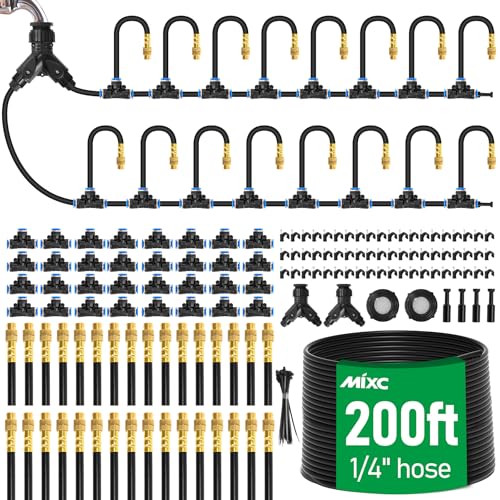
200 feet of tubing with 32 copper nozzles that bend and lock into mist or drip patterns.
This MIXC kit leans into copper nozzle quality. It includes 32 adjustable atomizing nozzles (which break water into a fine spray) made with copper for durability, each one on a 20-centimeter aluminum-core rod that bends into any position. That is a lot of spray points for 200 feet of 1/4-inch tubing. You can set up misting for a greenhouse roof or drip watering for a long row of pots without buying anything extra.
The kit comes with 324 total pieces, the highest count in this roundup. That includes 16 three-way quick connectors and a pack of 3/4-inch to 1/4-inch adapters to hook up to a standard faucet. Customers note that the push-fit connections hold securely, with no leaks on the T connectors. Many pair it with an automatic timer for hands-off watering while on vacation — they say 10-minute runs are enough even for thirsty tomato plants.
The limitation is that the nozzles do not fully shut off — they go down to a low mist but never stop completely. If you need individual on/off control at each nozzle, this is not the right system. The kit includes only four plug ends, so capping unused lines requires an extra purchase for larger setups. Some owners also note that you should connect no more than 8 rods per 50 feet of tubing to maintain good pressure.
Standout Features
- 32 copper nozzles on flexible aluminum-core rods for precise positioning
- 324 pieces provide huge flexibility for custom layouts
- Works well with a faucet timer for automated vacation watering
Things to Note
- Nozzles cannot be fully shut off — only reduce to a low mist
- Only 4 plug ends included; plan to buy more for larger setups
Choose this if: You want a large, flexible kit with copper nozzles that let you direct mist or drip exactly where each plant needs it.
Think twice if: You need per-nozzle shutoff or are covering a very long run — stick with 8 rods per 50 feet of tubing for steady pressure.
6. Rain Bird LNDDRIPKIT Landscape & Garden Kit

Rain Bird’s most comprehensive starter kit for flowers, shrubs, and beds with three watering device types.
This is the kit that covers the most plant types in one box. It includes drippers (emitters that release a slow trickle), micro-bubblers (which release a gentle bubbling flow for wider coverage), and micro-sprays (fine mist for seed beds) in 108 total pieces — so you can put a slow-drip emitter on a shrub, a bubbler on a flower bed, and a micro-spray on a patch of ground cover, all from the same system. Rain Bird uses pressure-compensating technology (a design that keeps the flow rate the same at every emitter, no matter how far it sits from the faucet), meaning every emitter delivers the same flow rate regardless of how far it sits from the faucet. That evens out watering across a long bed.
Setup follows a simple three-step process: connect to the faucet, insert fittings into the tubing, and attach the watering devices. The kit includes 50 feet of mainline hose — short compared to other kits here — so it is intended for small to average-sized landscapes. Owners consistently say it is the perfect starter kit for pots and raised beds, with one noting it can water nine large potted plants without issue.
The durability gets mixed feedback. A few reviewers point out that some emitters do not work from the box, though most consider it a good value even if you have to replace a few. The instructions are also a mixed bag — some find them clear, others turn to YouTube. It survives freezing winters if you use an in-line filter (a small screen that traps debris before it reaches the emitters) to prevent clogging.
Three-in-one watering: The mix of drippers, bubblers, and sprays in one kit is a genuine advantage for mixed-plant landscapes.
Best for: A landscaped garden with different plant types (shrubs, annuals, ground cover) where you need different watering styles from one system.
Hold off if: You need a large coverage area — the 50-inch mainline is short. You’ll need to buy extra tubing.
7. Rain Bird DRIPKITBAG Repair and Expansion Kit

A portable repair kit with 102 professional-grade parts and Rain Bird’s patented emitter tool.
This is not a full coverage kit — it is a repair and expansion bag designed for people who already have a drip system. The 102-piece set includes 100 feet of 1/4-inch blank distribution tubing (plain tubing without pre-installed emitters), 10 barbed tees, 20 barbed couplers, 10 tubing plugs, and 40 emitters across three flow rates (0.5 GPH, 1.0 GPH, and 2.0 GPH). That range of emitter speeds is what makes it useful: you can run a slow drip on a succulent (0.5 GPH, the slowest trickle) and a faster flow on a tomato (2.0 GPH, the fastest) from the same expansion line.
The standout piece is the patented Emitter Installation/Removal Tool, which owners say makes working with 1/4-inch fittings much easier than doing it by hand. Individual bags inside the pouch organize emitters, connectors, plugs, couplings, and stakes separately, so you are not dumping 100 pieces on the ground looking for a single tee. Owners call it a “nice assortment of items to either start or complete a job” and note it is especially great for fast drip line fixes.
The main complaint is that some kits arrive with missing parts — usually a three-way connector. Check the contents when it arrives. If you need a mainline or a faucet connector, this kit does not include them; it is designed purely as an add-on for an existing system.
What You Get
- Three emitter flow rates (0.5 / 1.0 / 2.0 GPH) for tailored watering
- Patented emitter tool simplifies both installation and removal
- Portable zipper bag keeps 102 parts organized in individual pouches
Limit to Note
- Not a standalone system — no mainline or faucet connector included
- Occasional missing parts reported; verify contents on arrival
Keep this in your shed for: Expanding or repairing an existing Rain Bird system, or adding drip lines to a garden that already has a mainline.
Not the right pick if: You are starting from scratch and need a full kit with a faucet connector and mainline.
8. Garden In Minutes Garden Grid 3×6 Watering System
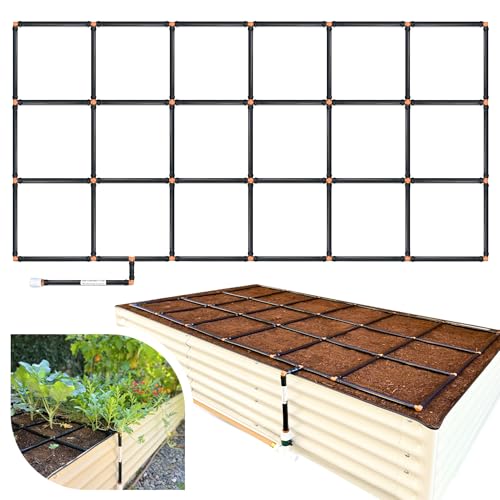
The fastest setup by far — pre-assembled grid that waters every square foot evenly in under two minutes.
This is the anti-DIY drip system. It arrives in pre-assembled sections. You unfold it over your raised bed, connect it to a garden hose, and it delivers 16 gentle streams of water per square foot. No cutting tubing, no pushing fittings, no layout planning — just connect and water. The grid layout doubles as a square-foot gardening guide, helping you space plants evenly across the bed.
The materials are UV-resistant polypropylene (a type of plastic designed to withstand sun exposure without cracking) built to survive full sun, heavy rain, and freezing winters. The company says original units from 2013 remain in use today. That is a 5–10× longer lifespan than soaker hoses or standard drip lines. It also includes a built-in fine mesh filter screen to keep debris out, and maintenance is as simple as brushing off the filter when needed. The 3×6 size fits a standard 3-foot by 6-foot raised bed.
The price is the biggest hurdle — it costs more than any of the DIY kits here. Some owners also note that the grid does not perfectly cover every raised bed shape (corners on a 4×4 bed can have a slight fit issue), but the company has responsive customer support if a piece is missing. If you want to automate it, just add a garden hose timer.
Why It Is Different
- Pre-assembled — no cutting, no fittings, no layout work required
- 16 water streams per square foot ensure even coverage with no dry spots
- UV-resistant build with claimed 5-10x lifespan over soaker hoses
Consider This
- Premium price — costs significantly more than DIY kits
- Fixed size for a 3×6 bed; not as flexible for irregular garden shapes
Perfect for: The gardener who hates assembly and wants a grid that waters every plant evenly from day one with zero frustration.
Pass on it if: You have an irregular garden shape or a limited budget — a DIY kit gives you more layout flexibility for less money.
Understanding the Specs
Tubing Diameter: 1/2″ vs. 1/4″
The mainline is the backbone of your system. A 1/2-inch mainline is thicker and carries water farther without losing pressure, so it is the right choice for runs longer than 50 feet or systems with many emitters. The 1/4-inch tubing branches off the mainline to individual plants. It is more flexible and easier to route around pots, but using it as a mainline over long distances will cause pressure drop (weaker flow at the far end). Look for a kit that gives you both sizes if your garden spans more than a few beds.
Emitter Type and Flow Rate
Different plants need different amounts of water. Drip emitters deliver slow, direct water to one plant’s root zone — good for shrubs and tomatoes. Vortex nozzles (which spin water into a fine mist) and mist nozzles cover a wider area with a fine spray, better for ground cover or seed beds. Adjustable nozzles let you switch between these modes on the same head. The flow rate is measured in gallons per hour (GPH). A 0.5 GPH emitter is a slow trickle; a 2.0 GPH emitter waters faster. Kits with multiple flow rates give you flexibility across different plants from the same system.
FAQ
How long does it take to install a drip irrigation kit?
Can I use a drip irrigation kit with a timer?
How much water does a drip irrigation system save compared to sprinklers?
What is the difference between a drip emitter and a mist nozzle?
Will a drip irrigation system work with low water pressure?
Are drip irrigation kits reusable year after year?
What does “pressure-compensating” mean in a drip emitter?
How do I prevent my drip irrigation system from clogging?
Can I expand a drip irrigation kit later?
Which drip irrigation kit is best for a raised garden bed?
Final Thoughts: The Verdict
For most users