
Standard sprinklers waste more than half the water to evaporation and wind, and a hose left running at the trunk invites rot and fungal disease while the critical feeder roots five feet away stay bone dry. Getting water deep into the root zone without drowning the crown is the single biggest challenge in establishing and maintaining healthy trees, yet most gardeners rely on tools designed for shallow-rooted lawns and flower beds. The solution is hardware engineered specifically for the unique geometry and hydrology of tree watering.
I’m Rikta — the co-founder and writer behind Lawn Gear Lab. I’ve spent hundreds of hours cross-referencing emitter flow rates, tubing diameters, and slow-release bag capacities, analyzing owner feedback across climates and soil types, and studying how these specific products perform under real-world drought and establishment pressure to build this guide.
An effective drip irrigation for trees delivers water at a rate the soil can absorb, targets the feeder-root zone at the drip line, and prevents moisture from collecting against the trunk where pathogens thrive.
How To Choose The Best Drip Irrigation For Trees
Tree roots extend far beyond the canopy’s edge — often 1.5 to 3 times the branch spread — and the vast majority of water-absorbing feeder roots live in the top 12 to 18 inches of soil in that outer ring. This anatomy dictates every buying decision: the tool must place water exactly there, at a rate the soil can infiltrate without runoff.
Target Zone: Trunk vs. Drip Line
Wetting the area immediately around the trunk does almost nothing for the tree. The trunk’s bark is not designed to absorb water, and constant moisture invites collar rot, fungal infections, and insect damage. A proper system delivers water at or beyond the canopy dripline, keeping the root crown dry and forcing roots to grow outward for stability and nutrient access. Look for tools with outward-facing spray patterns, rings that sit away from the trunk, or stakes that deliver water 8 to 12 inches beneath the soil surface.
Water Delivery Rate and Soil Infiltration
Heavy clay soil may only absorb 0.25 inches of water per hour, while sandy soil can take over two inches. If your emitter or soaker hose pushes water faster than the soil can accept it, the water runs off or pools, wasting it and starving roots. Slow-release bags that empty over 5 to 24 hours and deep stakes that feed water below the surface help match delivery to infiltration. For drip tape or soaker hose applications, a flow rate between 0.5 and 2 gallons per hour per emitter is the safest range for most tree-planting soils.
Durability and UV Resistance
Tree irrigation gear sits exposed to direct sunlight for entire growing seasons. Rubber soaker hoses, PVC bags, and ABS stakes all degrade at different rates under UV. Recycled rubber hoses with brass fittings hold up well for several seasons. The thickest watering bag materials — PVC with scrim reinforcement or PE plastic rated as sunlight-proof — resist cracking and handle repeated freeze-thaw cycles better than thin poly sheeting.
Ease of Expansion and Automation
Many tree irrigation setups start small — one ring or two stakes — and expand as the orchard or landscape grows. Kits with quick-connect fittings, Y-splitters, and 5/16-inch or larger mainline tubing allow you to add zones without replacing the base system. If you plan to connect to a hose timer or smart controller, verify the thread type (standard 3/4-inch GHT) and that the minimum working pressure of the components falls within your spigot’s range, typically 20 to 60 PSI.
Quick Comparison
On smaller screens, swipe sideways to see the full table.
| Model | Category | Best For | Key Spec | Amazon |
|---|---|---|---|---|
| Thiswing 360° Adjustable System | Micro-Spray Kit | Multiple trees & beds | 5/16″ tubing, 32 brass nozzles | Amazon |
| Underhill Deep Drip Stakes | Subsurface Stake | Deep root establishment | 8″ stake, 1.44″ diameter | Amazon |
| Tree Hugger 360° Sprinkler Ring | Outward Spray Ring | Single tree drip-line target | 16.5″ L, outward spray | Amazon |
| HEYTIMI 2-Pack Ring Set | Adjustable Ring | Young trees & shrubs | 20″ closed, 55″ unfolded | Amazon |
| STYDDI Soaker Hose | Soaker Hose | Rows & foundation planting | 50 ft, recycled rubber | Amazon |
| PANGCH Watering Bag 3-Pack | Slow-Release Bag | New transplants, drought | 20 gal each, 5–9 hr release | Amazon |
| ANPHSIN Watering Bags 12-Pack | Slow-Release Bag | Large orchard installations | 20 gal each, PE sunlight-proof | Amazon |
In‑Depth Reviews
1. Thiswing 360° Adjustable Drip Irrigation System
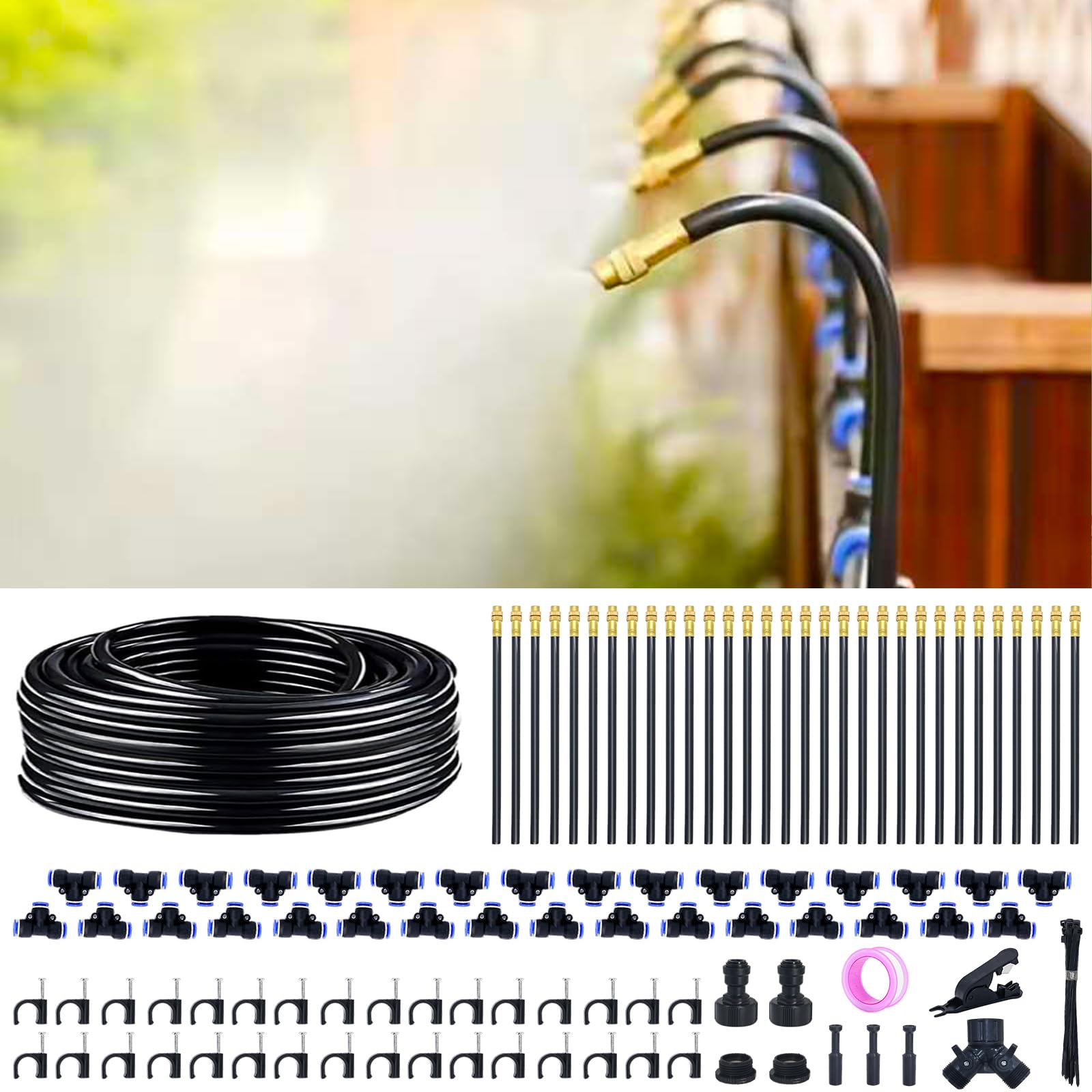
This kit solves the water-volume bottleneck that plagues 1/4-inch drip systems. The 5/16-inch mainline tubing delivers significantly higher flow rates across 100 feet, ensuring that nozzles at the far end of the run receive enough pressure for consistent mist or spray coverage. The 32 solid brass nozzles resist corrosion and can be individually adjusted from a fine mist to a targeted stream, making the system adaptable from young tree rings to raised vegetable beds.
Assembly relies on pneumatic push-to-connect tees that lock the tubing without glue or tools — a design borrowed from professional irrigation manifolds. Users report near-zero leaks when installed correctly, and the included pipe cutter and cable ties simplify layout. The nozzles are fully detachable for cleaning, a necessary feature given that mineral deposits will clog any emitter over time.
The tradeoff is that the kit does not include a pressure regulator or filter, so well water or hard municipal water should be run through a basic screen filter first. Also, the 360° spray pattern is not a true deep-drip delivery; for established trees that need water 12 inches down, pairing these nozzles with extension stakes or running the system on longer cycles is advisable.
What works
- 5/16-inch tubing supplies strong flow to all nozzles across 100 ft
- Brass nozzles adjust from mist to stream and resist corrosion
- Push-to-connect fittings enable leak-free installation without tools
- 32 nozzles cover multiple trees and beds from one spigot
What doesn’t
- No pressure regulator or inline filter included
- Spray pattern wets surface roots better than deep subsurface soil
2. Underhill Deep Drip Irrigation Stakes 8-Inch
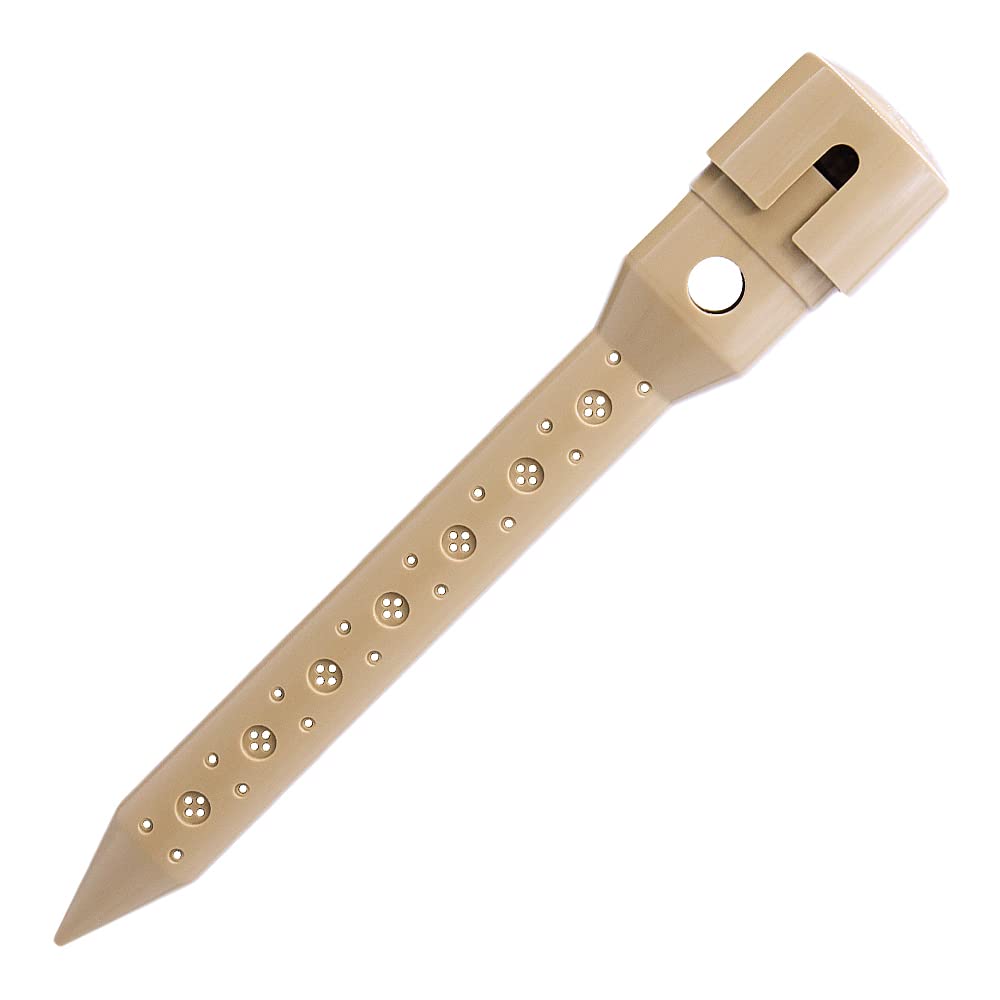
Where overhead sprinklers and surface soaker hoses lose 30% or more of their water to evaporation, these 8-inch stakes deliver it directly to the root ball. Each stake features a 1.44-inch diameter ABS body with mesh-covered holes that prevent soil from clogging the interior channel. The design encourages deep root growth by bypassing dry surface crust and placing water exactly where feeder roots proliferate, making it especially effective in sandy or compacted soil where water tends to bead and run off.
The stakes are compatible with both a standard garden hose connected to a tree berm and an automatic drip system. Users in hot, arid climates report significantly shorter watering times because almost no water is lost to surface evaporation. The four-stake case covers small to medium trees when placed around the drip line, and the stakes can be repositioned as the tree grows without damaging the root zone.
The main drawback is that the open-top design cannot form a watertight seal with a standard hose. Water sprays out of the side holes if you try to connect a hose directly to the top. They are designed for drip line connections that run through the side slot or for use inside a bermed ring. Also, at 8 inches, the stakes may be too short for deep-rooted established trees that need water at 12 to 18 inches.
What works
- Mesh-covered holes resist clogging even in heavy soil
- Delivers water and oxygen directly to deep root zone
- Reduces evaporation compared to surface methods
- Durable ABS plastic with a 2-year warranty
What doesn’t
- Cannot form a watertight seal with a standard hose end
- 8-inch depth may be insufficient for very large established trees
3. Tree Hugger 360° Outward Spray Tree Watering Ring
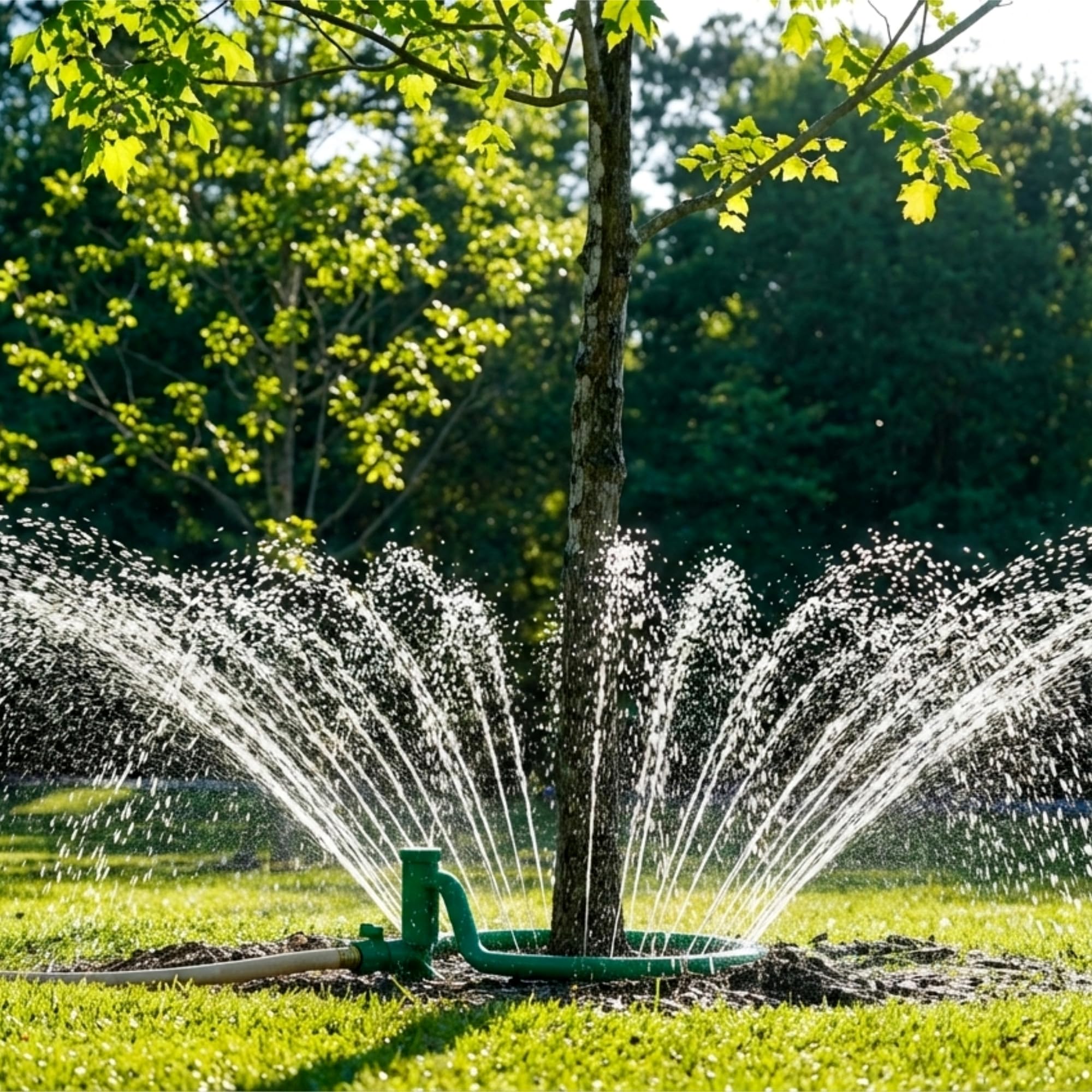
This ring’s defining engineering decision is that it sprays water outward, away from the trunk, instead of pooling it at the base. The outward 360° pattern targets the drip-line zone where the tree’s feeder roots are concentrated, keeping the trunk dry and reducing the risk of collar rot. An integrated adjustable valve on the hose side lets you dial the flow rate from a slow trickle to a full spray, which is useful for matching the output to the soil’s infiltration capacity.
The ring is made from UV-resistant plastic and is lightweight enough to move from tree to tree without effort. Setup requires minor assembly — connecting two halves — and then it attaches directly to any standard garden hose. Users report that even with low spigot pressure, the ring puts out more water than expected, and the outward spray covers an area roughly 3 to 5 feet in diameter around the ring, depending on the flow setting.
Because the ring is plastic and light, it can shift off position on windy days or on slopes. Some users add a landscape staple or small rock to keep it centered around the tree. Additionally, the 11-inch diameter ring is best suited for smaller-caliber trees; established trees with wide trunks may require the larger 20-inch version for proper drip-line alignment.
What works
- Outward spray keeps trunk dry and targets feeder roots
- Adjustable valve lets you match flow to soil type
- Lightweight and easy to move between trees
What doesn’t
- Lightweight ring can drift off-center in wind
- 11-inch size is small for large or multi-stemmed trees
4. HEYTIMI 2-Pack 360° Tree Water System Ring Set
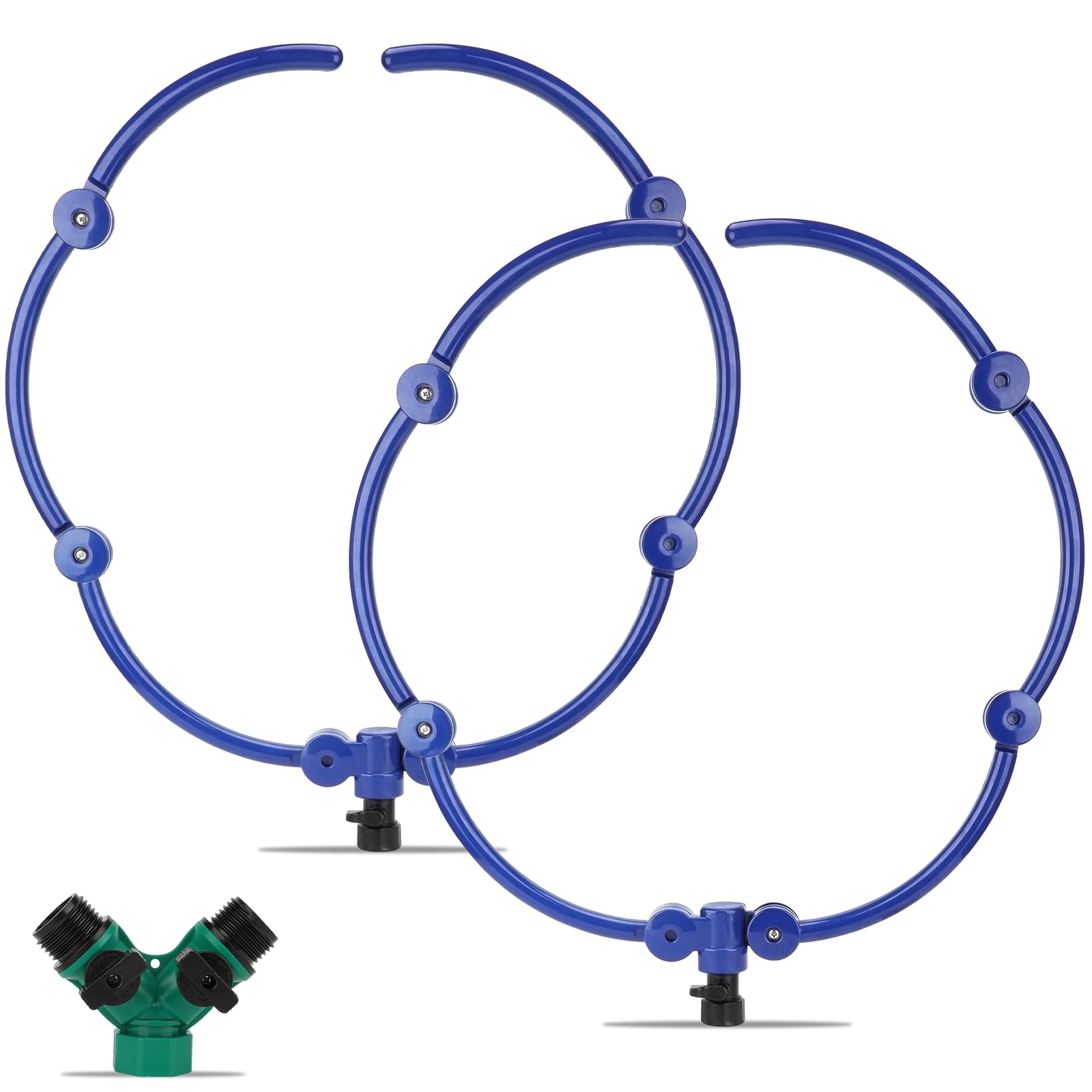
This set delivers two watering rings and a Y-hose splitter with individual shutoff valves, giving you the ability to water two young trees from a single spigot right out of the box. Each ring has a closed diameter of 20 inches and can be opened flat to approximately 55 inches of adjustable length, accommodating different trunk spacings and root zone sizes. The ABS plastic construction is rigid enough to hold its shape against moderate water pressure.
The rings use a trickle or low-spray pattern that keeps water close to the soil surface — ideal for new transplants whose root systems are still shallow. The included Y-splitter allows independent flow control to each ring, so you can give a larger tree more water while dialing back the flow to a smaller sapling. Setup requires no tools: connect the valve to the ring, attach the garden hose, and turn on the faucet.
The plastic threads on the valves and splitter are the weak point. Cross-threading during connection can strip them, and they require gentle hand-tightening rather than a wrench. Also, the rings sit on the ground rather than being staked down, so they may move during heavy wind or if a pet brushes against them.
What works
- Two rings plus Y-splitter with shutoff valves per set
- Adjustable length fits various trunk and root zone sizes
- Tool-free setup, connects directly to standard hose
What doesn’t
- Plastic valve threads are prone to stripping if overtightened
- Lightweight rings can shift position in wind or on slopes
5. STYDDI 50 Ft Soaker Hose

When you need to water a row of trees along a fence line or foundation, a 50-foot soaker hose offers the simplest approach. The STYDDI hose is made from recycled rubber with a flat profile that lays flat against the soil, and it emits water at a rate of 5 to 8 liters per hour at 60 PSI — a slow enough release for clay and loam soils to absorb without runoff. Solid brass couplings resist rust and cracking better than the plastic fittings found on budget soaker hoses.
The hose is designed for end-to-end extension: the rust-resistant end cap is removable, so you can connect a second hose and continue watering across a larger area. Users running the hose during extreme drought conditions report that it effectively delivered sufficient water to keep trees alive even under full daily flow, and the recycled rubber material remained flexible and kink-resistant in high heat.
Soaker hoses have a known tendency to clog over time because mineral deposits and sediment build up inside the porous wall. The pores are not cleanable, so once flow drops significantly, the hose must be replaced. Additionally, soaker hoses wet a uniform band of soil along their entire length — they cannot target the drip line of a single tree while leaving other areas dry, which makes them less precise than ring or stake systems.
What works
- Slow 5-8 L/hr release suits clay and loam soils
- Solid brass couplings resist rust and cracking
- Removable end cap allows extension for larger areas
What doesn’t
- Pores clog irreversibly over time from mineral deposits
- Uniform wetting cannot isolate a tree’s drip zone
6. PANGCH 20-Gallon Tree Watering Bag 3-Pack

The PANGCH bag wraps around the trunk and zips shut, then fills with up to 20 gallons of water that slowly seeps out through pinholes in the bottom over 5 to 9 hours. This deep, slow saturation encourages roots to grow downward rather than staying near the surface, making it ideal for newly planted trees that need consistent moisture during the first two growing seasons. The material is weather-resistant PVC with scrim reinforcement — significantly more puncture-resistant than single-layer poly bags.
The fill opening accommodates up to a 3-inch diameter hose end and takes just 2 to 5 minutes to fill. Nylon zippers hold up well to repeated opening and closing, and the black polypro straps are UV-resistant. Users in desert climates report that watering twice a week kept new trees thriving through summer heat, and the bags are reusable year after year if stored properly in the off-season.
Quality control is inconsistent: while most bags hold water reliably, a small percentage arrive with a visible tear or develop a seam leak after a few months. Additionally, the bags are vulnerable to lawn mower strikes; a single blade hit can destroy the bag, and the soft sides do not deflect impact.
What works
- 20-gallon slow release over 5-9 hours for deep saturation
- PVC with scrim reinforcement resists punctures and UV
- Wide opening fills quickly and zipper design is easy to use
What doesn’t
- Some units arrive with leaks or develop seam failures early
- Soft bag is easily destroyed by lawn mower or weed trimmer
7. ANPHSIN 12-Pack Slow Release Tree Watering Bags
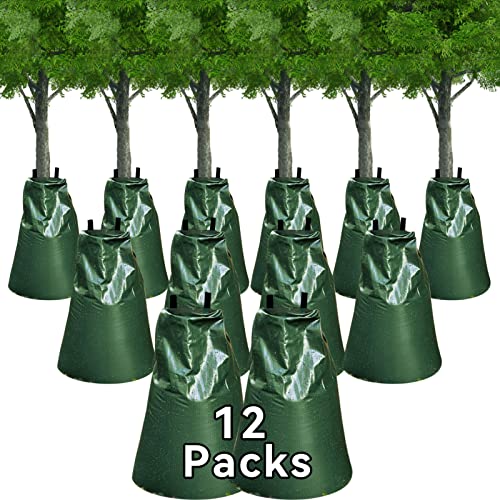
When you are managing a dozen or more new trees — a small orchard, a reforestation project, or a large residential lot — a single 3-pack of watering bags forces you to cycle through the same trees multiple times per week. This 12-pack covers 12 trees simultaneously, each bag holding 20 gallons and releasing water over 4 to 5 hours. The PE material is rated as sunlight-proof, meaning the bags resist UV degradation and can be left in the field all season without becoming brittle.
The bags are designed for simplicity: wrap around the trunk, zip closed, and fill. The zipper is heavy-duty nylon, and the bags lay flush against the trunk without gaping. Users report that the material is noticeably thicker than generic bags, with seams that hold up to the weight of 20 gallons of water without bursting. The large fill port accepts a standard hose end without adapters.
The 4-5 hour release window is shorter than the PANGCH bag’s 5-9 hour window, which means these bags deliver water faster and may cause runoff on heavy clay soils. Also, 20 gallons per fill is a lot of weight — the bags put significant strain on the zipper and bottom seam, and if the tree is on a slope, the bag can twist and empty unevenly.
What works
- 12-bag value covers an entire planting at once
- Sunlight-proof PE resists UV cracking
- Heavy-duty zipper and thick seams handle 20-gal fill
What doesn’t
- 4-5 hour release may run off on clay soil
- 20-gal weight stresses zipper and can twist on slopes
Hardware & Specs Guide
Emitter Flow and Tubing Diameter
The flow rate of a drip emitter or soaker hose determines how quickly water enters the soil and whether runoff occurs. A rate of 0.5 to 2 gallons per hour per emitter works for most tree-planting soils. Tubing inner diameter (1/4 inch vs. 5/16 inch) dictates how many emitters can be run on a single line — 5/16-inch tubing carries roughly 60% more water than 1/4-inch at the same pressure, which is why kits like the Thiswing system can power 32 nozzles without significant pressure drop at the far end.
Soaker Hose Material and Coupling
Soaker hoses are made from recycled rubber, polyurethane, or PVC. Recycled rubber hoses like the STYDDI have the best balance of flexibility and durability but eventually clog from mineral deposits. Solid brass couplings resist rust and cracking far better than plastic or pot metal, and 3/4-inch GHT threads are the universal standard for garden hose connections in the US. Avoid hoses with zinc alloy or thin stamped-brass fittings — they corrode quickly when left connected to a spigot.
Deep Stake Depth and Material
Subsurface stakes should reach at least 8 inches to bypass the dry surface layer and deposit water in the root zone. The Underhill stake’s 1.44-inch diameter provides enough volume to hold a significant reservoir of water, and the mesh-covered holes prevent soil from plugging the interior. ABS plastic is the ideal material because it is rigid enough to drive into hard soil, UV-resistant, and chemically inert so it does not leach into the water.
Watering Bag Capacity and Release Time
Bag capacity is measured in gallons, with 20 gallons being the most common sweet spot for a single tree. The release time — the number of hours it takes for the bag to empty — determines how deeply the water penetrates. A 5-9 hour release time (PANGCH) works well on loam and sandy soil. A faster 4-5 hour release (ANPHSIN) can cause runoff on clay. Look for bags with scrim reinforcement or UV-stabilized PE to survive multiple seasons of sun exposure.
FAQ
How much water does a new tree need per week?
Can I connect a watering bag to a drip irrigation system?
Why should I keep water away from the trunk of a tree?
Final Thoughts: The Verdict
For most gardeners, the drip irrigation for trees winner is the Thiswing 360° Adjustable System because the 5/16-inch tubing and 32 brass nozzles give you the flexibility to water multiple trees while controlling flow per nozzle, making it the most adaptable base kit. If you want deep root penetration without surface evaporation, grab the Underhill Deep Drip Stakes. And for large plantings of new trees where hands-free slow watering is the priority, nothing beats the ANPHSIN 12-Pack Watering Bags.