
Getting consistent moisture to the root zone of every tomato plant in your garden — without drowning the leaves or wasting water — is the single biggest frustration for home growers. Standard oscillating sprinklers spray the foliage, soaker hoses dry out on one side, and cheap drip kits often clog or leak within weeks. The right setup delivers a slow, targeted soak exactly where the plant needs it, reducing disease and boosting fruit yield.
I’m Rikta — the co-founder and writer behind Lawn Gear Lab. This guide is built on hours of cross-referencing specification sheets, studying flow-rate data, and analyzing hundreds of verified owner reviews to determine which kits actually perform for tomato-specific watering needs.
Whether you’re managing a few raised beds or a full backyard row garden, this guide breaks down the seven best candidates for the best drip irrigation for tomatoes, comparing tubing diameter, nozzle adjustability, and overall system coverage.
How To Choose The Best Drip Irrigation For Tomatoes
Tomatoes are sensitive to both overwatering and underwatering, and they hate wet foliage. A kit that sprays the leaves invites blight and fungal issues, while one that waters unevenly leads to blossom-end rot and cracked fruit. Focus on these criteria to pick a system that delivers consistent root-zone moisture.
Tubing Diameter and Flow Rate
Most kits ship with either 1/4-inch (6mm) or 5/16-inch (8mm) mainline tubing. The 1/4-inch line is fine for small pots or short runs under 50 feet, but pressure drops quickly over distance — especially on a slope. For a row of 4 to 6 tomato plants spaced 24 inches apart, a 5/16-inch mainline maintains more consistent flow to the last emitter. Check the kit’s total footage and your garden layout before choosing.
Nozzle Material and Adjustability
Plastic nozzles are common on entry-level kits, but they crack under UV exposure and clog more easily. Solid brass or copper nozzles resist rust, hold up to repeated adjustment, and deliver a finer, more consistent mist or drip stream. Look for nozzles that rotate 360 degrees and can be switched between a directed stream and a gentle soak — this lets you water the base of each stem without soaking the leaves.
System Type: Mist vs. Drip vs. Grid
Misting nozzles cover a wide area and work well for cooling or germinating seeds, but for established tomatoes you want water delivered directly to the soil. True drip emitters (0.5 GPH to 2.0 GPH) apply water slowly at a single point. Grid systems like the Garden Grid surround each square foot with multiple streams at soil level, offering a middle ground between misting and point-source drip. Choose based on whether your plants are in rows, raised beds, or individual pots.
Quick Comparison
On smaller screens, swipe sideways to see the full table.
| Model | Category | Best For | Key Spec | Amazon |
|---|---|---|---|---|
| Garden Grid 3×6 | Grid System | Raised beds | 16 streams per sq ft | Amazon |
| Bonviee 230FT | Mixed Tubing | Large gardens | 197ft 1/4″ + 33ft 5/16″ | Amazon |
| Cokacot 98.4Ft | Misting Kit | Greenhouses | 5/16″ tubing, 20 brass nozzles | Amazon |
| BUIGNDG 120Ft | Misting Kit | Large coverage | 120ft 1/4″, 26 copper nozzles | Amazon |
| Rain Bird DRIPKITBAG | Repair/Expansion | Custom drip layouts | 100ft 1/4″, 40 emitters (0.5,1,2 GPH) | Amazon |
| MIXC 100Ft | Misting Kit | Potted plants & beds | 1/4″ tubing, 16 brass nozzles | Amazon |
| Thiswing 50FT | Misting Kit | Small beds & patios | 5/16″ tubing, 16 copper nozzles | Amazon |
In‑Depth Reviews
1. Garden Grid Watering System, 3×6
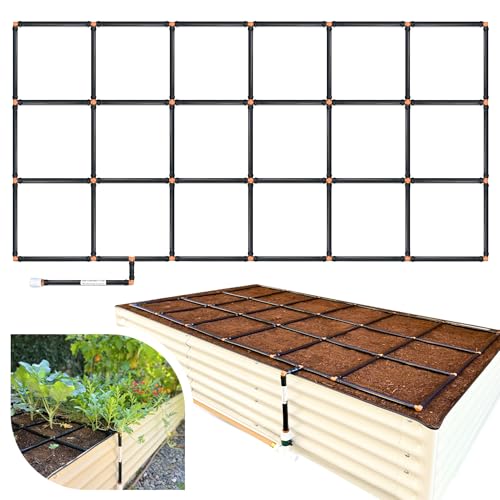
The Garden Grid is a fundamentally different approach to watering tomatoes in raised beds. Instead of running tubing and inserting individual emitters, this pre-assembled polypropylene grid sits on top of the soil and delivers 16 gentle streams of water per square foot directly at the root zone. Setup takes about two minutes — just place the grid in your 33.5 x 66-inch bed and connect a standard garden hose. No cutting, no pushing barbed fittings, and no threading tiny nozzles.
What makes it especially effective for tomatoes is the even coverage. A soaker hose or single drip emitter creates wet zones and dry spots, but every plant in a 3×6 bed gets the same amount of water. The streams are low-pressure, so there is no leaf wetting that promotes blight. Pairs easily with an automatic timer, and the built-in mesh filter screen keeps debris out of the water path. Original units from 2013 are still in use, which suggests a lifespan far beyond typical drip tape or soaker hose. The trade-off is that it only fits a standard 3×6 raised bed — it is not flexible for irregular layouts or in-ground rows.
Customer feedback highlights the time savings: one reviewer noted a drop from 8 hours of weekly hand-watering to 15 minutes with the grid on a timer. Another bought a second unit after the first performed flawlessly. The only common drawback is the initial cost, which is higher than a basic drip kit, but the durability and zero-maintenance design justify the premium for serious tomato growers.
What works
- Two-minute setup with no tools required
- Even 16-stream coverage per square foot prevents dry spots
- UV-resistant polypropylene lasts for years without clogging
What doesn’t
- Limited to standard 3×6 raised bed dimensions
- Higher upfront cost compared to basic drip kits
2. Bonviee Drip Irrigation System 230FT

The Bonviee kit covers the most ground in this comparison, supplying 197 feet of 1/4-inch tubing and 33 feet of 5/16-inch mainline. The push-to-connect fittings eliminate the frustration of wrestling with barbed connectors — you cut the line, push it into the fitting, and it locks with a tight seal. For a tomato garden that spans multiple raised beds, a long row in the ground, or a mix of both, this kit has enough material to reach every plant without needing a second purchase.
It comes with three types of adjustable stake sprayers, so you can dial in a gentle drip for young transplants or a wider spray pattern for mature, sprawling vines. The 5/16-inch mainline helps maintain pressure over longer runs, which is critical when you have eight or more tomato plants spaced along a 50-foot row. Owners report that the system is compatible with most hose timers, making it easy to set a daily watering schedule before work or during a vacation. One reviewer set up six 4×4 beds in about 30 minutes, praising the intuitive design. The main criticism is that the vortex-style stakes lose coverage area at lower water pressures — switching to the multi-stream stakes in the same kit solves that issue.
For the price, this is the strongest all-rounder for a gardener with diverse bed sizes. It is not as elegant as the Garden Grid for a single raised bed, but its flexibility across different garden shapes and its generous tubing length make it the smart pick for most tomato growers.
What works
- 230 feet of tubing covers large and irregular gardens
- Push-to-connect fittings assemble without tools
- Three sprayer types allow drip, mist, or stream per plant
What doesn’t
- Vortex stakes lose coverage at low water pressure
- Cutting and routing the tubing takes time for complex layouts
3. Cokacot 98.4Ft Drip Irrigation System
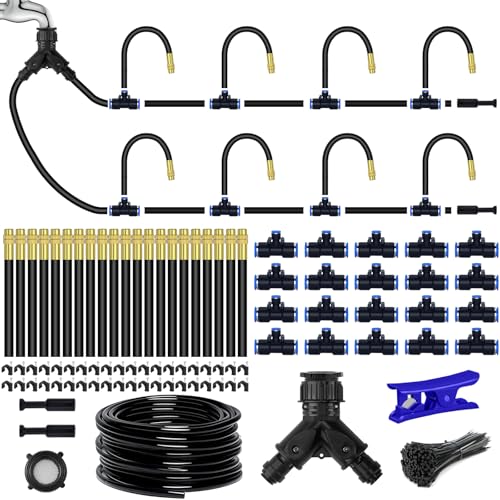
The Cokacot kit uses 5/16-inch (8mm) tubing with 20 solid brass misting nozzles that rotate 360 degrees and adjust between three flow modes. For tomato plants in a greenhouse or a covered raised bed, this system delivers a fine, even mist that cools the air around the plants while keeping the soil surface moist. The brass nozzles are a clear upgrade over plastic — they resist mineral buildup, handle repeated adjustments without cracking, and produce a finer atomization that wastes less water.
Included in the box is a dual-port diverter that fits both 1/2-inch and 3/4-inch hose threads, plus a filter net to catch sediment before it reaches the nozzles. The bendable nozzle stems let you aim the spray at the base of each tomato stem or lift it higher to create a canopy-level mist. The 98.4-foot length works well for two standard 4×8 raised beds or a greenhouse bench. Owners consistently praise the sturdy construction and the absence of leaks at the push-in connections. One reviewer noted that the included zip ties are a bit short and thin for securing the line along a fence, but that is a minor issue. The biggest limitation is that this is primarily a misting system — for deep root watering of established tomatoes, you may want to run the nozzles on the low stream setting rather than the full mist mode to avoid leaf wetness.
For a gardener who wants robust build quality and the flexibility to switch between misting for seedlings and gentle streaming for mature plants, this kit delivers premium materials at a reasonable cost.
What works
- Solid brass nozzles resist clogging and corrosion
- Three flow modes: mist, medium, and full stream
- 5/16-inch tubing maintains pressure over long runs
What doesn’t
- Misting mode can wet foliage in humid conditions
- Included zip ties are thin and short
4. BUIGNDG 120Ft 1/4″ Drip Irrigation System
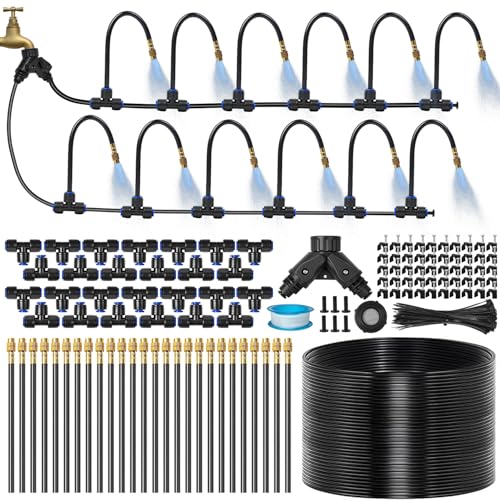
With 120 feet of 1/4-inch mainline and 26 adjustable copper misting nozzles, this BUIGNDG kit offers the highest nozzle count in this roundup. The pure copper nozzles are detachable and washable, which is essential for gardens with hard water that tends to clog small orifices. Each nozzle bends 360 degrees and locks into position, so you can direct a gentle stream to the base of each tomato plant while leaving the path between rows dry.
The tool-free pneumatic quick-connect system uses a rubber ring seal to prevent leaks — owners report that the connections stay tight even when the system is running at full household water pressure. The kit also includes 50 plastic stakes to hold the line in place, 40 cable clips for overhead routing, and six tube plugs. For a gardener with a large in-ground plot or multiple long raised beds, the 120-foot length eliminates the need for splitters and extension lines. The downsides are typical of 1/4-inch tubing: on runs longer than 50 feet, the pressure drops noticeably, and the last few nozzles may only produce a weak mist rather than a strong stream. Keep the layout compact or install a pressure regulator at the source for best results.
Customer reviews highlight the even coverage across three 4×8 beds and the ability to switch from mist to drip with a simple nozzle twist. One reviewer replaced an old plastic-tipped system and saw an immediate improvement in water distribution and plant health.
What works
- 26 copper nozzles provide excellent coverage for large gardens
- Detachable, washable nozzles resist hard-water clogs
- Pneumatic quick-connects are leak-proof
What doesn’t
- 1/4-inch tubing loses pressure on runs over 50 feet
- Stakes are lightweight and may not hold in loose soil
5. Rain Bird DRIPKITBAG Drip Irrigation Repair and Expansion Kit

Rain Bird’s DRIPKITBAG is not a complete start-to-finish irrigation kit — it is a repair and expansion kit for an existing drip system or for builders who want to design their layout from scratch. Inside the durable plastic pouch you get 100 feet of 1/4-inch blank distribution tubing, 40 pressure-compensating emitters in three flow rates (10 at 0.5 GPH, 20 at 1.0 GPH, and 10 at 2.0 GPH), plus 20 barbed couplers, 20 barbed tees, 10 tubing stakes with bug caps, and 10 tubing plugs. The star of the kit is the patented emitter installation and removal tool — it makes inserting emitters into the line a one-second operation and lets you pull them out without damaging the tubing.
For tomato growers, the key advantage is the pressure-compensating emitters. Regardless of elevation changes or distance from the water source, each emitter delivers a consistent flow rate. That means the plants at the end of a 100-foot row get the same amount of water as the plants near the faucet. The 0.5 GPH emitters are perfect for a slow, deep soak around each tomato transplant, while the 1.0 GPH and 2.0 GPH options let you dial in more water for larger plants later in the season. The trade-off is that this kit does not include a mainline hose, a timer, or a hose-end connector — you need to supply those separately or attach it to an Rain Bird manifold. Some owners also note that the kit is missing a three-way connector, so plan your layout in advance.
This is the best choice for a gardener who already has a basic system in place and wants to expand with professional-grade components, or for someone who prefers to build a custom layout rather than use a one-size-fits-all kit.
What works
- Pressure-compensating emitters deliver consistent flow across long runs
- Emitter removal tool makes installation and adjustment easy
- Three flow rates (0.5, 1.0, 2.0 GPH) suit different plant stages
What doesn’t
- Does not include a mainline, timer, or hose-end connector
- Some users report missing three-way connectors in their bag
6. MIXC 100Ft Drip Irrigation System
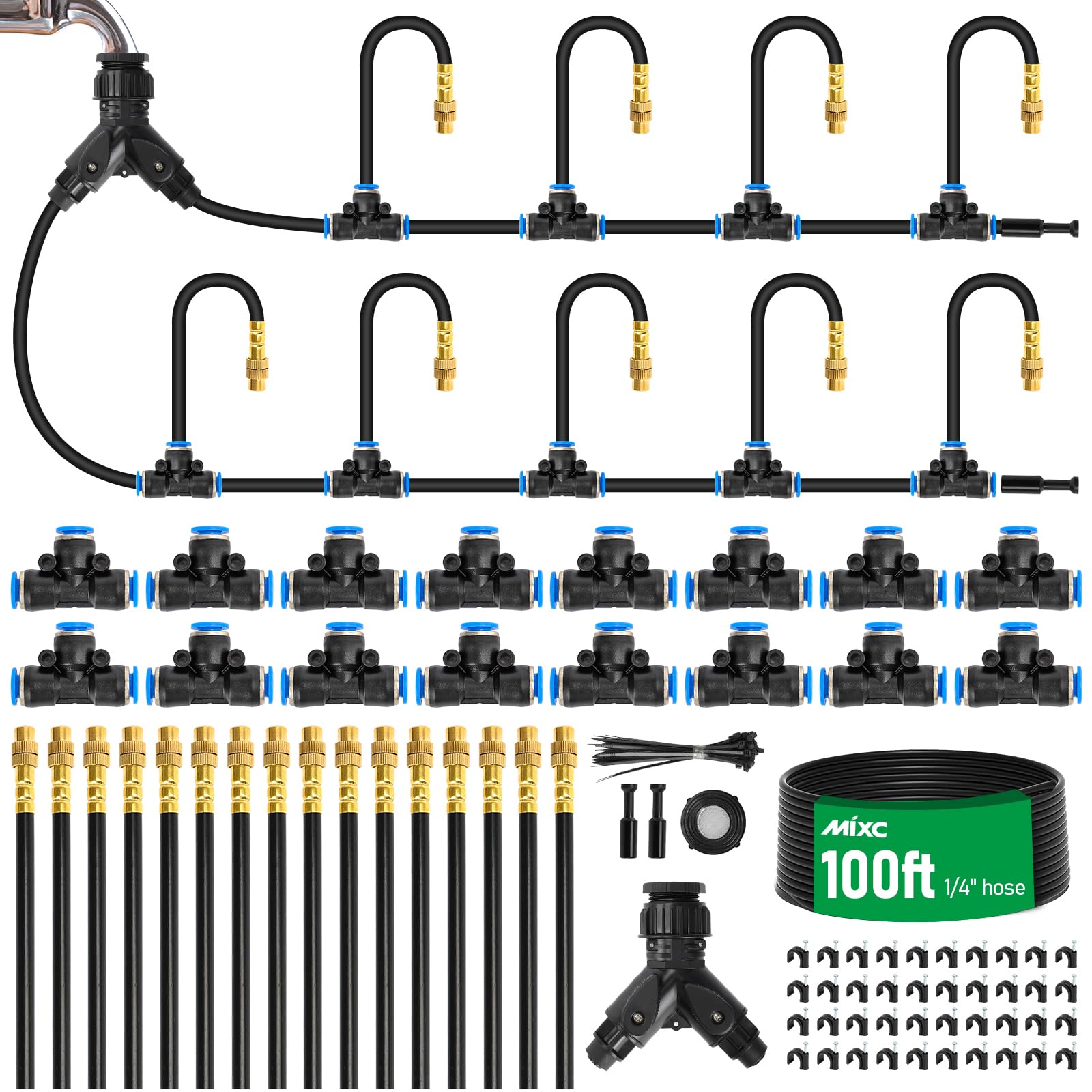
The MIXC kit uses standard 1/4-inch (6mm) components that are compatible with the vast majority of US-market drip fittings, which is a relief if you ever need to buy replacement parts. It includes 100 feet of tubing, 16 bendable brass atomizing nozzles, a 2-way quick connector, 16 three-way quick connectors, and 40 cable ties. The bendable rods have an aluminum interior that holds its position after bending, so you can aim each nozzle directly at the base of a tomato in a pot or container.
For tomato growers using containers on a patio or balcony, this kit provides enough tubing and nozzles to water a dozen 5-gallon pots with individual control over each plant. The brass nozzles adjust from a heavy drip to a fine mist, and the quick-connect tees let you add or remove branches without cutting the mainline. Owners report that the system works well with a hose timer for automated daily watering. The main limitation is the 1/4-inch tubing — pressure drops significantly beyond 50 feet, and if your garden has a steep uphill section, the far nozzles may struggle. One reviewer noted that the kit does not include end plugs for the line, so you will need to buy those separately or crimp the ends yourself.
If you are growing tomatoes in pots, raised planters, or a small backyard patch, the MIXC kit delivers solid brass hardware and enough flexibility to route water exactly where each plant needs it. Just keep the runs short and level.
What works
- Standard 1/4-inch fittings are easy to source replacements
- Brass nozzles with aluminum bendable rods hold position
- Works well with hose timers for automated watering
What doesn’t
- No end plugs included — must buy separately or crimp tubing
- 1/4-inch line loses pressure on long runs over 50 feet
7. Thiswing 50FT Drip Irrigation System

The Thiswing 50-foot kit is a straight-forward, no-frills entry into drip irrigation for small tomato patches. It uses 5/16-inch tubing, which is a notable feature at its price point — most kits in this bracket use the narrower 1/4-inch line. The wider inner diameter maintains better flow to the end of the line, which matters when you have six to eight tomato plants spaced along a 40-foot run. The kit includes 16 solid copper misting nozzles, 16 tees, a quick connector, pipe plugs, a tube cutter, fixing nails, and cable ties.
Assembly is simple thanks to the pneumatic quick-connects that push together like a SharkBite plumbing fitting — no glue, no wrenches, no wrestling with barbs. Owners consistently mention how easy it is to reconfigure the layout if you change your mind after installation. The copper nozzles produce a dense, fine atomization that works well for germinating tomato seeds or cooling a greenhouse bench, but for established plants you will want to turn the nozzles to a tighter stream to limit leaf wetness. The 50-foot length is ideal for a single 4×8 raised bed or a small row garden, but you will need a second kit if your planting area is larger.
The only consistent complaint is that the terminal plug can be difficult to seat properly — one user solved it by heating the line end with a lighter and fusing it shut. For the gardener with a modest tomato patch who wants a quick, leak-free setup with wider tubing than most budget kits offer, the Thiswing is a smart entry point.
What works
- Budged-friendly price with 5/16-inch mainline for better flow
- Solid copper nozzles resist corrosion and adjust easily
- Pneumatic quick-connects are fast and leak-free
What doesn’t
- 50-foot length limits coverage to small gardens
- Terminal plug can be difficult to seal properly
Hardware & Specs Guide
5/16 vs. 1/4 Inch Tubing
The inner diameter of the mainline determines how much water reaches your farthest nozzle. A 5/16-inch (8mm) tube has about 50% more cross-sectional area than a 1/4-inch (6mm) tube, so it maintains higher flow over distances of 50 feet or more. For a tomato bed longer than 30 feet, 5/16-inch tubing is the better choice to avoid weak output at the end of the line.
Brass vs. Plastic Nozzles
Brass or copper nozzles outperform plastic in three ways: they resist UV degradation, they are less prone to clogging from mineral deposits, and they hold their adjustment position after bending. Plastic nozzles may crack after a single season of sun exposure. If you plan to reuse the system year after year, invest in a kit with metal nozzles.
Gallons Per Hour (GPH)
Emitter flow rate determines how long you need to run the system. A 0.5 GPH emitter delivers a slow trickle ideal for a deep weekly soak, while a 2.0 GPH emitter reaches the root zone faster. For a mature tomato plant in a raised bed during peak summer, a single 1.0 GPH emitter running for 30 minutes per day provides about a half-gallon of water — adjust based on your soil type and climate.
Push-to-Connect vs. Barbed Fittings
Barbed fittings require you to force the tubing onto a ridged connector, which can be difficult with cold or stiff tubing. Push-to-connect (pneumatic) fittings use a collar and O-ring that seals when you push the tubing in. They are faster to assemble, easier to reposition, and less likely to leak at the connection point. Most modern kits now use push-to-connect designs.
FAQ
Can I use a misting system for mature tomatoes without getting the leaves wet?
How many drip emitters should I install per tomato plant?
Does a 1/4-inch drip line work for a tomato row longer than 50 feet?
Final Thoughts: The Verdict
For most gardeners, the drip irrigation for tomatoes winner is the Garden Grid 3×6 because it eliminates installation time and delivers perfectly even root-zone watering across the entire raised bed. If you want a flexible, large-coverage kit that works for multiple bed shapes, grab the Bonviee 230FT. And for building a custom dripping system with professional-grade pressure-compensating emitters, nothing beats the Rain Bird DRIPKITBAG.