
Specs are compiled from manufacturer listings and verified buyer reviews and can change over time — please confirm the key details on the product page before buying.
Drilling into a glazed ceramic pot is one of those jobs that seems simple until your bit skates across the surface and leaves a scratch you cannot buff out. The wrong bit shatters the glaze or grabs the edge, ruining a planter you just bought.
I’m Rikta — the founder and writer behind Lawn Gear Lab. This guide is built by comparing the manufacturers’ published specifications and the patterns across verified customer reviews, so you get each pick’s real strengths and trade-offs instead of marketing spin.
Below are the seven best bits, from a budget multi-pack covering every pot size to a premium single cutter for counters and tile. Whether you are adding one drain hole or outfitting a whole greenhouse, this guide to the drill bit for ceramic pot gives you the straight facts so you choose the right one the first time.
Our Picks at a Glance

How To Choose The Best Drill Bit For Ceramic Pot
Ceramic is dense and brittle — a standard wood or metal bit will chip or crack it. You need a tip that grinds instead of cuts, which is exactly what diamond and carbide bits do. After that, your choice depends on bit shape, how you cool it, and how many holes you plan to drill.
Diamond Tip vs Carbide Tip
For glazed ceramic pots, diamond-tipped bits are the clear winner. The diamond grit grinds through the hard glaze and into the bisque body without grabbing. Diamond tips are the crowd favorite — performance is the most-praised aspect across the board. Carbide-tipped bits (like Product 6) work on unglazed ceramic and soft tile, but they struggle on the slick glass-like surface of a glazed pot. Stick with diamond for your pot project.
Dry vs Wet Drilling
Running a bit dry generates heat that dulls the diamond grit and can crack the ceramic from thermal shock. Experienced owners universally advise using water. A simple spray bottle aimed at the hole keeps the bit cool and the dust down. Some bits come with a wax core inside that lubricates as you drill — that helps, but water is still the best friend of a long-lasting bit.
Bit Size and Count
Most ceramic pots need a hole between 1/4-inch and 1/2-inch for drainage. A single 1/4-inch bit is fine for one or two pots. If you have a collection of pots or different pot thicknesses, a multi-pack with several sizes saves you a trip back to the store. The table below shows each product’s size range and count so you can match it to your workload.
Quick Comparison
| Model | Best For | Tip Material | Unit Count | Size Range | Amazon |
|---|---|---|---|---|---|
| DKIBBITH Dry Diamond Core Drill Bit★ Best Overall | Large holes (faucets, planters) | Diamond | 1 | 3/4-inch | Amazon |
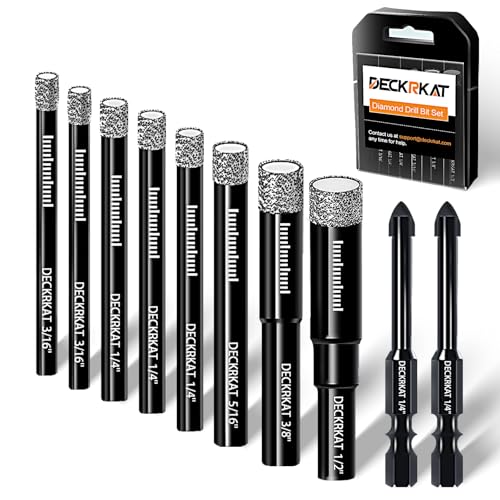
| DECKRKAT 10-Piece Diamond BitsAlso Great | Variety of sizes for many pots | Diamond | 10 | 3/16-inch to 1/2-inch | Amazon |
| DEWALT DW5572 1/4-Inch | Reliable single-bit for tight jobs | Diamond | 1 | 1/4-inch | Amazon |
| DKIBBITH 1-1/4″ Diamond Hole Saw | Oversized holes for bulkheads | Diamond | 1 | 1-1/4-inch | Amazon |
| BGTEC 10pcs Diamond Drill Bit Set | Multi-bit diamond set for several projects | Diamond | 10 | 1/4-inch (6mm) | Amazon |
| BGTEC Masonry Drill Bits | Hard unglazed ceramics and masonry | Tungsten Carbide | 10 | 5mm to 12mm | Amazon |
| BGTEC Dry Diamond Drill Bits Set | Combination diamond & carbide set | Diamond / Carbide | 10 | 1/4-inch (6mm) | Amazon |
In‑Depth Reviews
1. DKIBBITH Dry Diamond Core Drill Bits 3/4 Inch
Our pick — over 4.5★ from 650+ verified ratings; the strongest balance of quality and price.
A 3/4-inch core bit that chews through granite and porcelain alike.
This is the bit for jobs bigger than a standard pot drainage hole — think faucet holes, planter bulkheads, or drilling through a granite countertop for a soap dispenser. It comes with a 5/8-11 female thread for most angle grinders and an arbor adapter that converts to a 3/8-inch hex shank for power drills.
Performance and cutting quality are the top-praised aspects. — one buyer drilled two holes in granite for soap dispensers in about 10 minutes per hole using an angle grinder, starting at 45 degrees and working dry with periodic wiggling to expel debris. Another used a wood template to drill a perfect hole through porcelain tile. The diamond coating is abundant, and the bit handles ceramic, marble, stone, and concrete without dulling quickly.
The durability is mixed — the bit can wear faster than more expensive brand-name core bits, especially on repeated heavy use. For one or two big holes, it delivers exceptional value. If you need to drill dozens of large holes in stone, a premium core bit may last longer.
Where it shines
- Works with angle grinders and standard drills via the included hex shank adapter
- Drills clean holes through granite, porcelain, and concrete with a 45-degree start technique
- Priced well below comparable brand-name core bits — owners call it great value
Where to be careful
- Diamond grit wears faster than premium bits if you overheat it — keep water on the cut
- At 0.16 kg it is heavier than small bits; best used with a grinder for stable control
Best for: Big holes in ceramic planters, countertops, or tile when you have an angle grinder or a power drill with the included adapter.
Skip for: Small drainage holes — a 1/4-inch bit is easier to control and costs less.
2. DECKRKAT 10-Piece Dry Diamond Drill Bits & TileDrill Bits
Ten diamond bits that tackle every pot size in a single box.
This is the set you reach for when you have more than one pot to drill, or when you are not sure what size hole you need. The 10 bits run from 3/16-inch up to 1/2-inch, plus two masonry bits in the same pack. That covers tiny drainage holes for succulents all the way up to a large hole for a tabletop fountain. The 10-piece set gives you ten bits instead of a single-bit purchase — you have spares if one wears out or breaks.
Owners most praise how well these bits perform. One owner reports drilling a drainage hole in a ceramic pot in roughly three minutes using careful water-cooled technique, with no cracking. Another describes cutting through glazed ceramic for drainage as fast and clean. The bits use a wax lubricant inside the core and a side-flute design that clears debris as you drill. The round shank fits any standard electric drill or angle grinder.
The trade-off: these bits are not built for heavy daily professional use — durability gets mixed feedback, and they can wear faster if you apply too much pressure or let them overheat. For a home planter project or a weekend of potting, the value is tough to top. The 4.2-star average across 661 ratings confirms most buyers are happy, while the BGTEC 10-pack has a 4.5-star average across 995 ratings.
What wins people over
- Comes with 10 bits covering many sizes — 3/16-inch to 1/2-inch — for every pot you own
- Diamond vacuum-brazed tips cut cleanly through glazed ceramic without chipping
- Wax core and side flute help keep the bit cool and clear debris
The honest trade-off
- Bits are not extremely durable under heavy pressure — treat them gently with water cooling
- Drilling through granite or very thick stone takes noticeable time and extra bits
Reach for this if: You have multiple pots to drill and want the right size on hand without a second trip to the store.
Look elsewhere if: You only need one 1/4-inch hole — a single bit is simpler and costs less up front.
3. BGTEC Dry Diamond Drill Bit Set, 10pcs 1/4″ Hole Saw

The crowd favorite with diamond consistency across ten bits.
This BGTEC set earns the highest rating and the most reviews of any multi-pack here — 4.5 stars across 995 ratings. Each of the ten bits is a 1/4-inch (6mm) diamond-tipped hole saw with a round shank that fits standard drills and impact drivers. The tip measures 8mm of diamond length, and the bits use a wax core inside for built-in cooling and lubrication. A groove on the side removes stone chips as you drill.
Owners most praise the cutting performance. One owner reports getting 9 to 10 holes per bit on ceramic tile, compared to 3 or 4 holes from big-box-store diamond bits. Another drilled 6 holes in half-inch tile with a single bit and said it still cuts well. The vacuum-brazed diamond technology holds the grit firmly, and the dry-drilling wax core lets you work without a constant water drip — though spraying water doubles bit life and reduces dust.
The catch is that the bit tends to wander if you do not hold the drill perfectly straight, especially on slick glazed pot surfaces. Use a pilot indentation (or the included pilot tip method) to keep it planted. A few owners note the sharpness is not consistent across every bit in the pack. Still, for the per-bit cost, this set outlasts most single-bit competitors.
Best use-case: Repeated small holes in ceramic pots, tile, or glass, where you want a stack of identical bits so you never run out mid-job.
Grab these if: You need to drill many holes across multiple projects — the per-bit cost is lowest and the diamond life is proven.
Bypass if: You need a single larger hole over 1/4-inch, which none of these bits can deliver.
4. DEWALT Tile Drill Bit, Diamond Tip, 1/4-Inch (DW5572)
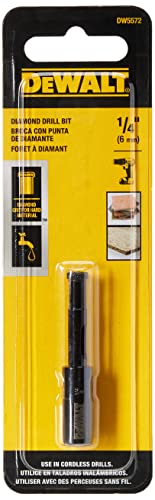
The brand name that makes one hole feel like a sure thing.
When you just need to put a single drainage hole in a ceramic pot and you want a bit you can trust to work the first time, this DEWALT gets it done. It is a diamond-welded tip bit with a 1/4-inch diameter and a reverse spiral thread that pulls water into the cut. The core ejection slot clears out the plug so you can drill repetitive holes without stopping to dig debris out.
Owners consistently call it effective — functionality and quality are the top-praised aspects. One buyer reports drilling 5 holes in porcelain tile for a toilet ring in minutes using a portable drill and water spray, and the bit remained intact and reusable. Another used it for drainage holes in ceramic planters, summing it up: “Not cheap but absolutely did its job.” It also outperforms other bits on extremely hard Italian porcelain tile, drilling through in 5-6 minutes compared to 15+ minutes with other bits.
Durability is the mixed note here — some owners find the bit wears out in as few as five holes, depending on the hardness of the material and whether they kept it wet. For a single pot or a small set of planters, it lasts fine. For a large tiling project, consider a multi-pack.
The short version: A no-surprises diamond bit from a brand that stands behind its tools, best when you need exactly one reliable 1/4-inch hole.
Ideal for: Quick, one-off pot drilling where brand confidence and a clean cut matter more than having spare bits.
Pass on it if: You need to drill many holes across thick stone — a multi-pack gives better value per hole.
5. DKIBBITH 1-1/4″ Diamond Hole-Saw Bit with Pilot Drill Bit
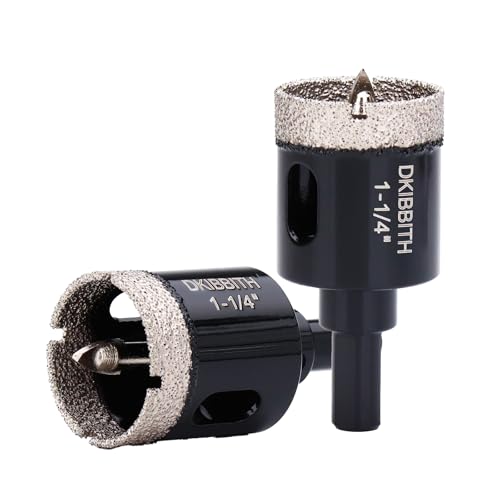
A hole saw that gives you a pilot guide for rock-steady starts.
This 1-1/4-inch diamond hole saw stands out because it includes a removable pilot drill bit that keeps the saw from wandering on smooth glaze. You start with the pilot bit to position the cut, then remove it with the included hex wrench and let the diamond saw do the rest. The cutting depth is 1-3/8 inches, enough to get through thick planter walls or countertops.
Functionality and cutting performance are the most-praised features. One owner drilled through a granite countertop using water lubrication and 30-second intervals, calling the result clean and easy. Another used it on a 3/4-inch glass tabletop and produced a clean hole. The diamond grit is securely bonded on the top quarter-inch of the saw, and the hex shank fits standard drills without slipping.
The main note from owners: this is not a wood-cutting hole saw, and some who tried it on wood struggled. Stick to ceramic, stone, tile, and glass as the manufacturer specifies. A few owners mention the bit shows wear after several uses, but for the price it outperforms big-box diamond hole saws.
One-sentence take: The pilot bit makes starting on slick glaze simple to use, and the diamond saw cuts through granite with patience and water.
Go for it if: You need a large-diameter hole (over 1 inch) and want the stability of a pilot guide.
Avoid if: Your pot hole is 1/2-inch or smaller — a standard twist bit is simpler and cheaper.
6. BGTEC Masonry Drill Bits, 10pcs Tungsten Carbide Tip
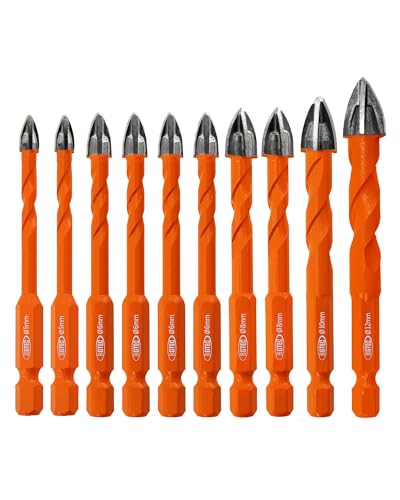
Tungsten carbide bits for unglazed ceramic and masonry at a bargain.
This 10-bit set uses YG6X cemented tungsten carbide — a material known for high hardness and abrasion resistance. The bits come in five sizes: 5mm (x2), 6mm (x4), 8mm (x2), 10mm, and 12mm. They fit standard drills via a quick-fit hex shank and use a crosshead design intended to reduce slipping on the start.
Performance and quality are the top-rated aspects. One owner drilled 24 holes in porcelain tile for mirrors and hooks, using the method of dipping the bit in cold water every 20-30 seconds to keep it cool. Another drilled clean holes in ceramic tile for glass shelves with no chipping or cracking. The bits are noticeably cheaper per bit than big-box masonry bits.
The catch is that these are not diamond tips — they are carbide, which means they work best on unglazed ceramic, brick, concrete, and masonry. On hard glazed ceramic pots, the carbide can slip or wear quickly. Durability is the most-cited negative aspect. Owners strongly recommend using water or coolant on hard materials. If your pot has a thick glossy glaze, a diamond bit is the better choice.
Strengths
- 10 bits across five sizes cover many drill needs beyond just pots
- Tungsten carbide stands up to masonry, brick, and concrete well
- Very low per-bit cost compared to diamond alternatives
Limitations
- Not ideal for slick glazed ceramic — the tip wanders and wears faster
- Bits can break or dull on first use if pressed too hard without water
Great pick if: You are drilling into unglazed terra cotta pots, brick, or concrete and want an affordable multi-pack.
Not the best if: Your pot has a hard glassy glaze — switch to diamond for that surface.
7. BGTEC Dry Diamond Drill Bits Set 1/4″ 6mm 10pcs with Carbide Tips

Half diamond hole saws, half carbide bits — a hybrid for mixed materials.
This set splits ten 1/4-inch (6mm) bits into five diamond-tipped hole saws and five carbide-tipped drill bits. The diamond bits use vacuum-brazed technology and a cooling wax core for dry drilling on ceramic, porcelain, marble, and glass. The carbide bits tackle wood, plastic, and softer masonry. The recommended speed range is 2000-5000 RPM.
The feedback is short and positive: buyers report the diamond bits worked on ceramic shower tile when regular bits failed, drilled clean holes in marble tile without cracking, and cut through a ceramic, glass, and clay pot for drainage holes with no issue. The carbide tips are used for concrete floor prep. For a buyer who needs both diamond and carbide capability in one box, this kit covers both bases.
The data here is light on review depth — the set has 4.4 stars across 301 ratings. The limiting factor is that all bits are the same 6mm (1/4-inch) size, so you get no variety. If you need larger holes or different diameters, you are locked into that one size. It works great for standard drainage holes, but not for anything wider.
Bottom line: A versatile kit if you value having both bit types in a single case, but you trade versatility in sizes for that convenience.
Choose this if: You want diamond for glazed pots and carbide for drilling into the shelf or wall in one purchase.
Pass if: You need multiple bit sizes — the single 6mm diameter limits what you can drill.
Understanding the Specs
Diamond Tip vs Carbide Tip
A diamond-tipped bit has industrial diamond grit bonded to the cutting edge. It grinds through hard, brittle materials like glazed ceramic, porcelain, granite, and glass without grabbing or chipping. The diamond particles do the work, so the bit does not need sharpening. A carbide tip (usually tungsten carbide) is a hard metal insert that cuts by scraping. It works well on unglazed ceramic, brick, concrete, and wood, but it struggles on slick glazed surfaces because the tip skates instead of biting. For ceramic pots with a glossy finish, diamond is the recommended choice — it is what the bulk of successful owner reports point to.
Dry Drilling vs Wet Drilling
Dry drilling means you run the bit without any added liquid, relying on the bit’s own cooling features (such as a wax core or side vents) to manage heat. Some bits, especially vacuum-brazed diamond bits, are designed for dry use and include wax lubricant that melts as the bit warms, reducing friction. Wet drilling means you use water — either a steady drip, a spray bottle, or dipping the bit in a cup of water every 20-30 seconds. Water keeps the diamond grit from overheating and losing its bite, and it also washes away abrasive dust that can clog the cutting edge. For ceramic pots, the consensus from experienced owners is that wet drilling gives you cleaner holes and longer bit life. A simple spray bottle aimed at the cut makes a noticeable difference.
FAQ
Can I use a regular wood or metal drill bit on a ceramic pot?
How do I stop the drill bit from slipping or “walking” on the glaze?
Should I use water when drilling into a ceramic pot?
What size drill bit do I need for a drainage hole in a pot?
How long does a diamond drill bit last on ceramic?
Can I drill through glazed ceramic and unglazed terra cotta with the same bit?
Is a diamond hole saw the same as a diamond twist drill bit?
What drill speed should I use for ceramic pot drilling?
Can I use an impact driver on ceramic pot drill bits?
Final Thoughts: The Verdict
If you want one dependable pick, the drill bit for ceramic pot winner is the DECKRKAT 10-Piece set because it gives you ten diamond bits in the most common pot-drainage sizes at a price that makes each hole cheap. If you want the highest-rated and most-reviewed diamond set, grab the BGTEC 10-piece 1/4-inch set — a 4.5-star average across 995 ratings proves it delivers drilling after drilling. And for the one-hole quick job, the DEWALT DW5572 is the no-surprises single bit that simply works.
How We Picked
We do not accept paid placement. Every pick is matched to a real buyer and a real use-case; we do not hands-on test units.
Sources & Methodology
Specifications: manufacturer listings and product documentation. Review insights: verified customer reviews, as of July 2026. Pricing: not shown on this page (it changes often); check the current price via the retailer link.
As an Amazon Associate, Lawn Gear Lab earns from qualifying purchases. This does not affect which products we feature.