
Specs are compiled from manufacturer listings and verified buyer reviews and can change over time — please confirm the key details on the product page before buying.
Most palm trees die not from neglect, but from the wrong dirt. Standard potting soil holds too much water, and palm roots — which need constant airflow — essentially drown. The fix is a specialized mix that drains fast while holding onto just enough moisture and nutrients to mimic the sandy, loamy ground palms evolved in.
I’m Rikta — the founder and writer behind Lawn Gear Lab. This guide is built by comparing the manufacturers’ published specifications and the patterns across verified customer reviews, so you get each pick’s real strengths and trade-offs instead of marketing spin.
Whether you are repotting a parlor palm or planting a pygmy date, the right dirt for palm trees is the single difference between a thriving canopy and a yellowing mess.
Our Picks at a Glance

How To Choose The Best Dirt For Palm Trees
Palm tree roots are sensitive. They dislike sitting in wet, compacted soil, and they need a steady supply of nutrients that standard potting mixes rarely provide. Picking the right bag depends on three things: drainage speed, nutrient content, and how much volume you actually need for your pot size.
Drainage Is Everything
Look for ingredients like perlite (volcanic glass chips that create air pockets), sand, or bark. These keep the mix loose so water runs through instead of pooling. A mix that stays soggy leads to root rot — the fastest way to lose a palm.
Built-In Nutrition Vs. “Gritty” Mixes
Some premium palm soils contain slow-release fertilizers like chicken manure or kelp meal, meaning you do not have to add plant food for months. Others — often called “gritty” mixes — have zero nutrients, so you must fertilize immediately. Know which type you are buying before you pot.
Bag Size And Pot Math
An 8-quart bag typically fills two 8-inch containers. If you have a single large potted palm, a 4-quart bag might be enough. For multiple palms or bigger planters, the 12-liter or 0.5-cubic-foot bags save you from buying twice.
Quick Comparison
| Model | Best For | Volume | Nutrient Source | Drainage Additives | Amazon |
|---|---|---|---|---|---|
| Miracle-Gro Cactus, Palm & Citrus (3-Pack)★ Best Overall | Best Overall Value | 8 Quarts per bag (3 bags) | Miracle-Gro Plant Food (enriched) | Fast-draining formula | Amazon |
| LGM Premium Cactus & Succulent Soil Mix | Best Organic Nutrients | 0.5 Cubic Feet | Chicken manure, kelp meal, iron sulfate | Volcanic ash, perlite | Amazon |
| GARDENERA Palm Tree Potting Mix | Small Container Palms | 4 Quarts | Canadian peat moss (organic matter) | Perlite, sand, New Zealand bark | Amazon |
| PALMPON (Lechuza) Potting Soil | Premium Self-Watering Pots | 12 Liters | Nutrient-rich special substrate | Pon-style granular structure | Amazon |
In‑Depth Reviews
1. Miracle-Gro Cactus, Palm & Citrus Potting Mix (3-Pack)
Our pick — over 4.5★ from 650+ verified ratings; the strongest balance of quality and price.
The three-bag bundle that covers every pot in your collection while staying affordable.
This is the straightforward choice if you have multiple palms or citrus trees to repot. The fast-draining formula is enriched with Miracle-Gro Plant Food, meaning your palm gets a gentle feed every time you water. Each of the three 8-quart bags fills two 8-inch containers, so this bundle alone can handle six medium pots — a strong lead on sheer volume alone, especially compared to single-bag options like the GARDENERA mix that holds only 4 quarts (with the bundle totaling 24 quarts).
Buyers report that after transplanting “some plants into this soil they all are doing amazing,” which backs up the 4.7 out of 5 score across 652 ratings. The granules are easy to work with, and the mix works for indoor and outdoor container plants alike. The only real catch is that the price per bag, while fair for the bundle, feels a touch high if you only need a single pot — you are paying for three.
What Stands Out
- Three 8-quart bags — enough for six 8-inch pots
- Enriched Miracle-Gro Plant Food feeds plants on initial watering
- Fast-draining formula helps prevent root rot in palm and citrus
The Trade-Offs
- 3-Pack is a lot of soil if you only have one small palm
- Some buyers found it “too expensive” for a single bag
Reach for this if: You have multiple container palms or citrus trees and want a dependable, nutrient-enriched mix in a single buy.
Look elsewhere if: You only need a small amount for one pot — a 4-quart bag will waste less soil and money.
2. LGM Premium Cactus & Succulent Soil Mix
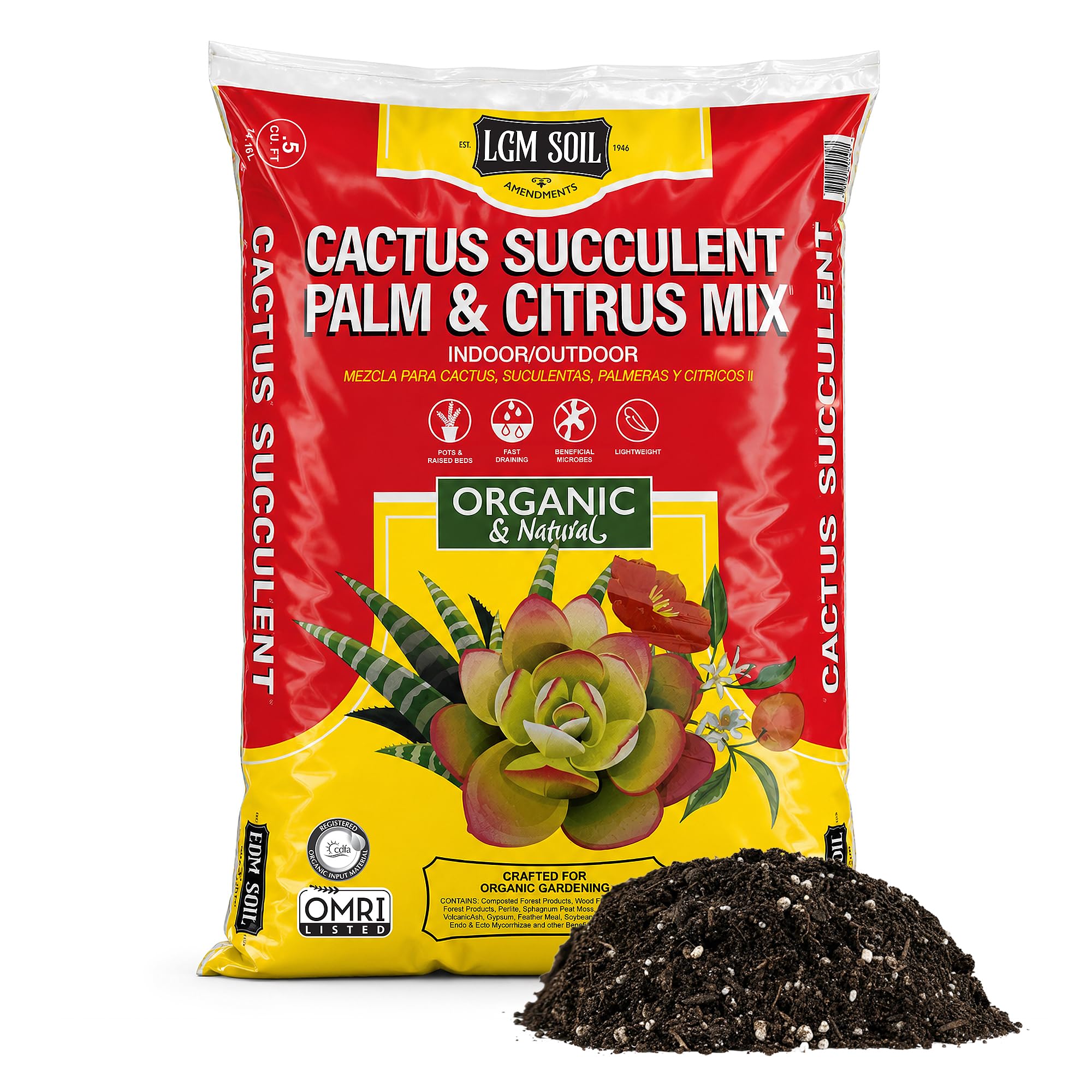
The organic mix that feeds your palm for months instead of forcing you to buy separate fertilizer.
Most “gritty” cactus mixes are sterile — they drain well but contain zero nutrients. LGM’s blend breaks that pattern by packing in chicken manure, kelp meal, and iron sulfate, so your palm gets a slow-release feed that keeps leaves green without extra bottles. The mix also uses Volcanic Ash and porous Perlite to create instant drainage, a setup that stops root rot before it starts. Unlike generic dense soils that suffocate roots, this one stays loose enough for palm roots to breathe.
Reviewers mention it is “well draining, exactly what I needed for my fiddle,” and a 4.4 out of 5 rating across 161 ratings confirms the quality. The 0.5 cubic feet volume is about 3.7 gallons — a solid middle ground between the small 4-quart GARDENERA bag and the massive Miracle-Gro 3-pack. The downside is the “lots of loose sticks” one reviewer noted, meaning the mix is not perfectly uniform, which is typical for organic blends.
Why It Works
- Contains chicken manure, kelp meal, and iron sulfate for natural feeding
- Volcanic ash and perlite ensure fast drainage
- pH-balanced for citrus, palms, and plumeria
What to Know
- Some buyers found loose sticks and bark chunks in the mix
- Family-owned since 1946, but the brand is less known than Miracle-Gro
Best for: A gardener who wants an organic, nutrient-dense mix that needs no extra fertilizer for the first several months.
skip it if: You prefer a uniform, fine-textured soil without visible bark pieces.
3. GARDENERA Palm Tree Potting Mix
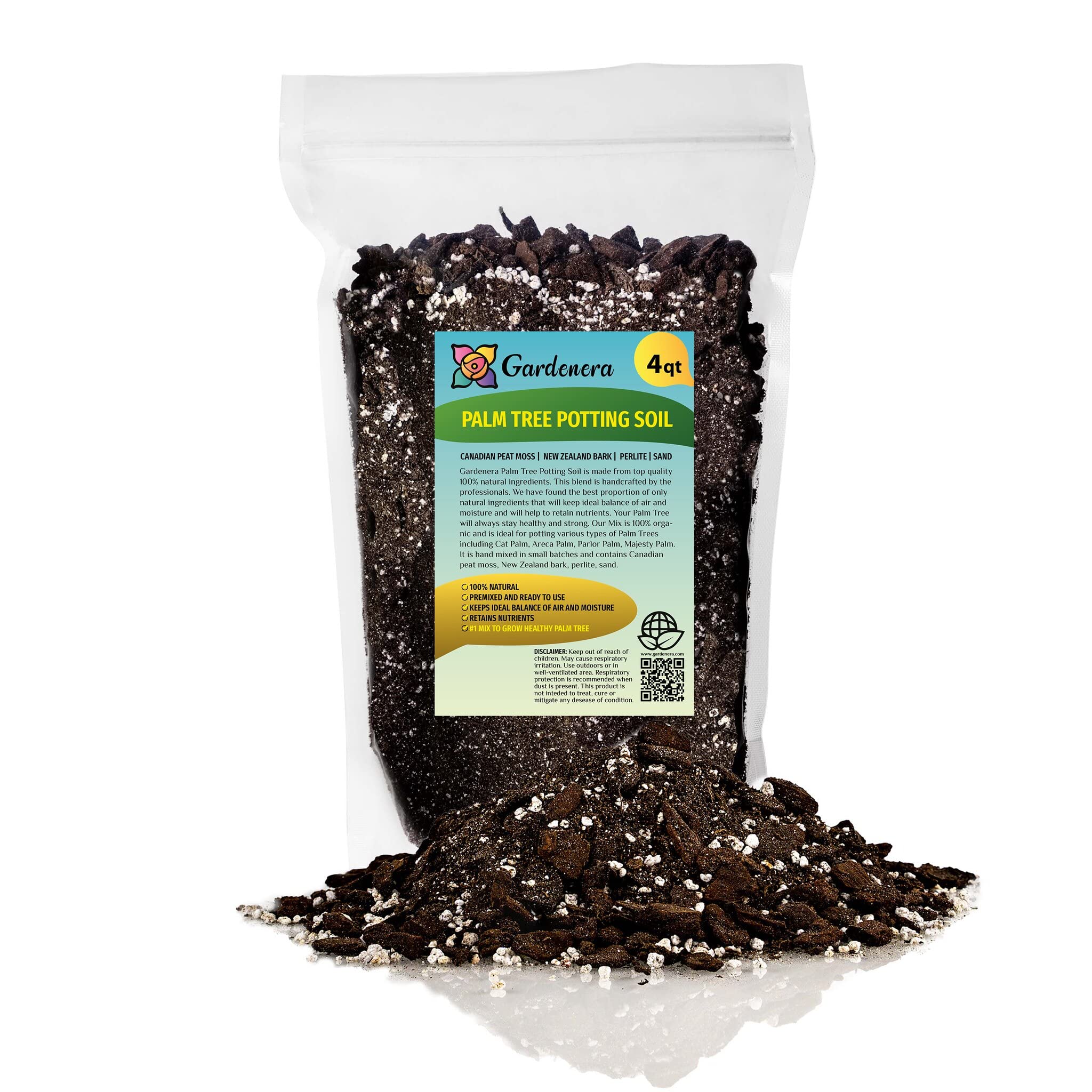
The small-batch mix that is perfect for a single palm pot but comes with a cautionary tale.
GARDENERA blends Canadian peat moss, New Zealand bark, Ukrainian perlite, and sand to create a soil that holds moisture without drowning roots. The 4-quart bag (about 1 gallon) is ideal for a single 8-to-10-inch pot, and the hand-crafted claim is backed by strong reviews: one buyer mentioned “my sago palm was dying before I changed to this soil now it is doing good again.” However, the quality control is inconsistent — a buyer reported a second bag emitted a strong rotten egg smell (potentially hydrogen sulfide), and one 1-star reviewer said it “killed both plants within 6 weeks.” At 42 ratings with a 4.3 average, the positive experiences outnumber the bad, but the risk is real.
Compared to the Miracle-Gro 3-pack, this bag holds a fraction of the volume (4 quarts vs. 24 quarts total). If you just need a small batch for one palm, this avoids waste and unused bags sitting in the shed. But the inconsistency between batches is a concern that the other picks here do not share.
The Pros
- Hand-crafted blend with Canadian peat moss, New Zealand bark, and sand
- 4-quart bag is the right size for one medium pot
- Promotes healthy root growth and prevents rot (when batch is good)
The Cons
- Some batches had a sulfur smell and killed plants
- Expensive per quart compared to the LGM mix
Go with this if: You have a single palm that needs repotting and you are willing to roll the dice on batch quality.
Avoid it if: Consistency matters to you — the LGM or Miracle-Gro options are safer bets.
4. PALMPON (Lechuza) Potting Soil for Palms
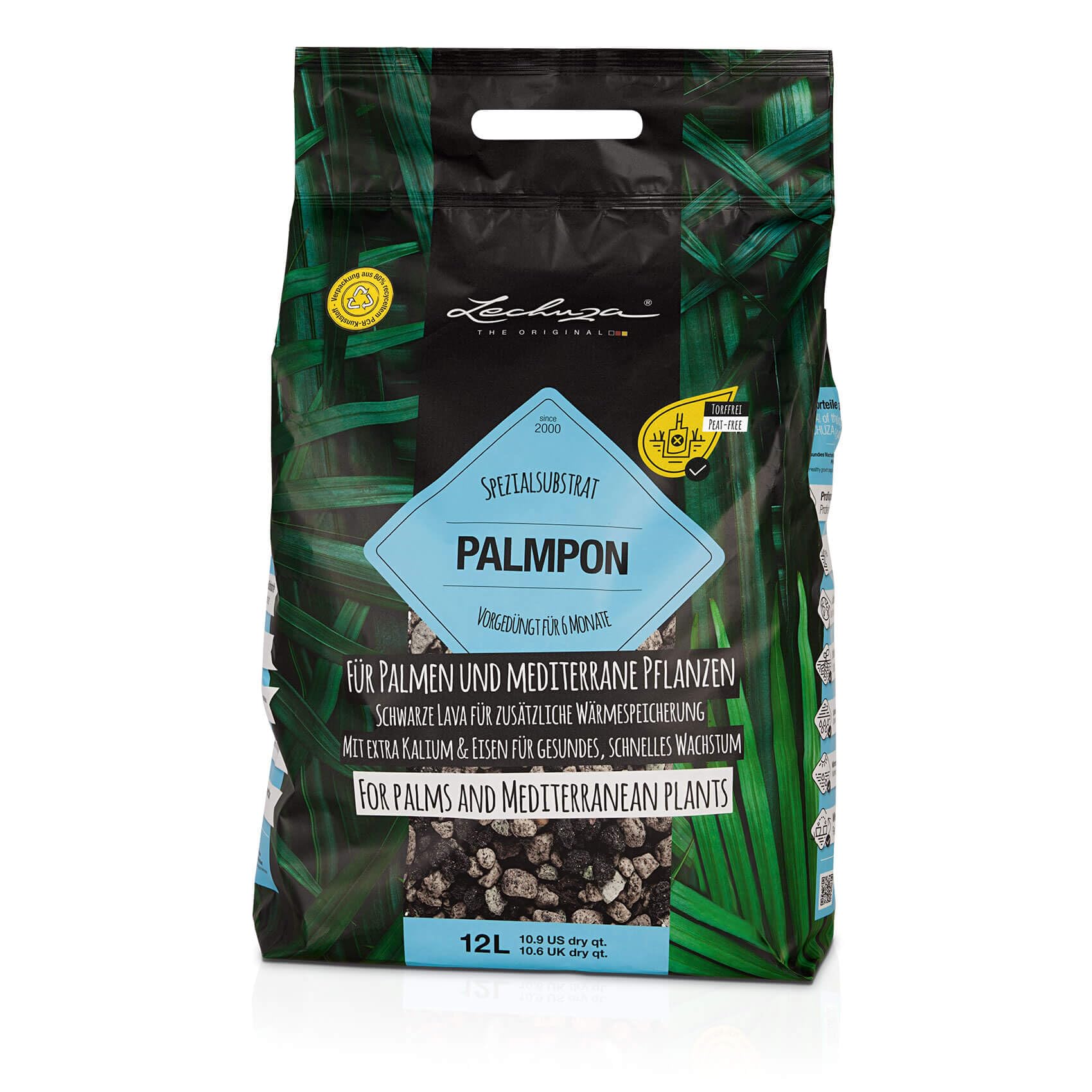
The German-engineered substrate that works perfectly with self-watering pots and never needs replacing.
Lechuza is best known for its self-watering planter systems, and this PALMPON substrate is designed specifically to work with them. Unlike traditional soil that can break down and turn muddy, these granules (a “pon” or granular substrate) stay structurally stable for years. One owner reported they tested it with olive trees and a Japanese maple, reporting the plant “never needs replacing, saves money long-term.” The 12-liter bag (roughly 3.2 gallons) is a generous single-bag size, though it does not match the volume of the Miracle-Gro 3-pack.
The rating is a near-perfect 4.7 out of 5 from 34 reviews, and the consensus among German-language buyers is that it “lives up to its promise and looks good.” The catch is the cost — this is the most expensive pick per unit volume. It is also only available as a single bag, so if you have several large palms, you will need multiple orders. But for a premium palm in a self-watering pot, there is no better match.
The Upside
- Granular structure stays intact for years — never needs replacing
- Designed for Lechuza self-watering pots but works in any container
- Nearly dust-free with very few fine particles
The Downside
- Highest price per volume among these four picks
- Single 12-liter bag; not cost-effective for large collections
Perfect for: A single prized palm in a self-watering pot where long-term stability matters more than upfront cost.
Not for: A budget shopper or someone repotting multiple plants at once — the volume-to-price ratio is too low.
Understanding the Specs
Volume (Quarts vs. Liters vs. Cubic Feet)
This is the single most practical spec. One quart roughly equals 0.95 liters, and 1 cubic foot equals about 29.9 quarts. An 8-quart bag fills two 8-inch containers. A 4-quart bag handles one such pot. A 0.5-cubic-foot bag (0.5 Cu Ft) gives you enough for about four 8-inch pots. Knowing this prevents you from either running short or buying more dirt than you need.
Drainage Additives (Perlite, Sand, Bark)
Palm roots require oxygen. Ingredients like perlite (expanded volcanic glass chips), coarse sand, and bark shreds create air pockets so water runs through fast. A mix that lists “drainage” but lacks these visible additives is probably not draining well enough for a container palm. Look for them in the ingredient list.
FAQ
Can I use regular potting soil for a palm tree?
How much dirt do I need for one medium palm tree?
Does palm tree soil have fertilizer already in it?
What is the difference between cactus soil and palm soil?
How often should I repot my palm tree with fresh soil?
Can I make my own palm tree soil at home?
What does “fast-draining” actually mean in a soil mix?
Is Lechuza PALMPON worth the high price?
Final Thoughts: The Verdict
Across the board, the dirt for palm trees winner is the Miracle-Gro Cactus, Palm & Citrus Potting Mix 3-Pack because it delivers a proven, fast-draining formula with built-in plant food at a volume that covers multiple pots. If you want organic nutrients that feed your palm for months without extra fertilizer, grab the LGM Premium Cactus & Succulent Soil Mix. And for a single premium palm in a self-watering pot, the standout is the Lechuza PALMPON substrate.
How We Picked
We do not accept paid placement. Every pick is matched to a real buyer and a real use-case; we do not hands-on test units.
Sources & Methodology
Specifications: manufacturer listings and product documentation. Review insights: verified customer reviews, as of July 2026. Pricing: not shown on this page (it changes often); check the current price via the retailer link.
As an Amazon Associate, Lawn Gear Lab earns from qualifying purchases. This does not affect which products we feature.