
Specs are compiled from manufacturer listings and verified buyer reviews and can change over time — please confirm the key details on the product page before buying.
You water your houseplant on schedule, but the leaves still turn yellow and drop. A digital soil tester gives you the numbers behind the problem — moisture, pH, and nutrients — so you know exactly what is off.
I’m Rikta, the founder behind Lawn Gear Lab. This guide is built by comparing the manufacturers’ published specs and the patterns across verified customer reviews so you get each pick’s real strengths and trade-offs.
The right digital soil tester keeps you from overwatering, underfeeding, and chasing issues with no obvious cause. This guide cuts straight to the models that actually work for houseplants, vegetable gardens, and lawns.
Quick Picks
- HSLGOVE Soil Test Kit, 7-in-One — Best Overall
- Auduto 7-in-1 Soil Test Kit — Best Value
- Luster Leaf Rapitest 4-Way Digital Soil Analyzer — Top Performer
- EDGEVEIL 4-in-1 Wireless Soil Tester — Most Versatile
- YINMIK Digital pH Tester for Soil — Premium Pick
- LDOPTO 6-in-1 Soil Test Kit — Ergonomic Choice
- YINMIK YK-S01 Digital Soil pH Meter — Pro Grade
How To Choose The Best Digital Soil Tester
A soil tester is only as useful as the numbers it shows. Picking the right one means knowing what those numbers measure and how the device gets them.
Understand what you actually need to measure
If you grow indoor houseplants in pots, moisture and light readings usually matter most. If you tend to a vegetable garden or lawn, pH and fertility (NPK — the balance of Nitrogen, Phosphorus, and Potassium) become critical. A multi-function meter like a 7-in-1 covers everything in one tool, while a dedicated pH tester gives you lab-grade accuracy for a single metric.
Probe material, depth, and durability
A tester’s probe is the only part that touches the soil. Look for corrosion-resistant metals (stainless steel or a high-quality alloy) and a shaft long enough to reach the root zone — around 6 to 8 inches works for most medium to large pots. A single-probe design disturbs fewer roots when you pull it out than a dual-prong fork.
Display readability and power source
A backlit LCD screen matters if you test plants in dim corners or outdoors in bright sun. The larger the display, the less squinting. Most testers run on AAA or LR44 button cells — check whether batteries are included in the box so you are not caught off guard on delivery day.
Quick Comparison
| Model | Best For | Functions | Probe Length | Display Type | Amazon |
|---|---|---|---|---|---|
| HSLGOVE 7-in-One | First-time buyers wanting one tool for everything | 7 | 6.8 inches | LCD + Dial | Amazon |
| Auduto 7-in-1 | Gardeners who need a corrosion-resistant metal probe | 7 | — | LCD | Amazon |
| Luster Leaf Rapitest 4-Way | Serious growers who want a separate corded probe | 4 | — | Digital LCD | Amazon |
| EDGEVEIL 4-in-1 Wireless | Managing many plants from one central screen | 4 | — | Large LCD | Amazon |
| YINMIK Digital pH Tester | pH-focused growers needing smartphone monitoring | 1 (pH) | — | Digital LCD | Amazon |
| LDOPTO 6-in-1 | Ergonomic display and stable circuit performance | 6 | — | 90° adjustable backlit LCD | Amazon |
| YINMIK YK-S01 | Avid gardeners who want an extra free electrode included | 1 (pH) | — | Digital LCD with backlight | Amazon |
In‑Depth Reviews
1. HSLGOVE Soil Test Kit, 7-in-One
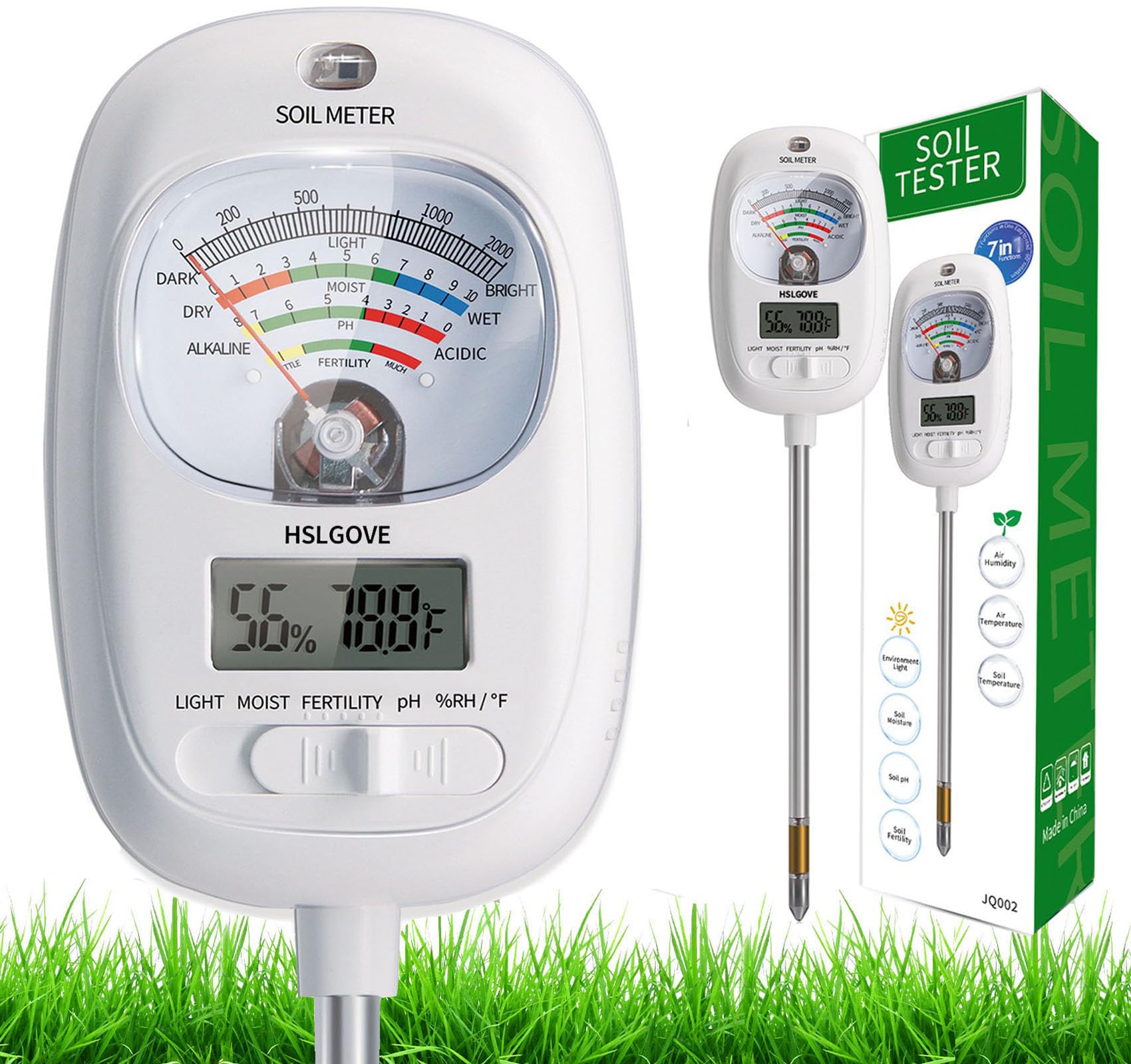
It packs seven measurements into a lightweight wand that shows both an analog dial and a digital LCD — so beginners see pH, moisture, and fertility in one glance.
The HSLGOVE 7-in-One gives you moisture, pH, fertility, temperature, light, indoor humidity, and air temperature from a single probe that is 6.8 inches long. The dual-dial design means you get an analog dial and a digital LCD screen, so you never wonder which number belongs to which function. A simple button cycles between modes. The probe uses three metal contacts for faster soil analysis. Buyers report it helps prevent overwatering and gives “accurate” results that “remove guesswork.”
At 4.8 ounces and 11.5 x 2.9 x 1.5 inches, this meter weighs 4.8 ounces versus the Luster Leaf Rapitest at 7 ounces — a real difference when you carry it from pot to pot. The single-probe design is also gentler on plant roots than a two-prong fork.
One limit: the manufacturer warns not to use it in liquid water. It is a soil moisture meter, not a water tester.
Why it stands out
- Seven functions in one device: moisture, pH, NPK fertility, temp, light, air humidity, and air temp
- Dual analog dial and LCD display makes reading simple for beginners
- Lightweight 4.8 oz build is comfortable to use across many pots
One real trade-off
- Not for testing liquid; designed only for damp soil
- Requires three button batteries (included) and a 3-5 minute wait for LCD stabilization
Your best all-rounder: Get this if you want one tool that covers every basic measurement for houseplants, garden beds, and lawns without juggling separate gadgets. It is lighter and more versatile than the Luster Leaf Rapitest for daily pot-to-pot checks.
Leave it on the shelf if: You only care about pH and need a dedicated lab-style meter with Bluetooth for data logging.
2. Auduto 7-in-1 Soil Test Kit
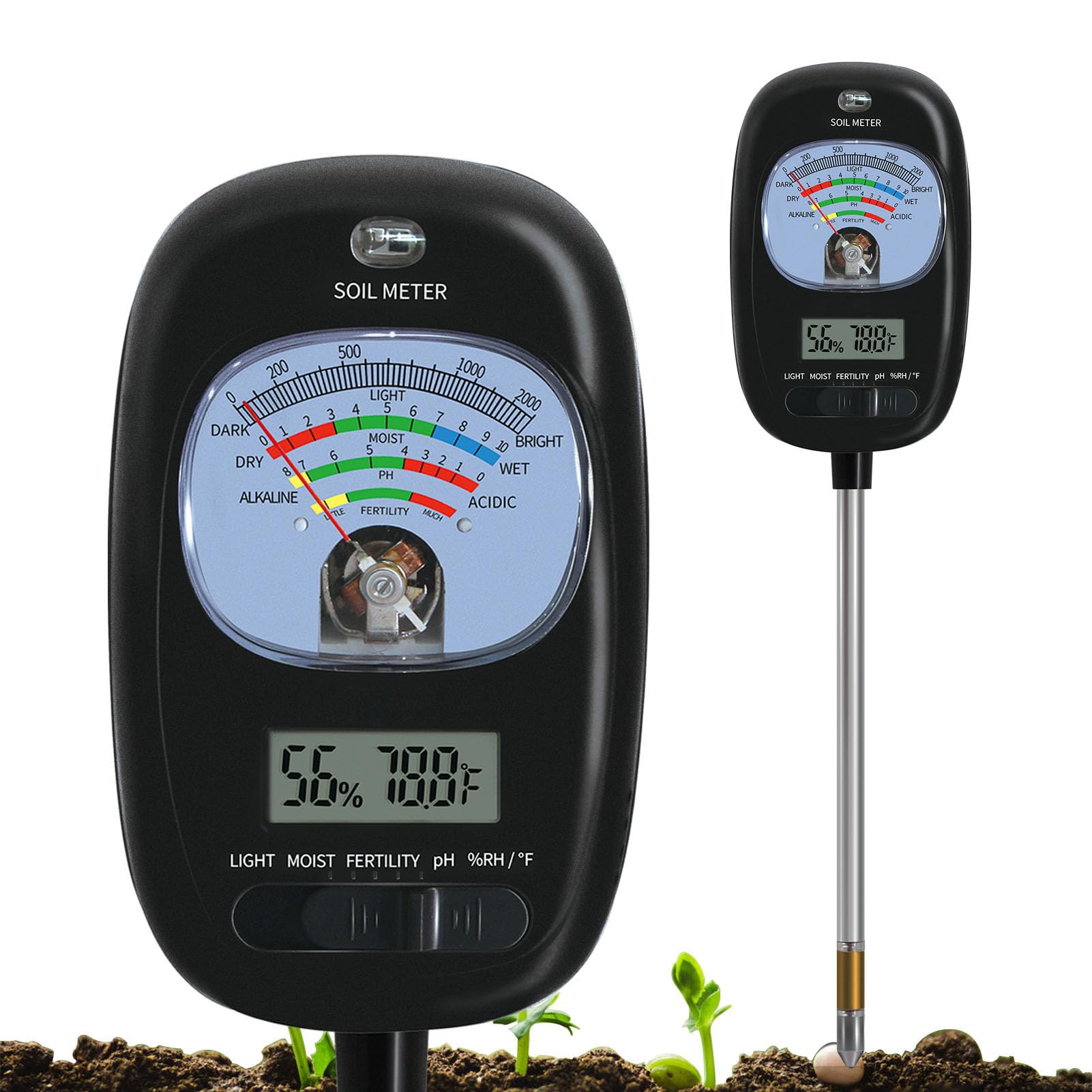
A corrosion-resistant metal probe that lasts longer than plastic-tipped budget testers, giving you seven functions without the premium price.
The Auduto 7-in-1 matches the HSLGOVE in function — moisture, pH, fertility, sunlight, air and soil temperature, and humidity — but it emphasizes its corrosion-resistant metal construction. Owners mention it delivers “quick consistent readings” for both indoor pots and outdoor vegetables. The LCD display is clear, and the instruction manual is straightforward for beginners.
It weighs 5.6 ounces versus the HSLGOVE at 4.8 ounces; its length is 11.85 inches. The manufacturer advises not to use it in rocks or sandy soil, and to always insert it two-thirds of the way into the ground. Users who follow that rule report stable, repeatable results across flower beds and lawns.
One caveat: the unit does not work in loose sandy soils where the probe cannot make firm contact.
What you get
- Corrosion-resistant metal probe designed for faster, accurate moisture and pH detection
- Seven measurement modes including sunlight intensity and air temperature
- Design patents for the combined dial-and-LCD layout
Watch out for
- Not suitable for sandy or excessively loose soil
- 2/3 insertion depth required for accurate readings — shallow insertion gives false data
Smart budget buy: Choose this if your garden has normal loamy soil and you want a corrosion-resistant, seven-function tool that costs the same as many basic 3-in-1 models. The metal probe here lasts longer than the plastic-tipped ones on cheaper testers.
skip it if: You garden in sand beds or need a tester that works in liquid nutrient solutions.
3. Luster Leaf Rapitest 4-Way Digital Soil Analyzer
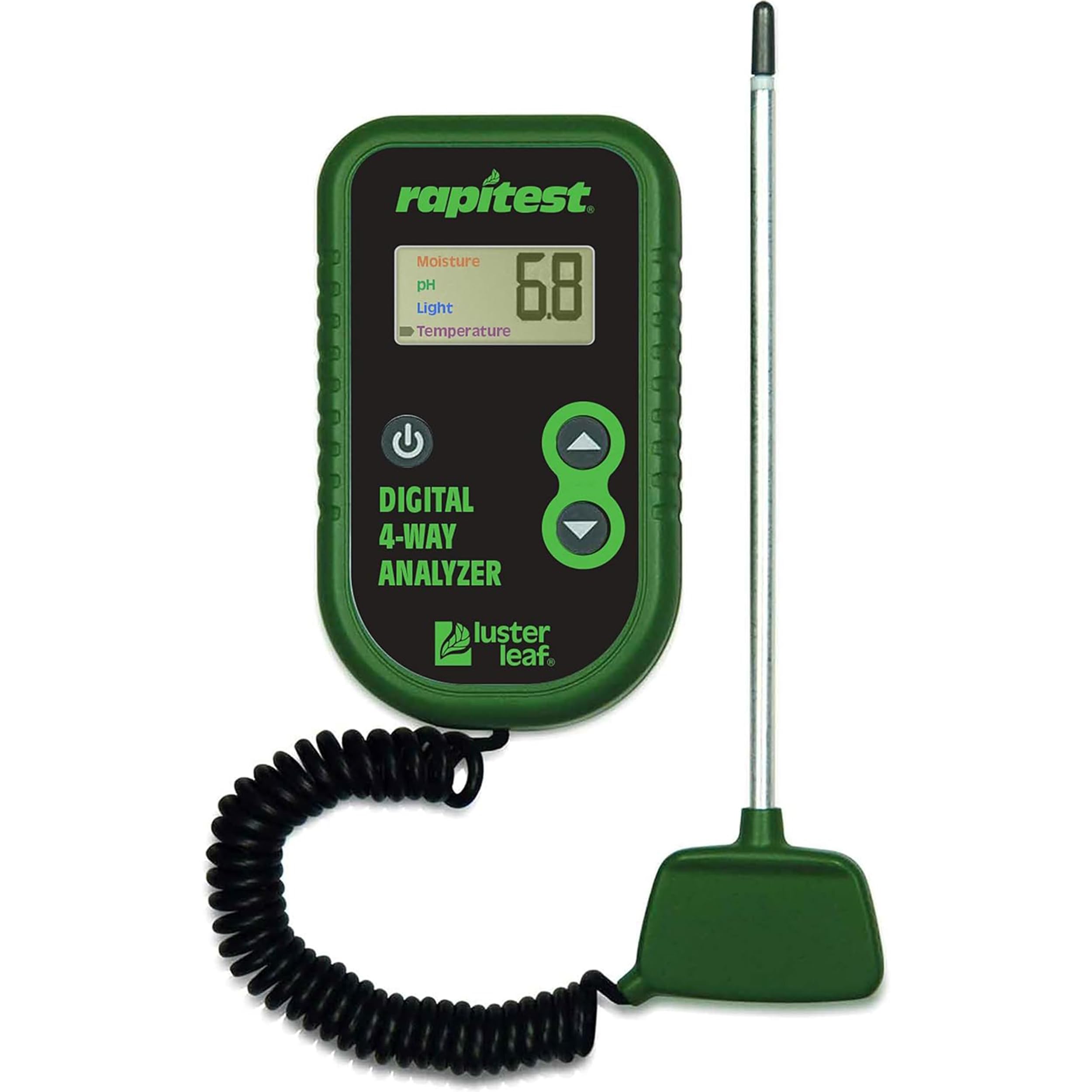
A cord separates the sensor from the screen — so you read pH, moisture, and light on the display while the probe stays buried in the pot.
Unlike the all-in-one wand designs from HSLGOVE and Auduto, the Luster Leaf Rapitest separates its probe from the screen with a cord. You read pH, moisture, temperature, and light on the display while the sensor sits undisturbed in the soil. It is a small ergonomic detail that matters when you test a dense garden bed without bending over. The manual includes a full pH plant list for over 450 different plants, so you get “needs acidic/alkaline” guidance right next to the reading.
Customers note it helps keep moisture levels “on-point” for both in-ground plantings and pots. One reviewer noted a real limit: “temperature maxes at 99°F (not for compost)” — so if you monitor hot compost piles, this unit cannot handle the heat. At 7 ounces and 12 x 7 x 2 inches, it is noticeably bigger and heavier than the HSLGOVE (4.8 oz, 11.5 x 2.9 x 1.5 inches).
Why it leads
- Corded probe keeps the sensor in the soil while you read the display at eye level
- Includes a full list of 450+ plants with their ideal pH ranges
- Designed and engineered in the USA by Rapitest, a long-standing home-testing brand
Its limits
- Temperature sensor maxes at 99°F — no good for compost piles or heated greenhouses
- One buyer mentioned the display dimmed after a few days of use
Reach for this if: You value the corded convenience of reading the screen while the probe stays planted, and you regularly reference a plant-pH guide. It is heavier than the HSLGOVE but gives you that eye-level reading advantage.
Look elsewhere if: You need a high-temp compost monitor or you prefer a lighter, pocketable wand for moving from pot to pot.
4. EDGEVEIL 4-in-1 Wireless Soil Tester
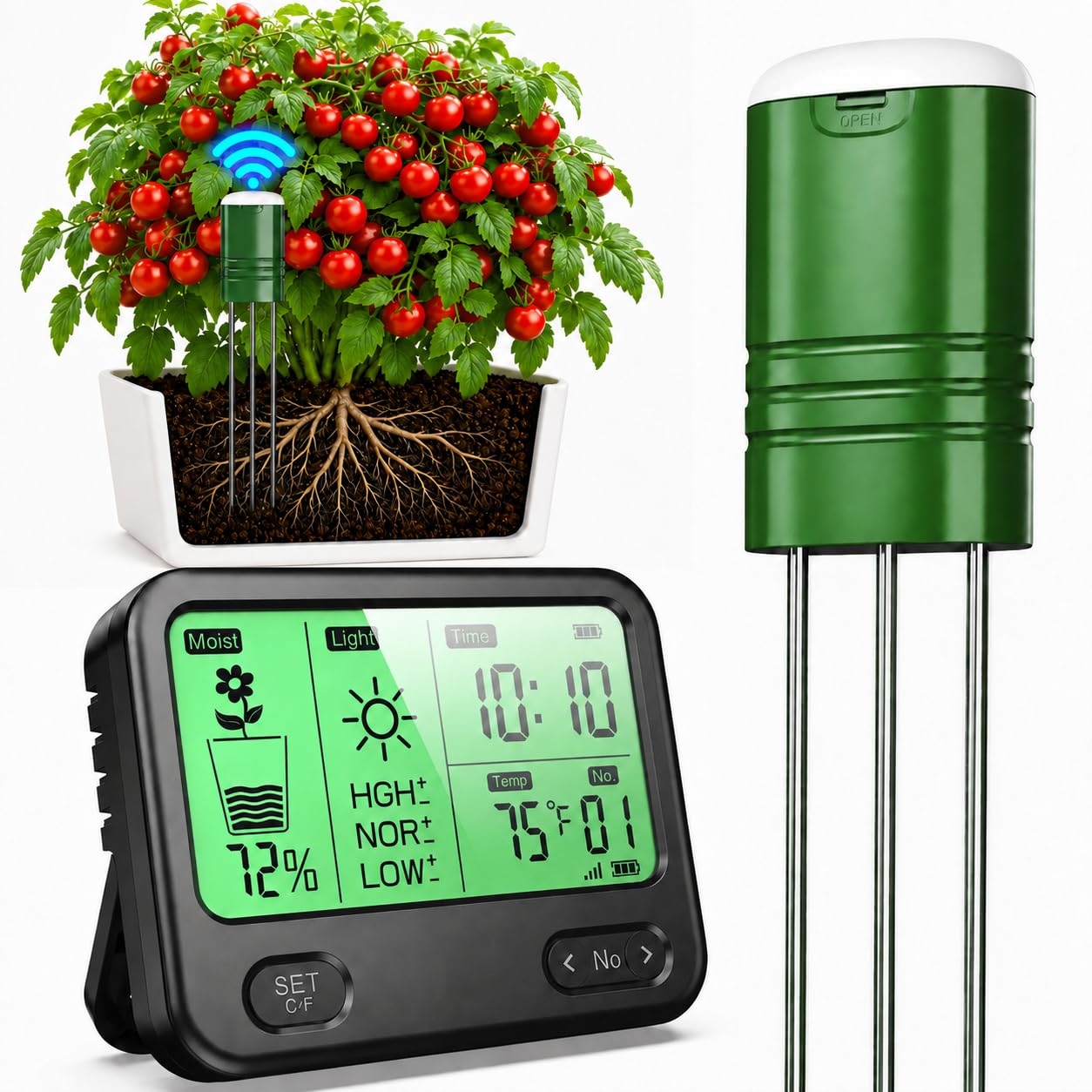
Check soil moisture from your couch without walking outside — the handheld screen works up to 328 feet from the sensor.
This is the only wireless model in the lineup. You leave the triple-probe sensor in the soil, and the handheld display picks up readings from up to 328 feet away — so you can check your garden beds from inside the house. The large LCD screen shows moisture, temperature, light, and a real-time clock all in one view. It flashes a reminder when moisture gets low. One display connects to up to 12 separate sensors, making it a serious tool for anyone managing a collection of plants across a yard.
Reviewers point out its “sturdy build” and “large, bright screen” that is “easy to read outdoors.” The triple-probe uses TDR (Time Domain Reflectometry — a method that sends a pulse along the probe to sense moisture at multiple points) technology, which gives more stable readings than the single-probe meters on the HSLGOVE or Auduto. At 9.2 ounces, it is the heaviest tester here because the display is bigger and it includes a wireless transmitter.
Batteries (2x AAA) are included in the box.
What makes it unique
- Wireless range up to 328 feet — check plants from inside the house
- One display can manage up to 12 separate soil sensors
- Triple-probe TDR technology provides more stable, multi-point readings
What to consider
- Heavier than other models (9.2 oz) due to the large wireless screen
- Only covers 4 functions (moisture, temp, light, clock) — no pH or fertility reading
Ideal for the remote monitorer: Pick this if you want to check soil moisture and temperature from indoors without walking the garden, especially if you plan to add multiple sensors later.
Not for the pH-obsessed: If you need pH or NPK fertility readings, this 4-in-1 does not cover them — stick with a 7-in-1 or a dedicated pH meter.
5. YINMIK Digital pH Tester for Soil

A stainless steel dibber protects the glass pH electrode in rocky soil, and the Bluetooth app logs 24-hour pH changes on your phone.
While the 7-in-1 meters spread their accuracy across many measurements, the YINMIK focuses entirely on pH — and it delivers professional-grade detail. You push the tapered stainless steel dibber into the ground, and the electrode inside takes a direct pH reading without you needing to mix a soil slurry. Remove the dibber, and the same pen tests the pH of your hydroponic nutrient solution or rainwater. It connects to the YINMIK app via Bluetooth, letting you log readings automatically and monitor pH changes over 24 hours.
The kit includes six packets of calibration buffer powder, three LR44 batteries, a brush, and a dropper. Buyers call it “accurate” and “easy to calibrate.” One reviewer says it matches readings within “a few hundredths” of far more expensive meters. However, a recurring complaint is that the Bluetooth connectivity can fail after several months. One owner reported the device would not connect and got stuck on one pH value even after recalibration.
At 10.6 ounces, the trade-off is a more sturdy build and a digital app ecosystem.
Its strong points
- Stainless steel dibber protects the glass pH electrode in rocky or dense soil
- Bluetooth app enables 24-hour monitoring and automatic data storage
- Works for both soil and water pH measurements (remove the dibber for liquids)
Watch for
- Bluetooth connectivity can fail over time, according to some users
- No compact storage case included in the package
Go here for pH precision: Choose the YINMIK if you need laboratory-style pH accuracy for a specific soil issue, enjoy logging data on your phone, and do not mind a single-function tool. It is heavier than the HSLGOVE but far more precise for pH.
Stick with a multi-meter if: You also need moisture, light, and temperature readings — this pen only does pH.
6. LDOPTO 6-in-1 Soil Test Kit
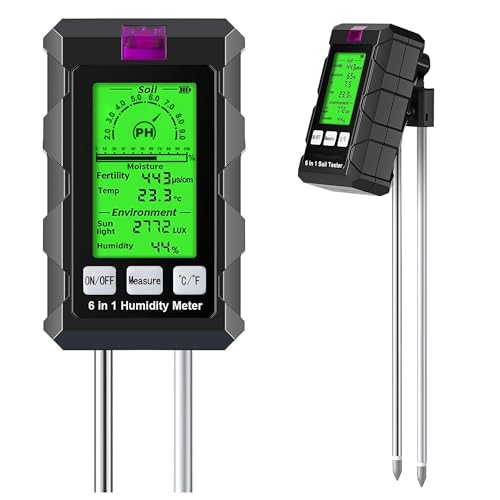
A 90-degree tilting backlit screen that stays readable whether you stand or crouch — no awkward neck bending to see the numbers.
The LDOPTO 6-in-1 is built around a display that rotates through 90 degrees, so you do not have to bend your neck at an awkward angle to read the numbers. It measures moisture, pH, temperature, sunlight, air humidity, and soil fertility — skipping indoor air temperature compared to the 7-in-1 models, but covering everything a gardener needs daily. The backlit screen helps when you test plants in a shady corner or take readings near dusk.
A key engineering detail: the manufacturer installed a high-precision voltage stabilization circuit that keeps the sensor power clean as the AAA batteries drain, so your readings do not drift as the cells lose juice. The lower temperature limit is 32 degrees Fahrenheit, and the temperature accuracy is rated at 1 degree Fahrenheit — useful for early-season soil checks. One thing to note: the customer reviews included with this product appear to be from a different product category (automotive cables), so buyer feedback on its gardening performance is not yet available in the data.
The tester requires 2 AAA batteries (not included).
What it does well
- 90° adjustable backlit LCD display makes reading comfortable from any angle
- Voltage stabilization circuit prevents reading drift as batteries deplete
- 1°F temperature accuracy and 32°F lower limit for cold-weather soil checks
Be aware
- No buyer reviews yet for the gardening function — real-world performance is unconfirmed
- AAA batteries are not included (2 required)
Best for the ergonomic gardener: Pick this if you value a screen you can tilt to read easily and you want stable readings without worrying about battery drain. The voltage stabilization is a feature the HSLGOVE and Auduto do not mention.
Proceed with caution: Because verified customer gardening reviews are missing from this data, you may want to wait for more user feedback before buying.
7. YINMIK YK-S01 Digital Soil pH Meter

A free spare electrode is included in the box — so one cracked probe does not end your testing season.
The YINMIK YK-S01 is a step up from the earlier YINMIK pH tester in both build and included accessories. Inside the box you get the meter, a replaceable electrode, a stainless steel dibber, a clean brush, three LR44 batteries, six calibration buffer packets for a 3-point auto calibration (pH 4.0, 7.0, and 10.0), and a dropper. That is a complete kit for long-term use — the spare electrode alone means you are not hunting for replacements if the glass tip cracks.
The meter has a backlight for dim working conditions, a HOLD button that locks the reading on screen, and automatic temperature compensation (ATC — the device adjusts the pH reading automatically for soil temperature so you get accurate results in cold spring soil or warm summer beds). Buyers who own the YK-S01 call it “the pH tester I was looking for” and note the calibration kit ensures reliability. One reviewer managing 35 blueberry varieties (which need acidic soil) says it is the “best Amazon purchase.” Another warns that dry soil can falsely inflate pH readings to 8.4-8.6, while properly damp soil gives stable readings around 6.4-6.8. The manufacturer does not provide moisture guidance for this pH-specific tool.
At 13.7 ounces and 11.42 x 1.5 x 1.5 inches, it weighs 13.7 ounces and measures 11.42 x 1.5 x 1.5 inches — but the included spare electrode, dibber, and full calibration kit justify its weight in the package.
Why it is premium
- Comes with a free replaceable electrode for long-term use without hunting for spares
- 3-point auto calibration (pH 4, 7, 10) using included buffer powder packets
- Automatic temperature compensation (ATC) ensures accurate readings in any season
Its limitations
- Dry soil gives falsely high pH readings (8.4-8.6) — soil must be damp for accuracy
- 13.7 oz is noticeably heavier than any other tester here
The hardcore pH specialist: Choose the YK-S01 if you grow acid-loving plants (blueberries, azaleas, potatoes) and need repeatable, calibrated accuracy with a backup electrode already in the box. It is heavier than the standard YINMIK pH tester, but you get a spare electrode and a full calibration kit.
Too much for casual use: If you just want a quick moisture check for your houseplants, this pro-grade kit is overkill — grab a 7-in-1 like the HSLGOVE instead.
Understanding the Specs
pH Measurement
pH tells you how acidic or alkaline your soil is on a scale of 0 to 14, with 7 being neutral. Most plants prefer slightly acidic soil (around 6.0 to 7.0). A digital pH meter gives you a precise number instead of the vague color strip on a disposable test kit — but the electrode needs to be clean and the soil should be damp for a true reading. Some premium meters like the YINMIK YK-S01 include automatic temperature compensation (ATC — the device adjusts the pH reading automatically based on the soil temperature) so your number is accurate whether the ground is cold in spring or warm in summer.
Moisture and TDR Technology
Moisture sensors measure the water content in soil, usually displayed on a scale of 1 (dry) to 10 (wet) or as a percentage. Basic testers use a simple resistance reading between two metal probes — the more water, the more conductivity. More advanced models like the EDGEVEIL use TDR (Time Domain Reflectometry — a method that sends an electrical pulse along the probe and measures the time it takes to bounce back, which changes with moisture content). TDR gives you more stable, multi-point readings that are less affected by soil salt levels or temperature swings.
FAQ
Do I need to calibrate a digital soil tester before first use?
How deep should I insert the probe for an accurate reading?
Can I use a digital soil tester in hydroponic nutrient solution or plain water?
How long does the probe last before it needs replacing?
Is a 7-in-1 tester more accurate than a dedicated pH meter?
Can I leave the probe in the soil permanently for continuous monitoring?
Do I need batteries, and are they included?
What does NPK fertility mean on a soil tester?
How do I clean and store the probe between uses?
Will a soil tester work in frozen or very dry soil?
Final Thoughts: The Verdict
For most people, the digital soil tester winner is the HSLGOVE 7-in-One because it packs seven essential measurements into a lightweight, dual-display wand that any beginner or experienced gardener can use immediately. If you want wireless convenience and multi-sensor expansion, grab the EDGEVEIL 4-in-1. And for pure pH accuracy with a backup electrode included, the standout is the YINMIK YK-S01.
How We Picked
We do not accept paid placement. Every pick is matched to a real buyer and a real use-case; we do not hands-on test units.
Sources & Methodology
Specifications: manufacturer listings and product documentation. Review insights: verified customer reviews, as of July 2026. Pricing: not shown on this page (it changes often); check the current price via the retailer link.
As an Amazon Associate, Lawn Gear Lab earns from qualifying purchases. This does not affect which products we feature.