
Specs are compiled from manufacturer listings and verified buyer reviews and can change over time — please confirm the key details on the product page before buying.
Waking up to find your hostas chewed to stubs or your orchard stripped overnight is a gut punch. That is why you are here, looking for the strongest defense for your yard, garden, or small farm.
I’m Rikta — the founder and writer behind Lawn Gear Lab. This guide is built by comparing the manufacturers’ published specifications and the patterns across verified customer reviews, so you get each pick’s real strengths and trade-offs instead of marketing spin.
To help you navigate, we’ve broken down the best options for a deer electric fence by covering both the chargers that deliver the shock and the netting that delivers the barrier.
Our Picks at a Glance


How To Choose The Best Deer Electric Fence
Before you pick a charger or netting, understand that a deer fence is a two-part system. A charger is useless without a proper ground, and netting is useless if it is not energized. You need to plan the layout and power source before you buy.
Match the Output to the Perimeter
Start by measuring your garden or pasture. A 25-mile rated AC charger might be overkill for a tiny 100-foot plot, while a 4-mile solar unit will struggle to keep power on a large, multi-wire perimeter with heavy weed contact. Match the mile rating of the charger to roughly double your fence length to ensure consistent power.
Decide Between Plug-In and Solar Power
If you have an outdoor outlet near your fence line, a plug-in AC charger gives you the most raw power and constant output regardless of weather. However, if your garden is far from the house, a solar charger is the only practical option. Solar models store daytime energy in an internal battery to run through the night, so you must consider how many cloudy days your area gets.
The Critical Role of the Ground Rod
The shock you feel is the current completing a circuit through the soil back to the charger. A poor ground rod (too short, rusty, or in dry sand) will produce a weak shock that deer will easily ignore. Invest in a quality copper rod and drive it deep into damp soil for the best results.
Quick Comparison
| Model | Best For | Power Output | Coverage | Power Source | Amazon |
|---|---|---|---|---|---|
| Zareba EAC25M-Z★ Best Overall | Large farms & heavy weeds | 1.0 Joule | 25 Miles | AC Plug-In | Amazon |
| 20 Miles Solar ChargerTop Performer | Solar with big voltage | 0.32J (10.2kV) | 20 Miles | Solar/AC Dual | Amazon |
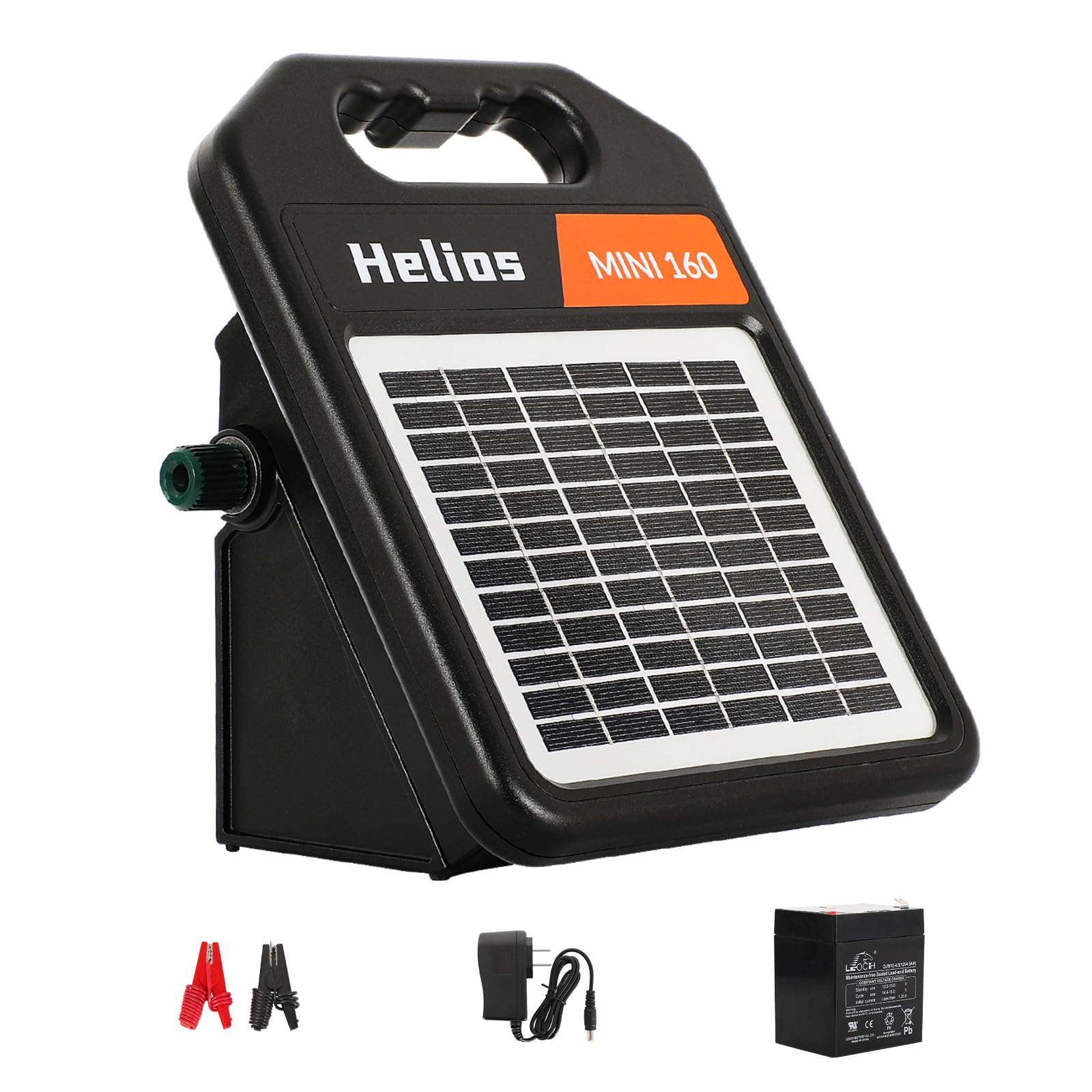
| ANDMON MINI160Compact Pick | Portable day/night protection | 0.16J | 10 Miles | Solar | Amazon |
| Zareba EDC5M-Z | Moderate gardens, battery use | 6-Volt Pulsed | 5 Miles | Battery | Amazon |
| TMEE Netting | Rotational grazing, goats | — | 35.5″H x 164’L | Needs 0.5J energizer | Amazon |
| PPOLB Netting | Taller barrier for predators | — | 47.2″H x 164’L | Needs 0.25J+ energizer | Amazon |
| VEVOR Netting | Tall perimeter for large livestock | — | 50″H x 164’L | AC/Solar/DC compatible | Amazon |
| LMRSTOO Netting | Easy mobility & dense mesh | — | 49.6″H x 164’L | Needs 0.3-0.5J energizer | Amazon |
| Gallagher S12 | Small pastures, reliable solar | 0.12 Stored Joule | 4 Miles / 18 Acres | Solar | Amazon |
In-Depth Reviews
1. Zareba 25 Mile AC Powered Charger
Our pick — 4.5★ from 800+ verified ratings; the strongest balance of quality and price.
The plug-in powerhouse that turns a 25-mile perimeter into a no-go zone for big animals.
If you are tired of weak shocks that deer laugh at, this AC charger delivers a serious 1.0 output joules punch. That is enough energy to handle cattle, horses, and even large predators, making it the definitive solution for keeping deer out of a large blueberry patch or orchard. It energizes up to 25 miles of fencing in ideal conditions, so you rarely have to worry about power dropping off at the far end of a long line.
What wins people over is the raw strength and simplicity. Buyers report a strong zap along a 200ft line, and the deer “training” is effective — tracks show deer turning away after just 5 days of encountering the fence. The rugged, heavy-duty cabinet protects the circuitry from weather extremes, and it is built in the USA with a 2-Year Limited Warranty including lightning damage. This is the kind of low-maintenance power that smaller solar units simply cannot match, making it a 2.5x jump in range compared to the 10-mile solar options.
The Heavy Hitter
- Massive 25-mile range covers even sprawling farm perimeters
- 1.0 joule output is strong enough for the largest livestock
- Performs reliably even in light to moderate weed conditions
- Full-load tested in the U.S. for quality assurance
Setup Reality
- Requires access to a standard AC outlet near the fence line
- Power can drop off significantly in heavy weed conditions, down to 6 miles
Best for: Anyone with a large property, access to an outlet, and a serious deer or livestock problem that needs immediate, powerful results.
Think twice if: You need a fence in a remote pasture with no power source; you will need to consider a solar model instead.
2. 20 Miles Solar Powered Charger
A dual-power dynamo that delivers solar convenience without sacrificing a serious 10.2kV sting.
This unit bridges the gap between plug-in power and solar flexibility. It is a Solar/AC Dual Power energizer, meaning you can mount the included panel for daily charging and rely on the internal battery for 24/7 protection. It generates a 5700-10200V output, which is enough to deter not just deer, but large predators like elk and bears. This is a 2.0x higher energy storage than the smaller 0.16J models, making it a strong middle-ground.
The effectiveness is the most-praised feature by a wide margin. Tester figures show 7000+ volts on the line, delivering a strong shock that effectively keeps deer and raccoons out of gardens. Owners appreciate that it handles medium applications like orchards well, and that the 3.16-pound weight makes it 2% heavier than the Zareba AC unit but far more portable. The internal battery maintains 7 days of operation without sunlight, so a short cloudy spell won’t leave your garden vulnerable.
Performance Edge: The high voltage output is the standout, earning the most praise from owners who need to stop heavy pressure from large wildlife.
The Trade-off: Some owners mention the weatherproofing is not perfect, with a few units collecting water inside; a recurring note is to keep it in a sheltered spot or verify the seals.
3. ANDMON Mini160 Solar Charger
The go-anywhere energizer that rotates to chase the sun and keep your garden safe.
Simplicity and portability are the core of this solar energizer. It is designed with 360-degree rotation, allowing the unit to be rotated on a T-post to face the sunlight all day long. This feature, combined with a super quality GEL acid battery, ensures reliable power in harsh, low-light conditions. It energizes up to 10 miles of fencing, making it a solid choice for strip grazing setups or protecting a raspberry patch and fruit trees from deer and elk.
You can mount this on a T-post and relocate it whenever your garden layout changes, which owners say is a breeze. Even on cloudy days, the 3-watt solar panel keeps the internal battery charged for 24/7 operation, so deer and rabbits stay out without you lifting a finger. One owner reports: “Works well deterring deer/elk from garden; protects raspberries, fruit trees, tomatoes.”
The main caveat in the reviews is power output. While it works for small gardens, some find it “isn’t very strong” and note it lacks the punch of larger units. There was also a mention of a unit received with a lower mile rating than advertised, so it is worth testing the voltage with a fence tester upon arrival to ensure you got the full 10-mile model.
Reach for this if: You need a lightweight, self-contained solar fence that can be easily moved between a small garden and a temporary grazing paddock.
Look elsewhere if: You have a long, multi-wire fence that demands maximum shock intensity to break determined deer pressure.
4. Zareba EDC5M-Z Battery Charger
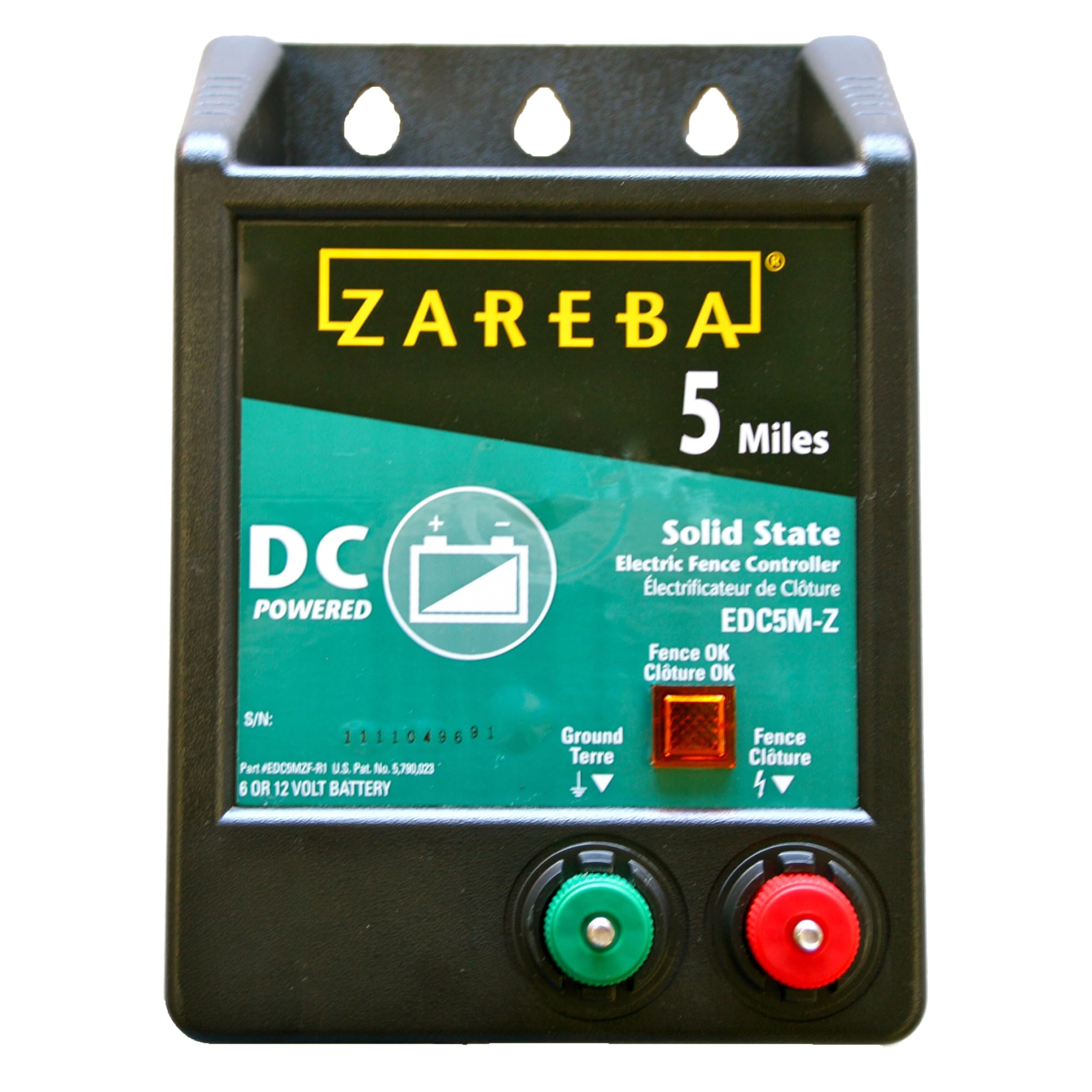
A reliable, battery-powered classic that punches above its weight for medium-sized gardens.
This Zareba energizer is a lesson in effective simplicity. It is a 6-volt battery-operated unit (battery not included) with a pulsed DC output at 1-second intervals. This makes it ideal for controlling horses, pigs, and cows, while also being a favorite for keeping bears away from beehives and deer out of vegetable plots. Its 5-mile range is perfect for medium-sized properties that don’t need the massive coverage of a 25-mile AC unit.
Once you ground it properly, owners say it works reliably. A 6-volt battery lasts about 3 weeks between swaps, and adding a small solar panel turns it into a low-draw, self-sustaining setup. The shock is firm but not brutal—one owner notes: “Won’t shock the crap out of you but will keep your horse in the yard.” If you want a dependable fence without paying for a premium solar unit, this fits.
Solid Performer: The low power draw and strong shock make it a favorite for 500 to 3000 sq ft gardens, deterring raccoons, squirrels, and dogs.
Maintenance Note: The recurring theme is that the fence requires clean wire and a proper ground; grass and corrosion on the line can short out the system, so periodic checks are needed.
5. TMEE Electric Goat Sheep Fencing Netting

A portable mesh fortress that creates an instant, visible barrier for rotational grazing.
If you are moving animals frequently, this netting is your best friend. It is a complete kit with 14 posts and 164 feet of 35.5-inch tall netting. The design features 9 horizontal strands, with the lowest 2 strands insulated to prevent the fence from grounding out to the earth. Bright green provides high visibility for animals and people, and the double-spiked carbon structural steel stakes keep it stable on uneven terrain.
The portability is a huge draw. Owners use it for rotational grazing of sheep and goats and to keep deer out of tomato patches. It is lightweight enough to transport and set up easily. However, the reviews are honest about its limits: it is not for poultry or small animals due to large holes (chickens walk through), and the durability of the posts under heavy pressure gets mixed feedback. A recurring caution is to avoid using it with horned animals unless it is electrified, as they can get tangled.
Why Owners Pick It
- Easy unroll-and-stake setup for quick relocation
- Insulated bottom strands prevent power loss to the soil
- Sturdy fiberglass posts handle hilly ground well
Who Should Skip
- Chickens and young poultry can slip right through the mesh
- Setup on hard, dry ground is a workout for the stakes
6. PPOLB Electric Fence Netting
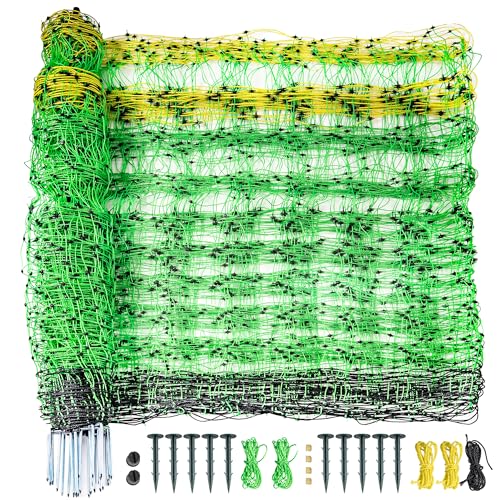
This taller netting adds the extra height needed to discourage large predators from jumping over.
The PPOLB netting is built with a focus on predator control. At 47.2 inches high, it is significantly taller than the standard 35-inch models, making it more likely to discourage coyotes, foxes, and stray dogs from jumping. It consists of 11 horizontal strands, with 9 being conductive, providing a dense wall of protection for your family pets, sheep, and larger animals.
It is a lightweight and portable option, which owners say is convenient to move or reconfigure as needed. The bottom rungs are not electrified, which owners specifically note as a “huge help” in preventing the line from shorting out against wet grass. For the price, many find it a huge savings compared to traditional livestock companies, offering solid effectiveness for goats and keeping coyotes out.
Effective Defense: The taller profile and triple-braided stainless steel wire stand up to goats and keep predators out, so your livestock stays safe.
The Catch: Setup varies: some find it simple, but others say the poles are spaced too far apart and sag in the middle, and a few units ship with posts that snap at the base. You’ll also need a 0.25 joule energizer (the power unit that sends the shock) for it to work.
7. VEVOR Electric Fence Netting
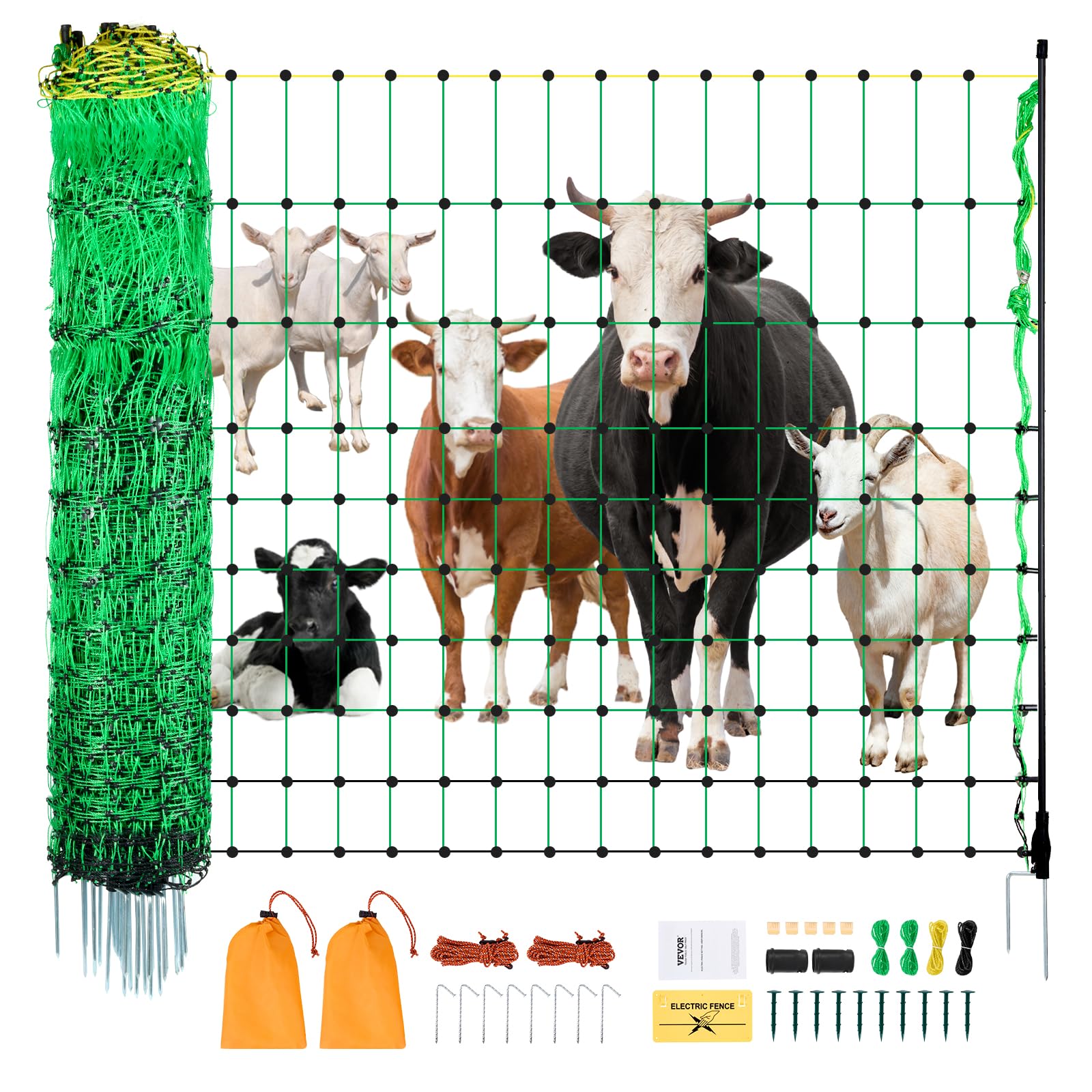
The tallest netting here, built to secure everything from deer to pet pigs with a 50-inch wall.
The VEVOR netting is designed for a comprehensive, secure enclosure. Standing at 50 inches high and running 164 feet long, it is the tallest option in this list, making it the ultimate barrier for large livestock like deer, hogs, and dogs. It comes with windproof kits and fiberglass posts, plus a warning sign and repair kit for easy maintenance. The wide applicability makes it a versatile choice for farms, ranches, and large backyards.
Owners find it easy to set up when it is new, and it works as intended for keeping Dorper sheep contained. The electric current is designed to be regulated, offering effective protection without causing harm. It is also highly flexible on power supply, compatible with AC110-240V, solar panels, and DC power sources (though the energizer is not included).
Standout Features
- Maximum 50″ height provides a high jump barrier
- Compatible with AC, solar, or battery power sources
- Includes windproof kits and repair materials for longevity
Owner Warnings
- The fiberglass poles are the weak point; spikes bend and break if moved often
- The netting tangles easily during takedown if you twist it
8. LMRSTOO Electric Poultry Netting Fence
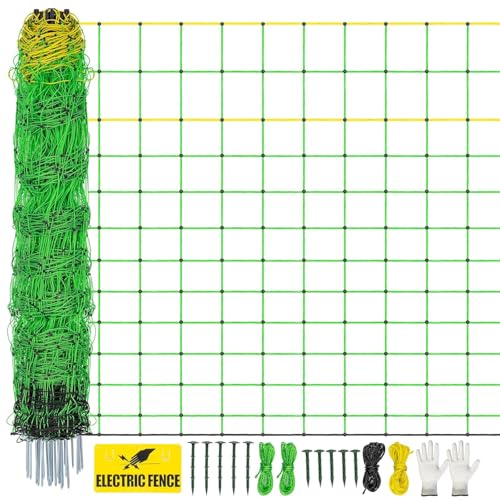
A high-density mesh that flexes easily to outline any yard, offering solid predator protection.
This electric mesh fence is designed with high-density grids (each grid is 3.5″ x 6.2″) to keep smaller animals in and predators out. The dense grid combined with stainless steel conductors and nylon wires makes it more durable and easily flexed to follow the outline of your yard or garden. It is a 49.6″ H x 164′ L roll, with a weight of 22 lbs that is manageable for a single person to carry and relocate.
The mobility is a key selling point for rotational grazing. Customers note it is easy to set up alone, and it links well to existing pens. The kit includes a pair of rubber gloves with good insulation for safety during setup. A 0.3J-0.5J energizer (not included) powers this fence. It is widely used for poultry like chickens, ducks, and geese, as well as goats, sheep, and hogs.
Easy Movement: The included fiberglass posts grip the ground well, and the high-visibility green color keeps animals calm.
Honest Caveat: The netting is viewed as slightly flimsy for large, aggressive animals; it is best suited for light-duty temporary fencing. Some owners also found the installation instructions lacking, but the setup is intuitive.
9. Gallagher S12 Solar Charger

The premium solar unit with legendary reliability, designed for serious small-pasture protection.
Gallagher is a name synonymous with quality fencing, and the S12 lives up to that reputation. This solar charger uses advanced Solar Lithium Technology with a 0.12 Stored Joule energizer. It powers up to 4 miles of single-wire fencing or 18 acres (0.6 miles of multi-wire fencing with some vegetation). It mounts directly to an unpainted grounding rod up to 0.5 inch in diameter, combining the physical mount and electrical ground into one elegant, space-saving design.
Reliability and ease of use are the most-praised aspects of this unit. Reviewers point out it holds a charge through a cloudy, rainy week and works flawlessly for years. As one owner notes, adding a proper ground wire dramatically increases the shock strength, making it “hurts like hell” but extremely effective at deterring deer completely from gardens. Place it in direct sun for 2-3 days before first use to fully charge the battery, and it will deliver consistent, weather-ready power backed by a 3-year manufacturer warranty and U.S.-based support.
Reach for this if: You want a premium, dependable solar charger for a remote paddock or garden where failure is not an option, and you value a strong brand warranty.
One limitation: The battery life has mixed feedback, with a few owners disappointed it stopped working after 1-2 years, but overall it delivers the most reliable solar performance in this lineup.
Understanding the Specs
Joules: The Real Power Rating
Joules measure the stored energy in a charger’s capacitor. A higher joule rating means a stronger, more consistent shock, which is critical for pushing through weeds or thick animal fur. A 0.12 joule solar charger is perfect for subtle deer deterrence on a short line, while a 1.0 joule AC charger is built to brute-force its way through heavy vegetation and stop the largest animals. Match joules to the amount of vegetation and the size of the animals you are dealing with.
Miles of Coverage vs. Reality
Manufacturers rate chargers in miles of fence under “ideal conditions” — usually meaning no weed pressure. In reality, weeds and grass touching the wire will drain power fast. The Zareba AC unit is useful for 25 miles in ideal conditions but drops to 12 miles in light weeds and 6 miles in heavy weeds. Always assume you will get about half the rated mileage if your fence line has any grass contact. Solar units often have lower mile ratings due to their battery capacity constraints.
FAQ
How many joules do I need to keep deer out?
Can I run an electric deer fence on solar power alone?
Why does my electric fence not shock animals anymore?
Is electric netting or polywire better for a deer fence?
Can I use a livestock charger for a garden deer fence?
Does an electric fence need to be grounded with more than one rod?
How high should a deer fence be to prevent jumping?
Why do I need to connect the battery on my new solar charger?
Final Thoughts: The Verdict
For most buyers, the deer electric fence winner is the Zareba 25 Mile AC Charger because its 1.0 joule output and massive 25-mile range make deer removal a one-time job. If you want the flexibility of solar power without sacrificing punch, the 20-Mile Solar Charger with its 10.2kV output is the one to grab. And for rotational grazing or a portable setup that you can move between gardens, the TMEE Netting Kit paired with a quality energizer is the hands-down favorite for hobby farmers.
How We Picked
We do not accept paid placement. Every pick is matched to a real buyer and a real use-case; we do not hands-on test units.
Sources & Methodology
Specifications: manufacturer listings and product documentation. Review insights: verified customer reviews, as of August 2026. Pricing: not shown on this page (it changes often); check the current price via the retailer link.
As an Amazon Associate, Lawn Gear Lab earns from qualifying purchases. This does not affect which products we feature.