
Crabgrass is the ultimate lawn invader—it sneaks in when the soil warms, outcompetes your turf for water and nutrients, and leaves behind bare patches that take all season to recover. A single plant can produce over 150,000 seeds, which means that without a targeted pre-emergent strategy paired with a balanced feeding schedule, you’re fighting a losing battle from the first spring warm-up. The right combination stops the seed germination cycle cold while delivering the nitrogen your grass needs to thicken into a natural weed barrier.
I’m Rikta — the co-founder and writer behind Lawn Gear Lab. I’ve spent countless hours analyzing NPK ratios, slow-release nitrogen percentages, prodiamine concentrations, and coverage specs across dozens of product labels, then cross-referencing them with hundreds of verified owner reports to find the formulations that actually deliver on their dual-action promises.
In this guide, I break down the seven most effective formulations that combine pre-emergent crabgrass prevention with season-long lawn nutrition. If you want a thick, weed-free lawn without wasting money on products that miss the application window, you’ve come to the right place to find a best crabgrass preventer and fertilizer that fits your lawn size and grass type.
How To Choose The Best Crabgrass Preventer And Fertilizer
Not all dual-action lawn products are created equal. A formula with too much quick-release nitrogen can burn your turf and feed the crabgrass you’re trying to stop. Here’s what to look for before you buy.
Active Ingredient — Prodiamine vs. Dithiopyr vs. Dimension
Prodiamine is the gold standard for pre-emergent control and is the active ingredient in Barricade-based products like The Andersons bags. It forms a chemical barrier in the top inch of soil that stops crabgrass seeds from root development. Dithiopyr (found in Preen Lawn Crabgrass Control) offers a small post-emergent window—it can suppress crabgrass that has already emerged up to the 4-leaf stage. If you missed the early-spring window, dithiopyr gives you a few weeks of forgiveness.
Slow-Release Nitrogen Percentage
The best crabgrass preventer and fertilizer should deliver at least 50% of its nitrogen as slow-release (water-insoluble nitrogen or polymer-coated sulfur-coated urea). This prevents the surge-and-fade cycle that stresses grass and leaves openings for weeds. Products like GreenView Fairway Formula boast 63% slow-release nitrogen, feeding your lawn steadily for up to 12 weeks without a growth spike that requires extra mowing.
Coverage Rate Per Bag
A 15-pound bag covering 5,000 square feet is the standard for mid-size suburban lawns. If you have a larger property (10,000 sq ft or more), the 40-pound Anderson’s Barricade bag covers more ground per purchase and usually offers a better cost-per-square-foot. Always confirm the spreader setting—granule size varies between brands, and the wrong setting can deposit too little active ingredient or too much nitrogen in a strip pattern.
Quick Comparison
On smaller screens, swipe sideways to see the full table.
| Model | Category | Best For | Key Spec | Amazon |
|---|---|---|---|---|
| The Andersons 18-0-4 Barricade – 40 lb | Pre‑emergent + Fertilizer | Large lawns, professional-grade control | 0.426% Prodiamine | Amazon |
| Jonathan Green Veri-Green – 15 lb | Pre + Post‑emergent | Season-long crabgrass + broadleaf control | 20-0-3 NPK | Amazon |
| Preen Lawn Crabgrass Control – 15 lb | Pre‑emergent (Dithiopyr) | Forgiveness if you apply 4 weeks late | Dithiopyr active ingredient | Amazon |
| The Andersons Barricade – 50 lb | Pre‑emergent concentrate | Maximum coverage, pure pre‑emergent | 0.48% Prodiamine | Amazon |
| GreenView Fairway Formula – 33 lb | High‑N Fertilizer | Thickening turf before summer stress | 63% slow‑release N | Amazon |
| Safer Brand Lawn Restore – 20 lb | Organic/Natural | Pet-safe, non‑burning formula | 9-0-2 NPK | Amazon |
| Scotts Turf Builder Weed & Feed – 14.3 lb | Weed & Feed | Killing existing dandelions + clover | 2,4‑D + Mecoprop formulation | Amazon |
In‑Depth Reviews
1. The Andersons 18-0-4 Barricade Fertilizer – 40 lb
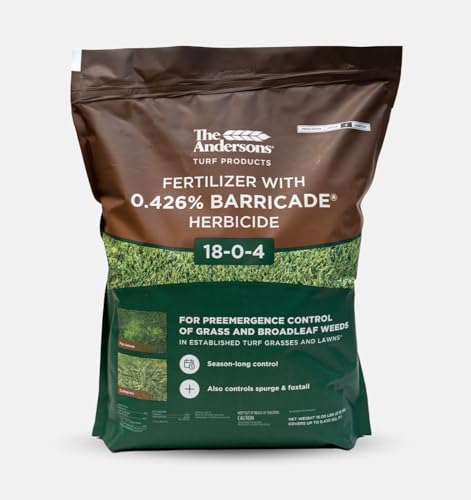
This is the professional-grade combo that lawn care enthusiasts reach for when they want one application in early spring to stop crabgrass, poa annua, and 28 other grassy/broadleaf weeds cold. The 18-0-4 NPK delivers a solid nitrogen boost (18 percent) without phosphorus, using the patented DG Technology—a dispersible granule that dissolves rapidly once watered in, moving the prodiamine barrier directly into the top soil layer. Owners consistently report seeing zero crabgrass through June and July, even in high-pressure regions like the transition zone.
The 40-pound bag covers 10,000 square feet at the standard label rate, which is nearly double the coverage of most 15-pound bags in this category. The prodiamine concentration (0.426%) is high enough to provide up to four months of residual control, but you must apply it before soil temperatures hit 55°F—it will not kill existing weeds. Users on zoysia and bermudagrass lawns in Texas and the Southeast have reported the thickest, greenest turf in the neighborhood after two consecutive seasonal applications.
At this price point, the Andersons bag delivers the lowest cost-per-thousand-square-feet of any dual-action product on this list. The only catch is that rapid-dissolve granules require a little more attention to watering—you need about half an inch of rain or irrigation within 48 hours to activate the barrier, but the trade-off is superior soil penetration compared to standard pelletized products that sit on the thatch layer.
What works
- DG Technology dissolves fast for better soil contact
- Covers 10,000 sq ft—ideal for larger lawns
- Strong prodiamine concentration provides season-long control
What doesn’t
- Must be watered in within 48 hours for activation
- Won’t kill existing crabgrass—timing is critical
2. Jonathan Green Veri-Green Crabgrass Preventer Plus Fertilizer – 15 lb

Jonathan Green’s Veri-Green formulation stands out because it provides both pre-emergent and post-emergent crabgrass control, meaning it kills crabgrass before germination and also stops seedlings that have already sprouted. The 20-0-3 analysis is heavily weighted toward nitrogen—ideal for thin lawns that need aggressive thickening before summer stress sets in. Owners who have used this bag for multiple seasons note that their lawns stay green up to three months on a single application without the yellowing that can happen with lower-quality slow-release products.
Beyond crabgrass, this product also controls goosegrass, dallisgrass, chickweed, henbit, oxalis, and spurge when applied before their germination window. The granular texture is fine enough to pass through a rotary spreader evenly but not so fine that it clumps in humidity. Long-time users consistently reorder this product year after year, reporting that they see dramatically fewer weeds in their lawn by mid-summer compared to neighbors using standard weed-and-feed products from big-box stores.
The trade-off is that this bag covers only 5,000 square feet at 15 pounds—if your lawn is larger than a quarter-acre, you’ll need two bags. Also, the product label explicitly warns against using it at the same time as seeding, because the pre-emergent chemistry will prevent grass seed from germinating. Plan for a 4- to 6-week gap between application and overseeding for best results.
What works
- Pre- and post-emergent action provides a wider application window
- 20-0-3 NPK thickens turf fast for natural weed suppression
- Controls goosegrass, dallisgrass, and other stubborn weeds
What doesn’t
- Only covers 5,000 sq ft per bag—larger lawns need multiple bags
- Cannot be used within 4-6 weeks of overseeding
3. Preen Lawn Crabgrass Control – 15 lb

Preen Lawn Crabgrass Control uses dithiopyr as its active ingredient, which offers a meaningful advantage if you’re a few weeks late on your spring application. While prodiamine must go down before crabgrass seeds germinate (soil temp below 55°F), dithiopyr can suppress and kill crabgrass that has already emerged up to the 4-leaf stage. This “forgiveness window” saves seasoned homeowners who sometimes miss the perfect calendar timing due to weather delays.
The 15-pound bag covers 5,000 square feet and is labeled for use on cool-season grasses (Kentucky bluegrass, tall fescue, perennial ryegrass) and warm-season varieties (bermudagrass, zoysiagrass, St. Augustinegrass, centipedegrass). Users in the Northeast and Midwest report seeing significantly less clover and crabgrass after a single early-spring application, and many have switched to Preen after trying Scotts products and experiencing weed breakthrough. One owner in New Jersey noted that four consecutive years of Preen applications resulted in a virtually weed-free lawn.
However, dithiopyr is slightly less residual than prodiamine—you’ll likely need a second application in late August for full season-long protection, especially in southern climates where crabgrass germinates in multiple flushes. A small but vocal minority of buyers report that the product seemed to accelerate crabgrass growth when applied too late (past the 4-leaf stage), so strict adherence to the label timing is critical.
What works
- Dithiopyr allows application up to 4 weeks after emergence
- Works on both cool- and warm-season grass types
- Users report dramatic weed reduction after 2-3 seasons
What doesn’t
- Shorter residual than prodiamine—requires late-summer reapplication
- Ineffective if applied after crabgrass exceeds 4-leaf stage
4. The Andersons Barricade Pre-Emergent – 50 lb
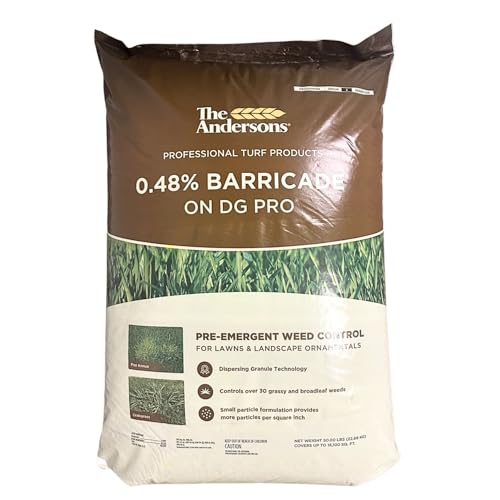
This is the pure pre-emergent concentrate from The Andersons—no fertilizer attached, just 0.48% prodiamine delivered in a 50-pound bag that covers up to 14,200 square feet. It’s designed for homeowners who want to apply their own nitrogen source separately, or for those who overseed and need a pre-emergent that won’t interfere with their fall fertility program. The DG Pro formulation ensures that every granule breaks down rapidly into hundreds of smaller particles, creating a more uniform chemical barrier than standard pelletized products.
Owners using this product on zoysia, bermudagrass, and tall fescue report that a single spring application holds the line through the entire growing season with zero crabgrass breakthrough—even in high-pressure regions like Texas and the Carolinas. Many users mention that the effectiveness surpasses Preen and Scotts in side-by-side comparisons, and the cost per square foot is roughly half that of retail weed-and-feed products. Because this bag has no nitrogen, you can apply it in early spring and again in early fall without worrying about pushing growth at the wrong time of year.
The biggest downside is that this product only prevents weeds—it provides zero nutritional benefit to your lawn. You’ll need to schedule a separate 21-0-0 or 30-0-0 fertilizer application 2–3 weeks after your pre-emergent goes down. Additionally, the 50-pound bag is heavy and can be difficult for some users to lift into a spreader without help.
What works
- Massive 14,200 sq ft coverage per bag—best value for large properties
- DG Pro forms a uniform barrier for superior weed prevention
- Pure prodiamine lets you control nitrogen timing separately
What doesn’t
- No fertilizer included—you must apply nitrogen separately
- 50 lb bag is heavy and hard to maneuver for some users
5. GreenView Fairway Formula Lawn Fertilizer – 33 lb

The GreenView Fairway Formula is a high-nitrogen fertilizer (27-0-5) with 63% slow-release nitrogen that feeds continuously for up to 12 weeks—longer than most products on this list. While it does not contain a pre-emergent herbicide, it’s an excellent partner for homeowners who already use a separate prodiamine or dithiopyr product and want a dedicated feed program to thicken their turf and naturally crowd out weed pressure. Owners consistently report that their lawn greens up visibly within 2–3 days and stays dark green through the heat of summer.
The 33-pound bag covers 10,000 square feet, making it a cost-effective choice for medium to large lawns. The 27-0-5 analysis is phosphate-free (the 0 in the middle), which protects waterways and is compliant with local phosphorus restrictions in many states. Bermudagrass owners in particular praise this product for producing a dense, carpet-like turf that resists crabgrass invasion by shading the soil surface. The slow-release profile also means fewer surge growth cycles, so you’re mowing less frequently than with standard 30-0-0 products.
Keep in mind that this is a pure fertilizer—it will not kill or prevent crabgrass on its own. It also contains no weed-control herbicide, so if you apply this on a lawn with active crabgrass seedlings, you’ll be feeding the weeds along with the grass. Pair it with a pre-emergent that goes down at least 2 weeks prior to your first nitrogen application.
What works
- 63% slow-release nitrogen feeds for up to 12 weeks
- Phosphate-free formula protects local waterways
- Larger bag covers 10,000 sq ft—good value per square foot
What doesn’t
- No pre-emergent or weed control included
- High nitrogen can burn if applied during summer heat
6. Safer Brand Lawn Restore Natural Lawn Fertilizer – 20 lb
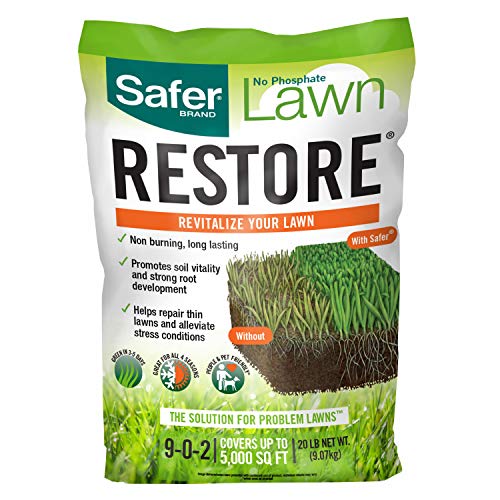
For homeowners who prioritize safety for children, pets, and local wildlife, Safer Brand Lawn Restore is the top natural option on this list. The 9-0-2 NPK is significantly lower than synthetic alternatives, but the formula relies on corn gluten meal and other naturally derived proteins to build soil biology and strengthen root systems without the risk of chemical burn. Owners report seeing a visible green-up within 3–5 days, and many say it revived dead-looking patches in their lawn faster than they expected from an organic product.
The non-burning formula means you can apply it even during warmer weather without worrying about yellow strips or scorched grass, and it’s safe for kids and pets to walk on immediately after watering-in. Long-time users with environmentally sensitive lawns or properties near streams and ponds prefer this product because it won’t contribute to algal blooms in nearby water. The 20-pound bag covers 5,000 square feet, and several buyers report using it twice per year (spring and fall) with consistent results.
The trade-off is that the 9-0-2 ratio provides less total nitrogen per application than synthetic 27-0-5 or 18-0-4 products, so you’ll see slower green-up and need more frequent reapplication to maintain dark color through peak summer. Also, the corn gluten content acts as a mild pre-emergent—it can inhibit grass seed germination if applied too close to overseeding, so plan a 3–4 week gap between application and seeding.
What works
- Non-toxic for pets and wildlife—safe to walk on immediately
- Non-burning formula tolerates warmer-weather application
- Builds soil biology with naturally derived ingredients
What doesn’t
- Lower nitrogen content requires more frequent reapplication
- Corn gluten inhibits grass seed germination if applied near overseeding
7. Scotts Turf Builder Weed and Feed – 14.3 lb
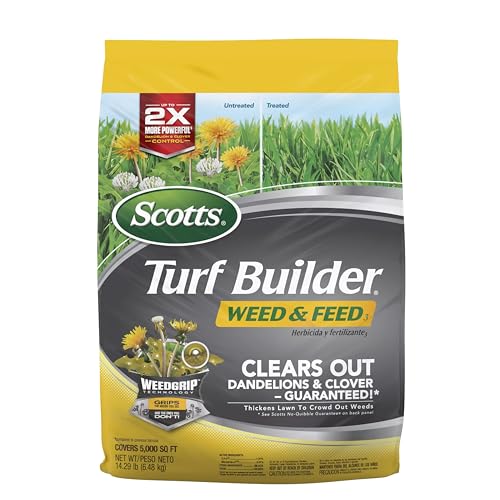
Scotts Turf Builder Weed and Feed is the most widely available dual-action product on retail shelves, and it’s designed primarily to kill existing broadleaf weeds (dandelions and clover) while feeding the lawn with a moderate nitrogen boost. The active ingredients 2,4-D and Mecoprop are effective post-emergent herbicides for common broadleaf weeds, and the Weedgrip Technology helps ensure that granules stick to weed leaves for better absorption. Owners using the hose-end spray version report seeing results within a week—dandelions wilt and grass greens up noticeably.
The 14.3-pound bag covers 5,000 square feet and works best when applied to damp grass so the granules adhere to weed foliage. Users with bermudagrass lawns in the South have praised the easy-to-use sprayer for spot-treating large areas quickly, and many say it eliminated their dandelion problem after two applications spaced 30 days apart. The formula also thickens grass over time, which helps crowd out future weed pressure naturally.
The critical limitation for this guide is that Scotts Weed and Feed does not contain a pre-emergent herbicide—it kills existing weeds but won’t prevent crabgrass seeds from germinating. Several owner reviews specifically note that it failed to control crabgrass and clover, because the post-emergent chemistry only works on actively growing broadleaf weeds. If your primary goal is crabgrass prevention, this product is best used as a supplemental tool in tandem with a dedicated pre-emergent like The Andersons Barricade or Preen.
What works
- Kills dandelions and clover within a week of application
- Thickens grass to crowd out future weeds
- Hose-end sprayer version is easy to use for large lawns
What doesn’t
- No pre-emergent—won’t prevent crabgrass seed germination
- Ineffective on crabgrass and clover according to several users
Hardware & Specs Guide
NPK Ratio Interpretation
The three numbers on any fertilizer bag (e.g., 20-0-3) represent the percentage by weight of nitrogen (N), phosphorus (P), and potassium (K). For crabgrass prevention plus feeding, you want a high first number (N) for leaf growth and greening, a middle number of 0 (to avoid excess phosphorus that can run off into waterways), and a small third number (K) for root and stress tolerance. Products like Jonathan Green at 20-0-3 or The Andersons at 18-0-4 are ideal because they prioritize nitrogen without introducing unneeded phosphorus.
Slow-Release vs. Quick-Release Nitrogen
Slow-release nitrogen (labeled as water-insoluble nitrogen or polymer-coated sulfur-coated urea) breaks down over 8–12 weeks, providing steady color without a growth spike. Quick-release nitrogen (ammonium nitrate, urea) greens up a lawn within 24–48 hours but can burn the grass and produces a surge of growth that requires more frequent mowing. For a crabgrass preventer plus fertilizer, aim for a product with at least 50% slow-release nitrogen—GreenView Fairway Formula leads here with 63% slow-release content.
FAQ
Can I apply a crabgrass preventer and fertilizer at the same time as overseeding?
How do I know when to apply a crabgrass preventer in my region?
What is the difference between prodiamine and dithiopyr?
Will a crabgrass preventer and fertilizer burn my lawn if I apply during hot weather?
Can I use a crabgrass preventer on St. Augustine or centipedegrass?
Final Thoughts: The Verdict
For most homeowners seeking a reliable best crabgrass preventer and fertilizer, the winner is The Andersons 18-0-4 Barricade 40 lb bag because it combines professional-grade prodiamine with a balanced 18-0-4 NPK fertilizer that thickens turf while preventing over 30 weed species—all at a coverage rate that suits both medium and large lawns. If you need a wider application window and may be late on spring timing, grab the Preen Lawn Crabgrass Control for its forgiving dithiopyr formulation. And for the maximum coverage at the lowest cost per square foot, nothing beats the Andersons Barricade 50 lb pure prodiamine bag—just pair it with a separate fertilizer application two weeks later for a complete spring program.