
A greenhouse roof or wall built with panes that crack under a hailstorm or cloud into yellow haze within a season is a setback no grower needs. Corrugated polycarbonate panels solve both problems with a cellular structure that diffuses light, insulates against temperature swings, and absorbs impacts that would shatter glass instantly. The choice comes down to thickness, UV-coating quality, and whether the panel profile matches your frame design.
I’m Rikta — the co-founder and writer behind Lawn Gear Lab. My research process involves cross-referencing polycarbonate density specs, twin-wall rib spacing, UV-stabilizer ratings, and long-term owner feedback from winterized chicken coops and high-desert greenhouses to identify which panels actually hold clarity and structural integrity after full seasonal exposure.
This guide breaks down the critical differences in wall thickness, light transmission percentages, and dual-side UV protection that separate average sheeting from lasting performance, helping you choose the best corrugated panels for greenhouse construction or replacement.
How To Choose The Best Corrugated Panels For Greenhouse
Selecting the right polycarbonate panel isn’t just about matching dimensions. The thickness, UV treatment, and structural design determine whether the greenhouse maintains a stable microclimate and whether the panels stay clear after a few seasons. Here are the factors that matter most.
Thickness: 0.16-Inch vs 0.24-Inch
The most common thicknesses are 0.16-inch (4mm) and 0.24-inch (6mm). Thinner panels weigh less, cost less, and are easier to bend into curved frames, but they offer less insulation and are more prone to flex under heavy snow loads. Thicker panels provide superior thermal retention and impact resistance, making them the better choice for permanent structures in areas with hail or freezing winters. For seasonal or temporary covers, the thinner gauge is adequate.
UV Protection: Single-Side vs Dual-Side Coating
Polycarbonate naturally degrades and yellows under prolonged UV exposure if not protected. Most budget panels have a UV coating on only one side, which must face outward during installation. Premium panels often include UV protection on both surfaces, extending clarity and preventing brittleness regardless of orientation. Dual-side coating is especially valuable for panels that are frequently handled or flipped during seasonal disassembly.
Panel Dimensions and Coverage
Standard panels measure 4 feet by 2 feet, but the exact length and width vary between brands by up to a quarter-inch. A 12-pack typically covers about 96 square feet, and a 15-pack covers roughly 118 square feet. Always measure your frame’s opening width and account for overlap or channel spacing before ordering, as panels that are slightly undersized or oversized can complicate installation and sealing.
Quick Comparison
On smaller screens, swipe sideways to see the full table.
| Model | Category | Best For | Key Spec | Amazon |
|---|---|---|---|---|
| UMIG 0.24-Inch (12-Pack) | Premium | Insulation & durability | 0.24-inch twin-wall | Amazon |
| VEVOR 15-Pack | Premium | Large coverage projects | 118.2 sq. ft. coverage | Amazon |
| UMIG 0.16-Inch (12-Pack) | Mid-Range | Value + dual-side UV | 80% light transmission | Amazon |
| Tatuo 12-Pack | Mid-Range | Multi-purpose use | Honeycomb multi-layer | Amazon |
| XISOCO 3-Pack | Mid-Range | Small repairs or coop | 99.5% UV protection | Amazon |
| Hotop 3-Pack | Budget | Starter greenhouse cover | 0.24-inch twin-wall | Amazon |
| DGSL 6-Pack | Budget | Lightweight installation | 0.16-inch twin-wall | Amazon |
In‑Depth Reviews
1. UMIG 12 PCS 4′ x 2′ x 0.24” Polycarbonate Greenhouse Panels

At 0.24 inches, these UMIG panels deliver the thickest twin-wall construction in this review, providing superior thermal insulation and impact resistance against hail and falling branches. The dual-side UV coating prevents yellowing regardless of orientation, a critical advantage for greenhouse roofs where both faces are exposed to direct sunlight over multiple seasons. With 80% light transmission, plants receive ample photosynthetically active radiation without the scorching heat buildup that single-layer plastic causes.
Owner feedback highlights the panels’ performance in extreme conditions: DIY aquarists cut them with a utility blade to create robust, evaporation-proof aquarium lids, while greenhouse operators report stable interior temperatures even during winter frosts. The packaging includes protective corner caps that minimize shipping damage, a common failure point for polycarbonate sheets. At about 8.5 kilograms per 12-pack, the panels are manageable for one-person installation on a wood or metal frame.
Some users observed minor yellowing on earlier batches after a full year of sun exposure, though this appears less pronounced in recent production runs. The panels measure slightly under 4 feet tall at 47.8 inches, so expect a small gap when fitting into nominal 48-inch frame openings. For permanent greenhouses where thermal retention and long-term clarity are the top priorities, this is the strongest all-around choice.
What works
- Thick 0.24-inch twin-wall offers excellent insulation and hailstorm protection
- Dual-side UV coating reduces yellowing risk over extended use
- Well-packaged with corner protectors to prevent transit cracks
What doesn’t
- Actual panel height (47.8 inches) is slightly shorter than nominal 48 inches
- Some reports of gradual yellowing after 12+ months of full sun
2. VEVOR 15 Pack Polycarbonate Greenhouse Panels 2′ X 4′ X 0.24”
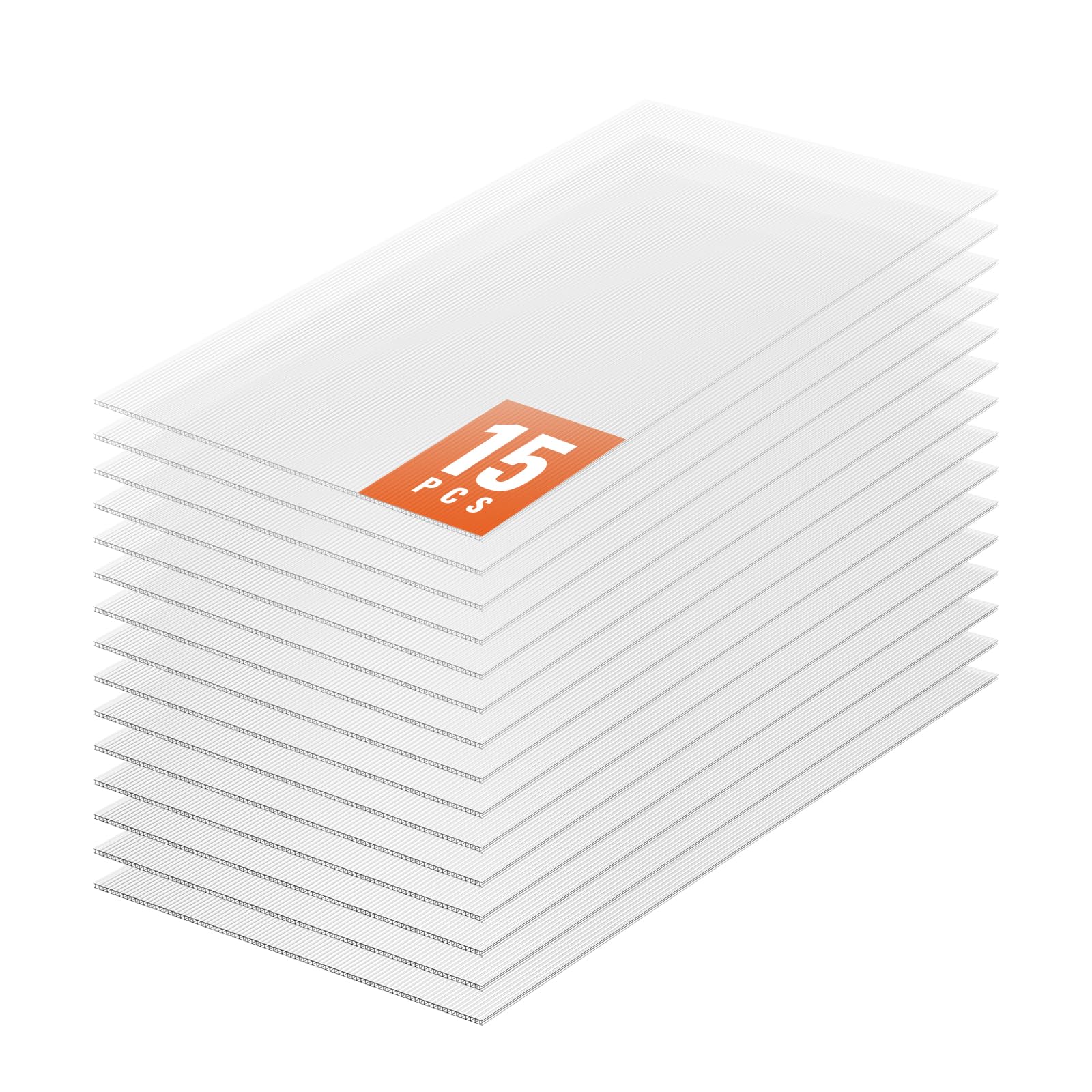
VEVOR’s 15-pack covers 118.2 square feet, making it the most economical option for large greenhouses or entire roof replacements. Each panel measures 0.24 inches thick with a double-layer honeycomb structure that resists deformation under snow loads and wind uplift. The 80% light transmission paired with 98% UV blockage keeps interior temperatures from spiking during summer afternoons while still delivering enough sunlight for vigorous plant growth.
Cold-climate owners report dramatic improvements: one Indiana user measured a 10-to-15-degree Fahrenheit rise inside a chicken coop during subzero conditions, with egg production continuing through -7°F weather. The panels are flexible enough to cold-form into gentle arches, suiting hoop-style greenhouse frames. Cutting is straightforward with a jigsaw or sharp box cutter, and the panels accept screws and rubber washers without cracking when pilot holes are pre-drilled.
The thin plastic film on both sides must be peeled before installation — the UV-coated side has a white covering, so orientation is clear. A few customers received panels with minor edge damage in transit, though the overall value remains strong given the coverage area per dollar. For larger structures where maximizing square footage on a budget is the goal, this pack delivers the best ratio of area to cost.
What works
- 15-panel set covers 118 sq. ft., ideal for full greenhouse retrofits
- 0.24-inch honeycomb structure withstands heavy snow and hail
- Significant temperature rise measured in winter chicken coops and cold frames
What doesn’t
- Occasional shipping damage reported on edge corners
- Thinner and more pliable than glass, requiring extra structural support
3. UMIG 12 PCS 4′ x 2′ x 0.16” Polycarbonate Greenhouse Panels
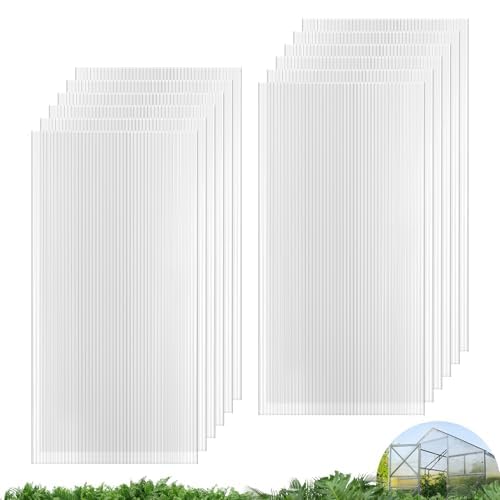
For growers who want dual-side UV protection at a mid-range price point, the 0.16-inch UMIG panels offer the same 80% light transmission and double-sided coating as the thicker version but in a lighter, more flexible package. This makes them a strong candidate for hobby greenhouses, cold frames, and curved roof applications where bending the panel into an arc is necessary. The weight savings also reduce stress on lightweight aluminum frames.
Users consistently praise the ease of cutting: a utility knife scores the surface cleanly, and the panels snap along the cut line without cracking. Chicken coop and duck run owners report noticeable temperature improvements after installation, with the panels trapping radiant heat while blocking drafts. The honeycomb internal structure helps diffuse light, reducing harsh shadows that can stress seedlings.
The trade-off is reduced structural rigidity compared to 0.24-inch sheets. Heavy snow accumulation may cause deflection if rafters are spaced widely, and the panels flex more under wind load. Some long-term users noted yellowing after 12 months, a common behavior with polycarbonate even with UV stabilizers. For seasonal use or mild climates where weight and flexibility matter more than absolute impact resistance, this 12-pack hits the sweet spot.
What works
- Dual-side UV coating on both faces prevents premature yellowing
- Lightweight and flexible enough for curved greenhouse roofs
- Scores and snaps easily with a standard utility knife
What doesn’t
- 0.16-inch thickness flexes visibly under heavy snow loads
- Some owners observed yellowing after one year of continuous sun exposure
4. Tatuo 12 Pack 4′ X 2′ X 0.16” Polycarbonate Greenhouse Panels

The Tatuo 12-pack uses a honeycomb multi-layer structure that provides better heat insulation than simple twin-wall designs, helping greenhouses stay cooler in summer and warmer in winter. Each panel is 0.16 inches thick with UV protection on both sides, ensuring the material doesn’t degrade regardless of which face is oriented outward — a helpful feature for builders who swap panels between roof and wall positions.
Hobby greenhouse operators replacing worn Harbor Freight roof panels found these slightly thicker than the originals, requiring minor width trimming to fit existing channels. The extra density actually improved thermal performance, with users reporting fewer drafts and less condensation drippage. The panels cold-form into gentle curves for tunnel-style structures and are sturdy enough to serve as room dividers or cellar privacy screens when not used outdoors.
The main drawback is that the 48-by-24-inch nominal dimensions run slightly large, so exact-fit installations may require cutting both length and width. The included protective film must be removed promptly after installation to prevent heat-bonding in direct sunlight. For multi-purpose projects that range from greenhouse cladding to chicken coop winterization, this bundle offers excellent versatility at a reasonable per-panel cost.
What works
- Honeycomb internal structure improves insulation over basic twin-wall panels
- UV protection on both sides eliminates orientation mistakes during installation
- Sturdy enough for non-greenhouse uses like room dividers and privacy screens
What doesn’t
- Panels are slightly oversized, requiring trimming for exact-fit frames
- Protective film can bond to the panel if left on in hot weather
5. XISOCO 3 PCS 4′ x 2′ x 0.24” Polycarbonate Greenhouse Panels

XISOCO’s 3-pack is designed for targeted repairs or small DIY greenhouse projects, offering 0.24-inch twin-wall construction with a 10-year limited warranty — the longest backing in this roundup. The 99.5% UV protection rating is among the highest listed, reducing the risk of panel yellowing and brittleness even under intense desert sun. Each sheet is cut to 48 by 24 inches with an industry-standard tolerance of plus or minus 0.19 inches.
Owners praise the panels for their performance in extreme climates: one user in the Southwest reported no discoloration after six months of full direct sun and high winds, while another used the sheets as flat exterior walls for a chicken coop and noted significant cold and rain blocking. The multiwall cellular structure reduces condensation buildup on the inside surface, a common issue that leads to dripping on crops below.
The main limitation is the pack size: three panels cover only 24 square feet, making it impractical for full greenhouse builds. The UV coating is applied to only one side, so orientation must be correct during installation. For patching damaged sections, replacing a few rotted panels, or enclosing a small cold frame, this compact pack provides premium-grade material without excess inventory.
What works
- 10-year limited warranty provides long-term peace of mind
- 99.5% UV protection prevents yellowing better than most competitors
- Cellular multi-layer design reduces interior condensation drippage
What doesn’t
- Only three panels per pack — insufficient for full greenhouse coverage
- UV coating is single-sided, requiring careful orientation during installation
6. Hotop 3 Pcs Polycarbonate Greenhouse Panels Double Layer 4′ X 2′ X 0.24”

Hotop’s 3-pack brings 0.24-inch twin-wall thickness at a budget entry point, making it an attractive option for someone testing polycarbonate glazing for the first time. The clear panels block UV and exterior heat while maintaining a bright interior environment that supports seedling development. The polycarbonate material resists cracking from thermal expansion and accidental impacts better than acrylic or fiberglass alternatives.
Customer feedback reveals creative cross-category use: many buyers repurpose these as DIY aquarium lids, noting that the double-layer structure prevents evaporation and keeps fish from jumping out. The panels cut easily with a sharp blade, though the material generates static electricity that attracts debris into the internal chambers — a minor nuisance during fabrication. The actual dimensions measure 47.64 by 23.82 inches, slightly undersized compared to the advertised 48-by-24-inch spec.
The three-panel volume limits the application to small greenhouses, single cold-frame repairs, or aquarium projects. Panels arrived well-packaged in most cases, though the relatively low per-pack price means larger builds require multiple purchases. For a low-cost introduction to polycarbonate greenhouse sheeting that still offers the thermal benefits of twin-wall construction, this is a sensible starting point.
What works
- 0.24-inch thickness provides real insulation without the premium price tag
- Works exceptionally well as DIY aquarium covers to prevent evaporation
- Clear material blocks UV while maintaining bright interior light levels
What doesn’t
- Actual panel size is 0.36 inches shorter than advertised spec
- Static charge attracts dust and debris into internal twin-wall chambers
7. DGSL 6 Pcs Polycarbonate Greenhouse Panels 4′ x 2′ x 0.16” Twin-Wall
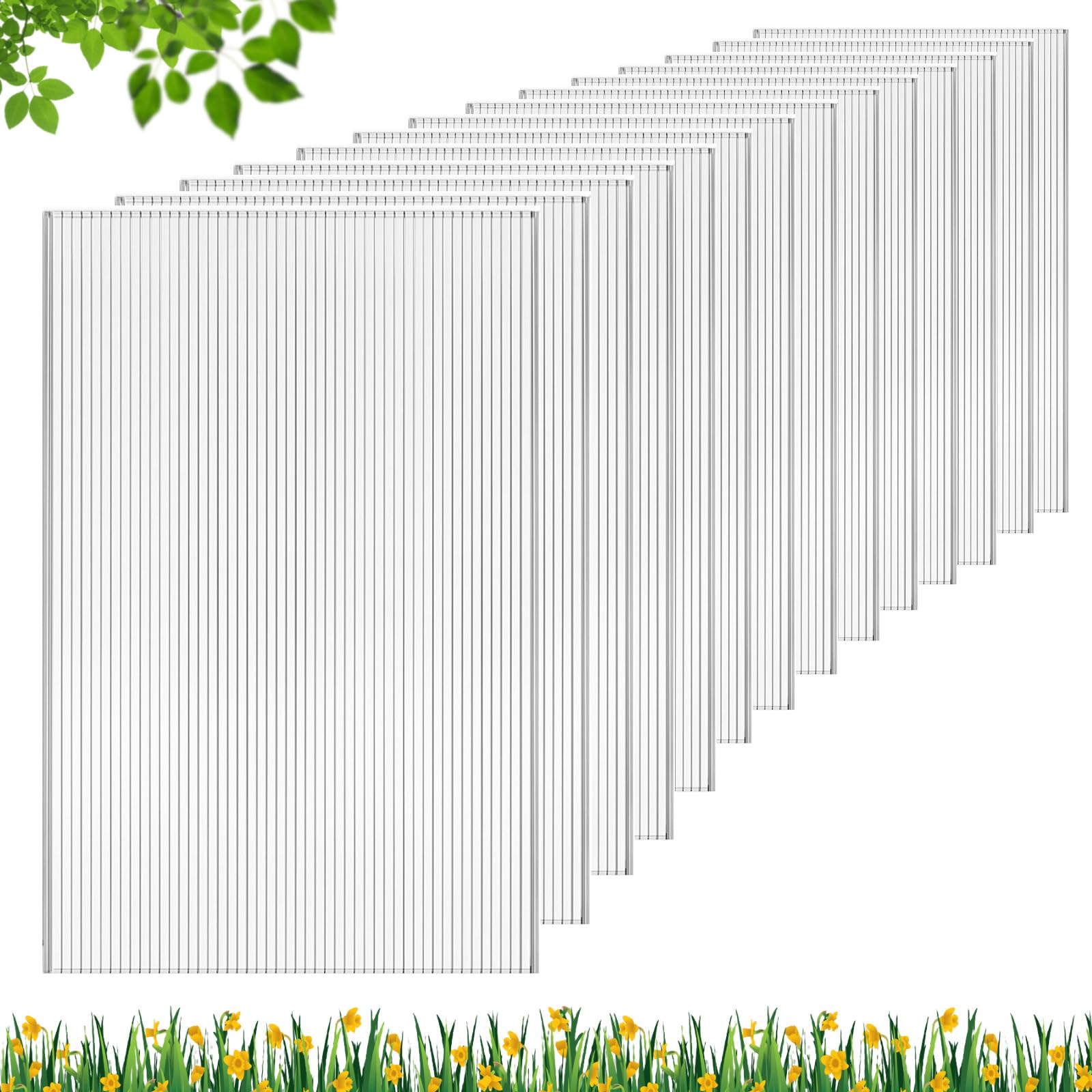
DGSL’s 6-pack uses 0.16-inch twin-wall polycarbonate to deliver the lightest panel option in this review, ideal for seasonal greenhouse covers or wrapping around chicken runs in winter. The material transmits 80% of available light while reflecting excess infrared radiation, keeping interior temperatures moderated across the seasons. The working temperature range spans -44°C to 120°C, making the panels suitable for climates with extreme cold snaps.
Installation is straightforward: users cut the panels with a razor knife or fine-tooth saw blade, then attach them to wooden frames with screws and rubber washers. One owner retrofitted his entire house windows with these panels for hurricane protection, reporting that rocks and hail pinged off harmlessly. The panels are pliable enough to wrap around curved coops and tunnels, though this flexibility reduces load capacity compared to thicker options.
The thin gauge is the limiting factor for permanent greenhouse structures. Snow loading can cause deflection, and the panels lack the rigidity to span wide rafters without sagging. The protective film must be stored away from heat sources to prevent adhesion issues. For budget-conscious projects where weight and ease of cutting are the primary drivers, this 6-pack offers adequate seasonal protection at the lowest per-panel cost in the lineup.
What works
- Lightweight panels are easy to handle, cut, and install on temporary structures
- 80% light transmission supports healthy plant photosynthesis
- Extreme temperature tolerance ranges from -44°C to 120°C
What doesn’t
- 0.16-inch thickness sags under heavy snow loads on wide-span frames
- Protective film can bond to panels if left in hot storage before installation
Hardware & Specs Guide
Twin-Wall Construction
All panels in this review use a twin-wall or honeycomb multi-layer design that creates air pockets between two solid polycarbonate faces. This trapped air layer provides thermal insulation roughly 40% better than single-sheet acrylic and prevents the interior condensation that causes dripping on plants. The internal rib spacing varies between brands, with closer-spaced ribs offering more structural rigidity but slightly reduced light transmission.
UV Stabilizer Coating
Polycarbonate is inherently UV-sensitive and will yellow within months if left uncoated. Panels with a co-extruded UV layer on one or both surfaces resist this degradation for years. Dual-side coating is preferred for roofs where both panel faces receive direct sun or for panels that are frequently removed and reinstalled in different orientations. Single-side panels must have the coated face oriented to the sun — the protective film on each sheet indicates the correct outward side.
FAQ
Can corrugated polycarbonate panels replace glass in an existing greenhouse frame?
Should I choose 0.16-inch or 0.24-inch panels for a greenhouse in a snowy climate?
How do I prevent polycarbonate panels from yellowing over time?
Final Thoughts: The Verdict
For most gardeners, the corrugated panels for greenhouse winner is the UMIG 0.24-Inch 12-Pack because it combines thick twin-wall insulation with dual-side UV protection at a competitive per-panel cost, delivering lasting clarity and thermal stability for permanent greenhouse structures. If you need maximum coverage on a budget, grab the VEVOR 15-Pack. And for small repairs or seasonal cold frames where premium UV resistance matters most, the XISOCO 3-Pack offers the strongest warranty and highest UV-blocking rating in the group.