
Specs are compiled from manufacturer listings and verified buyer reviews and can change over time — please confirm the key details on the product page before buying.
The promise of a cordless trimmer edger is a tidy yard without the hassle of gas, oil, or a tangled extension cord. The reality for many buyers is a single battery that dies halfway through the front yard and a spool head that refuses to feed line. This guide cuts through the confusion by comparing the exact runtime, cutting power, and real-world quirks of seven cordless models, so you know which one will actually finish your lawn.
I’m Rikta — the founder and writer behind Lawn Gear Lab. This guide is built by comparing the manufacturers’ published specifications and the patterns across verified customer reviews, so you get each pick’s real strengths and trade-offs instead of marketing spin.
You want a cordless trimmer edger that actually finishes your yard without dying halfway. The key is how the motor, battery capacity (measured in amp-hours), and line-feed system (how the trimmer line advances automatically) work together in your hand.
Quick Picks
- 21V HTCFLY Weed Wacker Cordless & Lawn Edger — Top Performer
- FOKIKIP 12″ 21V 2-Speed String Trimmer & — Longest Runtime
- JKLARI 21V Cordless Weed Wacker 2-in-1 — Balanced Value
- LPSUK 20V Cordless String Trimmer (3-in-1) — Light-Duty Champ
- Greenworks 24V Cordless String Trimmer/Edger — Ecosystem Pick
- WORX WG163 20V Cordless String Trimmer & — Precision Feed
- HortiHub 21V Weed Eater (Cordless Edger & — Budget Entry
How To Choose The Best Cordless Trimmer Edger
Before you click “buy,” understanding three key areas will help you pick the model that fits your yard size and your patience level. The wrong choice usually means a half-finished lawn or a trimmer head that jams every few minutes.
Battery Runtime and Charger Speed
The battery is the heart of any cordless trimmer edger. A model with two 2.0Ah lithium batteries and a fast charger (around 1 hour and 20 minutes to full) lets you swap packs and keep working. Look for “battery average life” figures in the specs: some units deliver 15 minutes per charge, while others stretch past 45 minutes. For a medium-sized yard, a combined runtime of 40 minutes or more is a practical starting point.
Cutting Power and Speed
Motor speed, measured in RPM (revolutions per minute), determines how easily the trimmer cuts through thick grass and weeds. A 9000 RPM motor is noticeably more aggressive on dense growth than an 8000 RPM motor — roughly a 12% speed advantage. The cutting width (usually 12 inches) also matters: a wider swath covers more ground per pass, which saves time on larger lawns.
Line Feed System
The line-feed system is the most common frustration point. Automatic line feed releases a small amount of line (typically 0.4–0.5 inches) each time you start the motor, so you never have to stop and tap the head on the ground. Some budget models rely on a bump-feed mechanism that requires a manual tap, which can interrupt your rhythm. Check customer reviews for mentions of jamming or inconsistent feed — this single feature can make or break your satisfaction.
Quick Comparison
| Model | Best For | Motor Speed | Battery Life | Weight | Amazon |
|---|---|---|---|---|---|
| 21V HTCFLY Weed Wacker | Best Overall Power | 9000 RPM | 30 min per battery | 5 lbs | Amazon |
| FOKIKIP 21V 2-Speed | Longest Total Runtime | Dual Speed | 45 min total | — | Amazon |
| JKLARI 21V Weed Wacker | Balanced Value & Power | 8500 RPM | 40 min total | 7 lbs | Amazon |
| LPSUK 20V String Trimmer | Light-Duty & Budget | 8000 RPM | ~1 hr per battery | 5 lbs | Amazon |
| Greenworks 24V Gen 2 | Ecosystem & Build | — | 30 min per battery | 5.18 lbs | Amazon |
| WORX WG163 20V | Command Feed Precision | 7600 RPM | ~30 min per battery | 5.5 lbs | Amazon |
| HortiHub 21V Weed Eater | Budget Entry-Level | 9000 RPM | 15 min per battery | 5.27 lbs | Amazon |
In‑Depth Reviews
1. 21V HTCFLY Weed Wacker Cordless & Lawn Edger
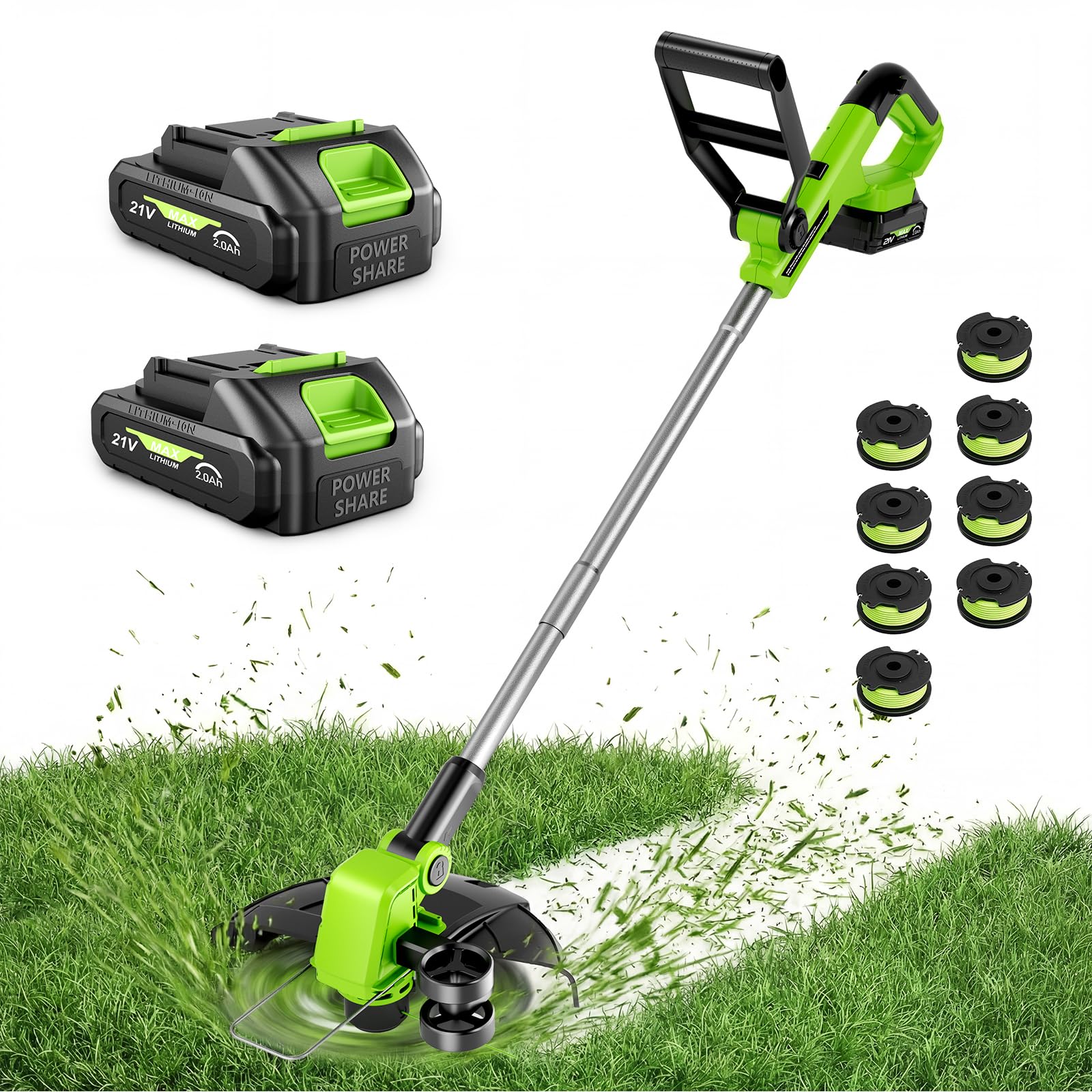
The 9000 RPM motor that rips through thick weeds faster than the average cordless trimmer.
You get a 21V motor spinning at 9000 RPM — 12% faster than the 8000 RPM from the LPSUK 20V model. That extra speed makes a real difference when you hit a patch of overgrown grass next to the fence. The 2-in-1 design switches from trimming to edging by holding a button on the handle, rotating the head 90°, so you do not stop to swap parts.
Buyers report “impressive 21V power at 9000 RPM” that “cuts quickly/cleanly,” and they note the two 2.0Ah lithium-ion batteries provide “over 30 minutes of runtime” per battery. The auto line feed releases about 0.5 inches of line each time you pull the trigger, keeping the 12-inch cutting width consistent without bumping the head. At 5 pounds, it shares the same lightweight feel as the HortiHub model but doubles the battery endurance.
A smart convenience feature is the dual-interlock safety switch: you have to press two buttons at once to start the motor, which helps prevent accidental startup when you are carrying it to the shed. Unlike the HortiHub unit, where one reviewer flagged battery safety concerns, the HTCFLY does not show similar complaints in its verified reviews — though you should still charge batteries while awake.
What Stands Out
- 9000 RPM motor outpaces typical 8000 RPM rivals by 12%.
- 30-minute runtime per battery covers most suburban front yards on one pack.
- Smooth auto line feed eliminates bumping (buyers confirm “smooth auto line feed”).
Know Before You Buy
- Not a commercial-grade tool — designed for residential yard maintenance.
- Assembly requires a Phillips screwdriver (tools not included).
the balance: You get the fastest cutting speed in this price range plus dependable dual-battery runtime (two batteries so you can swap and keep going), all without gas or a cord.
One Trade-Off: If you routinely tackle acres of heavy brush, you will eventually outgrow its 12-inch cutting path — but for suburban lots, it is a clear winner.
2. FOKIKIP 12″ 21V 2-Speed String Trimmer & Edger
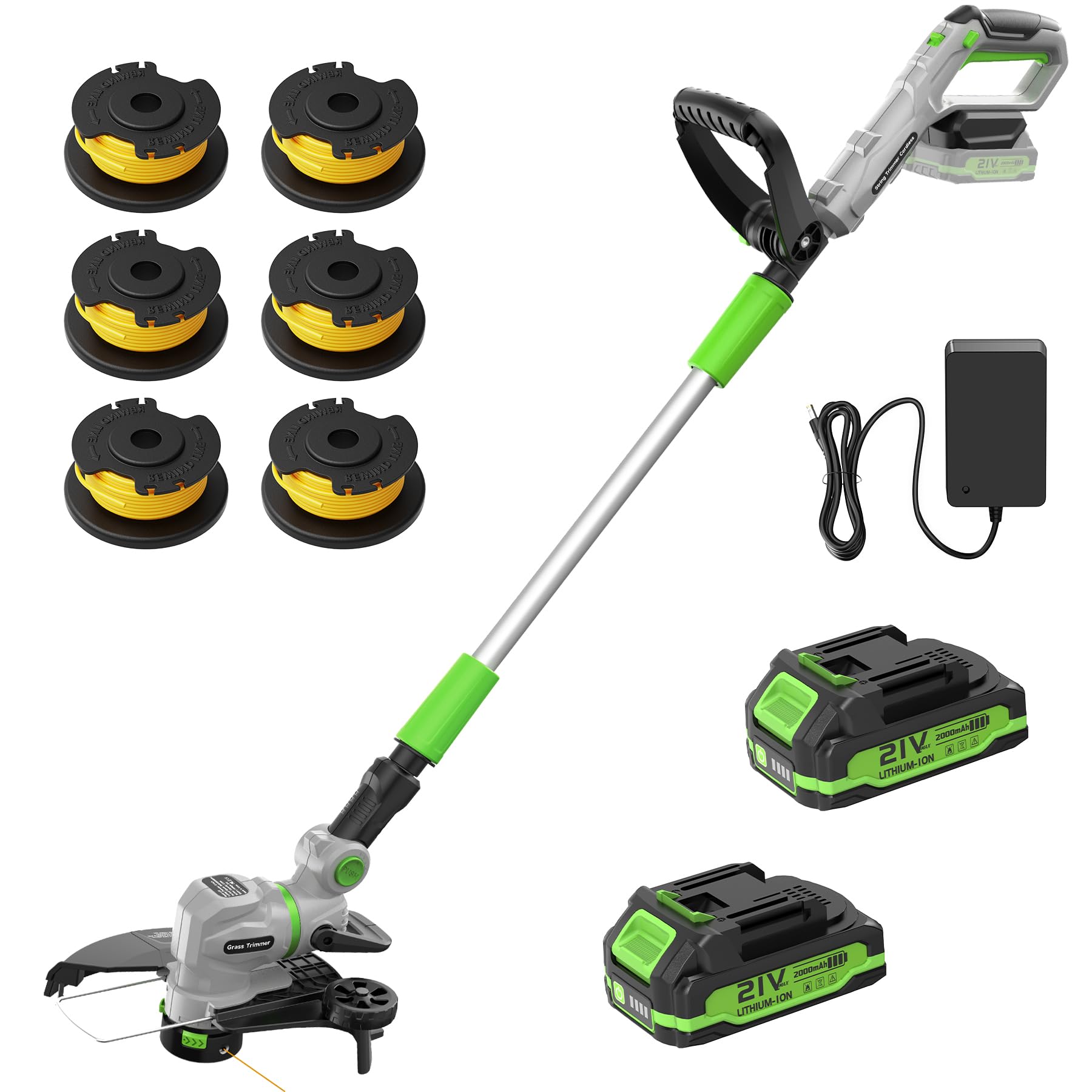
The only trimmer here that lets you choose low speed for light work or high speed for thick weeds.
A dual-speed control is rare at this price, and it gives you genuine flexibility: low-speed mode handles daily trimming around flower beds without throwing debris, while high-speed mode powers through dense or thick weeds. The 12-inch cutting width stays the same in both modes, so you cover ground efficiently no matter which speed you choose.
The fast charger tops up a depleted pack quickly, so you can alternate batteries and keep working. The automatic line feed advances the line every time you start the machine, and owners mention the system works smoothly without jamming.
Switching to edging mode is straightforward: you step on a pedal at the trimmer head, rotate the machine 90° to the right, and lock it. The 180° adjustable handle and 54° rotatable cutting head help you reach corners, fences, and steps. Six replacement spools are included, which extends the service life by roughly 3 times compared to models that include only one or two spools.
Why It Wins
- Two-speed motor adapts to light trimming vs. thick weed duty.
- 45-minute total runtime leads every model in this list.
- Six extra spools included — far more than the standard one or two.
Keep In Mind
- One reviewer noted it handles “light jobs” best and struggles in “heavily grassy or weedy areas.”
- First use requires untying a knot in the pre-installed line — a small but easy-to-miss step.
Reach for This If: You want the flexibility of two power modes and the longest combined battery life for a medium-sized yard with varied terrain.
Look Elsewhere If: You regularly cut through thick woody brush — this is not a brush cutter, and you will want a higher-torque motor for that.
3. JKLARI 21V Cordless Weed Wacker 2-in-1
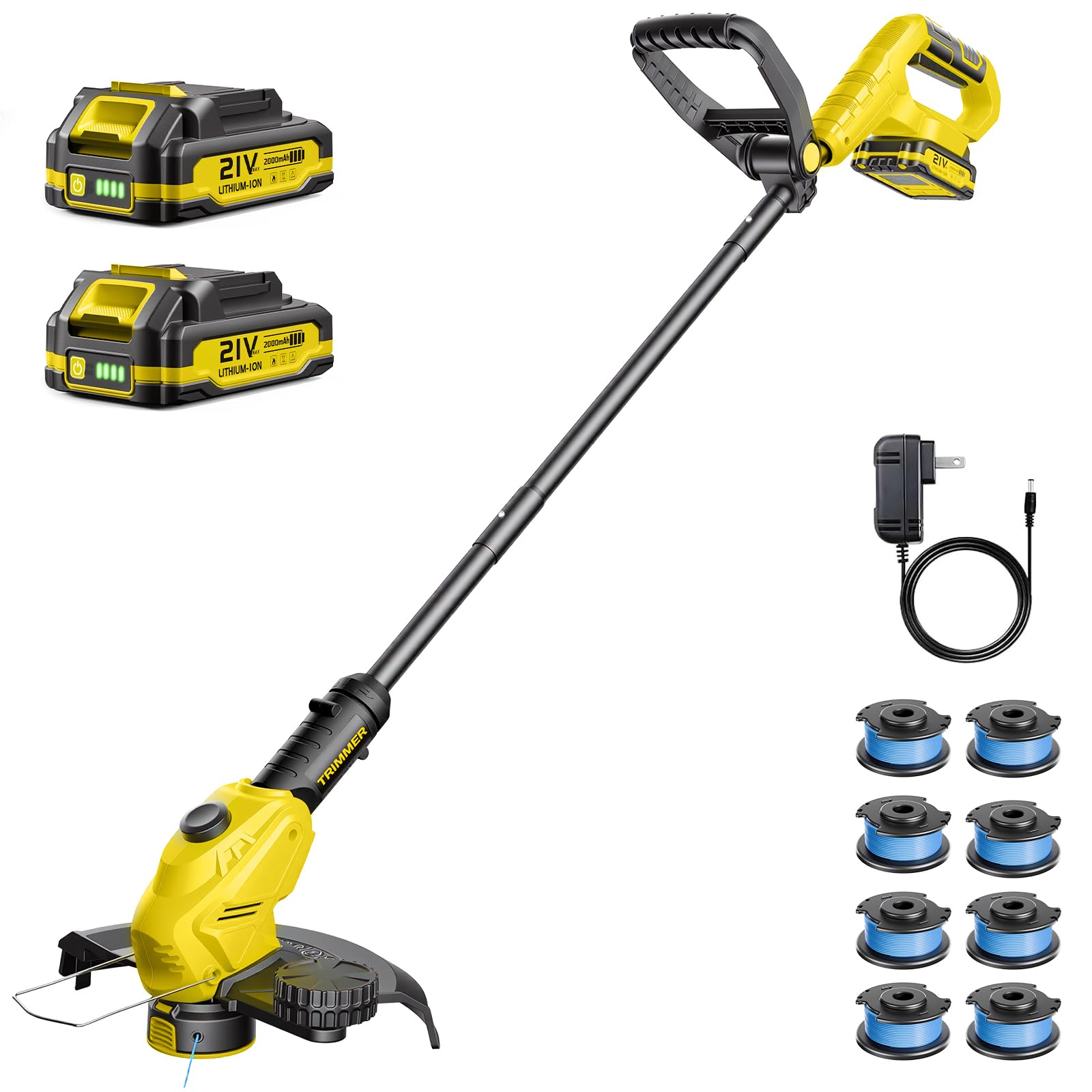
A middleweight contender that splits the difference between price and cutting power.
The JKLARI spins at 8500 RPM — slower than the 9000 RPM HTCFLY but faster than the 8000 RPM LPSUK — and customers note it handles “light to medium yard work” comfortably. The 21V motor and 12-inch cutting path are a familiar formula, but the battery average life of 40 minutes total (two 2.0Ah packs) slots it comfortably between the 30-minute HTCFLY and the 45-minute FOKIKIP.
Reviewers point out the 2-in-1 trimmer/edger switch (which flips the head from trimming to edging) is “smooth” and the adjustable handle rotates 180 degrees. One reviewer tested it on blackberry bushes and reports it cuts through them, though it stopped at bamboo. The automatic line feed system (which pushes out more line as you trim) is present, but shoppers say it can be “unreliable” at times, occasionally requiring a manual adjustment to keep the line advancing properly.
That extra weight might be noticeable if you are trimming for a full hour, though the 180-degree folding design helps with compact storage when you are done.
Strong Points
- 40-minute total runtime is a solid middle ground for most suburban yards.
- 8500 RPM motor cuts blackberry bushes (one reviewer confirmed).
- Folds for storage — a feature not all models offer.
Watch For
- 7 pounds is heavier than the 5-pound HTCFLY and Greenworks alternatives.
- Auto line feed can be unreliable per some reviewer experiences.
A Good Middle Ground: Choose this if you want a 21V trimmer with decent runtime and are willing to trade a bit of weight for the extra battery capacity over the 15-minute HortiHub model.
skip it if: You are a senior or a smaller user who prioritizes a lighter carry weight — the Greenworks or HTCFLY feel significantly lighter in hand.
4. LPSUK 20V Cordless String Trimmer (3-in-1)
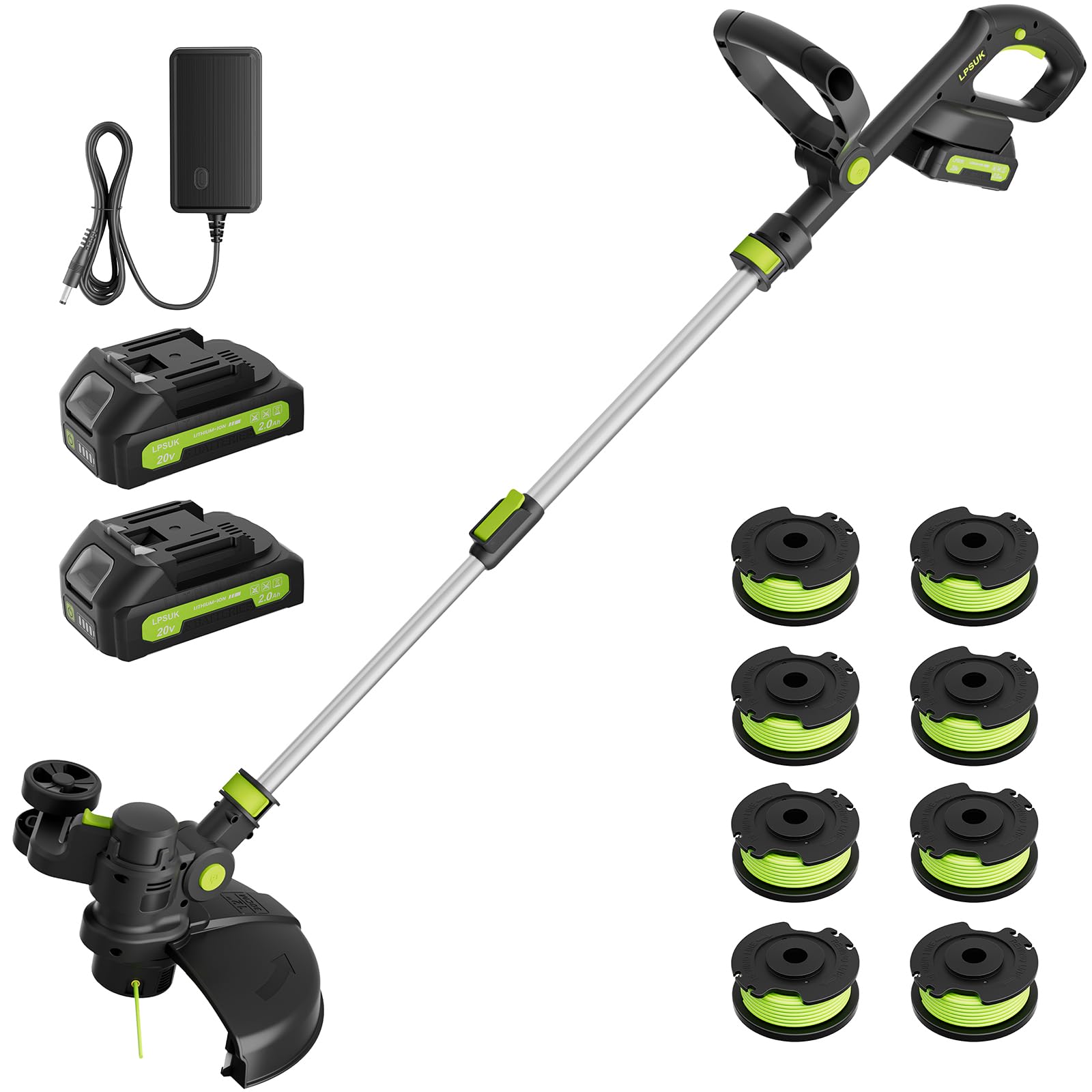
The featherweight that runs for an hour per battery — perfect for slow, steady trimming.
This 20V trimmer delivers an unusual battery endurance. Buyers report “~1 hour continuous trimming per battery,” which is an exceptional runtime for a 2.0Ah pack — but note the motor spins at 8000 RPM, which is 12% slower than the 9000 RPM HTCFLY. That means it cuts steadily rather than aggressively, and it is best suited for routine maintenance rather than hacking through tall overgrowth.
The 3-in-1 design adds a mowing mode alongside trimming and edging, which is unique in this group. The telescoping shaft extends from 38 to 49 inches, accommodating users from 4’8″ to well over 6 feet. The 60° adjustable head and 180° adjustable handle help you reach under patio furniture and along fences, and at just 5 pounds, it is the same weight as the HTCFLY — very easy to hold for extended sessions.
The automatic line feed system advances without disassembly, but one critical concern appears in the reviews: a verified buyer reported that both “batteries failed to charge after few uses” (first after two uses, the second later). The charger worked with other batteries, indicating the issue is with the battery packs themselves. This is a pattern to watch — if you buy this model, test both batteries immediately and keep an eye on charging behavior.
Best Bits
- Runs ~1 hour per battery — the longest single-pack runtime in this list.
- Lightest model at 5 lbs with telescoping shaft for all heights.
- Includes 6 spools and 2 batteries — generous accessory package.
Drawbacks
- Multiple verified reports of batteries failing to charge after limited use.
- 8000 RPM motor is slower than the 9000 RPM HTCFLY by 12%.
Good For: Someone who needs a very lightweight trimmer for frequent touch-ups on a small yard and wants the longest possible runtime on a single battery charge.
Not For: Anyone who cannot risk battery failure — the QC risk on these packs is higher than on the HTCFLY or WORX.
5. Greenworks 24V Cordless String Trimmer/Edger (Gen 2)

A 24V platform that shares batteries with 150+ tools — buy once, power everything.
The Greenworks runs on a 24V battery system, which is a different voltage from the 20V and 21V models above. That may not matter for trimming power — owners mention it handles “extensive overgrowth” and a 60-foot edge in “less than 10 minutes” — but it does matter if you plan to grow a tool collection. The 24V battery works with Greenworks chainsaws, leaf blowers, and more, so you are not locking into a dead-end platform.
At 5.18 pounds and 6 pounds with battery, it is light and the telescoping aluminum shaft adjusts for users from 4’8″ to 6’5″ to reduce back strain. The 90° rotating head helps you edge around tree roots and garden beds without bending. The single-line auto-feed head uses.065-inch line, and the push-button start means no pull cord — just squeeze the trigger.
Buyers are divided on the auto-feed system: some praise it, while others report “spool does not auto-feed string” and had to “restring frequently.” One reviewer notes the battery life “degrades after 3 uses.” The trimmer is quiet at 75 dB (decibels — quieter than a vacuum cleaner) and compliant with HOA noise rules for early-morning trimming. Greenworks backs the tool with a 3-year warranty and the battery with 2-year coverage, which is the longest warranty in this comparison.
Why Choose It
- 24V battery works with 150+ Greenworks tools — strong ecosystem value.
- Lightest weight (5.18 lbs) alongside the 5-lb HTCFLY and the 5.5-lb WORX.
- 3-year tool warranty + 2-year battery warranty beats most competitors.
Caveats
- Auto-feed system has reliability complaints — some customers note it jams.
- Battery life may degrade faster than expected per some feedback.
A Platform Play: Pick this if you already own or plan to buy other Greenworks 24V tools — the battery sharing alone justifies the choice.
Watch Out For: If you just want the most reliable auto-feed line system, the HTCFLY or WORX have fewer feed complaints in verified reviews.
6. WORX WG163 20V Cordless String Trimmer & Lawn Edger
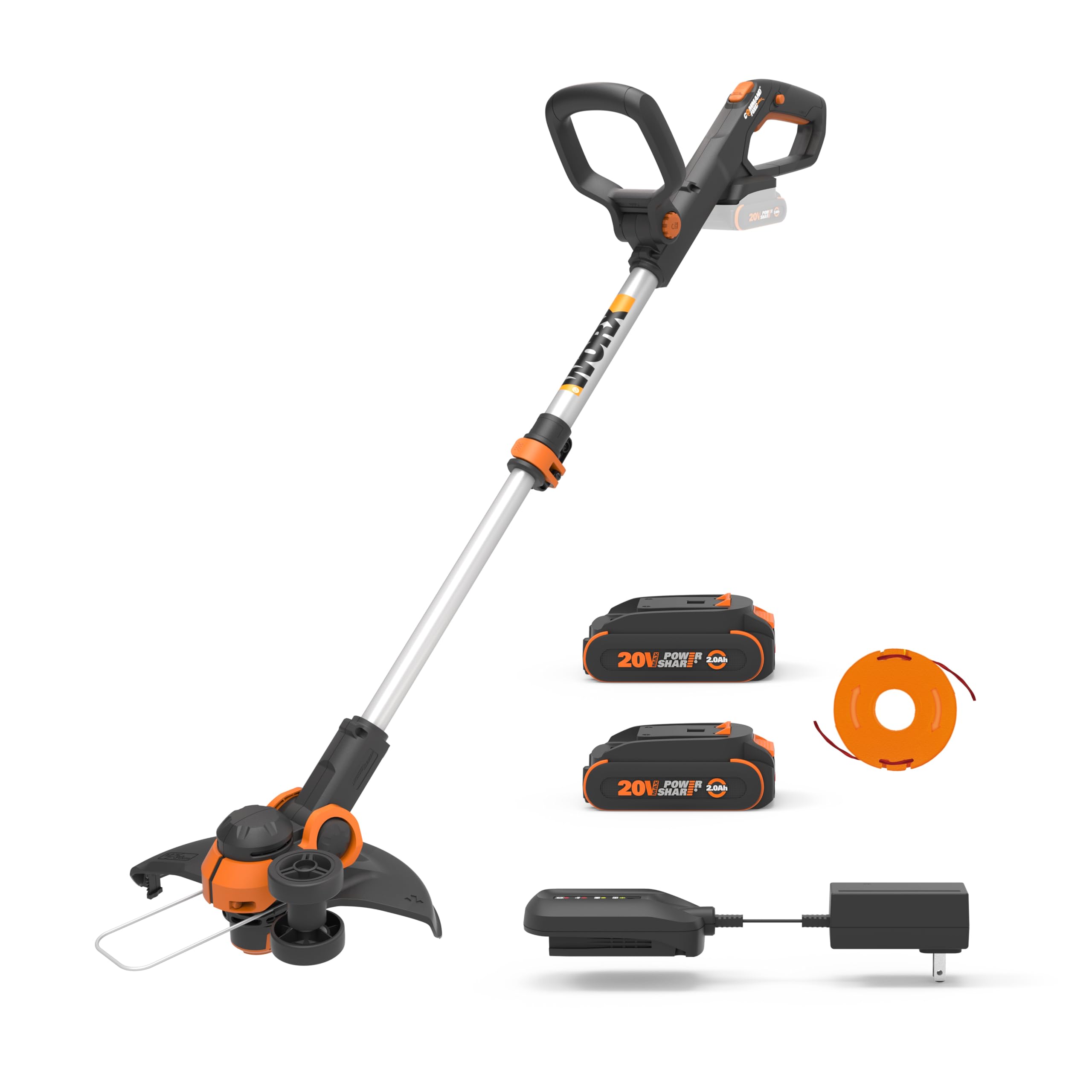
A push-button line feed that actually works — no tapping, no automatic jamming.
The WORX uses a push-button Command Feed spool system instead of an automatic or bump-feed mechanism. You press a button on the handle to advance the line instantly, giving you precise control over how much line extends. This avoids the automatic-feed jamming issues reported on the Greenworks and JKLARI models. WORX also offers a “free spools for life” program, which means you never buy replacement line again — just register the product.
The motor spins at 7600 RPM — the slowest in this list by a meaningful margin (the HTCFLY runs 18% faster at 9000 RPM). Buyers confirm it “bogs down in thick conditions” but say it “recovers” and is sufficient for a “well maintained” yard. The 2-in-1 design tilts the head 90° for edging, and the twin rubberized wheels guide the trimmer along sidewalks for straight lines. At 5.5 pounds, it is 0.5 pounds heavier than the 5-pound HTCFLY.
The lightweight batteries are a trade-off: reviewers point out “very small, light batteries with short runtime (~10 min)” in one case, while another reviewer says “both batteries handle [a] 1/4 acre” yard. The charger is described as “very snug” and hard to remove from the battery — a small but consistent annoyance. The WORX Power Share platform means the batteries work with any other 20V or 40V WORX tool.
What Works
- Command Feed push-button line system is reliable — no auto-feed jams.
- Free spools for life program eliminates future line purchases.
- Twin rubber edging wheels produce clean, straight sidewalks.
What Does Not
- 7600 RPM motor is the slowest in the lineup — less aggressive cutting.
- Battery runtime varies significantly across user reports; some get only ~10 min.
Best For: A homeowner who hates fighting with auto-feed jams and wants the most reliable line-advance system — the Command Feed is genuinely easier.
Skip If: You need to power through thick, overgrown grass routinely; the 7600 RPM motor will not keep up with the 9000 RPM alternatives.
7. HortiHub 21V Weed Eater (Cordless Edger & String Trimmer)
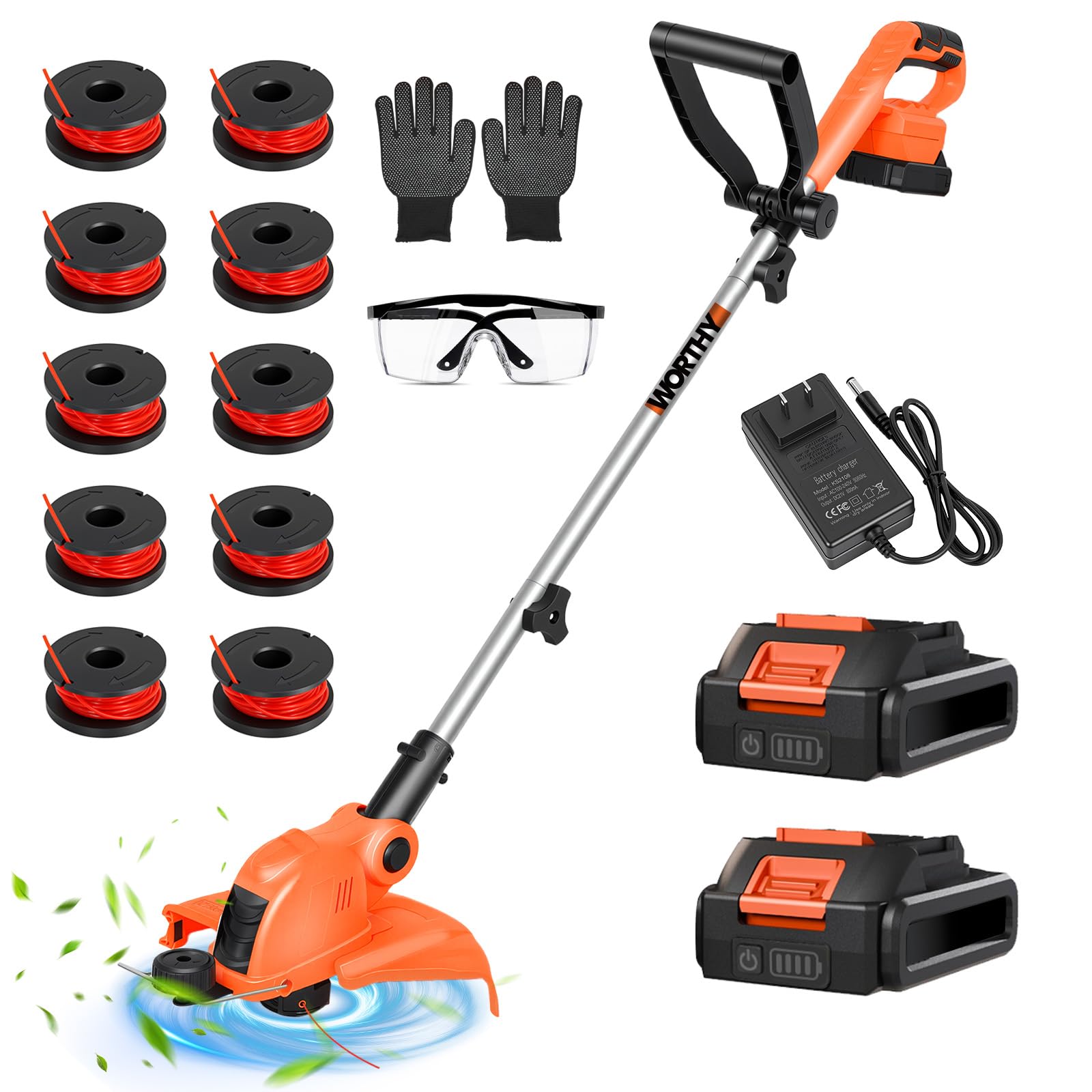
A 9000 RPM motor at entry-level pricing — but only 15 minutes per battery.
This HortiHub model has the same 9000 RPM motor speed as the top-rated HTCFLY, but the battery average life of 15 minutes per battery makes it the shortest-runtime trimmer in this comparison. With two 2000mAh batteries, you get approximately 30 minutes total — about half the runtime of the 45-minute FOKIKIP. That works for a very small yard, but for anything larger, you will likely need a second charging session mid-job.
Buyers describe it as a “great little trimmer” that is “not heavy duty” but “works well” for its price point. The auto-feed system releases 0.4–0.5 inches of line automatically on startup, and the 12-inch cutting width is standard for this category. Tool-free assembly is a nice convenience: you can put it together without any additional tools, and the kit includes impact-resistant goggles plus a reinforced safety guard.
The most concerning issue in the reviews: one buyer warns the batteries are “not UL-listed” and calls it a safety risk to charge unattended. They note to “charge only while awake.” This is a meaningful caution that you do not see in the reviews for the Greenworks, WORX, or HTCFLY models. If safety and battery certification matter to you, this is a real consideration.
Positive Surprises
- 9000 RPM motor matches the top performer’s speed — cuts aggressively when running.
- Tool-free assembly gets you started in minutes.
- Includes goggles and work gloves — a thoughtful touch.
Real Concerns
- 15-minute per-battery runtime is the shortest in this list.
- Batteries are not UL-listed — a safety caution raised by a verified buyer.
A Strict Budget Play: Choose this only if your yard is tiny (a few minutes of trimming) and your budget is extremely tight — the motor is fast, but the battery endurance and safety profile are compromised.
Do Not Pick: For a 1/4 acre or larger yard; the 15-minute runtime will force you to stop and recharge mid-lawn, and the non-UL batteries add a legitimate safety concern.
Understanding the Specs
Motor Speed (RPM)
RPM stands for revolutions per minute — literally how many times the cutting head spins in one minute. A higher number means the trimmer cuts through thick grass and weeds faster. The gap between an 8000 RPM model and a 9000 RPM model is about a 12% speed increase, which you notice when the trimmer does not stall on a clump of tall weeds. For routine maintenance on a well-kept lawn, 8000 RPM is enough. For overgrown patches that have been ignored for weeks, 9000 RPM saves you time and frustration.
Battery Capacity (Ah) and Runtime
Ah stands for ampere-hour, a measure of how much electrical charge the battery holds. A 2.0Ah battery is the standard size in this category. But the real-world runtime depends on the motor’s efficiency and how hard the trimmer is working. Some 21V trimmers with 2.0Ah batteries deliver 15 minutes per charge; others stretch past 30 minutes on the same-size pack. The number of batteries included matters almost as much: two batteries let you swap and keep going, effectively doubling your working time as long as the charger keeps up.
Cutting Width
This is the diameter of the circle the spinning line covers. All the trimmers here use a 12-inch cutting width, which is the standard balance for residential yards. A wider cutting path covers more ground per pass, so you finish faster. A narrower path gives you more precision around flower beds and fences. At 12 inches, you get a good balance of speed and control for most suburban lawns.
Auto Line Feed vs. Bump Feed
These are the two main systems for advancing the cutting line as it wears down. Auto line feed releases a small amount of line (typically 0.4–0.5 inches) automatically each time you start the motor — you never have to stop and tap the head. Bump feed requires you to tap the trimmer head on the ground to advance the line, which can be annoying if you are working on uneven terrain. The WORX Command Feed is a third option: it uses a button on the handle so you control exactly when line advances, which some users find more reliable than either automatic or bump-feed systems.
FAQ
How long does a cordless trimmer edger battery actually last?
Is 9000 RPM noticeably better than 8000 RPM?
Can I use any brand’s battery with a different brand’s trimmer?
Which is better — auto line feed or bump feed?
Do I need two batteries or is one enough?
How do I switch a 2-in-1 trimmer from trimming to edging mode?
Can a cordless trimmer edger replace a gas trimmer?
How heavy is too heavy for a cordless trimmer?
Final Thoughts: The Verdict
Across the board, the cordless trimmer edger winner is the 21V HTCFLY Weed Wacker because it pairs the fastest motor speed (9000 RPM) with dependable 30-minute battery runtime and a smooth auto line feed that buyers consistently praise. If you want the longest total runtime for a medium-sized yard, grab the FOKIKIP 2-Speed model with 45 minutes of combined power. And for precision edging with a line-feed system that never jams, the WORX WG163 delivers with its push-button Command Feed and free spools-for-life program.
How We Picked
We do not accept paid placement. Every pick is matched to a real buyer and a real use-case; we do not hands-on test units.
Sources & Methodology
Specifications: manufacturer listings and product documentation. Review insights: verified customer reviews, as of July 2026. Pricing: not shown on this page (it changes often); check the current price via the retailer link.
As an Amazon Associate, Lawn Gear Lab earns from qualifying purchases. This does not affect which products we feature.