
A cordless pruning saw that binds mid-cut or dies after a dozen branches isn’t a tool — it’s a frustration. The real test of a pruning saw isn’t its voltage rating on the box. It’s whether that 6-inch bar can rip through a 4-inch live oak limb without stalling, whether the chain tension holds for a full day of cleanup, and whether the battery platform you buy into powers your entire outdoor tool fleet or leaves you stranded. This guide stacks seven cordless pruning saws head-to-head on cut capacity, auto-oiling reliability, chain pitch, and real-world runtime — not marketing specs.
I’m Rikta — the co-founder and writer behind Lawn Gear Lab. I’ve spent countless hours cross-referencing motor specs, bar lengths, battery architectures, and thousands of verified owner experiences to separate the saws that genuinely earn their place on a truck tailgate from the ones that belong back on the shelf.
Whether you’re trimming branches around the house or clearing storm debris, finding the right tool starts here with our complete breakdown of the best cordless pruning saw options available right now.
How To Choose The Best Cordless Pruning Saw
A cordless pruning saw bridges the gap between manual loppers and a full-size chainsaw. Getting the specs right means the difference between a tool that makes quick work of overgrown branches and one that leaves you wrestling a stuck chain. Here’s what to check before you buy.
Bar Length and Cut Capacity
The bar length determines the maximum branch diameter you can cut in a single pass. A 6-inch bar handles up to about 4-inch limbs, which covers most pruning and light storm cleanup. An 8-inch bar pushes that to roughly 6-inch cuts, giving you more headroom for thicker branches without jumping up to a full 12- or 18-inch saw. Match the bar length to the typical branch size on your property — oversizing adds weight you don’t need for everyday trimming.
Brushless vs. Brushed Motors
A brushless motor delivers more torque per amp-hour, runs cooler, and lasts significantly longer than a brushed motor. It’s the single most meaningful upgrade in the cordless pruning saw category. The runtime gain is not incremental — a brushless saw can deliver 25 to 40 percent more cuts per charge compared to a brushed counterpart on the same battery. For any serious pruning work, brushless is the baseline.
Chain Tensioning Systems
A pruning saw’s chain stretches as it heats up during use. A tool-free dial or lever lets you tighten the chain in seconds without any additional tools. Bolt-lock systems require a wrench but generally provide a more rigid clamp that holds tension longer. The tradeoff is convenience versus reliability — and the best systems combine easy adjustment with a clamping mechanism that doesn’t loosen mid-job.
Quick Comparison
On smaller screens, swipe sideways to see the full table.
| Model | Category | Best For | Key Spec | Amazon |
|---|---|---|---|---|
| DEWALT DCCS623L1 | Brushless | One-handed heavy limbing | 8″ bar, auto-oiler | Amazon |
| Makita XCU14Z | Brushless | Light arborist work | 6″ bar, tool-free tension | Amazon |
| Milwaukee 2527-20 | Compact Brushless | One-handed precision cuts | 6″ bar, brushless motor | Amazon |
| Greenworks CS40B210 | Value Long Bar | Storm cleanup, camping | 12″ bar, 2.0Ah battery | Amazon |
| CRAFTSMAN CMCCS320D1 | Entry-Level | Light yard trimming | 6″ bar, 2.0Ah battery | Amazon |
| BLACK+DECKER BCCS320C1 | Budget Friendly | Small limb and bush pruning | 6″ bar, oil-free chain | Amazon |
| Husqvarna 350i | Pro-Spec | Heavy-duty property maintenance | 18″ bar, 7.5Ah battery | Amazon |
In‑Depth Reviews
1. DEWALT DCCS623L1

The DEWALT DCCS623L1 hits the sweet spot between compact maneuverability and real cutting muscle. Its 8-inch bar and high-efficiency brushless motor deliver over 100 cuts per charge on treated 4×4 pine — verified by multiple owners who timed the 3Ah battery at well past the advertised 70 cuts. The auto-oiling system keeps the chain lubricated continuously, which is rare at this bar length among pruning saws.
Owners consistently report the saw feels balanced and surprisingly lightweight, around 5 pounds with a larger 6.0Ah battery installed. The tip guard stabilizes upcuts just like the smaller 6-inch models, but the extra bar reach lets you tackle 6-inch branches without switching tools. The bolt-lock chain tensioning provides reliable clamping that doesn’t back off during extended use, though the safety button placement on the left side creates an awkward reach for left-handed users.
The build quality mirrors DEWALT’s full-size saws — metal bucking spikes and a solid oil tank cap that doesn’t leak. No storage case is included, and the 3Ah battery is adequate but a 5Ah upgrade transforms runtime for heavy sessions. For anyone who needs one saw for both pruning and medium limb removal, this is the most balanced option in the category.
What works
- Exceptional cut count per charge, often exceeding 100 cuts
- Reliable auto-oiler for continuous bar and chain lubrication
- Solid metal bucking spikes for durability during limbing
What doesn’t
- Safety switch positioned awkwardly for left-handed operators
- No carry case included in the kit
- 3Ah battery is sufficient but an upgrade extends runtime significantly
2. Makita XCU14Z

The Makita XCU14Z is built for arborists who work in the tree canopy — it’s featherlight at just over 2 pounds and designed for one-handed use. The 6-inch bar and 0.325-inch pitch chain cut cleanly through 4-inch live oak and cedar, with the brushless motor delivering up to 140 cuts per 2.0Ah battery in softwood. The retractable guard provides a chain barrier during carry but retracts automatically as you grip the handle, a thoughtful safety touch.
Owners praise the tool-free chain tensioning dial, which adjusts the bar and chain without needing any wrench. The auto-lubrication system keeps the chain oiled, though some users note the tension can loosen if the blade contacts dirt or gets pinched in a kerf. The lack of a variable-speed trigger means the chain runs at full speed immediately — adequate for most cuts but less forgiving for starting precise notches.
As a tool-only model, it requires a Makita 18V LXT battery, which is a smart buy if you’re already in the platform. For light limbing and shrub trimming where weight is the primary concern, the XCU14Z outperforms every other pruning saw in its class. Owners with smaller hands or limited grip strength consistently call it the easiest saw to handle for extended sessions.
What works
- Extremely lightweight at 33.8 ounces, best in class for one-handed use
- Retractable guard adds safety during transport without hindering operation
- Impressive cut count per battery charge on softwoods
What doesn’t
- Battery and charger sold separately, increasing total investment
- No variable-speed trigger for precise starting cuts
- Auto-tensioner can loosen under heavy load or if the chain binds
3. Milwaukee 2527-20
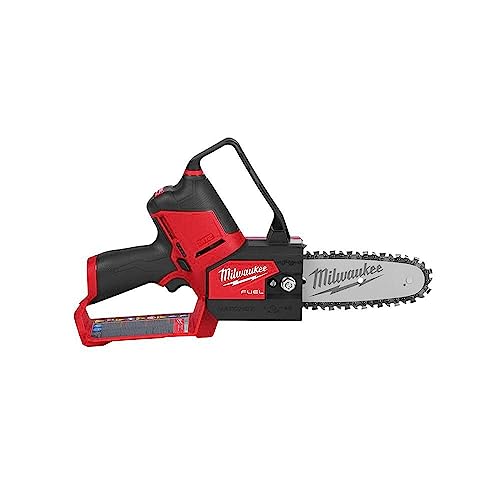
The Milwaukee 2527-20 proves that 12 volts can deliver surprising torque when paired with a brushless motor. This 6-inch pruning saw cuts through 3-to-8-inch hardwood without stalling, and the wrap-around handle design makes one-handed operation feel secure and balanced. Owners describe it as a “little beast” — it lacks the top-end speed of a full chainsaw but compensates with a smooth, controllable cut that reduces kickback on smaller branches.
The compact size is the main selling point. The 4.1-pound weight (with battery) and short 16.5-inch overall length let you reach into tight crotches between limbs where larger saws won’t fit. Battery life runs about 45 minutes of continuous cutting on a standard M12 4.0Ah pack. Owners note the safety latch trigger requires a deliberate push every time you restart, which prevents accidental starts but causes hand fatigue during long sessions.
It’s a tool-only purchase, so you’ll need an M12 battery and charger. For users already in the Milwaukee 12V ecosystem, this saw is a no-brainer. The metal chain adjustment mechanism stays tight and the bar maintenance is straightforward. It’s slower than a gas saw on thick hardwood, but the combination of portability and cutting ability is unmatched for ladder work and precision trimming.
What works
- Exceptional torque-to-size ratio for a 12V saw
- Wrap-around handle provides excellent one-handed control
- Compact length fits into tight branch crotches easily
What doesn’t
- Safety latch requires constant re-engagement, tiring for long jobs
- Battery and charger sold separately
- Slower cut speed compared to 18V or 20V competitors on thick hardwood
4. Greenworks CS40B210

The Greenworks CS40B210 stretches the definition of a pruning saw with its 12-inch bar, but its 6-pound weight keeps it firmly in the one-handed category. It’s designed for homeowners who need to handle both pruning and bigger storm cleanup without sizing up to a full chainsaw. The 40V 2.0Ah battery delivers about 50 cuts on a 4×4 treated post, and the auto-oiler extends chain life through continuous lubrication.
Owner feedback highlights the improved chain tensioning system that holds adjustment far better than earlier Greenworks models. The dual safety start (lock button plus trigger) prevents accidental startups, and the included battery doubles as a USB power bank for charging phones — a practical bonus for camping or emergency use. The low-recoil chain reduces kickback, which matters more with the longer bar that could otherwise grab on branch tips.
It runs slower than a gas saw and the chain loosens faster than premium models, requiring mid-job retensioning every 15-20 minutes of heavy use. But the 40V platform is shared across Greenworks’ string trimmers and blowers, making this an easy add-on for anyone already in the ecosystem. For mixed work that shifts from pruning to cutting 8-inch logs, the extra bar length pays off.
What works
- 12-inch bar handles larger limbs than typical pruning saws
- Battery doubles as a USB power bank for charging devices
- Improved chain tensioning stays tight longer than earlier models
What doesn’t
- Chain requires more frequent retensioning during prolonged use
- Cut speed is slower than gas and premium brushless competitors
- Side-mounted chain brake is less intuitive than top-mounted designs
5. CRAFTSMAN CMCCS320D1
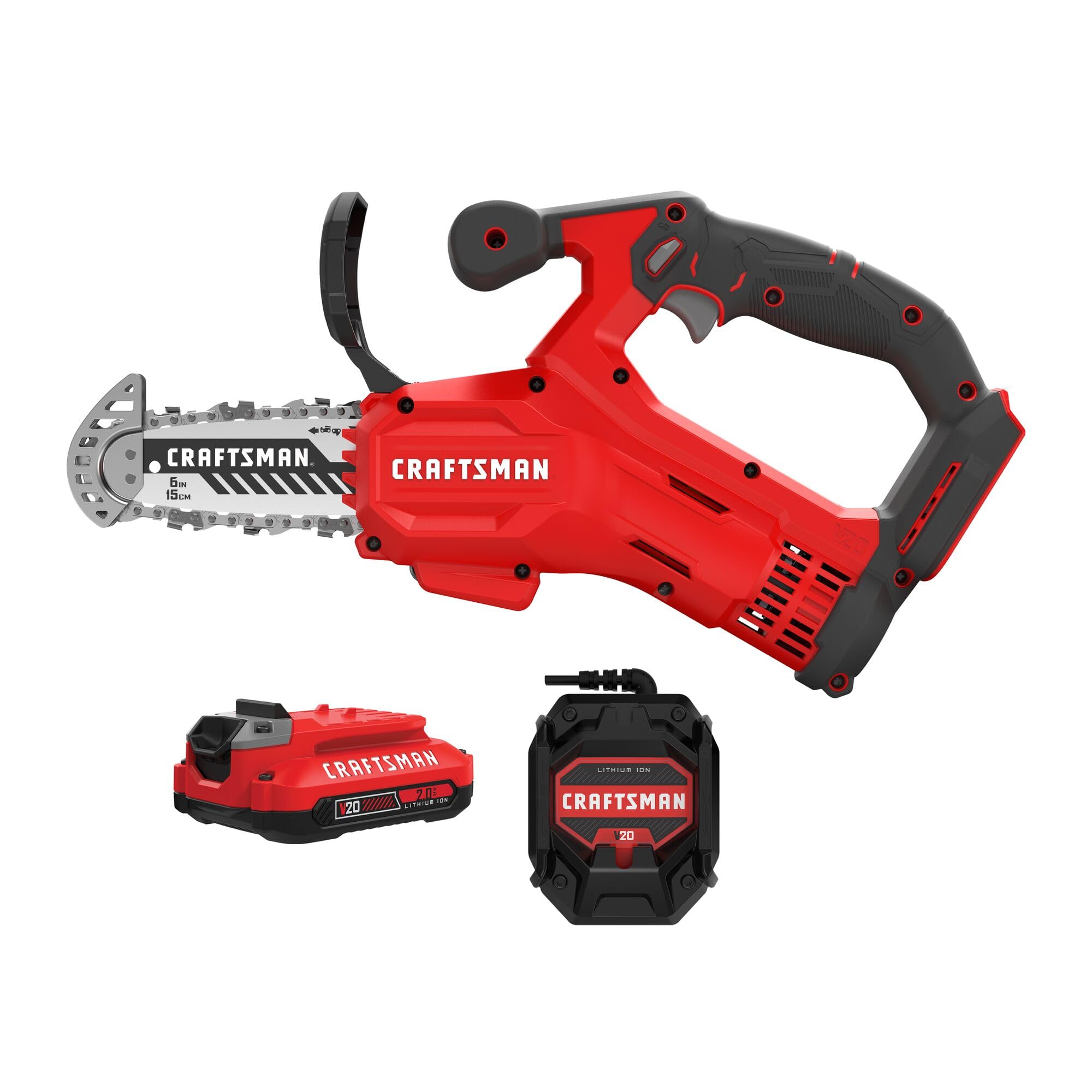
The CRAFTSMAN CMCCS320D1 is a 6-inch pruning saw built for light trimming around the yard. It uses the V20 battery platform, so existing CRAFTSMAN or BLACK+DECKER 20V MAX users have an instant battery pool. The integrated tip guard provides stability during upcuts, and the bolt-lock chain tensioning gives a rigid bar clamp that doesn’t loosen unexpectedly. With a 4-inch cut capacity, it handles typical branch work on properties up to an acre.
Owners consistently report the battery life as the standout feature, with many completing full yard trimming sessions on a single 2.0Ah charge. The saw is 14% lighter and 50% more compact than CRAFTSMAN’s larger CMCCSL621B, making it genuinely easy to overhead prune. The safety switch is positioned for right-hand-only use, which left-handed owners find limiting. The bar guard can also block the chain’s entry angle on thicker branches, requiring repositioning.
The included storage sheath with an onboard wrench holder keeps the tool organized between uses. The oil-free chain design reduces maintenance, though some owners prefer a lubricated chain for smoother cuts on dense hardwood. It’s a capable entry point for homeowners who want a dedicated pruning saw that shares batteries with their drill and impact driver.
What works
- Excellent battery life for its class, handles full yard sessions
- Very compact and lightweight for overhead pruning use
- Shares V20 battery platform with other CRAFTSMAN tools
What doesn’t
- Safety switch is designed for right-handed users only
- Bar guard can obstruct cutting on thicker branches
- Oil-free chain design may cut slower on dense, dry hardwood
6. BLACK+DECKER BCCS320C1
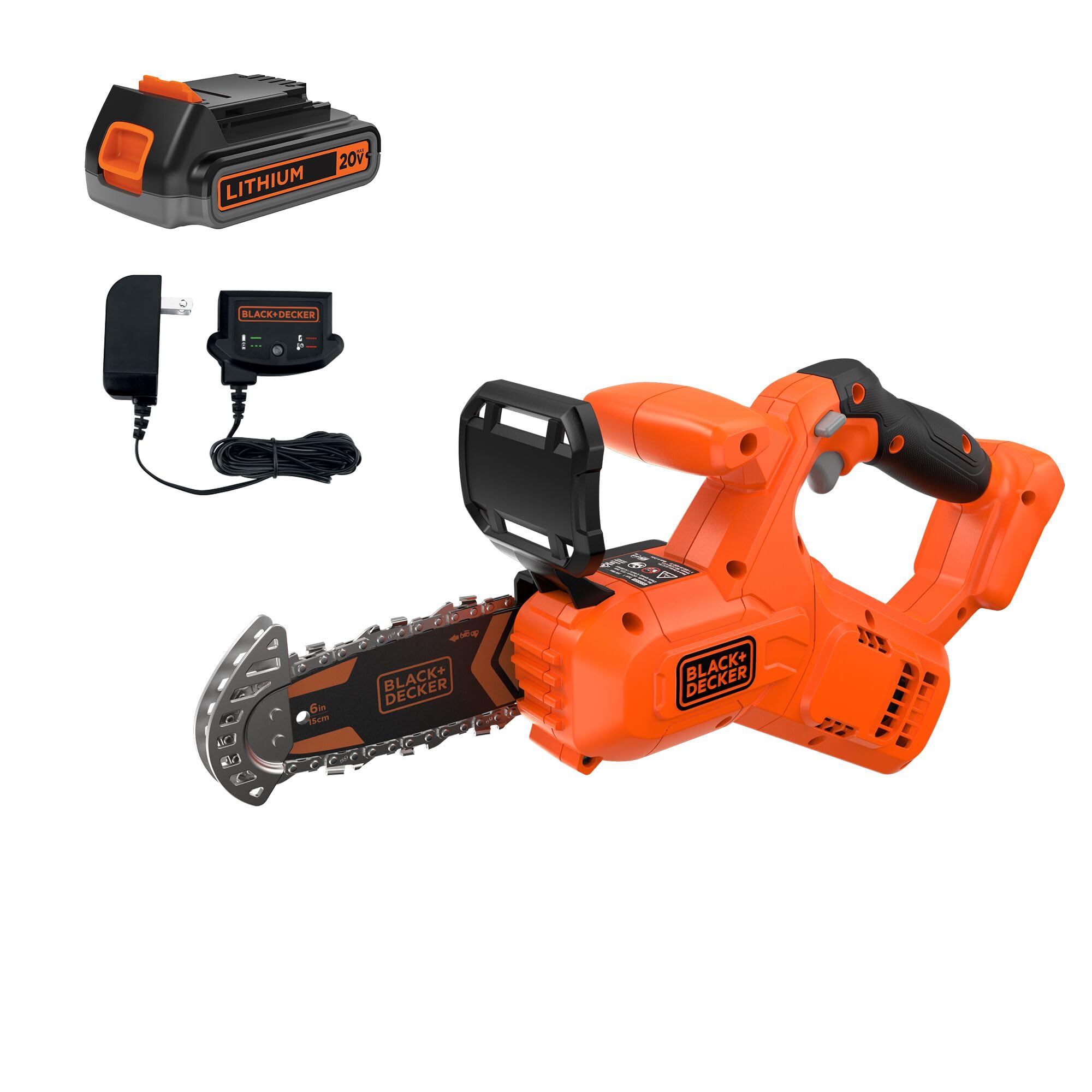
The BLACK+DECKER BCCS320C1 is the most accessible entry point into cordless pruning saws, with a 6-inch bar and a 4-inch cut capacity for small limbs and bushes. The oil-free chain design eliminates the need to carry bar oil, reducing maintenance to occasional hand-sharpening. The 20V MAX 1.5Ah battery delivers roughly 55 cuts per charge, enough for a typical afternoon of light pruning around a standard suburban lot.
Owner feedback highlights its usefulness for camping and trail maintenance as much as yard work. At just over 5 pounds, it’s light enough to toss in a truck bed or backpack. The bolt-lock chain tensioning holds the bar securely, though the included wrench is small and easy to misplace. The chain runs coarse from the factory and some owners note it tends to bind on green, stringy wood rather than slicing through cleanly.
The battery platform is the big advantage — BLACK+DECKER 20V MAX batteries are among the most widely available, making battery swaps easy if you already own their tools. There’s no auto-oiler, so users recommend WD-40 spray for occasional lubrication to extend chain life. For a first pruning saw or a secondary tool for light limbing, it punches above its price tier.
What works
- Oil-free design eliminates bar oil handling and mess
- Lightweight and compact for easy transport and one-handed use
- Widely compatible with existing BLACK+DECKER 20V MAX batteries
What doesn’t
- Chain is coarse from the factory and tends to bind on stringy wood
- No auto-oiler requires manual lubrication for best chain life
- Included wrench is small and easy to lose during field adjustments
7. Husqvarna 350i

The Husqvarna 350i is a full-size 18-inch chainsaw in a battery-powered package, not a pruning saw in the traditional sense. It’s for property owners who want one cordless saw that can fell small trees, split storm debris, and handle heavy limbing — and who are willing to pay for that versatility. The brushless motor with Boost Mode delivers 25% more power on demand, and the X-Cut chain provides lasting sharpness that outperforms typical OEM chains.
Owner experiences are split. Those who use it as a companion to a gas saw praise its instant start, quiet operation, and consistent torque. The tool-less chain tensioning is convenient, but multiple owners report a design weakness: the plastic housing surrounding the chain tensioner can crack or warp if the chain gets pinched, allowing the tensioner to pop out. This is a recurring concern for heavy users who work in dense wood where binding is more likely.
The included 7.5Ah battery delivers 30-45 minutes of continuous cutting, and the charger takes about 6-7 hours for a full recharge. Replacement batteries are expensive. For lighter-duty users who won’t push the saw to its binding limits, the 350i is a powerful alternative to gas. For anyone planning frequent heavy cuts in dirty or knotty wood, the plastic tensioner housing is a genuine long-term reliability question.
What works
- Cutting power comparable to a 50cc gas chainsaw without the noise or fumes
- Boost Mode provides 25% extra torque on demand for tough cuts
- X-Cut chain holds sharpness longer than standard OEM chains
What doesn’t
- Plastic chain tensioner housing is prone to damage if the chain binds
- Replacement batteries are expensive and the included charger is slow
- Heavier than equivalent gas saws, which can cause fatigue during extended use
Hardware & Specs Guide
Bar Length and Chain Pitch
Bar length on a cordless pruning saw directly limits the maximum branch diameter. A 6-inch bar cuts up to 4-inch limbs, an 8-inch bar reaches 6 inches, and a 12-inch bar can handle 8 to 10-inch logs. Chain pitch — the distance between drive links — matters too: 0.325-inch pitch chains are standard on pruning saws and produce smoother cuts than the 3/8-inch low-profile chains found on smaller electric saws. Matching the pitch to the sprocket is essential for proper chain fit and tension.
Battery Voltage and Amp-Hour Rating
Voltage determines the motor’s peak power ceiling, while amp-hour (Ah) rating determines runtime. A 20V saw with a 2.0Ah battery stores 40 watt-hours of energy. A 40V saw with the same 2.0Ah battery stores 80 watt-hours for longer runtime at higher torque. Brushless motors extract more cuts per watt-hour by reducing electrical losses in the motor windings. For heavy pruning, a 4.0Ah or larger battery prevents mid-job swaps.
FAQ
What size bar do I need for pruning fruit and ornamental trees?
Can a cordless pruning saw replace a manual pruning saw or loppers?
Final Thoughts: The Verdict
For most gardeners, the best cordless pruning saw winner is the DEWALT DCCS623L1 because the 8-inch brushless motor with auto-oiler provides the best balance of cut capacity and runtime for property cleanup and branch trimming. If you want ultra-light one-handed operation for arborist work, grab the Makita XCU14Z. And for budget-conscious homeowners who need a single 12-inch saw for both pruning and storm debris, nothing beats the Greenworks CS40B210.