
Specs are compiled from manufacturer listings and verified buyer reviews and can change over time — please confirm the key details on the product page before buying.
If you grow peaches, you already know the heartbreak of walking out to your tree in spring and finding leaves that look blistered, puckered, and red — that is peach leaf curl, the single most common fungal disease that ruins a stone fruit harvest. The right spray stops it before it ever starts, and the active ingredient proven to work is copper. Copper fungicide coats the leaf surface so fungal spores cannot germinate, and when you apply it at the right time (dormant season and again just before bud swell), your tree stays clean through the entire growing season. The trick is picking the right formulation — liquid concentrate, ready-to-use spray, or copper soap — because each one handles coverage, mixing, and convenience differently for the home orchard.
I’m Rikta — the founder and writer behind Lawn Gear Lab. This guide is built by comparing the manufacturers’ published specifications and the patterns across verified customer reviews, so you get each pick’s real strengths and trade-offs instead of marketing spin.
After looking at the active ingredient percentages, bottle sizes, and whether each product is labeled for peach trees specifically, I settled on the five most effective options to include in this roundup of the best copper fungicide for peach trees.
Quick Picks
- Bonide Captain Jack Copper Fungicide 16 oz Concentrate — Best Overall
- Bonide Captain Jack’s Copper Fungicide, 32 oz Ready-to-Use Spray (Pack of 2) — Premium Pick
- Neudorff Plant Fungicide Concentrate, Copper Soap Fungicide — Best Value
- Monterey Liqui-Cop – Copper Fungicide Garden Spray — Top Performer
- Fertilome (16134) Copper Fungicide Ready to Spray (32 oz) — Easiest to Use
How To Choose The Best Copper Fungicide For Peach Trees
Peach leaf curl is caused by the fungus Taphrina deformans, and the window to stop it is narrow — spray too late and the spores have already infected the buds. Copper fungicide works as a protective barrier, so the key is picking a product that sticks to the bark and buds through winter rains and early spring weather. Here is what to look for.
Active Ingredient: Copper Octanoate vs. Copper Sulfate vs. Basic Copper
Copper octanoate (also called copper soap) is the gentlest on leaves and is the active ingredient in the Bonide and Neudorff products here. It breaks down into soluble copper and fatty acids that microbes and plants can use — so it is less likely to cause leaf burn than older copper sulfate formulas. Copper sulfate (found in Monterey Liqui-Cop) is more potent and long-lasting, but you need to be more careful with concentration on tender new growth. For peach trees in the dormant season, either works; during the growing season, copper soap is safer for young leaves.
Formulation: Concentrate vs. Ready-to-Use vs. Hose-End Spray
A 16 oz concentrate like the Bonide Captain Jack makes several gallons of finished spray — best for multiple trees or a whole orchard. A ready-to-use spray like the Bonide 32 oz bottle is simpler: no measuring, just shake and spray, ideal for one or two small trees. The Fertilome hose-end spray eliminates mixing entirely; you attach it to your garden hose and it dilutes automatically. The trade-off is cost per gallon — ready-to-use is more expensive per application, but you do not waste unused concentrate.
Organic Certification and Harvest Interval
All five products here are approved for organic gardening, but the label language matters. “Approved for organic gardening” means the formulation meets USDA National Organic Program standards. Most copper fungicides can be used up to the day of harvest, which is critical if you are spraying for late-season issues like brown rot on ripening fruit. Always check the “days to harvest” interval on your product label — for peach trees, zero days is common with copper soap, but some copper sulfate products require a 1- to 7-day wait.
Quick Comparison
| Model | Best For | Active Ingredient | Size | Item Weight | Amazon |
|---|---|---|---|---|---|
| Bonide Captain Jack 16 oz Concentrate | Best Overall for Multiple Trees | Copper Octanoate | 16 fl oz (makes several gallons) | 1.3 lbs | Amazon |
| Bonide Captain Jack 32 oz Ready-to-Use | Premium Convenience for Single Trees | Copper Octanoate | 32 fl oz (2 pack) | — | Amazon |
| Neudorff Plant Fungicide Concentrate | Lightweight Concentrate for Small Gardens | Copper Soap | 16 fl oz | 1 lb | Amazon |
| Monterey Liqui-Cop | Premium Potency for Tough Fungus | Copper (Copper-Count-N) | 8 fl oz | 10.8 oz | Amazon |
| Fertilome Copper Fungicide Ready to Spray | Hose-End Simplicity for Large Orchards | Copper | 32 oz (hose-end) | 2.26 lbs | Amazon |
In‑Depth Reviews
1. Bonide Captain Jack Copper Fungicide 16 oz Concentrate

The budget-friendly concentrate that gives you gallons of peach leaf curl protection from one small bottle.
This is the 16 oz concentrate version of the same copper octanoate (copper soap) formula that Bonide also sells as a ready-to-use spray. Because it is a concentrate, you mix it with water according to the package directions — one bottle makes several gallons of finished spray, which is the most cost-effective way to treat multiple peach trees or a full row of stone fruit. At 1.3 pounds for the bottle, it is light to handle but packs enough active ingredient for a full season of dormant and growing-season sprays.
Buyers report that diluted concentrate sprayed 4x a week (as the disease pressure demanded) on tomatoes stopped all fungi and blight issues with fewer leaves clipped compared to homemade remedies. One reviewer noted the dark neon blue liquid stains hands and clothes, so wear gloves you do not mind marking. Unlike the heavier Fertilome hose-end spray (2.26 pounds vs. this 1.3-pound bottle), this Bonide concentrate gives you more control over dilution rates — you adjust the concentration depending on whether you are treating dormant trees or active growth.
The label lists peach leaf curl directly and covers black spot, powdery mildew, and blight. It is approved for organic gardening and can be used up until the day of harvest, so you can spray for late-season brown rot without worrying about timing.
What Works
- 16 oz concentrate makes multiple gallons — best per-tree value
- Approved for organic gardening and safe up to day of harvest
- Controls peach leaf curl, blight, black spot, and powdery mildew
- Copper soap formula is gentle on leaves compared to copper sulfate
Watch for
- Neon blue liquid stains hands, clothes, and fences
- Requires precise measuring and mixing — not grab-and-go
- Heavy or frequent use can cause leaf burn on sensitive plants
Reach for this if: you have more than one peach tree and want the lowest cost per application from an organic concentrate that specifically lists peach leaf curl.
Look elsewhere if: you only have one small tree and prefer not to mix — a ready-to-use spray will be simpler.
2. Bonide Captain Jack’s Copper Fungicide, 32 oz Ready-to-Use Spray (Pack of 2)

The grab-and-go spray bottle that one buyer credits with wiping out peach tree fungus in a single season.
If you have one or two peach trees and do not want to measure concentrate, this is the most convenient option. It comes as a two-pack of 32 oz trigger spray bottles, and the liquid is already mixed to the right concentration — you just shake well and spray every surface of the trunk, branches, and buds. Unlike the concentrate version, you do not need a separate sprayer or mixing bucket, so it is ready the moment you spot the first signs of peach leaf curl in early spring.
One buyer mentioned that the spray visibly reduced red fungus on their peach tree after the first application, and by the next year there was zero fungus — the tree was healthier. Another buyer saved five tomato plants from early-season blight within three weeks by removing spotted leaves and spraying the rest. The non-toxic smell and even coverage were noted as advantages over sulfur-based sprays. This is the same copper octanoate formula as the concentrate above, so it is also USDA organic and safe up to day of harvest.
The trade-off is cost per gallon — ready-to-use is more expensive than mixing your own concentrate. But for a home grower with a single peach tree, the convenience of not storing half-used concentrate for next season often wins.
Why It Works
- No mixing required — shake and spray directly on the tree
- Pack of 2 gives you a full season’s supply for small orchards
- Owners mention it eliminated peach tree red fungus by the second year
- Non-toxic smell and good sprayer coverage
Trade-offs
- Higher cost per application than concentrate
- Two 32 oz bottles may not cover large, mature trees
- Requires consistency and patience — results build over multiple sprays
Best for the hands-off grower: if you want to spray and forget, with no mixing steps, this is the pick for one or two peach trees.
Skip if: you have more than three trees or want the lowest cost per gallon — buy the concentrate instead.
3. Neudorff Plant Fungicide Concentrate, Copper Soap Fungicide
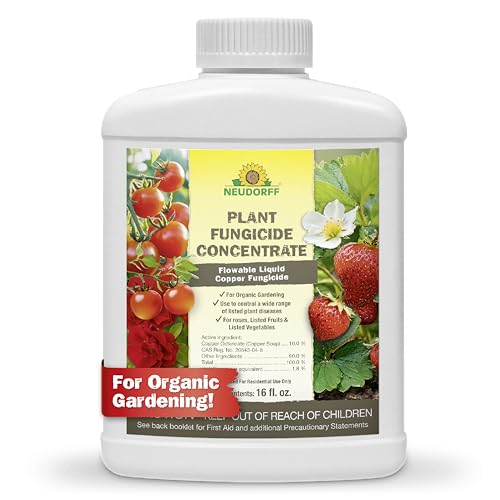
The lightest copper concentrate on the shelf at 1 pound, yet it still targets peach leaf curl directly.
Neudorff’s copper soap concentrate is listed for peach leaf curl, powdery mildew, black spot, rusts, downy mildew, late blight, and fruit rot — basically every fungal issue a peach tree can face in a humid season. At just 1 pound for the 16 oz bottle, it is significantly lighter than the 2.26-pound Fertilome spray, making it easy to handle if you are carrying multiple bottles to the orchard. The active ingredient (copper soap) decomposes into soluble copper and fatty acid, both of which are usable by microbes and plants, so you are putting less synthetic residue into the soil.
This concentrate is designed for home gardens, greenhouses, and indoor plants — but its label specifically includes fruit trees, so it is a valid pick for your peach tree. Like the Bonide concentrate, you mix it with water and apply with a pump or hose-end sprayer. Unlike the Monterey Liqui-Cop, which uses a different copper formulation, Neudorff’s copper soap is gentler on young leaves during the growing season, so you can use it for both dormant and in-season sprays without worrying about leaf burn as much.
The main caution is that it has fewer independent buyer reviews available than the Bonide products, so you are relying more on the manufacturer’s claims. However, the formulation is proven — copper soap is the same active ingredient used in the top-rated Bonide Captain Jack line.
Standout Points
- Very light at 1 pound — easiest to carry and store
- Specifically labels peach leaf curl on the bottle
- Copper soap breaks down naturally, safe for soil microbes
- Can be used up to day of harvest
Consider This
- Newer product with fewer customer reviews to gauge real-world performance
- Requires mixing and a separate sprayer
- Stronger copper sulfate formulas may work faster on stubborn infections
Choose this if: you want a lightweight concentrate with the gentlest copper formula for peach trees, and you trust the proven copper soap chemistry even without hundreds of reviews.
Pass if: you prefer a product with a long track record of buyer photos and testimonials — the Bonide concentrate has years of reviews backing it.
4. Monterey Liqui-Cop – Copper Fungicide Garden Spray
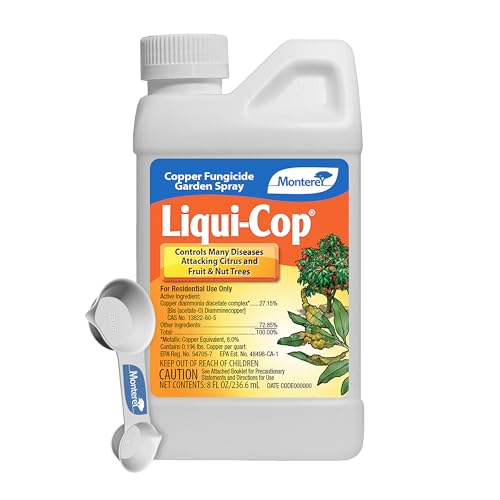
The most concentrated copper punch in the lightest bottle — 8 ounces of straight disease prevention.
Monterey Liqui-Cop uses a different copper chemistry than the Bonide and Neudorff copper soap products. Its active ingredient is a copper formulation often called Copper-Count-N, which is a fixed copper compound that provides a longer-lasting protective film on plant surfaces. This makes it a strong choice for peach trees in regions with heavy spring rainfall, where a copper soap might wash off faster and require more frequent reapplication. At just 10.8 ounces for the 8 oz bottle, it is the lightest product here by weight, yet the concentrate is potent — a little goes a long way.
The label lists anthracnose, brown rot, blight, downy mildew, botrytis blight, and leaf spot — all of which affect stone fruit trees. However, the manufacturer emphasizes that copper fungicides are preventative, not curative, meaning you must spray before the fungus infects the tree. For peach leaf curl, that means a thorough dormant spray before bud break, then a follow-up when the buds swell. Unlike the Fertilome spray, which is a hose-end ready-to-use, this Monterey concentrate needs mixing with water in a separate sprayer.
Because this is a fixed copper rather than a copper soap, it is slightly more likely to cause leaf burn if you use too high a concentration during the growing season. Stick to the label rates and you will be fine. The smaller 8 oz bottle is ideal if you only need to treat one or two trees and do not want a half-full bottle of concentrate sitting around for years.
What Makes It Different
- Fixed copper provides longer-lasting rain-resistant film than copper soap
- Extremely lightweight at 10.8 oz — the most portable option
- Targets brown rot, blight, and leaf spot for stone fruit
- Small bottle means less waste if you only have a few trees
Keep in Mind
- Faster and more potent, but slightly higher risk of leaf burn if over-mixed
- Requires mixing and a sprayer — not ready-to-use
- Fewer buyer reviews available for this specific listing
Reach for this if: you want the most concentrated and rain-resistant copper protection for your peach trees in a wet climate, and you are comfortable mixing your own spray.
Look elsewhere if: you prefer the gentler copper soap formula for in-season use on young leaves — go with Bonide or Neudorff instead.
5. Fertilome (16134) Copper Fungicide Ready to Spray (32 oz)
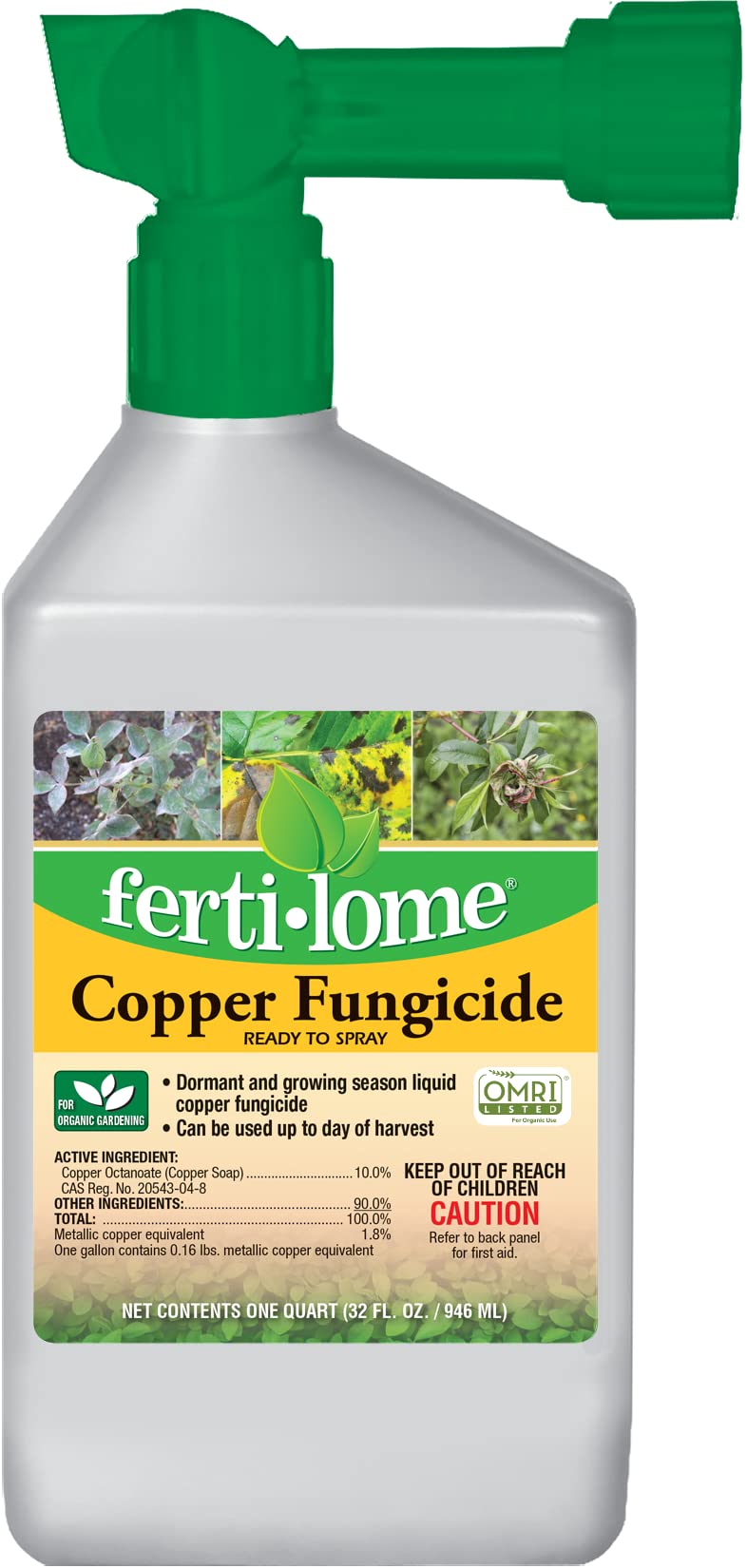
The hose-end spray that does the mixing for you — just attach and cover your entire peach orchard.
Fertilome’s copper fungicide is a ready-to-spray formulation that hooks directly to your garden hose. You do not mix anything; the bottle has a built-in dilution dial. This is the best option if you have multiple peach trees or a large orchard, because you simply turn on the water and walk the spray pattern down each row. At 2.26 pounds, it is the heaviest bottle in this lineup (more than double the 1-pound Neudorff), but the weight comes from the hose-end mechanism, not the copper concentrate itself.
The label is comprehensive: it lists peach leaf curl, needle blight, blackspot, anthracnose, leaf and fruit spot, cedar apple rust, powdery mildew, and early and late blight on tomatoes. It is OMRI listed for organic gardening, so you can use it on produce right up to harvest day. Because it is a copper fungicide (not copper soap), it provides both preventative and treatment action — the label says it is effective for both preventing and treating active diseases in plants, which is a stronger claim than the “preventative only” language on the Monterey Liqui-Cop.
The catch is that a hose-end sprayer uses more total water volume, so you go through the bottle faster than you would with a concentrate. If you only have one small peach tree, a ready-to-use trigger spray or a small concentrate bottle will last you multiple seasons. This Fertilome bottle is built for coverage — large trees, full rows, or a mixed vegetable garden alongside your fruit trees.
Why It Stands Out
- Hose-end dial mixes automatically — zero measuring or mixing
- Treats and prevents peach leaf curl, not just prevention
- OMRI listed for organic gardening, safe up to harvest
- Covers large trees and full orchards faster than any trigger spray
Be Aware Of
- Heaviest bottle at 2.26 pounds — less portable than other options
- Higher water usage means the bottle empties faster than concentrate
- Overkill for a single small peach tree
Best for the grower with a full orchard: if you have three or more peach trees and want to spray without mixing, the hose-end system saves time and effort.
Not ideal if: you only have one small tree — the 32 oz ready-to-use spray or a small concentrate bottle will be more practical and last longer.
Understanding the Specs
Copper Octanoate vs. Fixed Copper
Copper octanoate (copper soap) is the active ingredient in the Bonide and Neudorff products. It breaks down into soluble copper and fatty acid that soil microbes can process, so it is gentler on leaves and the environment. Fixed copper (used in Monterey Liqui-Cop and Fertilome) forms a longer-lasting film on the plant surface that resists rain better, but it can cause leaf burn if you use too high a concentration during active growth. For peach trees, copper soap is safer for in-season sprays, while fixed copper is excellent for dormant-season applications where the tree has no leaves.
Concentrate vs. Ready-to-Use vs. Hose-End
A 16 oz concentrate (Bonide, Neudorff, Monterey) makes multiple gallons of spray — you mix it in a pump sprayer or hose-end attachment. This gives you the lowest cost per gallon and the most control over dilution rates. A ready-to-use spray (Bonide 32 oz) is pre-mixed in a trigger bottle — no measuring, but higher cost per ounce. A hose-end spray (Fertilome) attaches to your garden hose and automatically dilutes as you spray, which is the fastest method for covering large areas but uses more water per application.
FAQ
When should I spray copper fungicide on my peach tree?
Will copper fungicide cure peach leaf curl after I see it?
Is copper fungicide safe for bees and pollinators?
Can I use copper fungicide on peach trees during the growing season?
How often should I reapply copper fungicide to peach trees?
What is the difference between copper fungicide and sulfur fungicide for peach trees?
Is copper fungicide safe to use up to the day of harvest?
Will copper fungicide stain my peach tree or the fruit?
How much copper fungicide do I need for one mature peach tree?
Can I mix copper fungicide with other pesticides or fertilizers?
Final Thoughts: The Verdict
For most peach tree growers, the best copper fungicide for peach trees winner is the Bonide Captain Jack 16 oz Concentrate because it gives you the best balance of cost per gallon, organic certification, and proven peach leaf curl control through years of buyer reviews. If you want the ultimate convenience for a single tree, grab the Bonide Captain Jack 32 oz Ready-to-Use (Pack of 2) — no mixing, just spray. And for large orchards where speed matters, the Fertilome Ready to Spray hose-end system lets you walk your entire row without stopping to refill a sprayer.
How We Picked
We do not accept paid placement. Every pick is matched to a real buyer and a real use-case; we do not hands-on test units.
Sources & Methodology
Specifications: manufacturer listings and product documentation. Review insights: verified customer reviews, as of July 2026. Pricing: not shown on this page (it changes often); check the current price via the retailer link.
As an Amazon Associate, Lawn Gear Lab earns from qualifying purchases. This does not affect which products we feature.