
Matching a fertilizer’s release rate to a plant’s growth cycle is the single most underappreciated skill in gardening. Get it wrong and you either burn tender roots with a sudden salt surge or watch your plants yellow from starvation while the granules sit inert. Controlled release fertilizers solve that tension by locking nutrients inside a semi-permeable coating that meters out food based on soil temperature, delivering a steady supply exactly when roots are active enough to take it in.
I’m Rikta — the co-founder and writer behind Lawn Gear Lab. I’ve spent hundreds of hours analyzing NPK ratios, coating technologies, and release curves across dozens of formulations to find which products actually deliver on their feeding window promises rather than flushing away after two rainstorms.
Whether you’re tending container vegetables, established perennials, or a lawn that needs season-long nutrition without weekly reapplications, this guide to the best controlled release fertilizer breaks down the seven top contenders by their real-world performance, nutrient composition, and ideal use case.
How To Choose The Best Controlled Release Fertilizer
Not all granular fertilizers release their nutrients on the same timeline. Understanding the coating system, the NPK analysis, and the target application will prevent the two most common mistakes: overfeeding sensitive plants and underfeeding heavy feeders during peak growth.
Release Technology and Coating Integrity
True controlled release fertilizers use a polymer or sulfur-based coating that allows water to diffuse through the prill shell at a rate governed by soil temperature. Cheap “slow release” products often rely on simple water solubility of organic materials, which means a heavy rain can dump the entire nitrogen load at once. Look for products that specify a release duration in months rather than vague language about “gradual feeding.”
NPK Ratio and Plant Type
The three numbers on the bag tell you the percentage of nitrogen, phosphorus, and potassium by weight. Leafy vegetables and lawns want a higher first number (nitrogen) for green growth. Flowering and fruiting plants benefit from a higher middle number (phosphorus) to support bud set and root development. A balanced 4-4-4 formulation works as a general-purpose option, while a 16-4-4 spike targets woody plants that need sustained nitrogen without excessive phosphorus runoff.
Application Form and Convenience
Granular prills are the most common form and can be broadcast, banded, or top-dressed. Spikes eliminate measuring and are ideal for individual trees and shrubs where you want to deliver nutrients directly to the root zone without broadcasting across bare soil. Liquid concentrates offer the fastest uptake but provide the shortest feeding window, so they are not true controlled release options unless combined with a polymer suspension.
Quick Comparison
On smaller screens, swipe sideways to see the full table.
| Model | Category | Best For | Key Spec | Amazon |
|---|---|---|---|---|
| FoxFarm Happy Frog | Granular | All-purpose organic feeding | 6-4-5 NPK with soil microbes | Amazon |
| Espoma Rose-Tone | Granular | Roses and flowering shrubs | 4-3-2 NPK with Bio-tone | Amazon |
| Nelson ColorStar | Granular | Long-lasting bloom boost | 5 nitrogen sources, 4-5 month feed | Amazon |
| Great Big Roses Liquid | Liquid | Root-zone soil activation | 70 trace minerals + humic acid | Amazon |
| Jobe’s Organics 4-4-4 | Granular | Large vegetable gardens | 16 lb bag, OMRI listed 4-4-4 | Amazon |
| Jobe’s Tree Spikes 16-4-4 | Spikes | Deep-rooted trees and shrubs | 30 spikes, 16-4-4 time release | Amazon |
| Nelson Crape Myrtle NutriStar | Granular | Flowering trees (crape myrtle, orchid) | 10-15-19 high phosphorus blend | Amazon |
In‑Depth Reviews
1. FoxFarm Happy Frog All Purpose Fertilizer

FoxFarm Happy Frog hits a rare sweet spot: a 6-4-5 NPK that skews slightly higher in nitrogen for green growth without sacrificing the phosphorus and potassium needed for flower and root development. The granular form is loose and dry, spreading easily by hand or with a small spreader, and it incorporates beneficial soil microbes and mycorrhizal fungi that continue working after the initial nutrient release. The OMRI listing confirms it meets organic production standards, which matters for edible beds.
User feedback shows it revived yellowing tomato and zucchini plants within a week of monthly application, with many gardeners reporting they use only half a bag per year for a modest garden. The primary complaint is the strong manure-like odor, which is intense enough that indoor use requires open windows or very small doses. Some users noted that if applied too thickly, a white mold forms on the soil surface after watering — this is harmless but visually unappealing.
For a mid-range organic granular that bridges the gap between gentle feeding and noticeable results, Happy Frog is hard to beat. The 4-pound bag is compact enough for smaller gardens and container growers, and the microbial additives give it an edge over straight fertilizer blends that lack soil biology support.
What works
- Balanced 6-4-5 ratio suits a wide range of plants
- Includes active soil microbes and mycorrhizae for root health
- Loose, dry granules spread evenly without clumping
What doesn’t
- Strong manure odor lingers after application
- Overapplication can cause surface mold on potting soil
- 4-pound bag is small for large in-ground beds
2. Jobe’s Organics Granular All Purpose Fertilizer 4-4-4

Jobe’s Organics delivers the largest volume in this lineup at 16 pounds, making it the clear choice for gardeners with substantial vegetable beds, multiple shrubs, or a lawn that needs organic feeding. The balanced 4-4-4 ratio provides even nutrition without pushing excessive foliage growth at the expense of flowers or fruits. The granules are friable and green-tinted, spreading cleanly through a hand-crank spreader without producing the dusty cloud that plagues some powdered organic products.
User reports consistently highlight dramatic yield increases — one gardener noted their squash, cucumber, and pepper plants responded so well the family “got really sick of eating squash.” The product can also be steeped in water to create a liquid feed, with flowers opening within 48 hours of application. The smell, while present, is described as milder than raw manure, which is a meaningful improvement over many organic fertilizers.
Jobe’s is OMRI listed and free of synthetic chemicals, so it fits into organic production systems. The 4-4-4 formulation is intentionally conservative, which means heavy feeders may need more frequent applications than a higher-nitrogen blend, but the risk of burning roots is correspondingly low. For the price per pound, this is one of the best values in organic controlled release feeding.
What works
- Large 16-pound bag covers extensive garden areas
- Balanced 4-4-4 ratio works on vegetables, shrubs, and lawns
- Can be used as a steeped liquid fertilizer for faster uptake
What doesn’t
- Nitrogen content is moderate for heavy-feeding crops like corn
- Pungent odor, though milder than straight manure
- Requires reapplication every 2-3 weeks during peak growth
3. Nelson Plant Foods ColorStar Outdoor & Indoor Plant Fertilizer
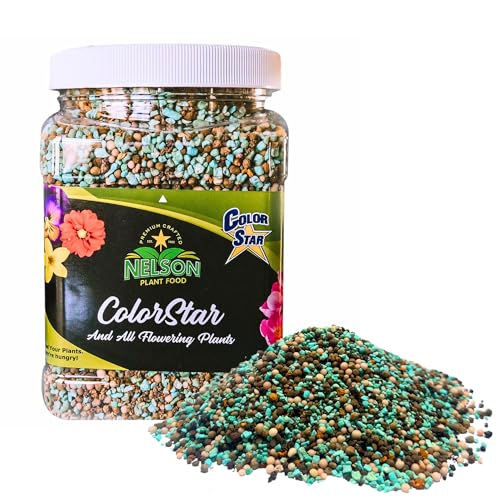
ColorStar is engineered specifically for bloom production, using five distinct nitrogen sources — including ureaform and ammoniated phosphate — that release at different rates over a 4- to 5-month window. This staggered-release approach prevents the mid-season crash that occurs when a single-source fertilizer exhausts its nitrogen supply. The bag contains 25% bone and blood meal, providing both slow-release phosphorus and organic iron to deepen flower color and foliage richness.
Hydrangea growers report significantly fuller blooms after a single spring application, and bedding plant users note that the jar, while compact, packs enough concentration to cover a full season of annuals and perennials. The 2-pound container is small relative to its price, which is the most consistent criticism — gardeners with large in-ground flower beds will need multiple jars to cover the space.
This is not a general-purpose fertilizer; the formulation is optimized for flowering plants, so using it on leafy greens or turf would produce unbalanced growth. But for anyone whose primary goal is bigger, longer-lasting blooms from a single application, the release profile of ColorStar justifies the premium positioning. The micronutrient suite — including chelated iron, zinc, and manganese — addresses the most common deficiencies that limit flower size.
What works
- Five nitrogen sources provide consistent feeding for up to 5 months
- High bone and blood meal content boosts bloom size and color
- Micronutrient blend prevents common flowering-plant deficiencies
What doesn’t
- Small 2-pound container is expensive for large flower beds
- Not suitable for vegetables or lawns due to bloom-specific ratio
4. Great Big Roses and Flowers Liquid Fertilizer Booster
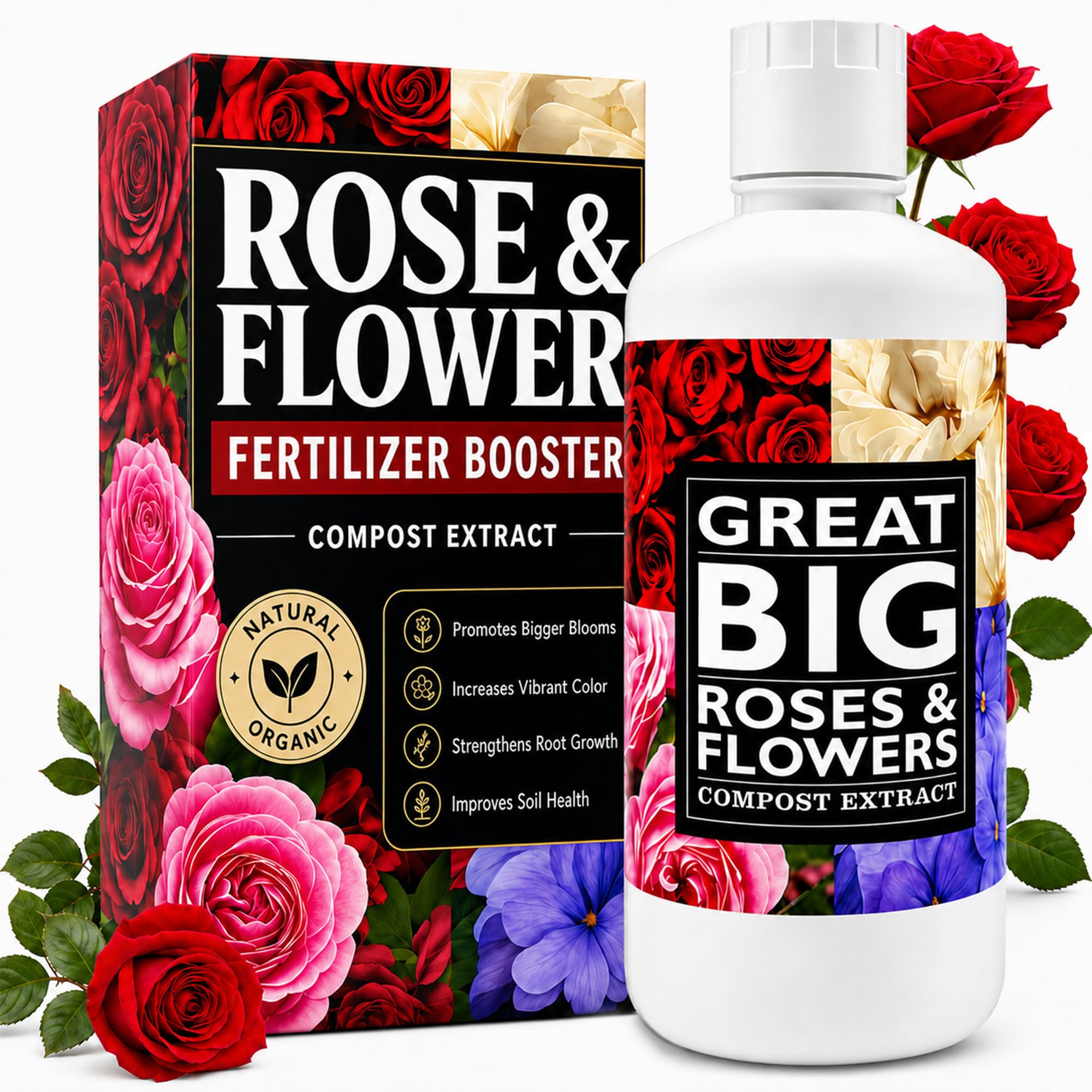
This liquid concentrate takes a fundamentally different approach from the granular products on this list. Rather than delivering a fixed NPK dose, Great Big Roses functions as a soil activator, supplying humic acids, seaweed extract, and over 70 chelated trace minerals that convert existing nutrients in the soil into plant-available forms. It amplifies the effect of whatever fertilizer base you are already using rather than replacing it, which makes it a companion product rather than a standalone feed.
User reports describe rose bushes that had not bloomed in years producing flowers within weeks of the first application. The concentrate mixes at 4 ounces per gallon of water, and a single 32-ounce bottle covers an entire growing season for most gardens. The liquid form moves quickly into the root zone without the delay of granular dissolution, which is ideal for correcting deficiencies mid-season or jump-starting stressed plants.
The jug design is a pain point — the wide mouth makes measuring into a watering can messy, and spillage of a concentrated product this expensive is frustrating. Additionally, because it works by activating the existing soil nutrient pool, it is less effective in heavily depleted or sandy soils that have few nutrients to unlock. For gardeners with decent soil who want to push their flowers to the next level, this is a potent tool.
What works
- Activates soil-bound nutrients for immediate plant uptake
- 70 trace minerals and humic acids improve overall soil biology
- Concentrated formula: one bottle covers a full growing season
What doesn’t
- Wide-mouth jug makes spill-free measuring difficult
- Relies on existing soil fertility — less effective in poor soils
- Not a complete fertilizer; best used alongside a base feed
5. Jobe’s Tree Fertilizer Spikes 16-4-4

For deep-rooted trees and shrubs, Jobe’s spikes bypass the issue of surface-applied fertilizer that never reaches the active root zone. Each spike is pressed into the soil along the drip line, where it dissolves gradually over the season, delivering a high-nitrogen 16-4-4 blend directly to the roots. The spike format eliminates measuring, runoff, and the risk of broadcast fertilizer landing on hardscape or grass where it does nothing for the target plant.
Users report that drought-stressed trees recovered after a single season of spike application, and shrubs like hydrangea, lilac, and rose of Sharon responded with consistent annual growth and blooming. The spikes are easiest to install in damp soil or pre-drilled holes; hard, dry ground can make insertion difficult without bending or breaking the spike. The 16-4-4 ratio is heavily weighted toward nitrogen, which is ideal for foliage and structural growth but less suited for flowering plants that need more phosphorus.
At 30 spikes per pack, this is an economical solution for homeowners with multiple trees or a shrub line that needs season-long feeding. The controlled release mechanism prevents the nitrogen burn that can occur with quick-release granular fertilizers applied to the root zone, and the absence of any mixing or measuring makes it one of the most user-friendly options in the category.
What works
- Spike format delivers nutrients directly to tree root zones
- No mixing, measuring, or runoff — just hammer into soil
- High nitrogen content supports vigorous foliage and branch growth
What doesn’t
- Hard, dry soil requires pre-drilling holes for installation
- 16-4-4 ratio is too nitrogen-heavy for flowering shrubs
- Not suitable for container plants or shallow-rooted annuals
6. Espoma Organic Rose-Tone 4-3-2

Espoma’s Rose-Tone is a purpose-built organic fertilizer for roses and flowering shrubs, formulated with a 4-3-2 analysis that prioritizes balanced growth while adding 5% calcium for cell wall strength and disease resistance. The Bio-tone formula includes beneficial microbes that continue breaking down organic matter in the soil after the initial nutrients are released. The 4-pound bag covers roughly 16 square feet when applied monthly through the growing season.
User reviews consistently report that drift roses went from spindly to vibrant after one cup per plant per month, with dramatically increased flower production. The product is approved for organic gardening and registered as an Organic Input Material, so it fits into certified organic production systems. The odor is present but manageable, especially compared to straight manure-based products. Some users noted the bag is smaller than expected, though the recommended application rate is low enough that it goes further than it appears.
Rose-Tone is also labeled for use on viburnum, bougainvillea, clematis, and other flowering ornamentals, making it a versatile option for mixed flower borders. The monthly application schedule means you will need to plan for repeat feedings through May to September, but the controlled release nature of the organic ingredients provides a gentler feeding curve than synthetic bloom boosters, reducing the risk of salt buildup.
What works
- Targeted 4-3-2 ratio with added calcium for rose health
- OMRI-approved for organic production systems
- Low application rate means the bag covers more plants than expected
What doesn’t
- Requires monthly reapplication during the growing season
- Mild odor may be noticeable in enclosed garden spaces
- 4-pound bag is small for large rose gardens with many bushes
7. Nelson Crape Myrtle & All Flowering Trees NutriStar 10-15-19
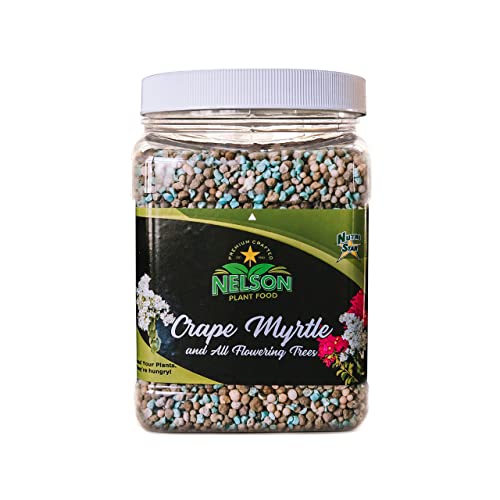
NutriStar takes a high-phosphorus approach with a 10-15-19 analysis, pushing the middle and last numbers to encourage flowering and root development in woody ornamentals. This is a specialized formula for plants that need a strong bloom push — crape myrtle, desert willow, mimosa, orchid trees, and similar species that can be stubborn about flowering. The granular form is applied to the soil surface around the drip line and watered in.
User reports are striking: one gardener whose orchid tree had not bloomed in years saw white flowers appear two weeks after application. Another noted that their crape myrtle, which had struggled to leaf out fully for several seasons, “flourished” after switching to NutriStar. The 4-pound container is compact — multiple users commented on the high price relative to the volume — and a single container lightly fertilizes about five small trees before needing a refill.
The 10-15-19 ratio is the highest phosphorus and potassium concentration in this roundup, which means it should be used only on plants that respond to bloom-boosting nutrition. Applying it to lawns or leafy greens would waste the phosphorus and risk runoff into waterways. For the specific task of forcing reluctant flowering trees into bloom, the release chemistry of NutriStar delivers results that lower-phosphorus blends cannot match.
What works
- High phosphorus and potassium formulation triggers heavy blooming
- Proven results on stubborn non-flowering trees
- Granular form is easy to apply and water in
What doesn’t
- Small container size limits coverage for large or multiple trees
- Expensive per pound compared to general-purpose blends
- Overly specialized for mixed gardens with diverse plant types
Hardware & Specs Guide
Polymer vs. Sulfur Coating
True controlled release fertilizers typically use a polymer resin coating that allows water vapor to diffuse through the shell at a rate governed by soil temperature. Sulfur-coated prills are cheaper but tend to release unevenly due to cracking during handling. Polymer-coated prills offer the most predictable release curve, typically spanning 3 to 9 months depending on the thickness of the shell and the temperature of the soil.
NPK Ratio Interpretation
The three-number analysis is a percentage by weight. A 16-4-4 product, like the Jobe’s tree spikes, contains 16% nitrogen, 4% phosphorus, and 4% potassium. The remainder is filler material and micronutrients. Matching the ratio to your plant’s growth stage is important: high first numbers push leaves, high middle numbers push flowers and roots, high last numbers push fruit development and stress tolerance.
FAQ
How long does controlled release fertilizer actually feed my plants?
Can I use a high-phosphorus bloom fertilizer on vegetable plants?
Final Thoughts: The Verdict
For most gardeners, the best controlled release fertilizer winner is the FoxFarm Happy Frog All Purpose because it combines a practical 6-4-5 ratio with beneficial soil microbes in an OMRI-listed organic format that works across containers, vegetables, and ornamentals. If you want long-lasting bloom feeding from a single spring application, grab the Nelson ColorStar. And for feeding mature trees without the hassle of measuring granular fertilizer, nothing beats the Jobe’s Tree Spikes 16-4-4 for convenient, targeted root-zone nutrition.