
Specs are compiled from manufacturer listings and verified buyer reviews and can change over time — please confirm the key details on the product page before buying.
You dump a bag of garden dirt into a pot and it turns into concrete. That is the problem with using the wrong stuff. A good potting mix stays fluffy, holds just enough moisture, and drains the rest — all while feeding roots. The right bag makes the difference between a balcony full of blooms and a pot of brown mush.
I’m Rikta — the founder and writer behind Lawn Gear Lab. This guide is built by comparing the manufacturers’ published specifications and the patterns across verified customer reviews, so you get each pick’s real strengths and trade-offs instead of marketing spin.
Repotting a houseplant or filling a dozen vegetable containers on the deck? Knowing which bag does what takes the guesswork out of the process. These are the best container soil picks broken down by volume, ingredients, and real-world performance.
Our Picks at a Glance

How To Choose The Best Container Soil
Container soil is not dirt — it is an engineered blend of ingredients designed to do three things in a confined pot: hold roots, hold air, and hold water in the right balance. Picking the wrong one means either drowning the roots or watching them dry out between waterings. Here are the specs that actually matter.
Volume — Small Bags vs. Bulk
Volume is listed in quarts or cubic feet, and the difference is bigger than it looks. One cubic foot equals roughly 30 dry quarts. If you are filling multiple 14-inch or 5-gallon containers, a single 2 cu. ft. bag saves you from buying three smaller bags. For a single houseplant or a few herb pots, an 8-quart bag is easier to store and carry.
Moisture Control — The AquaCoir Factor
Some mixes add a wetting agent and extra coir (coconut fiber) to absorb and hold more water than standard peat-based soil — up to 33% more by some formulations. This is a lifesaver for containers that sit in full sun or for anyone who tends to underwater. The trade-off is that the same soil can stay too wet for succulents or cacti.
Fertilizer — Slow-Release vs. No Feed
Many potting mixes include a starter fertilizer or a slow-release feed that lasts several months. This saves you from mixing liquid fertilizer every week, but it also means you cannot control the nutrient ratio yourself. If you prefer to custom-feed your plants, look for a soil with no added fertilizer so you are working from a blank slate.
Quick Comparison
| Model | Best For | Volume | Weight | Key Additives | Amazon |
|---|---|---|---|---|---|
| Miracle-Gro Moisture Control★ Best Overall | Watering forgiveness | 2 cu. ft. | 40.5 lb | AquaCoir | Amazon |
| Coast of Maine Bar HarborBest Organic | Premium all-purpose organic | 16 qt | 14 lb | Lobster & crab meal, kelp | Amazon |
| Coast of Maine Tomato & Veg | Organic vegetable growing | 20 qt | — | Composted manure, peat | Amazon |
| Black Gold Organic 2-Pack | Gnat-free indoor pots | 8 qt | — | Organic compost | Amazon |
| Espoma Organic 2-Pack | Precise organic feeding | 8 qt | — | Myco-Tone, kelp, worm castings | Amazon |
| Michigan Peat All Purpose | Bulk raised beds & big pots | 50 lb | 50 lb | Reed sedge peat, perlite, sand | Amazon |
| Miracle-Gro Potting Mix 2-Pack | Value packs for daily planting | 1 cu. ft. (2 bags) | — | Slow-release fertilizer | Amazon |
In‑Depth Reviews
1. Miracle-Gro Moisture Control Potting Mix
Our pick — over 4.5★ from 950+ verified ratings; the strongest balance of quality and price.
The heavy-lifter that catches your watering mistakes before the roots do.
This is the bag you grab when you want a safety net. Its AquaCoir formula (a blend of sphagnum peat moss, coir, and a wetting agent) absorbs up to 33% more water than basic potting soil. That means you can miss a watering day and your plant barely notices. It also releases excess water, so you do not rot the roots during a rainy week. At 40.5 pounds for 2 cu. ft., this is a hefty bag — buyers report it is heavy enough that home delivery beats hauling it from a store.
Owners mention a dramatic result with vegetables: two weak pepper plants transplanted into pure Moisture Control made a 100% turnaround. They grew faster with greener foliage and caught up in fruit production, while garden-soil plants struggled. The mix also feeds plants for up to 6 months, so you skip the liquid fertilizer schedule. One reviewer noted the fine texture and few sticks make it good for seed starting. No bugs reported, which is a common worry with bagged soil.
It costs more per bag than basic mixes, but the volume covers two 14-inch containers. That makes it a practical choice for anyone filling multiple pots. The catch is that “moisture control” means it can stay too wet for succulents or cacti — stick with this for flowers, vegetables, and general container plants.
The smart buy: If you want a near-simple to use mix that forgives inconsistent watering and feeds all season, this is the one. skip it if you need a dry, fast-draining blend for desert plants.
Reach for this if: You container-garden with flowers, vegetables, or shrubs and want the widest safety margin on watering. Look elsewhere if: You are growing succulents, cacti, or any plant that demands very fast drainage.
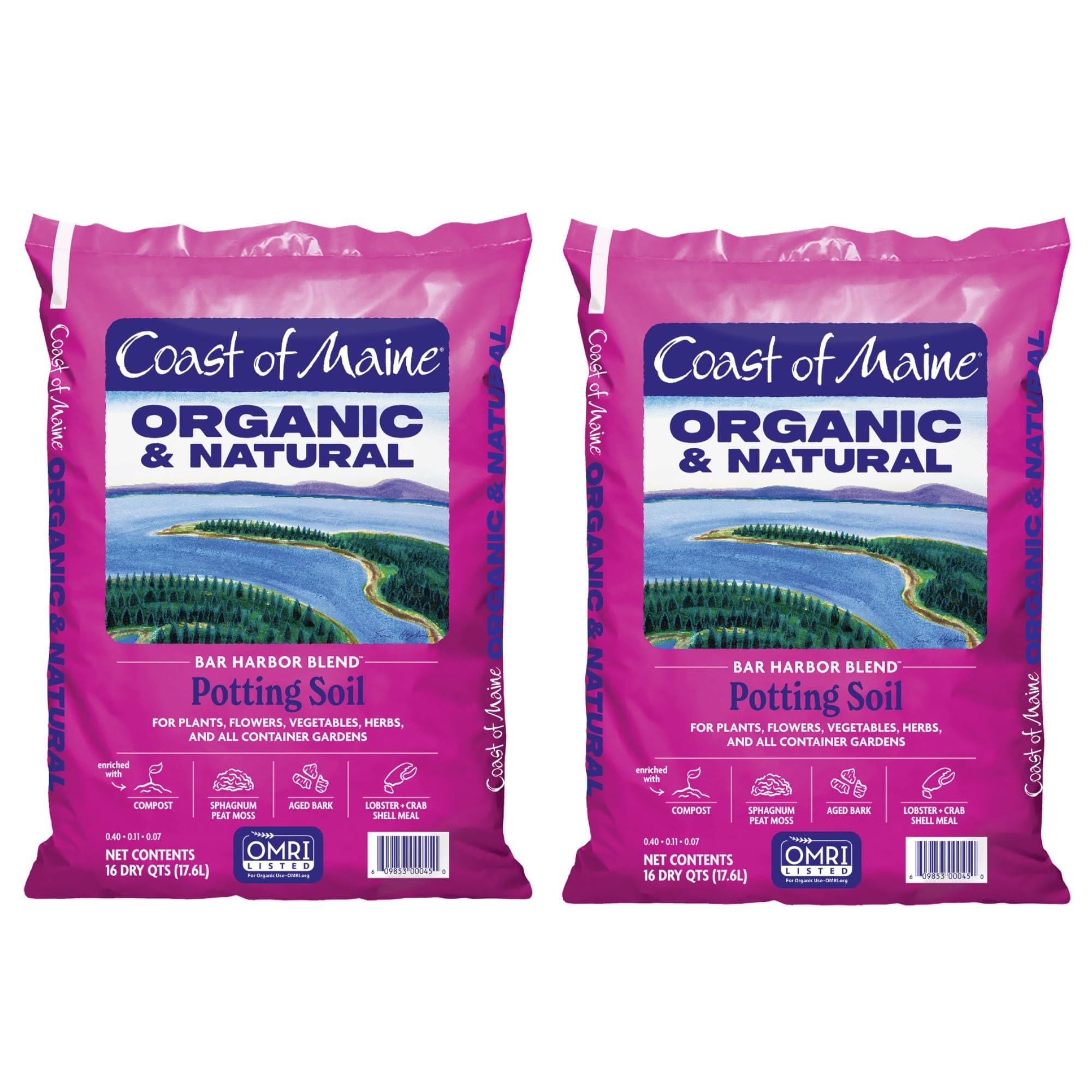
2. Coast of Maine Bar Harbor Blend Potting Soil
Lobster shells and kelp meal make this the most interesting thing in your potting shed.
This is the premium tier of organic potting soil and it earns the label with a unique ingredient list: sphagnum peat moss, compost, perlite, lobster and crab shell meal, and kelp meal. The shellfish meal provides a steady release of nitrogen and calcium — it breaks down into the soil rather than sitting on top. At 14 pounds for 16 quarts, it is noticeably lighter than many equivalent volumes, so it is easy to carry up stairs or across a patio.
The Bar Harbor Blend is formulated to encourage root development and sustained plant growth while minimizing the need for frequent watering and fertilizing. It works for vegetables, indoor plants, fruits, and herb gardens — one reviewer simply reported “wife said this is the best soil she’s tried thus far.” With a perfect 4.8 rating from 549 reviews, this mix stands out for its consistency and the visible effect on plant vigor.
The catch is the price per quart: it costs more than many all-purpose mixes. But if you are serious about organic gardening and want a soil that doubles as a slow-release feeding system, the difference shows up in your harvest.
Worth the extra dollar: For the organic gardener who wants a complete, nutrient-dense blend without adding fertilizers. pass on it if you need to fill many large pots on a budget — the 16-quart bag goes quickly.
Reach for this if: You prioritize organic ingredients and want a mix that feeds roots steadily from day one. Look elsewhere if: You need a massive volume for big raised beds — the price adds up fast.
3. Michigan Peat General All Purpose Premium Potting Soil

The 50-pound bag that refuses to let a budget stop a garden.
When you need to fill a lot of pots without draining your wallet, this is the bag. At 50 pounds, this is one of the heaviest mixes available, and it is pre-blended with reed sedge peat, perlite, and sand — no mixing required. Starter and slow-release fertilizers are already in the bag, so your plants get a nutrient boost from the first watering. The blend works for vegetables, flowers, bulbs, and general container gardening.
Customers note the soil arrives moist and has “perfect consistency for potting.” One buyer mentioned they use it for pot and container gardens and it arrives in a timely fashion. However, there is a consistent warning: multiple reviews mention fungus gnats emerging from the bag, with one saying “good soil but lots of gnats come out of it.” This is a common risk with organic soils stored outdoors, and it may not be an issue if you use the soil immediately outdoors or treat it before bringing it inside.
At 50 pounds, this bag is heavier than the 40.5-pound Miracle-Gro Moisture Control. The trade-off is the moisture-control technology and the 6-month feeding guarantee you get with the Miracle-Gro — you get more bulk here, but fewer engineered features.
Biggest Strengths
- Massive 50-pound bag covers a lot of pots in one trip
- Pre-mixed with perlite and sand for drainage
- Includes starter and slow-release fertilizer
Watch Out For
- Multiple reports of fungus gnats in the bag
- No moisture-control technology like premium mixes
Best for: The gardener filling many outdoor containers on a strict budget. Not ideal for: Indoor houseplant collections — the gnat risk makes it a gamble.
4. Coast of Maine Organic & Natural Planting Soil for Vegetables & Tomatoes

One bag per 5-gallon pot and your tomatoes finally stop sulking.
This mix is built specifically for heavy-feeding vegetables like tomatoes. It uses composted manure and sphagnum peat moss to create a lightweight blend that holds both air and moisture. The OMRI listing (Organic Materials Review Institute) means it is certified for organic use. At 20 quarts, it is a handy mid-size bag — big enough to fill a few large pots but light enough to carry one in each hand.
Reviewers point out the soil is “lightweight, high-quality foil; 1 bag per 5-gallon pot; plants thriving with no stress.” Another reviewer noted excellent moisture retention and drainage, with visible rapid plant growth, and that it “deters insects with aromatic wood.” The recommendation is strongest for heirloom tomatoes that need good drainage. One owner reported that while the bag is heavy, plants like it and grow well.
The main drawback is that buyers sometimes find undecomposed twigs in the mix, which you may need to pick out if you are growing fine-rooted crops like carrots.
Perfect for tomatoes: The composted manure and peat create a rich, draining environment that fruiting vegetables love. it’s not for you if you need a generic houseplant mix — it is designed for hungry plants.
Reach for this if: You are growing tomatoes, peppers, or other heavy-feeding vegetables in containers. Look elsewhere if: You need a finer, debris-free soil for starting tiny seeds indoors.
5. Espoma Organic Potting Soil Mix (2-Pack)

Worm castings and kelp meal in a bag — this is what your herbs and houseplants actually want.
This mix from Espoma goes further than most organic soils by including earthworm castings, alfalfa meal, kelp meal, and feather meal — all natural sources of nitrogen, phosphorus, and potassium. It also contains Myco-Tone, a proprietary blend of endo and ecto mycorrhizae (beneficial fungi that attach to roots and help them absorb more water and nutrients). The bag is 8 quarts, sold as a 2-pack, which is ideal for a few indoor containers or a small herb garden.
Shoppers say that “the soil came quickly and well packaged. The plants took to it immediately and are growing great.” One reviewer transplanted an African violet and noted it responded very well, growing quickly. Another reviewer found it “too dry, though, to actually absorb water on a new-plant” — a common issue with bagged soil that has been sitting in a warehouse. If you hit this, simply moisten the soil before planting and it will accept water normally. For indoor use, the soil is clean and does not come with the gnat problem some bulk soils have.
Compared to the Coast of Maine Tomato & Veg mix, this Espoma blend is more focused on indoor and general container use, with a finer texture. It costs more per quart than the bulkier mixes, but the quality of the ingredients — especially the worm castings and mycorrhizae — justifies it for anyone growing edibles or sensitive houseplants.
What Stands Out
- Rich organic ingredients: worm castings, kelp, alfalfa meal
- Myco-Tone mycorrhizae for better root absorption
- Clean and bug-free for indoor use
A Minor Issue
- Can arrive too dry to absorb water — needs pre-moistening
- More expensive per quart than bulk mixes
Best for: Indoor herbs, vegetables in small pots, and African violets — any plant that benefits from rich organic ingredients. Not for: Filling dozens of large outdoor containers where cost per quart matters most.
6. Black Gold 1302040 8-Quart All Organic Potting Soil 2 Pack

The affordable organic pack that does not bring fungus gnats to your houseplants.
If you have been burned by potting soil that comes with uninvited passengers, this 2-pack from Sun Gro under the Black Gold brand is worth a look. The soil is organic and arrives rich and moist — one customer observed “I tried this potting soil while keeping my fingers crossed that it wouldn’t introduce fungus gnats to my houseplants. Guess what? It didn’t. Not one fungus gnat!” That kind of relief is real when your indoor plants are sensitive to soil pests. The pack is two 8-quart bags, giving you 16 quarts total.
Buyers report good results with container gardens: “We have a container garden. Everything we have planted likes this soil.” The mix does not compact over time and does not cause standing water, which is a common issue with lower-end soils. One user highlighted it revives tired soil and promotes new growth in days. While it is “expensive but effective” according to that same review, the price per quart is competitive for an organic product.
Compared to the Espoma 2-pack at the same volume, the Black Gold is less ingredient-dense — it does not have the worm castings or mycorrhizae that Espoma packs in. If you want a simple, clean, organic mix that is unlikely to introduce pests, this is your pick. If you want a richer feeding blend, step up to Espoma.
Indoor-safe organic: For the houseplant owner who is tired of fighting gnats, this is a clean alternative. look elsewhere if you need a heavy-feeding mix for demanding vegetable plants — it works best as a general-purpose base.
Reach for this if: You need an organic potting soil for indoor plants and worry about soil-borne pests. Look elsewhere if: You want a nutrient-packed mix for heavy feeders — this is more of a blank slate.
7. Miracle-Gro Potting Mix (1 cu. ft., 2-Pack)

Two bags of the standard-setter, so you never run out mid-project.
This is the classic Miracle-Gro Potting Mix in a practical 2-pack of 1 cu. ft. bags. Each bag fills two 12-inch containers, so the bundle can handle four good-sized pots. Like the Moisture Control version, this mix feeds plants for up to 6 months and grows plants twice as big versus unfed plants, according to the manufacturer. It works with flowers, vegetables, shrubs, annuals, and perennials — basically anything that goes into a container. The texture is consistent and fine enough for everyday planting.
Owners mention “this Miracle-Gro potting soil has become my favorite soil for everyday planting” and note that “it has a good texture that’s easy to work with, and it helps plants settle in quickly.” One reviewer uses it in all their garden beds and says “the plants are looking very healthy.” A practical tip from a buyer: “Great size. Great value. Nice to be able to find dirt on Amazon in the middle of winter. Finding none in my area.” The only consistent observation is that quality varies slightly from bag to bag — some contain small debris, though it does not noticeably affect performance.
Unlike the Moisture Control formula, this is a standard potting mix without the AquaCoir water-holding technology. You get the same 6-month feeding, but you need to be more careful about your watering schedule. If you already have a reliable watering routine and do not need the extra forgiveness, this 2-pack saves you money compared to the single 2 cu. ft. Moisture Control bag.
Solid everyday choice: Reliable, feeds all season, and comes in a convenient split-pack. steer clear if you tend to forget to water — in that case, the Moisture Control version is better insurance.
Best for: Gardeners who have a consistent watering schedule and want a trusted, all-purpose potting mix in a practical 2-pack. Not ideal for: Those who need moisture-control technology or prefer an organic blend.
Understanding the Specs
Volume — Cubic Feet vs. Quarts
Volume tells you how much soil you actually get. One cubic foot equals roughly 30 dry quarts. A 2 cu. ft. bag fills two 14-inch containers, while an 8-quart bag handles a single medium houseplant. If you are buying for multiple pots, convert to cubic feet first — it is the easiest way to compare value across brands because quarts and pounds are not directly comparable for lightweight peat-based mixes.
Moisture Control Technology
Some mixes add coir (coconut fiber) and a wetting agent to absorb more water than standard peat-based soil — up to 33% more in the case of AquaCoir. This creates a buffer that helps plants survive missed waterings and prevents the soil from turning into a dry brick that repels water. The trade-off is that the same technology can keep the soil too wet for succulents, cacti, or any plant that needs fast drying between waterings.
Fertilizer Content
Many potting mixes include a starter charge of fertilizer and a slow-release feed that lasts months. This means you do not need to add liquid fertilizer for the first watering cycle. If you see “feeds up to 6 months” on the bag, the soil contains a coated granular fertilizer that releases nutrients gradually. For organic growers, some mixes rely on composted manure, worm castings, and kelp meal instead of synthetic granules — the feeding is slower but more natural.
Weight and Texture
Heavier bags (40+ pounds) usually contain more sand or dense organic matter, which means better anchoring for tall plants but harder handling. Lighter mixes rely on perlite (popped volcanic glass) and peat moss for aeration and drainage. A lightweight mix is easier to carry and work with, but it can be harder to keep tall plants upright without additional stakes. The texture also matters — fine mixes work well for seed starting, while chunkier blends with bark pieces suit pots with established plants.
FAQ
Can I use garden soil in a container?
What is the difference between potting mix and potting soil?
How much container soil do I need for a 5-gallon pot?
Should I add perlite to bagged potting mix?
Why do some potting mixes have fungus gnats?
How long does a bag of container soil last once opened?
Is organic potting soil better than synthetic?
Can I reuse potting soil from last year?
What does “feeds up to 6 months” actually mean?
Should I wet the soil before planting in a container?
Final Thoughts: The Verdict
For most buyers, the container soil winner is the Miracle-Gro Moisture Control Potting Mix because it forgives watering mistakes, feeds plants for 6 months, and gives you the largest single bag volume for your money. If you want an organic mix with unique nutrients, grab the Coast of Maine Bar Harbor Blend. And for the budget-conscious gardener filling many outdoor pots, the standout is the value of the Michigan Peat All Purpose Potting Soil — just watch for gnats if you bring it indoors.
How We Picked
We do not accept paid placement. Every pick is matched to a real buyer and a real use-case; we do not hands-on test units.
Sources & Methodology
Specifications: manufacturer listings and product documentation. Review insights: verified customer reviews, as of July 2026. Pricing: not shown on this page (it changes often); check the current price via the retailer link.
As an Amazon Associate, Lawn Gear Lab earns from qualifying purchases. This does not affect which products we feature.