
Specs are compiled from manufacturer listings and verified buyer reviews and can change over time — please confirm the key details on the product page before buying.
If you pour garden soil into a pot, it turns into a brick that drowns tomato roots. You need a mix that drains fast, holds just enough water for thirsty roots, and feeds your plants from the day you transplant through the final harvest. This guide compares five ready-made blends so you can see which one fits your pots and your budget.
I’m Rikta — the founder and writer behind Lawn Gear Lab. This guide is built by comparing the manufacturers’ published specifications and the patterns across verified customer reviews, so you get each pick’s real strengths and trade-offs instead of marketing spin.
Every bag on this list has been sifted for its drainage, nutrient load, and long-term performance in pots. Finding the right container soil for tomatoes means the difference between a handful of green fruits and weeks of heavy, red harvests.
Quick Picks
- Organic Mechanics Premium Blend Potting Soil — Best Overall
- Coast of Maine Organic & Natural Planting — Best Value
- Coast of Maine Bar Harbor Blend Potting Soil — Premium Performance
- Espoma Organic Potting Soil Mix, 2 Cubic Feet — Best All-Purpose
- Miracle-Gro Potting Mix, 8 qt. (3-Pack) — Budget Champion
How To Choose The Best Container Soil For Tomatoes
Tomatoes are heavy feeders that need a mix balancing moisture without turning into mud. The wrong soil leads to root rot (roots that suffocate in water), compacted roots, and tiny fruit. Here is what separates a great container mix from a dud.
Drainage is the first priority
Look for ingredients like perlite (small white volcanic glass bits that create air gaps), pumice, or sand that keep air pockets open. Soggy roots kill tomato plants faster than drought. A good mix feels fluffy and light in the bag.
Organic matter and nutrients
Compost, worm castings (earthworm waste rich in nutrients), kelp meal, or crab shell meal feed the plant over weeks, not hours. Avoid mixes that rely solely on synthetic fertilizer — they can burn roots or fade too fast for a full tomato season.
Bag size and your pot count
One 20-quart bag fills roughly one five-gallon pot. If you plan on a row of containers, buy in bulk or grab two-packs. Check the volume in quarts or cubic feet so you don’t run short at planting time.
Quick Comparison
| Model | Best For | Volume | Key Ingredients | Organic | Amazon |
|---|---|---|---|---|---|
| Organic Mechanics Premium Blend Potting Soil | Highest yield potential | 16 Quarts | Compost, worm castings, perlite | Yes | Amazon |
| Coast of Maine Planting Soil for Veggies & Tomato | Value / volume per bag | 20 Quarts | Composted manure, peat moss | Yes | Amazon |
| Coast of Maine Bar Harbor Blend | Premium aeration & slow-release feed | 16 Quarts (2-Pack) | Peat moss, perlite, lobster/crab meal, kelp meal | Yes | Amazon |
| Espoma Organic Potting Soil Mix | Versatile all-purpose with mycorrhizae | 2 Cubic Feet | Peat moss, humus, perlite, worm castings, Myco-Tone | Yes | Amazon |
| Miracle-Gro Potting Mix (3-Pack) | Budget-friendly with long feed | 8 qt. (x3) | Fertilizer blend, peat moss | No | Amazon |
In‑Depth Reviews
1. Organic Mechanics Premium Blend Potting Soil, 16 qt
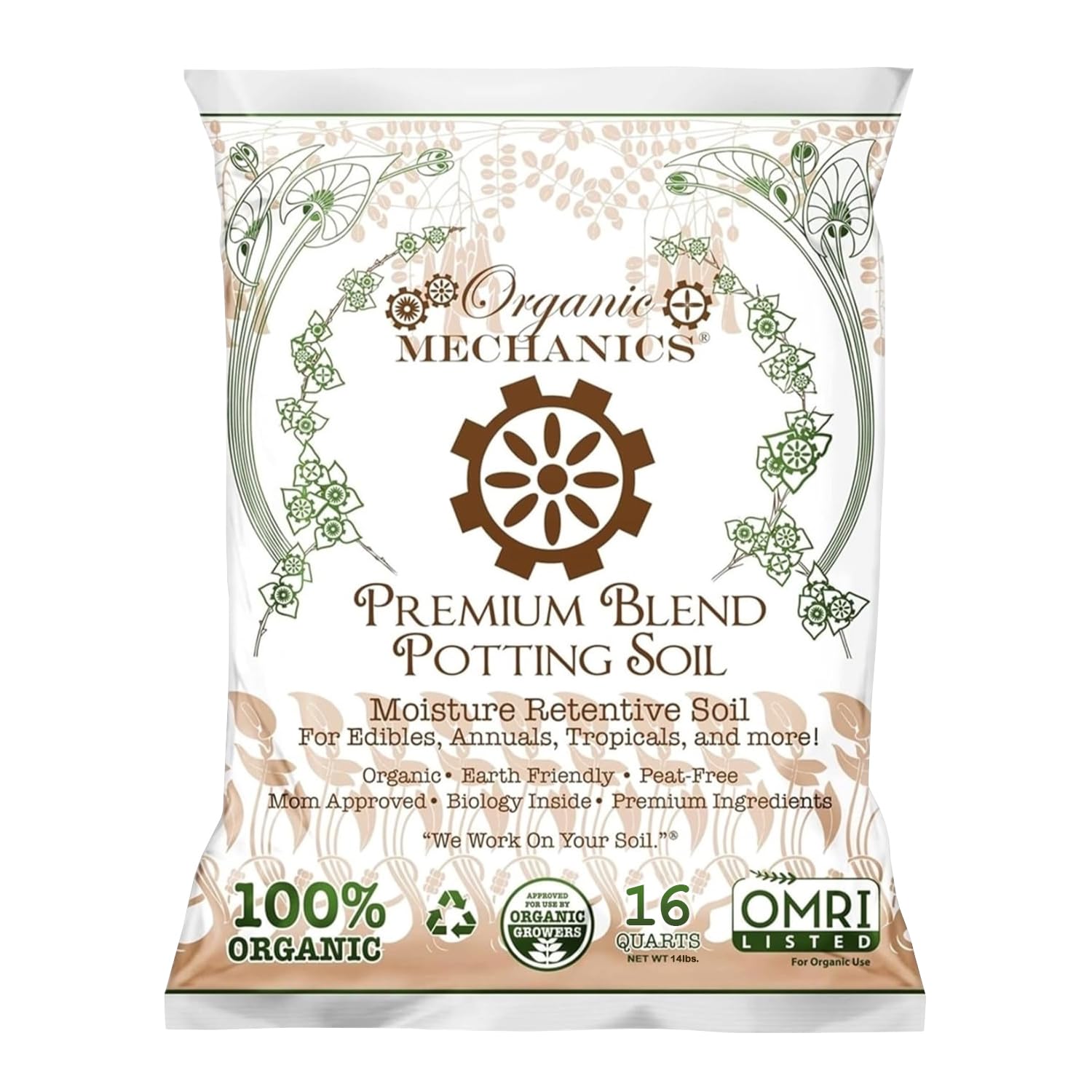
The Organic Mechanics Premium Blend is the only bag here with data claiming up to twice the tomato yield — no other mix on this list makes that promise.
You get more fruit per pot because of what the brand says research trials show: up to twice the tomato yield compared to conventional potting soil. That claim separates it. The mix uses compost, aged pine bark, coconut coir (a fiber from coconut husks that holds moisture), and worm castings (earthworm waste packed with nutrients) instead of peat, so it holds moisture without turning sludgy.
Reviewers recommend adding extra perlite (small white volcanic glass bits) for even better drainage — without it, they say the soil never stays perpetually damp or clumpy, a common complaint with cheaper mixes. One buyer who worked in a plant shop called it “the best by far” among the brands they rotated through. At 14 pounds, it is manageable to carry to a balcony or patio.
The cost per quart runs higher than the Coast of Maine Veggie blend, which gives you 20 quarts for less money. But if your pots are limited and you want the heaviest possible harvest from each one, this mix targets that goal directly.
Why it wins the top slot
- Research-backed claim of up to twice the tomato yield
- Peat-free formula is better for the environment and root biology
- Rich in compost and worm castings — plants thrive immediately
One honest trade-off
- Buyers recommend adding extra perlite for optimal aeration
- Higher per-quart cost than some contenders
Grab this bag if yield per pot is your first priority and you prefer a peat-free mix built on compost and worm castings. Pick the Coast of Maine Veggie blend instead if you need more volume for your dollar — it gives you 4 extra quarts for less money.
2. Coast of Maine Organic & Natural Planting Soil for Vegetables & Tomatoes, 20 Qt

You get 20 quarts of soil — a full 25% more than the 16-quart Organic Mechanics bag — and it fills one five-gallon pot exactly.
This is the bag buyers come back for. One bag per five-gallon pot is about right, and reviewers report seeing tomatoes and zucchini growing with “no obvious stress.” Compared to the Organic Mechanics mix, this Coast of Maine formula relies on composted manure and sphagnum peat moss (partially decomposed moss harvested from bogs). It is lightweight and drains well.
Some buyers report the occasional undecomposed twig you may want to pick out if you grow root vegetables. One longtime gardener called it “fabulous soil for vegetables,” adding that growth shows within days of transplanting. The price per quart is lower than all the premium picks here.
The organic bits are part of the compost, not a defect. If you want a polished, twig-free texture for seed starting or fine-root plants, move up to the Bar Harbor Blend.
What earns its value badge
- 20-quart bag — 25% more soil than the 16-quart competitors
- Lightweight texture that tomatoes love
- OMRI-listed organic at a very accessible price point
The fine print
- May contain small undecomposed twigs or organic bits
- Less premium ingredient diversity than the Bar Harbor Blend
Ideal for shoppers who need the most volume per bag and want an organic, lightweight mix that works straight out of the bag for tomatoes and zucchini. Pass on this if you want a polished, twig-free texture for seed starting or fine-root plants.
3. Coast of Maine Bar Harbor Blend Potting Soil, 16 QT (2-Pack)
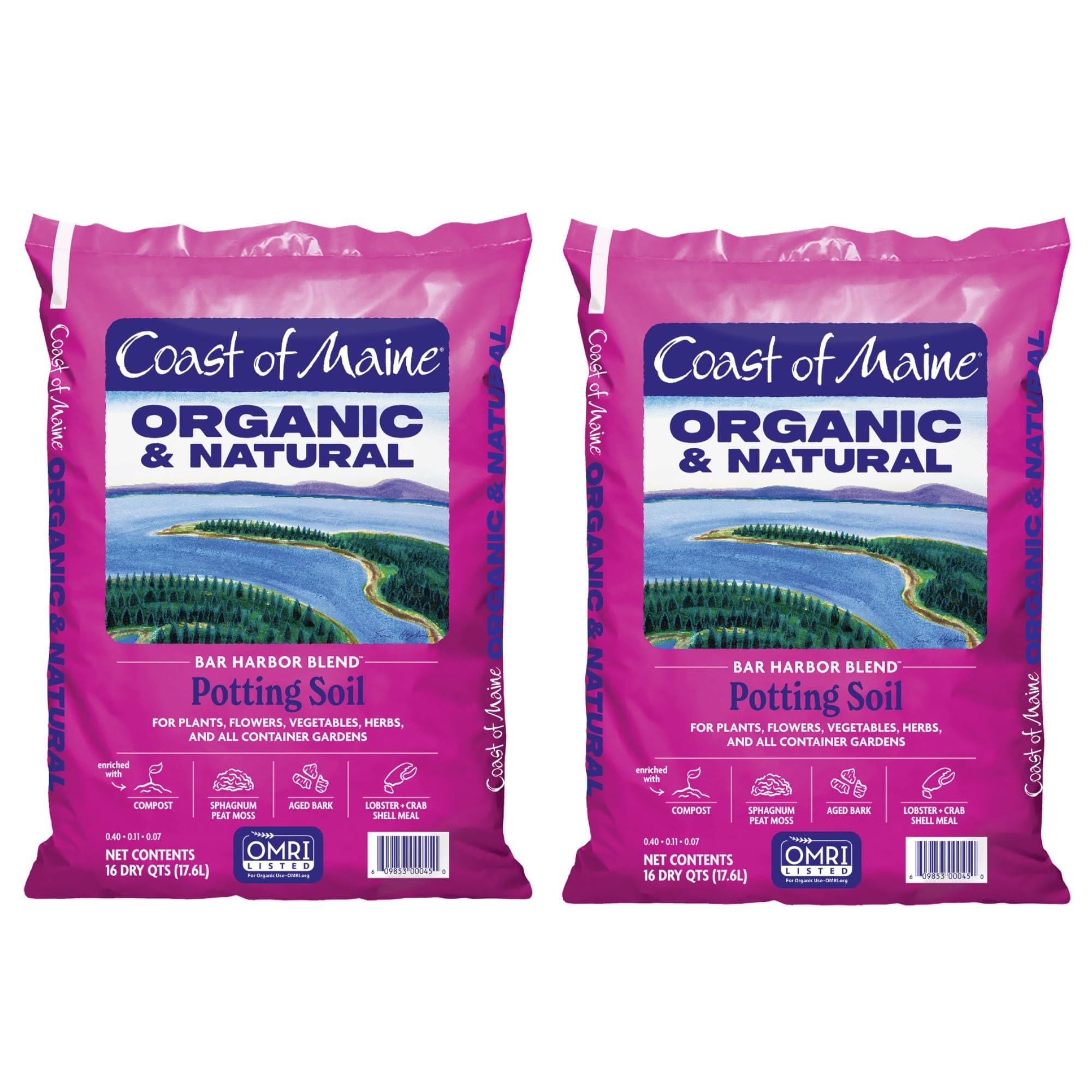
Lobster and crab shell meal plus kelp meal give this mix a unique slow-release nitrogen source — your tomato plants get steady food without risk of fertilizer burn.
This 2-pack gives you 32 quarts total, but the ingredients are the real story. The blend includes sphagnum peat moss, compost, perlite, and lobster and crab shell meal along with kelp meal (dried seaweed). Those marine ingredients provide slow-release nitrogen (a nutrient plants need for leafy growth that is released gradually). Owners mention that two bags were enough to mound up eight potato plants with extra leftover for two more planters.
Reviewers consistently say it is “one of the best soils out there,” with no unexpected weeds sprouting and a dark, nutrient-rich texture that smells earthy. One owner said their tomatoes “never looked so good” after switching from a top-brand competitor. The perlite content ensures good aeration, and the mix works for hanging baskets, raised beds, and window boxes, not just tomato pots.
The cost per quart is the highest on the list. If you want the marine-derived slow feed and the cleanest bag texture, this premium pick justifies the spend. If you are on a tight budget or only need soil for one or two small pots, the 2-pack may be more than you need.
The premium advantages
- Unique lobster, crab shell, and kelp meal for natural slow-release nitrogen
- Clean bag — no weeds, no large sticks, just dark rich compost
- Comes as a 2-pack (32 quarts total) for larger setups
The catch
- Highest cost per quart among all picks
- 2-pack format may be more than a single-pot gardener needs
Buy this for the cleanest, most nutrient-dense premium mix that feeds your plants slowly with marine-based ingredients — reviewers call it the “best soil.” skip it if you are on a tight budget or only need soil for one or two small pots; the 2-pack may be more than you need.
4. Espoma Organic Potting Soil Mix, 2 Cubic Feet

At 2 cubic feet (about 60 quarts), this is the largest bag on the list — it fills three to four large pots, far more than any competitor.
Espoma’s AP2 is a famously versatile mix used by indoor and outdoor container gardeners. The formula includes sphagnum peat moss, humus (decomposed organic matter), perlite, worm castings, alfalfa meal, kelp meal, and feather meal. The standout addition is Myco-Tone, a proprietary blend of endo and ecto mycorrhizae (beneficial root fungi that help plants absorb water and nutrients more effectively).
One reviewer noted they have houseplants over 25 years old that are sentimental to them, and they trust this soil to keep those plants thriving. Reviewers describe it as “loamy” and “chunky” with good structure that does not get dense or crusty over time. Unlike some mixes, it does not attract gnats (small flying insects common in overly moist soil), and it comes clean with no large stick or wood chunks to pick out.
It is not specifically tune for tomatoes the way the Coast of Maine or Organic Mechanics formulas are — it is a general-purpose organic mix. For most container tomato growers, that versatility is a strength, not a weakness.
Why it stands out
- 2 cubic feet — the largest bag, best for multiple pots or big projects
- Myco-Tone mycorrhizae boost root health and nutrient uptake
- Clean, chunky texture with no gnats or large debris
Consider this first
- Not specifically tailored for tomatoes like the other top picks
- Bulky bag may be heavy to move for some gardeners
Go for this if you want one massive bag of versatile organic soil that works for tomatoes, houseplants, and everything in between, with the added benefit of mycorrhizae fungi. pass on it if you want a formula with specialized ingredients like lobster meal or a peat-free blend.
5. Miracle-Gro Potting Mix, 8 qt. (3-Pack)

The 3-pack of 8-quart bags delivers 24 quarts total with built-in fertilizer — the manufacturer claims it grows plants twice as big compared to unfed plants, and it feeds for up to six months without extra work.
Miracle-Gro’s classic potting mix is the most recognizable name here. The built-in fertilizer feeds plants for up to six months, so you do not need to mix in additional plant food during the growing season. The manufacturer claims it grows plants twice as big compared to unfed plants, which appeals to value-conscious shoppers.
Reviewers appreciate the smaller bag size — easier to handle than a single massive bag. They also say it drains well and does not pack down into a hard block, so water reaches the roots consistently. This mix is not organic, so if that matters to you, skip it. Also, the 8-quart bags are individually smaller than single bags from other brands, meaning you may go through them faster with large containers.
The trade-off is the synthetic fertilizer and the lack of organic compost or worm castings that the higher-end mixes provide. For a low-maintenance option that feeds for months, this 3-pack delivers convenience.
The value highlights
- Feeds container plants for up to 6 months — no extra fertilizer needed
- Smaller bags (8 qt) are easy to carry and store
- Drains well, does not compact into a hard block
Where it falls short
- Not organic — relies on synthetic fertilizer
- No compost or worm castings for soil biology
Choose this for low-maintenance feeding that includes its own slow-release feed for six months and comes in easy-to-handle small bags. If organic ingredients and compost-based soil biology matter to your gardening approach, pick the Organic Mechanics or Coast of Maine options instead.
Understanding the Specs
Volume (quarts vs cubic feet)
This number tells you how many pots one bag fills. A 20-quart bag is roughly the right amount for one five-gallon pot. A 2-cubic-foot bag (about 60 quarts) fills three to four large pots. Always check the volume — two bags may look the same size but differ by 25% or more.
Key ingredients and what they do
Compost and worm castings feed the soil biology around the roots. Perlite creates the air pockets that prevent root rot. Coir or peat moss holds moisture so you do not have to water twice a day. Lobster meal and kelp meal add slow-release nitrogen from natural marine sources — a premium touch that fuels steady growth.
FAQ
Can I use regular garden soil for tomatoes in containers?
How much soil does one tomato plant need in a container?
Is organic potting soil better for tomatoes?
What is the difference between the Coast of Maine Veggie blend and the Bar Harbor blend?
Does the Organic Mechanics mix really double tomato yield?
Will Miracle-Gro Potting Mix feed my tomatoes all season?
Should I add perlite to my container soil?
How do I know when to repot my tomato plant?
Can I reuse container soil for tomatoes next year?
Does the pH of the soil matter for container tomatoes?
Final Thoughts: The Verdict
Across the board, the container soil for tomatoes winner is the Organic Mechanics Premium Blend because it is the only mix on the list with research-backed yield data — up to twice the tomatoes compared to standard soil. If you want the best value for filling multiple large pots, grab the Coast of Maine Veggie blend at 20 quarts per bag. And for a premium slow-feed option with marine ingredients that produce the richest soil texture, the standout is the Coast of Maine Bar Harbor Blend.
How We Picked
We do not accept paid placement. Every pick is matched to a real buyer and a real use-case; we do not hands-on test units.
Sources & Methodology
Specifications: manufacturer listings and product documentation. Review insights: verified customer reviews, as of July 2026. Pricing: not shown on this page (it changes often); check the current price via the retailer link.
As an Amazon Associate, Lawn Gear Lab earns from qualifying purchases. This does not affect which products we feature.