
Specs are compiled from manufacturer listings and verified buyer reviews and can change over time — please confirm the key details on the product page before buying.
Forcing a seed to push through heavy, clumpy garden soil is often a losing battle — the roots just cannot get enough air or moisture to break free. That is why the right compost for seeding makes all the difference: a light, fluffy, nutrient-rich mix that gives your seeds the perfect launchpad for strong, healthy roots from day one.
I’m Rikta — the founder and writer behind Lawn Gear Lab. This guide is built by comparing the manufacturers’ published specifications and the patterns across verified customer reviews, so you get each pick’s real strengths and trade-offs instead of marketing spin.
Whether you are starting tomatoes on a sunny windowsill or filling trays in a greenhouse, the exact blend of aeration (how much air the soil holds), moisture, and nutrients determines how fast and strong your seedlings grow — and that is why choosing the right compost for seeding is the single most important step you take before the first sprout breaks the surface.
Quick Picks
- Espoma Organic Seed Starter Premium Potting — Best Overall
- Purple Cow Organics Seed Starter 12 Quart Bag — Root-Building Power
- Vermont Compost Company Fort Vee Organic — Premium Volume
- Jiffy Natural & Organic Seed Starting Soil — Trusted Classic
- Duspro Seed Starter Potting Soil Mix — Peat-Free Star
- Doter Seed Starter Potting Soil Mix (2qt) — Budget Entry
- Doter Seed Starter Potting Soil Mix (4qt) — Budget Upgrade
How To Choose The Best Compost For Seeding
Not all bags labeled “seed starting mix” are built the same. A few key differences separate a mix that delivers fast, healthy germination (the process where a seed sprouts and grows its first root) from one that leaves you with weak, leggy seedlings. Focus on these three things before you buy.
Texture and Aeration
Seeds need a fine, crumbly texture so tiny roots can push through easily. Large bark chunks or compacted clumps block root growth and trap too much water. A mix that feels light and airy in your hand — like a loose, fluffy soil — lets oxygen reach the seed, which is essential for germination.
Moisture Retention vs. Drainage
Seeds must stay consistently damp, not wet. A mix that drains too fast dries out before the seed can sprout. A mix that holds too much water drowns the roots and invites damping-off disease (a fungal problem that kills seedlings at the soil line). Look for a blend with ingredients like perlite or vermiculite (small airy white or golden particles) that create a balance between holding moisture and letting excess water escape.
Nutrient Levels
Seeds contain enough stored energy to germinate, so heavy fertilizer is actually harmful in the first few weeks — it can burn tender roots. A good compost for seeding provides a mild, steady supply of nutrients from natural organic matter, not synthetic chemicals. Compost-based mixes usually offer gentle nutrition that lasts for several weeks before you need to add liquid fertilizer.
Quick Comparison
| Model | Best For | Volume | Key Ingredient | Organic | Amazon |
|---|---|---|---|---|---|
| Espoma Organic Seed Starter (2-Pack) | Best Overall — balanced roots & germination | 32 qt total (2 x 16 qt) | Sphagnum Peat Moss + Mycorrhizae | Yes | Amazon |
| Purple Cow Organics Seed Starter | Compost-based power for strong roots | 12 qt | Activated Compost | Yes | Amazon |
| Vermont Compost Company Fort Vee | Premium pick for heavy feeders & blocks | 20 qt | Composted Manure & Plant Matter | Yes | Amazon |
| Jiffy Natural & Organic Seed Starting Mix | Trusted peat-based classic for consistency | 10 qt | Peat Moss + Vermiculite | Yes | Amazon |
| Duspro Peat-Free Coco Coir Mix | Peat-free alternative for delicate roots | 8 Dry Quarts | Coco Coir + Worm Castings | Yes | Amazon |
| Doter Seed Starter 2 qt | Budget entry for a small tray | 2 qt | Loamy Compost | Yes | Amazon |
| Doter Seed Starter 4 qt | Budget upgrade for a few pots | 4 qt | Loamy Compost | Yes | Amazon |
In‑Depth Reviews
1. Espoma Organic Seed Starter Premium Potting Soil Mix (2-Pack)
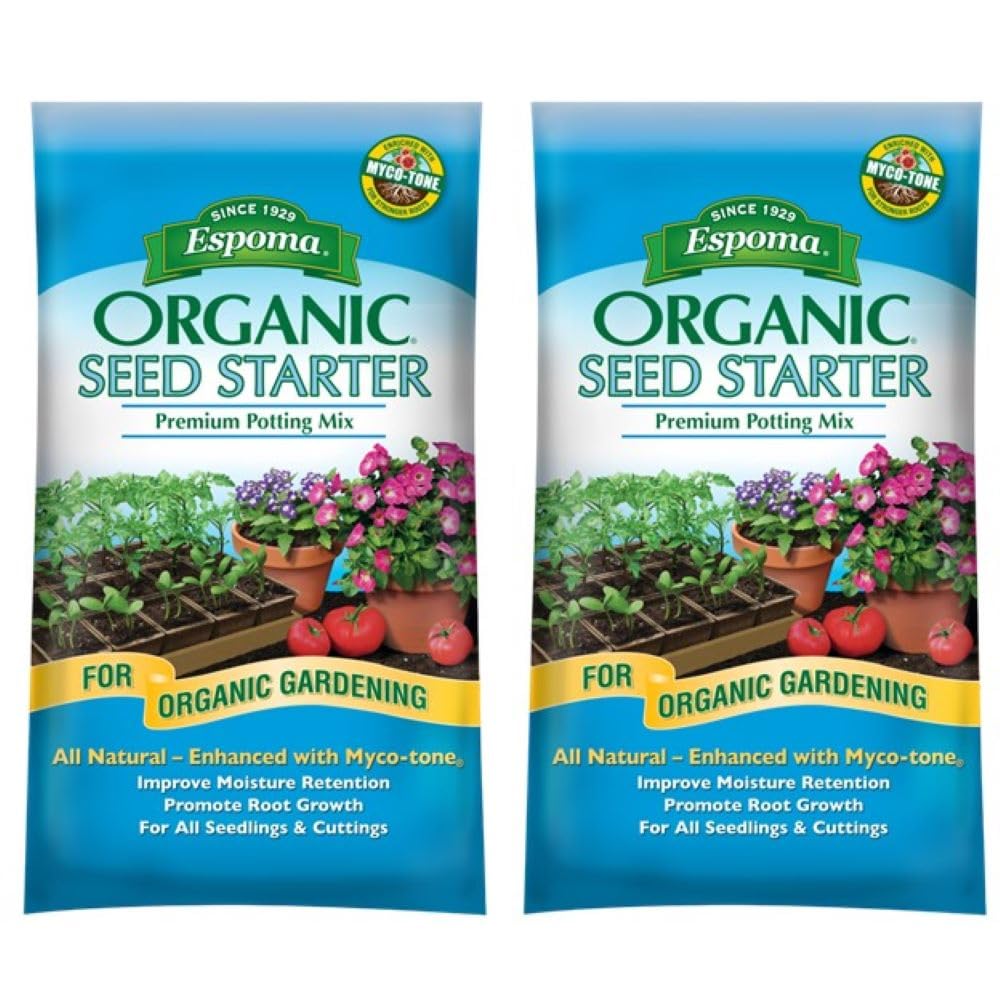
The two-bag value that gives strong roots, clean texture, and no synthetic chemicals.
Getting even germination across a tray of expensive seeds demands a mix that holds moisture without getting soggy. The Espoma Organic Seed Starter 2-Pack uses sphagnum peat moss and perlite (small white volcanic particles that keep the soil from compacting) for a light, fluffy feel — buyers report the mix stays “clean, light, fluffy soil” that gives a great germination rate. Unlike richer compost-based options, this one relies on the Myco-Tone blend of endo and ecto mycorrhizae (beneficial fungi that form a partnership with roots to boost water and nutrient uptake) rather than heavy feeding, so you get strong roots without the risk of burning tender seedlings.
One owner mentioned that a single 16-quart bag was more than enough to fill the entire 5-tray Gardzen set, so the 2-pack gives you plenty for multiple rounds. This mix also works well for rooting stem and leaf cuttings, making it a versatile tool for propagation. The trade-off is that the peat-based formula is not compost-based, so the nutrient supply is gentler and may require liquid feeding earlier than a compost-based mix like the Purple Cow Organics (which the maker says provides fertility for up to 45 days).
At 16 quarts per bag, the Espoma pack gives you a solid 32 quarts total — far more volume than the Doter 2-quart bag, for a well-rounded approach that suits everything from tomatoes to herbs to leaf cuttings.
Why seasoned growers pick it
- Owners mention “best seed starter I have used” with a strong germination rate
- Contains Myco-Tone mycorrhizae for stronger root systems
- Clean, light texture with no large chunks or bark pieces
- Good for both seed starting and rooting stem cuttings
One honest limitation
- Nutrient supply is gentler than compost-based mixes, so heavy feeders may need liquid fertilizer sooner
- Peat-based — for gardeners seeking a completely peat-free option, the Duspro coco coir mix is a better fit
Your best all-around starter: Go with the Espoma 2-Pack if you want a proven, organic mix that balances germination and root development for a wide range of seeds while staying affordable on large volumes.
One real trade-off: If you are growing heavy feeders like peppers or tomatoes and want a compost-based mix with built-in fertility for weeks, the Purple Cow Organics is the stronger pick.
2. Purple Cow Organics Seed Starter 12 Quart Bag

A compost-based fuel tank that keeps seedlings fed for weeks without extra fertilizer.
Purple Cow Organics takes a different approach than the peat-heavy mixes by building its seed starter around Activated Compost — a soil amendment the company has refined over 20 years. That compost base gives this mix enough fertility to keep seedlings going for up to 45 days without additional feeding, which is a real advantage if you are starting multiple trays and want to skip the fertilizer schedule. Customers note that “a lot of my seeds came up,” even with less expensive seeds.
The texture is well-suited for both standard plastic trays and soil blockers (tools that press the mix into cubes for transplanting) — one reviewer noted that the mix “worked beautifully for making soil blocks” that hold together perfectly. One reviewer found it “a little to compact” but still confirmed that all seeds started successfully. Unlike the Vermont Compost Fort Vee, which includes heavier composted manure, this mix is lighter and more uniform.
The catch is that the higher organic matter content means you need to be careful with watering — overwatering can lead to compaction, so a light hand at the spout helps. If you prefer a practically simple to use mix that handles a bit more moisture without compaction, the Jiffy peat-vermiculite blend is a safer bet.
What makes it stand out
- Compost-based mix provides fertility for up to 45 days — no early liquid feeding needed
- Excellent for soil blocking, with blocks holding shape and structure perfectly
- Reviewers point out strong germination rates even with non-premium seeds
- All-natural and organic — no synthetic plant foods or chemicals
Watch out for
- One review noted the mix can feel a bit compact and needs careful watering to avoid over-saturation
- Heavier texture than the fluffy Espoma or Jiffy blends — not ideal for very delicate, moisture-sensitive seeds
Reach for this if: You want a self-contained, compost-based mix that feeds seedlings for weeks without extra inputs — especially if you are doing soil blocking or growing heavy feeders like tomatoes and peppers.
Look elsewhere for: Extremely fine seeds or seeds prone to damping-off — the heavier texture needs a more careful watering rhythm than the airier Jiffy or Duspro mixes.
3. Vermont Compost Company Fort Vee Organic Potting Mix (20 Quarts)

The powerhouse blend for heavy feeders that keeps growing strong in the heat.
If you want a mix that feels like it was pulled straight from a well-tended compost pile, the Vermont Compost Company Fort Vee is it. It blends composted manure and plant materials with sphagnum peat moss, crushed granite and basalt for slow-release minerals, and biodynamic herbs. The result is a rich, dark mix that one reviewer described as “fluffy and light,” with visible gold flakes of vermiculite (a mineral expanded by fire that holds air and water) for aeration. Shoppers say “100% germination” on geraniums and petunias.
The 20-quart bag is the largest single-bag volume in this roundup — at 20 quarts versus the Doter 2 quarts and the Purple Cow 12 quarts. It holds water well even in 90°F Florida heat, reducing how often you need to water. The compost base provides enough nutrients for heavy feeders like broccoli, corn, cucumbers, and squash before transplanting. Unlike the Espoma mix, which uses mycorrhizae and a gentler nutrient profile, Fort Vee is built for plants that crave more from the start.
The downside is that the mix contains some larger bark pieces and twigs — one buyer mentioned “large bark/twigs” in the bag. This can make it less consistent for fine-seeded crops like lettuce or petunias where a very uniform texture matters more. For those seeds, the finely-screened Duspro coco coir mix or the Jiffy peat-vermiculite blend is better suited.
Where this mix shines
- Excellent for heavy feeders — broccoli, peppers, tomatoes, cucumbers, and squash thrive with its nutrient density
- Buyers report impressive water retention even in 90°F heat, reducing watering frequency
- Large 20-quart bag — the biggest single volume, giving you more growing medium per purchase
- Contains slow-release minerals from crushed granite and basalt for steady long-term feeding
A consideration for fine seeds
- Contains visible bark pieces and twigs — not as uniformly fine as the Jiffy or Duspro mixes
- Heavier texture may compact if overwatered — suitable for experienced growers who know their watering rhythm
Choose Fort Vee for: Large-scale seed starting where volume matters, especially for hungry crops like corn, cucumbers, and squash that benefit from its rich, compost-based nutrition.
Choose something finer for: Tiny seeds like petunias, lettuce, or herbs — the bark and twig content can obstruct consistent germination. For those, the Duspro or Jiffy mixes deliver a more uniform texture.
4. Jiffy Natural & Organic Seed Starting Soil Mix (10 QT)

A decades-old formula that gives consistent, fine-textured germination every time.
Jiffy has been making seed starting mix for generations, and this bag is a straightforward three-ingredient line-up: peat moss, vermiculite, and lime. Peat moss can absorb up to 20 times its weight in water, which means this mix holds moisture around the seed without becoming a soggy clump. Vermiculite (the lightweight, golden-brown mineral particles) prevents soil compaction and can soak up 3-4 times its volume in water, improving aeration so roots can breathe. The lime adjusts the pH (a measure of acidity versus alkalinity) to a healthy level for most seeds — usually around 6.0-6.5.
Owners mention “excellent germination rate, healthy seedlings” with a fine texture that has no large bark chunks. One owner reported it is “by far my favorite starter soil” because it holds together when transplanting to larger pots, unlike some mixes that fall apart and disturb roots. The Jiffy mix holds 320.0 oz, while the Doter 2-quart bag holds 64.0 oz., so you get significantly more medium for your money if you are filling a few trays.
The catch is that peat moss harvesting has environmental concerns — it comes from non-renewable peat bogs. If that matters to you, the Duspro peat-free coco coir mix is a direct alternative. Also, the nutrient level in Jiffy is relatively low, so after about 2-3 weeks, you will want to start liquid feeding, especially for heavy feeders. It does not have the built-in 45-day fertility of the Purple Cow Organics mix.
Why gardeners keep coming back
- Fine, uniform texture with no large bark chunks — excellent for tiny seeds like lettuce or petunias
- Peat moss holds up to 20x its weight in water for consistent moisture
- Holds together well when transplanting — less root disturbance than some looser mixes
- Verified by buyers for “high quality fine dirt” that helps seeds sprout and grow fast
What to expect
- Peat moss is non-renewable — not the best choice if you prefer a peat-free product
- Lower nutrient content than compost-based mixes — expect to add liquid fertilizer after 2-3 weeks
Stick with Jiffy if: You want a reliable, proven seed starting mix that gives a fine, consistent texture every time, especially for small seeds where uniform germination matters most.
Try the Purple Cow if: You want the extended fertility of a compost-based mix that keeps feeding without liquid fertilizer for over a month — but you will trade off some of the fine-textured consistency Jiffy is known for.
5. Duspro Seed Starter Potting Soil Mix (8 Dry Quarts)
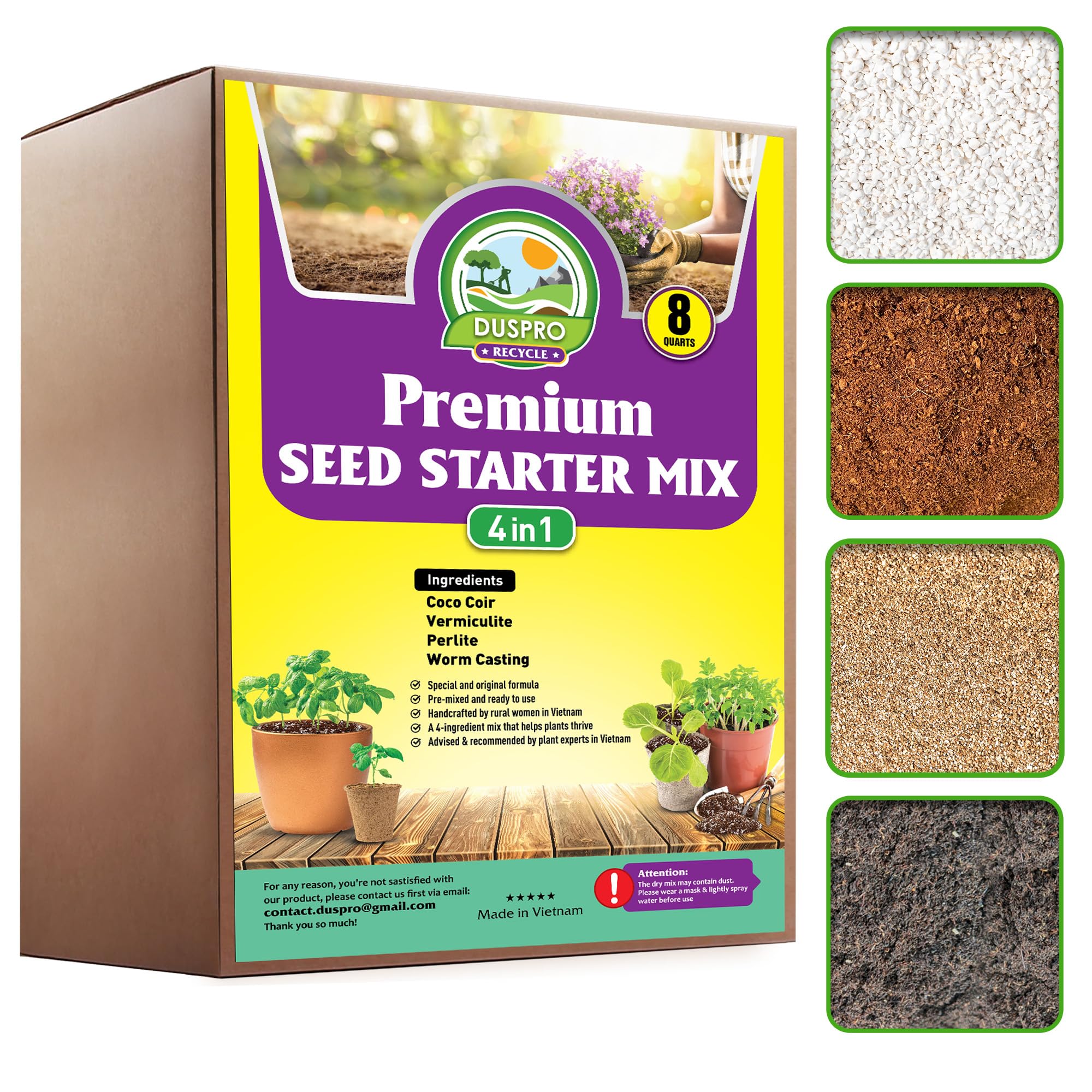
A no-peat 4-in-1 blend built with coco coir, perlite, vermiculite, and worm castings.
For gardeners who want to avoid peat moss entirely, Duspro uses coco coir (a fibrous material from coconut husks that holds water well) as the base, mixed with perlite, vermiculite, and worm castings (nutrient-rich organic matter from earthworms). The texture is hand-screened to be fine and consistent, which helps small seeds stay in contact with the mix for steady moisture uptake. Customers note “excellent results with my garden plantings,” especially for wick-watered seed trays where a balanced moisture transfer is critical.
One reviewer gave a detailed take: for wick-watered trays, this mix has a “perfect balance of moisture transfer and aeration,” unlike other blends that either wick too much water and become soggy or contain too many hydrophobic fibers (particles that repel water) that create dry spots. That makes it a strong candidate for automated or low-maintenance watering setups. It is also ready to use right out of the bag — just moisten, fill trays, and plant.
The worm castings provide gentle, slow-release nutrients, which gives it a slight edge over the Jiffy peat-vermiculite mix on early feeding. However, at 8 dry quarts, the volume is lower than the Jiffy 10-quart bag’s 320.0 oz (the Duspro is 1.0 Count, effectively 8 qt), so if you are filling multiple large trays, the Jiffy gives you more medium. The price per quart also tends to land in the mid-range — not the budget-friendly tier of the Doter 2-quart bag, but not the premium territory of the Vermont Compost 20-quart bag.
Why peat-free fans love it
- No peat moss — uses sustainable coco coir as the base ingredient
- Excellent balance of moisture transfer and aeration for wick-watered tray setups, according to buyers
- Worm castings provide gentle, natural nutrients for early growth
- Fine, hand-screened texture — good for delicate seeds like herbs and flowers
One thing to note
- Smaller volume than the Jiffy bag — 8 dry quarts vs 10 quarts — if you are filling multiple trays, the Jiffy goes further per bag
- Some buyers noted that not every seed sprouted, which may depend on seed quality as much as the mix itself
Go peat-free with Duspro if: You are specifically avoiding peat moss and want a fine, balanced coco coir blend with natural fertility from worm castings — especially for wick-watered trays or automated setups.
Choose Jiffy instead if: Peat is not a concern and you want the largest volume for your money, especially if you are filling many trays at once for a big planting season.
6. Doter Seed Starter Potting Soil Mix (2qt)
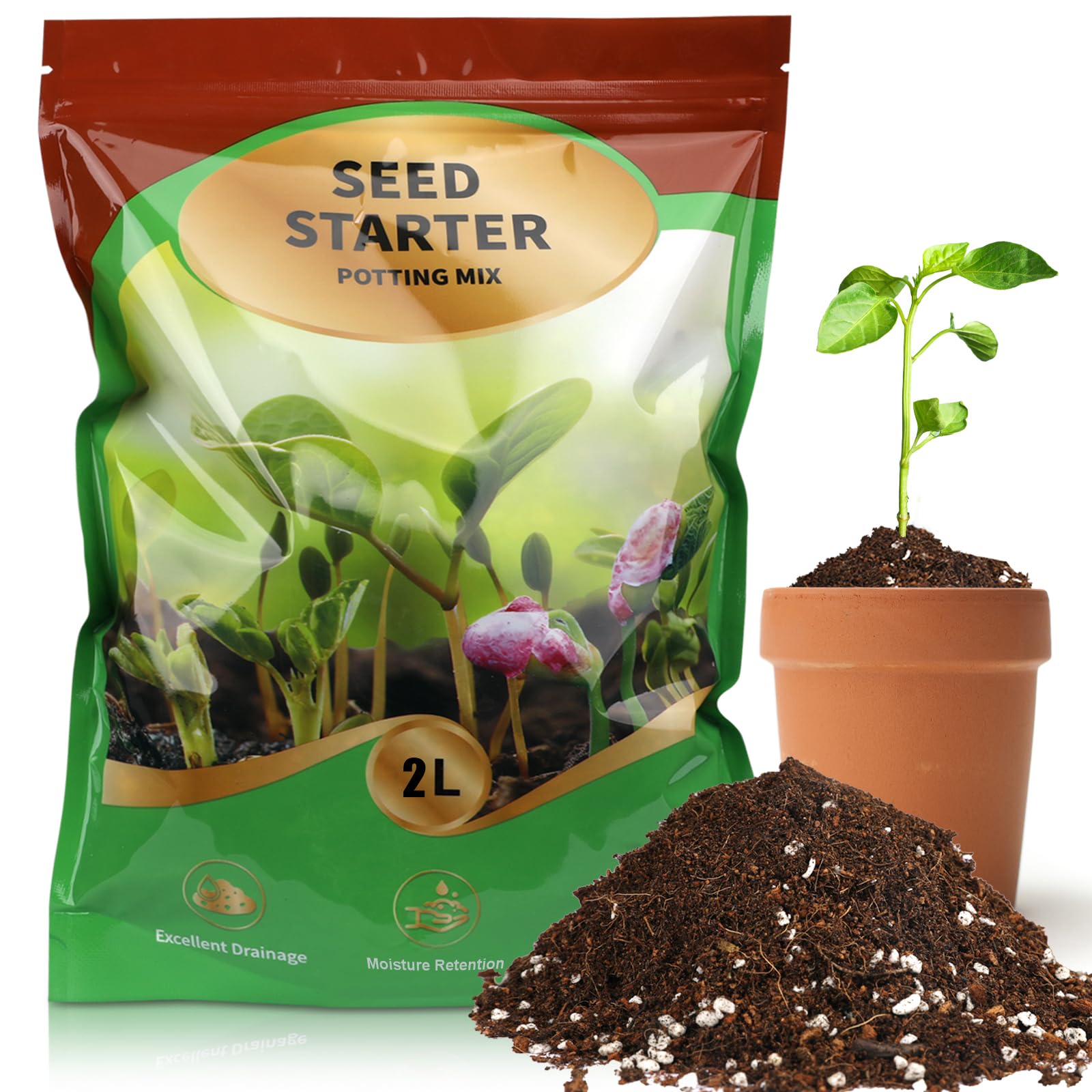
A low-cost loamy mix that gets a few seeds started when you only need a small amount.
If you are starting just one or two trays and do not want to buy a big bag, this 2-quart Doter mix is the smallest option in the list. It is a loamy compost-based mix — meaning it has a fine, crumbly texture that is ready to use straight from the bag. The brand claims it is pH balanced for a wide range of seeds, and buyers support that, saying it is “perfect for seeds.” One customer observed it “was growing seeds in just a few weeks.” That said, the 2-quart volume is very limited — it is 2 quarts compared to the Purple Cow Organics 12-quart bag and holds 64.0 oz, while the Jiffy 10-quart bag holds 320.0 oz.
The price point puts it in the most budget-friendly tier of this guide, which makes sense for a beginner who wants to test a few varieties without committing to a larger bag. However, the small bag size is the main drawback — multiple buyers mentioned it is “smaller than you see” and one noted that it “might not be worth the eight or nine dollars that you paid for” given the bag size. For a few starter pots, it works, but if you are planning to fill more than one 10×20 tray, you will need 3-4 bags to match the volume of a single Jiffy bag.
The mix itself is described as having “excellent potting soil” quality. Unlike the Purple Cow or Vermont mixes, which pack heavier nutrients, this loamy blend is gentler — a good fit for starting any flower vegetable seeds without worry about nutrient burn.
What makes it budget-friendly
- Very small 2-quart bag — ideal for a single tray or a few pots without leftover mix
- Buyers confirm seeds germinate in just a few weeks with healthy growth
- Loamy texture is fine and ready to use — no mixing or sifting needed
- pH balanced for a wide range of flower, vegetable, and herb seeds
Volume compromise
- Very small bag — holds 2 quarts versus Purple Cow’s 12 quarts and Jiffy’s 10 quarts
- Value per quart is lower than buying larger bags — you pay more for the smaller bag size
Best for: A beginner or small-space gardener starting just a few seeds at a time, who wants to keep the commitment low and the cost minimal.
skip it if: You are starting multiple trays or want the best value per quart — the Jiffy or Purple Cow bags give you much more medium for a relatively small price increase.
7. Doter Seed Starter Potting Soil Mix (4qt)
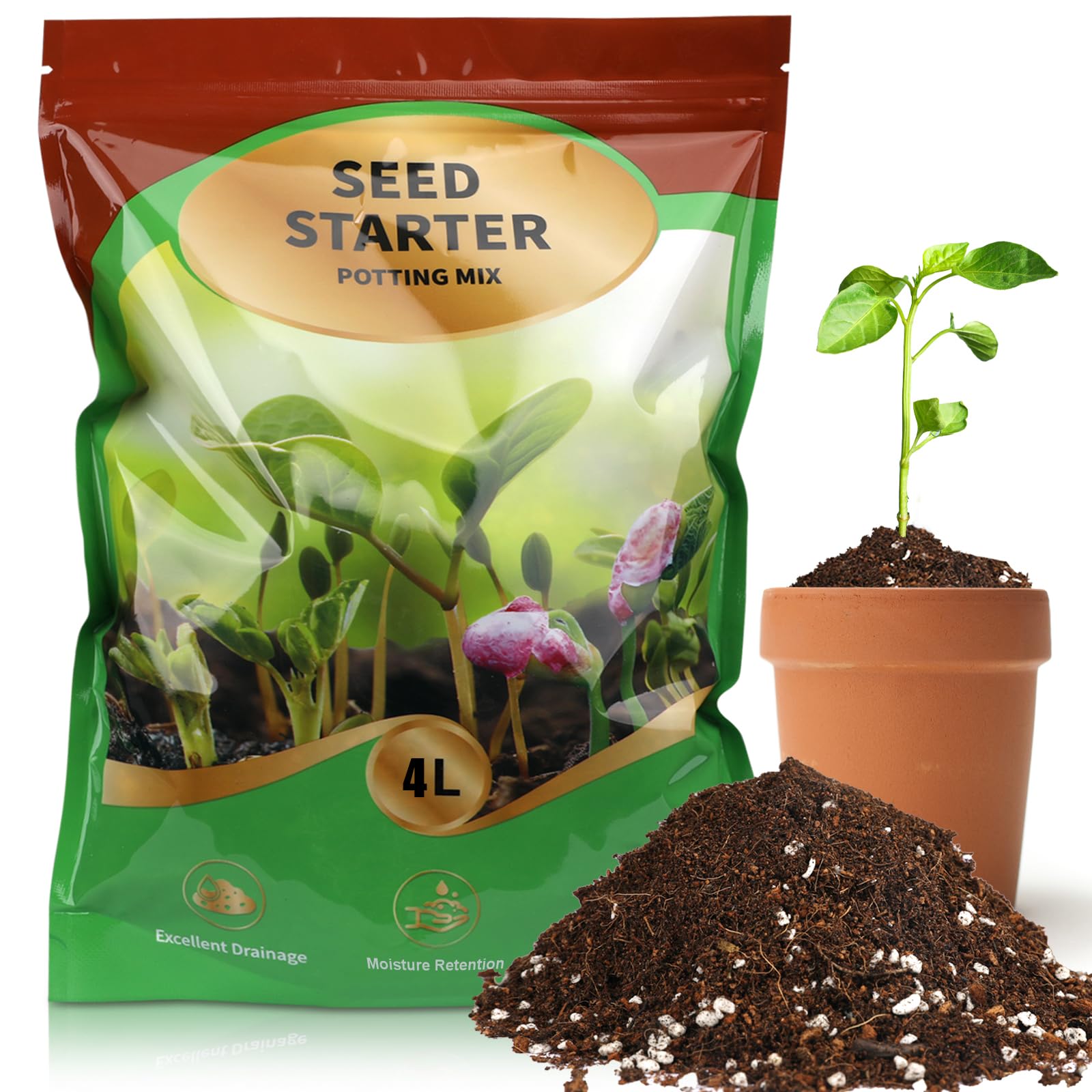
A slightly larger version of the same loamy mix, giving you a bit more to work with for small projects.
This is essentially the same product as the Doter 2-quart bag but with double the volume — 4 quarts instead of 2. The same loamy compost base is pH balanced and ready to use, with buyers giving it the same feedback: “perfect for seeds” and “growing seeds in just a few weeks.” The longer you use it, the more you notice the consistency — no large bark chunks, just a uniform, fine texture that supports seed-to-soil contact.
At 4 quarts, this mix is still a small volume, but it gives you more room to work than the 2-quart option if you are starting a few more pots. It weighs 0.87 kilograms (about 1.9 pounds) — light enough for easy handling, though one user highlighted the bag “is extremely small,” so the size might surprise you if you are used to bulk bags. The Jiffy bag holds 320.0 oz, while the Doter 4-quart bag holds 128 oz.
The key trade-off is the same as with the 2-quart version: the smaller bag size means a higher cost per quart. If you only need a small amount, the 4-quart is a better value than buying two 2-quart bags, but the Jiffy or Purple Cow still give you far more medium per dollar. For someone who wants to test the loamy approach before committing to a large bag, this is the balance — more than enough for a tray or two without the leftover bag taking up space.
A step up from the tiny bag
- Double the volume of the 2-quart bag — enough for 2-3 small trays or a few larger pots
- Same consistent loamy texture, pH balanced, and ready to use without mixing
- Buyers confirm strong germination rates with healthy seedlings
- Lightweight at just 0.87 kg — easy to pick up and pour
The same volume limitation
- Still a small bag compared to bulk options — 4 quarts vs. 10-16 quarts in the mid-range choices
- Unit cost per quart is higher than buying a single larger bag from Jiffy or Purple Cow
Grab this if: You want a small step up from the 2-quart bag and need enough for a few more pots without storing a large surplus — ideal for a small windowsill gardening project.
Choose the Jiffy or Purple Cow for: Bulk value — if you know you will be seeding multiple times in a season, the larger bags give you far more medium per dollar and reduce the need for repeat purchases.
Understanding the Specs
Volume (Quarts)
This is the number one spec to look at. Quarts tell you how much growing medium you are getting. A 2-quart bag is enough for a single small tray or a few pots. A 10-quart bag can cover multiple standard 10×20 trays. Check the seed count you plan to start — bigger volume is almost always better value per quart, especially if you are seeding more than once in a season.
For a typical home garden season, a 10- to 12-quart bag is the balance: it fills about 2-3 standard trays or dozens of 4-inch pots without leaving you with a half-empty bag that dries out. If you only need a few starts, a 2- or 4-quart bag saves space in the shed.
Compost vs. Peat vs. Coco Coir
The base ingredient defines how your mix behaves. Compost-based mixes like the Purple Cow Organics are rich in organic matter and provide a steady, gentle release of nutrients for 4-6 weeks — ideal if you want to skip liquid feeding early. Peat-based mixes like Jiffy are very water-retentive (peat holds up to 20x its weight in water) and have a fine, uniform texture that is great for tiny seeds, but peat is non-renewable. Coco coir-based mixes like the Duspro are a renewable, peat-free alternative that also holds water well but tends to be less fertile on its own — worm castings or another natural fertilizer are often added to compensate.
FAQ
Can I use regular garden soil for seeding?
How long does an opened bag of seed starting mix last?
What is the difference between potting mix and seed starting mix?
Do I need to add fertilizer to my seed starting mix?
Can I reuse seed starting mix?
Will any compost for seeding work for both indoor and outdoor trays?
Why do some seeds germinate faster than others in the same mix?
Is peat-free seed starting mix as good as peat-based?
Final Thoughts: The Verdict
Across the board, the compost for seeding winner is the Espoma Organic Seed Starter 2-Pack because it delivers strong germination rates, a fluffy and consistent texture, and the root-boosting Myco-Tone mycorrhizae at a volume that covers several trays without being wasteful. If you want a compost-based mix with built-in fertility for up to 45 days, grab the Purple Cow Organics Seed Starter. And for serious large-seed starting with heavy feeders like cucumbers and squash, the Vermont Compost Company Fort Vee stands apart with its rich, nutrient-packed 20-quart bag that keeps crops eating well.
How We Picked
We do not accept paid placement. Every pick is matched to a real buyer and a real use-case; we do not hands-on test units.
Sources & Methodology
Specifications: manufacturer listings and product documentation. Review insights: verified customer reviews, as of July 2026. Pricing: not shown on this page (it changes often); check the current price via the retailer link.
As an Amazon Associate, Lawn Gear Lab earns from qualifying purchases. This does not affect which products we feature.