
Specs are compiled from manufacturer listings and verified buyer reviews and can change over time — please confirm the key details on the product page before buying.
A mango tree that refuses to bloom, drops its fruit early, or just sits there looking tired — that’s usually a soil problem, not a bad tree. The right compost delivers the exact nutrients your mango needs at each growth stage, from pushing out new leaves after a cold snap to setting sweet fruit in the heat of summer. You want a mix that feeds the roots without burning them, releases steadily through the seasons, and suits your watering routine.
I’m Rikta — the founder and writer behind Lawn Gear Lab. This guide is built by comparing the manufacturers’ published specifications and the patterns across verified customer reviews, so you get each pick’s real strengths and trade-offs instead of marketing spin.
You will find a range of organic and liquid options below, each matched to a different mango-growing scenario — this is the honest breakdown of the best compost for mango tree growth that takes the guesswork out of feeding your tree.
Our Picks at a Glance

How To Choose The Best Compost For Mango Tree
Mangos are heavy feeders, especially during the spring flush and fruit-setting phase. A good compost or fertilizer for them supplies a balanced ratio of nitrogen (for leaves), phosphorus (for roots and flowers), and potassium (for fruit sweetness and size). You also want a source of calcium to prevent blossom-end rot and micronutrients like zinc and iron to keep foliage dark green.
Granular vs. Liquid: Which Feeding Style Fits Your Routine?
Granular formulas (like the Down to Earth or FoxFarm picks) are slow-release — you sprinkle them around the drip line a few times a year and water them in. They build long-term soil health with organic matter. Liquid concentrates (like the HiThrive or TPS Nutrients options) give you faster results because the nutrients are immediately available to the roots. Liquids are better if your tree is potted, suffering a deficiency right now, or you prefer mixing a batch every two weeks.
Quick Comparison
| Model | Best For | NPK Ratio | Form | Weight/Volume | Amazon |
|---|---|---|---|---|---|
| Down to Earth Fruit Tree 6-2-4★ Best Overall | Long-term organic soil building | 6:2:4 | Powder | 5 lb / 2365.88 ml | Amazon |
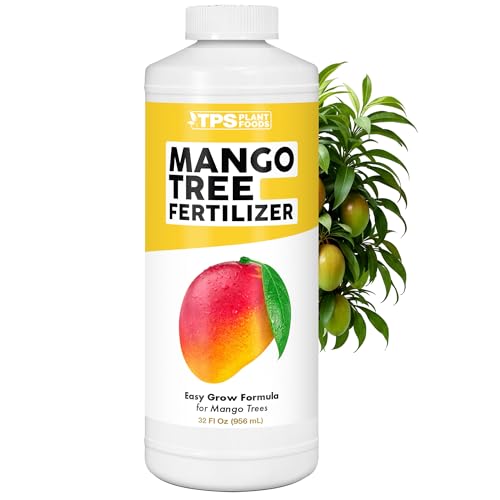
| TPS Nutrients Mango LiquidTop Performer | Potted mango & precise 1:100 mixing | — | Liquid | 32 oz | Amazon |
| Espoma Citrus-tone 5-2-6 | No-mix convenience for citrus & mangos | 5:2:6 | Granules | 4 lb / 1892.7 ml | Amazon |
| HiThrive Mango Liquid 32 oz | Fast correction for struggling trees | — | Liquid | 2.6 lb / 32 oz | Amazon |
| FoxFarm Happy Frog 7:3:3 | Yellow-leaf recovery & mycorrhizal boost | 7:3:3 | Granules | 4 lb | Amazon |
| Gardenwise 6-4-6 | Three-feed-per-year simplicity | 6:4:6 | Granules | 128 oz (4 qt) | Amazon |
| Gardenera Organic Kelp | Stress recovery & soil microbe health | — | Liquid | 32 oz | Amazon |
In‑Depth Reviews
1. Down To Earth All Natural Fertilizers Organic Fruit Tree 6-2-4, 5 lb
Our pick — over 4.5★ from 750+ verified ratings; the strongest balance of quality and price.
The five-pound workhorse that rebuilt a struggling tree from the ground up.
This is the pick for anyone who wants to feed the soil as much as the tree. With a 6:2:4 NPK mix (nitrogen, phosphorus, potassium) and added calcium carbonate for proper fruit development, it covers the full growing cycle — from leafy spring growth to firm, sweet mangos. The 5 lb box provides 2365.88 milliliters, versus the Espoma bag’s 1892.7 milliliters, so you cover more drip-line area per purchase. Buyers report that this fertilizer revived a struggling crabapple tree; after 2 years of use, the tree now has healthy leaves, abundant berries, and stronger roots, allowing stake removal soon. The powder form blends quickly into soil with no harsh smell, unlike some granule fertilizers.
The formula is OMRI-listed for organic production (reviewed by the Organic Materials Review Institute), meaning it meets national organic standards. It includes feather meal, fish bone meal, langbeinite (a natural mineral), and kelp meal — ingredients that break down slowly and feed the microbial life in your mango’s root zone. It does not expire if stored in a cool, dry place, so a single box can last multiple seasons for a small backyard mango tree. The main trade-off is you have to measure and mix it into the topsoil, unlike a no-mix granule.
Slow-burn powerhouse: Best for the grower who thinks in seasons, not days — this feed builds deep soil fertility that keeps a mango tree productive year after year.
Reach for this if: you want an all-organic, single-bag solution that feeds your mango tree and improves the soil at the same time, with enough volume for multiple trees.
Look elsewhere if: you need a fast-acting cure for an immediate deficiency or you prefer a ready-to-use liquid you can spray on.
2. TPS Nutrients Mango Tree Fertilizer – Liquid Plant Food, 32 oz
A precision liquid that doubled a mango seedling’s size in a single month.
If you grow mangos in a pot or have sandy soil that drains nutrients fast, a liquid feed gives you control. This formula from TPS Nutrients uses a 1:100 mixing ratio (one part fertilizer to one hundred parts water), which makes it easy to adjust strength based on your tree’s age and season. The 32 oz bottle is made specifically for mangos and tropical fruit trees, providing a balanced diet for root strength and consistent fruit production. Owners mention that a mango seedling doubled in size in about 1 month after use, with new leaves growing in days — even in the intense Houston heat and humidity. Another owner mentioned it works well biweekly with no leaf burn in very sandy soil, which is a common problem with stronger synthetic feeds.
Unlike the Down to Earth powder, you do not need to work this into the soil — just mix with water and pour around the drip line. It is especially useful for container-grown mangos that cannot access the slow-release nutrients of a large in-ground soil ecosystem. The catch is you need to stay on a regular biweekly schedule during the growing season, whereas the granular picks only need application a few times per year.
Why it stands out
- Fast-acting liquid formula — results visible in days, not weeks
- Precise 1:100 mix ratio reduces risk of over-fertilizing potted trees
- Made specifically for mango and tropical trees, not a general citrus blend
One thing to know
- Requires mixing every 1-2 weeks during active growth — less convenient than a seasonal granular feed
Perfect for: potted patio mangos or in-ground trees in fast-draining sandy soil where a slow-release granule washes away too quickly.
Not ideal if: you want a “set and forget” fertilizer that you apply three times a year and ignore the rest of the season.
3. FoxFarm Happy Frog Citrus and Avocado Fertilizer 7:3:3, 4 lb

The granule that turned yellow leaves dark green in days — buyers swear by it.
FoxFarm brings a unique advantage to the table: this 4 lb granule contains mycorrhizal fungi (beneficial soil microbes that attach to roots and help them absorb more water and nutrients). The 7:3:3 mixing ratio (higher in nitrogen than the Down to Earth 6:2:4) makes it a strong choice for pushing leafy growth in the spring flush. Customers note that citrus trees were struggling with yellow leaves; after using this fertilizer, yellowing vanished in days, new growth emerged, and the lime yield was the highest ever. The strong smell (one reviewer compared it to horse feed) means you should water it in immediately and keep dogs away — but the results speak for themselves.
The key difference from the Espoma pick below is the nitrogen-phosphorus-ratio: FoxFarm’s 7:3:3 delivers a bigger nitrogen jolt for leaf recovery, whereas Espoma’s 5:2-6 puts more emphasis on potassium for fruit sweetness. If your mango has pale leaves or sparse foliage after winter, this is the fix.
Yellow-leaf specialist: The mycorrhizal fungi and high nitrogen make this the best pick if your mango is showing classic signs of nutrient deficiency and you want a proven, rapid recovery.
Go for this if: your mango tree has yellowing leaves, you want slow-release nitrogen that feeds for weeks, and you appreciate the added mycorrhizae for root health.
skip it if: the strong smell is a problem for your outdoor space, or you prefer a lower-nitrogen formula for a tree that is already very leafy.
4. HiThrive 32oz Mango Fruit Tree Fertilizer – Makes 32 Gallons
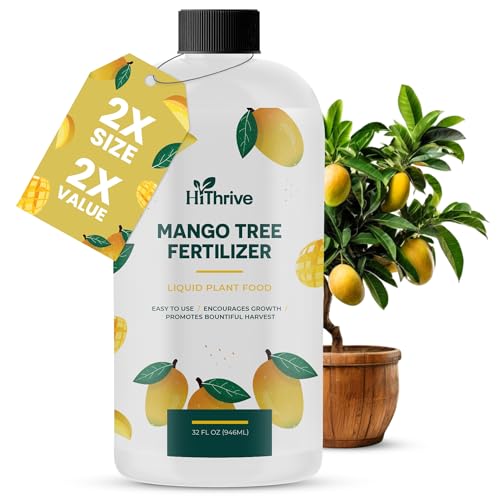
A mango-specific liquid that made a dormant tree sprout new branches for the first time in months.
This is the only pick in the list that is formulated exclusively for mangos — not citrus, not general fruit trees. The 32 oz bottle makes 32 gallons of liquid fertilizer, compared to the smaller 16 oz version. It packs nitrogen for leaf growth, phosphorus for root strength, and potassium for sweeter fruit, plus calcium, iron, and zinc to fix common mango deficiencies. Reviewers point out it made their mangoes sprout new branches for the first time in months, and that the tree showed healthy new growth, greener leaves, and faster development. One reviewer noted you need a sprayer to apply it efficiently; a spray bottle works for small trees, but medium-sized trees take more time to cover evenly.
Compared to the TPS Nutrients liquid, the HiThrive formula is more concentrated (1:128 ratio, roughly) and includes a broader micronutrient profile. The recommended schedule is every 1-2 weeks during the growing season and every 4 weeks in cooler months, which is slightly more frequent than some growers prefer. But for a mango tree that has stalled, the targeted formulation is tough to top.
Best mango-specific pick
- Made only for mangos — includes the exact micronutrient balance they need
- High concentration — 32 oz makes 32 gallons, great value per feeding
- Brings back stalled trees quickly, per multiple buyer reports
A practical head-scratcher
- Best applied with a sprayer, which is an extra purchase if you do not already own one
Ideal for: a mango tree that has stopped growing, dropped foliage, or refused to fruit — the micronutrient boost targets exactly those problems.
Consider something else if: you prefer a no-mix granular feed you can just sprinkle around the trunk and water in.
5. Espoma Organic Citrus-Tone 5-2-6, 4 lb

The no-mix granule that works on mangos, citrus, and even strawberries — buyers love the versatility.
Espoma’s Citrus-tone is a straight-out-of-the-bag granule — no mixing, no measuring cup, just sprinkle around the drip line and water in. The 5:2:6 ratio (higher in potassium than nitrogen) supports fruit development and sweetness, which matters most once your mango tree has a good canopy and you want the harvest to taste great. The 4 lb bag holds 1892.7 milliliters of material, making it a lighter purchase than the Down to Earth box. Shoppers say it is great for not just citrus; one user applied it on strawberries and raspberries with good results. Another reviewer mentioned it has a very strong smell and needs to be used outdoors only, keeping dogs away because the odor attracts them — the smell fades after about a week.
Where this shines over the HiThrive or TPS liquids is the sheer convenience: you apply it three times per year (late winter pre-bloom, spring post-bloom, and fall) and the exclusive Bio-tone formula works with the soil microbes to release nutrients as the tree needs them. It is approved for organic gardening and has been made in the USA by Espoma since 1929. The trade-off is you cannot correct an immediate deficiency as fast as a liquid feed would.
Low-effort fruiting feed: Best for the grower who wants a reliable, season-spanning granule that prioritizes fruit quality over leafy growth, with minimal hands-on time.
Choose this if: you want a simple three-times-a-year schedule, your mango already has healthy leaves, and you care most about fruit size and sweetness.
Pass on it if: your tree is struggling with yellow leaves or stunted growth — the lower nitrogen content is not ideal for recovery.
6. Gardenera Premium Organic Seaweed & Kelp Superfood for Mango Trees, 32 oz
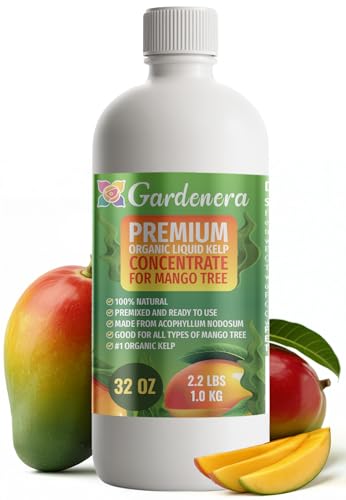
A kelp concentrate so dilute a single 32 oz bottle makes 180 gallons of feed.
This is not a complete fertilizer — it is a bioactive supplement. The formula is derived from Ascophyllum nodosum kelp and contains natural growth hormones, amino acids, and trace minerals that stimulate root development and improve stress tolerance. The mixing ratio of 1:562.5 is extremely dilute (about 1 teaspoon per gallon), which means the 32 oz bottle goes a very long way. Buyers report it rescued a plant and helped young banana trees survive brutal cold; one long-term user said their houseplants have thrived for years on it. For a mango tree recovering from saltwater flooding, heat stress, or transplant shock, the kelp hormones encourage cell division and new root growth without the risk of burning the roots.
Compared to the HiThrive and TPS liquid picks, Gardenera is a supplement you use alongside a complete fertilizer — it adds the biological “spark” but does not provide the full NPK a mango needs on its own. Use it as a weekly foliar spray or soil drench during high-stress periods. It is made in the USA in small batches and is safe for all mango cultivars from Alphonso to Tommy Atkins. The catch: because it is so dilute, you need to keep it on a regular schedule to see the cumulative effect on tree vigor.
Stress-buster bonus
- Extreme dilution means one bottle lasts most growers an entire season or more
- Organic kelp formula boosts root growth and heat/drought tolerance
- Safe to use as a foliar spray on leaves without burning them
Not a standalone feed
- Does not provide the full NPK nutrition a mango tree needs — pair with a granular or complete liquid fertilizer
Best for: a mango tree recovering from environmental stress (drought, flood, frost, heat) or a grower who wants to add a bi-weekly biostimulant alongside a main fertilizer.
Not for you if: you want a single bottle that covers everything your mango needs — this is a helper, not a meal.
7. Gardenwise 6-4-6 Avocado and Citrus Tree Fertilizer, 4 Quarts
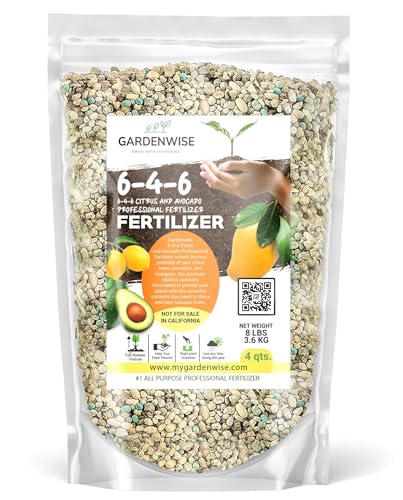
A slow-release granule that asks you to feed your mango just three times a year.
Gardenwise hits a balanced 6:4:6 NPK ratio with a quick-release nitrogen component that gives the tree an immediate energy boost, paired with slow-release minerals that keep feeding for months. You only apply it three times per year: late winter, late spring, and early fall. The 128 oz (4 quart) bag is the largest volume in this lineup, so it works well for a small orchard or a very large backyard mango. Owners mention it helped an avocado tree recover after storms and freezing temperatures, and another grower said it helped their avocado seedlings from seed do a little better. It is formulated for avocado, mango, and citrus trees, making it a flexible orchard solution if you grow multiple fruit types.
The main difference from the FoxFarm 7:3:3 is the potassium level — the Gardenwise 6:4:6 has a higher potassium count (6 vs 3), which supports better fruit set and flavor later in the season. It also releases nitrogen quickly for a green-up effect, whereas FoxFarm is fully slow-release. One buyer mentioned they have only used it for one season and did not have long-term data, so first-time users should monitor their tree’s response and adjust the amount for the next season if needed.
Orchard-scale convenience: If you have more than one mango tree (or a mix of citrus and avocados), this single bag covers them all with a three-times-a-year routine that is hard to mess up.
Grab this if: you want the biggest bag for your money, a slow-release that requires minimal scheduling, and a formula that works across multiple fruit tree types in your yard.
Look elsewhere if: your mango is potted or small — the large bag is more than you need, and a liquid or smaller granule would be more practical.
Understanding the Specs
NPK Ratio: The Three Numbers That Matter
The three numbers on every fertilizer bag stand for Nitrogen (N), Phosphorus (P), and Potassium (K). Nitrogen drives leafy green growth — important for mangos after winter or pruning. Phosphorus supports root development and flower formation. Potassium is the fruit-quality nutrient: it influences sweetness, size, and how well the fruit stores on the tree. A higher middle number (like the 4 in Gardenwise’s 6:4:6) is helpful during bloom, while a higher last number (like the 6 in Espoma’s 5:2:6) benefits the fruiting stage.
Slow-Release vs. Quick-Release: The Feeding Speed
Granular fertilizers like the Down to Earth 6:2-4 and FoxFarm 7:3:3 release nutrients gradually as soil microbes break down the organic matter. This is safer for your tree — less risk of burning roots — and feeds consistently over weeks. Quick-release fertilizers (often found in liquid concentrates) provide nutrients immediately to the roots. They are useful for correcting a deficiency fast, but they require more frequent application. The liquid picks in this guide (HiThrive, TPS, Gardenera) are quick-release and need mixing every 1-2 weeks during the growing season.
FAQ
Can I use a general fruit tree fertilizer on my mango tree?
How often should I fertilize a mature mango tree?
Is it safe to use a liquid fertilizer on a newly planted mango tree?
What does the OMRI label mean on a fertilizer bag?
Will kelp fertilizer alone provide enough nutrition for my mango tree?
Why do the liquid fertilizers have a strong smell?
Can I use a mango tree fertilizer on other fruit trees in my yard?
How do I know if my mango tree is getting too much nitrogen?
What is the best way to apply granular fertilizer to a mango tree?
Do I need to stop fertilizing my mango tree in the winter?
Final Thoughts: The Verdict
For most growers, the compost for mango tree winner is the Down to Earth Organic Fruit Tree 6-2-4 because it combines a proven organic formula, the largest dry volume, and verified results for reviving struggling fruit trees. If you want a fast-acting liquid that shows results within weeks, grab the TPS Nutrients Mango Tree Fertilizer. And for a low-maintenance granule that only needs three applications per year, the standout is the Espoma Citrus-tone 5-2-6 in terms of pure convenience and fruit-quality potassium.
How We Picked
We do not accept paid placement. Every pick is matched to a real buyer and a real use-case; we do not hands-on test units.
Sources & Methodology
Specifications: manufacturer listings and product documentation. Review insights: verified customer reviews, as of July 2026. Pricing: not shown on this page (it changes often); check the current price via the retailer link.
As an Amazon Associate, Lawn Gear Lab earns from qualifying purchases. This does not affect which products we feature.