
Specs are compiled from manufacturer listings and verified buyer reviews and can change over time — please confirm the key details on the product page before buying.
Whether you’re coaxing blueberries into sweetness, turning hydrangeas blue, or keeping rhododendrons glossy, the secret isn’t more water or more sun — it’s the pH in the root zone. Many garden soils sit stubbornly neutral, which blocks these acid-loving plants from pulling up the nutrients they need. The right compost for acidic soil does the work for you: it feeds, it conditions, and it tips the balance into the 4.5–6.5 range these plants crave.
I’m Rikta — the founder and writer behind Lawn Gear Lab. This guide is built by comparing the manufacturers’ published specifications and the patterns across verified customer reviews, so you get each pick’s real strengths and trade-offs instead of marketing spin.
Here are the proven options for anyone seeking compost for acidic soil, ranked by real-world performance and owner feedback so you pick the right one the first time.
Our Picks at a Glance

How To Choose The Best Compost For Acidic Soil
Two very different products do the same basic job here, and confusing them is the most common mistake. There are pre-mixed planting soils that already sit at a low pH, and there are granular fertilizers that you sprinkle on to feed plants already in the ground. Decide which stage your garden is at first — planting something new, or feeding what’s already established — then the choice is simple.
Match the product to the job
For new beds, containers, and transplants, a low-pH planting soil gives roots a soft, acidic home from day one. For established shrubs and berry patches, a granular feed like the Espoma Holly-Tone delivers nutrients over many weeks without disturbing the roots. Buying a fertilizer when you’re actually repotting, or a planting soil when your shrubs are already in the ground, is where most frustration starts.
Check the N-P-K numbers
Every fertilizer label carries three numbers — nitrogen, phosphorus, and potassium — that tell you what it feeds. The 4-3-4 analysis on Holly-Tone means a balanced feed with slightly heavier nitrogen for leafy, flowering growth. A higher first number pushes foliage; a higher middle number pushes roots and blooms. Match the ratio to what your plant is doing that season.
Read the fine print on “organic”
Organic claims mean different things. For planting soil, an “OMRI listed” label means the product has been reviewed against strict organic standards — Coast of Maine carries this. For fertilizer, “approved for organic gardening” and “registered Organic Input Material” confirm the same thing for Espoma. If a bag makes a vague organic claim, treat it as marketing until a certification is printed on the label.
Quick Comparison
In‑Depth Reviews
1. Coast of Maine Planting Soil for Acid Loving Plants
Our pick — over 4.5★ from 300+ verified ratings; the strongest balance of quality and price.
The ready-to-use mix that gets new blueberries and azaleas off to a perfect start.
When you’re planting acid-loving shrubs and berries, this pre-mixed soil gives them an acidic home from day one. Coast of Maine blends composted manure and sphagnum peat moss (a fibrous moss that holds moisture) into a mix formulated for a low pH, so rhododendrons, azaleas, hollies, blueberries, strawberries, ferns, fuchsias, camellias, dogwoods, and conifers all start in the right conditions. The balance between moisture retention and drainage is deliberately tuned — you get soil that holds water without drowning roots, which is exactly what container berries need over a hot week.
Buyers praise the mix’s quality, with one gardener potting two plants from a single bag thanks to the generous 20-quart volume. At 28 pounds, it is noticeably lighter than a comparably sized bag of dense garden soil, so moving it around the yard or filling raised pots is easier on your back. Owners consistently report greener plants, stronger stems, and blooms appearing within weeks.
The recurring note in the research is that actual pH results vary from the label — some owners suggest testing your soil before trusting the bag alone. That is a fair caveat, not a flaw. If you want to nudge an existing bed toward acidic rather than build a new one from scratch, a granular feed is the better tool for that job.
Reasons to pick it
- Lightweight and fluffy, easy to wet and work with
- Nutrient-rich organic blend — OMRI listed for organic gardening
- Ready to use with no mixing, balanced for moisture and drainage
Keep in mind
- Test your soil’s pH, as measured results can vary from the label
- Meant for planting and revitalizing soil, not for feeding established shrubs
Best for: anyone planting acid-loving flowers, berries, or shrubs into new beds or containers and wanting a ready-to-use, organic start.
Think twice if: your acid-loving plants are already in the ground — you’ll want a granular feed instead.
2. Espoma Organic Holly-Tone 4-3-4 Plant Food (4 lb. Pack of 3)

A 4-pound trio that delivers the original acid-loving plant food in easy-to-use granules.
This is the feed for everything already growing in acidic soil. Holly-Tone is the original plant food for acid-loving plants — not just hollies, but azaleas, hydrangeas, rhododendrons, blueberries, evergreens, strawberries, and camellias. The 4-3-4 analysis, boosted with 5% sulfur, works to keep the soil environment favorable for these plants, and the natural organics break down slowly to keep feeding over a long stretch. Buyers report “insane growth for everything, including trees planted when it’s hot,” and use it as a direct substitute for other Espoma tone products at the same ratio.
What wins people over here is the approachable scale. Each 4-pound bag is easy to carry and store, and the 3-pack spreads coverage across multiple beds or a whole container garden. The granules are ready to use with no mixing — sprinkle around the drip line (the circle at the edge of the plant’s branch spread where water falls) and water in. Because it draws ingredients from bone meal, poultry manure, and alfalfa meal, it is approved for organic gardening and registered as an Organic Input Material.
Keep in mind this is a fertilizer, not a soil amendment. It feeds the acid-loving plants you already have; it won’t rebalance a bed that has drifted to neutral or alkaline. Compare it with the Coast of Maine soil above: that one builds the acidic home during planting, while this one keeps the occupants fed all season. For the gardener with established shrubs, the 4-pound trio is tough to top for the money.
Editor’s read: the small-bag format and proven organic formula make this the sensible default for feeding existing acid lovers without committing to a 50-pound investment.
Owner sentiment: effectiveness is the theme — buyers repeatedly note more berries and brighter blooms, and the Espoma brand trust carries through.
Reach for this if: you have established azaleas, hydrangeas, blueberries, or evergreens that just need a reliable seasonal feed.
Look elsewhere if: you’re starting a brand-new garden bed from scratch and need soil, not fertilizer.
3. Espoma Organic Holly-Tone 4-3-4 Plant Food (50 lb. Bag)
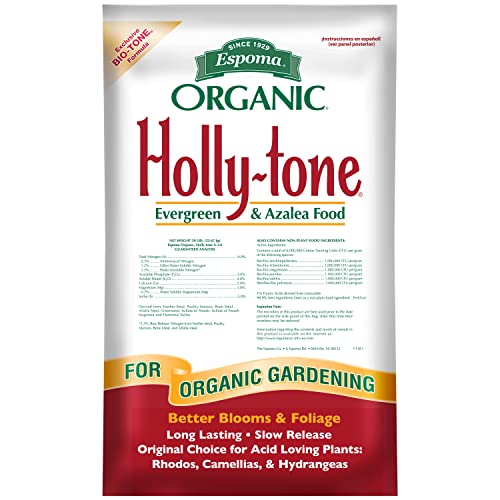
A 50-pound season-long supply for yards full of hungry acid-loving shrubs.
When your property holds a dozen holly bushes, a hedge of azaleas, and a row of blueberries, a 4-pound bag disappears fast. This 50-pound bag is the heavy-duty version of the same original Holly-Tone formula, with the identical 4-3-4 analysis (4% nitrogen, 3% phosphate, 4% potash) and 5% sulfur content for all acid-loving plants. The economics are simple: one bulk purchase covers a whole landscape for a season or more, and owners call out the “great price for a large bag.” One gardener’s hydrangeas bloomed twice as much after application, and azaleas “have never looked so good.”
There’s a real trade-off to weigh. At 50 pounds, this is physically heavy — a delivery that lands on your porch is a workout to relocate, and you’ll want a dedicated scoop and storage bin. Owners also flag an unpleasant odor from the natural ingredients, which is the honest flip side of an organic product built from bone meal and poultry manure. Neither is a reason to skip it, but both are worth knowing before a big purchase.
For sheer scale and value per feeding, this beats the 4-pound trio hands down — the 3-pack weighs in at 12 pounds total, while this single bag delivers 50 pounds of the same proven feed. Owner feedback shows quality and effectiveness ratings match the smaller pack. This is the buy for anyone who wants to feed the whole yard, not just a few pots.
Why it stands out
- Bulk 50-pound bag covers an entire landscape for the season
- Same trusted original formula with 4-3-4 analysis and 5% sulfur
- Registered Organic Input Material, made in the USA
Honest trade-offs
- Heavy to move and needs storage space
- Natural ingredients carry a noticeable odor
The bottom line: landscapers and gardeners with many acid-loving plants get the best per-feeding value from this bulk bag.
Who should skip it: anyone with limited storage or a small yard — the 4-pound pack is easier to handle.
Understanding the Specs
pH Range for Acid-Loving Plants
pH is a 0-14 scale measuring how acidic or alkaline something is, with 7 as neutral. Acid-loving plants like azaleas, blueberries, and rhododendrons typically want soil in the 4.5-6.5 range. In that zone, nutrients open up and roots can absorb them. A pre-mixed soil like Coast of Maine does the work for you; a fertilizer like Holly-Tone helps maintain the right conditions over time.
N-P-K Ratio on Fertilizer Labels
The three numbers on any fertilizer bag — like the 4-3-4 on Holly-Tone — stand for nitrogen, phosphorus, and potassium by percentage. Nitrogen pushes leafy green growth, phosphorus supports roots and blooms, and potassium builds overall hardiness. A balanced 4-3-4 suits flowering shrubs; a higher first number favors foliage-heavy evergreens.
FAQ
What is the difference between acidic planting soil and an acidifying fertilizer?
How often should I apply Holly-Tone to my acid-loving plants?
Will acidic compost make my hydrangeas bloom blue?
Is Coast of Maine planting soil certified for organic gardening?
How much soil do I need for a single blueberry bush?
Can I use Holly-Tone on plants that aren’t acid-loving?
Does the 50-pound Holly-Tone bag smell bad?
What does the 4-3-4 on the Espoma label mean?
Which plants benefit most from acidic compost?
Is it better to buy multiple small bags or one large bag?
Final Thoughts: The Verdict
If you want one dependable pick, the compost for acidic soil winner is the Coast of Maine Planting Soil because it handles the trickiest part — building an acidic, organic home for new plants — with zero mixing or measuring. If you want a no-fuss seasonal feed for established shrubs, grab the Espoma Holly-Tone 4 lb. pack. And for a yard full of acid lovers, the 50-pound Holly-Tone bag is the one to reach for.
How We Picked
We do not accept paid placement. Every pick is matched to a real buyer and a real use-case; we do not hands-on test units.
Sources & Methodology
Specifications: manufacturer listings and product documentation. Review insights: verified customer reviews, as of August 2026. Pricing: not shown on this page (it changes often); check the current price via the retailer link.
As an Amazon Associate, Lawn Gear Lab earns from qualifying purchases. This does not affect which products we feature.