
Specs are compiled from manufacturer listings and verified buyer reviews and can change over time — please confirm the key details on the product page before buying.
You need a weed killer that actually does the job the first time—not something that turns a few leaves brown and lets the roots laugh it off. Commercial-grade herbicides use active ingredients at higher concentrations than anything you find at the local hardware store, meaning they hit tough perennial roots and woody brush that homeowner formulas just annoy. The right pick here saves you time, frustration, and the cost of re-treating the same patch of ground.
I’m Rikta — the founder and writer behind Lawn Gear Lab. This guide is built by comparing the manufacturers’ published specifications and the patterns across verified customer reviews, so you get each pick’s real strengths and trade-offs instead of marketing spin.
After digging through the specs, coverage claims, and real buyer experiences for five top contenders, here is what you need to know to choose the very best commercial weed and grass killer for your land.
Quick Picks
- Roundup Pro Herbicide Industrial Weed Control 2.5 Gal. — Top Performer
- Roundup Pro Concentrate Herbicide 2.5 Gal. — Best Value
- Albaugh Gly Star Plus Herbicide 2.5 Gal. — Smart Budget Buy
- Roundup ProMAX 1.67 Gallon 780671 — Fast & Compact
- RoundUp Promax 1.67 Gallon Jug — Brush Buster
How To Choose The Best Commercial Weed And Grass Killer
Not all jugs of concentrate are the same. Two products can both say “glyphosate” on the label but differ wildly in potency, coverage, and how fast you see results. Here are the three numbers to check before you buy.
Active Ingredient Percentage
The concentration of the active chemical (usually glyphosate) dictates how much you need to mix per gallon of water and how effectively it kills deep-rooted perennials. A 41% concentration is the standard commercial baseline; a 50.2% concentrate like the Roundup Pro Herbicide Industrial hits harder on tough woody species like poison ivy or tree saplings in a single pass. Higher percentage also means a little goes further, so a single jug treats more square footage.
Coverage Area Per Jug
This is the real-world measure of value. Some products list coverage of 435,600 square feet per 2.5-gallon jug when mixed at the minimum rate for annual weeds, while others list 943.08 square feet. The catch is that coverage is entirely tied to your mix rate—spot-treating a few dandelions uses far less concentrate than blanketing a full acre of tough brush. Match the jug size and coverage to the size of your property or job site.
Surfactant System
A surfactant is a wetting agent that helps the herbicide stick to and penetrate the waxy surface of leaves instead of beading up and rolling off. Some concentrates come with a surfactant already mixed in; others require you to buy and add it separately. Built-in surfactant (like the system in Albaugh Gly Star Plus) simplifies your mixing and improves consistency, especially on broadleaf weeds with slick leaves.
Quick Comparison
| Model | Best For | Active Ingredient | Coverage | Volume | Amazon |
|---|---|---|---|---|---|
| Roundup Pro Herbicide Industrial 2.5 Gal. | Maximum potency for woody brush & trees | 50.2% Glyphosate | 435,600 sq. ft. | 2.5 Gal. | Amazon |
| Roundup Pro Concentrate 2.5 Gal. | Best value super-concentrate for large areas | Herbicide (concentrate) | Up to 435,600 sq. ft. | 2.5 Gal. | Amazon |
| Albaugh Gly Star Plus 2.5 Gal. | Budget-friendly with built-in surfactant | 41% Glyphosate | Refer to label | 2.5 Gal. | Amazon |
| Roundup ProMAX 1.67 Gal. | Fast rain-fast action (30 min) | Glyphosate | 943.08 sq. ft. | 1.67 Gal. | Amazon |
| RoundUp Promax 1.67 Gal. Jug | Slow, fatal kill on heavy brush | Glyphosate | Refer to label | 1.67 Gal. | Amazon |
In‑Depth Reviews
1. Roundup Pro Herbicide Industrial Weed Control 2.5 Gal.

The jug with the highest glyphosate percentage you can legally buy.
This is the heavy artillery. With a 50.2% glyphosate concentration, it is engineered for industrial sites, utility rights-of-way, and roadside management where soft consumer formulas fail. The super-concentrate format treats a massive 435,600 square feet per jug—over ten acres—when mixed per the label. That matches the Roundup Pro Concentrate at 435,600 square feet, versus the Roundup ProMAX at 943.08 square feet, making it the undisputed coverage champion for large-scale work.
Buyers report that the high potency “effectively killed persistent cottonwood root shoots under driveway” and browned leaves in a single day with no re-treatment needed. It is also water-soluble and works on a long list of tough species including bermudagrass, cattails, pampas grass, and horsetail. The catch is that it requires careful mixing with protective gear and is not for residential lawns—this is strictly for commercial and industrial use where complete vegetation removal is the goal.
Knockdown speed: Visible wilting on annual weeds in 2-4 days; tough perennials like poison ivy in 7 or more days, though some owners mention browning in 3 days with good weather.
The trade-off: At 20 pounds versus the 17-pound RoundUp Promax, it is the heaviest jug and requires a pump spigot or careful pouring to avoid waste.
Reach for this if: You need to clear large areas of woody brush, tree saplings, or deep-rooted perennials with one application and want the highest concentration available.
Look elsewhere if: You need a rapid knockdown for a small residential lawn—this is overkill for spot-treating dandelions.
2. Roundup Pro Concentrate Herbicide 2.5 Gal.
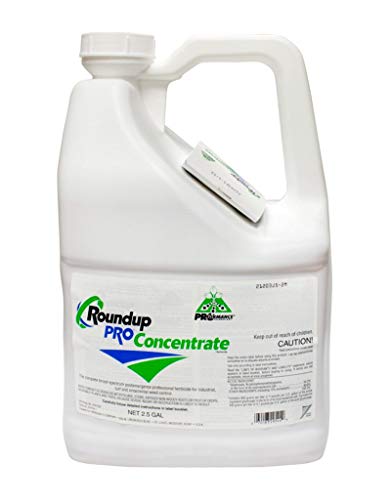
The super-concentrate that stretches a single jug into 150 gallons.
This is the pick for anyone who needs maximum versatility from a single purchase. At a mix rate of 2.5-3 ounces per gallon of water, one 2.5-gallon jug produces roughly 150 gallons of ready-to-spray solution at standard strength, or about 30 gallons at super-strength for stubborn brush. Customers note it “works in 3-4 days, kills in a week,” which is noticeably faster than the 7-10 day timeline reported for the RoundUp Promax slower formula. It treats up to 435,600 square feet, tying the Industrial version on coverage.
Unlike the 50.2% Industrial formula, this is a super-concentrate that you dilute more aggressively—so you get more total spray volume per dollar. One reviewer called it “cost-effective concentrate makes ~150 gal regular” and recommended a 63mm threaded hand pump spigot to handle the heavy jug. The main limitation is that it is not labeled for sale in Wisconsin or New Jersey, so check your state regulations before ordering.
Why it is a strong value
- Produces more finished spray volume than any other 2.5-gallon jug here due to aggressive dilution.
- Faster visible death than the Promax series—reviewers point out 3-4 days.
- Trusted Roundup formulation with consistent commercial-grade results.
One thing to consider
- Not available for sale in Wisconsin or New Jersey.
- Heavy jug requires a pump spigot or careful pouring to avoid spillage.
Best for: Property managers, farmers, or large-lot owners who want the most economical way to treat many acres without paying for maximum concentration they do not need.
skip it if: You need the absolute highest potency for woody brush—the 50.2% Industrial formula packs more per ounce.
3. Albaugh Gly Star Plus Herbicide 2.5 Gal.

The same active ingredient as Roundup Ultra, at a lower cost.
Albaugh Gly Star Plus matches the 41% glyphosate concentration of the premium Roundup Ultra but lands at a friendlier price point. It also includes a built-in surfactant—a wetting agent that helps the herbicide penetrate waxy leaf surfaces—so you do not have to buy a separate additive or risk poor coverage. The manufacturer states it is not labeled for residential use, so this is aimed at commercial applicators, farmland, and industrial sites.
You get total root kill, but you have to wait for it. Shoppers say it “takes about 10 days to two weeks to see everything dead, but for the price it’s worth it.” The systemic action (the chemical moves from the leaves down into the roots) kills the whole plant, not just the top. One reviewer notes the “instruction booklet is excellent” with detailed mixing rates for many different plant species. The big catch: this product is not for sale in California, Montana, Nevada, Oregon, Washington, or Wyoming, so check your state’s rules before you buy.
Worth noting
- Built-in surfactant means one less product to buy and mix.
- 320 fluid ounces per jug versus 213.76 fluid ounces for the Promax jugs.
- Excellent instructions with specific mix rates for dozens of weed species.
The watch-out
- Slower knockdown than some alternatives—expect 10-14 days for full results.
- Not available in six states, limiting accessibility for some buyers.
Reach for this if: You want commercial-grade performance with built-in surfactant at a lower cost than the big-brand Roundup jugs.
Look elsewhere if: You need the fastest possible kill speed, or you live in one of the six restricted states.
4. Roundup ProMAX 1.67 Gallon 780671
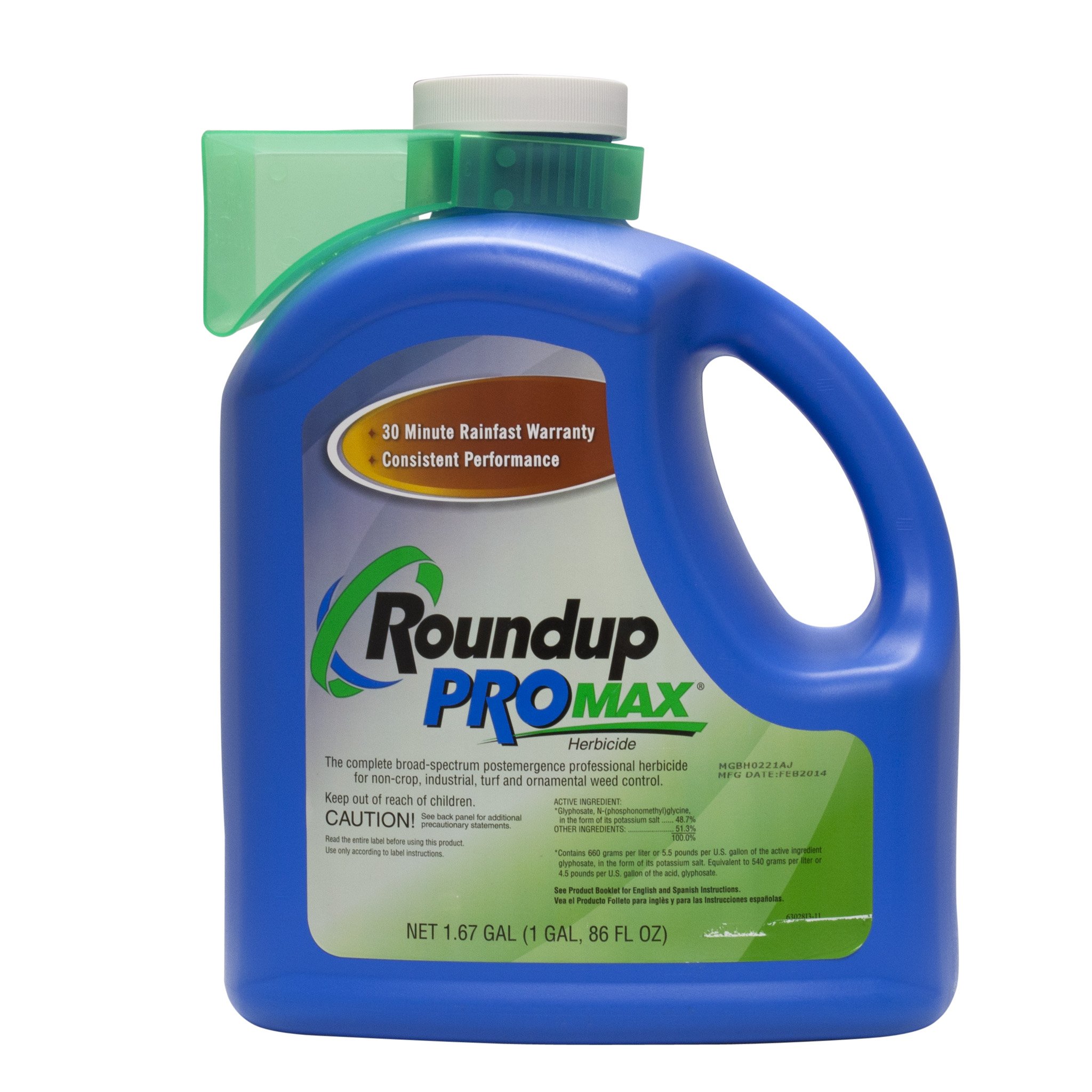
Rain-proof in half an hour, so you can spray before a storm.
The standout feature of the Roundup ProMAX is its rain-fast time of just 30 minutes—the fastest in this comparison. That means if you are spraying ahead of an unpredictable weather forecast, you can be confident the product will stick to the leaves and do its work without washing off. It is designed for trim and edge applications, turf renovation, and weeding shrub beds, making it a versatile tool for both commercial landscaping and larger residential properties.
Buyers report it “killed St. Augustine and bermudagrass on 6900 sqft lawn with first pass at 2.5oz/gal” though a second application was needed for some areas. At a coverage of 943.08 square feet per jug, compared with 435,600 square feet for the larger jugs, it is best for targeted spot treatments or smaller job sites rather than blanketing an entire acre. One reviewer noted it “mixed well but produces suds,” so be aware of foam in your tank.
Why it stands out: No other pick here can survive a rain shower after just 30 minutes. That alone makes it the right choice for unpredictable climates like Florida or the Pacific Northwest.
The limitation: Coverage is 943.08 square feet, while the Industrial and Pro Concentrate jugs list 435,600 square feet, so scale up your shopping cart if you have multiple acres to treat.
Best for: Quick turnarounds, spot treatments, and spray-and-run applications where weather is a real constraint.
pass on it if: You need to treat large acreage—you will burn through this small jug fast and pay more per square foot compared to the super-concentrates.
5. RoundUp Promax 1.67 Gallon Jug
The slow-burn killer that completely wipes out kudzu and ivy.
This jug is for you if you want total kill and can wait for it. Buyers consistently report it works slower than other Roundup versions—taking 7-10 days to fully kill weeds—but the death is thorough and reaches deep roots. One reviewer described clearing heavy vegetation including kudzu and ivy over two months with repeated applications, calling the formula “magical.” The key mix rate is 2 ounces per gallon for a 1.5% solution (the percentage of active ingredient in the spray). One review claims coverage of over 400,000 square feet from a single 1.67-gallon jug when treating annual weeds. It’s not for you if you need fast results in under a week.
Despite being only 1.67 gallons, it weighs 17 pounds. One review claims over 400,000 square feet of diluted coverage, while the Roundup ProMAX lists 943.08 square feet at standard mix rates. The difference is the dilution ratio—this is a more concentrated formulation that stretches further. The catch is that it is slower than the other Roundup variants: if you need fast visual results in 2-3 days, the Roundup Pro Concentrate or the Industrial formula will get you there faster.
What works
- One review claims over 400,000 square feet of coverage at the 2 oz/gal rate.
- Fatal to tough woody species like kudzu, ivy, and brush after multiple applications.
- Detailed booklet guides mix rates for dozens of weed and brush types.
What to know
- Slower knockdown than other Roundup products—7-10 days versus 3-4 days for the Pro Concentrate.
- At 17 pounds versus the 20-pound Industrial jug, it is still a heavy lift.
Reach for this if: You are fighting deep-rooted woody brush, kudzu, or ivy and can wait a week or two for complete, fatal results.
Look elsewhere if: You need to see fast visual confirmation that the product is working—the Pro Concentrate or Industrial formula show results in half the time.
Understanding the Specs
Glyphosate Percentage
This is the number that determines how much concentrate you need per gallon of water and how effectively it kills deep-rooted perennials. A 41% glyphosate product (like Albaugh Gly Star Plus) is the standard commercial baseline. A 50.2% product (like the Roundup Pro Industrial) is more concentrated, meaning you use less per gallon and get stronger results on woody species. Higher concentration does not necessarily mean faster kill—the speed depends on the adjuvant system and the weed species.
Surfactant
A surfactant is a chemical additive that breaks the surface tension of water, helping the herbicide droplets spread out and stick to waxy or hairy leaves instead of beading up and rolling off. Some concentrates come with surfactant pre-mixed; others require you to buy it separately and add it to your spray tank. Built-in surfactant saves a step and ensures correct ratios, but limits your ability to customize the mix for specific weed types or environmental conditions.
FAQ
What is the difference between Roundup Pro and Roundup ProMAX?
Can I use commercial weed killer on my home lawn?
How long does it take for commercial glyphosate to work?
How do I mix commercial glyphosate concentrate?
Will these products kill woody brush and trees?
Are these products safe around pets and children?
How much area will a 2.5-gallon jug cover?
Why are some of these products not available in certain states?
Can I mix these with other herbicides or adjuvants?
What is the difference between a selective and non-selective herbicide?
Final Thoughts: The Verdict
For most buyers, the commercial weed and grass killer winner is the Roundup Pro Herbicide Industrial because its 50.2% glyphosate concentration delivers maximum potency on tough brush and massive coverage in one jug. If you want the best value for treating large acreage without paying for the highest concentration, grab the Roundup Pro Concentrate. And for budget-conscious buyers who still want a built-in surfactant, the Albaugh Gly Star Plus is the smartest choice.
How We Picked
We do not accept paid placement. Every pick is matched to a real buyer and a real use-case; we do not hands-on test units.
Sources & Methodology
Specifications: manufacturer listings and product documentation. Review insights: verified customer reviews, as of July 2026. Pricing: not shown on this page (it changes often); check the current price via the retailer link.
As an Amazon Associate, Lawn Gear Lab earns from qualifying purchases. This does not affect which products we feature.