
Bringing a heavy weed problem under control on a farm, pasture, fence line, or industrial site comes down to one choice: which herbicide actually finishes the job without requiring round after round of re-treatment. The difference between a disappointing product that merely browns the tops and a serious commercial-grade solution that kills roots and brush for months is all in the active ingredient concentration, application volume, and whether the formula is built for the specific weeds you are fighting.
I’m Rikta — the co-founder and writer behind Lawn Gear Lab. This guide is built by comparing the manufacturers’ published specifications and the patterns across verified customer reviews, so you get each pick’s real strengths and trade-offs instead of marketing spin.
The best recommendation for your property depends on matching the right chemistry to your target weeds and coverage area. Below, each pick is compared by its concentration, coverage, and what verified buyers report about real-world results.
How To Choose The Best Commercial Herbicide
Buying a commercial herbicide means deciding between chemistry types, concentration levels, and total liquid volume — and getting it wrong means wasted money or dead weeds coming right back. Here is what to focus on so you land on the right product the first time.
Active Ingredient & Concentration
The active ingredient is the chemical that actually kills the plant. Glyphosate (the same active ingredient found in Roundup) is a non-selective killer — it kills almost everything it touches — and is great for clearing entire fields, fence lines, or industrial sites. For selective control where you want to kill weeds without harming your grass, look for ingredients like MSMA (Monosodium acid Methanearsonate) or Triclopyr (a brush-killing chemical found in Remedy). Concentration is measured as a percentage: a higher number means more killing power per ounce of liquid, so you can use less product to cover the same area.
Coverage and Liquid Volume
Commercial herbicides come in jugs ranging from 1 gallon to 2.5 gallons and larger. Check the total square footage a jug covers at the recommended mix ratio — a 2.5-gallon jug of concentrate can cover over 400,000 square feet, while a 1-gallon jug might cover about half an acre depending on the weeds you are fighting. Buy the smallest size that fits your property to avoid storing leftover concentrate that expires before your next use.
Selective vs. Non-Selective
If you are spraying a pasture or lawn where you want the grass to survive, you need a selective herbicide that targets broadleaf weeds and specific grasses (like MSMA for dallisgrass or Triclopyr for brush). If you are clearing a fence row, driveway, sidewalk crack, or industrial lot where you want everything dead, grab a non-selective herbicide like glyphosate or diquat that knocks out all vegetation in its path. Using a non-selective product on your lawn will kill the grass too.
Quick Comparison
On smaller screens, swipe sideways to see the full table.
| Model | Category | Best For | Key Spec | Amazon |
|---|---|---|---|---|
| Roundup Pro Concentrate | Non-Selective | Large-area total vegetation control | 300 fl. oz. / 2.5 gal. | Amazon |
| Roundup Pro Industrial | Non-Selective | Tough perennial weeds & brush | 320 fl. oz. / 2.5 gal. | Amazon |
| Remedy Specialty Herbicide | Selective Brush | Pasture brush & fence lines | 128 fl. oz. / 1 gal. | Amazon |
| Ranger Pro Glyphosate | Non-Selective | Budget-friendly large-scale spraying | 640 fl. oz. / 2.5 gal. | Amazon |
| Target 6 Plus MSMA | Selective Turf | Dallisgrass & nutsedge in turf | 320 fl. oz. / 2.5 gal. | Amazon |
| Alligare Diuron 80 DF | Pre & Post Emergent | Industrial sites & non-crop areas | 25 lb. granules | Amazon |
| Weedtrine D Aquatic | Aquatic | Pond & waterway weed control | 128 fl. oz. / 1 gal. | Amazon |
In‑Depth Reviews
1. Roundup Pro Concentrate Herbicide
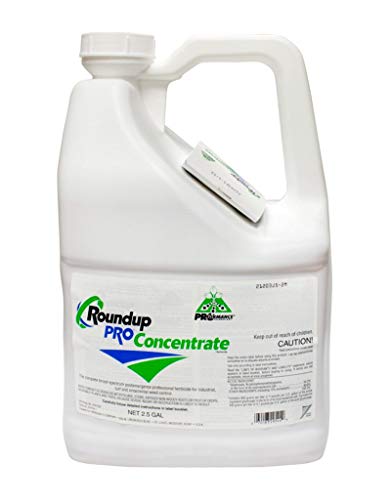
2.5 gallons of super concentrate covering up to 435,600 square feet per jug makes this the top pick for anyone who needs to kill every weed on a large property — fields, fence rows, driveways, or entire pastures — without spending a fortune on repeated applications.
Owners mention that it starts working in 3 to 4 days and finishes off the weeds within a week, which is noticeably faster than many generic store brands. The real value here is the cost per treated acre — customers note this concentrate is significantly cheaper than buying the same active ingredient in pre-mixed spray bottles from hardware stores. A number of users also recommend pairing it with a 63mm threaded pump for easy transfer out of the heavy jug.
The main limit is that Roundup Pro Concentrate cannot be shipped to Wisconsin or New Jersey, so check your state before ordering. For anyone managing a large tract of land who wants the most trusted name in total vegetation control at the best per-gallon value, this is the right pick.
Why it’s great
- Covers up to 435,600 sq. ft. per jug
- Shows results in 3-4 days per verified buyers
- Better value than pre-mixed retail options
Good to know
- Not available in Wisconsin or New Jersey
- Heavy 2.5 gal. jug requires a pump or careful pouring
- Non-selective — kills all vegetation it touches
2. Roundup Pro Herbicide Industrial Weed Control

If you need more muscle than the standard Roundup Pro Concentrate, this industrial-grade formula packs a 50.2% glyphosate concentration — a notably higher percentage than the standard concentrate, which means it delivers faster knockdown on stubborn perennials like woody brush, trees, vines, and invasive grasses. Reviewers point out that one buyer saw leaves brown in a single day on persistent cottonwood root shoots under a driveway, with no re-treatment needed.
This 2.5-gallon jug holds 320 fluid ounces and covers up to 435,600 square feet, so you get the same coverage as the standard concentrate but with more killing power per ounce. It is labeled for industrial, turf, ornamental, forestry, roadside, and utility rights-of-way use, making it the better bet if you are battling thick brush or deep-rooted perennials that weaker mixes might only wound. Several buyers also say the formula dries in about three hours, which is ideal for climates with frequent afternoon rain.
The catch is that at 50.2% concentration this formula is more potent, so careful mixing is crucial — overspray drift can kill desirable plants and trees in the breeze, and you must use protective gloves and a mask. Choose this over the standard concentrate if your property is overrun with woody brush, poison ivy, or trees you need to kill at the stump, and you want the strongest glyphosate mix available without a specialty license.
Where it shines
- High 50.2% glyphosate concentration for tough weeds
- Dries in ~3 hours, good for rainy climates
- One jug covers 435,600 sq. ft.
Worth noting
- Requires protective gear during mixing and application
- Drift can harm nearby desirable plants
- Non-selective — kills everything it contacts
3. Remedy Specialty Herbicide Weed Killer & Brush Control
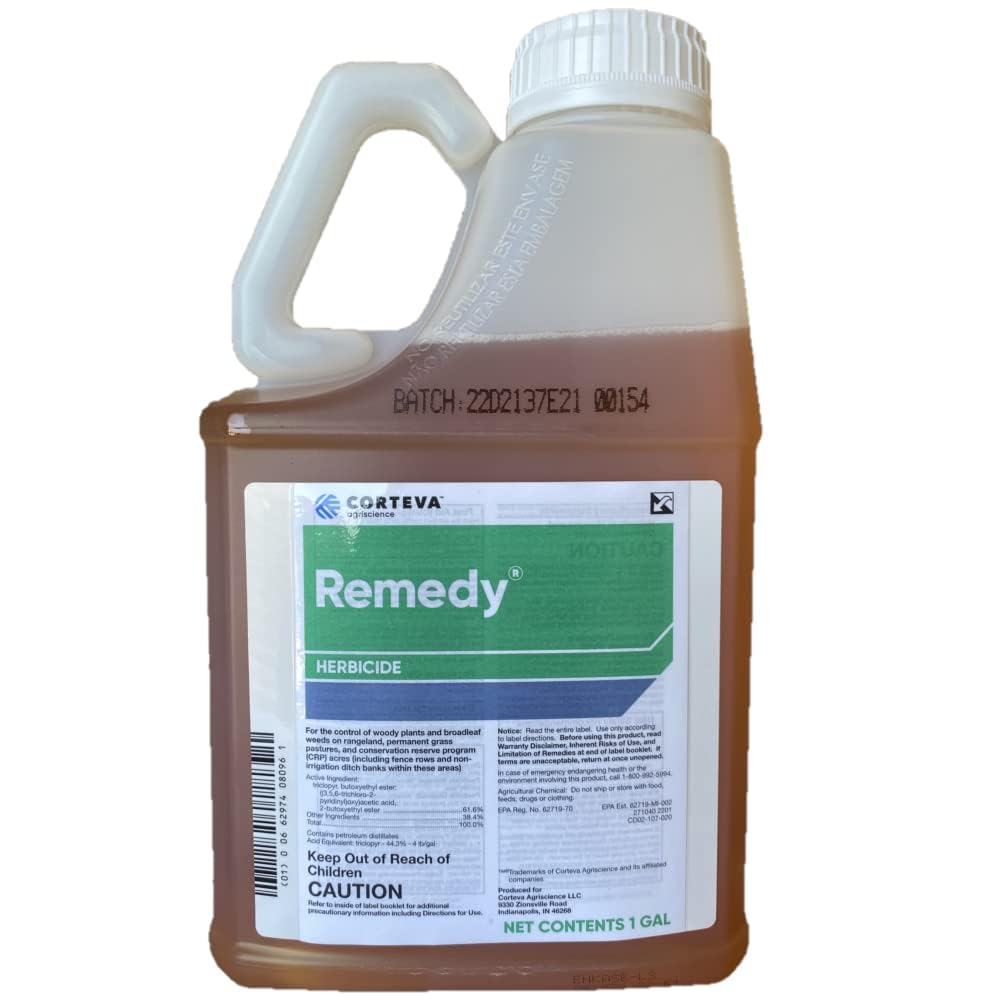
If you are managing a pasture or fence line where you need to kill brush and broadleaf weeds without harming the surrounding grass, this is the herbicide designed exactly for that scenario. The active ingredient Triclopyr targets woody plants and broadleaf weeds while leaving your pasture grass intact — a critical difference from glyphosate which nukes everything in the spray zone. One reviewer described how it “absolutely annihilated my cogon grass problem,” a notoriously tough invasive species that resists many general-purpose killers.
The 1-gallon jug holds 128 fluid ounces, and because it is a selective concentrate, a little goes a long way when spot-treating individual bushes or tree stumps. Shoppers say excellent results mixing it with diesel for basal bark applications on honey locust trees and multiflora rose, killing them at the stump with almost no resprouting. The formula is also low-odor, which is a welcome feature when you are spending hours spraying fence lines on a warm day.
The downside is that this product is specialized — it works wonders on brush and broadleaf weeds but is not effective on grassy weeds, so do not buy it if your problem is primarily crabgrass or dallisgrass in a turf setting. For anyone fighting woody invaders, invasive brush, or tough pasture weeds and wanting to preserve their grass cover, Remedy is the clear specialist to choose.
What stands out
- Selective — kills brush without harming pasture grass
- Low-odor formula for comfortable application
- Excellent for stump-treatment of invasive trees
The trade-offs
- Ineffective on grassy weeds
- Requires careful mixing for best results on brush
- 1 gal. jug covers less area than 2.5 gal. options
4. Ranger Pro Glyphosate Herbicide Concentrate

The single number that matters most in this category is volume: the Ranger Pro pack delivers 640 fluid ounces (a full 2.5 gallons) — that is five times the volume of the Weedtrine D Aquatic herbicide’s 128 fluid ounces, making it the biggest single-volume jug in this lineup for the same general glyphosate chemistry. With a 41% glyphosate concentration (the same active ingredient as Roundup), it mixes at 2 to 3 ounces per gallon of water for broad-spectrum vegetation control on large areas like residential fields, parks, and recreational grounds.
The trade-off you accept for this bulk value is a lower concentration than the industrial Roundup Pro at 50.2%. Buyers report it still works well: one reviewer sprayed several acres and a sizeable front-area area, reporting that weeds dried up within two weeks at the highest mix ratio. The product is also noted for maintaining its potency even after years of storage, which is useful if you buy in bulk and use it slowly over multiple seasons.
For property owners who need to treat acres of land on a tight budget and are willing to mix a slightly lower concentration themselves — getting the same active ingredient for significantly less per gallon — Ranger Pro offers the strongest price-to-performance ratio of any glyphosate product here.
The upsides
- 640 fl. oz. per pack — most liquid for the price
- 41% glyphosate is the same active ingredient as Roundup
- Maintains potency after years of storage per reviews
Keep in mind
- Lower concentration than industrial-grade options (50.2%)
- Non-selective — kills all vegetation
- Large jug is heavy to move and requires a pump
5. Target 6 Plus (MSMA 48.2%) Turf Herbicide

For golf course superintendents, sod farmers, and turf managers battling persistent grassy weeds like dallisgrass and nutsedge — species that laugh at glyphosate because they grow among desirable grass — this 2.5-gallon jug of MSMA (Monosodium acid Methanearsonate) at 48.2% concentration is a specialist tool that actually works. The 320 fluid ounces of concentrate mix at 2 ounces per gallon of water for general applications, and because it is selective, it kills target weeds while leaving your turfgrass (like Bermuda, zoysia, or St. Augustine) intact when mixed correctly.
Reviews highlight how effectively it knocks out dallisgrass in Japanese zoysia lawns, with one buyer saying it wiped out the infestation impressively. The formula is also notably thick and high-quality, manufactured in Israel according to a verified buyer. Because this product is so potent, reviewers caution that overdosing the mixture can severely brown your grass and even send Bermuda into dormancy — so follow the label measurements precisely.
If you are managing a high-value turf area like a golf course fairway, a commercial sod farm, or a premium lawn where you need to eliminate tough grassy weeds without killing the grass itself, Target 6 Plus is the exact right tool — just skip it if you need total vegetation control for a field or fence line.
Why we’d pick it
- Selective — kills grassy weeds without harming turf
- High 48.2% MSMA concentration for tough species
- Thick, high-quality formula per verified reviews
A few caveats
- Overdosing can severely damage turfgrass
- Not effective on broadleaf weeds
- Requires precise mixing per label instructions
6. Alligare Diuron 80 DF Herbicide
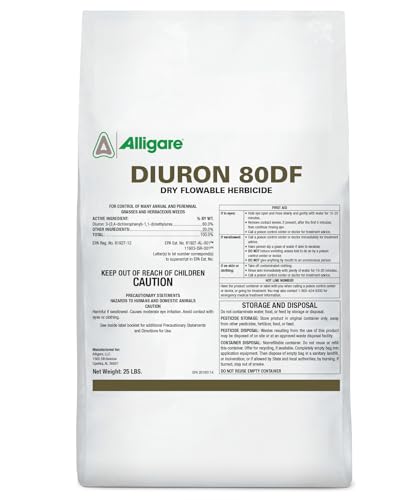
If you manage a highway right-of-way, an airport perimeter, a railway corridor, or a large industrial storage area where you need long-term weed prevention rather than just spot-spraying existing growth, this 25-pound bag of dry granular Diuron is a completely different approach — it is a pre-emergent and post-emergent herbicide that stops weeds before they sprout and kills those that have already emerged. The “80 DF” means 80% Diuron dry flowable, a highly concentrated formula that requires only a small amount per acre.
This product is rain-activated, meaning after you spread it, rain within two weeks works it into the soil where it forms a barrier that keeps crabgrass, ryegrass, pigweed, and foxtail from germinating for weeks. Owners mention it is extremely powerful and that a small handful mixed with a gallon of water produces visible results within days on existing growth. Several reviewers use it for pond scum control, though the label specifies it is for industrial and non-crop areas only.
The honest limit is that this is a specialized industrial tool — it is not for pasture, lawn, or garden use, and the granular form requires a spreader for even application over large areas.
Strong points
- Prevents new weeds AND kills existing growth
- Rain-activated for extended soil barrier
- 25 lb. bag covers very large industrial areas
Before you buy
- Labeled for industrial/non-crop use only
- Granular form needs a spreader for even coverage
- Extremely potent — overspray can harm aquatic life
7. Weedtrine D Aquatic Herbicide
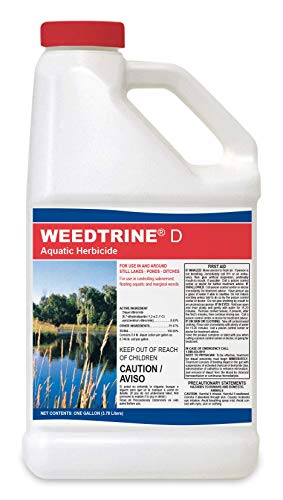
Compared to the other herbicides on this list, Weedtrine D is the only one formulated specifically for aquatic environments, making it a specialized value rather than a general-purpose option. The 1-gallon jug (128 fluid ounces) treats approximately half an acre of weed growth, and its active ingredient, diquat dibromide, kills weeds on contact and is fast-acting — one buyer who had tried several products and even experienced a fish kill with another chemical said this worked safely and as advertised, clearing duckweed that had persisted for years.
Because it targets plants both above and below the water surface, you spray it directly onto floating weeds and it quickly dilutes to reach submersed growth. Customers note visible results within hours on duckweed and floating weeds, with full control coming in days. The product is noted by reviewers as safe for fish and wildlife when used according to the label, which is critical for anyone managing a stocked pond. You will need to add a surfactant (a soap-like chemical that helps the spray stick to leaves) for best results on weeds above the waterline.
The limitation is that this product cannot be shipped to several states including California, New York, and Washington, and water-use restrictions apply — you cannot use the treated water for irrigation, drinking, or swimming for a period after application. For pond owners and aquatic weed managers who need a professional-grade solution that targets the specific weeds living in water, Weedtrine D is the exact pick.
What we like
- Specifically formulated for aquatic weed control
- Fast-acting — results visible in hours on duckweed
- Safe for fish and wildlife per verified reviews
The downsides
- Cannot ship to AK, CA, CT, HI, ME, NJ, NY, WA
- Water-use restrictions apply after treatment
- Requires a surfactant for above-water weeds
Understanding the Specs
Active Ingredient Concentration
This is the percentage of the actual weed-killing chemical in the bottle. A higher number (like 50.2% in the industrial Roundup Pro) means more killing power per ounce of liquid, so you can use less product per gallon of water. Lower concentrations (like 41% in Ranger Pro) mean you need to use more ounces per gallon to get the same effect. For tough perennial weeds, woody brush, or deep-rooted invasive plants, go for a higher concentration product to avoid having to re-spray.
Unit Count (Fluid Ounces)
This tells you the total liquid volume in the jug. A 640-fluid-ounce jug (like Ranger Pro) is 5 gallons worth of product, while a 128-fluid-ounce jug is 1 gallon. Bigger numbers mean you can treat more total area per purchase, but also mean a heavier jug to move and store. Always cross-reference the unit count with the recommended mix ratio to figure out how much total spray solution you can make from one jug.
FAQ
Can I use a commercial glyphosate herbicide on my lawn without killing the grass?
How do I calculate how much concentrate I need for my property?
Which commercial herbicide is best for killing brush and small trees?
Do I need a license to buy commercial herbicides like the ones on this list?
Final Thoughts: The Verdict
For the majority of shoppers, the best commercial herbicide winner is the Roundup Pro Concentrate because it combines the most trusted name in weed control with a 2.5-gallon jug that covers up to 435,600 square feet at a very reasonable per-acre cost. If you need stronger chemistry for woody brush and perennials, grab the Roundup Pro Industrial with its 50.2% glyphosate concentration. And for pasture managers who need to kill brush without harming grass, the standout is the Remedy Specialty Herbicide.