
Specs are compiled from manufacturer listings and verified buyer reviews and can change over time — please confirm the key details on the product page before buying.
You need a commercial-grade electric leaf blower that keeps moving wet, matted leaves all day without slowing down. The real question is not whether battery power can match gas — at the top end, it already does — but which model gives you the runtime and air volume to finish the whole property on one charge without wrecking your arms. This guide compares five of the strongest cordless contenders by their published specs and the real-world experiences of buyers who used them on large lots.
I am Rikta, the founder of Lawn Gear Lab. This guide compares manufacturers’ published specifications and patterns across verified customer reviews. You get each pick’s real strengths and trade-offs instead of marketing claims.
Below you will find the best commercial electric leaf blower options ranked by power, runtime, and weight. Honest notes on where each one falls short help you match the right tool to your property’s size.
Quick Picks
- EGO Power+ LB8803-2 — Best Overall
- Husqvarna Leaf Blaster 350iB — Power Boost Pick
- Greenworks 80V BL80L414 — Balanced Performer
- Bosch GBL18V-450N18 — Quiet Operator
- EWORK 20V Cordless Leaf Blower — Budget Champion
How To Choose The Best Commercial Electric Leaf Blower
Picking a commercial-grade cordless blower depends on three numbers. CFM (cubic feet per minute) is the volume of air it pushes. MPH (miles per hour) is the speed of that air. The battery’s amp-hour rating (Ah) roughly tells you how long it runs. For heavy wet leaves and large driveways, prioritize high CFM first — the volume moves the pile. MPH matters mostly for dislodging debris stuck in landscaping rocks or gravel. A tool that advertises 770 to 880 CFM and 190 to 200 MPH sits solidly in commercial territory. The battery is the hidden cost: bigger Ah usually means more runtime but more weight. Most serious cordless blowers use 40V to 80V systems. If you already own tools from one brand’s battery platform, that can save you hundreds of dollars on extra batteries.
Air Volume (CFM) vs. Air Speed (MPH)
CFM is the amount of air the motor can move each minute. Think of it as the muscle that shifts a thick pile of wet oak leaves. MPH is the velocity of that air — it blasts a single stubborn acorn out of a crack. For clearing a yard, watch CFM. For cleaning out a garage or blowing off a deck, MPH matters more. A good commercial blower gives you both: at least 700 CFM and 190 MPH.
Battery System and Runtime
Voltage (40V, 56V, 80V) determines how much power the motor can draw. Higher voltage can sustain higher CFM without overheating, but it means heavier batteries. Amp-hours (Ah) tells you how long the battery lasts before a recharge. A 4.0Ah battery on a 700+ CFM blower runs roughly 15 to 25 minutes at full throttle. If your lot takes longer, you need a second battery or a larger capacity battery (5.0Ah or 7.5Ah). Many reviewers point out that no cordless blower has long runtime at turbo power — that is physics. Plan for quick charging and hot-swapping batteries.
Weight and Ergonomics
A high-powered blower with a big battery can weigh between 5.9 and 10 pounds or more. That does not sound like much until you hold it at arm’s length for 20 minutes. Look for a model with cruise control or a trigger lock so you do not squeeze a trigger the whole time. A shoulder strap helps with heavier units. Also check the balance — a battery that mounts near the handle rather than at the far end makes the tool feel lighter than it is.
Quick Comparison
| Model | Best For | CFM | MPH | Battery & Voltage | Amazon |
|---|---|---|---|---|---|
| EGO Power+ LB8803-2 | Maximum air volume & dual batteries | 880 CFM | 200 MPH | 56V, 2 x 4.0Ah | Amazon |
| Husqvarna 350iB | Best overall CFM & MPH balance | 800 CFM | 200 MPH | 40V, 7.5Ah | Amazon |
| Greenworks 80V BL80L414 | Lightweight power with fast charging | 770 CFM | 190 MPH | 80V, 4.0Ah | Amazon |
| Bosch GBL18V-450N18 | Quietest operation & pro build | 450 CFM | 123 MPH | 18V, 8.0Ah | Amazon |
| EWORK 20V | Budget-friendly twin battery set | 700 CFM | 200 MPH | 20V, 2 x 4.0Ah | Amazon |
In‑Depth Reviews
1. EGO Power+ LB8803-2

The tool that moves 880 CFM of air without gas or pull-start hassle.
This EGO hits the highest air volume in the group at 880 CFM (cubic feet per minute) and matches the top speed at 200 MPH (miles per hour). That is the single most powerful handheld cordless blower in this comparison — it lets you shift wet leaves and heavy debris faster than any other here. It comes with two 56V 4.0Ah (amp-hour) batteries and a charger, a major advantage since no other brand includes two batteries in the kit. That second battery lets you keep working while the other charges. The carbon fiber body keeps the weight manageable despite the heavy 56V batteries. The onboard digital display shows battery charge level and cruise lock status in real time — a nice touch for monitoring your remaining runtime at a glance.
Buyers report that the turbo mode is genuinely startling. One reviewer warned you need to be “firmly planted on your feet” before pulling the trigger the first time. The downside is noise: at full power it is loud enough that you need hearing protection. Another owner mentioned the included 4.0Ah batteries work fine, but a 5.0Ah battery would give noticeably more runtime on turbo. They noted replacement batteries are expensive. Still, with 880 CFM and the ability to swap between two batteries, this is the blower for anyone who needs to clear a large yard or commercial property in one session.
Air-power king: No other cordless handheld in this lineup moves more air. The 880 CFM and 200 MPH combination, plus the twin-battery kit, makes this the ideal pick if your property demands maximum clearing force and you want to avoid downtime for charging.
The honest trade-off: The 4.0Ah batteries do not last long at turbo. Expect 15-20 minutes of full-power operation per battery. EGO’s 5.0Ah or larger batteries will give you better runtime if you buy them separately.
Reach for this if: you need the highest CFM available in a cordless handheld, and the included second battery means you never stop to recharge mid-job.
Look elsewhere if: light weight and quiet operation matter more to you than raw air-moving power. For a much lighter option that still handles wet leaves, consider the Greenworks 80V.
2. Husqvarna Leaf Blaster 350iB

A 40V powerhouse that delivers 800 CFM and the largest single battery in this comparison.
Husqvarna’s 350iB delivers 800 CFM (cubic feet per minute) and 200 MPH (miles per hour). That puts it right behind the EGO on pure air volume but ahead on battery capacity — the included 40V 7.5Ah (amp-hour) battery is the largest single battery in this lineup. The brushless motor has a power boost mode that delivers 20 percent more power on demand. Buyers confirm that in turbo mode the blower has so much force you have to brace the butt of it against your hip. One owner with a large, hilly lot covered in pine needles and fir trees reported getting “almost all the way done on a single charge, and that was running at normal speeds.” That is proof of what the 7.5Ah battery can do at standard settings. The cruise control feature locks your selected speed so you do not have to hold the trigger, which reduces hand fatigue on longer jobs.
The catch is weight. At 10 pounds with the large battery, this is the heaviest blower in the group — at 10 pounds versus the Greenworks at 5.95 pounds. Owners mention the battery itself is heavy and creates a slight imbalance. One reviewer noted their arms were “shaky for a bit” after an hour of use. The battery is also expensive to replace, and the kit only includes one. A built-in debris scraper on the nozzle is a nice idea for loosening wet leaves, though one owner found it worked better in concept than practice on their wooden deck.
What makes it a commercial-grade buy
- 800 CFM at 200 MPH equals gas-blower power without the emissions or pull-start hassle
- The 7.5Ah battery gives you the longest single-charge runtime of any blower here — enough for a large lot on normal speeds
- Power boost mode adds 20% more force for stubborn, wet debris
- Cruise control locks the speed so your trigger finger gets a break
The weight penalty you should know about
- 10 pounds makes it noticeably heavier than the Greenworks (5.95 lbs) and EGO alternatives
- The large battery can unbalance the tool, causing arm fatigue during extended use
- Only one battery in the kit, and a spare is expensive — consider a second purchase if your property is very large
- Fairly noisy; buyers recommend noise-cancelling earbuds or earplugs
Go with this if: you want the longest single-battery runtime available and need gas-level power from a cordless tool.
Pass it by if: facing a 10-pound tool for 30-plus minutes is a dealbreaker. The EGO, at a similar weight but with two batteries, lets you swap rather than lug one heavy pack.
3. Greenworks 80V BL80L414

An 80-volt blower that weighs just 5.95 pounds but moves 770 CFM — a lighter alternative to the heavier picks.
The Greenworks 80V delivers 770 CFM (cubic feet per minute) and 190 MPH (miles per hour) from an 80-volt system, the highest voltage in this comparison. Higher voltage means the motor can sustain more power with less heat buildup. The brushless motor claims 30 percent more torque than brushed equivalents, according to the brand. The big story is the weight: at 5.95 pounds, it is the lightest full-power blower in the group, at 5.95 pounds compared to the Husqvarna at 10 pounds. That makes a real difference if you carry it around a large yard for 20 minutes or more. The kit includes one 4.0Ah (amp-hour) battery and a rapid charger with a built-in cooling fan. One buyer mentioned the battery was fully recharged in less than 50 minutes from dead. The variable speed trigger plus cruise control lets you lock in any power level between a gentle 20 MPH breeze for dusting off a patio and full-force 190 MPH for clearing the yard.
Customers note the power is genuinely impressive. One owner said the Greenworks “cleared the pavement and the backyard in 19 minutes,” outperforming their old Stihl BG 50 gas blower. The same reviewer noted they did not even need the turbo button on high power — the standard setting was strong enough. A caution that came up repeatedly is that the actual weight with the 80V battery onboard is closer to 11.5 pounds. That is still decent but much heavier than the advertised tool-only weight. One owner wished for a shoulder strap attachment point, though most users found it balanced well.
Where it shines
- 5.95-pound tool weight (lightest of the high-CFM models here) is a genuine advantage for arm fatigue
- 80V motor delivers 770 CFM — enough for heavy wet leaves, as multiple reviewers confirmed
- Variable speed from 20 MPH to 190 MPH, plus a cruise control lock, offers fine control
- Fast charger with a cooling fan recharges the 4.0Ah battery in under 50 minutes
What to watch for
- Weight with the 80V battery is about 11.5 pounds, not 5.95 — the advertised figure is tool-only
- No second battery included; you need to budget for a spare if your property requires more than 20 minutes at high power
- Noise level reaches around 100 dB on high, so ear protection is still wise
Best suited for: the buyer who wants high CFM and high voltage without the weight penalty of a 10-pound tool — and who already has or is willing to buy a second 80V battery for longer sessions.
Not ideal for: anyone who needs the max possible CFM from the EGO (880) or wants two batteries in the box.
4. Bosch GBL18V-450N18
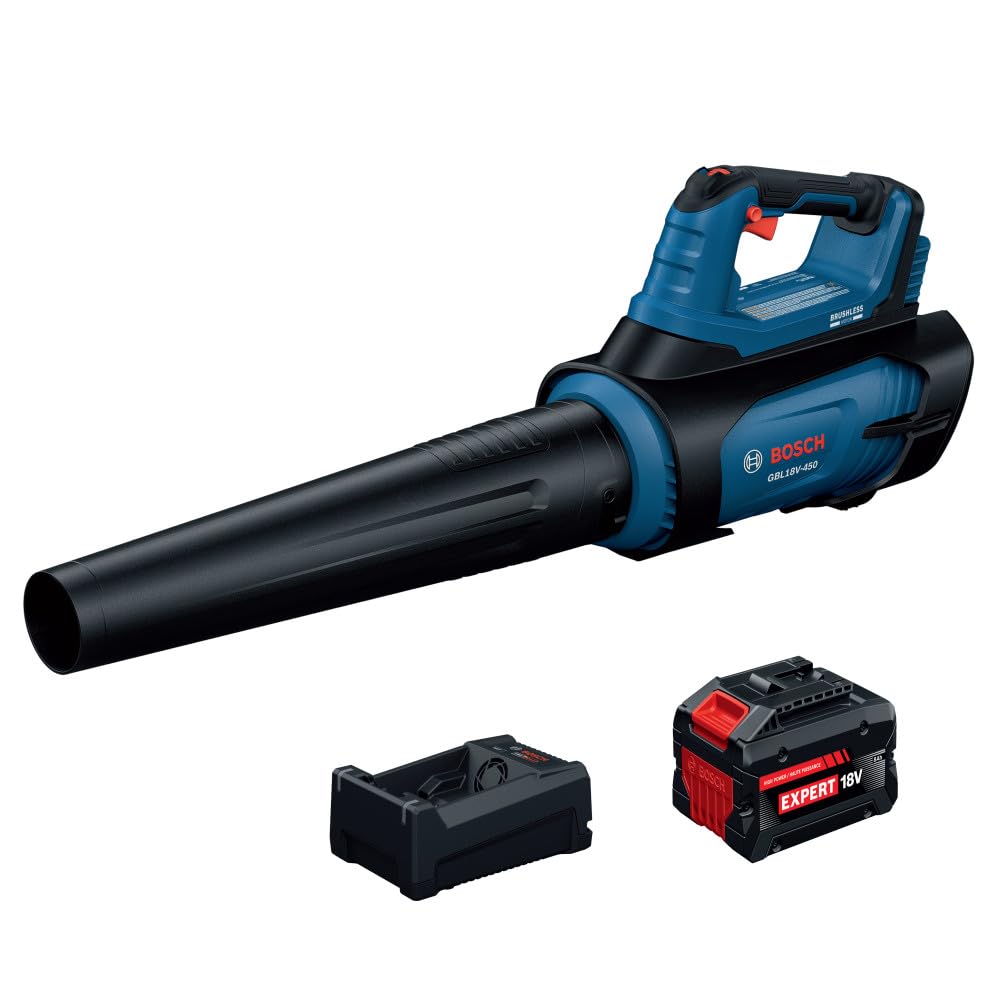
The pro-grade Bosch that cuts noise to 64 dB — almost conversation-level quiet — while still clearing debris.
This Bosch operates at just 64 decibels (dB), dramatically quieter than any other blower here. Most competitors push 90 to 110 dB at full power. At 64 dB, you can hold a conversation next to it, and neighbors will not hear you running it early in the morning. The trade-off is air power: 450 CFM (cubic feet per minute) and 123 MPH (miles per hour). That is roughly less than the EGO at 880 CFM and the Husqvarna at 800 CFM. It is still plenty for clearing a driveway, patio, garage, or light yard debris, but it will struggle with deep piles of wet leaves. The kit includes one 18V 8.0Ah (amp-hour) high-power battery. The trigger lock-on button locks the blower in the on position and lets you adjust speed while locked — a nice ergonomic touch for long cleaning sessions. At 9.48 pounds, it is in the middle weight-wise, but the well-balanced design helps offset that.
Buyers consistently call it powerful for its class. One owner reported “it is so strong you have to be careful.” The BITURBO brushless motor is designed to deliver corded-level performance from a battery, according to the brand. Reviewers point out it is a professional-quality build with a five-year warranty on the tool and three years on the battery. The main limitation is the air volume: at 450 CFM, it is not in the same league as the 700+ CFM blowers for big-yard work. This is a premium pick for the pro who values low noise, fast charging, and compatibility with the Bosch 18V / AMPShare battery ecosystem over raw leaf-moving power.
Quiet and refined: The 64 dB noise level is a standout for noise-sensitive neighborhoods or early-morning work. The 8.0Ah battery gives extended runtime relative to the lower power draw.
Not a heavy-lifter: At 450 CFM and 123 MPH, this blower is best for clearing hard surfaces and lighter debris, not for moving thick piles of wet leaves across a large yard.
Choose this for: quiet operation, professional build quality, and the five-year warranty — especially if you are already in the Bosch 18V tool ecosystem.
skip it if: you need 700+ CFM to move heavy wet leaves or clear a large property. For that, look at the EGO or Husqvarna instead.
5. EWORK 20V Cordless Leaf Blower
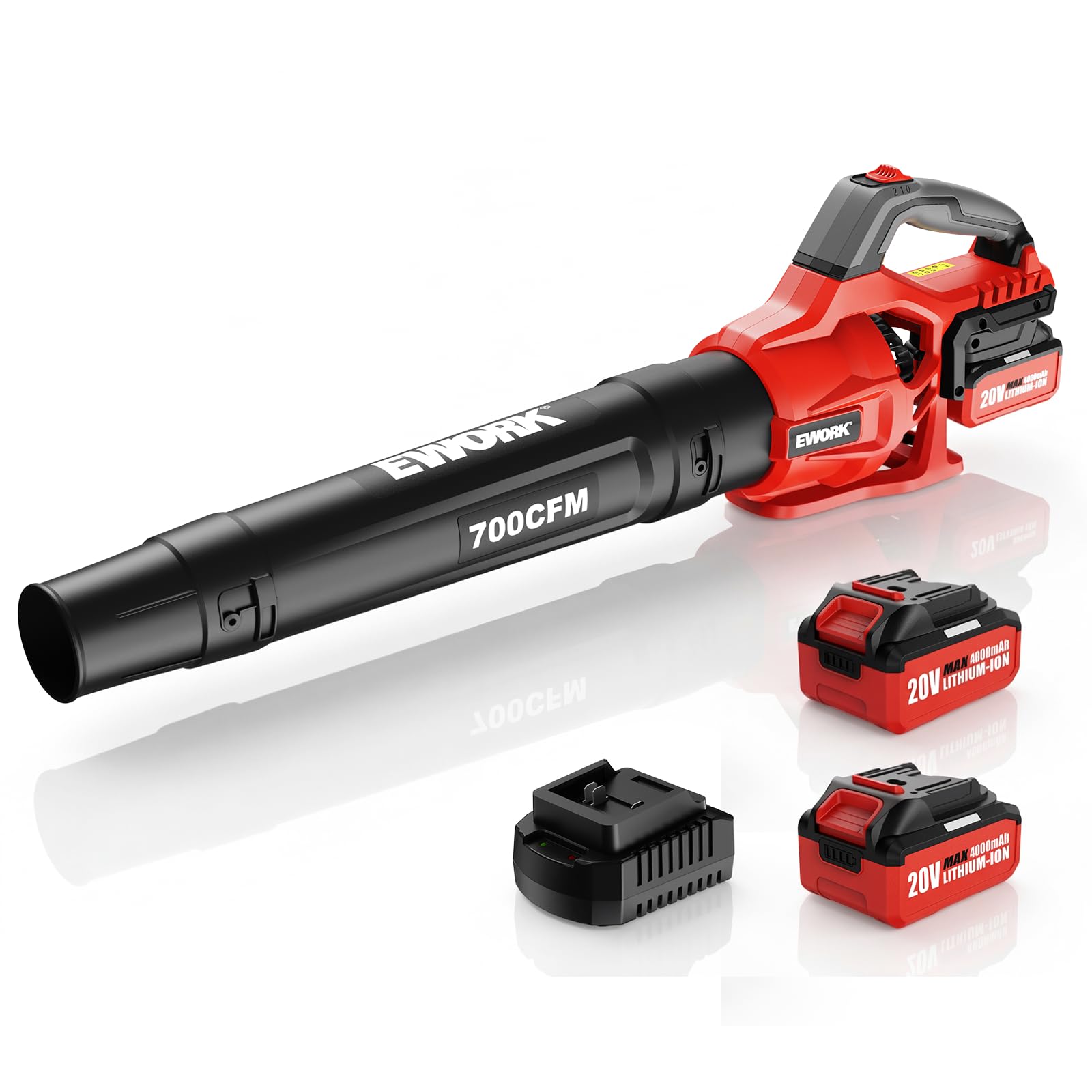
A 700 CFM blower at a budget price — but runtime will test your patience on a large yard.
The EWORK 20V punches well above its price bracket with a claimed 700 CFM (cubic feet per minute) and 200 MPH (miles per hour). Those numbers match blowers costing more. At just 4.1 pounds, it is the lightest blower in this entire lineup. It comes with two 4.0Ah (amp-hour) batteries and a charger, so you can swap batteries as soon as one dies. The two-speed control gives you a low setting for patio dust and a high setting for leaves and light snow. Buyers confirm it is “powerful without being too heavy.” Multiple older users mentioned they could handle it one-handed without fatigue. For small to medium properties, the value proposition is strong: you get commercial-level air speed at a fraction of the price.
The honest trade-off is runtime. One customer observed: “Battery last about 15-20 mins when using on high speed.” That is on par with the high-power blowers here, but the 20V system means larger batteries are not available — you are stuck with the 4.0Ah packs. For a small yard or driveway cleanup, two batteries are enough. For a larger property, you will be swapping and recharging constantly. Another buyer observed that on the low setting, one battery was sufficient for a normal cleanup. The plastic build feels less premium than the Bosch or EGO, but for the buyer who only needs to clear a modest yard or a few driveways, the EWORK delivers impressive air power while staying affordable.
Where it delivers
- 700 CFM and 200 MPH at a budget-friendly price — the best air-volume-to-cost ratio here
- Only 4.1 pounds makes it easy for anyone to use one-handed, including older users
- Two 4.0Ah batteries and a charger included — no extra purchase needed
- Adjustable 2-speed control and quick assembly
Where it falls short
- 20V system means the included 4.0Ah batteries are the maximum size available
- Runtime is about 15-20 minutes on high speed, limiting its use for large properties
- Build quality is lighter-duty plastic compared to premium competitors
Get this if: you need high CFM and MPH on a budget, or you have a small to medium yard where two batteries can finish the job.
Avoid it if: your property requires sustained high-power operation beyond 20 minutes. For that, the EGO or Husqvarna will save you from constant battery swaps.
Understanding the Specs
CFM (Cubic Feet per Minute)
This is the volume of air the blower pushes each minute. A higher CFM means you move larger piles of leaves and heavier debris faster. For commercial use on a large property, look for at least 700 CFM. The EGO at 880 CFM is the strongest in this group. The Bosch at 450 CFM is better suited to hard surfaces and light debris.
MPH (Miles per Hour)
This is the speed of the air as it exits the nozzle. Higher airspeed is useful for dislodging debris stuck in rocks, gravel, or grass. 200 MPH is the top speed shared by the EGO, Husqvarna, and EWORK models. The Greenworks runs at 190 MPH and the Bosch at 123 MPH. For blowing packed wet material out of landscaping, prioritize MPH.
FAQ
What does CFM mean on a leaf blower?
Is a higher voltage blower always better?
How long does a battery last on a commercial electric leaf blower?
Can I use a leaf blower to dry my car?
Is 200 MPH enough for wet leaves?
Are commercial cordless blowers as powerful as gas blowers?
Why is my leaf blower battery draining so fast?
Will a 20V blower handle a large yard?
Which blower is quietest?
Can I use a different brand’s battery with my blower?
Final Thoughts: The Verdict
If you want one dependable pick, the best commercial electric leaf blower is the EGO Power+ LB8803-2 — it delivers the highest air volume (880 CFM) and speed (200 MPH) in the group, includes two batteries for non-stop work, and wraps it in a carbon fiber body that keeps the weight manageable. If you want the longest single-charge runtime and do not mind a heavier tool, grab the Husqvarna 350iB. For a lightweight, fast-charging option that still handles heavy wet leaves, the Greenworks 80V is your pick.
How We Picked
We do not accept paid placement. Every pick is matched to a real buyer and a real use-case; we do not hands-on test units.
Sources & Methodology
Specifications: manufacturer listings and product documentation. Review insights: verified customer reviews, as of July 2026. Pricing: not shown on this page (it changes often); check the current price via the retailer link.
As an Amazon Associate, Lawn Gear Lab earns from qualifying purchases. This does not affect which products we feature.