
Specs are compiled from manufacturer listings and verified buyer reviews and can change over time — please confirm the key details on the product page before buying.
Your microgreen seeds need a growing medium that keeps them moist but not soggy, gives roots something to hold, and does not introduce mold or salt. Get the growing medium wrong, and you waste weeks of growth. Get it right with coconut fiber (also called coco coir, the ground-up husk of a coconut), and you get a fluffy, pH-balanced, clean base that holds water without turning into mud.
I’m Rikta — the founder and writer behind Lawn Gear Lab. This guide is built by comparing the manufacturers’ published specifications and the patterns across verified customer reviews, so you get each pick’s real strengths and trade-offs instead of marketing spin.
We looked at volume, weight, wash quality, and real buyer experiences across seven products to find the coconut fiber for microgreens that actually delivers consistent results without hidden salts or contaminants.
Quick Picks
- MODELLOR Coco Coir Bricks, 4-Pack (5 lb) — Best Overall
- Premium Organic Coconut Coir Bricks – 6 Pack — Value Six-Pack
- Minute Soil – Compressed Coco Coir Fiber Grow Medium – 3 Bricks — Space-Saver
- MagJo Naturals 100% Pure Coco Coir 11-Pound Block — Bulk Block
- Vivlly Coco Coir Brick 10 LB — Triple-Washed
- Plantonix Coco Bliss 6-Pack (650gm Bricks) — Finest Texture
- CANNA Coco Brick 40L — Premium Pick
How To Choose The Best Coconut Fiber For Microgreens
Microgreens grow fast — you want a medium that gives the seeds instant contact with moisture while letting air reach the roots. Not all coconut fiber bricks are the same. Here is what to check before you click buy.
Salt Content and Wash Quality
Coconut husks naturally hold salts from the ocean. If the coir is not washed before compression, those salts can stop seeds from germinating. Look for “washed”, “triple-washed”, or “low EC” (electrical conductivity, a measure of salt content) on the label. A low EC under 0.5 is ideal for tiny, sensitive roots.
Expanded Volume vs. Weight
A brick’s dry weight tells you how much it weighs on the shelf. The expanded volume tells you how many trays it will fill. A 10-pound brick that swells to 75 quarts covers a lot more surface than several small bricks with the same total weight. For microgreens, you want volume — you are growing on a flat bed, not in deep pots.
Organic Certification
If the product carries an OMRI (Organic Materials Review Institute) listing, it has been verified as acceptable for organic growing. OMRI is the gold standard for knowing your coir is free from synthetic additives. Many microgreens growers sell their harvest as organic, so this certification matters more here than in general potting.
Quick Comparison
| Model | Best For | Expanded Volume | Dry Weight | Count / Packs | Amazon |
|---|---|---|---|---|---|
| MODELLOR Coco Coir Bricks, 4-Pack | Balanced value & volume | 9 Gallons | 5 Pounds | 4 bricks | Amazon |
| Premium Organic Coconut Coir Bricks 6-Pack | Small projects on a budget | 36 Quarts | 1.4 Pounds | 6 bricks | Amazon |
| Minute Soil 3 Bricks | Peat-free quick start | 4.5 Gallons | — | 3 bricks | Amazon |
| MagJo Naturals 11-Pound Block | Single-bulk volume | 17 Gallons | 11 Pounds | 1 block | Amazon |
| Vivlly Coco Coir Brick 10-LB | Triple-washed low salt | 75 Quarts | 10 Pounds | 1 brick | Amazon |
| Plantonix Coco Bliss 6-Pack | Impurity-free fine texture | 12.5 Gallons | 8.4 Pounds | 6 bricks | Amazon |
| CANNA Coco Brick 40L | Premium performance | 40 Liters expanded | — | 1 brick | Amazon |
In‑Depth Reviews
1. MODELLOR Coco Coir Bricks, 4-Pack (5 lb)
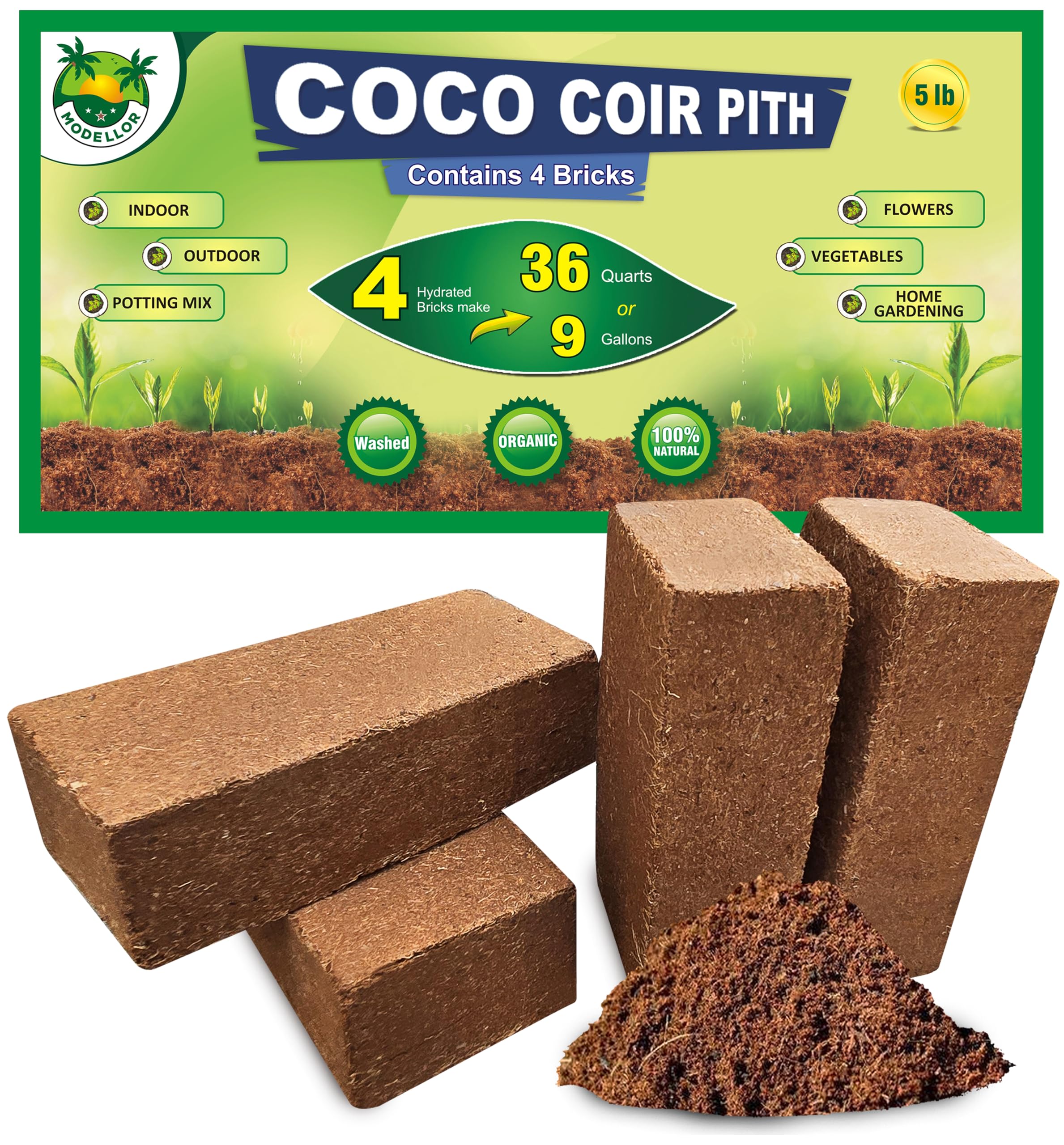
Four compact bricks that puff into nine gallons of fluffy, low-salt base.
The MODELLOR 4-pack sits at the balance of value and volume for microgreens growers who need a moderate amount of material at once. Each brick is triple-washed (that means the ocean salts have been rinsed out repeatedly, so your tiny seeds are not hit with harsh minerals), and the manufacturer says the coir is pH-balanced right out of the bag. The 5-pound total weight expands into 9 gallons of growing medium — enough to fill roughly eight to twelve standard 1020 seedling trays, depending on depth.
Buyers report that one brick “expands to nearly 5 gallons” and that the coir is “clean, odorless, no debris.” They also note it holds moisture without becoming soggy, which is exactly what microgreens need to germinate evenly without damping off. The big trade-off against larger single blocks: at 4 separate bricks you hydrate them individually, which takes a little more active time, but you can also store unused bricks dry for months.
Versus the 1.4-pound Premium Organic bricks below, the MODELLOR pack gives you roughly 3.6x the total dry weight for slightly less cost per ounce — and because the bricks are already triple-washed, you save yourself the step of a pre-soak rinse.
What microgreens growers will like
- Triple-washed and low-EC — no salt shock for tiny roots
- Each brick expands to nearly 5 gallons per buyer reports
- Compact packaging and dry storage means no bulk bag sitting around
One limitation to know
- Four separate bricks need four hydration cycles, not one pour
The pick for most growers: If you want a clean, pre-washed coco coir that delivers consistent volume and does not demand a huge storage container, this is the one.
Pass if: You need a single massive block to do all your trays at once — you will hydrate each brick individually here.
2. Premium Organic Coconut Coir Bricks – 6 Pack
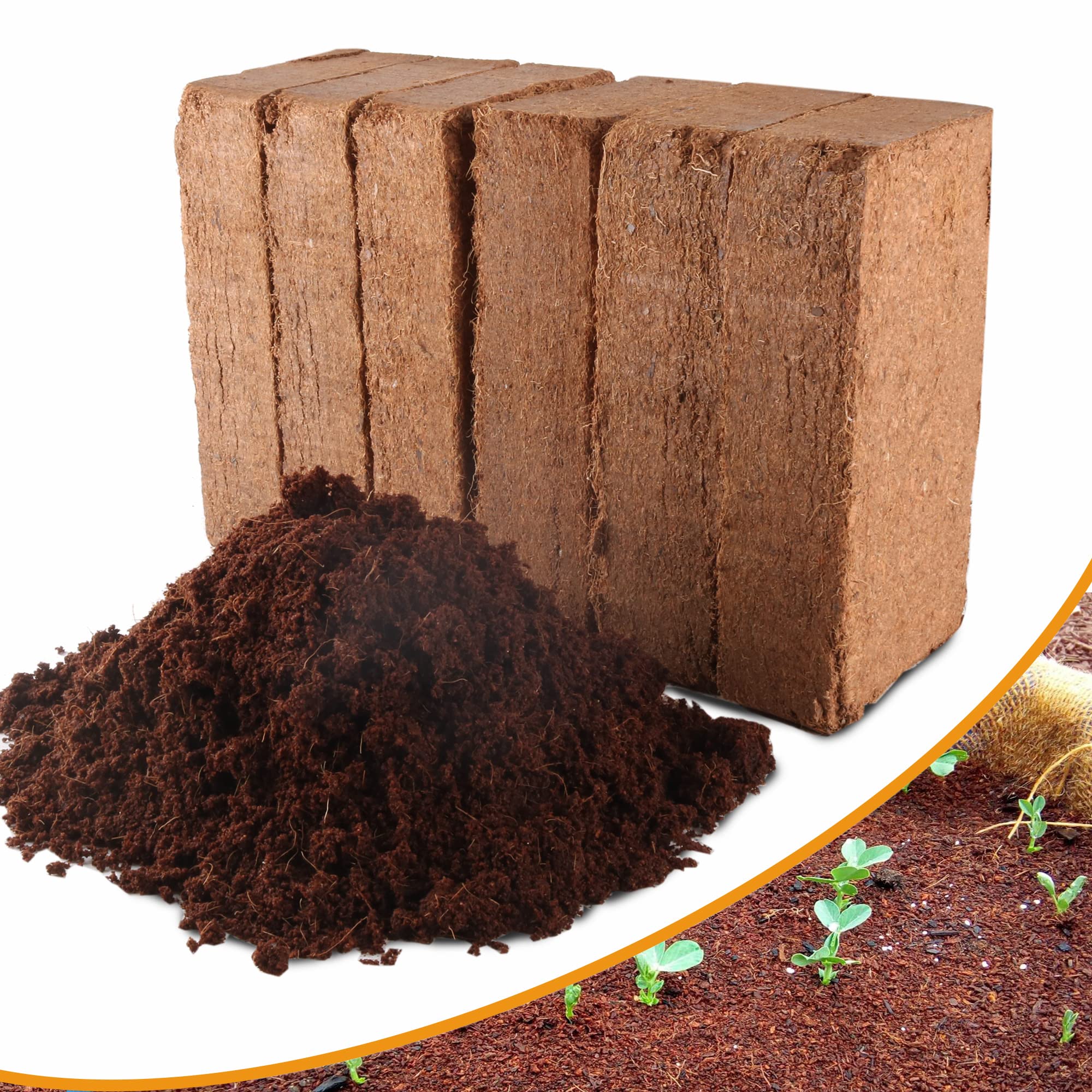
Six light bricks that go far for microgreen trays on a budget.
The Avalution six-pack is the lightest entry in the lineup at 1.4 pounds total, yet the six bricks together expand to 36 quarts of growing medium. That means each single brick fills roughly a 5-to-6-quart container — a classic bucket’s worth, which is exactly what one reviewer noted: “3block will fill a standard bucket and it retains moisture very well.” The coir is described as a 100% organic material extracted from the coconut husk, with a low EC (low salt) and balanced pH.
For microgreens, the benefit is obvious: six small bricks let you stagger your grows. You can hydrate one brick for a single 1020 tray and leave the other five bricks dry on the shelf. The trade-off is that at 1.4 pounds total, this pack holds 64% less dry weight than the Vivlly 10-pound brick — you will run through it faster if you are running multiple trays each week. One buyer mentioned soaking the bricks overnight before hand-breaking them, which adds a little planning time that a triple-washed loose block might skip.
Still, if you are just starting with microgreens and want to test coco coir without committing to a huge block, this six-pack is the most forgiving entry point.
Why it works for beginners
- Six individual bricks let you hydrate exactly what you need
- Light enough to store anywhere — 1.4 pounds total
- Low-EC and pH-balanced right from the product data
The catch
- Total volume is lower than any single large block in this list
Reach for this if: You are new to microgreens and want low commitment — six bricks lets you try one, keep five.
Look elsewhere if: You fill more than two trays per week; you will order again fast.
3. Minute Soil – Compressed Coco Coir Fiber Grow Medium – 3 Bricks

Three bricks, quiet rehydration, and OMRI-listed organic confidence.
Minute Soil comes from Mountain Valley Seed Company, a seed-house brand known for microgreens and sprouting supplies. Each brick takes 10 cups of water to rehydrate and yields about 1.5 gallons, so the three-brick pack gives you 4.5 gallons total. The product is OMRI listed for organic production (that means an independent lab verified it for organic use — you can sell your greens as organic if you meet the rest of the standard). It is also peat-free, which matters if you want a peat-alternative footprint.
Owners mention that “seeds germinated in two weeks; two bricks remain for future use” — a signal that the coir itself did not slow down germination. Another tip from a reviewer: use hot water instead of cold and the brick “will instantly puff up.” The one downside is that you cannot partially use a brick; you must soak the whole thing. At 3 bricks, that is three separate 10-cup hydration events. Compared to the Vivlly 10-pound block at 75 quarts, this pack yields about 57 gallons less — so it is best for small batch growers.
If you are doing only one or two 1020 trays at a time, this is the neatest, most compact choice on the list.
The fine points
- OMRI-listed organic — verified for organic production
- Raw and unamended — you control the fertilizer from scratch
- Light, compact bricks that store flat
The limitation
- Each brick must be fully soaked — no split-brick option
Lean in if: You need certified-organic coir for selling microgreens or just want a small batch without leftover mess.
skip it if: You run ten trays per cycle and need one massive rehydration session.
4. MagJo Naturals 100% Pure Coco Coir 11-Pound Block

A single 11-pound brick that expands to fill a five-gallon bucket.
MagJo Naturals is one of the big-volume options for microgreens growers who need a lot of coir in one go. The OMRI-listed block weighs 11 pounds and, according to the specs, expands to 17 gallons — a 3.8x volume gap over the Minute Soil three-pack. One buyer confirmed that the “11 lb block expands to fill 5-gal container.” It is sourced from OMRI-registered manufacturers and washed to remove salt, which matters because unwashed coir can stunt germination.
The main practical decision here is that you cannot break the block into manageable pieces. One reviewer warned: “Don’t even try to break this stuff into pieces. Just soak the whole thing.” That means you need a bin large enough to hold 17 gallons of expanding material. If you have a 20-gallon tote, you are fine. If you only have a standard bucket, this block will overflow it. Also, a few buyers mentioned a slight tea-tree-oil-like odor, though the general consensus is that the coir is clean and salt-free.
The MODELLOR 4-pack, by contrast, gives you four smaller blocks that each expand to 9 gallons total — same volume flexibility in a different format. MagJo wins if you want one rehydration event and have the container for it.
Strengths for heavy users
- 17 gallons from a single block — massive volume in one pour
- OMRI listed and salt-washed for organic growing
- One rehydration event, not four
What to plan for
- You need a very large container — 5+ gallons — to soak it whole
Grab this if: You fill multiple trays per cycle and want the most volume per single rehydration.
Pass if: You lack a 5+ gallon container or prefer storing dry bricks separately.
5. Vivlly Coco Coir Brick 10 LB

A 10-pound block that swells to 75 quarts of low-salt, triple-washed coir.
If you are a microgreens grower who prioritizes salt-free clean material, the Vivlly 10-pound brick is the spec-heavy option. It is triple-washed, meaning the salt (EC) is brought below 0.5 — a number that matters because microgreen roots are thin and salt-sensitive; an EC below 0.5 is considered very low. The coir is also aged for over 18 months before compression, a process that breaks down the toughest fibers so the final medium is softer and more consistent for root penetration.
The volume here is significant: 75 quarts translates to roughly 18.75 gallons. The manufacturer states 30% air porosity (meaning nearly a third of the expanded volume is air space), which helps oxygen reach roots quickly during the short microgreen growth window. One owner reported that the instructions say 7-10 gallons of water, but they used 3.5 gallons slowly and got a good result.
Like the MagJo block, this is a single brick, so you need a large container and a plan to use it all. The low EC and triple-wash process make it a cleaner option than the Premium Organic 6-pack for sensitive seeds like basil or amaranth.
what separates it
- Triple-washed to EC less than 0.5 — ultra-low salt for delicate seedlings
- Aged 18+ months for softer, more consistent fiber
- 30% air porosity means the roots get more oxygen
The catch
- One massive brick — cannot split it; need a big bin for hydration
Buy it for: Clean, low-salt medium that gives sensitive microgreen varieties the best start.
Not for: Small-space growers who lack a large hydration bucket or tote.
6. Plantonix Coco Bliss 6-Pack (650gm Bricks)

Screened ultra-fine so no sticks or sand reach your microgreen roots.
Plantonix Coco Bliss takes the pre-wash concept further by also pre-screening the coir through a very fine filter to remove fibers, sand, and rocks — the sort of debris that other brands sometimes leave in. The result is a very fluffy, consistent texture that microgreen seeds love because every particle makes even contact with moisture. The 6-pack yields 12.5 gallons total, and each 650-gram (about 1.4-pound) brick is manageable to hydrate one at a time.
Customers note that the coir is “very clean” and that they found “only ~1 plastic piece” across multiple bricks. One reviewer using it for seed starting said, “seeds sprouted faster, likely due to quality.” The other advantage is the high cation exchange capacity (CEC), which means the coir holds onto nutrients and releases them to the roots later — useful if you fertilize your greens with a dilute solution. The volume of 12.5 gallons is sandwiched between the MODELLOR 4-pack (9 gallons) and the MagJo block (17 gallons), so it is a solid middle-ground choice for someone doing three to four trays per cycle.
The trade-off is that per-pound this is one of the more expensive options on the list, though the pre-screening saves you the time of picking out debris.
Why it stands out
- Pre-screened extra fine for zero large debris
- High CEC holds onto liquid fertilizer better than raw coir
- 6 bricks let you stagger hydration runs
The trade-off
- Higher price per pound than bulk blocks
Choose this for: The cleanest, finest-grade coir where even a spec of sand is unacceptable.
pass on it if: Volume is your only metric — bulk blocks give more per dollar.
7. CANNA Coco Brick 40L

The professional-grade brick that serious growers turn to for repeatable results.
CANNA is a well-known name in controlled-environment growing, and their Coco Brick reflects that pedigree. The dry brick is 8 liters and expands to 40 liters (about 10.5 gallons). The product data states it is organic and a “natural plant medium.” what separates it is the consistency: CANNA coir is known for having very low salt content and a uniform fiber structure that holds water evenly across the entire block — no dense spots that do not rehydrate.
Buyers consistently rate this as the top performer. One review says: “best coco coir bricks! I’ve tried a lot and this is definitely the best!” Another notes that “coco outperformed soil” and that the brick is “clean, salt-free, and unbuffered; ideal for building custom soil from scratch.” For microgreens, the unbuffered nature means you have full control over what nutrients you add (seedling greens need very little). The block comes in a bag that you can use as a mixing container, as one customer observed reusing the bag for future projects.
The major downside is the price — this is the most expensive brick per liter on the list. If you are growing microgreens at a commercial scale, the reliability may justify the premium. For a home grower doing one tray at a time, it is hard to justify over the MODELLOR or Vivlly options.
The professional advantage
- Clean, salt-free, and unbuffered — total control over your base
- Reviewers point out it outperforms every other brick they have tried
- Reusable bag for mixing soil
The reality check
- Premium price tag that casual growers will notice
For serious growers only: If you are running a microgreen operation where yield consistency matters more than cost, this is the best base.
Overkill if: You are a home hobbyist — the MODELLOR or Vivlly will give you 95% of the quality for less.
Understanding the Specs
Low EC (Electrical Conductivity)
EC measures how many dissolved salts are in the coir. Microgreen seeds are small and sensitive — high salt can stop them from germinating or cause yellow tips. A washed coir with an EC below 0.5 is ideal. If the product does not mention EC, it may not have been washed at all, and you might want to soak and rinse it before use.
Expanded Volume
This is the amount of fluffy growing medium you get after adding water. A brick that yields 9 gallons fills roughly eight to twelve 1020 seedling trays (the standard 10×20-inch flat tray). Volume matters more than dry weight because microgreens are grown shallow. A bigger expanded volume means more trays per brick.
FAQ
Do I need to rinse coco coir before using it for microgreens?
How much coco coir do I need for a standard 1020 tray of microgreens?
Can I reuse coco coir for a second batch of microgreens?
Is coco coir pH-balanced for microgreens?
What is the difference between coco coir and peat moss?
Does coco coir contain fungus or pests?
Why does my coco coir brick smell like tea tree oil?
Can I mix coco coir with other mediums for microgreens?
How long does a coco coir brick last once opened?
Which coco coir is best for growing microgreens on a commercial scale?
Final Thoughts: The Verdict
For most growers, the coconut fiber for microgreens winner is the MODELLOR 4-pack because it combines triple-washed purity, a generous 9-gallon yield, and the flexibility of four separate bricks at a reasonable price. If you want the cleanest, finest medium with zero debris, grab the Plantonix Coco Bliss. And for the absolute lowest salt content and highest air porosity at scale, the Vivlly 10-pound brick delivers a massive 75 quarts of root-ready material.
How We Picked
We do not accept paid placement. Every pick is matched to a real buyer and a real use-case; we do not hands-on test units.
Sources & Methodology
Specifications: manufacturer listings and product documentation. Review insights: verified customer reviews, as of July 2026. Pricing: not shown on this page (it changes often); check the current price via the retailer link.
As an Amazon Associate, Lawn Gear Lab earns from qualifying purchases. This does not affect which products we feature.