
Specs are compiled from manufacturer listings and verified buyer reviews and can change over time — please confirm the key details on the product page before buying.
Starting seeds indoors means you control moisture, texture, and the risk of rot. One wrong growing medium can be too dense, too acidic, or carry hidden pathogens that kill your seedlings after weeks of care.
I’m Rikta — the writer behind Lawn Gear Lab. This guide compares manufacturers’ published specs and patterns from verified customer reviews, so you see each pick’s real strengths and trade-offs.
This guide to the best coconut coir for seed starting covers seven top contenders, from pellets for small trays to bulk bricks for raised beds, with key specs and honest trade-offs for each.
Quick Picks
- MODELLOR Coco Coir Bricks, 4-Pack (5 lb) — Best Overall
- Plantonix Coco Bliss 6-Pack (8.4 lb) — Cleanest Purity
- ZeeDix 100 Pack 30mm Organic Coco Coir Pellets — Pellets for Precision
- MagJo Naturals 100% Pure Coco Coir 11 Pound Block — Bulk Champion
- Avalution 3-Pack Coco Coir Bricks (1.4 lb) — Budget Trio
- GROW!T JSCPB Coco Coir Mix Brick (Pack of 3) — Fine-Tuned Texture
How To Choose The Best Coconut Coir For Seed Starting
Seed starting coir is not the same as the chunky stuff for reptile bedding or mulch. Seedlings need a fine, consistent texture, low salt content, and a neutral pH (neither acidic nor alkaline). Focus on these three factors before you buy.
Texture and Filtration
Seedlings need a fine, fluffy medium their tiny roots can push through easily. Look for coir labeled “pre-screened” or “fine texture” — it keeps out fibers and sand that block root growth. The Plantonix Coco Bliss is screened multiple times through a very small filter to remove fiber and sand, a big plus for delicate starts.
EC (Electric Conductivity) and Salt Content
Coir naturally contains salts from the coconut husk. If the EC (electric conductivity, which measures soluble salt levels) is too high, those salts can burn your seedling tips and stunt growth. Pick a “low EC” or “washed/pre-buffered” product for seed starting. Brands that triple-wash their coir, like MODELLOR, or rinse it thoroughly, like MagJo, remove those excess salts for a safer start.
Compressed Size vs. Expanded Volume
Decide between convenience (pellets that each turn into a small pot-sized plug) and bulk (bricks that expand into gallons of loose soil). A pack of 100 30mm pellets works well for a few trays. A 5 lb block that yields 9 gallons of soil suits larger garden beds or multiple seeding sessions. Check the expanded volume in quarts or gallons — that is the real measure of how much medium you get.
Quick Comparison
| Model | Best For | Unit Count | Expanded Volume | Item Weight | Amazon |
|---|---|---|---|---|---|
| ZeeDix 100 Pack 30mm Pellets | Convenient individual plugs | 100.0 Count | — | — | Amazon |
| Avalution 3-Pack Coco Coir Bricks | Quick hydration for small gardens | 67.2 Ounce | — | 1.4 Pounds | Amazon |
| MODELLOR Coco Coir Bricks 4-Pack | Largest volume for the weight | — | 9 Gallons | 5 Pounds | Amazon |
| GROW!T Coco Coir Mix Brick Pack of 3 | Fine texture for aroid mixes | 1.0 Count | 2 Gallons | — | Amazon |
| Minute Soil 30 Pucks | Pre-portioned discs, no measuring | 26.0 Ounce | 5.5 Quarts | — | Amazon |
| MagJo Naturals 11 Pound Block | Massive bulk for large beds | — | 17 Gallons | — | Amazon |
| Plantonix Coco Bliss 6-Pack | Pre-screened purity for clean starts | 135.0 Ounce | 12.5 Gallons | 8.4 Pounds | Amazon |
In‑Depth Reviews
1. MODELLOR Coco Coir Bricks, 4-Pack (5 lb)
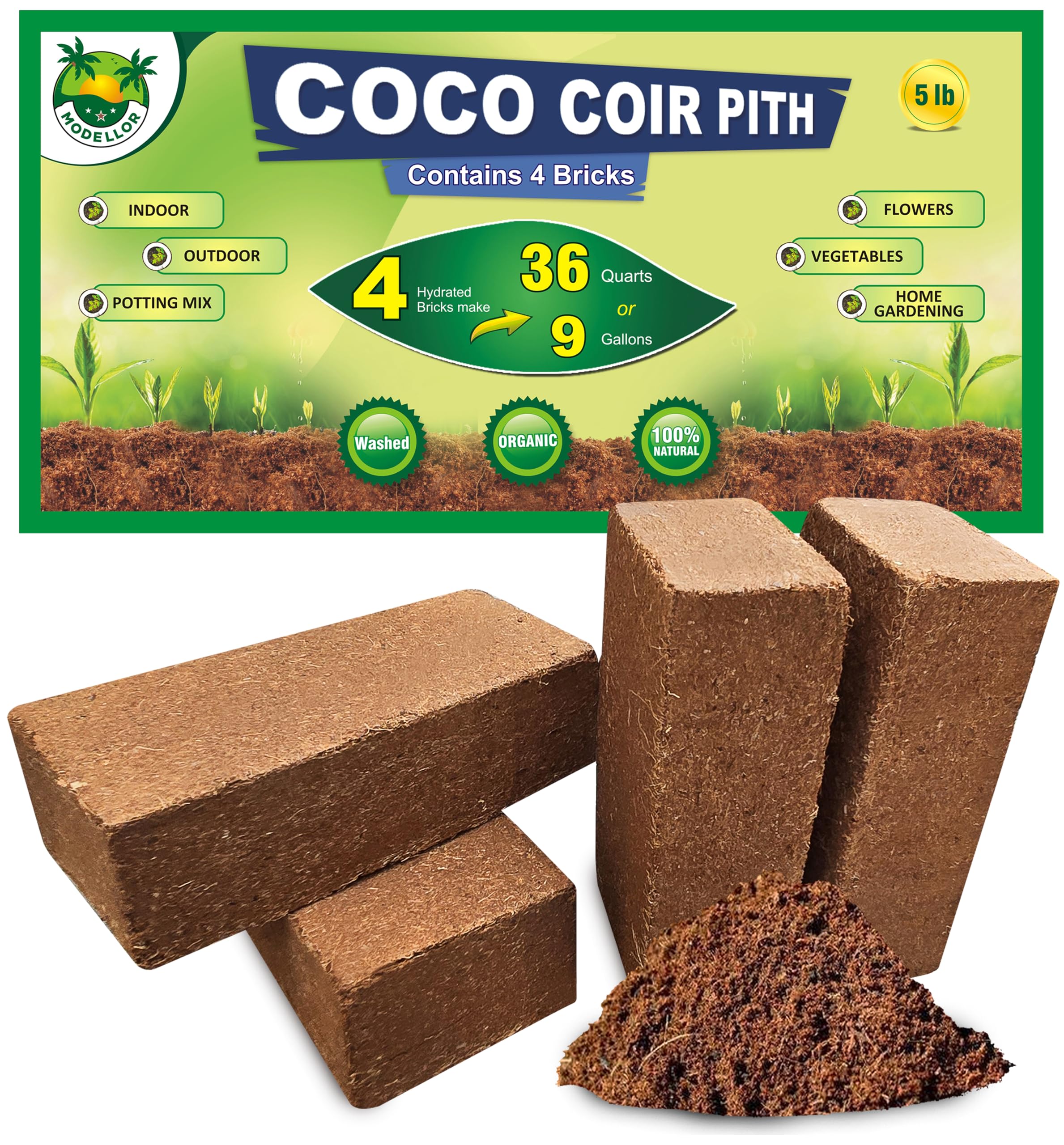
The big-volume option that expands way further than the package suggests.
This set of four bricks weighs 5 lbs total. Once hydrated, it yields 9 gallons (36 quarts) of fluffy growing medium — that is 4.5 times more than the GROW!T bricks, which produce only 2 gallons. You can fill dozens of seed trays or a small raised bed without buying multiple packs. The coir is triple-washed and pH-balanced, which keeps salt levels low so they will not burn your seedlings.
Buyers report it hydrates fast and expands more than expected. One buyer describes it as “clean, odorless, no debris” and notes it holds moisture without getting soggy. At 5 pounds, the pack is heavier than the Avalution 1.4-pound bricks, but the volume payoff is clear.
What Puts It Ahead
- Triple-washed for low EC (reduced salt content) — safer for seedlings
- 4 bricks yield 9 gallons total, enough for multiple large projects
- Fine, consistent texture with no debris or sticks
One Thing to Consider
- At 5 lbs total, the pack is heavier than pellet-based options
A big-batch buy: Grab this if you need a lot of clean, low-salt coir for multiple seed-starting sessions or raised-bed amending.
Not for small trays: If you only want 10-20 starter plugs, a pellet pack is lighter and more convenient.
2. Plantonix Coco Bliss 6-Pack (8.4 lb)

Pre-rinsed and filtered so your seedlings get nothing but clean coir.
Plantonix screens their coir multiple times through a very small filter to remove fiber, sand, and rocks. You get a pure, consistent texture perfect for seed starting. This 6-pack weighs 8.4 lbs and expands to 12.5 gallons of soil — more than enough for multiple seed trays or to mix into potting soil for containers. The neutral pH and high cation exchange capacity (how well the material holds onto plant nutrients) means your seedlings get better nutrient uptake once you add fertilizer.
Owners mention the coir is very clean with almost no plastic bits. One reviewer says their seeds sprout faster thanks to the quality of the medium. Compared to the Avalution 1.4 lb bricks, this pack gives you more expanded volume per block, so you get more use out of each brick.
The Big Plus
- Pre-rinsed and pre-screened for minimal dust and debris
- Expands to 12.5 gallons — covers more seedling trays than standard 1.4 lb blocks
- OMRI-listed for organic gardening
Trade-off
- Higher upfront cost than single-brick options
Purity-first pick: Get this if you want the absolute cleanest medium with no sand or fibers that could clog up your starter trays.
Overkill for small jobs: A 6-pack will last most home gardeners several seasons — store the extra bricks dry.
3. ZeeDix 100 Pack 30mm Organic Coco Coir Pellets
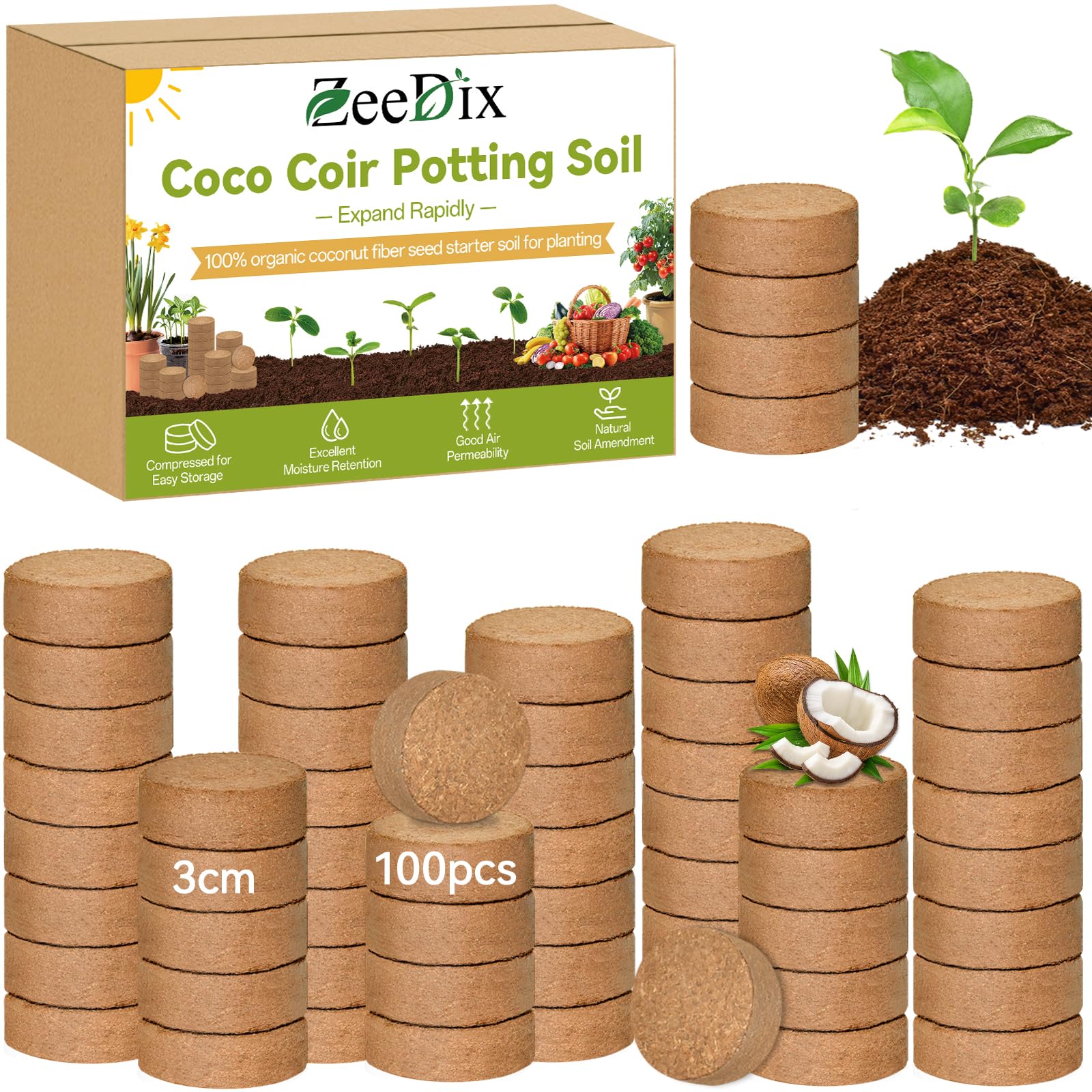
One hundred individual plugs ready to hydrate and drop a seed into.
If you want a ready-to-go format for starting seeds, these 30mm compressed pellets are the standard. Each pellet expands into a small pot-sized plug when you add water — no measuring, no breaking apart bricks. The coir is made from 100% organic fiber with low EC and balanced pH, so the salt level is safe for tender seedlings. This is a 100-count pack, giving you a big head start on the season.
Customers note the pellets expand quickly with hot water (warm water recommended) and produce a light, airy starting mix. Unlike the MODELLOR bricks which need to be broken into portions, these are pre-portioned. The 100.0 count offers 100 times more individual growing sites than the 1.0-count GROW!T brick pack.
Why Pellets Win
- Pre-portioned 30mm discs — no measuring or breaking required
- Low EC and pH balanced for safe germination
- Expands quickly with warm water, producing a fluffy medium
The Limitation
- Pellets create small individual plugs — not ideal for mixing bulk soil
Tray-ready solution: Reach for this if you want the easiest seed-starting experience — hydrate 100 pellets and you are ready to plant 100 seedlings.
Not for loose soil: skip it if you need loose coir to blend with potting mix — bricks are better for that.
4. MagJo Naturals 100% Pure Coco Coir 11 Pound Block

The single biggest block on the list for gardeners with serious volume needs.
This 11 lb compressed block expands to 17 gallons of coco peat when hydrated — far more than any other single product here. That volume is ideal for filling large raised beds, preparing bulk potting mix for a whole season, or even worm farming. The coir is sourced from OMRI-registered manufacturers and washed thoroughly to remove excess salt, so the EC (electric conductivity) stays low enough for seed starting.
Reviewers point out the block expands to fill a 5-gallon container per quarter, and that the salt content measured between 40 to 200 ppm TDS (total dissolved solids, a direct measure of salt load), confirming it is low-salt. One buyer warns: do not try to break this into pieces — just soak the whole thing. Unlike the smaller 1.4 lb Avalution bricks, this block requires a large container (like a 20-gallon bin) for hydration.
The Volume Advantage
- Expands to 17 gallons — the largest expanded volume among all picks
- Washed for low salt (40-200 ppm TDS) — safe for seedlings
- OMRI-listed for certified organic use
The Challenge
- Requires a very large container to hydrate — not for small spaces
Massive-scale choice: Buy this if you are prepping soil for a raised bed or a full season of gardening and want the lowest cost per gallon.
Too much for seed starts only: For just starting a few trays, a smaller pack will be more manageable.
5. Minute Soil Compressed Coco Coir Fiber — 40 MM 30 Pucks
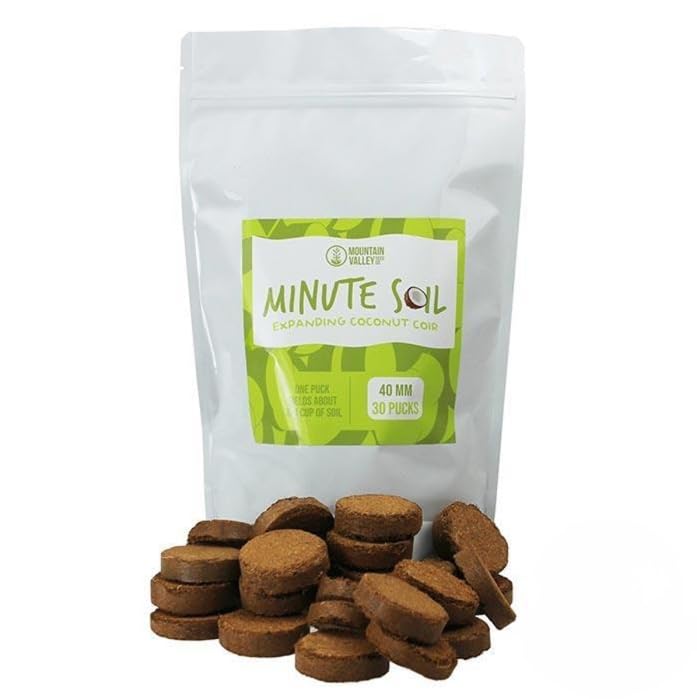
Thin wafers that puff up into soil — no mess, no measuring.
Each 40 MM disc needs only 1/3 cup of water to re-hydrate and yields about 3/4 cup of soil. The bag of 30 pucks expands to roughly 5.5 quarts of loose medium. Mountain Valley Seed Company markets these as raw, untreated, and OMRI-listed for organic production — no added fertilizers, so you control the feed. That makes them a strong choice for cat grass, microgreens, or any crop where you want a blank slate.
Shoppers say the wafers are thin but expand a lot, and the packaging saves space. One reviewer calls it the “cleanest indoor cat grass planting method” — though they note it is expensive for the amount of soil you get. Compared to the ZeeDix pellets which are 30mm, these are 40mm discs, giving you a slightly larger plug per unit.
The Upside
- Neat, pre-portioned discs — no dust or mess
- Raw and non-amended — you choose the fertilizer
- OMRI-listed for organic gardening
The Downside
- Expensive per volume of soil compared to bulk bricks
Quick-start discs: Ideal if you want a tidy, chemical-free medium for a small indoor project like cat grass or microgreens.
Not cost-effective for bulk: If you are filling many trays, bricks give you way more soil per dollar.
6. Avalution 3-Pack Coco Coir Bricks (1.4 lb)

Three lightweight bricks that each turn into a bucket-load of soil.
Each brick measures about 8 x 4 inches. When fully expanded, the set reaches 18 quarts. That is a decent amount of soil from just 1.4 lbs of compact material — though it is 3.6 times lighter than the 5-pound MODELLOR bricks, so you get less total mass. The coir claims low EC and balanced pH, making it suitable for seed germination and potting mixes. The bricks absorb up to 8-10 times their weight in water, which helps prevent waterlogged roots.
Buyers report that 3 blocks fill a standard bucket and that the coir retains moisture very well. One reviewer mixed it with topsoil for reseeding a lawn. The main trade-off is that these are light and compact, easy to store, but you get less expanded volume per pack compared to heavier options.
Good For
- Lightweight and compact — easy to store in small spaces
- Each brick expands to fill a bucket — good for small projects
- Low EC and pH balanced for starting seeds
Not Ideal If
- Lower total yield than heavier blocks like MODELLOR or MagJo
Entry-level bricks: Pick these for a starter pack that is easy to store and gives you enough coir for a few seed trays or container mixes.
Heavy gardener: If you are filling raised beds, a heavier block gives more volume for the money.
7. GROW!T JSCPB Coco Coir Mix Brick (Pack of 3)

A fine-grade mix from Hydrofarm that aroid growers love for its texture.
This set of three bricks from GROW!T (made by Hydrofarm) produces 2 gallons of expanded coco coir — the smallest yield on this list. However, the texture is finer than many competitors, making it ideal for aroid soil mixes where you want good water retention without large fiber chunks. The coir is free from pathogens and seeds, so you will not introduce weeds or diseases to your seedlings.
Owners mention the coir is fine and retains more water than expected, but works well as a soil component. One reviewer noted that all 3 bricks swelled to about 30 quarts (roughly 10 quarts per brick). Compared to the 9-gallon yield of the MODELLOR pack, this is a 4.5 times smaller volume — best suited for precision mixing rather than bulk projects.
The Texture Edge
- Fine particle size — excellent for aroid mixes and seed starting
- Free from pathogens and seeds — safe for indoor starts
- High water-to-air ratio prevents oversaturation
Volume Trade-off
- Only yields 2 gallons total — smallest volume per dollar here
Texture specialist: Choose this for making custom potting blends where fine, consistent fiber and high water-holding capacity matter more than total volume.
Skip for bulk: If you are filling a raised bed or multiple large trays, a heavier block gives far more for the same money.
Understanding the Specs
EC (Electric Conductivity)
EC measures the amount of soluble salts in your coir. A low EC means less salt, which is critical for seed starting because high salt concentrations can burn root tips and stunt growth. Look for terms like “low EC,” “washed,” or “pre-buffered” when shopping. The MagJo block measured between 40 and 200 ppm TDS (total dissolved solids) — a clear sign of low salt content.
Expanded Volume (Quarts/Gallons)
This is the most important number for a brick or block purchase. The compressed weight tells you how heavy the package is, but the expanded volume tells you how much soil you actually get. A 5 lb brick yielding 9 gallons (36 quarts) gives you a lot more use than a lighter brick yielding only 2 gallons. For seed starting, one gallon of loose coir fills roughly one standard 1020 seed tray about 2 inches deep.
FAQ
Is coconut coir better than peat moss for seed starting?
How much water do I add to a ZeeDix 30mm pellet?
How long does an opened brick of coco coir last in storage?
Can I reuse coconut coir from one season to the next?
What is the difference between 30mm and 40mm coir pellets?
Do I need to add fertilizer to coco coir for seed starting?
How do I break apart a hard coco coir brick?
Which product gives the most soil for the lowest cost?
Will any of these products work for hydroponics?
Is coconut coir organic?
Final Thoughts: The Verdict
For most buyers, the coconut coir for seed starting winner is the MODELLOR 4-Pack because it strikes the best balance of triple-washed purity, massive 9-gallon yield, and easy hydration — giving you plenty of clean medium for multiple seed trays and garden projects in one box. If you want the ultimate in pre-portioned convenience for a small indoor setup, grab the ZeeDix 100 Pellets. And for bulk preparers who need to fill a whole raised bed, the standout is the MagJo 11 lb Block with its 17-gallon expansion.
How We Picked
We do not accept paid placement. Every pick is matched to a real buyer and a real use-case; we do not hands-on test units.
Sources & Methodology
Specifications: manufacturer listings and product documentation. Review insights: verified customer reviews, as of July 2026. Pricing: not shown on this page (it changes often); check the current price via the retailer link.
As an Amazon Associate, Lawn Gear Lab earns from qualifying purchases. This does not affect which products we feature.