
Microgreens demand a growing medium that drains sharply, holds just enough moisture for rapid germination, and offers absolutely zero resistance to delicate emerging roots. Dense potting soils or bark-heavy mixes suffocate seeds before they break the surface, which is why serious indoor growers have turned almost exclusively to compressed coconut husk fiber. The right coir brick expands into a fluffy, airy structure that reduces damping-off risk and delivers consistent germination trays every cycle — but only if the salt content is low and the fiber is finely screened.
I’m Rikta — the co-founder and writer behind Lawn Gear Lab. I’ve spent countless hours comparing triple-washed brick yields, verifying EC levels below 0.5, and reading through thousands of cultivation logs to find the coir that actually performs for microgreens without causing root burn or contamination.
After evaluating water-holding capacity, expansion ratios, particle fineness, and verified grower feedback, I’ve narrowed the market to the seven most reliable options — this guide to the best coconut coir for microgreens will save you the wasted trays and disappointing germination rates that come from grabbing the wrong block.
How To Choose The Best Coconut Coir For Microgreens
Not all coir bricks are created equal. A block that works fine for a houseplant can salt-burn a tray of pea shoots or broccoli microgreens within 72 hours. You need to prioritize specific specs when the crop cycle is measured in days, not months.
EC and Salt Content Are Non-Negotiable
Microgreens are hyper-sensitive to dissolved salts because their root systems are tiny and they absorb water rapidly. Look for coir advertised as triple-washed with an EC below 0.5 mS/cm. Anything above 0.7 mS/cm can stunt germination and cause tip burn on tender cotyledons. Pre-buffered bricks also prevent pH swings that lock out early-stage nutrients.
Fiber Fineness Determines Root Penetration
Coarse coir with long strands creates large air pockets that dry out too fast for microgreens. Fine, screened coir that passes through a 4-millimeter mesh lets roots spread unimpeded and holds capillary moisture evenly across the tray. Avoid bricks that list visible wood chips, sand, or long coconut fibers.
Expansion Ratio Affects How Many Trays You Fill
A standard 10×20 microgreen tray needs roughly 2 quarts of hydrated coir. Check the manufacturer’s stated expanded volume per brick. A 1.25-pound brick that expands to 3 gallons yields about 6 trays. A ten-pound block expanding to 75 quarts covers roughly 37 trays. Buy the size that matches your seeding frequency.
Quick Comparison
On smaller screens, swipe sideways to see the full table.
| Model | Category | Best For | Key Spec | Amazon |
|---|---|---|---|---|
| Modellor Premium Super Washed | Brick | Purity & Fast Hydration | 9 Gallons from 5 lb | Amazon |
| Happy Trees Coir & Perlite | Loose Fill | Ready-to-Use Convenience | 30% Perlite Mixed In | Amazon |
| Minute Soil by Mountain Valley | Brick | Small Batch Seeding | 1.5 Gallons per Brick | Amazon |
| Vivlly 10 lb Coco Coir Block | Brick | High Volume Growing | 75 Quarts Expanded | Amazon |
| Plantonix Coco Bliss 6-Pack | Brick | Ultra-Fine Screened Purity | 12.5 Gallons Expanded | Amazon |
| Boomer Shroomer Bulk Substrate | Pre-Mix | Specialty Mushroom/Microgreen | 10 lb Hydrated Yield | Amazon |
| MagJo Naturals 44 lb 4-Pack | Bulk Brick | Commercial-Scale Production | 17 Gallons per Brick | Amazon |
In‑Depth Reviews
1. Modellor Premium Super Washed 4-Brick Pack
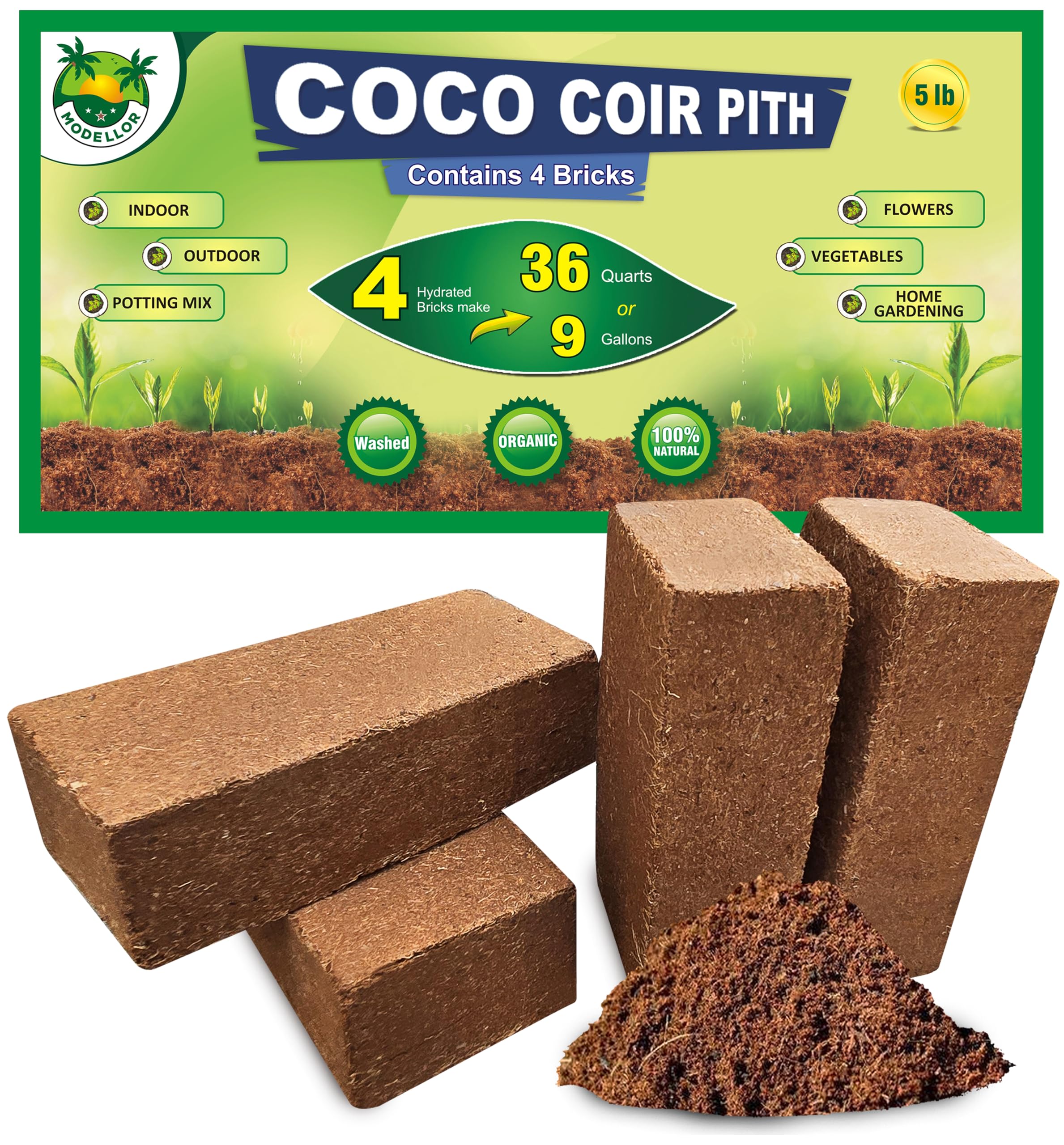
Modellor’s 4-brick bundle delivers 9 gallons of hydrated coir from just 5 pounds of compressed brick, making it one of the most space-efficient options for microgreen growers who fill multiple trays per week. Each 1.25-pound brick is triple-washed and pH-balanced, which means you can hydrate and plant immediately without a separate rinse step — a time saver when you’re cycling trays on a tight schedule. Verified buyers consistently report that the texture is consistently fluffy and free of the woody debris that plagues cheaper brands.
The brick size splits conveniently: soak one brick for smaller batches or drop all four into a 5-gallon bucket for a full tray rotation. Growers note that sunflower and pea shoots root aggressively into this medium, with visible germination improvement over standard peat-based mixes. The expansion is generous — one tester measured nearly 5 gallons from a single brick — so the per-batch cost stays low even at mid-range pricing.
No strange odors, no salt crust on the surface after watering, and no pest larvae. The Modellor bricks are about as foolproof as coir gets for microgreens. The only real limitation is that the blocks are dense and take a few minutes of soaking and crumbling to hydrate fully if you don’t use hot water.
What works
- Pre-buffered, triple-washed — no rinsing needed before seeding.
- Expands to 9 gallons total, enough for 4-5 standard trays.
- Consistent fluffy texture with no salt crust or debris.
What doesn’t
- Bricks are hard; requires hot water for quick breakdown.
- Not OMRI-listed if that certification matters to your operation.
2. Happy Trees Coir and Perlite 10L Bag
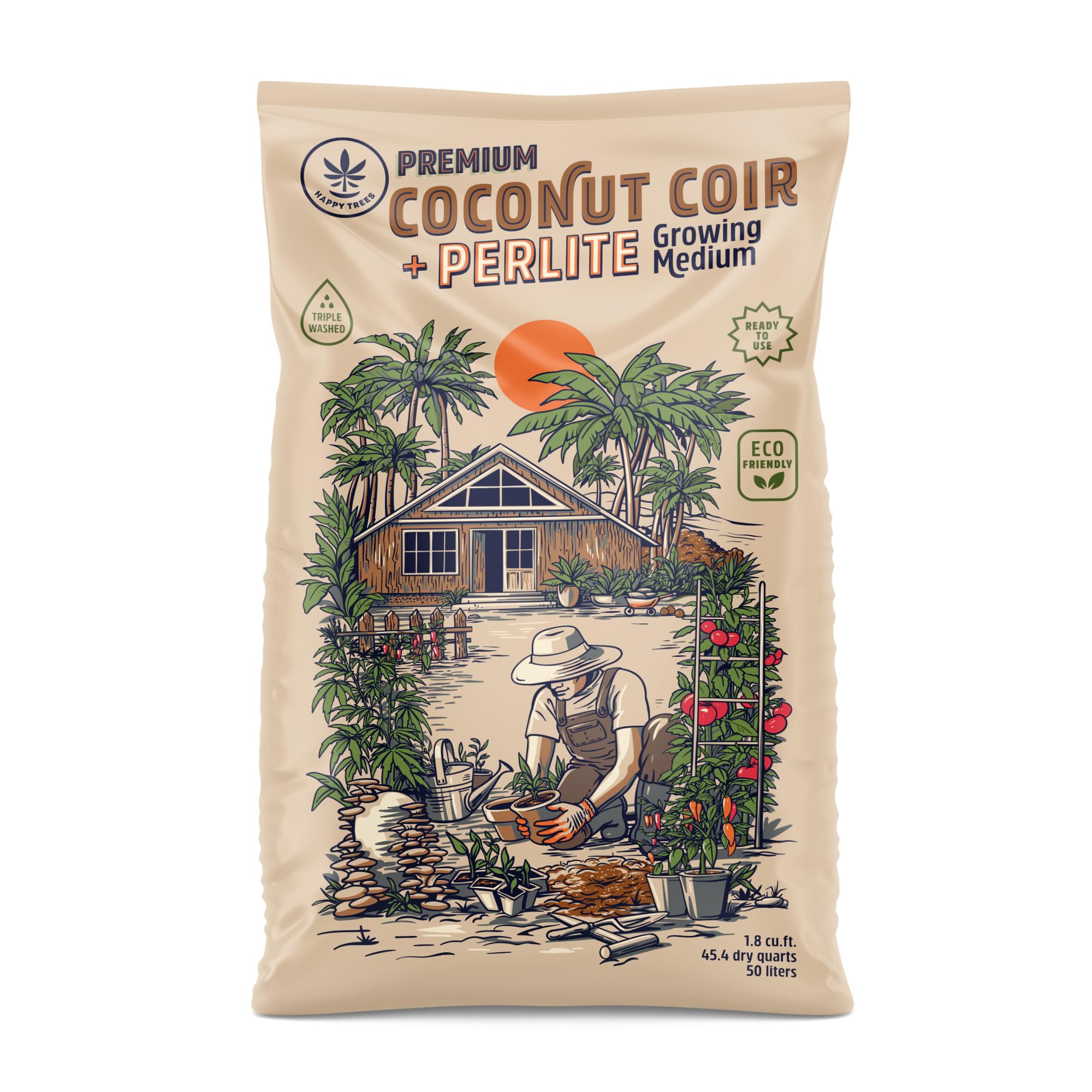
Happy Trees skips the brick ritual entirely — this 10-liter bag arrives pre-expanded and loose, already blended with 30 percent perlite for extra drainage. For microgreen growers who hate hydrating blocks and breaking apart fibrous chunks, this is the most convenient option on the list. You scoop directly into trays, level it with your hand, and seed immediately. No soaking bucket, no waiting, no cleanup.
The blend is triple-washed and buffered, so EC stays low enough for sensitive varieties like amaranth and basil. The perlite inclusion helps prevent the surface from crusting over after watering, which reduces the chance of seeds getting trapped under a hard layer. Growers using this medium for broccoli and kale microgreens report even germination with minimal damping-off.
The trade-off is that perlite can float to the top during heavy overhead watering, and you are paying for water weight since the bag is pre-hydrated. It also costs more per gallon than buying dry bricks. But if convenience and zero prep time are worth the premium, this bag is hard to beat.
What works
- Pre-hydrated and pre-mixed — no soaking, no dust, immediate use.
- Triple-washed with low salt content, safe for sensitive microgreens.
- Perlite improves aeration and prevents surface crusting.
What doesn’t
- Perlite can separate and float during overhead watering.
- More expensive per gallon than dry brick alternatives.
3. Minute Soil 3-Brick Pack by Mountain Valley

Minute Soil keeps things simple: three compressed bricks that each yield 1.5 gallons of raw, untreated coir. The bricks are OMRI-listed for organic production, and because they contain no added fertilizers or wetting agents, you have full control over what goes into your microgreen trays. This is ideal for growers who want to custom-blend their own amendments or who prefer a minimalistic approach to seed starting.
The fiber is fine enough that microgreen roots penetrate without resistance, and the expansion is reliable — add 10 cups of water per brick and wait 10 minutes. Growers note that the bricks can’t be split partially; you must hydrate the whole brick at once, which can be frustrating if you only need a quart of medium. Many users solve this by rehydrating all three at once and storing the excess in a sealed bucket for the next cycle.
The other consideration is that this is truly raw coir — no pH buffering or salt rinsing is guaranteed, though most users report EC levels are low enough for microgreens. If you have particularly hard tap water, a quick test is recommended before seeding a full tray.
What works
- OMRI-listed, raw and unamended — full control over nutrients.
- Small brick size (1.5 gallons each) is perfect for hobby-scale use.
- Expands quickly with hot water, minimal debris.
What doesn’t
- Cannot hydrate partial bricks — have to soak full block each time.
- Not pre-buffered; may need pH adjustment in hard water areas.
4. Vivlly 10 lb Coco Coir Block

Vivlly packs 10 pounds into a single compressed block that expands to a massive 75 quarts — roughly 18 to 20 standard microgreen trays from one block. The EC is stated below 0.5 mS/cm, and the aging and buffering process removes excess salts that typically plague lower-end coir. For growers running continuous weekly cycles, this is the most economical per-tray option in the lineup.
The block is dense and requires 3 to 4 gallons of warm water to fully hydrate. Breaking it up manually without a large bucket is difficult, so budget time for the soak. Once expanded, the texture is fine and uniform, with only rare strands of longer fiber. Growers using it for wheatgrass and sunflower shoots note that root mats lift cleanly at harvest without the coir crumbling apart.
Some customers mention a powdery dust when handling the dry block, so open it in a well-ventilated area or wet the surface before breaking. The block is large enough that growers with small spaces may find storage challenging, but the per-tray value is undeniable.
What works
- 75 quarts yield from a single block — outstanding value per tray.
- EC below 0.5 mS/cm, safe for the most sensitive microgreens.
- Consistent fine texture after hydration, clean root lift.
What doesn’t
- Dry block generates dust; needs careful handling.
- Requires large container and hot water for full hydration.
5. Plantonix Coco Bliss 6-Brick Pack

Plantonix’s Coco Bliss is screened through an extremely fine mesh to remove sand, rocks, and long fibers, resulting in one of the cleanest coir textures available for microgreens. The 6-brick pack yields 12.5 gallons total, and each brick hydrates to a fluffy, almost soil-like consistency that roots love. The pre-rinsing and low EC ensure zero risk of salt burn, even during the first 48 hours when microgreens are most vulnerable.
Growers testing this against cheaper bricks report that Coco Bliss expands fuller and holds its structure longer without compacting over multiple waterings. The high cation exchange capacity means nutrient retention is excellent if you feed with a dilute fertilizer after day four. It is also OMRI-listed, which is a requirement for certified organic microgreen operations.
The premium pricing per pound is the main hurdle. You are paying for the multi-stage screening and the brand’s consistency program. But if your microgreen business depends on uniform germination and zero contamination risk, the extra cost translates directly into less waste and higher tray quality.
What works
- Multi-screened to remove sand and fiber chunks — ultra-clean texture.
- OMRI-listed organic, safe for certified commercial grows.
- High CEC retains nutrients well when feeding microgreens.
What doesn’t
- Premium price per brick compared to similar-sized competitors.
- Bricks are small (650g each), require multiple per large tray run.
6. Boomer Shroomer Dry Bulk Substrate

Boomer Shroomer blends coco coir with vermiculite and gypsum in a dry mix designed for mushroom cultivation, but the same CVG formula works well for microgreens that benefit from extra moisture retention and pH stabilization. The gypsum prevents the coir from compacting into a dense mat, while the vermiculite adds air pockets that help peas and sunflowers root deeply without waterlogging.
The 1.15-kilogram package yields about 10 pounds of hydrated substrate when you add boiling water — enough for two monotubs or roughly four standard microgreen trays. Because the mix is designed to be pasteurized with boiling water, it arrives microbiologically clean, which reduces the chance of mold competing with your seeds during the first few days. Growers who have used it for microgreens report zero contamination and strong germination across all varieties.
The obvious catch is that this is a niche product designed primarily for mushroom growers. The vermiculite-to-coir ratio is fixed, and you cannot adjust it. If you prefer a pure coir base and want to control your own amendments, this pre-blended route limits your flexibility. But if you want a ready-to-pasteurize mix that also performs for greens, it is a reliable shortcut.
What works
- CVG blend provides excellent moisture retention and aeration.
- Pasteurizable with boiling water — low contamination risk.
- Pre-measured portions take the guesswork out of mixing.
What doesn’t
- Fixed vermiculite ratio limits customization for pure-coir growers.
- Priced for specialty mushroom market, not cheapest per tray.
7. MagJo Naturals 44 lb 4-Pack
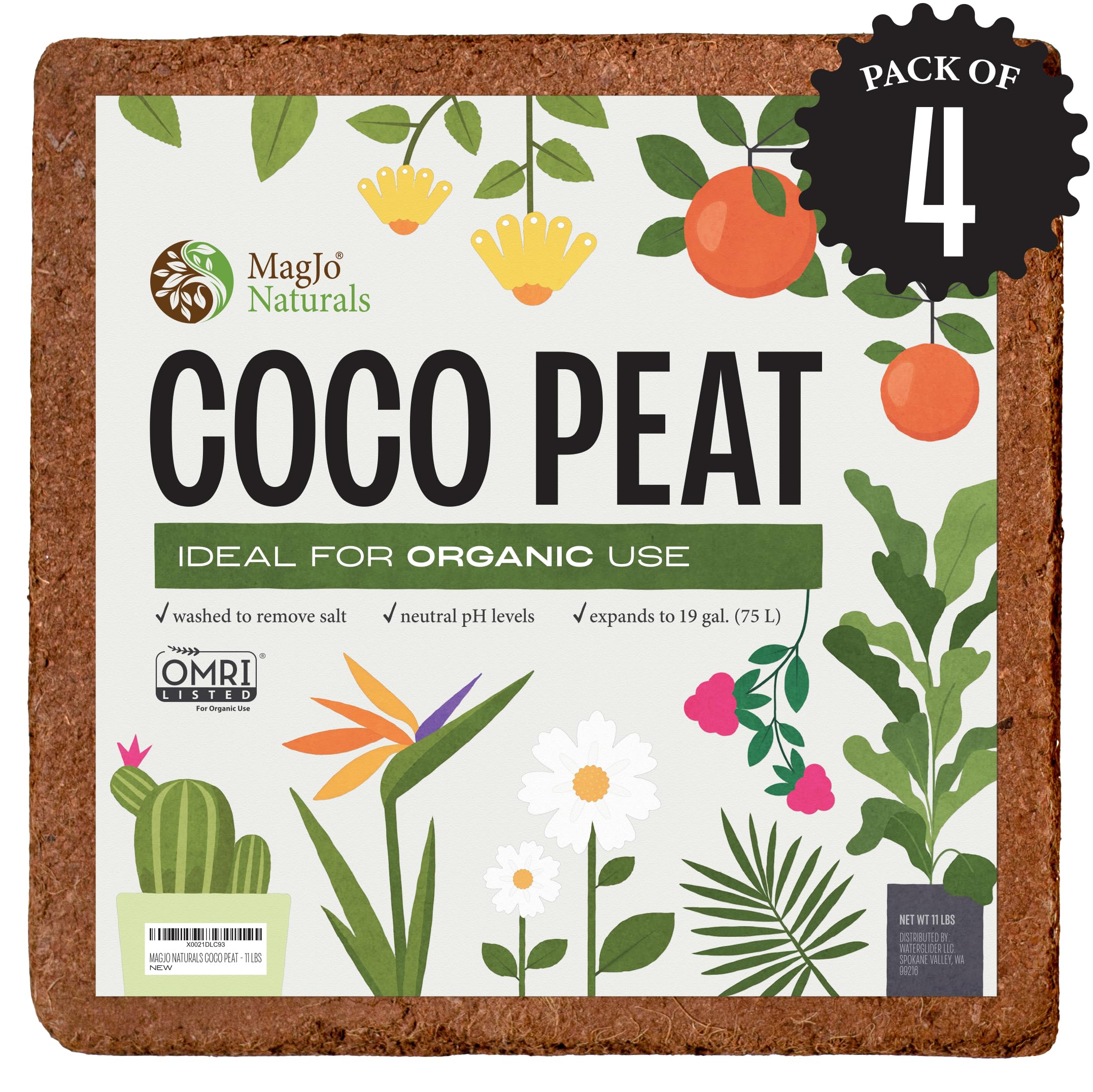
MagJo’s 4-pack delivers 44 total pounds of compressed coir — each 11-pound brick expanding to about 17 gallons. This is the clear choice for commercial microgreen growers or anyone running 30+ trays per week who wants to buy once and not think about reordering for months. The coir is sourced from OMRI-registered manufacturers and washed to remove salt, though the stated EC is not as tightly advertised as the Vivlly or Modellor options.
Growers testing the 11-pound bricks report that the expansion is generous and the texture is fine enough for microgreen root systems. The bricks come wrapped in heavy plastic that can be tricky to open cleanly. You absolutely need a 20-gallon container to hydrate a single brick fully — attempting to break it manually is not worth the effort. Users who soaked the whole block at once ended up with the best consistency.
Some users detected a slight tea-tree-like scent from the coir, which dissipated after hydration. This is not a sign of contamination but rather a natural volatile compound from the husk processing. The main drawback is the upfront investment in both money and storage space — these bricks are large and heavy. But the per-gallon cost for a large-scale operation is among the lowest available.
What works
- 44 lbs total — enough for 50+ trays, lowest per-tray cost in this guide.
- OMRI-sourced, washed, and low-salt for organic grow operations.
- Fine, fluffy texture after hydration; roots lift clean.
What doesn’t
- Massive bricks require a large container and patience to hydrate.
- Slight natural odor reported by some users after initial soak.
Hardware & Specs Guide
EC and Salt Content (Electrical Conductivity)
EC measures dissolved salts in the coir. For microgreens, an EC of 0.5 mS/cm or lower is critical — anything above 0.7 mS/cm can cause tip burn, stunted root growth, and uneven germination. Triple-washed and pre-buffered coir ensures that excess sodium and chloride are flushed out before the brick reaches your tray. Always check the product listing for stated EC; brands that don’t disclose it often have high salt levels unsuitable for microgreens.
Expansion Ratio and Volume Yield
Compressed coir bricks vary wildly in how much medium they produce. A standard 1.25-pound brick should yield 2 to 3 gallons of hydrated coir. A 10-pound block should yield 70 to 80 quarts. Under-expanding bricks waste money and mean you’ll run out mid-tray. Read verified reviews for real-world expansion data; some brands advertise one yield but deliver significantly less after hydration.
Fiber Fineness and Screening
Microgreen roots are fine and delicate — they cannot push through long, woody fibers or navigate around pebbles and sand. Coir that has been screened through a 4mm mesh or finer produces a uniform, fluffy texture that allows roots to spread evenly. Premium brands like Plantonix and Modellor emphasize multi-stage screening, while budget coir often contains visible debris that must be picked out by hand.
pH Buffering and Stability
Raw coir typically has a pH between 5.0 and 6.5, which is slightly acidic to neutral. Pre-buffered coir is treated with calcium or magnesium to stabilize the pH around 5.8 to 6.2 — the sweet spot for microgreen nutrient uptake. Unbuffered coir can swing in pH depending on your water source, which may lock out calcium and cause leaf discoloration. Pre-buffered bricks save you the guesswork.
FAQ
Can I reuse coconut coir for a second round of microgreens?
How much coir do I need per 1020 microgreen tray?
Should I choose fine or coarse coconut coir for microgreens?
Do I need to add nutrients to coconut coir for microgreens?
Final Thoughts: The Verdict
For most gardeners, the coconut coir for microgreens winner is the Modellor Premium Super Washed 4-Brick Pack because it combines triple-washed purity, fast hydration, and consistent 9-gallon expansion at a mid-range price that balances quality and value. If you want ready-to-use convenience without soaking bricks, grab the Happy Trees Coir and Perlite Bag. And for high-volume commercial operations that need the lowest per-tray cost, nothing beats the MagJo Naturals 44 lb 4-Pack.