
Specs are compiled from manufacturer listings and verified buyer reviews and can change over time — please confirm the key details on the product page before buying.
Your plants in coco coir depend entirely on what you mix into the water—the fine fibers drain fast and steal calcium, so a standard one-bottle fertilizer can leave them hungry or burned. The best coco coir nutrients use chelated minerals that stay available in that low-nutrient medium, plus extra calcium and magnesium to replace what the coir absorbs. This guide matches each pick to the way you actually grow, whether you hand-water fabric pots, run an auto-feed system, or want the simplest possible routine.
I’m Rikta — the founder and writer behind Lawn Gear Lab. This guide is built by comparing the manufacturers’ published specifications and the patterns across verified customer reviews, so you get each pick’s real strengths and trade-offs instead of marketing spin.
If you grow in coco coir, your plants rely entirely on what you put in the water, so choosing the wrong nutrient line can set you back weeks. Here is what you need to know to pick the best coco coir nutrients for your setup, your budget, and your experience level.
Quick Picks
- Canna Coco A & B, 1 L, Set of 2 — Best Overall
- ENVY Hydroponic Plant Food A & B – Quart Set — Premium Versatile
- Real Growers Grow Dots Extended – Single Application Plant Food — Set & Forget
- Lotus Nutrients Grow Pro Series – Water Soluble Powder, 16oz — Simplest Mix
- General Hydroponics FloraBlend – Vegan Compost Tea, 1 Qt. — Supplemental Boost
- VIVOSUN Liquid Nutrients Base A & B Bundle – 8oz Each — Budget Entry
- Canna 5 L Coco Part A & B – Veg & Bloom Nutrient — Bulk Investment
How To Choose The Best Coco Coir Nutrients
Picking a nutrient line for coco depends on three things: how the medium holds onto minerals, how much time you want to spend mixing, and whether your setup runs on a timer or your own two hands. Here is what to look for in each bottle.
Two-Part Liquids vs One-Part Powders
The classic approach is a two-part liquid system—Part A and Part B that you mix separately and combine after diluting in water. This keeps calcium and phosphates from reacting in the bottle, so the nutrients stay available. The alternative is a single powder that dissolves completely, cutting your mixing time in half. Powders save on shipping weight and shelf space, but they require a precise scale or scoop to get the dose right. Two-part liquids tend to be more forgiving for new growers because you can adjust each bottle slightly without recalculating the whole batch.
Chelated Micronutrients and Calcium Content
Coco coir naturally binds to calcium and magnesium, stealing them from the roots before they get absorbed. That is why many coco nutrient lines contain extra calcium (Ca) or a dedicated CalMag additive. The minerals need to be “chelated”—chemically wrapped so they stay dissolved in water and available for the roots—especially in a medium that drains as fast as coco. Look for ingredients like DTPA iron (a type of chelated iron that stays active across a wider pH range) and a calcium reading of at least 4-5% if you are running a low-calcium water source.
Feeding Schedule and Your Setup
If you hand-water fabric pots, you can afford to mix fresh nutrients each feeding and adjust the strength week by week. If you run an automatic drip or an autopot system, you need a nutrient that stays stable in the reservoir for days without pH drift or sediment buildup. Some nutrients are specifically formulated for “run-to-waste” coco setups, meaning you feed a little extra and let the excess drain out so salts never accumulate in the pot. Others are built for recirculating systems where the same water passes through multiple times—those need to be cleaner and less likely to precipitate.
Quick Comparison
| Model | Best For | Type | Volume | NPK Ratio | Amazon |
|---|---|---|---|---|---|
| Canna Coco A & B, 1 L | Best Overall Coc-Specific Formula | Two-Part Liquid | 1 L | 4-0-1 / 0-4-2 | Amazon |
| ENVY Hydroponic A & B | Premium Versatility | Two-Part Liquid | 64 fl oz | 6-0-5 / 1-5-6 | Amazon |
| Real Growers Grow Dots Extended | low-maintenance | Timed-Release Granules | 24 oz | — | Amazon |
| Lotus Nutrients Grow Pro Series | Simplest Single-Bottle | Water-Soluble Powder | 16 oz | — | Amazon |
| General Hydroponics FloraBlend | Supplemental Tea Additive | Liquid Compost Tea | 1 qt | 0.5-1-1 | Amazon |
| VIVOSUN Base A & B | Budget Two-Part Entry | Two-Part Liquid | 16 fl oz | — | Amazon |
| Canna 5 L Coco A & B | Best Bulk Value | Two-Part Liquid | 5 L | — | Amazon |
In‑Depth Reviews
1. Canna Coco A & B, 1 L, Set of 2

The two-bottle system purpose-built for the chemistry of coco coir.
This nutrient line is the one experienced coco growers recommend most often because it is designed specifically for coco substrates, not adapted from a hydro or soil formula. Part A delivers an NPK (nitrogen-phosphorus-potassium) of 4-0-1 and Part B delivers 0-4-2, and the blend includes natural chelates plus humic and fulvic acids (compounds that help roots absorb minerals) so the plant can actually use what you feed. At 5.5 pounds for the set of two 1-liter bottles, it is a substantial container that lasts through multiple cycles. Unlike the 2.35-pound FloraBlend from General Hydroponics below, this is a full base nutrient, not a supplement—you feed it alone from start to finish.
Buyers report consistent “explosive growth at day 30” and note how clean the line runs in autopots (self-watering pots that feed from a reservoir) — no sludge, no pH swings. Some growers caution that the label suggests a dosage that can be too hot for young plants, recommending you start at 1/4 to 1/2 of the listed amount and work up. One reviewer summed it up simply: “Canna A+B, CalMag, PK 13/14. Simple. Works well in autopots.”
Because it is so clean in solution, this is the pick for anyone running an automated drip or autopot system where sediment and salt buildup kill performance—it stays stable in the reservoir for days. If you want the most precise control over your feed, pick the ENVY A & B instead, but for proven, consistent results in automated systems, the Canna line is the default choice.
What makes it the default
- Formulated from the ground up for coco, not a soil or hydro refit
- Contains humic and fulvic acids for better absorption in fast-draining media
- Consistent, clean performance in recirculating and run-to-waste setups
The fine print
- Labeled dosage tends to be aggressive for seedlings and early veg
- Upfront cost for 1 L is higher than the VIVOSUN or Lotus powder
- Need separate CalMag and PK 13/14 for best results in flower
Your move: If you are serious about coco and want the most proven two-part line on the market, start here. It pairs perfectly with autopots and recirculating systems.
One caveat: Follow the low-dose advice from the reviews—going full-strength on the label can burn sensitive plants in early growth.
2. ENVY Hydroponic Plant Food A & B – Quart Set

A high-calcium two-part system that covers veg and bloom with one blend.
ENVY packs 5% calcium into Part A, which is noticeably higher than the Canna line—a direct answer to the way coco coir steals calcium from the root zone. The formula reads Part A at 6-0-5 and Part B at 1-5-6, giving you nitrogen in veg and phosphorus-potassium in flower from the same two bottles. You never need to swap to a separate bloom formula. Each bottle holds 32 fluid ounces for a combined 64 fluid ounces of total liquid, making this one of the largest ready-to-use two-part sets on this list. Every bottle includes DTPA iron (a chelated form of iron that stays available even if your pH swings a point or two), which is a detail you usually only see in pro-level hydro nutrients.
Reviewers mention that the nutrient has “no smell” and that they got “great germination, plant growth for a long period of time.” Several growers use it in tower gardens and high-output systems, noting that a little goes a long way—64 ounces can last a small home grow several seasons if you follow the recommended mixing ratios.
Where the Canna line shines best in autopots, the ENVY line feels equally at home in DWC (deep water culture—where roots hang in nutrient solution) and NFT (nutrient film technique—a thin stream of water flows over roots) systems because of its clean dissolving profile and the stability of the chelated micronutrients. If you use these hydroponic setups, the ENVY’s 5% calcium gives you an edge over the Canna 1 L set.
Why it stands out
- 5% calcium content in Part A addresses the biggest challenge in coco growing
- Single pair of bottles runs veg to harvest—no separate bloom product needed
- Large 64 fl oz total volume offers better per-ounce value than smaller sets
The trade-off
- Higher upfront price than budget options like VIVOSUN
- Less widely reviewed than the Canna line, so fewer user experience data points
- May require additional additives for very heavy bloom feeders
Best fit: Growers who want a high-calcium, single-blend solution for multiple grow methods—from tents to outdoor gardens. The calcium content alone gives it an edge for coco over general-purpose hydro nutrients.
Note: Reviewers report it works well for vegetables like tomatoes and tomatillos, making it a strong choice for edible gardens too.
3. Real Growers Grow Dots Extended – Single Application Plant Food
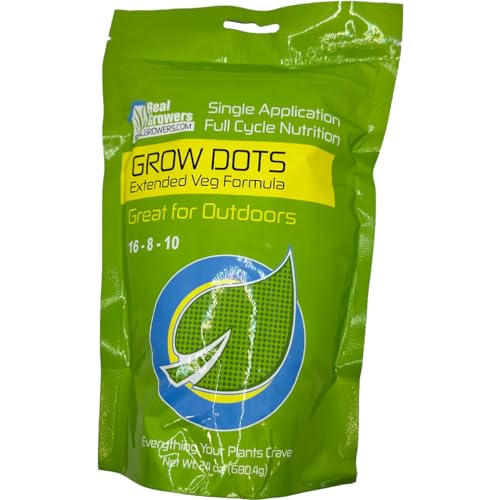
A single sprinkle of granular nutrients that feeds from veg through harvest.
This is the most category-disrupting product on the list: instead of mixing bottles every watering, you mix 75 grams of tiny granules into every 5 gallons of coco coir at potting time, and the dots release nutrients as the temperature in the root zone rises—meaning they feed more when the plant is actively growing and slow down when it rests. The 24-ounce bag contains enough for multiple medium-sized pots. Real Growers designed the Extended version specifically for longer vegetative cycles, using a temperature-based release mechanism (the granules respond to root-zone warmth) rather than a simple timed coating.
Owners mention “incredible for all plants! Takes all the measuring of nutrients right out the equation and all you need to do is water.” One long-term user mentioned they “use the extended release for Photo flowering and the blue bag for Autos. Then just use recharge to water once or twice a week.” The obvious limitation is that you trade the precision of a liquid system for set-and-forget convenience; you cannot dial in a specific PPM (parts per million—a measure of nutrient concentration in water) mid-cycle or correct a deficiency quickly without supplementing with liquid nutrients.
If your schedule does not allow for weekly mixing and pH checking, and you want a “just water” approach that still produces solid results, the Grow Dots system is worth a close look. It pairs naturally with beneficial microbe products like Recharge, as the reviews highlight. This is the one to pick over the Canna or ENVY liquid systems if your main priority is eliminating mixing time.
The biggest win
- Single application at potting time eliminates measuring and mixing for the entire cycle
- Temperature-dependent release syncs feeding with plant growth rate
- Works with coco, soilless mixes, and pairs well with beneficial microbes
The catch
- No mid-cycle adjustment possible without adding separate liquid nutrients
- Not ideal for beginners who want to learn precise feeding control
- Higher sticker price per cycle compared to liquid two-part systems
Who it works for: Anyone who wants to simplify their grow to the absolute minimum—mix Grow Dots into the pot at the start, then just water with plain pH-adjusted water until harvest. Great for busy growers or vacation setups.
Who should skip it: If you enjoy fine-tuning the feed or correcting problems quickly, you will miss the control of a liquid system.
4. Lotus Nutrients Grow Pro Series – Water Soluble Powder, 16oz

One powder that dissolves completely—no Part A and Part B to juggle.
At 16 ounces in a single bag, this powder weighs exactly twice as much as the 8-ounce VIVOSUN two-part bundle (which is a 2.0x gap) and replaces the need for two separate bottles. The formula contains over 14 ingredients including 100% chelated trace elements and amino acids, designed to work across coco coir, hydro, and soil without needing a different product line for each medium. It is a water-soluble powder that dissolves fully, meaning no sediment at the bottom of the reservoir and no pump clogging in recirculating systems. The feeding schedule is about as simple as it gets—measure, dissolve, feed. One buyer reports being a “loyal customer for years” and harvested “12+ oz of Cherry Pie” following the soil schedule.
Because it is a single powder, you lose the ability to adjust Part A or Part B independently for specific growth phases. The formula is designed to carry you from vegetative through early flower transition, and you can pair it with Lotus Boost and Lotus Bloom for the full cycle. The pH-friendly formulation means fewer adjustments compared to some two-part lines, which matters in coco where pH swings happen faster than in soil.
The powder format makes it a strong contender for anyone shipping nutrients or traveling with them—no leaking bottles, no heavy glass jugs. At 16 ounces, it takes up about as much space as a snack bag. This is the cleanest alternative to the VIVOSUN two-part bundle, with a longer shelf life and less waste.
What simplifies your life
- Single container eliminates mixing A and B separately
- Dissolves fully with no sediment or pump-clogging residue
- Works across coco, hydro, and soil—one bag for all systems
The limitation
- Cannot adjust nitrogen vs phosphorus-potassium independently mid-cycle
- Requires a precise scale or scoop—eyeballing the dose leads to issues
- Designed for veg through early flower; full cycle needs the Bloom companion
Reach for this if: You are tired of counting bottles and want a clean, pH-friendly powder that handles veg and early flower with one scoop. Ideal for growers who like simple, repeatable routines.
Not for you if: You want to fine-tune the NPK ratio for each growth phase independently.
5. General Hydroponics FloraBlend – Vegan Compost Tea, 1 Qt.

A vegan compost tea supplement that revives root structure without burning.
The FloraBlend is not a standalone base nutrient—its NPK ratio of 0.5-1-1 tells you it is low in nitrogen and built as an additive to support your main feeding program. At 2.35 pounds for the quart bottle, it is significantly lighter than the 5.5-pound Canna A&B set (a 2.3x gap), and the 946-milliliter volume is smaller than the 1-liter Canna bottles. Use this as a root soak or foliar spray (a mist applied to the leaves) alongside a base nutrient like General Hydroponics FloraSeries or MaxiBloom. One buyer described the results: “After a few weeks you’ll see a huge difference in how the plants respond, damn near amazing.”
Because it is a vegan compost tea (plant-derived instead of animal-based, without manure or bone meal), it introduces beneficial microbes and organic compounds to the coco medium without adding heavy salts. It works across coco coir, hydro, and soil, and the label recommends using it from germination through ripening. Customers note it is effective as a foliar spray and root soak, improving root structure compared to untreated plants, and that it has no strong odor when mixed.
The catch—and growers consistently mention this—is that you absolutely must use this as an additive, not a replacement. If you are buying only one bottle to feed your plants in coco, this is not that bottle. It pairs best with an existing two-part or one-part base nutrient system. In contrast to the full Canna A & B base set, the FloraBlend is meant to add microbial life, not replace the main feed.
When to use it
- Adds microbial activity back into coco, which can feel sterile compared to soil
- Works as both root drench and foliar spray—flexible application
- Vegan formula avoids animal-derived inputs some growers prefer to skip
Know this
- It is a supplement, not a base nutrient—you still need a primary feed
- Smaller volume (1 quart) compared to two-part sets that last multiple cycles
- Needs to be stored cool and shaken well before each use
Add it when: Your base coco nutrient is working but you want more root development and microbial diversity without switching to a full organic line. Best used as a foliar spray or root soak alongside a complete base like MaxiBloom.
One more thing: Mix at half strength for young plants and increase as they mature—reviewers warn against starting at full concentration.
6. VIVOSUN Liquid Nutrients Base A & B Bundle – 8oz Each

An affordable two-part bundle to dip your toes into coco feeding.
VIVOSUN’s bundle gives you two 8-ounce bottles—one Part A and one Part B—for roughly the same price as the 16-ounce Lotus powder container (which is a 2.0x weight gap). The total liquid volume is 16 fluid ounces across both bottles. It is a 100% water-soluble base nutrient kit designed to stabilize pH and improve nutrient absorption, and it is compatible with all growing media including coco coir, soil, and hydroponics. The mixing ratio is simple: equal parts A and B, diluted separately then combined—never mix the concentrates together directly, as that would cause a reaction that locks out the nutrients. Reviewers point out: “At 5ml/gallon tap water, these containers hold a lot of quantity and quality.”
The bundle covers both vegetative and flowering stages with one two-part set—you do not need a separate bloom formula. The liquid is concentrated enough that the 8-ounce containers can last several weeks depending on your plant count and feeding frequency. One reviewer measured that using 5 milliliters per gallon, the bottles go further than expected, especially in a small home grow. The main difference between this and the ENVY or Canna two-part sets is the total volume and the calcium concentration—VIVOSUN does not call out a specific high-calcium formulation, so plants in coco may benefit from an additional CalMag supplement if you see signs of calcium deficiency.
At the entry level, the straightforward instructions (“from seed to harvest, you only need two bottles”) and the low entry cost make this an easy starting point for a first coco grow, with the option to upgrade to the Canna or ENVY lines later without regretting a big investment.
Why start here
- Two-part system covers veg and flower with one purchase
- Concentrated formula stretches further than the bottle size suggests
- Low-cost way to try a two-part nutrient without a big upfront spend
What is missing
- Small total volume (16 fl oz) compared to ENVY’s 64 fl oz or Canna’s 2 L
- No high-calcium boast like the ENVY line—CalMag supplement may be needed in coco
- Bottles are compact; you will reorder sooner than with larger sets
Best for: First-time coco growers who want a simple two-part system to learn on. When you outgrow the volume, you can step up to the Canna or ENVY lines with more confidence.
Figure out your monthly usage before you commit long-term.
7. Canna 5 L Coco Part A & B – Veg & Bloom Nutrient

Five liters each of the same proven formula—built for multi-cycle production.
This is the bulk version of the same Canna A&B formula that took the #1 spot above, scaled to 5 liters per bottle for a combined 10 liters (roughly 2.6 gallons) of base nutrient. At 27 pounds total shipping weight, it is the heaviest item on this list by a wide margin—the 5.5-pound 1-liter set is a fraction of that weight. The mixing ratio for this run-to-waste formulation is 1:250 (1 part A and 1 part B diluted into water), which is even more concentrated than the 1:1 mixing ratio of the 1-liter set because the application difference matters—run-to-waste systems, where you feed a bit extra and let the excess drain out, need a different concentration than a recirculating setup. A buyer notes that “about half to a third of the price if you buy 5L vs 1L,” meaning the cost per milliliter drops dramatically at this size.
Reviewers confirm the same performance as the smaller bottles: “fast shipping, well-packaged, sealed, expires Spring 2027. Great for coco, simple through veg/flower, economical in 5L size.” One pointed out that the container design is the weak link—the bottles are functional but not built for repeated pouring, so growers often transfer the liquid to a more user-friendly dispenser. The formula itself triggers explosive growth and clean performance in autopots and drip systems, just like the 1-liter version.
This is the economical choice for anyone running multiple pots or a continuous cycle. The only honest downside is the sheer size and weight—if you are a small home grower with one or two 5-gallon pots, the 1-liter set is a smarter fit so the nutrients stay fresh. This is the bulk alternative to the smaller Canna 1 L set, delivering the same formula at a lower cost per dose for large operations.
Why buy 5 L
- Cost per dose drops to about half or a third of the 1-liter price at this volume
- Same proven, coco-specific formulation as the #1 pick
- Designed for run-to-waste systems—discharge the excess without worry
The practical trade-off
- At 27 pounds, shipping and handling are significant
- Container design makes pouring awkward; many users transfer to a different bottle
- Too much for a single small cycle—nutrients may sit for months after opening
Get this if: You have multiple plants, large pots, or a continuous growing cycle where you will use the full 5 liters within a season. The per-dose savings add up fast.
Stick with the 1 L if: You are a hobbyist running a couple of plants. The smaller bottles keep the product fresher and are much easier to handle and store.
Understanding the Specs
NPK Ratio
NPK stands for nitrogen (N), phosphorus (P), and potassium (K)—the three primary macronutrients every plant needs. A ratio like 4-0-1 means 4% nitrogen, 0% phosphorus, and 1% potassium. In coco, the medium holds no nutrition of its own, so the NPK numbers tell you exactly what the plant is getting. Higher nitrogen (the first number) pushes leafy vegetative growth. Higher phosphorus (the middle number) and potassium (the last number) support flowering and fruiting. Two-part systems let you change the ratio between veg and bloom by adjusting how much of each bottle you use.
Chelated Micronutrients
Micronutrients like iron, zinc, and manganese are essential in tiny amounts, but in coco coir they can lock up and become unavailable to the plant if they are not chelated. Chelation (pronounced “kee-lay-shun”) wraps the mineral in an organic compound that keeps it dissolved in water across a range of pH levels. When you see “DTPA iron” on a label, that means the iron is bound to a synthetic chelate called DTPA (diethylenetriaminepentaacetic acid), which stays stable from pH 4 through 8. Non-chelated minerals often precipitate out of solution in coco’s fast-draining environment, so the roots never get them. This is why a good coco nutrient line always lists its chelated ingredients.
FAQ
Can I use general-purpose plant food in coco coir?
What is the difference between two-part and one-part nutrients for coco?
Do I need CalMag when using coco coir nutrients?
How often should I feed plants grown in coco coir?
What pH should I target for coco coir nutrients?
How long do liquid nutrients stay good after opening?
Is it better to use liquid or dry (powder) nutrients for coco?
Can I mix different brands of nutrients together?
What does “run-to-waste” mean for coco nutrients?
Are there organic options for feeding coco coir?
Final Thoughts: The Verdict
For most growers running coco, the best coco coir nutrients winner is the Canna Coco A & B, 1 L set because its formula is purpose-built for coco’s unique chemistry, it stays clean in reservoirs, and it has the most consistent long-term grower reviews in this category. If you want a high-calcium, all-in-one two-part system for multiple grow methods, reach for the ENVY Hydroponic A&B. And for anyone who wants to skip mixing altogether and just water from transplant to harvest, nothing in this list matches the convenience of the Real Growers Grow Dots Extended.
How We Picked
We do not accept paid placement. Every pick is matched to a real buyer and a real use-case; we do not hands-on test units.
Sources & Methodology
Specifications: manufacturer listings and product documentation. Review insights: verified customer reviews, as of July 2026. Pricing: not shown on this page (it changes often); check the current price via the retailer link.
As an Amazon Associate, Lawn Gear Lab earns from qualifying purchases. This does not affect which products we feature.