
A climbing rose without a proper trellis is a tangled, sprawling mess that robs your garden of vertical drama. The right structure channels those vigorous canes upward, exposing blooms to sunlight and air, which reduces disease and doubles flower production. Choosing a trellis that matches your rose’s mature height and weight determines whether you get a postcard-worthy archway or a collapsed eyesore by mid-season.
I’m Rikta — the co-founder and writer behind Lawn Gear Lab. My process for identifying the top contenders in this market involves cross-referencing steel gauge, powder-coat longevity, ground-stake penetration depth, and hundreds of verified owner experiences to separate the rust-prone lightweights from the decade-long performers.
The following breakdown of the best climbing rose trellis models focuses on real-world stability, assembly workflow, and the specific plant loads each design can safely handle across multiple seasons.
How To Choose The Best Climbing Rose Trellis
Climbing roses are not lightweight annuals. A mature ‘New Dawn’ or ‘Eden’ can put forty pounds of wet wood and foliage on a structure by August. The trellis you select must handle that dead load while resisting wind gusts that act as a lever on the entire frame. Three factors determine whether a trellis delivers or disappoints: anchoring system, material thickness, and the spatial envelope it offers for cane training.
Anchoring & Ground Engagement
The single most common failure of a freestanding climbing rose trellis is tipping. Models that rely on short spikes under four inches are suitable only for potted use or light vine support. For full-size shrub roses, look for a trellis with ground stakes at least seven to eight inches long, preferably with a pronged or cross-bar base that resists rotational torque. If the design includes a secondary stake on the arch or ladder panel, that dramatically reduces the lever action caused by wind loading on the upper canopy.
Material, Gauge & Coating
Iron and steel dominate the heavy-duty segment, but the difference between a 12-gauge wall and a 16-gauge wall is the difference between a structure that flexes under load and one that holds rigid. A powder-coated finish adds a sacrificial layer that resists chipping from cane movement and weather exposure. Cheaper electroplated or bare-paint finishes flake within two winters, exposing base metal to oxidation. For climbing roses, a minimum of 0.7-inch diameter tubing on arch models is the baseline for long-term reliability.
Height, Width & Training Room
Climbing roses require vertical clearance to reach their flowering zones. A trellis under five feet forces the plant to bend horizontally or cascade, which reduces bloom density. Aim for a structure at least six feet tall above ground for most hybrid teas and floribunda climbers. The horizontal width should allow for at least two main canes to be spread into a fan pattern — eighteen inches is the tightest practical width, while twenty-four to thirty inches gives a more natural splay. Lattice or grid-style panels provide abundant tie-off points, while arch designs require that you weave canes diagonally across the frame.
Quick Comparison
On smaller screens, swipe sideways to see the full table.
| Model | Category | Best For | Key Spec | Amazon |
|---|---|---|---|---|
| Queension Extra Large Garden Arch | Arch Arbor | Massive walk-through displays | 110.4″H x 86.4″W | Amazon |
| VEVOR Garden Trellis 4-Pack | Flat Panel | Multi-plant support along walls | 87″H x 20″W per panel | Amazon |
| Outvita 7FT Garden Arch Arbor | Arch Arbor | Storm-resistant entry gate | 8 ground stakes, 7.8″ insertion | Amazon |
| LZRS Rustic Iron Arch 2-Pack | Flat Panel | Adjustable-angle side-by-side setup | 71″H x 40″W combined | Amazon |
| VINGLI Garden Arbor | Arch Arbor | Budget-friendly entry arch | 28″W x 75″H, lattice sides | Amazon |
| Macteyia Metal Trellis 2-Pack | Flat Panel | Decorative bird-pattern display | 86.7″H x 19.7″W | Amazon |
| SCENDOR Trellis 2-Pack | Flat Panel | No-assembly ready-to-place use | 71″H x 15″W, welded one-piece | Amazon |
In‑Depth Reviews
1. Queension Extra Large Garden Arch 7.2Ft Wide 9.2Ft High

The Queession arch delivers the largest footprint in this comparison at 110 inches tall and 86 inches wide, which means two mature climbing roses can be trained on opposite sides without competing for light. The 0.8-inch diameter heavy-duty steel tube resists bending under the cumulative weight of multiple heavy canes, and the prongs base design sinks into turf or soil to prevent lateral shift. Owner reports confirm this structure held thick jasmine vines for nearly a year with no rust development, indicating the frosted coating passes real-world weathering tests.
Assembly uses a buckle connection system that requires no tools — the arch can be stood up by a single person and disassembled just as quickly for seasonal storage or relocation. The double-arch shape provides enough headroom for a person to walk through comfortably, making it functional as a garden entrance while supporting heavy climbers. The matte black finish blends into foliage without glare, keeping the visual focus on the flowers rather than the hardware.
The top of the arch has a slight intentional flexibility that helps when fitting it into tight spaces, but this also means the arch will sway under extreme wind loads if the base is not fully anchored. The prongs base does not include flat base plates, so the arch relies entirely on ground penetration for stability — it will tip if left unsecured in loose soil. For maximum security, pair the ground stakes with 12-inch landscape spikes driven at an angle through the base loops.
What works
- Massive 9.2-foot height accommodates the tallest climbing rose varieties.
- Buckle assembly eliminates the need for tools or hardware.
- Prongs base resists tipping when properly staked.
What doesn’t
- Open arch design offers fewer horizontal tie-off points than lattice panels.
- No base plates means stability depends entirely on stake depth.
2. VEVOR Garden Trellis 4-Pack 87 x 20 in
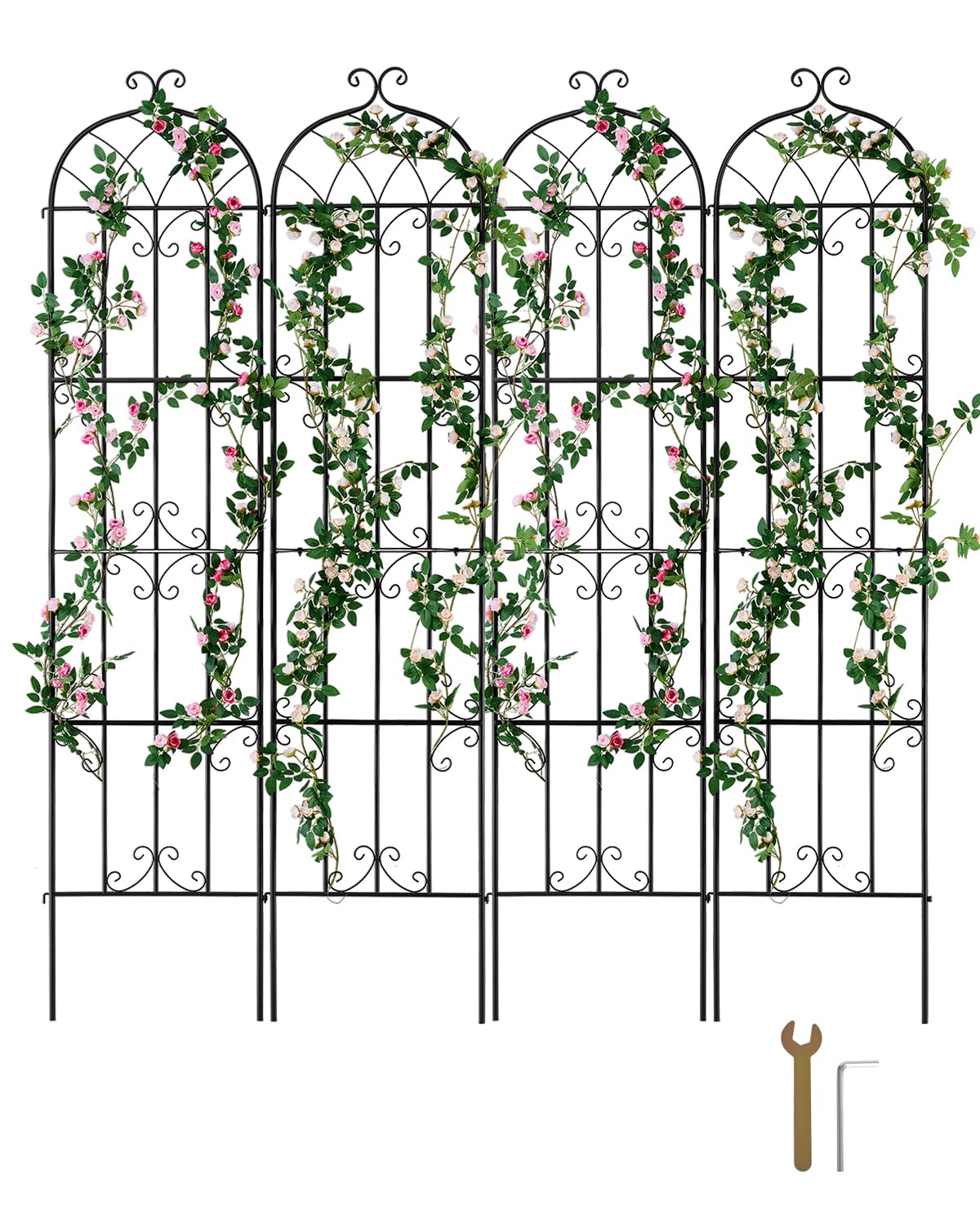
With four panels in a single purchase, the VEVOR set gives you the surface area to support a row of climbing roses along a fence line or to create a dedicated trellis wall for multiple plants. The Q195-grade metal is stiffer than standard mild steel, which reduces flex when canes reach full density in their second season. The powder-coated finish is applied consistently across the edges and weld points, a detail that prevents rust from starting at the most vulnerable locations.
Each panel stands 87 inches tall by 20 inches wide, a height that accommodates vigorous climbers without forcing them to cascade at the top. The rectangular grid pattern provides abundant vertical and horizontal tie-off points, making it straightforward to weave canes into a fan shape. Assembly requires only two nuts and bolts per panel, and the included ground spikes penetrate 8 inches for a secure hold in loamy or clay soil.
The panels are lighter than they look at 26.5 pounds for the four-pack combined, which is an advantage for moving them into position but a potential drawback if you need freestanding stability without a wall. The design works best when placed against a solid backing or when panels are wired together to form a rigid screen. Owners report the panels are shorter than expected once the ground spikes are fully inserted, so account for the 8-inch stake depth when planning clearance.
What works
- Four-panel bundle delivers exceptional coverage for the money.
- Q195 metal resists bending better than standard tubular steel.
- Grid layout simplifies cane training into a fan pattern.
What doesn’t
- Panels feel lightweight and require wall backing for rigid freestanding use.
- Stake insertion reduces effective above-ground height.
3. Outvita 7FT Garden Arch Arbor

The Outvita arch stands out for its eight individual ground stakes, each capable of 7.8 inches of soil penetration, which together create a foot-print that resists the uplift and twist common in open arch designs. The double-layer frame consists of two interconnected arch profiles, adding torsional rigidity that single-panel arbor designs lack entirely. This geometry allows the structure to support heavy hybrid tea roses and even espalier-trained fruit alongside climbers without leaning.
Assembly is rated at 15 minutes thanks to pre-drilled holes with reinforced insert nuts that prevent cross-threading. The snap-together connections on the crossbars eliminate the wobbly mid-assembly phase that frustrates builders of competing models. The powder-coated iron surface is smooth to the touch with no burrs, so rose canes rubbing against the frame will not suffer abrasion damage that could introduce disease.
The 83.86-inch height and 52-inch width are ample for a single climbing rose to create a full canopy, but the arch is narrow enough that two large plants on opposite sides may crowd each other by the third season. The instructions are not the clearest — some owners report confusion over which screw size corresponds to which connection point. Spend an extra five minutes sorting hardware before starting assembly and the process goes smoothly.
What works
- Eight ground stakes deliver exceptional wind resistance.
- Double-layer arch frame resists twisting under dead load.
- Snap-together crossbars eliminate wobble during assembly.
What doesn’t
- Narrow 52-inch width limits dual-plant installations.
- Assembly instructions require careful sorting of hardware.
4. LZRS Rustic Iron Arch 2-Pack 71x20in

The LZRS set introduces a clever hook mechanism at the top that allows each panel to be positioned at various angles, creating a freestanding arch when joined or a flat trellis when separated. This adaptability is unusual in the climbing rose trellis category — it means you can start with a narrow corridor shape in year one and expand the angle as the rose canopy widens in subsequent seasons. The iron wire construction uses a thicker gauge than cheap lattice panels, and the black powder coating has a rustic matte finish that does not glare in afternoon sun.
Each panel measures 71 inches tall by 20 inches wide, giving a combined 40-inch width when connected side by side. The horizontal rails are spaced widely enough for rose canes to pass through without scraping, but the vertical wires are close enough together to support even young tendrils. Assembly is straightforward — connect the top and bottom sections with the provided screws, then stake the feet into the ground or a planter.
The bottom stakes reduce effective above-ground height, so the actual support zone for climbing roses is closer to 64 inches from the soil line. Some panels arrived with minor powder-coat chips or rust spots on the weld points, which is a QC inconsistency that should be checked on arrival. For the price, the design flexibility is strong, but the hundred percent rustproof claim depends on touching up any chips immediately with outdoor metal paint.
What works
- Adjustable hook design lets you set the angle for different plant shapes.
- Rustic powder coat blends naturally with garden foliage.
- Two-panel set covers 40-inch width for generous cane spread.
What doesn’t
- Ground spikes reduce usable height below 71 inches.
- Occasional chips in powder coat require immediate touch-up.
5. VINGLI Garden Arbor
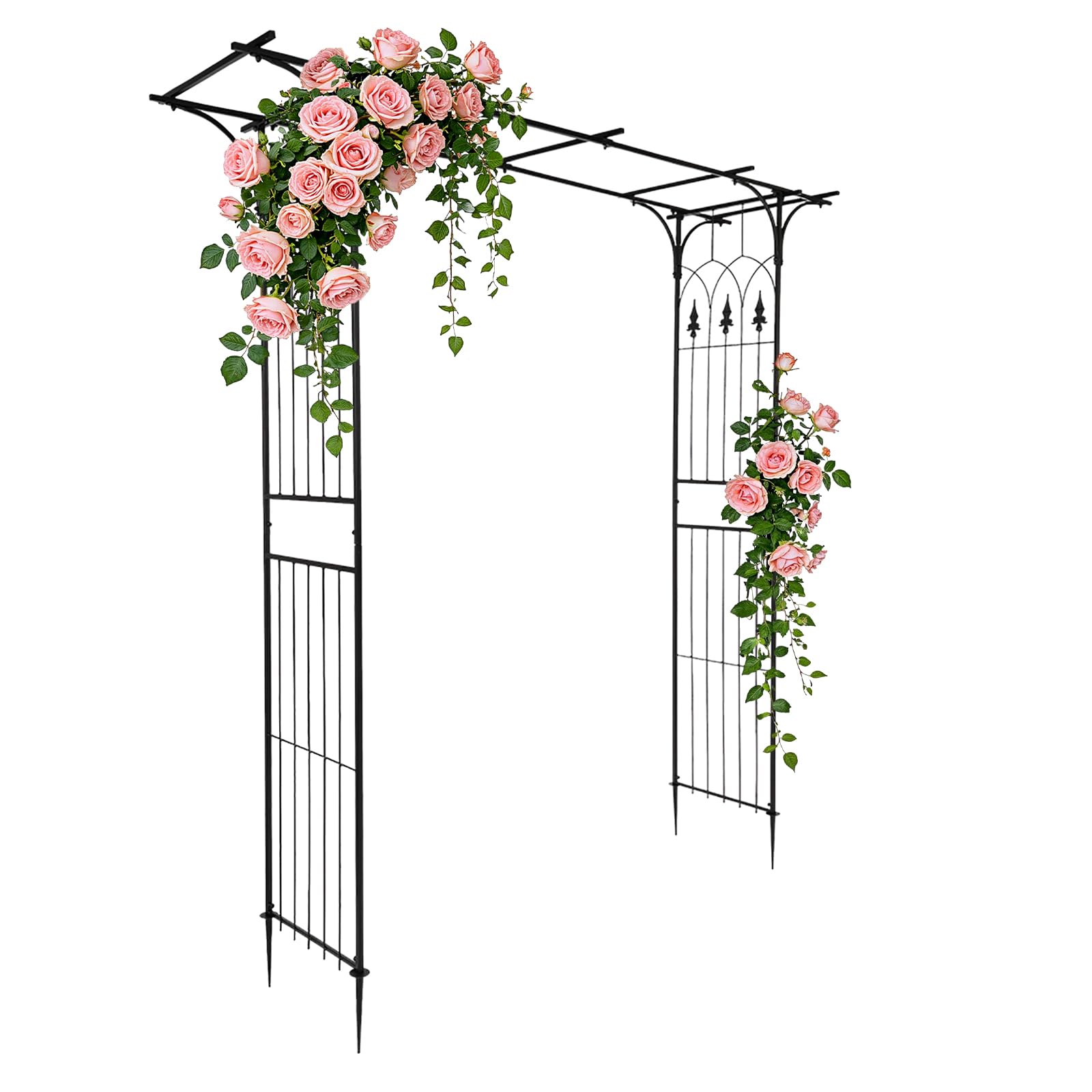
The VINGLI arbor combines an open arch top with squared lattice side panels, creating a structure that is equally suited for climbing roses and as a standalone garden focal point. The lattice provides hundreds of natural tie-off points, making it trivial to train canes into a dense, flower-covered wall rather than a sparse arch. The powder-coated iron frame has proven resistant to rust in owner reports spanning multiple seasons, and the 75-inch height provides the vertical clearance needed for most climbing roses to reach their bloom zone.
Assembly takes between 30 minutes and 2.5 hours depending on whether you work alone — the side panels require alignment of multiple crossbars, and the instructions use small diagrams that are easy to misread. Owners consistently note that the legs must be positioned under the second and fourth crossbars, not at the very ends, for the structure to sit square. The long ground nails provide adequate hold in soft garden soil once driven straight, but the arbor’s lightweight iron frame can shift in high winds if not anchored.
The lattice spacing is tight at roughly four inches, which is ideal for supporting clematis and smaller-flowered climbers but may require you to weave thicker rose canes around the frame rather than through it. The shape works best as a gateway arch where foot traffic passes through, rather than as a wall-mounted trellis. Overall, this is a handsome and functional entry-level arbor that rewards careful assembly with years of service.
What works
- Lattice panels offer abundant tie-off points for dense cane training.
- Powder-coated iron resists rust through multiple wet seasons.
- Classic arch shape adds instant visual structure to any garden.
What doesn’t
- Assembly is awkward alone and requires careful crossbar alignment.
- Lightweight frame can shift in high wind without deep anchoring.
6. Macteyia Metal Trellis 2-Pack 86.7×19.7in
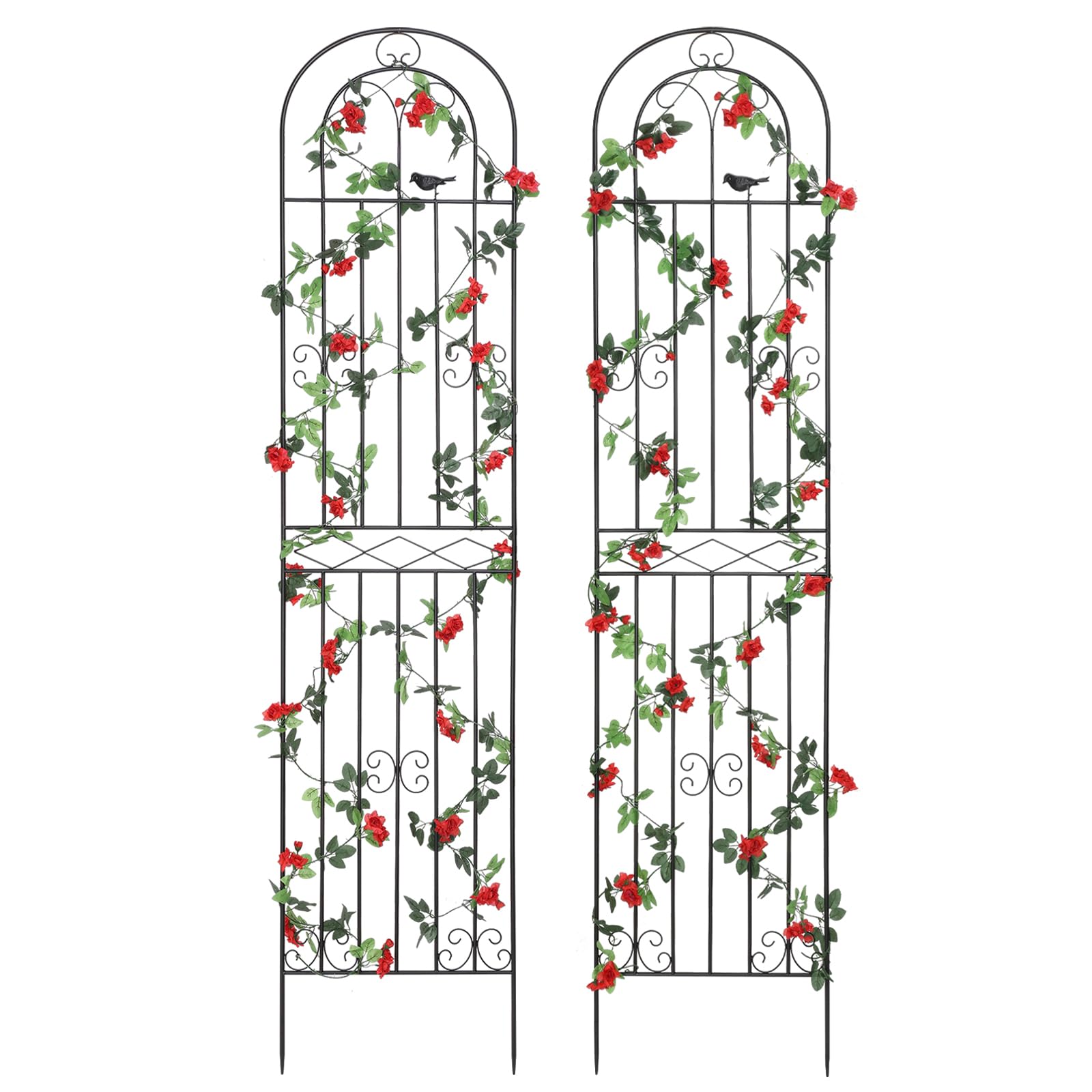
The Macteyia trellis stands 86.7 inches tall with an 8.46-inch ground spike that provides deep soil engagement for lateral stability. The semicircular top and decorative bird cutout add visual interest even before the climbing rose fills the frame, making it a good choice for locations where the trellis itself will be visible during the dormant season. The powder-coated iron construction has drawn consistently positive feedback from owners who have used it for climbing roses, clematis, and jasmine across multiple growing seasons.
Assembly is minimal — the top and bottom sections connect with two sets of bolts, and the included plant tie tape makes it easy to secure canes without damaging their bark. The 19.7-inch width is on the narrower side, so this works best for a single rose plant or a pair trained vertically rather than fanned out horizontally. The black finish is uniform and matches the aesthetic of most contemporary garden designs.
Some owners note that the wing nuts securing the top legs face outward toward the line of sight, which is a minor visual distraction until the rose covers the connection point. The trellis is lightweight at 12 pounds for the two-pack, which makes installation easy but also means the structure can be pushed out of vertical alignment if the ground around the spike softens after heavy rain. Full-year security may require a secondary stake or a dab of construction adhesive on the connection joints.
What works
- Tall 86.7-inch profile suits most climbing rose varieties.
- Decorative bird pattern adds charm during dormant months.
- Deep 8.46-inch spike resists wind better than shorter stakes.
What doesn’t
- Narrow 19.7-inch width limits horizontal cane spread.
- Wing nut placement is visible and breaks the clean line.
7. SCENDOR Trellis 2-Pack 71x15in
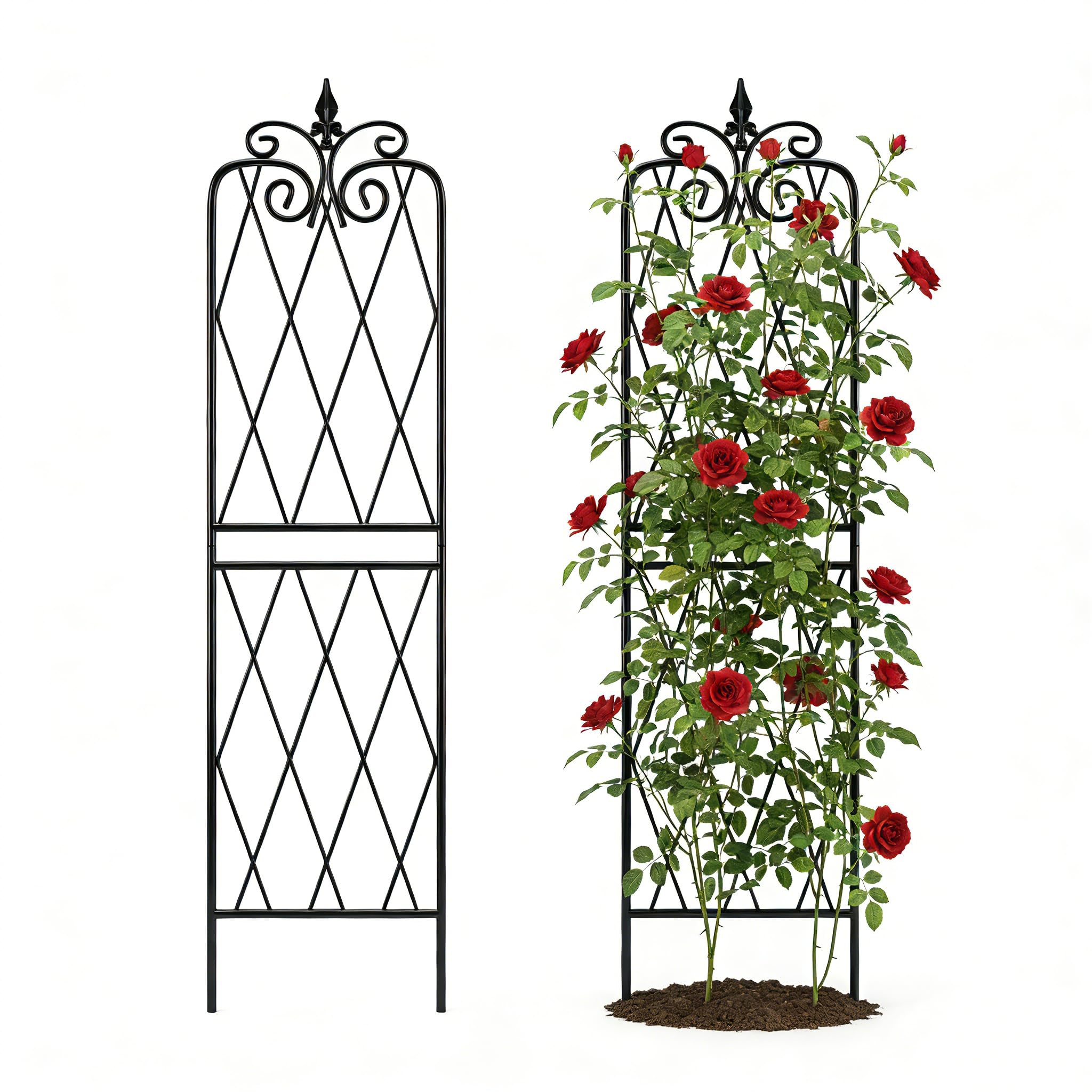
The SCENDOR trellis eliminates the single most common frustration in this category — no assembly required. The frame is fully welded into a single rigid panel that arrives ready to stake into the ground, saving at least 20 minutes of bolt-and-bracket work. This also means there are no connection points to loosen over time, which makes the structure inherently more rigid than sectional models. The antique black powder coat and butterfly cutout pattern give it a distinctive look that stands out against green foliage.
At 71 inches tall and 15 inches wide, this is the narrowest panel in the comparison, which makes it ideal for use in tight corners, between windows, or inside wide cement pots where a larger trellis would overwhelm the container. Owners have repurposed these panels as window grilles by removing the bottom ground spikes, showing the versatility of the all-welded design. The 8-inch ground spike provides reasonable hold in firm soil, though the narrow footprint means the trellis can lean if used as a fully freestanding unit without wall support.
Weight is only 3.6 kilograms for the two-panel set, so each panel is light enough for one-handed carrying and installation. This low mass is a trade-off: the trellis lacks the heft of the Queession or VEVOR models, so it works best when placed against a fence, wall, or in a pot where the base is protected from lateral forces. For young climbing roses still establishing their root system, the SCENDOR provides more than enough support for the first two to three seasons.
What works
- Fully welded one-piece construction eliminates assembly and loose joints.
- Lightweight at 3.6kg for two panels, easy to position and reposition.
- Decorative butterfly pattern looks intentional and attractive.
What doesn’t
- Narrow 15-inch width limits spread to a single vertical cane line.
- Light panel requires wall backing for full stability against wind.
Hardware & Specs Guide
Stake Depth & Anchoring Physics
The lever force on a climbing rose trellis equals the height of the structure multiplied by the lateral wind load on the plant canopy. A trellis that is 7 feet tall with a 15-square-foot sail area in a 30 mph wind experiences roughly 160 foot-pounds of torque at the soil line. To resist this without tipping, the ground stake must offer a moment arm of at least 6 inches in dense soil or 8 inches in loose garden bed mix. Models like the Outvita and Queession that use multiple stakes or pronged bases spread this load over a wider footprint, reducing the risk of soil failure and progressive leaning over the season.
Powder Coating vs. Electroplating
Powder coating applies a dry thermoplastic layer that is thermally fused to the metal at 400°F, creating a continuous surface that resists chipping at weld points and cut edges. Electroplating, sometimes used on budget trellis imports, deposits a microscopic zinc layer that offers only temporary galvanic protection. Once the thin plating is compromised by soil contact or the friction of rose canes rubbing against the metal, rust begins at the breach and spreads under the remaining coating. For permanent outdoor installation, insist on powder-coated finish — the VEVOR and Queession models both use this process, which explains their strong multi-season owner feedback.
FAQ
How tall should a climbing rose trellis be for a mature rose bush?
Will a flat lattice panel support a heavy climbing rose better than an arch?
Can I use a powder-coated iron trellis in a pot or container?
Final Thoughts: The Verdict
For most gardeners, the climbing rose trellis winner is the Queension Extra Large Garden Arch because its massive 9.2-foot height and 17-tube steel frame provide the structural envelope for the largest climbing roses to reach their full bloom potential without overcrowding. If you want a flat panel system that delivers unbeatable coverage per dollar, grab the VEVOR Garden Trellis 4-Pack. And for a no-hassle, zero-assembly option that works perfectly against a wall or in a pot, nothing beats the SCENDOR Trellis 2-Pack.