
Specs are compiled from manufacturer listings and verified buyer reviews and can change over time — please confirm the key details on the product page before buying.
Your lemon, lime, or orange tree needs the right balance of nutrients to give you big, sweet fruit instead of tiny, sour ones with yellow leaves. This guide cuts through the marketing claims and compares seven real products on the specs and customer feedback that matter for a better harvest.
I’m Rikta — the founder and writer behind Lawn Gear Lab. This guide is built by comparing the manufacturers’ published specifications and the patterns across verified customer reviews, so you get each pick’s real strengths and trade-offs instead of marketing spin.
This honest breakdown of the best citrus fertilizer options shows you which formula and application method fits your trees without guesswork.
Quick Picks
- GARDENWISE Professional Citrus Fertilizer + Vital Micronutrients (64 oz) — Best Overall
- Fertilome Fruit, Citrus and Pecan Tree Food 19-10-5 (3.25 lbs) — High-Nitrogen Heavy
- Espoma Organic Citrus-Tone 5-2-6 Natural & Organic Fertilizer (4 lb) — Organic Powerhouse
- Citrus Fertilizer – Liquid Plant Food for Better Flowering, More Fruit (32oz) — Fast-Absorbing Liquid
- Jobe’s Organics Fruit & Citrus Tree Fertilizer Spikes, 3-5-5 Time Release (6 Spikes) — Set & Forget Spikes
- FoxFarm Happy Frog Citrus and Avocado Fertilizer – OMRI Listed (4 lb) — Microbe-Loving Blend
- Nelson – Citrus Fruit & Avocado Tree Plant Food, NutriStar 12-10-10 (2 lb) — Potassium-Rich Formula
How To Choose The Best Citrus Fertilizer
Citrus trees are heavy feeders. They need a steady supply of nitrogen for leaf growth, phosphorus for root strength and flowering, and potassium for fruit size and quality. The trick is picking a fertilizer that gives a balanced meal without burning the roots.
NPK Ratio: What Those Three Numbers Actually Mean
The three numbers on the bag, such as 6-4-6 or 19-10-5, stand for nitrogen (N), phosphorus (P), and potassium (K). For citrus, a ratio where nitrogen and potassium are fairly close together, with phosphorus slightly lower, is a good starting point. A very high first number, such as 19-10-5, delivers a strong nitrogen punch for leafy growth, but you need to be careful with the dose to avoid overdoing it.
Granular vs Liquid vs Spikes: Which Application Method Fits?
Granular fertilizers are the traditional choice: you sprinkle them around the base of the tree and water them in, and they release nutrients slowly over several weeks or months. Liquids mix directly into your watering can and get absorbed by the roots almost immediately, which is great for a quick boost but requires more frequent application. Spikes are the simplest option: you push them into the soil around the tree and they dissolve slowly, making them a good choice if you want a low-fuss, pre-measured dose.
Organic vs Synthetic: Does It Matter?
Organic fertilizers rely on natural ingredients like bone meal, alfalfa meal, and composted materials. They feed the soil microbes first, which in turn release nutrients to the tree. They often have a mild, earthy smell and are less likely to burn roots if you accidentally apply too much. Synthetic or chemical fertilizers are more concentrated and work faster, but they can build up salts in the soil over time if you overuse them. For most home growers, a quality organic option is a safe and effective bet.
Quick Comparison
On smaller screens, swipe sideways to see the full table.
| Model | Best For | NPK Ratio | Form | Unit Count | Amazon |
|---|---|---|---|---|---|
| GARDENWISE Professional Citrus | Balanced yield & ease | 6-4-6 | Granules | 64.0 oz | Amazon |
| Fertilome Fruit, Citrus and Pecan Tree Food | High-nitrogen boost | 19-10-5 | Granules | 52.0 oz | Amazon |
| Espoma Organic Citrus-Tone | Organic feeding | 5-2-6 | Powder | 64.0 oz | Amazon |
| TPS Nutrients Citrus Liquid Plant Food | Fast liquid absorption | — | Liquid | 32.0 fl oz | Amazon |
| Jobe’s Organics Fruit & Citrus Spikes | No-mess convenience | 3-5-5 | Spikes | 6 Count | Amazon |
| FoxFarm Happy Frog Citrus & Avocado | Soil microbe health | 7-3-3 | Granules | 64.0 oz | Amazon |
| Nelson NutriStar Citrus & Avocado | High potassium formula | 12-10-10 | Granules | 32.0 oz | Amazon |
In‑Depth Reviews
1. GARDENWISE Professional Citrus Fertilizer + Vital Micronutrients (64 oz)

The well-balanced granular formula that combines steady feeding with vital micronutrients for a bigger harvest.
This is the pick that hits the balance between a complete nutrient profile and easy application. Its 6-4-6 NPK ratio is specifically designed to support leafy growth (nitrogen), flowering (phosphorus), and fruit quality (potassium) without the risk of burning your tree. Beyond the big three, the GARDENWISE formula includes magnesium for greener leaves, zinc for plant defenses, copper for metabolism, iron for vibrant foliage, and boron for fruit development. Buyers report that “Great customer service from Alexandra” and that the product caused “tons of new growth on lime tree within 1 week.”
As a slow-release granule, the 64-ounce bag lasts for months with just a few applications per year, making it a good value for the long run. Compared to the Fertilome option below, which packs a much higher 19-10-5 nitrogen punch and requires a lighter hand, the GARDENWISE formula is more forgiving for beginners and container growers. You simply sprinkle it around the tree, water it in, and the coated granules release nutrients with each watering.
One reviewer noted their potted Meyer lemon tree bloomed fully within a week of application. However, as with any granular fertilizer for potted trees, be sure to follow the feeding schedule closely—over-fertilizing in small containers can cause root stress. For most gardeners looking for a one-bag solution that covers both macro and micronutrients, this is the clear winner.
Balanced nutrition champion: The smoothest path to a thriving citrus tree, with a complete micronutrient package you do not have to buy separately.
Application requires attention: Potted tree owners need to be careful with the 6-8 week feeding schedule to avoid over-fertilizing in confined soil.
Reach for this if: You want a single, balanced formula that covers all the bases for your in-ground or potted citrus trees without needing extra supplements.
Look elsewhere if: You need a rapid green-up for dramatic yellowing leaves—a liquid feed might show faster visual results.
2. Fertilome Fruit, Citrus and Pecan Tree Food 19-10-5 (3.25 lbs)
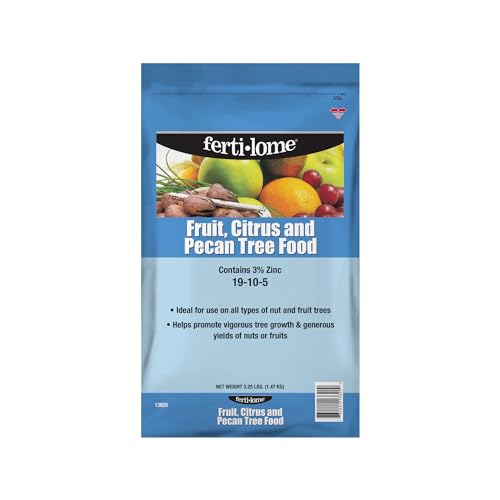
A powerful, time-tested nitrogen boost for trees that need a serious push in leaf production.
If your citrus tree looks pale and spindly, a high-nitrogen formula like this can green it up fast. The Fertilome mix has a 19-10-5 ratio, which means it delivers a strong dose of nitrogen to fuel vigorous leafy growth. It is also formulated with zinc to help control rosette in pecan trees, making it a specialized option for growers who manage nut trees alongside their citrus. Owners mention that one person “Have used this product for more than 20 years” on peach and cherry trees, calling it consistent.
This is a concentrated granular that you should apply twice a year for best results. The catch is that at 52 ounces (compared to the 64-ounce GARDENWISE bag), you get a smaller physical volume even though the nutrient concentration is much higher. You need to be careful with the dose—because the nitrogen number is so high, applying too much can burn roots or push excessive leafy growth at the expense of fruit. One buyer mentioned the “High cost for the amount” and uncertainty about results.
For established, in-ground citrus trees that are already producing but need a reliable annual feeding program, this is a proven choice. However, for beginners or those with potted trees, the lower-nitrogen options are safer and easier to manage.
What the long-time users say
- Customers praise its consistent results over “more than 20 years” of use
- Designed to feed fruit, citrus, and nut (pecan) trees with a single product
- Includes zinc specifically to address rosette disease in pecan trees
Where you need to be careful
- High nitrogen content demands precise dosing—overuse can burn trees
- Smaller bag (52 oz) compared to some same-price competitors
- Some buyers find the cost per application relatively high
Best for experienced growers: A powerful, targeted nitrogen source for established trees that need a proven annual feeding regimen.
skip it if: You are growing in pots or are new to fertilizing—the high NPK numbers leave little room for error.
3. Espoma Organic Citrus-Tone 5-2-6 Natural & Organic Fertilizer (4 lb)

An all-organic, no-mix formula that feeds your soil life as much as it feeds your citrus tree.
Espoma is a trusted name in organic gardening since 1929, and the Citrus-Tone 5-2-6 reflects that heritage. The NPK ratio is lower than synthetic fertilizers, which is typical for organics—the nutrients come from natural ingredients like bone meal and feather meal and are released more slowly as soil microbes break them down. It also includes 5% calcium, which helps strengthen cell walls in the tree and improves fruit firmness. The 64-ounce bag covers a good area.
One owner reported it is “Great for not just citrus..I used it on strawberries and raspberries too.. good results.” This is a common pattern: organic fertilizers tend to improve overall soil health, so they benefit a wider range of plants. However, the natural ingredients give it a strong earthy, manure-like smell. Reviewers consistently warn that the odor can be quite intense for the first week. One owner wrote “Very smelly. Definitely use outdoors only,” noting that their dog was attracted to the scent. The smell fades after a week or so.
If you prioritize organic gardening methods and want a product that is safe for kids, pets, and the environment, Citrus-Tone is an excellent choice. Just plan to apply it outdoors (which you should be doing anyway) and give the scent a few days to settle into the soil.
Soil-first approach: Great for building long-term soil health across a whole garden, not just citrus trees.
The honest trade-off: Strong smell for about one week post-application is a common complaint—best for outdoor use only.
Pick this if: Organic gardening is your priority and you are okay with a natural earthy smell that fades after a week.
Look elsewhere if: The odor would bother you or you have dogs that might dig—the scent attracts some pets.
4. Citrus Fertilizer – Liquid Plant Food for Better Flowering, More Fruit (32oz)
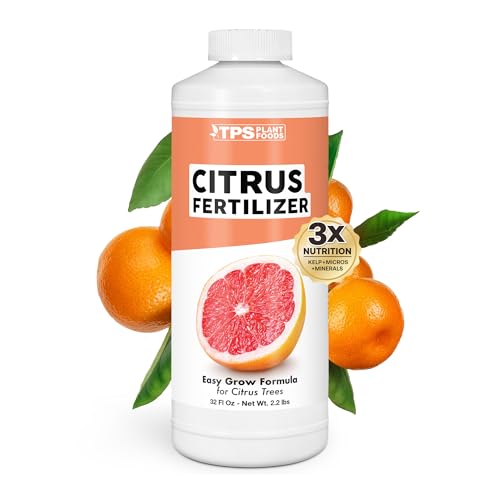
A concentrated liquid that your trees absorb almost immediately, perfect for a quick growth spurt or fixing deficiencies.
If you see yellowing leaves and want to correct it fast, liquid fertilizer is the way to go. This TPS Nutrients formula comes as a concentrated liquid that you dilute by mixing 2 tablespoons per gallon of water. Reviewers confirm the “Liquid formula, easy to mix with water,” and note noticeably “improved leaf greenness and fruit production” on their lemon and orange trees. The 32-ounce bottle makes roughly 32 gallons of ready-to-use feed, so it stretches further than you might think.
The bottle includes micronutrients like magnesium, calcium, and iron, which are essential for preventing common citrus deficiencies. However, a detailed customer review pointed out that the formula “Contains all of the nutrients required by citrus trees, but is lacking in nitrogen.” For optimal growth, you may need to supplement with a high-nitrogen product, especially if your tree is in a pot where nitrogen depletes quickly. Compared to the granular GARDENWISE option, this liquid delivers results in days, but you will need to apply it more frequently to maintain those results.
For potted citrus trees on a patio or indoors, this is an easy, mess-free way to feed. One customer observed, “Nice to not have to mix anything up. Just add to watering can.” Keep in mind that you are paying for convenience—a single bottle costs more per feeding event than a bag of granules.
Convenient plus
- Fast-acting liquid gets nutrients to roots within days, not weeks
- Easy to mix with no dust or odor—ideal for indoor and patio use
- Includes magnesium, calcium, and iron for deep green leaves
What to watch for
- Low on nitrogen; reviewers suggest you may need a supplemental nitrogen source
- More costly per application than granular fertilizers
- Requires more frequent application (every 1-2 weeks) vs slow-release granules
Best for potted trees: A quick, convenient boost for patio or indoor citrus that you can add directly to your watering can.
Consider another if: You want a low-maintenance feeding program for in-ground trees—this needs your regular attention.
5. Jobe’s Organics Fruit & Citrus Tree Fertilizer Spikes, 3-5-5 Time Release (6 Spikes)

Pre-measured spikes that you push into the soil for the easiest, mess-free feeding routine possible.
For anyone who wants to fertilize with zero measuring, zero mixing, and zero guesswork, these Jobe’s spikes are the solution. Each spike has a 3-5-5 NPK ratio, lower in nitrogen than many other options here, which leans the formula toward supporting root development and fruit production rather than just leaf growth. The product is OMRI listed for organic gardening, meaning it is made without synthetic chemicals, and it includes Jobe’s Biozome—a proprietary mix of microorganisms, including archaea, that help break down the spike’s material for faster nutrient delivery to the roots.
One buyer shared that they get “an abundance of juicy, sweet lemons every year” from their potted Meyer lemon trees using these spikes. Another reviewer noted that following the package directions for timing (late Fall/early Spring) and placement (away from the trunk) made the difference between subpar results and noticeable growth improvement. Compared to the FoxFarm granular option below, which feeds the soil microbes with a diverse blend, the Jobe’s spikes are a more targeted, less versatile product—you cannot adjust the dosage per tree size.
The main trade-off is control. With a bag of granules, you can feed a small tree half a cup and a large tree two cups. With spikes, you are stuck with a pre-set dose per spike, and the package comes with only six spikes total. If you have a single small tree, one package may last multiple seasons, but for a full grove, you will need to buy several packs.
Simplest feeding method: Push it in, water, and forget about it—spikes eliminate mess and measurement entirely.
The inflexibility issue: Pre-measured doses mean you cannot tailor the amount to your specific tree size or soil conditions.
Perfect for casual gardeners: Anyone who wants a low-fuss, organic feeding routine with no measuring cups or mixing.
Not for large groves: If you have many trees or need precise nutrient control, a granular or liquid option will serve you better.
6. FoxFarm Happy Frog Citrus and Avocado Fertilizer – OMRI Listed (4 lb)

A soil-microbe-powered blend that encourages strong root partnerships for better nutrient uptake.
FoxFarm’s Happy Frog line is legendary among gardeners, and this citrus and avocado formula lives up to the reputation. It has a 7-3-3 NPK ratio with slow-release nitrogen that fuels vegetative growth, plus it includes mycorrhizal fungi—these beneficial fungi attach to the tree’s roots and effectively increase the root system’s reach, helping the tree absorb more water and nutrients from the soil.
A customer who was struggling with yellow leaves on their citrus trees reported that after using this product, “yellowing vanished and new growth appeared within days.” They noted their lime yield was the highest ever. However, the same reviewer pointed out that the product may need more frequent application during the peak growing season; leaves yellowed again after just one feeding. Like the Espoma product, this has a noticeable smell—reviewers compare it to horse feed or alfalfa meal, which is one of its primary ingredients.
The 4-pound bag is a decent size, but the price per pound is on the higher end compared to some entry-level granular options. If you already use FoxFarm products in your garden and appreciate a soil-biology-first approach, this is a logical choice. For value-seekers, the GARDENWISE bag gives more volume for a similar price.
Why gardeners love it
- Includes beneficial mycorrhizal fungi for stronger root systems
- OMRI listed for organic gardening with slow-release nitrogen
- Users with multiple citrus trees recommend it as a long-term staple
Keep in mind
- May need reapplication more often than other slow-release granules
- Strong natural smell that attracts some dogs
- Smaller bag size for the price compared to some alternatives
Best for soil health believers: If you want to feed your soil biology as part of your citrus care routine, this is the right pick.
Consider a different choice if: You are on a budget or want the most volume for your dollar—this bag is compact for its price tier.
7. Nelson – Citrus Fruit & Avocado Tree Plant Food, NutriStar 12-10-10 (2 lb)
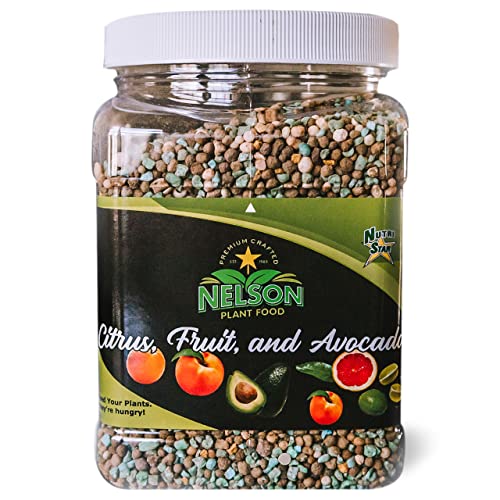
A balanced synthetic formula with a notable potassium boost for fruit quality and cold resistance.
Nelson Plant Food’s NutriStar 12-10-10 is designed with a higher potassium level than most citrus fertilizers on the market. Potassium (the third number in the NPK ratio) is the nutrient that directly influences fruit size, flavor, and the tree’s ability to withstand colder temperatures. The formula also includes calcium, which the manufacturer says increases the size and strength of limbs and trunks. This makes the Nelson a good pick if you live in a region where late frosts are a risk for your citrus.
One reviewer saw their orange tree “take off and grown a full batch of new leaves” within two months of starting this fertilizer. The product works with the soil’s biology to time nutrient release, providing a boost right after application followed by longer-lasting feeding. However, the 2-pound bag is small compared to the GARDENWISE or Fertilome options. The high nitrogen content (12%) also means you need to be careful with the dose on smaller or younger trees to avoid burning.
For an entry-level synthetic fertilizer, this is a solid choice that covers all the major bases. The manufacturer recommends applying it every 30 days during the growing season, so you will need to stay on schedule. If you compare its price to the 64-ounce Espoma bag, the per-feeding cost is lower for the Nelson, but you will need to apply it more frequently throughout the season.
Fruit-focused formula: The higher potassium content is specifically there to boost fruit size, sweetness, and winter hardiness.
Size vs price check: At only 2 pounds, this bag is smaller than it looks—you may need multiple bags for a full season of feeding.
Choose this if: You want a straightforward synthetic feed with a strong emphasis on fruit production and cold-weather resilience.
Consider another if: You prefer a larger bag for the money or want a no-fuss organic product that feeds less frequently.
Understanding the Specs
NPK Ratio: The Three Essential Numbers
Every fertilizer bag shows three numbers separated by dashes, like 6-4-6 or 19-10-5. These stand for nitrogen (N), phosphorus (P), and potassium (K). Nitrogen pushes leaf growth and gives trees that deep green color. Phosphorus supports root development and flower formation. Potassium is the fruit-maker—it drives fruit size, sweetness, and overall quality. For citrus, look for a ratio where nitrogen and potassium are roughly balanced, and phosphorus is slightly lower. High-nitrogen formulas like 19-10-5 are for green-up but need careful dosing to avoid burning.
Micronutrients: The Hidden Helpers
Beyond the big three NPK numbers, citrus trees need small amounts of micronutrients to thrive. Magnesium (Mg) helps the tree produce chlorophyll for that rich green leaf color. Iron (Fe) prevents yellowing between the veins on young leaves. Zinc (Zn) supports growth regulation and fruit set. Boron (B) is critical for flower development and fruit formation. A fertilizer that lists these on the label, like the GARDENWISE formula, reduces the chance of deficiency spots that make your tree look sickly.
FAQ
When is the best time to fertilize my citrus trees?
Can I use a regular all-purpose fertilizer on my citrus trees?
How often should I apply granular fertilizer vs liquid?
What does OMRI listed mean on a fertilizer label?
Is it safe to fertilize potted citrus trees the same way as in-ground trees?
Why do my citrus tree leaves look yellow even after I fertilize?
What is the difference between time-release spikes and slow-release granules?
Can I use a citrus fertilizer on avocado trees and other fruit trees?
Final Thoughts: The Verdict
The best citrus fertilizer for most people is the GARDENWISE Professional Citrus Fertilizer because it packs a balanced 6-4-6 NPK ratio plus a full suite of micronutrients in an easy slow-release granule that suits both in-ground and potted trees. If no-measure simplicity matters more, grab the Jobe’s Organics Fruit & Citrus Tree Fertilizer Spikes with their pre-dosed, push-and-forget design. And for fast liquid feeding on potted patio trees, the TPS Nutrients Liquid Citrus Fertilizer gives you results in days from a 32-ounce bottle that makes 32 gallons of feed.
How We Picked
We do not accept paid placement, and we did not hands-on test every unit. Instead, we match each pick to a real buyer and use-case by comparing the manufacturers’ published specifications against the patterns in verified customer reviews — so you get each pick’s real strengths and trade-offs instead of marketing copy.
Sources & Methodology
Specifications: manufacturer listings and product documentation. Review insights: verified customer reviews, as of July 2026. Pricing: not shown on this page (it changes often); check the current price via the retailer link.
As an Amazon Associate, Lawn Gear Lab earns from qualifying purchases. This does not affect which products we feature.