
Nothing is more frustrating for a hydrangea enthusiast than watching vibrant leaves fade to a sickly yellow while blooms lose their rich, intended color. That yellowing is chlorosis—a sign your hydrangea can’t access the iron it needs, often because your soil’s pH is locking that mineral away. The right chelated iron supplement bypasses that soil chemistry problem, delivering iron directly to the plant for fast, visible recovery.
I’m Rikta — the co-founder and writer behind Lawn Gear Lab. I’ve spent countless hours digging into soil chemistry data, comparing chelation formulas, and analyzing hundreds of verified owner reports to nail down which iron products actually reverse chlorosis in hydrangeas and which ones fall short.
This guide breaks down the top options for giving your hydrangeas deep green foliage and vivid blooms by targeting the exact iron deficiency at the root of the problem. Whether you’re fixing an existing issue or setting up a seasonal regimen, these are the best chelated iron for hydrangeas choices available right now.
How To Choose The Best Chelated Iron For Hydrangeas
Not all iron supplements are created equal, and hydrangeas have very specific needs that set them apart from other garden plants. Picking the wrong formula can waste your season or, worse, burn your shrubs. Here’s what to look for.
Chelation Type: EDTA vs. DTPA vs. EDDHA
The chelating agent determines how stable the iron remains in your specific soil pH. For hydrangeas in moderately alkaline soil (pH 7.0–8.0), EDDHA chelated iron resists precipitation far better than EDTA, keeping iron plant-available longer. DTPA works in slightly acidic to neutral soils but breaks down above pH 7.5. Check the label for the chelate type, not just “chelated iron.”
Iron Concentration and Form
Liquid formulas provide the fastest green-up, often showing results in 3–5 days via foliar spray or soil drench. Granular iron requires soil moisture and microbial activity to break down, which can take two weeks or more. A product like Monterey Dr. Iron delivers 22% iron in uniform granules that don’t stain hardscapes. For targeted, rapid chlorosis correction, a water-soluble or liquid chelate is the superior choice.
Secondary Nutrients for Hydrangeas
Hydrangeas also need sulfur, magnesium, and often aluminum sulfate to set blue blooms. A combined product like Fertilome Soil Acidifier Plus Iron or Grow More Hydrangea Blueing Formula addresses both the iron deficiency and the pH conditions that cause it. Pure iron supplements work well if your pH is already correct; otherwise, you need a multi-action soil acidifier.
Application Safety and Compatibility
Over-application of iron can stain concrete, patios, and even leaf surfaces if not watered in properly. Non-staining formulas like Monterey Dr. Iron are safer around hardscapes. For potted hydrangeas, liquid concentrates offer precise control—just dilute and drench. Always confirm that the product is labeled safe for hydrangeas and won’t burn roots when applied at the recommended rate.
Quick Comparison
On smaller screens, swipe sideways to see the full table.
| Model | Category | Best For | Key Spec | Amazon |
|---|---|---|---|---|
| Miracle-Gro Water Soluble Azalea Food | Water-Soluble | General acid-loving plant feeding | NPK 30-10-10 | Amazon |
| Liquinox Iron Zinc Chelated Solution | Liquid Chelate | Foliar chlorosis correction | 0.2% Fe + 0.2% Zn | Amazon |
| Ferti-lome Soil Acidifier Plus Iron | Liquid Acidifier | Lowering pH + iron delivery | Contains S, Zn, Mg, Cu | Amazon |
| Monterey Dr. Iron 22% Iron | Granular Supplement | Non-staining lawn & garden greening | 22% Fe, 55% Sulfur | Amazon |
| Espoma Organic Holly-tone 4-3-4 | Organic Granular | Long-term soil health for acid gardens | 36 lb bag, Bio-tone | Amazon |
| Ferti-lome Chelated Liquid Iron | Liquid Chelate | Economical broad-spectrum green-up | 1 gal concentrate | Amazon |
| Grow More Hydrangea Blueing Formula | Powder Acidifier | Turning pink hydrangeas blue | Aluminum sulfate base | Amazon |
In‑Depth Reviews
1. Miracle-Gro Water Soluble Azalea, Camellia, Rhododendron Plant Food

This water-soluble powder delivers a balanced 30-10-10 NPK ratio designed specifically for acid-loving plants. With a mixing ratio of 1 tablespoon per gallon for outdoor use, it provides rapid nitrogen-driven green-up alongside the micronutrient profile hydrangeas need. The 5-pound bag covers a large area, and the resealable closure—though imperfect—keeps the powder dry between uses. Users report visible greening within one week and improved bloom production on azaleas and rhododendrons after two applications.
What makes this a strong general option is its versatility: it feeds everything from potted indoor hydrangeas to full garden beds of hollies and camellias. The formula won’t burn foliage when used at the recommended rate, and it dissolves completely in water without clogging sprayers. For the gardener who wants a single solution for multiple acid-loving species across an entire landscape, this is the most practical choice.
The main limitation is its nitrogen-heavy profile—while excellent for foliage growth, it doesn’t directly address iron chlorosis caused by high soil pH. If your hydrangeas are already yellowing from alkaline soil, you’ll need a separate chelated iron supplement or a soil acidifier to tackle the root cause. This product is best used as a maintenance feed for already-healthy plants.
What works
- Fast visible green-up within 7 days
- Versatile for many acid-loving species
- Resealable bag extends shelf life
What doesn’t
- High nitrogen may not suit iron-deficient soil without pH fix
- Resealable Velcro closure can fail with powder residue
- Not formulated for direct chlorosis correction
2. Liquinox 3032 Iron Zinc Chelated Solution

This fully chelated liquid blend combines 0.2% iron with 0.2% zinc, targeting the two most common micronutrient deficiencies that cause leaf chlorosis. The liquid form allows both soil drench and foliar spray application, giving you flexibility depending on the severity of the deficiency. Foliar spraying delivers iron directly into leaf tissue within hours, bypassing soil pH problems entirely. Users with jasmine vines and roses reported yellowing leaves turning green and prolific flowering within a week of application.
The 32-ounce bottle provides multiple treatments for a moderate-sized garden. For hydrangeas with active chlorosis, a foliar spray at 2 tablespoons per gallon shows results faster than any granular product. The zinc component is a bonus for plants in zinc-deficient soils, which often show stunted new growth alongside interveinal chlorosis. This is a targeted corrective product, not a general maintenance fertilizer.
The iron concentration is relatively low compared to specialist iron-only products. For severe or widespread chlorosis, you may need multiple applications or a higher-concentration alternative. The liquid must be shaken well before each use, as the chelates can settle over time. This product works best as a rapid intervention for a handful of affected plants rather than for whole-lawn or large bed treatments.
What works
- Fast foliar absorption corrects chlorosis in days
- Dual iron and zinc formulation covers two deficiencies
- Versatile for soil drench or spray application
What doesn’t
- Low iron concentration needs repeat applications
- Settles in bottle; requires shaking before use
- Best for spot treatment, not large-scale coverage
3. Fertilome (10665) Soil Acidifier Plus Iron
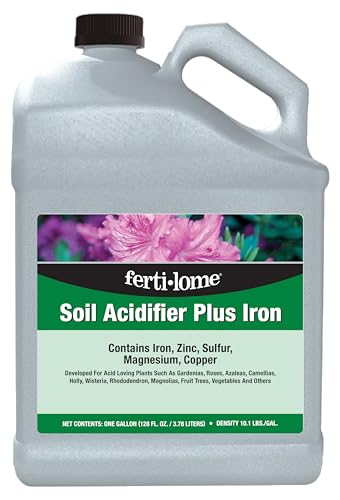
This liquid concentrate addresses the root cause of hydrangea chlorosis: alkaline soil that locks iron away. By supplying sulfur, zinc, magnesium, and copper alongside chelated iron, it simultaneously lowers soil pH and delivers the micronutrients that become unavailable in high-pH conditions. The recommended dilution of 2 tablespoons per gallon of water makes a 1-gallon bottle stretch far—sufficient for multiple seasons of spot treating individual shrubs or beds.
Customer reports from hydrangea and blueberry growers confirm that two applications corrected yellowing leaves and triggered deeper green foliage and more abundant blooms. The fast-acting liquid penetrates the root zone more quickly than granular soil acidifiers like elemental sulfur, which require microbial breakdown over weeks. For potted hydrangeas where pH drifts quickly due to tap water alkalinity, this is a precise tool for bringing the root environment back into the optimal 5.5–6.5 range.
The product’s efficiency comes with a warning: it can lower pH too aggressively in containers if over-applied. Users advise starting with half the recommended dose in pots and monitoring pH weekly. The 1.5-pound bottle is lightweight but the gallon volume means it takes up storage space. This is a dual-action product best suited for gardeners who need both pH correction and immediate iron availability.
What works
- Simultaneously lowers pH and delivers iron
- Fast-acting liquid absorbs quicker than granules
- Contains multiple trace elements for comprehensive correction
What doesn’t
- Can drop pH too fast in containers if overused
- Bottle size heavy for its volume relative to concentrate strength
- Requires pH monitoring to avoid overshooting
4. Monterey Dr. Iron 22% Iron Supplement
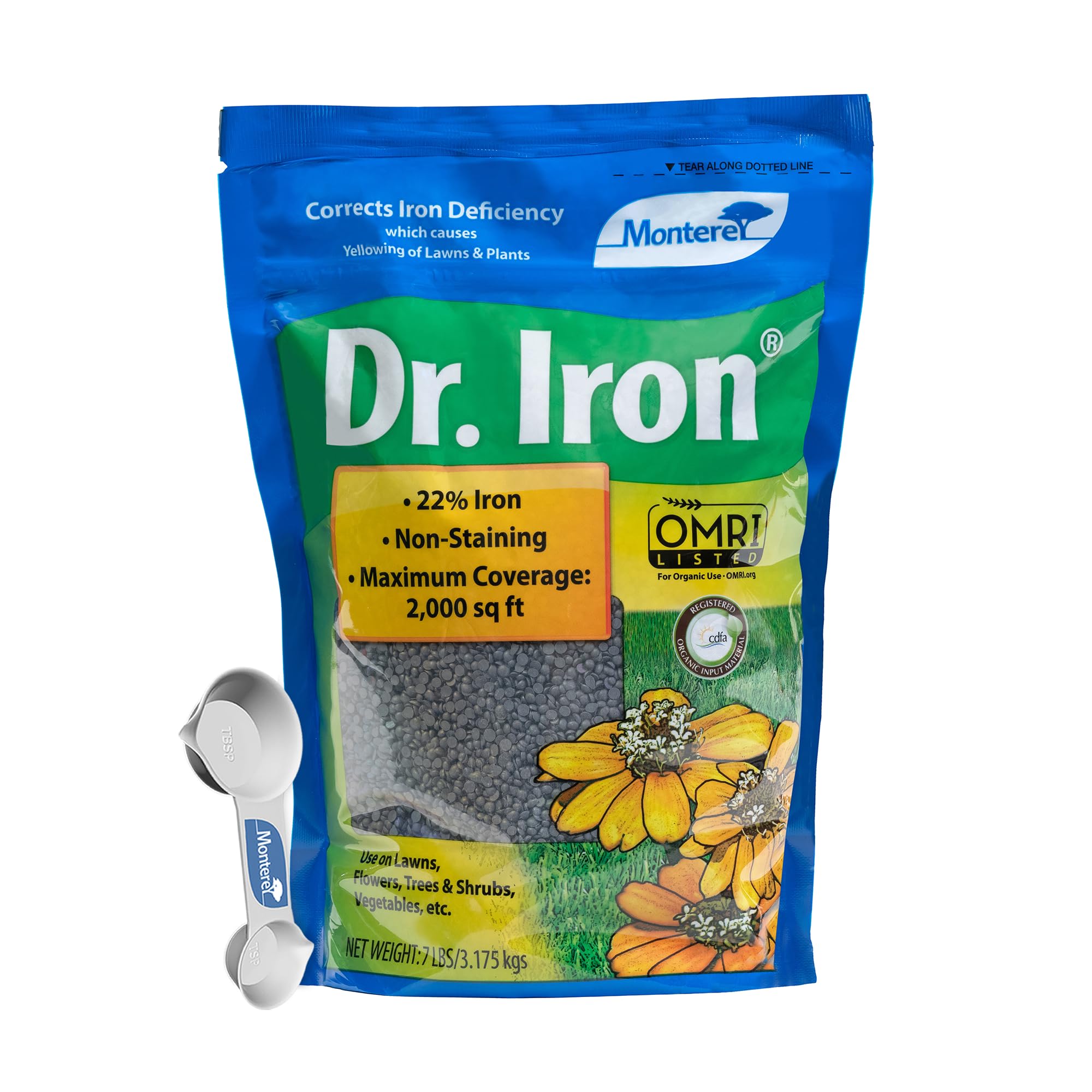
Monterey Dr. Iron brings a heavy 22% iron content alongside 55% sulfur in a uniform granular form that spreads evenly through a rotary spreader. The 7-pound bag treats up to 2,000 square feet, making it a strong option for large hydrangea beds or foundation plantings. Its key differentiator is the non-staining formula—unlike many iron products that leave orange residue on concrete and patios, this one rinses clean. The OMRI listing for organic gardening adds appeal for growers following organic practices.
User feedback highlights its effectiveness on sandy, iron-leached soils common in Florida and coastal regions. The slow-release granular form provides season-long iron availability with up to four applications per year. The particle size is uniform enough to avoid dust inhalation during application, and it causes no foliar burn even in full sun when watered in promptly. For acid-loving shrubs like hydrangeas, the sulfur component also helps gradually lower soil pH over repeated applications.
Granular iron requires consistent soil moisture to dissolve and become plant-available. In dry conditions or during drought, the granules sit on the surface without releasing iron. It also takes longer to show results compared to liquid chelates—expect 10–14 days for visible green-up. For a gardener who wants low-effort, long-lasting iron supplementation without staining risks, this is a premium granular choice.
What works
- Non-staining formula safe for hardscapes
- Uniform granules spread evenly with rotary spreader
- High iron content lasts multiple seasons per bag
What doesn’t
- Granular form shows slower results than liquid
- Needs consistent moisture to activate
- Not ideal for spot-treating individual plants
5. Espoma Organic Holly-tone 4-3-4

Holly-tone is the original organic fertilizer for acid-loving plants, and its 36-pound bag provides exceptional value for gardeners with extensive hydrangea beds. The 4-3-4 NPK analysis is low and slow, feeding soil microbes rather than forcing rapid foliage growth. The Bio-tone formula includes beneficial microbes and mycorrhizae that enhance nutrient uptake over the entire growing season. Feeder roots access the organics as they break down, creating a sustained reservoir of nutrition rather than a quick synthetic hit.
Users report explosion of blooms on azaleas and hydrangeas, as well as improved vigor on evergreens and magnolias. The 5% sulfur content helps maintain acidic soil conditions over time. Spring and fall application cycles match the natural growth rhythm of hydrangeas, supporting both foliage development and flower bud set. The granular form requires no mixing—just spread around the drip line and water in.
Holly-tone’s iron content is not listed as a specific percentage, and it is not a fast chlorosis corrector. If your hydrangeas are already yellowing from acute iron deficiency, this product will work too slowly on its own. It is best used as a foundational soil amendment for ongoing health, with a separate chelated liquid iron product kept on hand for spot treatments when yellowing appears. The bag is large and heavy, which can be a storage challenge.
What works
- Exceptional long-term soil health and bio-activity
- Huge bag covers large gardens affordably
- Organic and OMRI-compliant for organic growers
What doesn’t
- Too slow for acute chlorosis correction
- Iron content not disclosed for targeted deficiency
- Heavy bag requires storage space
6. Fertilome Chelated Liquid Iron, 1 Gallon

This gallon jug of chelated liquid iron offers the most cost-effective way to cover large areas with a micronutrient green-up. The concentrate mixes at 1 tablespoon per gallon of water, so a single gallon of concentrate can produce 256 gallons of spray solution—enough for multiple applications across an acre of lawn or dozens of hydrangea shrubs. Users in the South report dramatic greening of St. Augustine grass and Bermuda lawns within 2 days of application, with no burning even at quarter-strength rates in full sun.
For hydrangeas specifically, the liquid form allows both soil drench and foliar application. The chelated formula resists oxidation in the tank, so you can mix and store the solution for a few days without losing efficacy. The lack of nitrogen means this product greens leaves without triggering excessive vegetative growth, which is ideal for hydrangeas where you want blooms to remain the focus. It is a pure iron supplement, not a multi-nutrient feed.
The label lists “shade” as a specific use, which is misleading—this works fine in full sun. The brand is less well-known than Southern AG or Monterey, which may concern buyers looking for a trusted name. The bottle lacks a measuring cap, so you need a separate tablespoon or measuring device. For pure, budget-friendly iron delivery at scale, this is a top contender.
What works
- Extremely cost-effective per gallon of spray solution
- Fast foliar green-up in 2–3 days
- Nitrogen-free, safe for bloom-focused feeding
What doesn’t
- Less-known brand compared to top competitors
- No measuring cap included
- Label specificity can be confusing
7. Grow More Hydrangea Blueing Formula
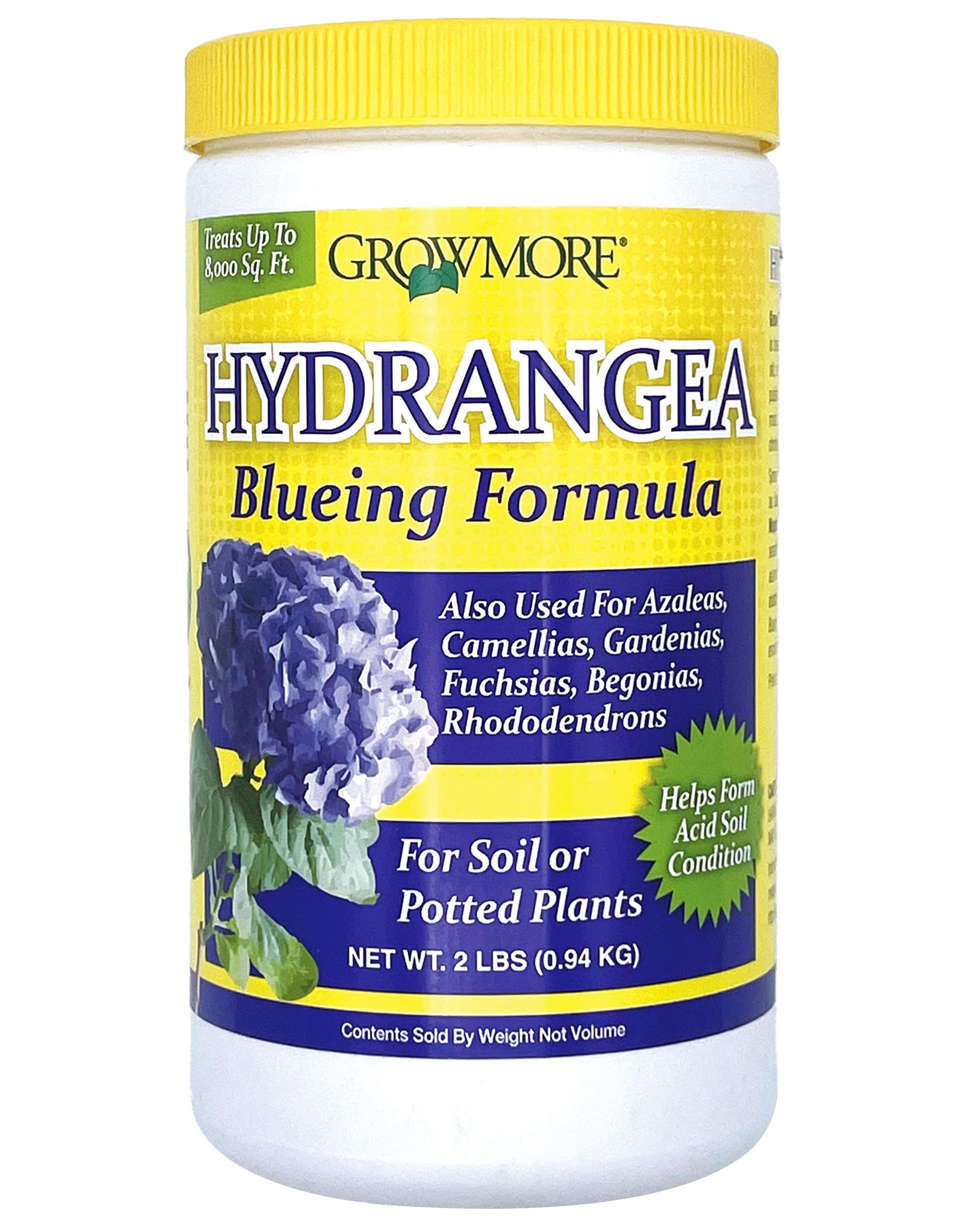
This powder is formulated specifically to shift hydrangea bloom color from pink to blue by supplying aluminum sulfate, which acidifies the root zone and makes aluminum available for pigment expression. It is not primarily an iron supplement, but the soil acidification it triggers unlocks existing iron in the soil while lowering pH to the 5.2–5.5 range ideal for blue blooms. Users in the Pacific Northwest and other regions with slightly basic soil report successful color transitions after multiple spring applications.
The 2-pound jar provides multiple seasons of treatment for a single large hydrangea plant. Application is simple: sprinkle around the drip line and water in. The effect is visible after several weeks as new flower heads open with blue or purple tones. For gardeners specifically chasing blue hydrangeas rather than overall plant health, this product is more targeted than a general iron supplement. The American-made packaging reinforces quality control.
Aluminum sulfate can be toxic to hydrangeas if over-applied, especially in pots where the chemical concentrates. It does not provide direct available iron—if your hydrangeas also have chlorosis symptoms, you’ll need to pair this with a chelated iron product. Some users reported that their plants failed to bloom after using this, which may indicate over-application or use during active drought stress. This is a niche tool for color manipulation, not a general health supplement.
What works
- Effectively shifts pink blooms to blue/purple
- Single jar lasts multiple seasons
- Simple granular application
What doesn’t
- No direct iron; doesn’t fix chlorosis alone
- Can suppress blooming if over-applied
- Not suitable for potted plants without careful dosing
Hardware & Specs Guide
Iron Source and Chelation
The form of iron dictates how quickly and effectively your hydrangeas can access it. Inorganic iron sulfate (FeSO₄) is cheap but becomes unavailable in alkaline soil above pH 7.0. Chelated iron uses an organic molecule to shield the iron ion, keeping it soluble and plant-available across a wider pH range. EDDHA chelates work in soil up to pH 9.0, while EDTA chelates break down above pH 6.5. Always look for “chelated” on the label and identify the specific chelating agent for your soil conditions. Liquid chelates provide the fastest correction; granular chelates release more slowly but last longer.
Soil pH and Hydrangea Bloom Color
Hydrangea bloom color is directly tied to soil pH and aluminum availability. At pH below 5.5, aluminum becomes soluble and is absorbed by roots, producing blue sepals. At pH above 6.5, aluminum is locked in the soil and pink blooms result. The iron chelate you choose should align with your target pH: blue-seeking growers need an acidifier like Fertilome Soil Acidifier Plus Iron, while growers happy with pink blooms may only need a straight iron chelate. Regular soil testing prevents the guesswork—a simple pH meter or test kit tells you if your iron supply will even work.
FAQ
How quickly will chelated iron green up my hydrangeas?
Can I use chelated iron on hydrangeas that are already blue?
What is the difference between chelated iron and iron sulfate for hydrangeas?
Final Thoughts: The Verdict
For most gardeners, the chelated iron for hydrangeas winner is the Fertilome Soil Acidifier Plus Iron because it tackles the two most common root causes of chlorosis simultaneously—low iron availability and high soil pH. If you want a fast foliar response for a few affected plants, grab the Liquinox Iron Zinc Chelated Solution. And for non-staining, slow-release granular coverage of large hydrangea beds, nothing beats the Monterey Dr. Iron 22% Iron Supplement.