
A mature Monstera deliciosa with split leaves and fenestrations is a living sculpture — until its weight pulls the whole plant sideways out of the pot. The difference between a sprawling mess and an upright centerpiece comes down to the support system you choose. A cheese plant moss pole does more than prop up a stem; it mimics the tree trunks these epiphytes cling to in the wild, encouraging aerial roots to dig in and produce the giant, fenestrated foliage collectors chase.
I’m Rikta — the co-founder and writer behind Lawn Gear Lab. For this guide, I compared over a dozen current models across three critical metrics: material durability, moisture retention, and how effectively the design lets a Monstera’s aerial roots actually anchor and climb.
Whether you are training a young cutting or supporting a five-foot specimen that already lurches to one side, the solution is a properly selected cheese plant moss pole sized for the task.
How To Choose The Best Cheese Plant Moss Pole
A Monstera isn’t a philodendron that politely trails. It sends out thick, woody aerial roots that want to dig into a rough, moist surface. The wrong pole — one that is slick, too thin, or made of material that dries out in hours — will leave those roots dangling uselessly and the plant flopping. Focus on these three factors to avoid buying a stake that looks good on arrival but fails in month three.
Material Matters: Coir vs. Metal Mesh vs. Plastic
Coco coir poles are the most common entry-level option. They are cheap, lightweight, and the fibrous texture gives roots something to grab. The problem is that dry coir becomes hydrophobic water runs right off and the pole turns into a brittle stick that offers no humidity. Metal mesh poles with a plastic backing (the D-shape design) solve that: you fill the core with sphagnum moss yourself, which holds moisture for days and lets roots burrow inside the pole for real anchorage. Clear plastic poles with cutout slots are a middle ground — they hold moss well and let you see root development, but the smooth plastic surface can slow initial attachment if the pole isn’t kept consistently moist.
Height and Stackability
A single 17-inch pole works for a juvenile plant in a four-inch pot, but a mature Monstera in a ten-inch pot needs at least 36 inches of vertical support. Stackable poles let you add sections as the plant grows without disturbing the root ball, which is crucial because prying a root-bound Monstera off an old pole often damages the stem. If the pole uses a mechanical click-lock or zip-tie connection, check how much wobble exists at the joint — a flimsy connection collapses under the weight of large leaves.
Assembly and Maintenance Realities
Pre-filled and pre-assembled poles are convenient but often packed tight with low-quality coir that compacts and sheds over time. DIY kits that ship as a flat metal mesh roll plus a plastic backing sheet let you control the moss density and pole diameter. The tradeoff is time: rolling the mesh, securing with zip ties, and stuffing long-fiber sphagnum moss into a narrow tube takes 15 to 20 minutes per pole. For a single Monstera, that is a one-time chore. For five plants, it is an afternoon. Consider also how the pole handles bottom-watering — some designs accept a water bottle inverted into the top cap, others rely solely on surface misting.
Quick Comparison
On smaller screens, swipe sideways to see the full table.
| Model | Category | Best For | Key Spec | Amazon |
|---|---|---|---|---|
| HOLANHING 6-Pack (60/40/24) | Metal Mesh D-Shape | Large Monsteras needing deep root penetration | 60-inch max height, 6 pieces | Amazon |
| ADGYULB DIY Kit (4ft D-Shape) | DIY Metal Mesh | Custom builds for specific pot sizes | 10 ft wire mesh, 4 ft plastic sheet | Amazon |
| Sproot Bendable 2-Pack (48 inch) | Coco Coir + Aluminum Core | Adjustable shaping around stem paths | 48 inch height, bendable core | Amazon |
| Haispring 8-Pack Plastic (17 inch) | Plastic Honeycomb | Multiple small plants, root visibility | 17 inch, 8 pieces, honeycomb pattern | Amazon |
| Bluepro 6-Pack Plastic (15 inch) | Plastic D-Shape | Juvenile plants, clear root monitoring | 15 inch height, semi-cylindrical shape | Amazon |
| HOLANHING 6-Pack Metal (40 inch) | Metal Mesh Tube | Budget-friendly DIY with high capacity | 40 inch height, 6 pieces, vinyl coated | Amazon |
| ALENEY 4-Pack Coir (17 inch) | Coconut Coir Tube | Low-maintenance setup for beginners | 17 inch, stackable to 56 inch | Amazon |
In‑Depth Reviews
1. HOLANHING 6-Pack Metal Moss Pole (60/40/24 inch)

This kit delivers the best structural philosophy for aroid support: a welded metal mesh that forms a rigid D-shape backed by a semi-translucent plastic sheet. The flat mesh face gives aerial roots a 360-degree grid to weave through, while the curved PP backing traps sphagnum moss moisture for days instead of hours. You get two poles at 60 inches, two at 40 inches, and two at 24 inches — enough to handle a single massive Monstera with a stackable tower or equip six smaller plants simultaneously.
Assembly requires unrolling the mesh, attaching the backing sheet with the included zip ties, and stuffing in your own long-fiber sphagnum. The 60-inch sections are particularly rare in pre-made kits and provide the uninterrupted height a mature Monstera needs without a wobbly mid-stem splice. Users report that the vinyl coating on the iron mesh stays corrosion-free even with constant moisture, and the translucent backing lets you check root colonization without pulling the pole apart.
The only friction point is the time investment — each pole takes several minutes to zip-tie closed and fill, and the sheer quantity of zip ties (300 included) means trimming flush is tedious but necessary to avoid sharp nubs. For a grower with multiple aroids, the upfront assembly is a one-hour job that pays off in years of sturdy, re-usable support.
What works
- Full 60-inch poles eliminate the need for mid-plant stacking and the instability that comes with it
- Mesh grid lets aerial roots penetrate the pole for true mechanical anchorage, not just surface clinging
- Semi-translucent backing lets you monitor root growth and internal moisture without disassembly
What doesn’t
- Assembly is manual and time-consuming — expect 10-15 minutes per pole for rolling and zip-tying
- You must supply your own sphagnum moss, adding an extra purchase for first-time builders
2. ADGYULB DIY Kit (4ft D-Shape & 6ft Round)

This is the most complete DIY kit on the market for growers who want total control over pole dimensions. You get a 10-foot roll of vinyl-coated galvanized wire mesh plus a 4-foot D-shaped plastic sheet, along with wire-cutting pliers, non-slip gardening gloves, 100 nylon cable ties, plant tape, and 25 reusable plant clips. The mesh roll alone lets you cut two 5-foot poles or one continuous 10-foot column, which is ideal for a specimen Monstera that has already outgrown standard 48-inch supports.
The difference between this and cheaper flat-mesh rolls is the vinyl coating — raw hardware cloth rusts within months when kept moist; this coating prevents corrosion and has no sharp edges that snag stems or fingers. The included pliers are functional, not disposable, and the claw-shaped plant clips grip the D-shaped backing better than adhesive Velcro strips. Users specifically note that the flat mesh face is wide enough for a mature Monstera’s aerial roots to fully embed, whereas coir poles force roots to wrap around a narrow cylinder.
The tradeoff is that you are building from scratch. Cutting the mesh to length requires measuring and a second person to hold the roll if you want clean 90-degree cuts. The sphagnum moss is not included, and stuffing a tall, narrow D-shape pole requires patience to avoid air pockets. For a single Monstera, the 10-foot mesh is excessive; for three or four plants, it is the most economical way to get professional-grade poles.
What works
- 10-foot continuous mesh lets you build custom heights without splicing weak connections
- Vinyl coating prevents rust and eliminates sharp edges that damage stems and hands
- Full tool kit (pliers, gloves, ties) means no secondary hardware store run
What doesn’t
- Requires measuring, cutting, and stuffing — not a 5-minute setup for impatient growers
- No sphagnum moss included, so the total cost increases if you don’t already own it
3. Sproot Bendable 2-Pack (48 inch)
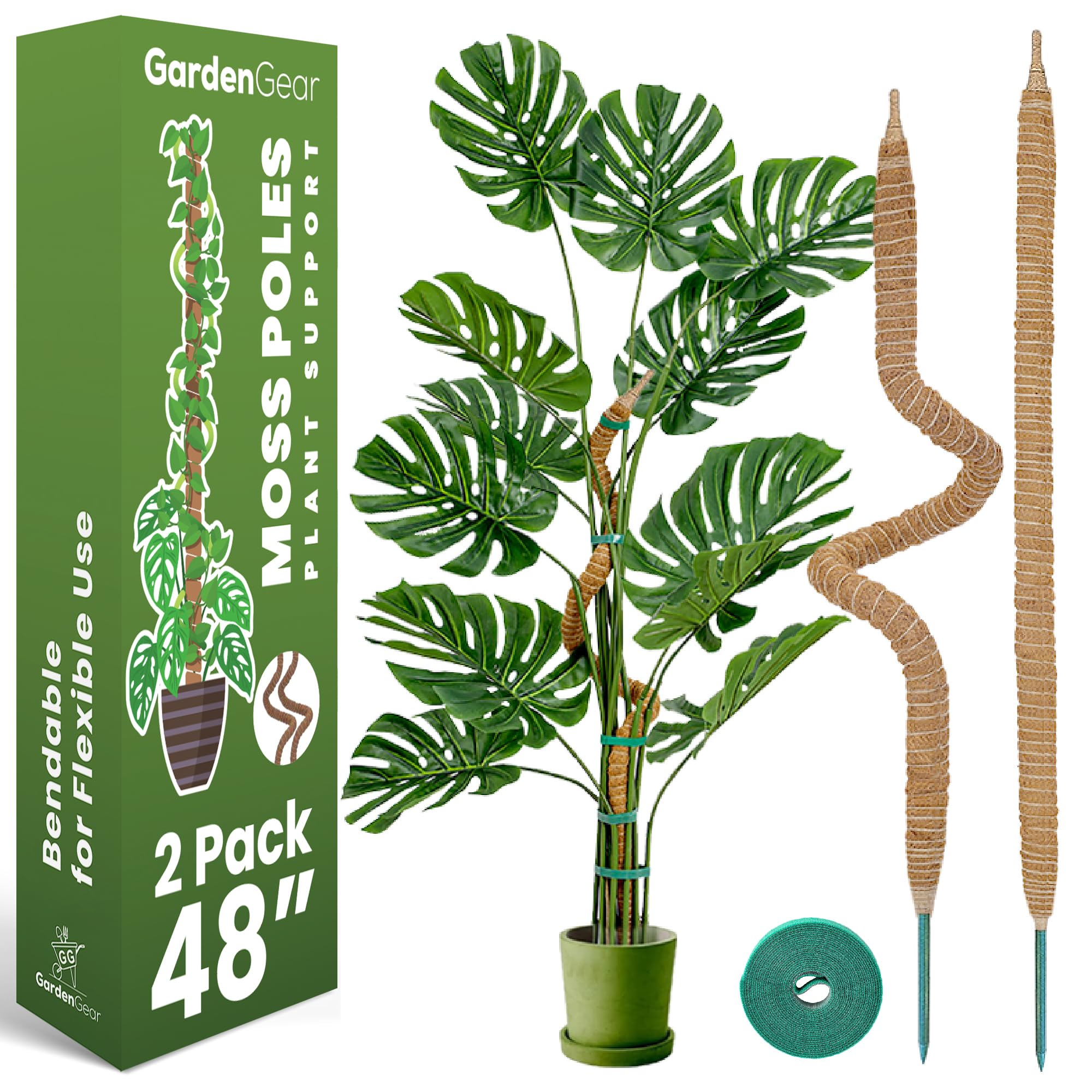
Most pre-made poles are rigid tubes that force you to position the plant around the support. The Sproot pole solves that with a patent-pending aluminum core wrapped in coco coir that bends into any curve without springing back. If your Monstera has a zigzag stem from past neglect or you need to route the pole around a pot’s edge, this adjustability is a genuine time-saver. The 48-inch height is sufficient for a 3-4 foot plant, and the 1-inch diameter is thick enough to resist bowing under the weight of large leaves.
The coco coir wrapping is denser than most budget poles — it sheds less fiber during handling and holds moisture better when misted. Unlike hollow mesh poles, this one is solid all the way through, so there is no stuffing required and no air pockets. The included 10 feet of plant tie tape is wide and fabric-like, reducing stem abrasion compared to thin twist ties. Users consistently report that the bendable core makes installation feel intuitive: push the pole into the soil, bend the top toward the plant’s leaning stem, and attach.
The limitation is that coir is inherently less moisture-retentive than a sphagnum-filled metal mesh pole. If your indoor humidity is below 40%, the coir dries to a crispy shell within a day, and aerial roots will not anchor as aggressively. This pole works best for growers who regularly mist or have a humidifier. It is also 0.55 kilograms per pair — heavier than plastic poles, so a top-heavy Monstera in a lightweight nursery pot may tip.
What works
- Aluminum core bends to match irregular stem paths without snapping or losing shape
- Dense coir wrapping sheds less debris and provides better initial grip for aerial roots than loose-fill alternatives
- 48-inch height supports mature plants without requiring stacking
What doesn’t
- Coco coir dries quickly in low-humidity environments, reducing root-attachment incentive
- Heavier than plastic or hollow mesh — may need a heavy ceramic pot to counterbalance weight
4. Haispring 8-Pack Plastic Moss Pole (17 inch)
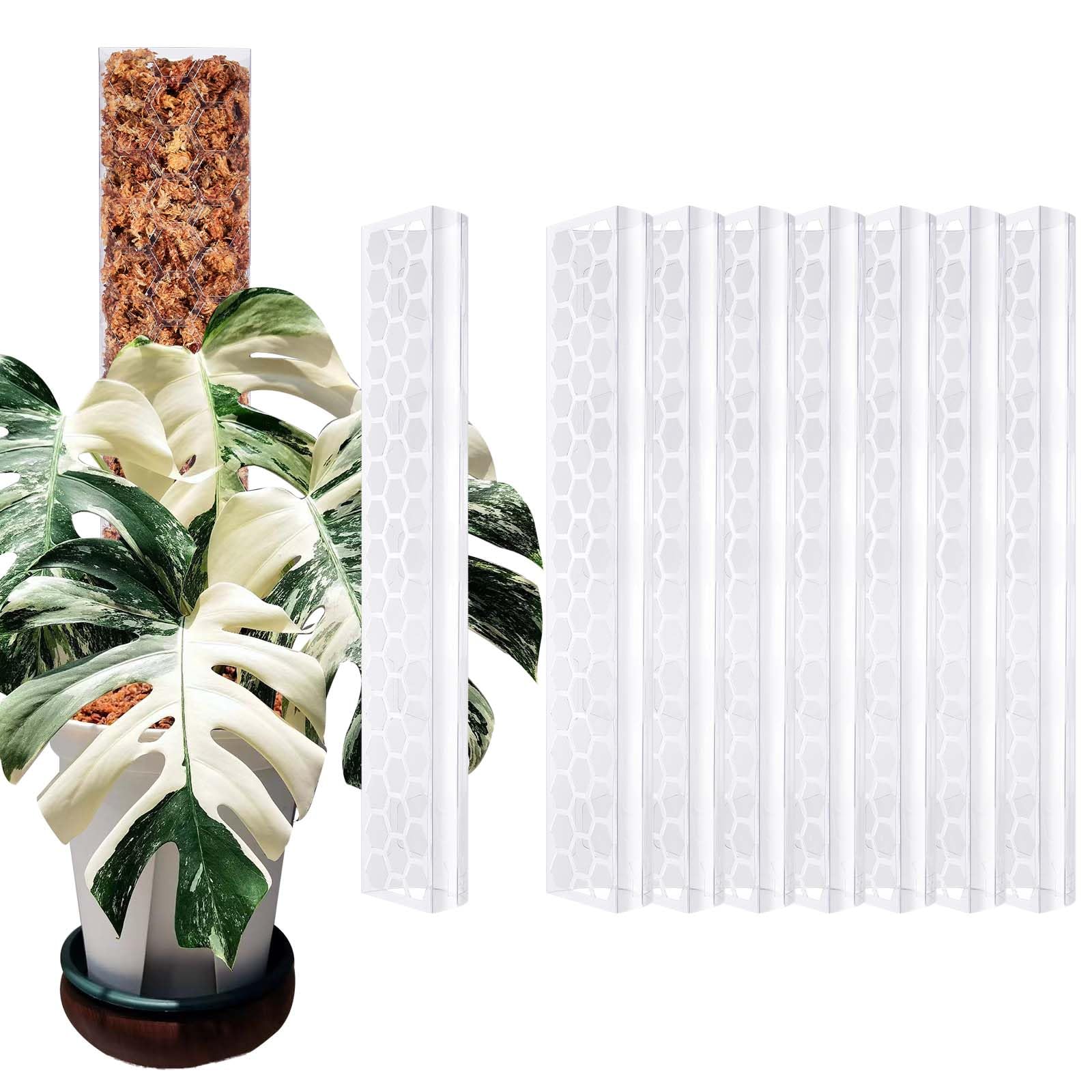
This eight-pack of 17-inch semi-cylindrical plastic poles targets the grower with multiple young aroids who wants consistency across the collection. The honeycomb cutout pattern provides plenty of slots for Monstera aerial roots to insert themselves, and the transparent PP plastic lets you see soil moisture levels and root colonization without pulling the pole. Each piece folds along two pre-scored crease lines to form the D-shape, and they stack via interlocking tabs to extend height as plants mature.
The stand-out feature here is the cost-per-unit — eight poles for the price that other brands charge for two or three. The plastic is thick enough that it does not flex under moderate stem pressure, and users report that stacking two or three sections together creates a surprisingly rigid column. The included sphagnum moss recommendation is accurate: filling the hollow interior with moist long-fiber moss turns the pole into a humidity reservoir that plastic alone cannot provide. When kept misted, aerial roots weave through the hexagonal holes and anchor securely.
The assembly trick is that the folding tabs require precise alignment — if the crease line is slightly off from the factory fold (some units ship with a permanent crease from packaging), the halves do not snap together flush. Several users note that a narrow strip of duct tape along the seam solves the issue permanently. The 17-inch individual height also means a mature Monstera will need three stacked sections to reach 51 inches, and the interlock connection is less rigid than a zip-tie fastening — expect some rotational play if the plant is top-heavy.
What works
- Eight pieces per pack makes this the most economical option for equipping a full plant collection
- Transparent honeycomb design provides full visibility of root development and internal moisture levels
- Thick PP plastic resists rot and holds shape longer than any coir-based pole
What doesn’t
- Tab-lock stacking is less rigid than zip-tie or screw connections — sections can twist under heavy foliage
- Factory crease from shipping can make folding uneven; minor taping may be needed for a flush seam
5. Bluepro 6-Pack Plastic (15 inch)

Bluepro’s 15-inch pole is the slimmed-down version that works well for juvenile Monsteras, rooted cuttings, or any aroid in a 4- to 6-inch pot where a full-size pole looks obtrusive. The semi-cylindrical clear plastic folds along two crease lines (do not roll it into a full cylinder — that mis-assembly is the most common user error) and leaves a flat face with oval cutouts that give aerial roots direct access to the sphagnum moss you pack inside. Six poles per pack means you can support a half-dozen young plants for the price of a fancy coffee run.
The clear material is the real advantage here: you can see exactly how far the roots have colonized the moss column and whether the internal moisture is still adequate. The plastic does not degrade in soil, so these poles outlast coir by years and can be scrubbed clean and reused. Users with 20 or more of these poles report that they stack neatly by overlapping the flat faces and securing with a zip tie, creating a continuous 30-inch or 45-inch pole without the wobble of snap-together tabs. The included green plant tie roll is generous at about 30 feet.
The 15-inch height is inherently limiting — a Monstera that pushes out two or three new leaves per month will outgrow this pole in one growing season. Stacking two units together is possible, but the plastic is not designed with a positive locking system, so the seam can slide if the plant is not also tied at the top. This is a starter pole best used as a bridge to a taller mesh system, not as a permanent home for a mature specimen.
What works
- Fully transparent construction lets you visually track root colonization and moss moisture at a glance
- Non-rotting plastic lasts indefinitely and can be washed, sanitized, and reused across multiple plants
- Slim profile fits snugly inside small nursery pots without crowding the root ball
What doesn’t
- 15-inch height is too short for any Monstera beyond the juvenile stage — expect to outgrow it quickly
- No positive stacking mechanism — extending height requires creative zip-tying that may shift under load
6. HOLANHING 6-Pack Metal Moss Pole (40 inch)

This is the 40-inch version of the HOLANHING metal mesh system, offered in a six-pack format that makes it the highest-capacity option for a grower with a large Monstera collection. Each pole is a vinyl-coated iron mesh sheet that you roll into a tube and secure with the included zip ties — no plastic backing sheet, so the coverage is 360-degree open mesh. This design is simpler and faster to assemble than the D-shape version, and the full cylinder shape allows you to pack sphagnum moss around all sides of the pole interior.
The absence of a plastic backing means the moss dries faster because both the interior and exterior are exposed to air. For growers in high-humidity environments (50% RH or higher), this is actually beneficial because it prevents the moss from staying waterlogged. Users specifically praise this kit for eliminating the DIY drudgery of cutting sharp-edged hardware cloth — the factory edges are clean, and the vinyl coating means no rust or scraped fingers. The included 80 zip ties and roll of plant tie plus gloves make this a true all-in-one for the 40-inch height class.
Without a solid backing, the pole is structurally less rigid than the D-shape variant. A top-heavy Monstera with large leaves can cause the tube to ovalize and lean, especially if the zip ties are not cinched extremely tight. The 40-inch height is good for mid-size plants, but stacking two sections to reach 80 inches introduces flex at the joint that requires staking into the pot rim for stability.
What works
- 360-degree open mesh allows roots to penetrate from any angle and gives you complete access for moss packing
- Factory-cut edges are clean and coated — no sharp metal burrs compared to generic hardware cloth
- Six poles per pack at 40 inches each provides massive capacity for a multi-plant collection
What doesn’t
- No solid backing makes the tube less rigid — heavy foliage can deform the mesh over time
- Open mesh dries moss faster than D-shape designs, requiring more frequent misting in dry rooms
7. ALENEY Moss Pole 4-Pack (17 inch)

The ALENEY 4-pack is the classic coconut coir tube design — a dense, pre-formed cylinder that requires zero assembly and goes straight into the pot. Each 17-inch section stacks by inserting the top of one into the bottom of another, reaching a maximum of 56 inches. This is the closest you can get to a quick-fix moss pole: unwrap, insert, tie the stem, and walk away. For a beginner who just wants to stop their Monstera from flopping without researching mesh gauges or moss types, this is the logical starting point.
The natural coir fiber is hydrophilic enough to hold moisture when first misted, and the fibrous texture gives young aerial roots a rough surface to press against. Each pack includes adhesive tape and jute rope for securing stems, though the tape is not reusable and loses grip if repositioned. Users report that the coir holds its shape well during the first three to four months, and the stackable connection is simple — no tools, no zip ties, just friction-fit between sections.
The performance ceiling is low. Coir becomes hydrophobic once it dries fully, and in an air-conditioned home that can happen within 24 hours of misting. Dry coir does not encourage aerial roots to dig in; it just sheds water and offers a brittle surface. The 17-inch individual sections are also quite thin (1.7 inches in diameter), so stacking three to four sections for a tall plant creates a narrow column with limited internal moss volume. Roots that do attach tend to cling to the surface rather than penetrate the interior, which means the plant can still tip in its pot if the root system is not yet established below.
What works
- Zero-assembly design is ready to use in under 60 seconds — perfect for first-time Monstera owners
- Stackable friction-fit connection lets you extend height incrementally as the plant grows
- Natural coir fiber blends visually with potting mix and looks organic against green stems
What doesn’t
- Coir becomes hydrophobic quickly — once dry, it repels water and aerial roots lose their attachment surface
- Thin 1.7-inch diameter provides very little internal volume for moss or root penetration
Hardware & Specs Guide
Mesh Gauge and Coating
The most overlooked spec on a metal moss pole is the wire gauge and whether the mesh is coated. Uncoated galvanized wire rusts at the cut points within two to three months when kept in constant contact with moist sphagnum moss. The HOLANHING and ADGYULB kits use a vinyl (PVC) coating that seals the iron core from moisture and eliminates the sharp edges that snag stems. For a mesh kit, look for at least 1.5mm wire thickness before coating — thinner wire deforms under the weight of a mature Monstera’s leaves, which can easily top 500 grams per leaf.
Moss Retention and Drying Rate
How long the pole stays moist between waterings depends on surface area and backing. A 360-degree open mesh like the budget HOLANHING 40-inch dries the moss fastest because both the inner core and outer surface are exposed to air. D-shape poles with a solid plastic backing (ADGYULB, HOLANHING 60/40/24) slow evaporation because the curved back traps moisture against the plastic. Plastic poles with cutouts (Bluepro, Haispring) sit in the middle — the moss core is partially exposed but enclosed enough to stay damp for two to three days at normal indoor humidity. Coco coir poles dry fastest of all; they lose moisture through their entire surface area and cannot be re-wetted easily once dry.
FAQ
Can I use a moss pole for a Monstera that already has stems bending sideways?
How often should I mist a coir moss pole versus a sphagnum-filled metal pole?
Will a moss pole prevent my Monstera from growing huge leaves?
Final Thoughts: The Verdict
For most gardeners, the cheese plant moss pole winner is the HOLANHING 6-Pack Metal Moss Pole (60/40/24) because it combines the structural rigidity of a D-shape metal mesh, the longest available sections, and enough pieces to support a growing collection without frequent re-buying. If you want total control over pole height and prefer to handcraft each support, grab the ADGYULB DIY Kit. And for a grower with multiple young plants who values clear root visibility and a budget-friendly per-unit price, nothing beats the Haispring 8-Pack Plastic Pole.