
The indoor-garden aisle is packed with boards that blast your seedlings with blinding pink light yet leave your basil leggy and your tomatoes pale. When your propagation shelf demands consistent photon output without draining your wallet, the real fight is no longer between HID and LED—it is between cheap blurple junk and a genuinely capable, measurably efficient panel. Learning to decode PPFD estimates, actual wattage draw, and spectrum composition separates a thriving indoor nursery from a rack of disappointed leaves.
I’m Rikta — the co-founder and writer behind Lawn Gear Lab. I spend my days cross-referencing horticultural lighting datasheets, comparing spectral distribution graphs, and combing through hundreds of verified owner reports to identify which budget-friendly fixtures actually deliver the foot-candle density that seedlings, cuttings, and low-light ornamentals need.
Whether you are outfitting a four-tier wire rack or a single shelf of succulents, the right choice boils down to coverage geometry, timer flexibility, and real power draw versus marketing wattage. This guide cuts through the exaggerated claims to bring you the definitive analysis of the best cheap led grow lights that will not leave your plants craving more.
How To Choose The Best Cheap LED Grow Lights
Budget grow lights often cut corners on spectrum breadth, driver quality, and thermal management. Knowing where they compensate—and where they fail—saves you from a shelf of elongated, light-starved stems.
Actual Wattage vs. Equivalent Wattage
The most abused metric in this category. A fixture advertised as “1000W” may pull only 100W from the wall. For cheap LED panels, the real power draw is the sole number that matters for calculating heat output, electricity cost, and rough photosynthetic photon flux. Stick to manufacturer-listed wattage in the product specs; anything under 15W is only reliable for direct desktop use on a single pot, while 36W to 100W panels can cover a standard 2-by-4-foot propagation shelf.
Spectrum Composition and Color Temperature
Pink or “blurple” fixtures (narrow red+blue bands) work for vegetative stretching and flowering but make it impossible to spot pest or nutrient issues under the unnatural hue. White full-spectrum boards (3000K to 5000K with added 660nm deep red) look pleasant in a living space and support all growth stages without the visual strain. For a cheap light, prioritize a white-based spectrum with a deep red supplement over a pure red-blue array unless you are growing inside a closed tent where aesthetics do not matter.
Timer Integration and Memory Function
Consistent photoperiods are critical for seedlings and flowering plants. Lights with a built-in timer and memory function maintain the schedule even after a power interruption. The best budget options offer at least 4/8/12/16-hour settings; 24-hour continuous cycles are rarely useful and can actually stress plants that require a dark period for respiration.
Form Factor and Mounting Versatility
Linkable bar-style panels are ideal for straight runs on wire shelving because they daisy-chain to a single outlet. Clip-on gooseneck units work on desks or shelf edges but struggle to distribute light evenly across larger trays. For multi-tier propagation, choose a panel with zip-tie or adhesive mounting that can sit within 6–12 inches of the canopy without burning leaves.
Quick Comparison
On smaller screens, swipe sideways to see the full table.
| Model | Category | Best For | Key Spec | Amazon |
|---|---|---|---|---|
| SDOVUERC 768 LEDs Panel (4-Pack) | Panel | Shelf-wide seed starting | 36W actual, 768 LEDs, daisy chain | Amazon |
| Beelux 1000W Equivalent | Panel | 4x4ft grow tent veg/bloom | 100W actual draw, dual switch | Amazon |
| Uallhome 200W Panel (2-Pack) | Panel | Cannabis seedlings, transplant trays | 200W equivalent, UV+IR, 6ft cord | Amazon |
| FECiDA Desk Grow Light | Desktop | Bonsai, single pot, seedlings | 25W, 2000 lm, 16-24in adjustable | Amazon |
| FREELICHT 4FT Bar (2-Pack) | Bar | Long shelf runs | 40W actual, 144 LEDs, linkable | Amazon |
| SDOVUERC Tri-Head Clip (2-Pack) | Clip | Desk succulents, tight spaces | 15W, 5-level dimming, 3 modes | Amazon |
| Hlite 16in Bar (4-Pack) | Bar | Seedlings and decor plants | 20W actual, pink spectrum, linkable | Amazon |
In‑Depth Reviews
1. SDOVUERC Full Spectrum 768 LEDs Grow Lights (4-Pack)
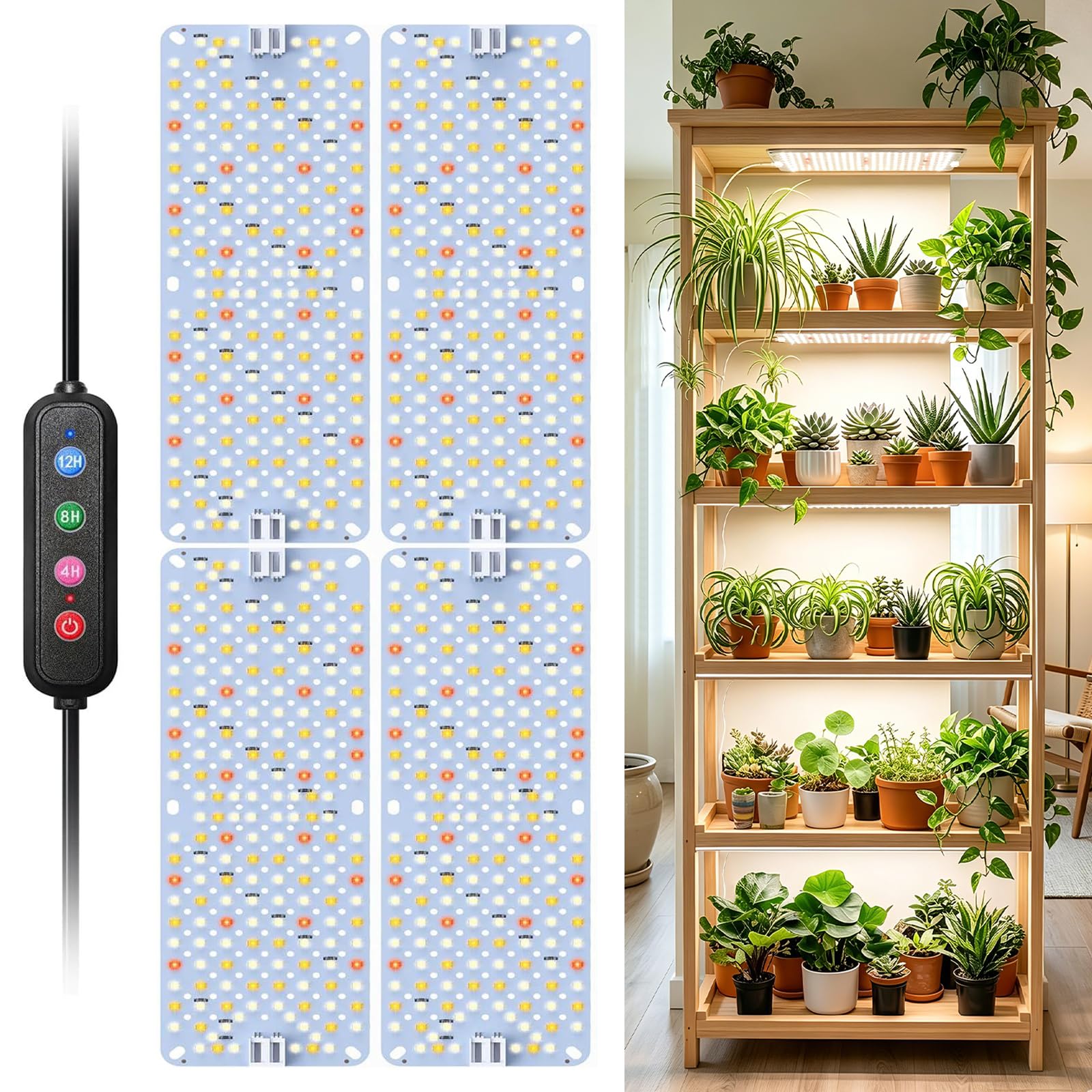
This four-panel kit delivers a combined 36W of actual draw from 768 LEDs, which is significantly higher than the 20W-per-bar typical of the category. The sunlike blend of 3000K warm white, 5000K cool white, and 660nm deep red provides a spectrum that is both visually comfortable for a living space and effective across propagation, vegetative, and flowering stages. The 90 CRI rating means you can actually see nutrient deficiencies and pest damage under these lights, an advantage pure blurple fixtures cannot offer.
The daisy-chain function connects up to ten panels while maintaining even brightness, and the 8.2-foot main cord plus 3.28-foot jumper wires give you plenty of slack to route around shelving. The vented aluminum housing keeps surface temperatures low even at full power—a critical safety factor when panels sit inches above tender seedlings. Each panel measures 11.7 by 3.8 inches, a footprint that fits perfectly across standard 36-inch wire shelves without overhang.
Buyers consistently praise the immediate germination response when paired with a heat mat, with sprouts appearing within 24 hours on a 16-hour photoperiod. The timer offers 4, 8, 12, 16, 20, and 24-hour settings with memory retention, so once programmed, the light cycles automatically every day without re-adjustment. The only practical drawback is the non-dimmable output—there is no way to reduce intensity for light-sensitive species without raising the fixture higher.
What works
- Highest real wattage per dollar in this group; actually usable PPFD for propagation
- Pleasant white spectrum with deep red supplement for full-cycle growth
- Daisy-chain wiring is straightforward and maintains uniform brightness across panels
What doesn’t
- Not dimmable, so you lose fine control over light intensity at the canopy
- PCB-on-aluminum design is somewhat fragile if the panel is dropped or stepped on
2. Beelux 1000W LED Grow Light

The Beelux is not shy about being a serious panel for a mid-range footprint. Its real power draw of roughly 100W, verified by multiple reviewer watt-meter tests, puts it in a different league than the sub-40W bar-style lights. It claims to replace a 1000W HPS, and while that is an exaggeration on photon output, it does produce 5130 lumens of light that penetrates deeper into a 4-by-4-foot tent canopy.
The dual-switch design separates the veg (blue-heavy) and bloom (red-heavy) channels, letting you tailor the spectrum to the growth phase without moving the fixture. The metal housing with side-vent convection cooling runs cool enough that the unit remains touch-comfortable even after 12 hours of operation. An internal fan version exists, but many owners report that the passive cooling model is silent and reliable if airflow around the tent is adequate.
Customer feedback highlights strong stem and leaf development on tomatoes, peppers, and cannabis under the veg setting, followed by robust flower density under the bloom setting. The modular build—two separate heatsink sections connected by a driving board—means you could theoretically swap in a quieter fan if the stock one ever fails. The main downside is the weight: at nearly three pounds, you need sturdy hanging cable ratchets, not lightweight zip ties.
What works
- 100W true draw provides real photon density for a 4×4 area
- Dual veg/bloom switches allow phase-specific spectrum tuning
- Passive cooling is silent and sufficient for most indoor setups
What doesn’t
- Heavier than budget panels; needs sturdy hanging hardware
- Lacks an integrated timer, so you must buy a separate outlet timer
3. Uallhome 200W LED Grow Light Panel (2-Pack)

The Uallhome twin-pack brings UV and IR wavelengths into the budget bracket, which is rare at this price point. The inclusion of deep red, blue, UV, and IR diodes means the spectrum more closely mimics a full mid-range quantum board than a typical entry-level panel. Each unit is only one inch thick, making it easy to slide into tight tent corners or under cabinet overhangs.
Rated at 200W equivalent while drawing far less from the wall, the actual wattage is modest, but the even distribution of 200 individual LEDs across a 12-by-12-inch surface creates uniform canopy coverage without the hot spots that often burn seedlings under cheaper panels. Owners report that variegated monstera pushed a new leaf within a week of installation, and cannabis seedlings stayed compact without the yellowing that strong boards can cause.
The included hanging kit uses basic steel cables, and reviewers recommend swapping to ratchet hangers for easier height adjustment. The light has no built-in timer, so you will need an external timer for consistent photoperiods. The passive cooling design keeps operation silent, and the aluminum housing dissipates heat well enough that the surface stays cool to the touch, even after all-night cycles.
What works
- UV and IR diodes expand the spectrum beyond basic red+blue
- Thin, lightweight form factor fits tight spaces easily
- Cool operation eliminates risk of leaf burn even at close distances
What doesn’t
- No integrated timer; requires an external solution for automated cycles
- Hardware kit uses short cables that limit hanging flexibility
4. FECiDA Desk Grow Light
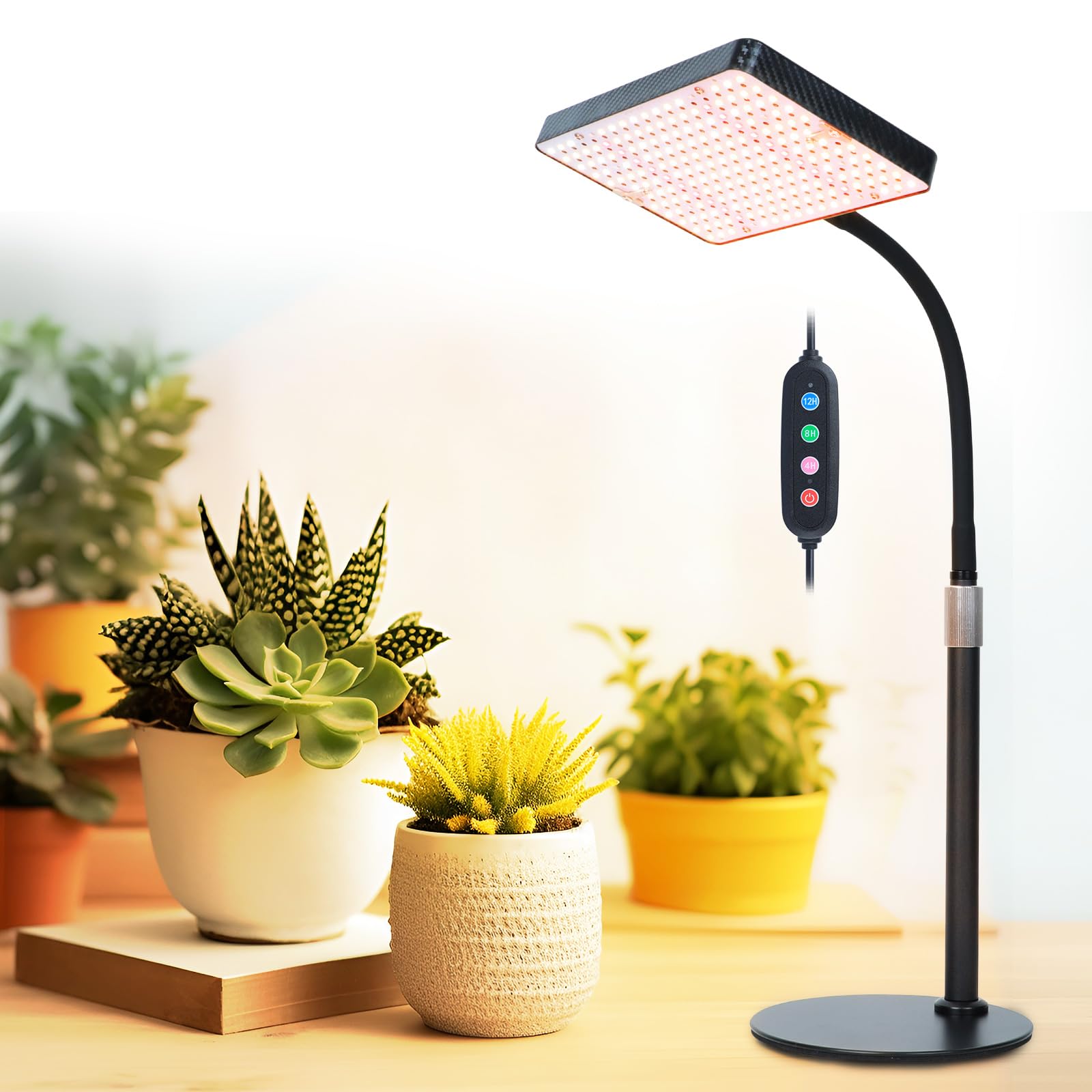
This freestanding unit is the only desktop grow light in the roundup that does not rely on a clip, and its weighted base provides surprising stability for a fixture that can extend up to 24 inches tall. The 208 LEDs produce 2000 lumens—enough to support a single medium-sized bonsai, a cluster of succulents, or a 4-inch pot of seedlings on a countertop. The 25W draw is verified by the manufacturer and confirmed by owners.
The five-mode timer (4/8/12/16/20 hours) is one of the more sophisticated programming options at this price. Pushing two timer buttons simultaneously unlocks the 16-hour (4+12) and 20-hour (8+12) settings. The memory function retains the schedule, so after a power outage the light resumes the correct cycle without manual re-programming. Owners of bonsai trees particularly appreciate the ability to set a 16-hour photoperiod during the growing season and switch to 12 hours for winter dormancy.
Criticism centers on the top-heavy design—when the light head is angled significantly forward, the base becomes easier to tip. The included power cord uses a USB connector, which may require a separate wall adapter if your existing USB port cannot supply enough current. The light is not dimmable, so adjusting intensity requires raising the head or moving the desk plant farther from the panel.
What works
- Freestanding design works on any flat surface without clamp shelf
- Five timer settings with memory for fully automated photoperiods
- Full spectrum is both pleasant to look at and effective for single plants
What doesn’t
- Can be top-heavy when the gooseneck is fully extended or angled
- USB power cable may need an adapter if your USB port is underpowered
5. FREELICHT 4FT LED Grow Light (2-Pack)

If your setup runs the length of a standard wire shelf, these 4-foot bars provide the longest continuous coverage in the lineup. Each bar draws 40W and uses 144 high-efficiency LEDs in a typical red-blue blurple array. The narrow 1.6-inch width means they can be mounted side-by-side on a single shelf to cover the full width of a large seedling tray.
The linkable connector system lets you chain up to four bars to one outlet, eliminating power-strip clutter. Buyers report that two bars mounted eight inches above a 2-by-4-foot tray provide enough intensity to keep fiddle leaf figs happy and pothos pushing new leaves even in rooms with no natural light. The included mounting kit offers both hanging cables and surface-mount brackets, giving you flexibility for wall, ceiling, or shelf edge installation.
The narrow red-blue spectrum, while effective for vegetative growth and flowering, makes leaf inspection difficult. Several owners noted that the power cord connector is bulky and protrudes awkwardly, which can be a problem if the fixture sits behind furniture or against a wall. The two-year warranty is better than most budget options, but the lack of integrated timing means you are on the hook for a separate outlet timer.
What works
- 4-foot length gives unmatched coverage for long shelf runs
- 40W actual draw is one of the highest wattages in bar form factor
- Linkable to four units saves outlet space and wiring
What doesn’t
- Blurple spectrum makes it hard to visually diagnose plant health
- Bulky power connector limits placement against walls or furniture
6. SDOVUERC Tri-Heads Grow Light (2-Pack)
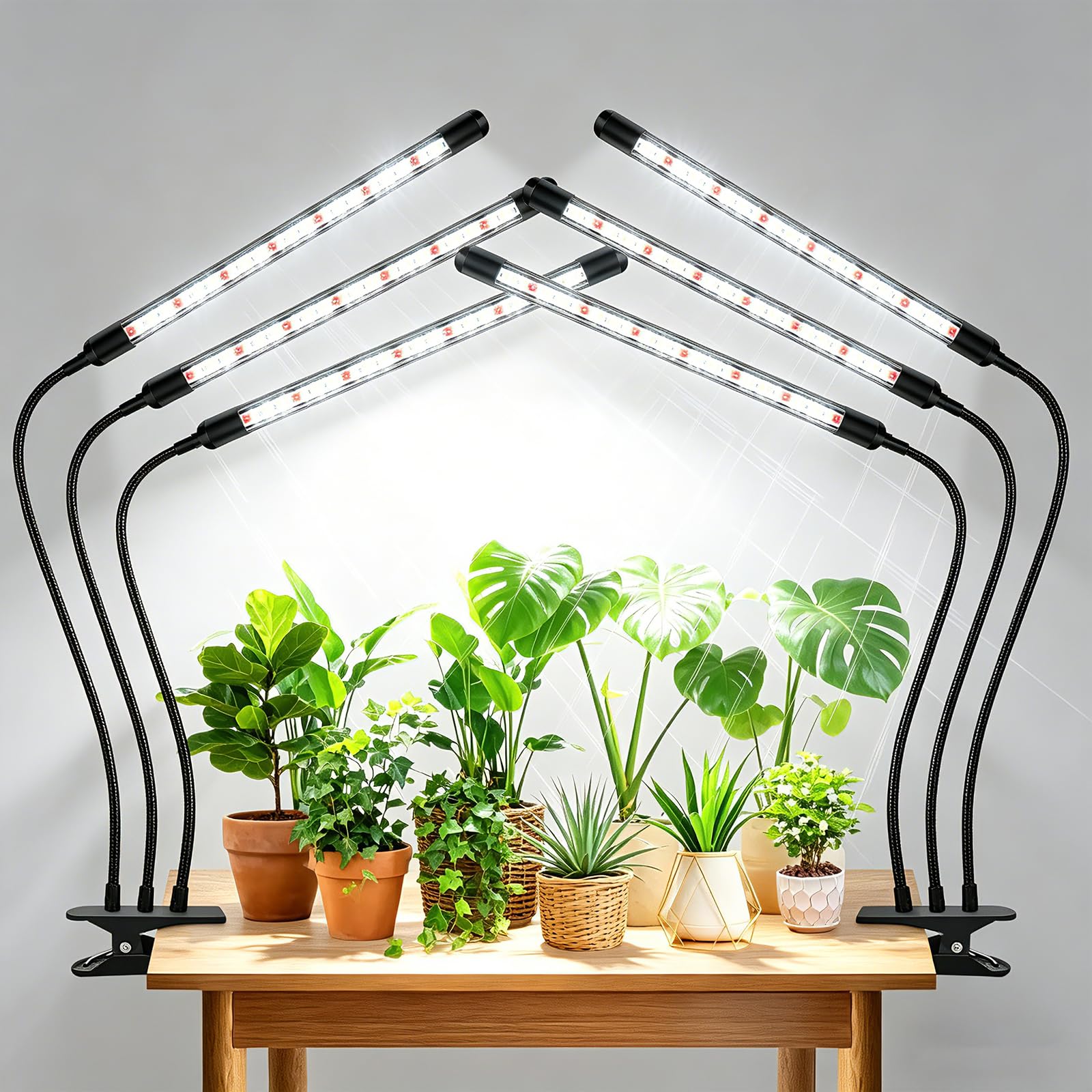
This two-pack of tri-head clip lights brings three independently adjustable arms per unit, each fitted with a 360-degree gooseneck. Total draw is 15W per unit (45W for the two-pack), which is modest but enough for a dense cluster of succulents, a small propagation station, or a single shelf of seedlings. The V-shaped head layout spreads light over a wider area than a single round bulb, reducing shadow on the edges of the tray.
The five-level dimming and three spectrum modes (cool white 6000K, cool white plus 660nm deep red, and full spectrum) give you more customization than most cheap LED grow lights. The timer offers 6, 12, and 18-hour settings with memory, and the 18-hour cycle is particularly valuable for light-loving plants like cannabis clones or tropical orchids that need extended photoperiods. The foam-padded clip grips surfaces up to about 1.5 inches thick without scratching furniture.
Several owners noted that the goosenecks can be slightly stiff to position initially but hold their angle well once set. The USB-powered design means each light draws power through a USB-A adapter; if your station has limited USB ports, you may need a multi-port charger. The overall plastic construction feels light but durable enough for stationary use on a desk or shelf.
What works
- Three adjustable heads per unit cover a wider footprint than standard clips
- 5-level dimming and 3 spectrum modes offer real flexibility
- 18-hour timer setting accommodates long-photoperiod plants
What doesn’t
- 15W total is low for larger trays or high-light-demand species
- USB power means you need a separate adapter for each unit
7. Hlite 16in LED Grow Lights (4-Pack)
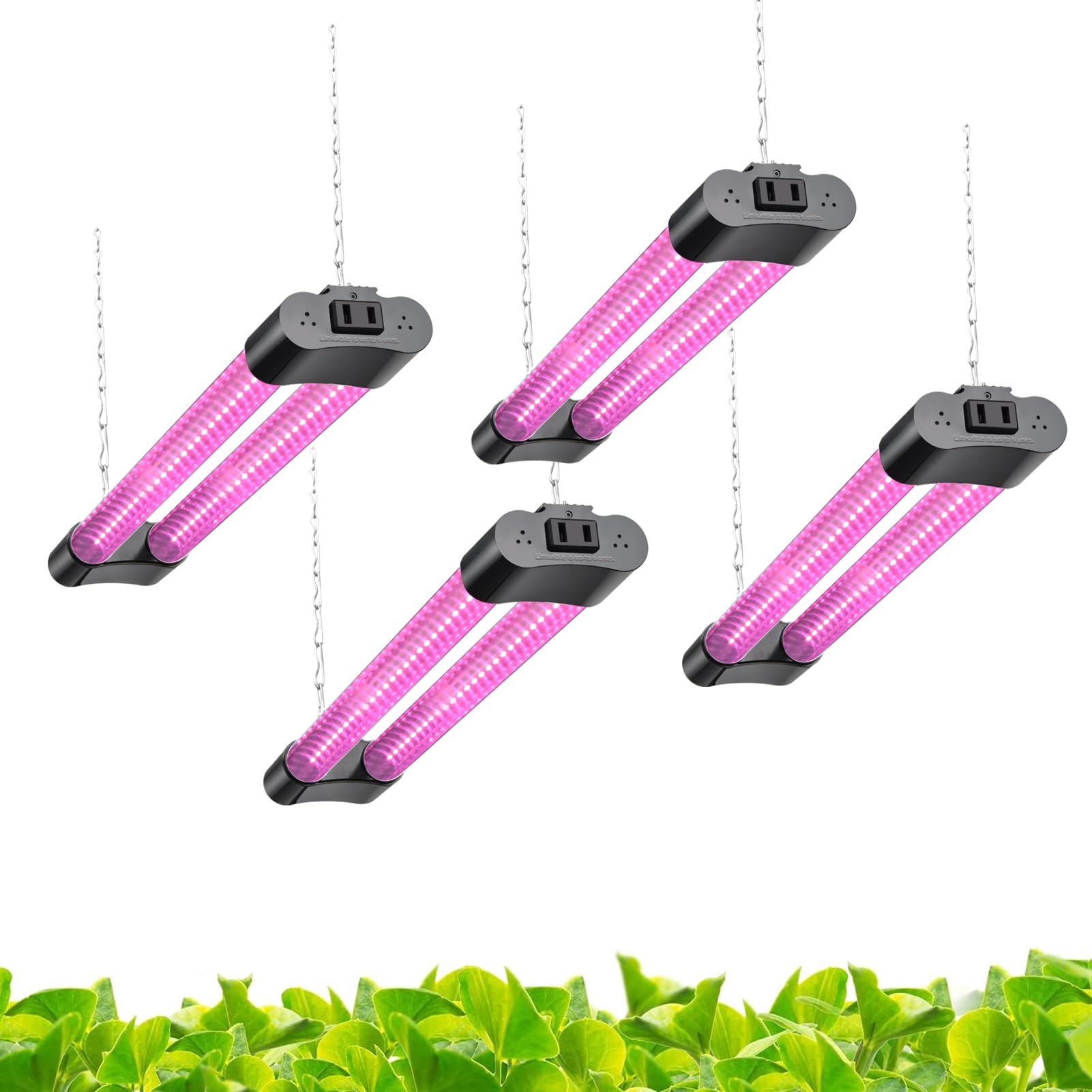
The Hlite four-pack is the most cost-efficient way to light a wire shelf, delivering four 20W bars that can be daisy-chained up to six units. The pink hue is typical of cheap blurple LEDs, and while it is visually harsh, the spectral output does support vigorous vegetative growth in tomatoes, peppers, and flowers as confirmed by several reviewers. Each bar measures 16.5 by 3.15 inches, which fits neatly on standard shelf racks without overhang.
Installation is straightforward: the kit includes screws, hooks, chains, zip ties, and brackets, giving you nearly every mounting option you might need. The power cord is a generous 5 feet, allowing some flexibility in where you place the outlet. Multiple owners noted that plants responded noticeably within days of setup, with seedlings staying stocky rather than leggy when the bars are suspended six to eight inches above the canopy.
The lights are not dimmable and have no integrated timer, so you must control the photoperiod manually or through a separate outlet timer. The pink light makes it difficult to evaluate leaf color, and several owners mentioned that the fixture is best suited for temporary seed-starting setups rather than a permanent decorative display. The value is undeniable, but the lack of timer and dimming puts it behind the competition in terms of convenience.
What works
- Four bars per pack provide broad coverage at an entry-level price
- 20W per bar is decent actual wattage for seed starting
- Multiple mounting options with included hardware
What doesn’t
- No timer or dimmer, so photoperiod control is manual
- Pink blurple light makes visual health checks difficult
Hardware & Specs Guide
Actual Wattage Draw
The single most important spec for cheap LED grow lights. Many fixtures advertise “1000W” but pull only 100W from the wall. For propagation and low-light ornamentals, 20W per square foot of shelf area is a safe baseline. The SDOVUERC panel (36W total) and the Beelux (100W actual) provide the highest measured output in this group. Always check the manufacturer’s listed wattage in the technical specifications, not the headline marketing number.
Spectrum and Color Temperature
White full-spectrum lights (3000K-5000K with added 660nm deep red) allow you to see true leaf colors, making pest and nutrient issues visible. Blurple fixtures (narrow red+blue) sacrifice visual clarity for theoretical photosynthetic efficiency at a specific wavelength. For general indoor gardening, especially in living spaces, a white-based spectrum with deep red supplement is the more practical choice. The FECiDA and SDOVUERC panel use this blend effectively.
Timer and Memory Function
Automated photoperiods are critical for consistent plant growth. Lights with a built-in timer and memory function (SDOVUERC panel, FECiDA, SDOVUERC tri-head) eliminate daily manual switching and survive power interruptions without resetting. Units without timers (Beelux, FREELICHT, Hlite) require an external outlet timer, which adds cost and complicates clean wiring. For multi-shelf setups, a built-in timer is a major convenience.
Form Factor and Coverage Geometry
Bar-style lights excel on wire shelving because they span the full shelf width and can be daisy-chained for clean power routing. Clip-on goosenecks work best for single pots or small clusters on a desk. Panel lights (Beelux, Uallhome) concentrate light in a square footprint and are best for tent applications where height allows the beam to spread. Match the form factor to your planting layout: long bars for propagation shelves, panels for tents, clips for desktop accent plants.
FAQ
How close should I hang cheap LED grow lights to my seedlings?
Can I use blurple lights in a living room without making it look like a nightclub?
Do cheap LED grow lights need a separate fan for cooling?
Final Thoughts: The Verdict
For most gardeners, the best cheap led grow lights winner is the SDOVUERC 768 LEDs Panel because it delivers the highest actual wattage per dollar, a pleasant white-plus-deep-red spectrum, and a daisy-chain timer system that automates photoperiods across an entire shelf. If you want high-output coverage for a tent, grab the Beelux 1000W. And for a desktop setup where a clip-on unit makes sense, nothing beats the SDOVUERC Tri-Head for flexible positioning and spectrum customization.