
The ideal chainsaw for a woman is rarely a scaled-down version of a man’s tool—it’s a machine rethought around lighter weight, ergonomic handle contours, and a starting system that doesn’t demand brute force. Whether you’re clearing storm debris, pruning branches, or cutting firewood, a chainsaw that fits your physique and grip strength transforms the task from exhausting to empowering.
I’m Rikta — the co-founder and writer behind Lawn Gear Lab. I’ve analyzed the engineering specs and user feedback across 25+ chainsaw models to isolate the specific weight, bar length, and power-source characteristics that actually matter when the tool is your daily companion in the yard.
After sorting through dozens of options, I built this guide to help you match a saw to your strength and cutting needs — this is the definitive resource for finding the best chainsaw for women that doesn’t compromise on performance or safety.
How To Choose The Best Chainsaw For Women
The best saw for you depends on a few physical and mechanical factors that go beyond brand loyalty. Below are the critical specs to evaluate before making your purchase.
Bar Length & Weight Balance
A 12-inch bar is the sweet spot for most women: long enough to cut through 10-12 inch logs yet short enough to keep the overall weight under 10 pounds. Over the years, manufacturers have tuned bar lengths to match engine or motor output, so a 14-inch bar on a lightweight 40V battery saw still feels maneuverable. Always compare the fully loaded weight (with battery or fuel) rather than the dry weight.
Power Source: Battery vs. Gas
For the vast majority of women, a cordless electric chainsaw removes the biggest barrier to entry: starting. No pull cord, no fuel mixing, no engine flooding. Modern 40V and 56V brushless motors deliver power equivalent to 30-35cc gas engines, which is plenty for limbing and medium-sized firewood. Gas saws like the Husqvarna 120 III offer higher sustained power for heavy use, but they weigh more and require two-handed pull-starting — a real consideration for smaller frames.
Ergonomics & Safety
Top-handle designs are inherently more compact and naturally suited for smaller hands, but they typically lack the full wrap-around grip of rear-handle saws. Look for a model with a chain brake (activated by the wrist or thumb), a secondary safety trigger lock, and an anti-vibration system that reduces fatigue over 30-minute sessions. Tool-free chain tensioning saves time and frustration, especially for first-time users.
Battery Ecosystem & Long-Term Value
If you choose a battery-powered saw, note that the cost of additional batteries often exceeds the saw itself. Premium brands like EGO, SKIL, and Greenworks share batteries across their full OPE (outdoor power equipment) lineups. Investing in a higher-capacity 4.0Ah or 5.0Ah battery from the same family extends runtime significantly without buying an entirely new setup.
Quick Comparison
On smaller screens, swipe sideways to see the full table.
| Model | Category | Best For | Key Spec | Amazon |
|---|---|---|---|---|
| Greenworks 40V 12″ | Battery | Storm cleanup, pruning | 6 lbs w/battery, 50 cuts/charge | Amazon |
| EGO POWER+ CS1201 | Battery | Light-duty limb work | 8.4 lbs, 130 cuts/charge | Amazon |
| SEESII 12″ Cordless | Battery | Budget-friendly trimming | 12 lbs, 2x 4.0Ah batteries | Amazon |
| DEWALT DCCS623B | Battery | Brush clearing, saplings | 4.6 lbs, 8″ bar | Amazon |
| SKIL PWR CORE 40 14″ | Battery | Weekend firewood | 11.5 lbs, 15-min quick charge | Amazon |
| Husqvarna 120 Mark III | Gas | Heavy tree cutting | 38cc, 16″ bar, 10.7 lbs | Amazon |
| JPNTECH 12″ Top Handle | Gas | Budget gas power | 8.6 lbs, 25.4cc | Amazon |
| NEO-TEC 12″ Top Handle | Gas | One-handed climbing cuts | 8.2 lbs, 12,000 RPM | Amazon |
| PROYAMA 26CC 12″ | Gas | Heavy cleanup with spares | 11.5 lbs, 2 chains included | Amazon |
In‑Depth Reviews
1. Greenworks 40V 12″ Cordless Compact Chainsaw

The Greenworks 40V hits the ideal weight-to-power ratio for a women’s chainsaw: just 6 pounds with the battery attached, yet it delivers enough torque to slice through 4×4 treated lumber in a single pass. The 12-inch low-kickback bar keeps the center of gravity close to the body, reducing the feeling of tip-weight that fatigues the shoulders during extended pruning sessions.
Users consistently report 40-60 minutes of runtime on the included 2.0Ah battery — enough for a full weekend of storm cleanup or light firewood prep. The tool-free chain tensioner is genuinely one-handed, and the auto-oiler ensures the bar stays lubricated without manual pumping. The 40V platform also shares batteries with Greenworks’ string trimmers and leaf blowers, adding long-term ecosystem value.
Where it trails gas saws is in sustained heavy cuts: the motor bogs if you lean into a dense hardwood knot. For the average user trimming 6-10 inch limbs, though, it’s a near-perfect balance of lightness, safety, and reliable electric starting.
What works
- Exceptionally light at 6 lbs for a 12″ bar saw
- Auto-oiler extends bar and chain life with no manual work
- Tool-free chain tensioning is fast and stays tight during use
What doesn’t
- Bogs down on dense hardwood knots or logs over 10″ diameter
- 40–60 minute runtime may require a second battery for longer jobs
- Thumb-activated chain brake requires deliberate hand positioning
2. EGO POWER+ 12″ Battery Chainsaw CS1201
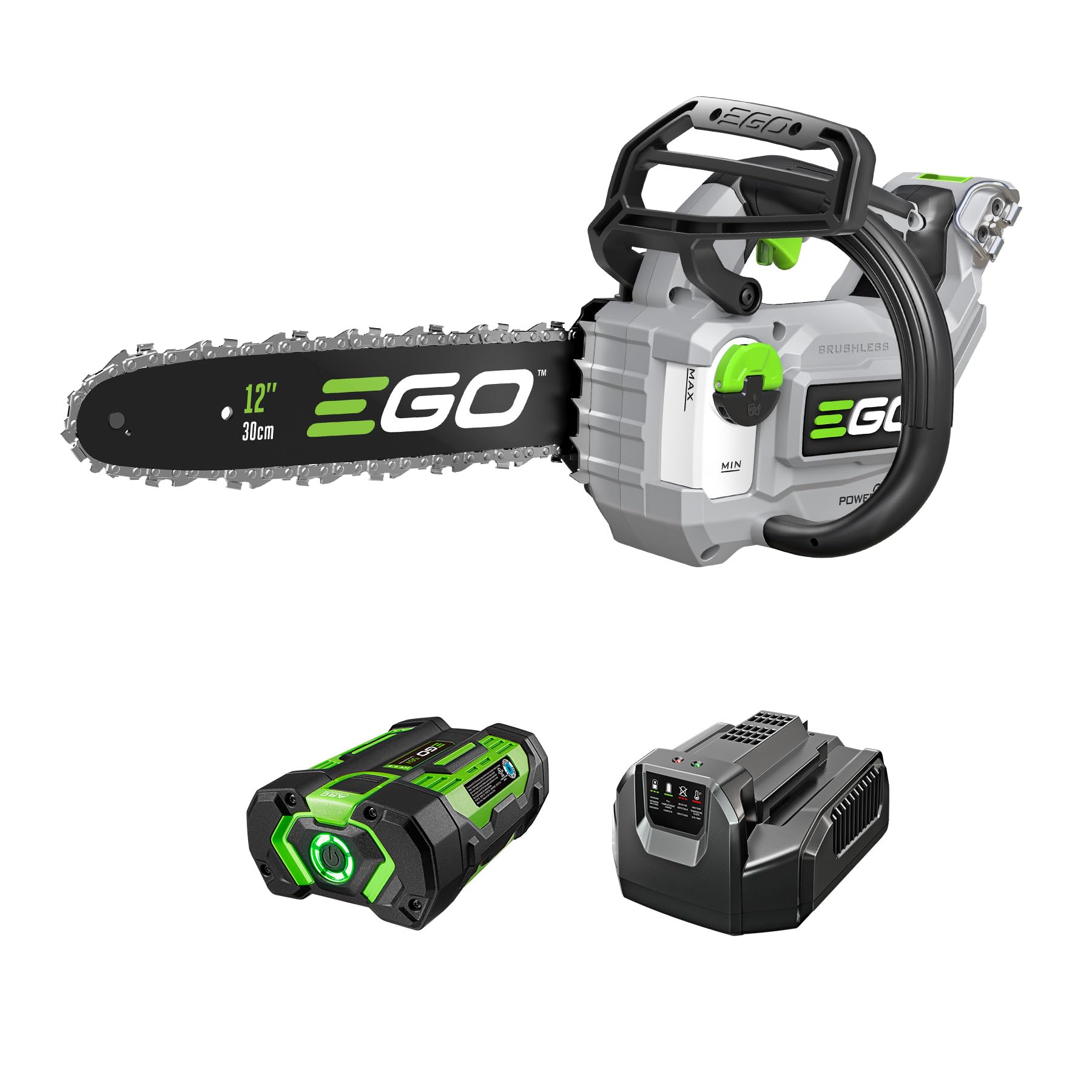
EGO’s CS1201 packs the equivalent of a 30cc gas engine into a 12-inch bar saw weighing only 8.4 pounds — notably heavier than the Greenworks but with a class-leading 130 cuts per charge on a 4×4. The 56V brushless motor spins the chain at 20 meters per second, making it one of the fastest-cutting cordless saws in its bar class.
Professional landscapers have reported that their crews grab the EGO first over gas saws because of the instant electronic start — no pull cord to yank while balancing on a ladder. The tool-free chain tensioning system is dead simple, and the saw integrates with the entire EGO 56V battery family, including higher-capacity 5.0Ah and 10.0Ah packs for extended runtime.
The trade-off is cost: it’s positioned firmly in the premium tier, but the battery and charger are included, and the build quality justifies the price. The chain is loud for a battery saw, and some users note that the chain brake is a thumb-activated lever rather than a full-wrap inertia brake.
What works
- Exceptional 130 cuts per charge on standard 4×4 lumber
- Instant electronic start eliminates pull-cord struggle
- Shares batteries across the full EGO 56V ecosystem
What doesn’t
- Premium price point compared to competing 12″ battery saws
- 8.4 lbs is heavier than some gas models in the same bar length
- Chain is noticeably louder than the motor during operation
3. SEESII Electric Chainsaw Cordless 12″ with 2x 4.0Ah Batteries
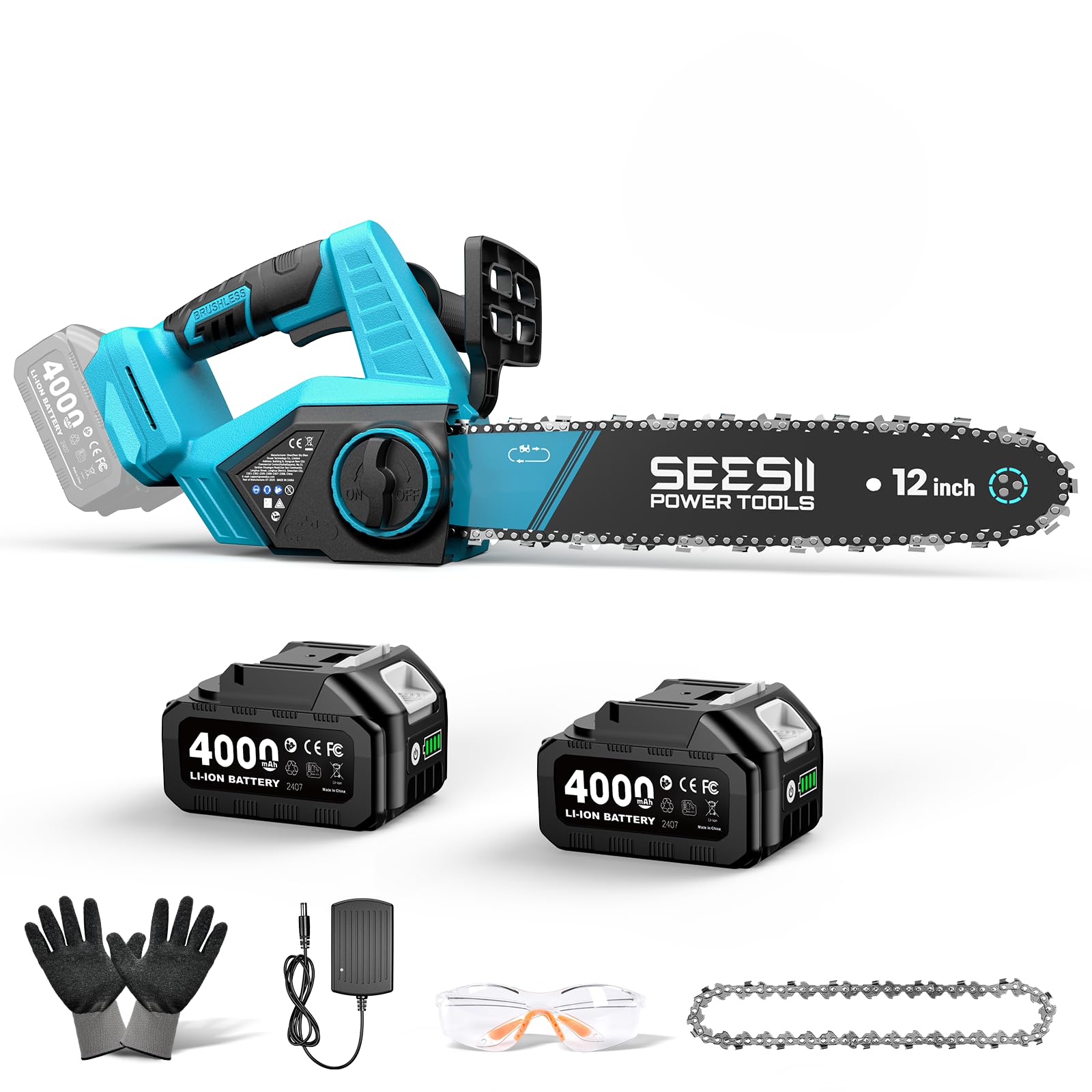
SEESII loads this kit with two 4.0Ah batteries and a 1200W brushless motor, giving you the longest total runtime of any entry-level cordless saw in this roundup. Multiple owners report finishing full afternoons of clearing woods and cutting firewood without touching a charger, even on 4-6 inch hardwoods.
The 12-inch bar handles everything from pruning to storm debris, though the saw weighs a full 12 pounds — heavier than the Greenworks and EGO saws because the batteries are integrated into a larger chassis. The built-in battery indicator and smart auto-oiling system are welcome features, and the kit includes a carrying case, safety gear, and a maintenance toolkit.
Where the SEESII stumbles is chain retention: several buyers note the chain loosens during heavy use and requires periodic retightening with the included wrench. It’s not a dealbreaker — tool-free tensioners are faster, but the included wrench makes the adjustment straightforward.
What works
- Two 4.0Ah batteries provide all-day runtime for most homeowners
- 1200W brushless motor cuts fast through hardwoods up to 10″
- Kit includes case, safety gear, maintenance kit, and spare chain
What doesn’t
- Weighs 12 lbs — noticeably heavier than competing cordless saws
- Chain loosens during heavy cuts and requires frequent retensioning
- Safety button is positioned for right-hand-only use
4. DeWalt 20V 8″ Pruning Chainsaw DCCS623B

The DeWalt DCCS623B is the lightest saw here at approximately 4.6 pounds, which makes it nearly a one-handed tool for pruning saplings and trimming branches up to 7 inches in diameter. Several elderly women have left reviews noting they could operate this saw with full control despite reduced grip strength — that’s the real-world benefit of an 8-inch bar on a 20V brushless motor.
It’s a tool-only purchase (batteries and charger sold separately), which assumes you already own DeWalt 20V batteries. Owners who upgrade to the Oregon R34 chain report even smoother cuts through dense oak. The automatic oiler works consistently, and the wrench stores in the scabbard for on-the-go adjustments.
The limitation is obvious: an 8-inch bar means you can’t fell 12-inch trees or cut firewood logs. This is a dedicated pruning saw for fine branch work and underbrush, not a multi-purpose chainsaw. If your yard contains mostly limbs under 6 inches, this is the most controllable and least fatiguing option available.
What works
- Extremely light at 4.6 lbs — easy to control one-handed
- Excellent battery life; one charge can last full weekend for brush work
- DeWalt 20V ecosystem compatibility for existing owners
What doesn’t
- 8″ bar limits cutting capacity to limbs under 7″ diameter
- Tool-only — no battery or charger included in the box
- Safety switch can be annoying to hold continuously for small cuts
5. SKIL PWR CORE 40 14″ Brushless Chainsaw CS4555-10

SKIL’s 14-inch model is the largest bar in this cordless collection, powered by a 40V brushless motor that cuts faster than most competitive 40V saws and matches the torque of entry-level gas models. The tool-less chain tensioning dial is exceptionally smooth, and the auto-lubrication system keeps the bar cool through long cutting sessions. At 11.5 pounds, it’s heavier than the 12-inch cordless saws, but the extra inch of bar gives you the ability to cut through 12-14 inch logs in a single pass.
The standout feature is the PWR JUMP charger: it pulls the 2.5Ah battery from 0 to 30% in only 15 minutes, which means a single battery can keep cutting all day with short recharge breaks. Several users pair two SKIL batteries and work continuously by swapping and charging. The anti-kickback brake adds confidence for less experienced operators.
The battery runtime per full charge is about an hour of mixed cutting, which is on the shorter side for a 40V saw. You’ll definitely want a second battery or plan work around the 15-minute top-off recharge cycle.
What works
- 14″ bar handles larger logs than typical cordless saws
- Rapid 15-minute charge from 0–30% keeps you working
- Tool-free chain tensioning is fast and reliable
What doesn’t
- Battery runtime per charge is about 1 hour of mixed cutting
- 11.5 lbs is heavier than 12″ cordless alternatives
- Not suitable for all-day heavy logging; demands short recharge breaks
6. Husqvarna 120 Mark III 16″ Gas Chainsaw

If you need to fell small trees, process firewood, or tackle a major storm cleanup that a battery saw can’t sustain, the Husqvarna 120 Mark III brings true pro-grade engineering. The 38cc X-Torq engine delivers 1.88 HP at a weight of 10.7 pounds — lighter than some 14-inch battery saws — and the LowVib dampeners reduce arm fatigue during long sessions.
The Air Injection system expels dust before it hits the filter, which extends service intervals significantly. Combined with the air purge and combined choke/stop controls, starting is as predictable as a gas saw gets — most owners report a 2-3 pull start when cold and a single pull when warm. The inertia-activated chain brake is a full safety mechanism that engages automatically during kickback, which is a more robust design than thumb-activated brakes on battery saws.
The main barrier is the 16-inch bar: it requires two-handed operation and a stable stance, which may feel unwieldy for smaller users. Some owners recommend buying a shorter 14-inch bar separately for better balance. Fuel mixing and maintenance also add to the ownership effort compared to cordless saws.
What works
- 38cc X-Torq engine provides gas-grade sustained power for heavy cutting
- 10.7 lbs is surprisingly light for a 16″ gas saw
- Inertia chain brake and LowVib reduce kickback risk and fatigue
What doesn’t
- 16″ bar may feel too long for smaller-framed users
- Requires mixed fuel (gas + 2-stroke oil) and regular chain sharpening
- Pull-starting can be temperamental if choke sequence isn’t followed
7. JPNTECH 12″ Top Handle Gas Chainsaw 25.4CC

JPNTECH packs a 25.4cc 2-cycle gas engine into a top-handle chassis that weighs only 8.6 pounds — light enough for one-handed limbing if you have decent arm strength. The wrap-around handle reduces fatigue, and the 12-inch bar makes it nimble for climbing cuts and tight spaces where a rear-handle saw won’t fit.
For the price, the cutting performance is impressive: owners report slicing through 12-inch oak and spruce with no bogging, and the precision carburetor keeps fuel consumption low. The spring-assisted pull cord makes starting easier than most budget gas saws, though some units come with a rubber-band starter that has a reputation for early failure. The included toolkit covers basic adjustments.
Reliability is a mixed bag. Many owners report strong performance after years of use, while others note that the clutch slips under heavy load and the air filter can leak fine particulates. At this price point, you’re trading predictable longevity for immediate affordability.
What works
- Very light at 8.6 lbs for a gas-powered chainsaw
- Cuts 12″ logs effectively with good fuel efficiency
- Top-handle design allows one-handed operation in tight spaces
What doesn’t
- Rubber-band starter system prone to breakage on some units
- Clutch can slip when the chain loads up during heavy cuts
- Air filter may let fine dust through, shortening engine life
8. NEO-TEC 12″ Top Handle Gas Chainsaw 25.4CC

NEO-TEC’s 25.4cc saw hits 12,000 RPM, making it the fastest-spinning chainsaw in this review. That translates to exceptionally clean cuts through 3-inch oak without the blade slowing, and owners who heat with wood report using the saw for 10-12 hours on a single chain. The 8.2-pound weight and metal lanyard ring make it ideal for tree climbing and elevated pruning.
The engine requires a 25:1 gas-to-oil mix — richer than the typical 50:1 ratio most modern saws use. This is critical: buyers who skip the manual and use 50:1 mix report hard starting and poor idling. After break-in, the saw pulls strongly and the low-vibration handle reduces fatigue noticeably compared to budget gas competitors. The two-nut bar retention system is sturdier than single-nut designs.
Idling issues are the most common complaint: many units stall after cutting unless you feather the throttle. The manual is poorly translated, and replacement parts ship directly from China — not ideal if you need a quick fix mid-season.
What works
- 12,000 RPM chain speed cuts through hardwoods effortlessly
- Light at 8.2 lbs with lanyard ring — excellent for climbing
- Two-nut bar retention system is more secure than single-nut designs
What doesn’t
- Requires 25:1 fuel mix — easy to get wrong if you don’t read the manual
- Many units don’t idle well after cutting; engine stalls frequently
- Poorly translated manual and parts ship from China
9. PROYAMA 26CC 12″ Top Handle Gas Chainsaw

PROYAMA’s 26cc top-handle saw comes with two chains in the box — a practical bonus for heavy-use buyers who go through chains quickly. The anti-vibration system dampens some of the handheld vibration that plagues budget gas saws, and the wrap-around handle is well-padded for comfort. At 11.5 pounds, it’s heavier than the JPNTECH and NEO-TEC gas saws, but the extra displacement gives it a torque advantage for burying the bar in dense wood.
Assembly out of the box is quick, and most owners report starting within 2-3 pulls after priming. The quick-stop chain brake adds a meaningful safety layer. However, the carburetor often ships with the high-speed needle set too rich, requiring adjustment before the saw runs optimally. Once tuned, it pulls hard through logs up to 12 inches.
The biggest downsides are inconsistent quality control and a poorly designed carrying case. Some units develop starting issues after 20-30 hours, and customer support varies. For the price (including two chains and basic safety gear), it’s a high-risk, high-reward option for users who are comfortable with carb tuning and basic engine maintenance.
What works
- Two chains included — immediate backup for heavy cutting days
- 26cc engine delivers strong torque for 12″ logs and dense hardwoods
- Quick-stop chain brake and safety switch add protection for new users
What doesn’t
- Carburetor often needs tuning out of the box for optimal running
- Inconsistent quality control — some units fail after 20-30 hours
- 11.5 lbs is heavy for a 12″ top-handle saw; can fatigue smaller arms
Hardware & Specs Guide
Bar Length & Gauge
The bar length determines the maximum diameter log you can cut in one pass. For women, 12-inch bars are ideal because they keep the overall weight under 10 pounds while cutting through 10-12 inch wood. The chain gauge (typically 0.043″ or 0.050″) and pitch (3/8″ LP is standard) dictate compatibility when buying replacement chains. All nine models reviewed use 0.043″ or 0.050″ low-profile chains, which reduce kickback risk compared to full-chisel chains.
Power Source & Motor Type
Battery saws use brushless DC motors rated between 40V and 56V, with amp-hour (Ah) ratings indicating energy capacity — higher Ah means longer runtime between charges. Gas saws are measured by engine displacement in cubic centimeters (cc). For reference, a 25-26cc gas engine delivers similar cutting torque to a 40V battery saw, while a 38cc engine like the Husqvarna 120 produces significantly more sustained power. Brushless motors are lighter and more efficient than brushed, which is why all premium battery saws now use them.
Weight & Ergonomics
Fully loaded weight (with battery or fuel) is the most critical spec for user comfort. A difference of just 2 pounds drastically changes how controllable the saw feels during overhead cuts or long sessions. Top-handle saws naturally center the weight closer to the user’s hand, making them feel lighter than their scale weight suggests. Anti-vibration technology — rubber dampeners between the engine and handle — directly affects how long you can cut before your hands go numb. Every gas saw here uses some form of vibration reduction, but coverage varies widely.
Oiling System & Maintenance
All modern chainsaws use an automatic oiler that pumps bar-and-chain oil onto the guide bar during operation. The oil tank capacity dictates how often you need to refill: a 60mL tank (typical on compact battery saws) may require refilling after 20-30 minutes of heavy cutting, while larger gas saws hold enough for 45-60 minutes. Some entry-level gas saws have adjustable oil flow screws, which is useful for fine-tuning between summer and winter cutting. Tool-free chain tensioning is a major convenience — you can adjust the chain tension without touching a wrench or screwdriver.
FAQ
Should I buy a gas chainsaw or a battery chainsaw as a first-time user?
What bar length is ideal for a woman with average arm strength?
How do I maintain a chainsaw chain to prevent it from loosening during cuts?
Are top-handle chainsaws as safe as rear-handle models for ground use?
Final Thoughts: The Verdict
For most gardeners, the chainsaw for women winner is the Greenworks 40V 12″ because it combines the lightest fully-loaded weight (6 lbs) with a 12-inch bar that handles real pruning and storm cleanup without the pull cord struggle. If you want maximum runtime and ecosystem flexibility, grab the EGO POWER+ CS1201 for its 130 cuts per charge and instant-start motor. And for heavy firewood processing or felling small trees with gas-grade power, nothing beats the Husqvarna 120 Mark III.