
Specs are compiled from manufacturer listings and verified buyer reviews and can change over time — please confirm the key details on the product page before buying.
Taking down a few dead limbs after a storm, trimming overgrown branches off your fence, or cutting kindling for a fire pit should not require a 40-pound gas saw that needs mixed fuel and 20 pulls on a starter cord. The real question for you is which power type — corded electric, battery, or gas — and bar length actually fit the work you do most often. Pick wrong, and you will either trip over an extension cord or run out of battery halfway through the job.
I’m Rikta — the founder and writer behind Lawn Gear Lab. This guide is built by comparing the manufacturers’ published specifications and the patterns across verified customer reviews, so you get each pick’s real strengths and trade-offs instead of marketing spin.
Knowing the difference in amp ratings, bar lengths, and weight will lead you to the right tool. This is your complete guide to the chainsaw for home use.
Quick Picks
- Oregon CS1500 Self-Sharpening Electric Chain Saw — Best Overall
- Makita UC4051A Chain Saw, Electric, 16 in. Bar — Premium Build
- Husqvarna 130 Gas Powered Chainsaw, 38-cc 2-HP, 16 Inch — Gas Powerhouse
- Greenworks 40V 12″ Cordless Compact Chainsaw — Compact Workhorse
- BLACK+DECKER 12 Amp 16 in. Electric Chainsaw (CS1216) — Budget Corded
- Dewalt Chainsaw Pruning 20V 8IN DCCS623B — Compact Pruner
- BLACK+DECKER 20V MAX Pruning Chainsaw Kit (BCCS320C1) — Ultra-Compact
How To Choose The Best Chainsaw For Home Use
Picking the right chainsaw for home use means matching the power source, bar length, and weight to the kind of trees and branches on your property. Here is what to focus on.
Power Source: Corded Electric vs Battery vs Gas
Corded electric saws deliver unlimited runtime and strong power (often 12 to 15 amps) without the smell or maintenance of gas. The catch is you are tethered to an outlet — you need a heavy-duty extension cord (typically 12-gauge or thicker for a 100-foot run). Battery-powered saws give you freedom to walk around the yard, climb a ladder, or take the saw to a remote campsite, but runtime is limited to the battery’s capacity (a common 2.0 Ah pack on a 40V saw delivers roughly 50 cuts through 4×4 treated wood per charge). Gas-powered saws offer the highest power and longest runtime without cords or charging, but require mixing 2-cycle oil and fuel, routine engine maintenance, and are heavier and louder than electric alternatives.
Bar Length and What You Can Actually Cut
The bar length determines the maximum diameter log you can cut in a single pass. As a rule of thumb, the usable cutting depth is about two inches less than the bar length. That means a 16-inch bar handles logs up to roughly 14 inches thick, while an 8-inch bar is best for branches up to about 6 inches. For most home yards — trimming limbs, cutting fallen branches, and occasional storm cleanup — a bar between 12 and 18 inches is the balance. A bar that is too long makes the saw heavier and harder to control for light pruning; a bar that is too short forces you to cut from both sides on bigger logs.
Weight and Handling
A chainsaw you dread picking up will get left in the shed. Corded saws typically weigh between 10 and 13 pounds, which is fine for ground-level cutting but becomes tiring during overhead pruning. Battery saws can be as light as 6 pounds (like the Greenworks 40V compact model) and are much easier to maneuver one-handed. Gas saws vary widely — a 38cc model may weigh around 11 to 13 pounds with fuel and bar. Consider where you will use the saw most: if it is reaching up into a tree, lighter is dramatically better; if you are bucking logs on the ground, a little extra weight helps the blade drive through the wood.
Safety Features
Every chainsaw you buy for home use should have a chain brake — a hand guard that stops the chain instantly if the saw kicks back toward you. Automatic chain oiling keeps the bar and chain lubricated during operation (less friction means less effort and longer chain life). Tool-free chain tensioning lets you tighten a loose chain in seconds with a twist of a knob rather than fumbling for a wrench mid-cut. Low-kickback bars and chains are standard on nearly all modern home-use models and reduce the severity of kickback.
Quick Comparison
On smaller screens, swipe sideways to see the full table.
| Model | Best For | Power Source | Bar Length | Item Weight | Amazon |
|---|---|---|---|---|---|
| Oregon CS1500 | Best Overall | Corded Electric (2400W) | 18 Inches | 12.6 Pounds | Amazon |
| Makita UC4051A | Premium Corded | Corded Electric | 16 Inches | 12.3 Pounds | Amazon |
| Husqvarna 130 | Gas Power | Gas (38cc) | 16 Inches | 5.7 Pounds | Amazon |
| Greenworks 40V 12″ | Compact & Portable | 40V Battery | 12 Inches | 10.89 Pounds | Amazon |
| BLACK+DECKER CS1216 | Budget Corded | Corded Electric (550W) | 16 Inches | 10 Pounds | Amazon |
| Dewalt DCCS623B | Light Pruning | 20V Battery | 8 Inches | 2.09 kg | Amazon |
| BLACK+DECKER BCCS320C1 | Ultra-Compact Pruning | 20V Battery | 6 Inches | — | Amazon |
In‑Depth Reviews
1. Oregon CS1500 Self-Sharpening Electric Chain Saw

The heavyweight corded saw that sharpens its own chain in seconds.
If you want a single saw that handles everything from trimming limbs to bucking firewood without mixing fuel, the Oregon CS1500 takes the top spot. Its 2400-watt (about 15A) motor is rated at 2400 watts versus the BLACK+DECKER CS1216 at 550 watts, and its 18-inch bar measures 18 inches versus the Dewalt pruning saw’s 8-inch bar. That extra power and reach means you can cut through 18-inch limbs without flipping the log. Buyers report that after 4 years the saw still “cuts 18″ limbs easily with own weight,” which tells you the motor does not fade over time.
The headlining trick here is the built-in PowerSharp self-sharpening system: when the chain starts to dull, you press a button and the saw hones the chain in 3 to 5 seconds. No guesswork, no file, no trip to the hardware store. The trade-off is that replacement PowerSharp chains are noticeably more expensive than standard chains, and one reviewer noted the sharpening feature failed after about 12 sharpenings due to depth gauge wear on their unit. Because it is corded, you are tethered to an outlet (buyers recommend a 100-foot medium-duty cord for typical yard reach), and at 12.6 pounds versus the 10-pound BLACK+DECKER CS1216, the extra weight is noticeable during overhead pruning but fine for ground work.
The tool-free chain tensioning and automatic oiling system keep maintenance simple. One buyer mentioned that the oiler can clog with sawdust debris if you are not careful, which can cause overheating, but they found a quick cleaning fixed it. Overall, this is the low-maintenance choice for someone who wants one corded saw to do real cutting year after year without fiddling with a file. You would pick this over the Makita UC4051A if a self-sharpening chain and a longer 18-inch bar matter more to you than a soft-start motor.
The self-sharpening advantage: The PowerSharp system removes the biggest headache of chainsaw ownership (dull chain) — press a button and you are back to cutting in seconds.
The bigger-is-better reality: The 18-inch bar and 2400W motor cut deeper and faster than any other saw in this lineup, but the weight and cord limit its portability for quick pruning.
Reach for this if: You want a single electric saw that can handle nearly any home cutting job (storm cleanup, firewood, limbing) without needing gas or sharpening tools.
Look elsewhere if: You are primarily pruning small branches from a ladder — the 12.6-pound weight and extension cord requirement make the lighter battery saws a better fit for that work.
2. Makita UC4051A Chain Saw, Electric, 16 in. Bar

The corded electric saw built to outlast your gas-powered one.
If you have owned a Stihl or another gas saw and grown tired of carburetor problems, fuel mixing, and hard starts, the Makita UC4051A is the corded alternative that several owners mention actually outperforms their gas saws — one reviewer wrote that their Makita electric “outperforms user’s problematic Stihl MS 200T” and another said it “outperforms user’s well-maintained Stihl” when cutting 4 to 14-inch diameter wood. The 16-inch bar gives you the same reach as the Black+Decker CS1216 and the Husqvarna 130, but the Makita’s soft-start trigger ramps up power gradually, which reduces the jolt and makes start-ups feel smoother than the Black+Decker’s instant-on motor.
The rubberized grip handles and built-in current limiter (which protects the motor from burnout when you push too hard) are nice touches that you do not find on cheaper corded saws. Customers note that this saw needs a heavy-duty 10-gauge extension cord — even a 150-foot run of 10-gauge showed no power loss, according to one user. The tool-less blade and chain adjustments let you swap or tension the chain without reaching for a wrench, and a large oil reservoir with a clear view window means you can see the oil level at a glance, unlike some saws where you have to guess.
The catch is that the Makita UC4051A is heavier than the Oregon CS1500 (12.3 pounds vs 12.6 pounds) and its motor is not self-sharpening. One owner reported the bar oil hole can clog with dust, and another recommended packing the pinion gear housing with extreme-duty grease because the factory lubrication is minimal. It is also the most expensive corded option here — but buyers describe it as “the last chainsaw you will ever buy” because the build quality (metal chain contact surfaces, durable plastic housing) outlasts cheaper corded saws.
Built to last
- Soft-start extends motor life
- Current limiter prevents burnouts under load
- Tool-less chain adjustments
- Visible oil window
Worth considering
- Requires 10-gauge extension cord (not 14-gauge)
- No self-sharpening feature
- Oil hole can clog with sawdust
Best for long-term value: The Makita is for the homeowner who owns a corded saw for a decade and expects heavy-duty commercial-style performance without gas engine maintenance.
Skip if you want light weight: At 12.3 pounds and needing a thick extension cord, it is not the tool you grab for a quick five-minute pruning session in the front yard.
3. Husqvarna 130 Gas Powered Chainsaw, 38-cc 2-HP, 16 Inch

The gas-powered saw that starts easy and handles like a smaller tool.
When you need to work far from any outlet and you do not want to time your cutting around a battery charge cycle, the Husqvarna 130 with its 38-cc 2.2-HP X-Torq engine delivers pure gas power. Its 16-inch bar matches the reach of the Makita and Black+Decker corded saws, but there is no cord to drag and no battery to drain. At 5.7 pounds, it is significantly lighter than every corded saw in this list (the Oregon CS1500 weighs 12.6 pounds), which surprised most buyers who associate gas saws with shoulder-straining weight.
Husqvarna’s X-Torq engine technology lowers fuel consumption and reduces emissions compared to older 2-cycle designs, and the fuel pump combined with a combined choke/stop control makes starting simpler than a traditional gas saw — one customer observed it “started on 3rd pull after 6 primer shots” straight from the start. The Air Injection centrifugal cleaning system expels dust before it reaches the air filter, which extends engine life between cleanings. The inertia-activated chain brake adds a key safety layer: if the saw kicks back, the brake stops the chain in a fraction of a second.
That said, not every buyer had a perfect experience. One user highlighted the saw stalled repeatedly and required 10-15 pulls to restart, and adjusting idle and gas mixture did not fix it — Amazon refunded but would not accept a return. Another noted a bent bar adjustment screw that cost to replace. Even with those complaints, multiple owners say they trust the Husqvarna brand after using one for over 20 years, and the majority of reviews call it a reliable mid-range home saw for occasional heavy use.
What you get
- 38cc X-Torq engine — fuel efficient and lower emissions
- Air Injection keeps the filter cleaner
- LowVib dampeners reduce hand fatigue
- 5.7 pounds is lighter than any corded 16-inch saw here
What to watch for
- Gas engine requires fuel mixing and seasonal maintenance
- Some units have QC issues (stalling, bent screws)
- Louder than any electric saw in this list
Perfect for off-grid cutting: If you need to fell trees in the back forty or cut on a property with no outdoor outlets, the Husqvarna 130 gives you gas power in a lighter-than-expected package.
Not for the fuel-averse: If you want pull-start convenience, skip this — every corded or battery saw here eliminates the need to store and mix oil and gas.
4. Greenworks 40V 12″ Cordless Compact Chainsaw

The battery-powered saw that handles storm cleanup without tethering you to a cord.
At about 6 pounds (the listed 10.89 pounds includes the packaging — the bare tool is lighter) with a wrapped grip, the Greenworks 40V is the most portable serious chainsaw here. It is built for those times you need to scramble up a ladder after a storm or reach into a tight corner of the yard. The 12-inch low-recoil bar is smaller than the 16-inch and 18-inch corded saws, but reviewers point out cutting limbs up to 7 to 10 inches with it, and one reviewer measured “50 cuts (4×4″ treated wood)” on a single charge of the included 2.0 Ah battery. That runtime competes well with the Black+Decker BCCS320C1’s 55 cuts per charge claim, but the Greenworks has a bigger bar for thicker wood.
The dual safety start (separate lock and trigger) prevents accidental starts, and the tool-free auto-tensioning lets you tighten a loose chain without pulling out a tool. The battery also doubles as a portable power bank to charge a phone or iPad, which is a nice extra if you are camping. The auto-oiler keeps the bar lubricated and extends chain life compared to oil-free saws like the Black+Decker BCCS320C1 (which relies on WD-40 spritzing).
In real terms that means the Greenworks cuts slower through dense wood than a corded saw and buyers caution that the chain loosens more quickly than they expected, requiring re-tensioning mid-session. If you have a big pile of logs to cut, a corded saw gets it done faster, but if you want to walk around and prune without a cord, this is the pick. Compared to the Dewalt DCCS623B, the Greenworks saw handles thicker wood (up to 10 inches vs 7 inches) but weighs more.
Why it stands out
- Only ~6 lbs — easy for ladder work
- 40V battery works with other Greenworks tools
- 3-year tool and battery warranty
- Battery can charge a phone in a pinch
Keep in mind
- Less horsepower than the Black+Decker pruning saw
- Chain loosens relatively quickly
- 12″ bar limits you to limbs under ~10″
Grab this if you prune from a ladder: The light weight and cordless freedom make this the best choice for overhead cutting that would be awkward or tiring with a heavier corded saw.
Choose a corded saw if you cut thick wood often: For firewood or storm cleanup with logs over 10 inches, the Oregon or Black+Decker corded saws are faster and never run out of power.
5. BLACK+DECKER 12 Amp 16 in. Electric Chainsaw (CS1216)
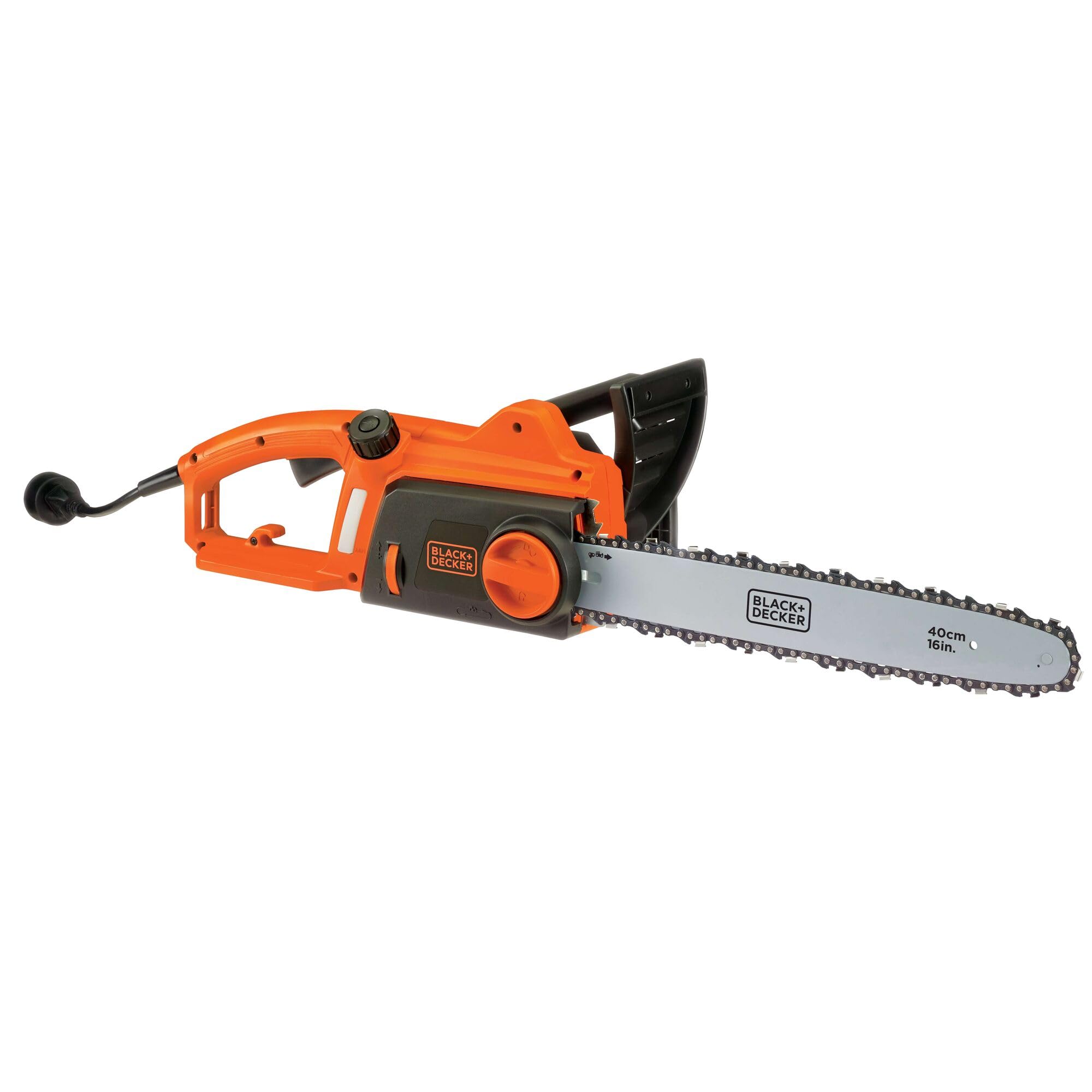
The affordable 16-inch corded saw that surprised reviewers with its power.
Priced as the cheapest full-size chainsaw in this lineup, the Black+Decker CS1216 is the classic “buy it once for occasional use” corded saw — and it consistently earns 5-star reviews from homeowners who do not cut every week but need a saw that works when they do. Shoppers say that it “cut 3 large boxwoods in under 30 min” and that the “16” bar cut 22″ logs easily,” which disproves the assumption that a budget corded saw can only handle twigs. At 10 pounds versus the Oregon CS1500 at 12.6 pounds, it is noticeably easier to maneuver for a 16-inch saw.
The 550-watt (12 amp) motor is rated at 550 watts versus the Oregon’s 2400-watt motor, so while it cuts, it chips away slower through dense hardwood. The low-kickback bar and chain provide smooth operation, and the tool-free chain tensioning lets you adjust mid-cut when the chain inevitably stretches (a common issue at this price level). The automatic oiling system delivers continuous lubrication, and the clear oil window means you always know how much is left.
The main complaint from buyers is that the chain jumped off the bar when sideways pressure was applied — the saw lacks chain guides that pricier saws include — and the chain takes 5 to 6 seconds to stop after you release the trigger, which feels slow compared to saws with a chain brake. One shopper added that the weight and balance make one-handed operation cumbersome, and the trigger grip is tight enough that it is hard to release quickly. For periodic yard work, these are manageable quirks; for daily pro use, they are dealbreakers.
Great for occasional use
- 16″ bar at a budget-friendly price
- 10 pounds — lighter than most 16″ corded saws
- Tool-free chain tensioning
- Automatic oiler with visible oil window
Known limitations
- Chain stays spinning 5-6 sec after trigger release
- Chain can jump the bar under sideways pressure
- Slower than the Oregon through thick hardwood
Ideal for light seasonal duty: If you only cut fallen branches a few times a year and want a 16-inch bar without spending much, this saw works reliably between uses.
Pass if you need consistent daily performance: The chain jumping and slow stop make it less safe for heavy or frequent use — the Oregon or Makita are better for that.
6. Dewalt Chainsaw Pruning 20V 8IN DCCS623B

The compact 8-inch saw that makes quick work of 6-inch limbs with one hand.
If you already own Dewalt 20V tools, the DCCS623B is the simplest upgrade for pruning — it uses the same battery platform, comes as a tool-only (no battery or charger), and weighs around 4.6 pounds (2.09 kg) making it light enough for one-handed cutting. The 8-inch bar gives it less reach than the Oregon CS1500’s 18-inch bar, but buyers report it is “excellent for clearing saplings/branches up to 7” and one reviewer used it for “bush trimming and limbs up to 5-6″” before upgrading to a 12-inch Dewalt for bigger work. Multiple users emphasize that it handles limbs “like butter” and battery life lasts “all weekend on one charge.”
The 2.8 horsepower rating (classified as 2.8 HP, though this is measured differently than gas horsepower) gives it more than enough twist for its intended range. One reviewer noted that swapping to an Oregon 8-inch R34 chain made cuts even faster. The tool is practically silent compared to a gas saw, so you can prune in the backyard without disturbing neighbors. The only recurring complaint is oil leakage if stored improperly — reviewers recommend draining the oil before storage or laying the saw flat with the filler cap pointed up.
Unlike the Black+Decker BCCS320C1 which includes a battery and charger, the Dewalt is tool-only, so you need to own a Dewalt 20V battery already. That makes it a smart choice for Dewalt ecosystem owners and a separate purchase for everyone else. If you are starting from zero, the Black+Decker BCCS320C1 kit with a battery is more cost-effective.
Works best for Dewalt owners
- Shares Dewalt 20V batteries
- Very light — one-hand use is easy
- Cuts limbs up to 7″ with no struggle
- Fantastic battery life per charge
What to know
- Tool-only — no battery or charger included
- 8″ bar limits max cut size
- Oil can leak if not stored correctly
Perfect for trimming small limbs: If you are on the Dewalt 20V platform and need a one-hand pruning saw for branches under 7 inches, this is the natural pick.
Not for bigger logs: The 8-inch bar runs out of reach quickly — the Greenworks 12-inch or any 16-inch corded saw cuts thicker wood in fewer passes.
7. BLACK+DECKER 20V MAX Pruning Chainsaw Kit (BCCS320C1)
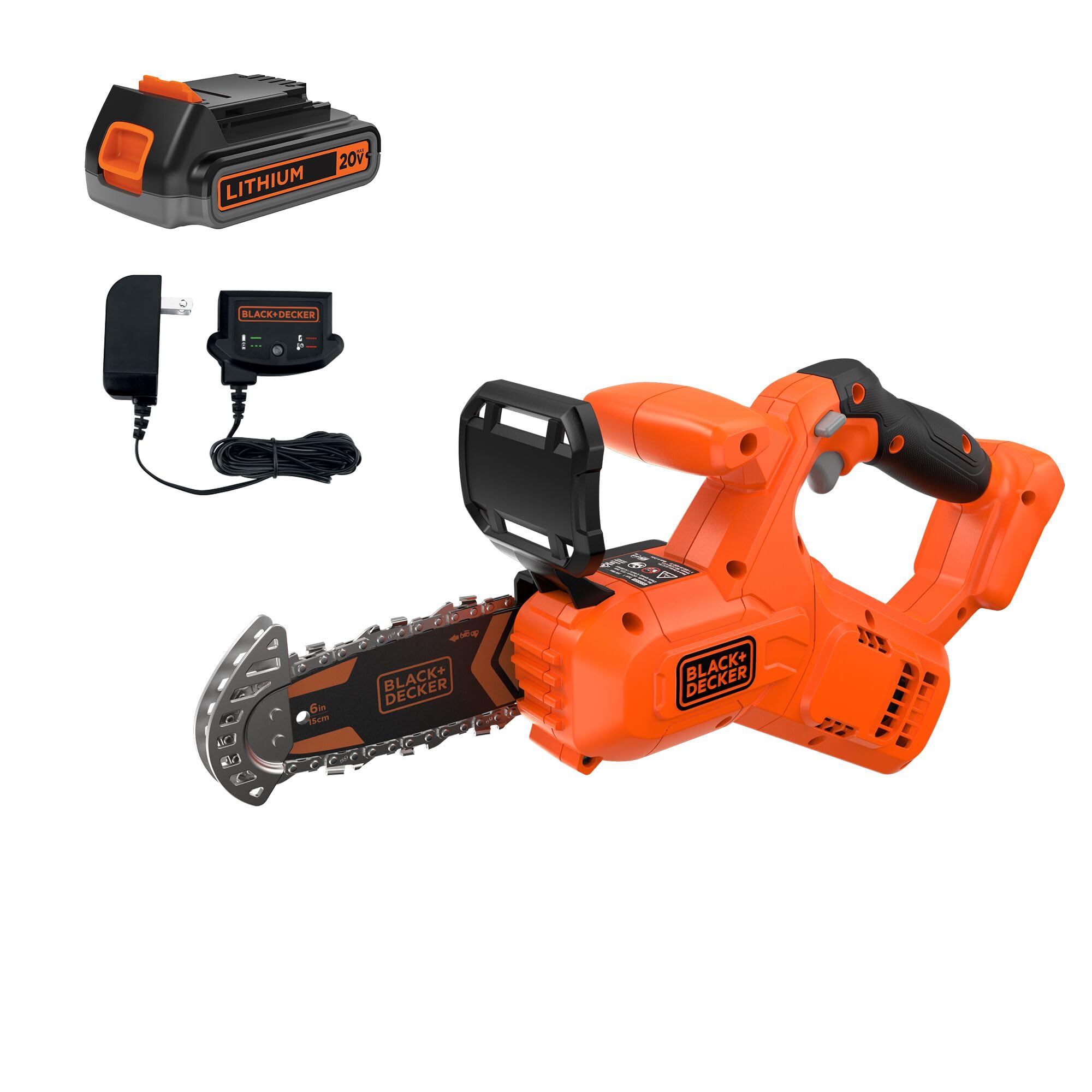
The tiniest saw here — built for branches up to 4 inches and nothing bigger.
The Black+Decker BCCS320C1 is a 6-inch pruning saw kit (battery and charger included) designed for exactly one job: cutting small-to-medium branches that are too big for loppers but too small to justify firing up a full-size chain saw. Owners mention it is “perfect for 3/4-5 inch branches” and that it fits in the gap between hand pruners and a 16-inch corded saw. The 4-inch cut capacity means you cannot take on anything thicker than a fence post — unlike the Dewalt DCCS623B which handles branches up to 7 inches — but for quick trimming around the yard, that is plenty.
The integrated tip guard provides stability when making upcuts (cutting upward from below a branch), and the bolt lock chain tensioning keeps the bar clamped reliably. Because it is oil-free, you never need to refill a reservoir — just spritz the chain with WD-40 occasionally, as one buyer mentioned. The included 20V battery delivers up to 55 cuts per charge, which competes directly with the Greenworks 40V’s 50 cuts rating, and the storage sheath holds an onboard wrench so you can tighten the chain whenever it loosens.
The catch is that the chain is quite coarse for such a small saw, leading one buyer to say it “tends to bind” during longer cuts, and because it runs at 1 horsepower, it cuts slower than a larger saw. One reviewer warned that the chain requires regular sharpening because the stock chain dulls faster than a standard chain. For small pruning tasks (think shaping bushes, trimming fence-line limbs, or cutting kindling around the campsite), it is a better fit than carrying a heavy 16-inch saw. But if you ever need to cut a branch thicker than your wrist, this is the wrong tool.
Why it wins for small jobs
- Kit includes battery and charger — no extra cost
- 6″ bar is great for tight spaces and bushes
- Oil-free — no messy bar oil to refill
- Rated for 55 cuts per charge
Limits to know
- 4-inch cut capacity — cannot handle thick logs
- Chain is coarse and binds during longer cuts
- Requires regular sharpening to stay effective
Best for precision trimming: If you mostly cut branches between 3/4 inch and 5 inches (the exact range that loppers struggle with), this kit saves you from dragging out a bigger saw.
Not for storm cleanup: When you need to cut 8-inch limbs after a storm, the Greenworks 40V 12-inch or any 16-inch corded saw is necessary — this tiny bar will not reach.
Understanding the Specs
Amps vs Horsepower in Electric Saws
For corded electric chainsaws, the amp rating directly tells you how much power the motor draws — a 12-amp saw like the Black+Decker CS1216 delivers typical home-use power, while a 15-amp saw (often listed as 2400 watts) like the Oregon CS1500 produces significantly more torque. In the battery-powered world, manufacturers sometimes use a horsepower figure that is not directly comparable to gas engine horsepower. The simple rule: higher amps (or watts) in corded saws means faster cutting through thicker wood; for battery saws, voltage (20V vs 40V) and battery capacity (Ah) determine runtime more than the horsepower number on the box.
Bar Length and Cutting Depth
The bar length in inches (6, 8, 12, 16, 18) determines the largest diameter log you can cut in one pass from one side. A 16-inch bar typically cuts logs up to about 14 inches thick; a 12-inch bar cuts up to about 10 inches; an 8-inch bar cuts up to about 6 inches. Choosing a bar that is too long adds weight without benefit if you only prune small branches. Choosing a bar too short means you flip the log and cut from both sides. For most home yards with varied tree sizes, a 12- to 16-inch bar is the versatile balance.
FAQ
Can I use a chainsaw for home use on pruning small branches?
How long does a 40V battery last on a Greenworks chainsaw?
Does a corded electric chainsaw need a special extension cord?
What is the self-sharpening feature on the Oregon CS1500 and does it last?
Is a gas chainsaw more powerful than an electric one for home use?
Which chainsaw is best for taking down a tree in the backyard?
How often do I need to sharpen a chainsaw chain for home use?
What is the difference between a pruning saw and a full-size chainsaw?
Does the BLACK+DECKER CS1216 have a chain brake?
Can I use a 20V Dewalt chainsaw for camping and trail clearing?
Final Thoughts: The Verdict
For most people, the chainsaw for home use winner is the Oregon CS1500 because its 18-inch bar, 2400-watt motor, and built-in self-sharpening system handle everything from pruning to storm cleanup without the hassle of gas or chain files. If you want premium corded reliability, grab the Makita UC4051A for its soft-start, current limiter, and commercial-level build quality. And for cordless freedom around the yard, the standout is the Greenworks 40V 12-inch at just 6 pounds with a battery that works across the Greenworks tool platform.
How We Picked
We do not accept paid placement, and we did not hands-on test every unit. Instead, we match each pick to a real buyer and use-case by comparing the manufacturers’ published specifications against the patterns in verified customer reviews — so you get each pick’s real strengths and trade-offs instead of marketing copy.
Sources & Methodology
Specifications: manufacturer listings and product documentation. Review insights: verified customer reviews, as of July 2026. Pricing: not shown on this page (it changes often); check the current price via the retailer link.
As an Amazon Associate, Lawn Gear Lab earns from qualifying purchases. This does not affect which products we feature.