
Specs are compiled from manufacturer listings and verified buyer reviews and can change over time — please confirm the key details on the product page before buying.
A flimsy garden bed that warps, cracks, or rots after one season is the fastest way to kill your gardening momentum. You want years of reliable growing space without wrestling with rotten wood or splintered corners. The three picks here all use real North American cedar (a naturally rot-resistant softwood with a straight grain). They differ sharply in thickness, size, and how much soil they hold — which directly affects how long they last and how much you can plant.
I’m Rikta — the founder and writer behind Lawn Gear Lab. This guide is built by comparing the manufacturers’ published specifications and the patterns across verified customer reviews, so you get each pick’s real strengths and trade-offs instead of marketing spin.
If you want a natural, rot-resistant wood bed that skips chemical pressure treating (where wood is soaked with preservatives under high pressure), these three models represent the best you can buy right now. Think of this as your straightforward roadmap to finding the right cedar raised garden bed for your yard and your budget.
Quick Picks
- Infinite Cedar Premium Cedar Raised Garden Bed – 3′ — Best Overall
- Infinite Cedar Premium Cedar Raised Garden Bed – 1″ — Maximum Planting
- Greenes Fence Premium Cedar Raised Garden Bed — Critter Defense
How To Choose The Best Cedar Raised Garden Bed
Picking the right cedar garden bed depends on three things: wood thickness, overall size, and how easy it is to put together. Thicker wood lasts longer but costs more. A bigger bed holds more soil but takes up more yard space. No-tool assembly saves your back but might not be as sturdy as bolted corners. Here is the breakdown.
Wood Thickness: The Lifespan Decider
The single most important spec is how thick the cedar boards are. Thicker wood resists warping, cracking, and rot better over time. The beds here come in 1-inch thick and 3/4-inch thick options (3/4 inch is the same as 0.75 inch). The 1-inch boards are noticeably heavier and sturdier, while the 3/4-inch boards are lighter and still good quality — just not as resistant to the elements in the very long run.
Soil Capacity and Dimensions
Your bed’s capacity, measured in cubic feet (a box 1 foot tall, 1 foot wide, and 1 foot long), tells you how much soil you need to fill it. A larger capacity means you can plant more densely or grow deeper-rooted crops like carrots or potatoes. But bigger is not always better — you also need to reach the center of the bed comfortably. Standard widths are 3 feet or 4 feet, and lengths usually run 6 to 8 feet. Match the dimensions to your available space and your reach.
Assembly and Construction Style
Some beds use interlocking dovetail joints (wedge-shaped tabs that fit into matching slots) that snap together without any tools or hardware. Others use bolts, nuts, and pre-drilled boards for a more traditional build. Tool-free setups are faster, but bolted corners tend to stay tighter over time. Check whether the bed uses any screws, nails, or corner brackets — and whether you are comfortable assembling it in its final location (a good idea, since moving a full bed of soil is a pain).
Quick Comparison
| Model | Best For | Wood Thickness | Dimensions | Soil Capacity | Amazon |
|---|---|---|---|---|---|
| Infinite Cedar 3’x6’x11″ | Easy solo assembly | 1 inch | 72 x 36 x 11 in. | 16.5 cu. ft. | Amazon |
| Infinite Cedar 4’x8’x16.5″ | Maximum planting space | 1 inch | 96 x 48 x 16.5 in. | — | Amazon |
| Greenes Fence 4’x8’x10.5″ | Critter defense | 3/4 inch | 48 x 96 x 10.5 in. | 28 cu. ft. | Amazon |
In‑Depth Reviews
1. Infinite Cedar Premium Cedar Raised Garden Bed – 3′ x 6′ x 11″

A 1-inch-thick cedar bed that a 72-year-old assembled solo in minutes, according to buyers.
This is the bed that makes first-time gardeners breathe easy. The boards are a full 1 inch thick, made from rot-resistant North American Western Red Cedar with no chemicals or stains added. Buyers report easy solo assembly for a 72-year-old, noting the cedar was pristine with no knots, cracks, or warping. It is also handcrafted in Maine and backed by a 5-year warranty (the manufacturer guarantees workmanship and material quality for five years from the date of purchase, assuming normal use).
The 72 x 36 x 11 inch dimensions and 16.5 cubic feet of soil capacity make it a comfortable reach-across size — you can tend the center without stepping into the bed. Unlike the Greenes Fence model with its 3/4-inch boards, this one uses thicker wood for added durability. Just be aware that after four weeks one reviewer noted a long piece warped; the manufacturer sent a replacement kit, though the second kit also had bowed planks. Assembly is tool-free with no screws or nails — the corners use a dovetail-less interlocking design that some owners reinforce with aftermarket metal brackets.
The catch is the 3-foot width. If you want the maximum 4-foot-wide planting area like the Infinite Cedar 4’x8’x16.5″ offers, you will need to size up. But for a manageable, thick-wood bed that saves your back on setup day, this is the one to beat.
Real strengths
- 1-inch thick Western Red Cedar resists rot naturally
- Tool-free assembly takes minutes
- 5-year workmanship warranty from a Maine-based maker
- No chemicals, stains, or pressure treating
Honest trade-offs
- Some owners mention warping in longer boards after a few weeks
- 3-foot width means less planting area than 4-foot models
- 16.5 cu. ft. capacity is smaller than the Greenes Fence’s 28 cu. ft.
Reach for this if: you want the thickest wood (1 inch) in a manageable size, prefer no-tool setup, and value a USA-made bed with a real warranty.
Look elsewhere if: you need a full 4×8 foot footprint or worry about warping in long planks — the 4’x8′ Infinite Cedar may suit you better.
2. Infinite Cedar Premium Cedar Raised Garden Bed – 1″ Thick Wood (4′ x 8′ x 11″ H)

A 4×8 foot planting powerhouse with 1-inch thick walls and a generous 16.5-inch height — deeper soil means less bending.
If you are ready to commit serious yard space to vegetables or flowers, this bed gives you the biggest footprint in the lineup — 96 x 48 inches with a 16.5-inch depth. That extra height means you can fill it deep for root crops like carrots and potatoes, and you will do less bending. The wood is 1-inch thick North American Western Red Cedar, unfinished so it will age naturally to a silver-gray patina (a soft gray color from sun and rain). Assembly uses pre-cut and pre-drilled boards with bolts and nuts; the manufacturer describes it as easy assembly without claiming it is tool-free.
Where this model really stands apart from the Greenes Fence 4’x8’x10.5″ is the board thickness — 1 inch versus 3/4 inch. The Infinite Cedar is also heavier at 55 pounds in the box, which buyers should note when moving it into position. The manufacturer guarantees workmanship and material quality for five years from the date of purchase, assuming normal use. All boards are natural western red cedar with no added chemicals and no pressure treating.
The trade-off is straightforward: you get the largest available planting area plus thicker wood, but you do not get the integrated CritterGuard fence system that the Greenes Fence model includes. If pests are a problem in your yard, you will need to add your own fencing or netting. The bolt-together assembly is also more involved than the tool-free corners on the 3’x6′ Infinite Cedar above.
Why it stands out
- Generous 4×8 foot footprint with 16.5-inch depth for deep soil
- 1-inch thick Western Red Cedar for long-term rot resistance
- No chemicals or pressure treating — safe for organic gardening
- 5-year workmanship warranty included
What to consider
- Heavier build (55 lbs) requires two people to move into place
- Bolt assembly takes more time than tool-free interlocking designs
- No built-in critter fence — you supply your own pest protection
Best for: serious gardeners who want the maximum 4×8 planting area and are willing to spend a little longer on assembly for thick, durable walls.
skip it if: you need an all-in-one pest defense system or prefer a lighter, tool-free setup — the Greenes Fence model or the smaller Infinite Cedar may be a better fit.
3. Greenes Fence Premium Cedar Raised Garden Bed with CritterGuard Fence System
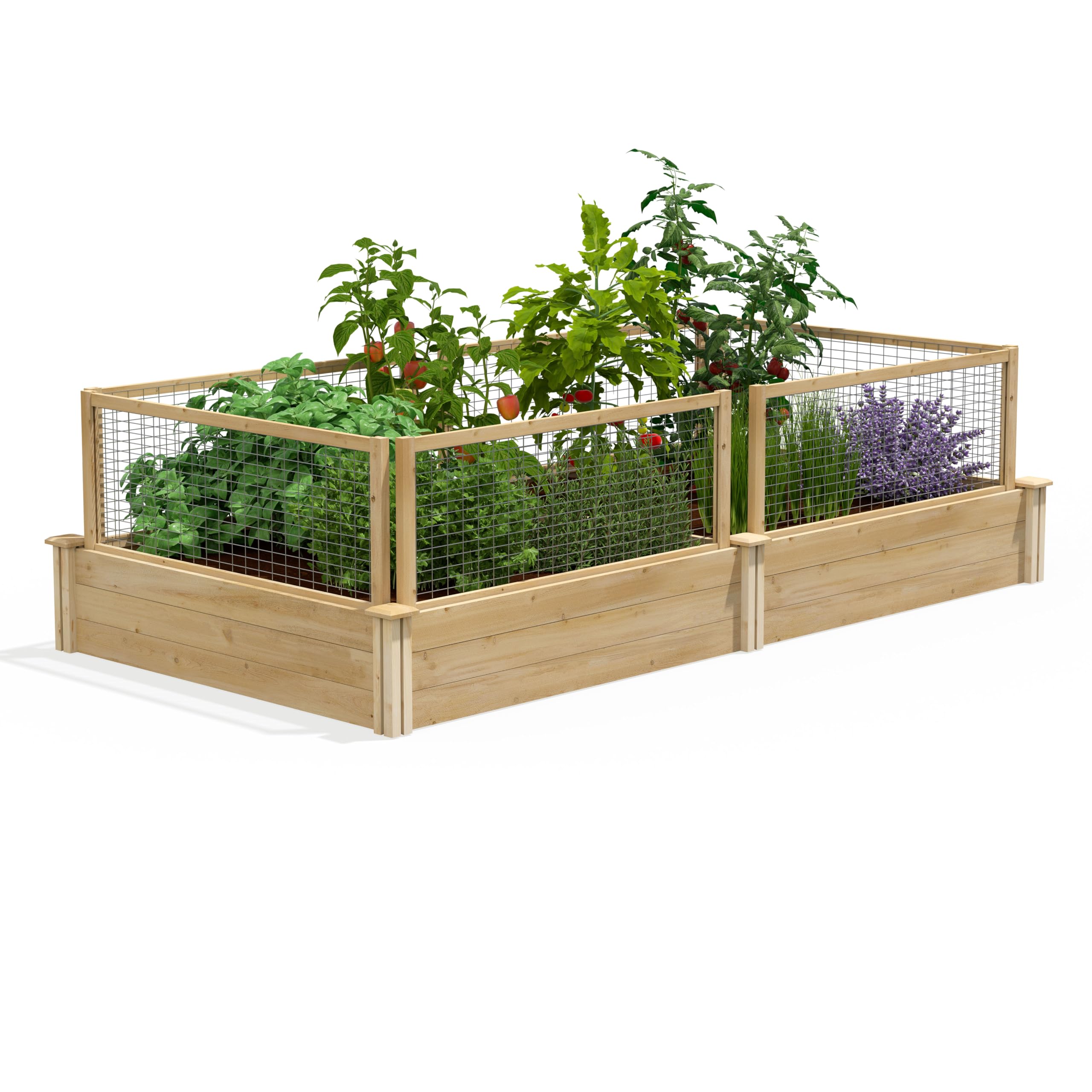
A 4×8 bed with a built-in fence to keep rabbits and squirrels out of your vegetables — no extra hardware needed.
Pests are the silent crop killer, and this is the only bed here that ships with a ready-to-use critter defense. The Greenes Fence model comes with self-staking CritterGuard fence panels that you simply push into soft soil around the bed — no digging or separate hardware. The bed itself holds up to 28 cubic feet of soil, at 28 cubic feet versus the Infinite Cedar 3’x6’x11″ at 16.5 cubic feet, giving you serious room for deep-rooted plants. The dimensions are 48 x 96 x 10.5 inches with 3/4-inch thick boards and 2.5-inch square corner posts (thicker than typical 2×2 posts, so the corners hold their shape better).
Assembly is fast thanks to dovetail interlocking joints (wedge-shaped tabs and slots) and routed corner posts (channels cut into the posts for boards to slide into) that also allow stacking or expansion later. The cedar is chemical-free North American wood, left unfinished so it weathers to a natural silver-gray patina over time. Unlike the Infinite Cedar beds which use 1-inch thick wood, the Greenes Fence uses 3/4-inch boards — slightly thinner but still solid, and the dovetail joints add structural rigidity. The manufacturer includes tools and an instruction manual in the box.
The honest catch is the 10.5-inch height, which is 6 inches lower than the Infinite Cedar 4’x8’x16.5″ at 16.5 inches. You get less soil depth for root vegetables like carrots and parsnips, though the 28 cubic foot capacity partly compensates with sheer width and length. Reviewers have not yet reported on long-term durability, so the 3/4-inch board thickness remains an open question after a few seasons. If pests are a daily battle in your yard, the integrated fence makes this a strong contender despite the height trade-off.
Key strengths
- Built-in CritterGuard fence panels push into soil — no tools needed
- Generous 28 cu. ft. soil capacity for lots of planting
- Dovetail interlocking joints for fast, tool-free assembly
- Routed corner posts allow stacking or future expansion
Trade-offs to know
- 3/4-inch boards are thinner than the 1-inch Infinite Cedar models
- 10.5-inch height offers less root depth than taller beds
- Long-term durability of 3/4-inch wood is unconfirmed by long-term reviews
Pick this if: rabbits, squirrels, or birds regularly raid your garden and you want an all-in-one bed with a fence that sets up in minutes.
pass on it if: you need maximum soil depth for deep-rooted crops or prefer the thicker 1-inch wood of the Infinite Cedar beds.
Understanding the Specs
Wood Thickness (inches)
The thickness of the cedar boards directly determines how long the bed resists warping, cracking, and rot. A 1-inch thick board is heavier, more expensive, and generally lasts longer than a 3/4-inch board (3/4 inch equals 0.75 inch). All three picks use solid Western Red Cedar, which naturally resists decay without chemical treatment. Thicker boards also hold screws or bolts better over time.
Soil Capacity (cubic feet)
This number tells you how many cubic feet of soil you need to fill the bed completely. A 28 cubic foot bed means a lot more growing volume than a 16.5 cubic foot bed. The trade-off is cost — more soil and a bigger bed cost more upfront. Capacity also affects drainage and moisture retention, so match it to what you plan to grow.
FAQ
Is cedar better than pressure-treated wood for raised garden beds?
How long will a cedar raised garden bed last?
Can I leave my cedar bed unfinished?
How much soil do I need to fill a 4×8 foot cedar raised bed?
Do I need to assemble the bed in its final location?
What is the weight limit for a cedar raised garden bed?
Can I stack two beds on top of each other?
Does the CritterGuard fence keep out all animals?
Are these beds safe for growing vegetables and herbs?
What tools do I need for assembly?
Final Thoughts: The Verdict
For most buyers, the cedar raised garden bed winner is the Infinite Cedar 3′ x 6′ x 11″ because it pairs a full 1 inch of thick Western Red Cedar with genuinely tool-free assembly at a manageable size. If you need the biggest possible 4×8 footprint with 1-inch thick walls, grab the Infinite Cedar 4′ x 8′ x 16.5″. And for keeping bunnies and squirrels out of your vegetables without extra hardware, the Greenes Fence with CritterGuard is the pick.
How We Picked
We do not accept paid placement. Every pick is matched to a real buyer and a real use-case; we do not hands-on test units.
Sources & Methodology
Specifications: manufacturer listings and product documentation. Review insights: verified customer reviews, as of July 2026. Pricing: not shown on this page (it changes often); check the current price via the retailer link.
As an Amazon Associate, Lawn Gear Lab earns from qualifying purchases. This does not affect which products we feature.