
Specs are compiled from manufacturer listings and verified buyer reviews and can change over time — please confirm the key details on the product page before buying.
A fence that sags when a cow leans on it or snaps when a deer hits it is useless. You need a cattle panel fence — woven steel that stops a 1,500-pound bull but still bends around rocky ground without breaking. The best overall pick, the Cattle Panel 4ft x 328ft 14 Gauge (ZESHANGUS), combines 14-gauge mesh (mid-thickness wire that balances strength and flexibility) with a 12-gauge (thicker) border along the top and bottom so it stays tight under pressure. For something taller, the Galvanized Farm Fence 5ft x 164ft (HMOLIKH) gives you an extra foot to stop deer. If you need a flexible panel on uneven terrain, the Cattle Panel 14Gauge 4FT x 328 FT (ZESHANGUS) woven-wire roll absorbs impacts instead of breaking at weld points.
I’m Rikta — the founder and writer behind Lawn Gear Lab. This guide is built by comparing the manufacturers’ published specifications and the patterns across verified customer reviews, so you get each pick’s real strengths and trade-offs instead of marketing spin.
Understanding gauge (wire thickness), mesh design (how big the gaps are at the top versus bottom), and zinc coating (the rust protection layer) is the smartest way to pick a fence that lasts.
Our Picks at a Glance
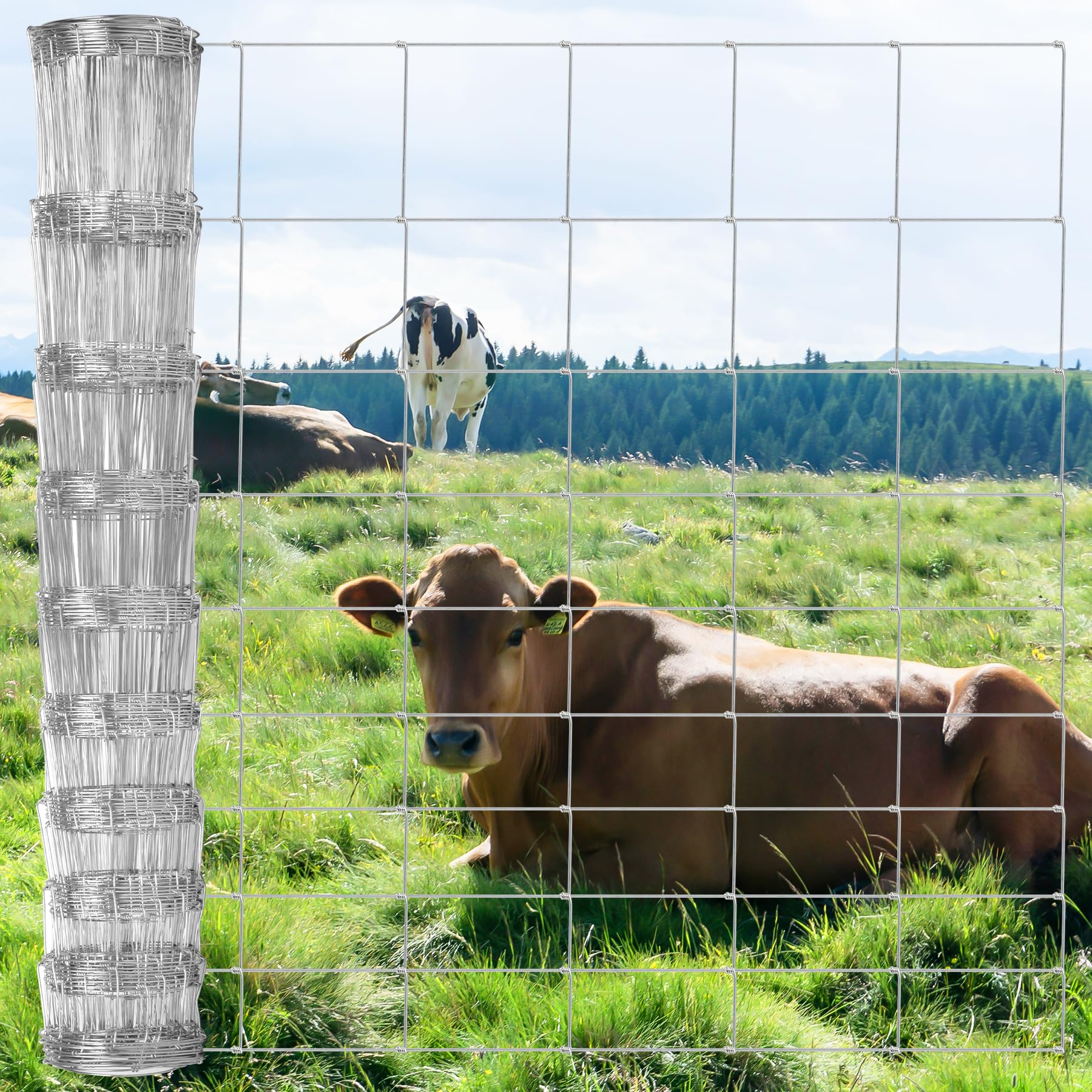
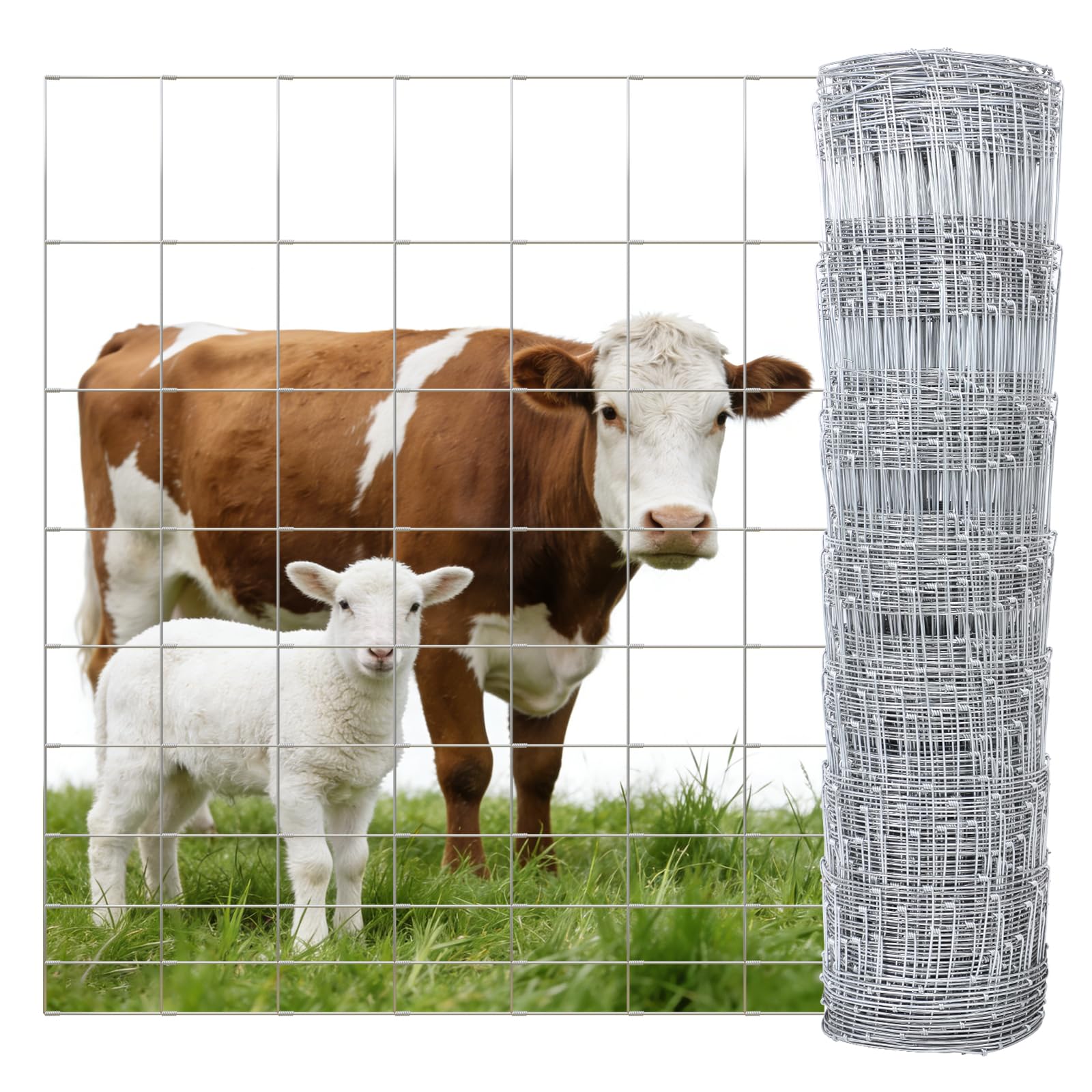
How To Choose The Best Cattle Panel Fence
You need the right wire thickness, mesh pattern, and rust protection for your animals and weather. A fence that keeps chickens in will not survive a season with a bull. Here is what to check.
Gauge Number — The Single Most Important Number
Wire gauge (the diameter of the steel wire) determines strength. A lower number means thicker, stronger wire. A 14-gauge fence is the most common all-purpose choice for cattle, horses, and hogs. A 12-gauge reinforced border (a thicker wire along the top and bottom edges) adds impact resistance where animals are likely to push or lean.
Mesh Design: Tapered or Uniform
A tapered mesh starts with wide openings near the top (around 8 inches) and narrows to small openings near the bottom (3.5 inches). The wider top gives you visibility and keeps the roll lighter; the tighter bottom stops small animals like goats, piglets, and dogs from squeezing through. A uniform mesh uses the same opening size throughout and is more common for deer fences where large escape is the only worry.
Galvanization: Zinc Coating Quality
Hot-dip galvanization coats each wire in a thick layer of zinc that fights rust. In normal environments a good coating should last 15-20 years before corrosion appears. In coastal, high-humidity, or high-impact livestock areas you can still get 10-15 years from a heavy zinc coating. A thin coating means the fence rusts from the inside out within a few seasons.
Quick Comparison
| Model | Best For | Gauge / Border | Height | Length / Area | Amazon |
|---|---|---|---|---|---|
| Farm Fence 4.5FT x 100FT (Toriexon)★ Best Overall | Mid-Range Pet/Livestock | 11 GA & 14 GA mix | 4.5 ft | 100 ft | Amazon |
| Cattle Panel 4ft x 328ft 14 Gauge (ZESHANGUS)Also Great | Best Overall Heavy Duty | 14 GA body / 12 GA border | 4 ft | 328 ft | Amazon |
| Cattle Panel 14Gauge 4FT x 328 FT (ZESHANGUS) | Premium Extra Length | 14 GA body / 12 GA border | 4 ft | 328 ft / 1312 sq ft | Amazon |
| Galvanized Farm Fence, 5ft x 164ft (HMOLIKH) | Tall Perimeter Enclosure | 14 GA | 5 ft | 164 ft / 820 sq ft | Amazon |
| Livestock Fence, 4ft X 164ft (Mymawzey) | Value Long Run | Galvanized Steel | 4 ft | 164 ft | Amazon |
| Farm Fence 4ft x 164ft (YESON) | Budget All-Purpose | 14 GA | 4 ft | 164 ft / 656 sq ft | Amazon |
In-Depth Reviews
1. Farm Fence 4.5FT x 100FT, Galvanized Cattle Fence (Toriexon)
Our pick — over 4★ from 100+ verified ratings; the strongest balance of quality and price.
A shorter, thicker-wire fence that feels right for dogs and smaller livestock runs.
At 32 pounds for a 100-foot roll, this fence is noticeably lighter than the 50.7 pounds of the Livestock Fence (Product 2). The mix of 11-gauge and 14-gauge steel wire is unique: 11-gauge is thicker than the 14-gauge body used by most other picks, meaning the horizontal wires are beefier where a dog or goat might push. The gradient mesh shrinks from top to bottom, with small bottom squares that reviewers point out prevent dogs from reaching through.
One reviewer called it “thick wire suitable for 80+ lb dogs; durable, easy install, less noticeable than chain-link.” Another mentioned they installed it solo with ease and that the included free quality pliers were a nice bonus. The fence stands 4.5 feet tall — a middle ground between standard 4-foot rolls and the 5-foot HMOLIKH — which helps slightly with deer without needing taller posts.
Some shoppers say it feels flimsy for large farm animals. One buyer mentioned bluntly “not sure how well it will hold up to farm (large) animals.” This is really a dog-and-small-livestock fence, not a bull enclosure.
Why it works
- Mixed 11-ga and 14-ga wire adds extra thickness where animals push hardest.
- Light enough at 32 lbs for a single person to unroll and install.
- Small bottom mesh keeps dogs from squeezing through or reaching out.
One limitation
- Not built for large livestock like cattle or horses — the wire can bend under heavy pressure.
- At 100 ft, you may need multiple rolls for a sizable pasture.
Reach for this if: You are fencing a dog yard or a small goat/sheep pen and want a wire that is thick enough for daily pushes but light enough for DIY install.
skip it if: You need to contain 1,500 lb cattle — step up to a 12-ga reinforced border panel instead.
2. Cattle Panel 4ft x 328ft 14 Gauge Heavy Duty (ZESHANGUS)
A 328-foot roll with reinforced edges that takes the worry out of heavy livestock.
This fence keeps cattle from pushing through because of its 12-gauge (a noticeably thicker wire) border along the top and bottom edges. The main mesh is 14-gauge (a mid-thickness wire that balances bendability and strength) galvanized steel, but that thicker border resists sagging when a bull leans on it. The mesh tapers from 8-inch gaps at the top — so you can see across the pasture — down to 3.5-inch gaps at the bottom, so goats and piglets cannot squeeze out. Buyers report thick, sturdy, heavy-duty construction with strong impact resistance for cattle and deer.
One owner noted large dogs cannot climb it and that the springy material spooks them off, while a small 13 lb dog cannot escape thanks to the properly sized bottom holes.
The maker claims a reliable 15–20 year lifespan in normal environments and 10–15 years in extreme conditions like coastal or high-humidity areas thanks to the hot-dip galvanized coating. That is a serious durability promise for someone fencing off a permanent pasture.
What it does best
- 12-gauge reinforced border resists sagging from heavy livestock pressure.
- Tapered mesh keeps both calves and small animals contained.
- Large 328-foot coverage handles big fencing projects in one roll.
Know before you buy
- Some reviews note the 12-gauge top/bottom wires are lighter than expected.
- At 328 feet, unrolling the entire roll smoothly requires two people.
Who this works for: Ranchers and hobby farmers fencing a permanent pasture for cattle, horses, or mixed herds where long-term rust resistance and impact strength are non-negotiable.
Think twice if: You only need a small dog run — a shorter, lighter roll will save you hassle and money.
3. Cattle Panel 14Gauge Woven Wire Fence 4FT x 328 FT (ZESHANGUS)
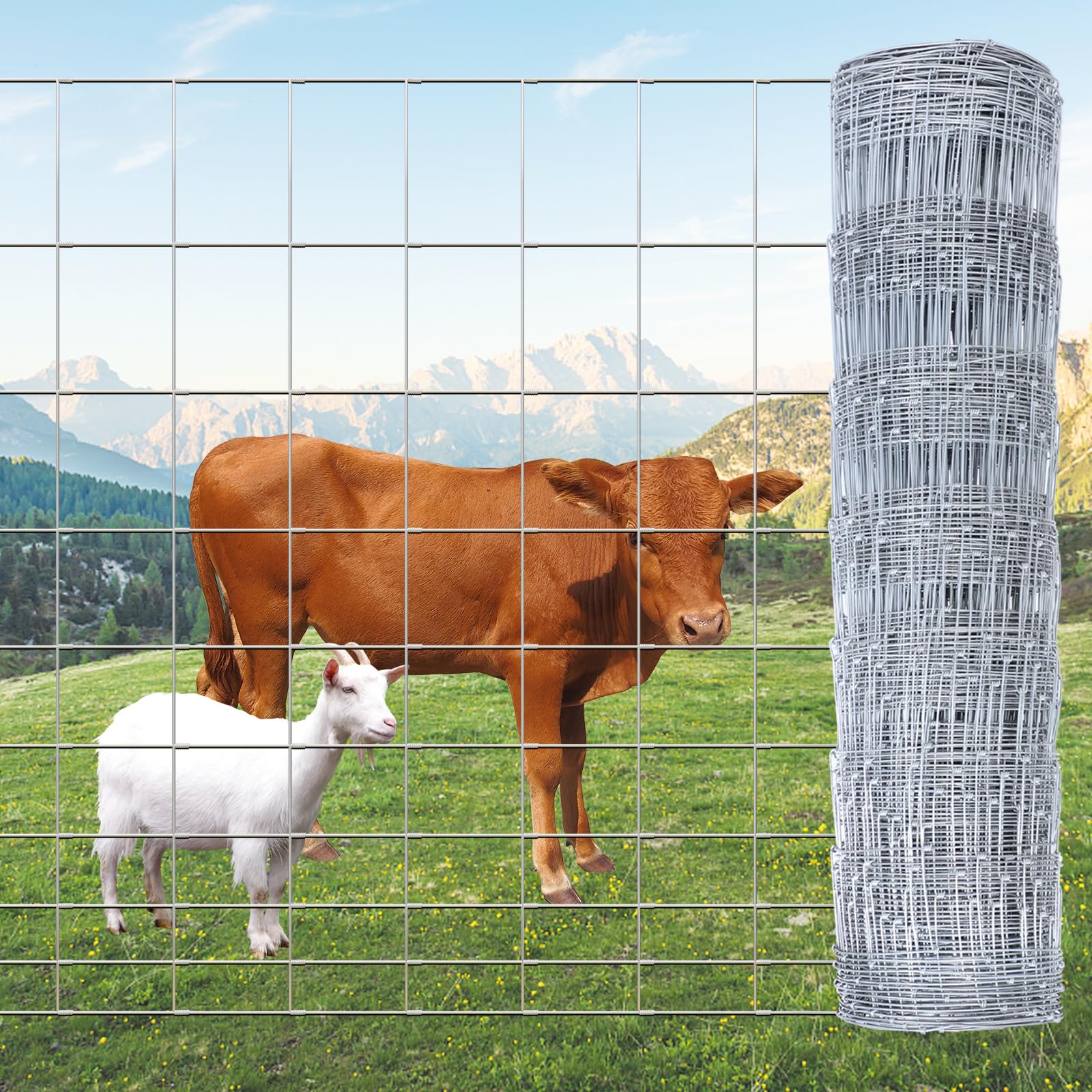
Four feet tall, 328 feet long, and woven to flex instead of snap under pressure.
This is the woven-wire version of the ZESHANGUS above. It uses a 14-gauge body with 12-gauge reinforced borders, but the true woven grid (where wires are interlocked in an over-under pattern) lets the panel flex under an animal’s weight or heavy wind without breaking weld points. That makes it great for uneven terrain where a rigid panel would deform. One reviewer noted they installed all 324 feet by themselves and called it a “great fencing for large area, medium sized dogs.”
The graduated mesh design uses 3.5-inch openings near the bottom to stop piglets and poultry from slipping out while keeping predators from reaching in, and 8-inch openings above to reduce weight and keep visibility. At 1312.0 square feet, this roll covers 1312.0 square feet versus the YESON fence’s 656.0 square feet, meaning fewer splices for large perimeter jobs. The maker claims the same 15-20 year lifespan in normal conditions and 10-15 years in extreme conditions as the other ZESHANGUS model.
Reviewers report the wire can arrive bent in places if the roll was not wrapped carefully. However, most say the value at this price — described as “half the price of other wire” by one owner — makes the occasional bend a minor irritation.
Standout features
- Woven construction flexes without breaking weld points under livestock pressure.
- Tapered 8in to 3.5in mesh handles mixed-species containment from piglets to cattle.
- Large 328-foot roll covers big spaces without needing multiple panels.
What to watch for
- Occasional packaging issues can cause bent wire on arrival.
- Not as rigid as welded panels — best used with t-posts every 5-6 feet.
Why grab this one: If you need a single continuous roll for a large, uneven property and prefer a fence that absorbs impacts rather than breaking at weld points.
Consider something else if: You need a rigid, no-flex barrier for a small garden bed — a shorter, welded panel would be easier to handle.
4. Galvanized Farm Fence, 5ft x 164ft (HMOLIKH)
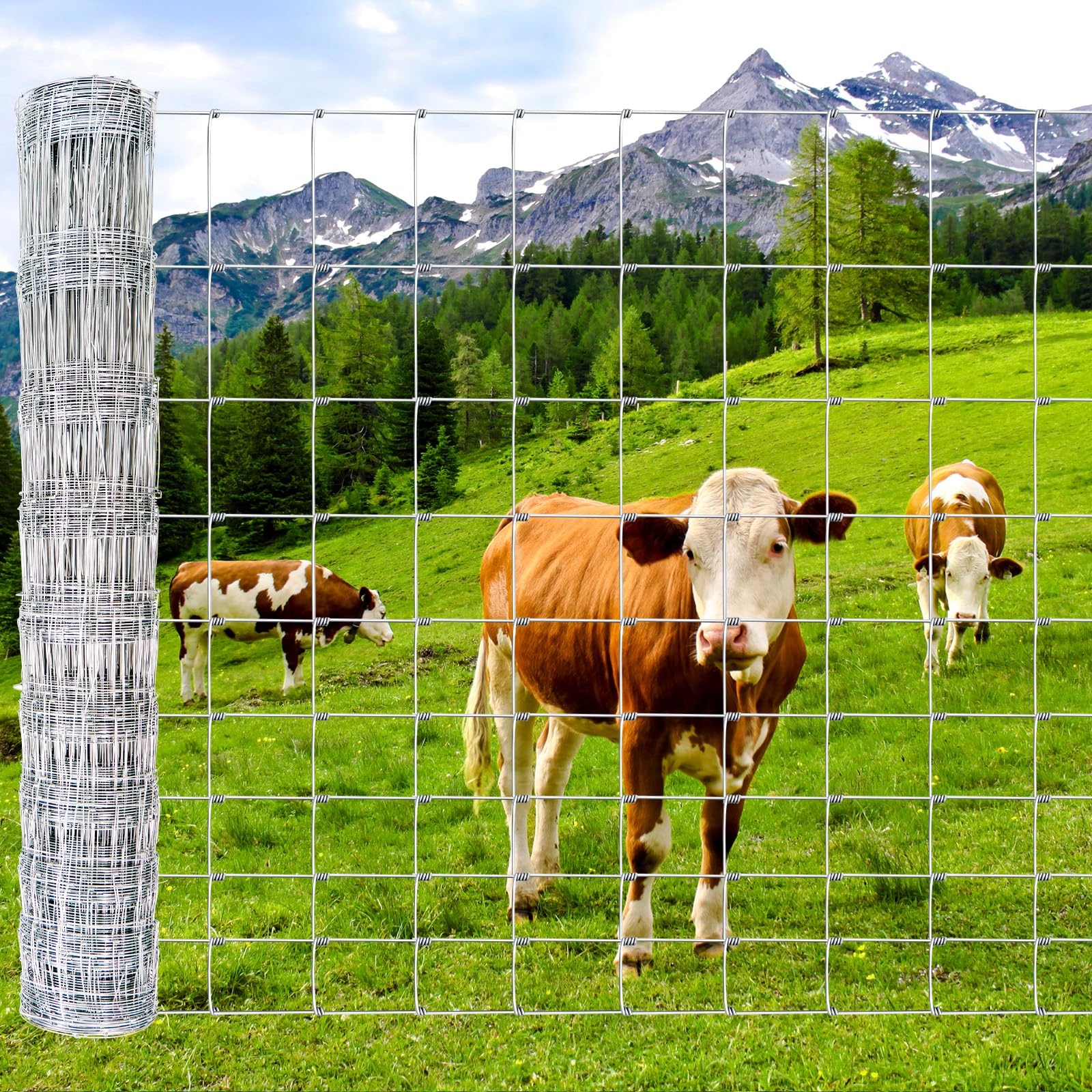
Five feet of height that gives deer one more reason not to bother jumping.
At 5 feet tall and 164 feet long, this is the tallest option here — a full foot taller than standard 4-foot rolls. That extra height matters if you are fencing in deer, which can clear a 4-foot fence without breaking stride, or if you have large livestock like horses that test the top edge. The 14-gauge hot-dip galvanized steel wire is the same gauge as most of the other picks, but the taller dimension means 820.0 square feet of coverage from a single 164-foot roll. That is 820.0 square feet versus the YESON fence’s 656.0 square feet.
Owners mention the fence is “thick, sturdy, heavy-duty with strong impact resistance for cattle/deer” and that the uniform mesh prevents escapes and intrusions. The hierarchical design — where mesh sizes gradually shrink from top to bottom — is meant to disperse impact pressure. One reviewer uses it successfully for chickens, saying it works “as designed.”
Reviews here are mixed: about half call it very sturdy and ideal for pasture enclosures, while others say it is flimsy and bows out despite tight stretching. One buyer who rated it 1 out of 5 stars noted wind tears it up easily. The difference likely depends on post spacing — t-posts every 4-5 feet rather than 6-8 feet seem to make the difference between a taut barrier and a sagging one.
Its strength
- Tallest option at 5 ft — effective deer deterrent without an extra strand of barbed wire.
- Hot-dip galvanized coating resists rust in wet conditions, per manufacturer claim.
- Large 820 sq ft coverage handles sizable pastures or garden perimeters.
Keep in mind
- Some customers note the wire is too flexible and bows under pressure without tight post spacing.
- Wider mesh may struggle to contain small animals like rabbits at the bottom.
Best for: A property with deer pressure or larger livestock where an extra foot of height makes the difference between a fence that contains and one that is a suggestion.
Not ideal for: Small pets or goat enclosures where you need tight, narrow mesh near the ground to prevent escapes.
5. Livestock Fence, 4ft X 164ft Galvanized Wire (Mymawzey)

Heavy-duty weight per foot that says “I am here to stay” without the premium price tag.
At 50.7 pounds for a 4 ft x 164 ft roll, this is the heaviest standard-length fence in the mid-range tier. That weight comes from a thick hot-dip galvanized coating that buyers report makes it surprisingly sturdy for the price. The mesh holes are designed differently at the top and bottom, with smaller openings near the ground to prevent small animal entry. Several owners use it as a garden perimeter fence to keep deer out, with one noting deer have run into it several times with no serious damage.
Compared to the 32-pound Farm Fence (Product 1), this roll is 50.7 pounds, giving you more steel and more zinc per foot for roughly similar coverage area. That extra weight also makes unrolling a two-person job — one buyer cautioned it is “like a spring-loaded time bomb” when unrolling, so wear gloves and keep your face clear.
This is not an active livestock fence. Multiple reviews describe it as “somewhat light duty” and “perfect for protecting gardens from the deer” rather than containing cattle or horses. One owner reported it is a “little flimsy but good for the price” and said t-posts every 5 feet is optimal for sturdiness.
What stands out
- Heavy hot-dip galvanized coating resists rust and stands up to weather for years.
- At 164 ft, it offers good value per foot for large garden or deer fencing projects.
- Buyers confirm it stops deer impact without serious damage to the fence.
What it is not
- Not designed for active livestock containment — cattle and horses can push through.
- Unrolling requires caution; the springy wire can snap back unexpectedly.
Who gets the most from it: Gardeners and homesteaders who need a long, affordable deer barrier that handles impact without breaking.
Pass if: You plan to hold cattle, hogs, or horses long-term — the wire is too light for that daily pressure.
6. Farm Fence 4ft x 164ft Heavy Zinc Coating (YESON)

A budget-friendly roll that gets the job done for dogs and gardens while staying affordable.
At 4 feet tall and 164 feet long with 656.0 square feet of total coverage, this is the entry-level option for a suburban yard or a small pasture. The 14-gauge hot-dip galvanized steel wire uses twisted weaving technology where vertical and horizontal wires are locked together so they do not slip apart under tension. The mesh gradually shrinks from top to bottom — preventing small animals from squeezing through the bottom without using extra wire on the top half.
Owners mention the fence arrived in just 2 days, expertly packaged with zero damage — one reviewer called it “clearly a professional operation.” Many owners use it as a dog fence with t-posts and zip ties, and several say it keeps their pittie from bending the fence and keeps deer from jumping over. The red line running along the top wire makes the fence more visible in low light, reducing the chance someone walks into it.
The gauge is lighter than some competing rolls. One buyer who rated it 1 star claimed the wire is closer to 16 gauge than the advertised 14 gauge, and that it breaks easily when stapling and wrapping. Another noted it kept getting stuck on itself towards the end of unrolling, and that at 4 feet, the height requires adding a top strand if you need to stop deer from jumping clean over it.
Where it shines
- Budget-friendly price makes it an easy choice for large garden or dog enclosures.
- Twisted weaving technology keeps the grid tight and prevents wires from slipping.
- Buyers praise the fast, damage-free shipping and professional packaging.
Be aware
- Some customers note the 14-ga wire feels closer to 16-ga — lighter than expected.
- At 4 ft tall, it may not stop deer from jumping on its own.
Who this fits: A homeowner or small-acreage owner on a tight budget who needs a reliable dog fence or garden barrier without premium steel thickness.
Not the one for: Heavy livestock containment or any situation where 16-gauge-level wire would risk breaking under pressure.
Understanding the Specs
Gauge Thickness
Gauge is the diameter of the steel wire — a lower number means thicker, stronger wire. A 12-gauge wire is thicker than a 14-gauge wire, which is thicker than a 16-gauge wire. For cattle panels, a 14-gauge body with a 12-gauge reinforced border is the balance: the body is flexible enough to unroll and shape around corners, but the thicker border takes the impact when a cow leans or a deer runs into it. A fence made entirely from 11-gauge wire (like the mixed-gauge Toriexon) is heavier and harder to work with but offers maximum puncture resistance where dogs push against the mesh.
Woven vs Welded Construction
Woven wire fences are built by interlocking horizontal and vertical wires in an over-under pattern, similar to fabric. This lets the panel flex under pressure without breaking individual welds — useful on uneven terrain and for absorbing impacts from livestock. Welded wire fences use spot welds at each intersection and are rigid, so they hold their shape better for small garden cages but can snap at the welds under heavy animal pressure. Most cattle panel fences use woven construction because the flexibility prevents breaks where animals push repeatedly.
FAQ
What gauge cattle panel fence do I need for cattle?
Will a 4-foot tall fence stop deer from jumping over?
How do I prevent small animals from squeezing through the bottom of a cattle panel fence?
How long does a galvanized cattle panel fence last?
Can I install a cattle panel fence by myself?
What is the difference between a cattle panel fence and a hog panel?
Will a cattle panel fence rust if I use it near a salt lick or in a coastal area?
Can I use a cattle panel fence as a garden trellis or compost bin enclosure?
How do I tension a cattle panel fence so it does not sag?
What is the difference between hot-dip galvanized and electro-galvanized cattle panels?
Final Thoughts: The Verdict
For the majority of shoppers, the cattle panel fence winner is the Cattle Panel 4ft x 328ft 14 Gauge (ZESHANGUS) because the 12-gauge reinforced border and tapered mesh design handle everything from cattle to goats without sagging or rusting for years. If you want the extra height to stop deer entirely, grab the Galvanized Farm Fence 5ft x 164ft (HMOLIKH). And for a large, flexible enclosure on uneven ground where weld points would snap, the Cattle Panel 14Gauge 4FT x 328 FT (ZESHANGUS) woven wire roll gives you the coverage and impact absorption to hold mixed herds across acres of pasture.
How We Picked
We do not accept paid placement. Every pick is matched to a real buyer and a real use-case; we do not hands-on test units.
Sources & Methodology
Specifications: manufacturer listings and product documentation. Review insights: verified customer reviews, as of July 2026. Pricing: not shown on this page (it changes often); check the current price via the retailer link.
As an Amazon Associate, Lawn Gear Lab earns from qualifying purchases. This does not affect which products we feature.