
Specs are compiled from manufacturer listings and verified buyer reviews and can change over time — please confirm the key details on the product page before buying.
Forgetting to feed your succulents is rarely the problem — it’s feeding them the wrong thing that sends them soft, stretched, or pale. Unlike leafy houseplants that gulp down high-nitrogen meals, cacti and succulents need a leaner, more balanced diet that matches their slow, steady rhythm. The right cactus and succulent fertilizer won’t make them explode overnight, but it will reward you with plump leaves, vibrant color, and roots that handle your occasional watering forgetfulness.
I’m Rikta — the founder and writer behind Lawn Gear Lab. This guide is built by comparing the manufacturers’ published specifications and the patterns across verified customer reviews, so you get each pick’s real strengths and trade-offs instead of marketing spin.
Picking the right cactus and succulent fertilizer depends on understanding what your plants actually need versus what the label claims.
Quick Picks
- HiThrive 16oz Succulent Fertilizer — Best Overall
- Grow Queen Complete Organic 11-Pack — Organic Power
- Gardenera Plant Superfood Spray — Rapid Rescue
- Espoma Organic Cactus! (2-Pack) — Trusted Brand
- Growth Technology GT Succulent Focus — Precision Feed
- Nelson Plant Food NutriStar Granules — Set & Forget
How To Choose The Best Cactus And Succulent Fertilizer
Feeding a cactus is nothing like feeding a tomato plant. These plants evolved in lean, gritty soil, so a standard houseplant fertilizer — often too high in nitrogen — can trigger rapid, weak growth that leaves them lopsided and vulnerable. Here is what to look for when shopping.
Form Matters: Liquid vs. Granular vs. Powder
Liquid fertilizers give you precise control and fast uptake — you mix a capful into water and feed immediately. Granular slow-release options like the Nelson NutriStar feed over months with a single application, which is ideal if you tend to forget. Powders, such as the Grow Queen packets, sit somewhere in between: you mix a single serving into the soil and it releases nutrients slowly. Choose based on how often you want to intervene — liquids for the attentive, granules for the low-maintenance crowd.
Nutrient Balance (N-P-K)
Look for a formula with lower nitrogen (the first number) relative to phosphorus and potassium. High nitrogen makes succulents stretch out, lose their compact shape, and become prone to rot. A balanced 8:6:8 ratio, like the one in the Nelson NutriStar, or a low-nitrogen liquid concentrate, is much safer for maintaining that tight rosette form and vibrant leaf color.
Micronutrients and Additives
Calcium, magnesium, and zinc are not just filler — they play real roles in cell wall strength and chlorophyll production. The Growth Technology GT Succulent Focus includes all 12 essential minerals and is pH-buffered to keep them available to the roots. If you see Vitamin B-1 on the label, like in the Gardenera spray, it is there to help reduce transplant shock and encourage root development after repotting.
Quick Comparison
| Model | Best For | Form | Volume | Feeding Duration | Amazon |
|---|---|---|---|---|---|
| HiThrive 16oz | Best Overall Value | Liquid Concentrate | 16 fl oz (makes 32 gallons) | Every other watering | Amazon |
| Grow Queen 11-Pack | Organic Slow Release | Powder (single-serve) | 11 servings (covers 44 plants) | 2–8 months | Amazon |
| Gardenera Spray | Quick Rescue & Roots | Liquid Spray | 8 fl oz | As needed | Amazon |
| Espoma Organic Cactus! | Trusted Organic Brand | Liquid Concentrate | 8 fl oz (2-pack) | Every 2–4 weeks | Amazon |
| GT Succulent Focus | Precision pH Control | Liquid Concentrate | 8.5 fl oz (250ml) | With every watering | Amazon |
| Nelson NutriStar | Granular Low-Maintenance | Granules | 2 lb | Every other month | Amazon |
In‑Depth Reviews
1. HiThrive 16oz Succulent Fertilizer
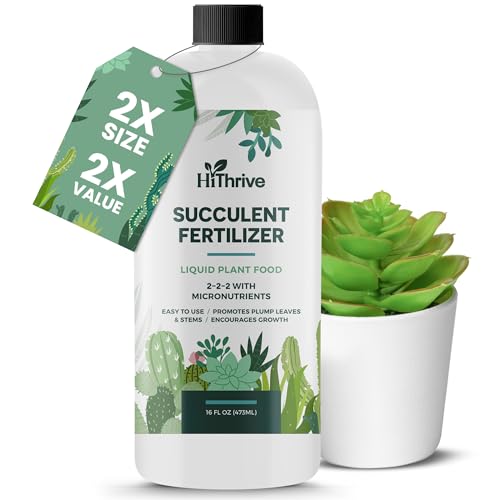
The 16.0-ounce bottle that turns into 32 gallons of feed — that is enough for your whole collection for months.
You get more feeding sessions per dollar here than with almost any other liquid on the list. The HiThrive holds 16.0 Fluid Ounces and mixes at a lean ¼ teaspoon per quart of water. That works out to a full 32 gallons of finished fertilizer, versus the Gardenera spray at 8.0 Fluid Ounces. The formula delivers nitrogen for leafy growth, phosphorus for roots, and potassium for overall resilience, plus extra calcium, magnesium, and zinc to keep leaf edges from shriveling.
Buyers report using it repeatedly — one returning customer wrote that it made their agave plant grow and look great, and a reviewer with a collection of succulents noted better growth and healthier leaves after just a few waterings. The mixing ratio is simple enough that you can feed on every other watering without thinking too hard about it.
Compared to the Grow Queen powder below, this is a faster-acting option — you see results within a week or two — but it does require you to mix fresh each time rather than applying once for months.
Why It Wins
- Massive 32-gallon yield from one 16-ounce bottle
- Balanced NPK plus calcium, magnesium, and zinc
- Easy ¼-teaspoon-per-quart mixing ratio
The Trade-Off
- Requires mixing every watering — less set-and-forget than granular options
- Liquid form can burn if over-concentrated, though the ratio is forgiving
Best for the daily caretaker: If you water regularly and want the most feeding mileage per bottle, the HiThrive delivers the volume and balanced nutrition to keep a whole succulent shelf thriving.
Skip if you want zero effort: If mixing a capful every time sounds like a chore, the granular Nelson NutriStar below will suit your style better.
2. Grow Queen Complete Organic 11-Pack
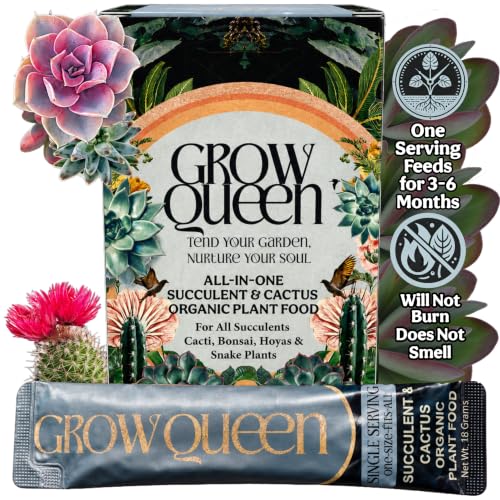
A single packet feeds up to six small succulents for up to eight months.
This is the only completely organic, OMRI-listed (Organic Materials Review Institute — a certification that means the ingredients are approved for organic farming) option in the lineup — and it skips the liquid bottle entirely. Each of the 11 packets treats up to 1 gallon of soil (or about six small succulents), so the whole box covers roughly 44 plants. You simply sprinkle one serving onto the soil, water it in, and the time-release microbes do the work for 2 to 8 months. The maker says the formula contains diverse beneficial microbes that boost the plant’s immune system and improve soil structure over time.
The standout benefit here is forgiveness. The powder is a non-burning formula, meaning you cannot accidentally hurt your plants by over-applying — unlike liquid concentrates where a heavy hand leads to root damage. It also has no strong odor, so it works well indoors without making your living room smell like a farm. And because it enriches the soil permanently rather than just feeding the leaves, it pairs well with any liquid fertilizer you might already be using.
The catch is that it is slower to show visible results compared to the HiThrive liquid — you are feeding the soil food web first, and the plant benefits come second. If your cactus is already struggling, you might want a faster liquid rescue.
What Stands Out
- Certified organic, vegan, pet-friendly, and non-toxic
- One application lasts 2–8 months — genuine set-and-forget
- Non-burning formula is safe even if you over-apply
What To Know
- Slower visible results than liquid fertilizers
- You need to scratch the powder into the soil if you dislike the look
Reach for this if you are organic-only: The OMRI listing and vegan, pet-safe ingredients make it the cleanest choice for households with kids or curious animals.
Look elsewhere if you need a quick turn: If you want to see a difference within days rather than weeks, stick with the HiThrive liquid.
3. Gardenera Plant Superfood Spray
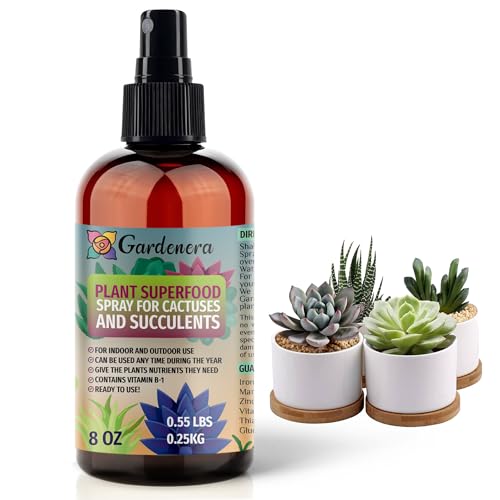
A spray that hits leaves and soil with Vitamin B-1 to beat transplant shock fast.
This is not your standard dilute-and-water fertilizer. The Gardenera formula comes ready-to-use in an 8.0 Fluid Ounce spray bottle and contains Vitamin B-1 to stimulate root development, plus glucose for an immediate energy boost and micronutrients including iron, manganese, and zinc. You spray it directly onto the leaves and the soil surface, so the plant absorbs it through both foliage and roots at the same time — which is why one reviewer noted it revived their dying avocado and Meyer lemon trees within weeks.
Buyers using it on houseplants report it works fast: one reviewer saw their dieffenbachia respond within a week after a single spray, and another uses it every 9–10 days on a fiddle leaf fig that sailed through winter despite fluctuating temperature and humidity. The same reviewer mentioned preferring a handle-grip spray bottle over the finger-depress nozzle, though the included sprayer works fine for smaller collections.
At 8.0 Fluid Ounces, this sits below the HiThrive at 16.0 Fluid Ounces — so you pay for the convenience of a ready-to-use spray rather than the raw volume of concentrate. It is best kept as a spot-treatment tool or a rescue spray rather than your main daily feed.
Why It Stands Out
- Spray-on application means no measuring or mixing
- B-1 vitamin helps reduce transplant shock after repotting
- Works on foliage and soil for double absorption
Consider This
- Smaller volume (8 oz) runs out faster than concentrates
- Some buyers find the spray nozzle less comfortable than a trigger handle
Perfect for the emergency kit: Keep this on hand for stressed plants, new arrivals, or anytime you repot and want to prevent that sad droop.
Not your main feed: If you have a large collection, you will go through this bottle fast — grab the HiThrive for routine feeding and use this as a booster.
4. Espoma Organic Cactus! (2-Pack)

Two bottles of organic liquid feed from a name gardeners have trusted for decades — Espoma.
Espoma has been making organic soil amendments long before “clean label” was a trend, and this Cactus! formula sticks to that heritage. You get two 8-ounce bottles (16 ounces total), and the mixing ratio is a simple ½ cap per quart of water applied every 2 to 4 weeks. It is formulated specifically for cactus, succulents, palms, and citrus, so it stays low enough in nitrogen to avoid stretching your echeveria while still promoting root strength and new growth.
The formula is organic and listed as safe around kids and pets — a practical concern if your jade plant sits on a low shelf where a toddler might grab a handful of dirt. Buyers do report faster results than with the organic Grow Queen powder, since this is a liquid that hits the roots immediately, but it requires more frequent application (every 2-4 weeks instead of every 2-8 months).
Compared to the HiThrive, the Espoma costs more per ounce of concentrate, so your dollar goes further with the HiThrive for routine feeding. But the two-pack format is convenient if you want one bottle at home and one at the office, or if you simply prefer a brand you recognize from the garden center.
Strengths
- Organic and safe around kids and pets
- Two bottles = one for home, one for the office
- Simple ½-cap-per-quart mixing routine
Weaknesses
- Higher cost per ounce than HiThrive
- Requires feeding every 2-4 weeks — more frequent than granules
Go for it if brand trust matters most: Espoma’s long reputation and the two-pack convenience make this a solid pick if you want an organic liquid from a name you already know.
Consider the value alternative: If you are less concerned about brand and more about volume, the HiThrive makes 32 gallons of finished feed, while the Espoma two-pack gives you two 8-ounce bottles of concentrate.
5. Growth Technology GT Succulent Focus
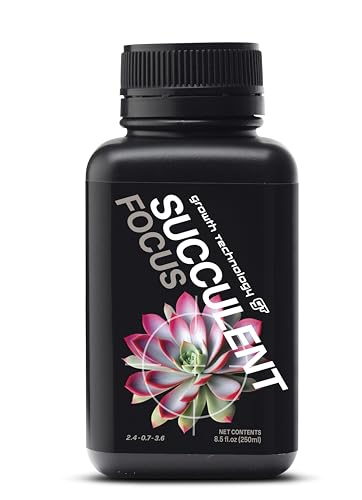
A pH-buffered (pH-adjusted to prevent minerals from locking up in soil) liquid concentrate that keeps all 12 essential minerals available to your plant’s roots.
Most liquid fertilizers lose effectiveness if your tap water pH is off — the minerals bind up in the soil and never reach the roots. This GT Succulent Focus solves that by being pH buffered, meaning the formula adjusts the water’s pH so calcium, magnesium, and other nutrients stay dissolved and ready for uptake. It contains all 12 essential minerals (unlike many cheap mixes that stop at 5 or 6) and is deliberately low in nitrogen and phosphorus to match the slow growth of succulents.
Buyers are vocal about the results: one reviewer called it the best fertilizer they have found for hydroponic succulents, saying their plants grew like weeds with it. Another noted that it works beautifully on Alocasia and Monstera as well, with no burning and stronger growth. The mixing ratio is flexible — 3-5ml per litre for soil, and 5-7ml per litre for hydroponics — so you can dial it up or down as your plants mature.
One honest limitation is that the original bottle can leak during shipping, as a few reviewers mentioned. The 8.5-ounce (250ml) size is also smaller than the HiThrive, so you pay a premium for the precision chemistry. This is a specialist tool for growers who want fine control rather than a budget-friendly option for a big collection.
Why It Excels
- pH-buffered formula keeps all 12 minerals plant-available
- Low nitrogen and phosphorus suit slow-growing succulents
- Flexible dosage for soil or hydroponic setups
Be Aware
- Smaller bottle (8.5 oz) at a higher cost per ounce
- Some buyers experienced bottle leaks during shipping
Best for the precision grower: If you measure your pH and want a complete mineral profile that actually stays available to your plants, this is the most technically advanced liquid in the lineup.
Not for casual feeding: If you just want to water and go without measuring milliliters, the HiThrive or Espoma are more forgiving daily choices.
6. Nelson Plant Food NutriStar Granules
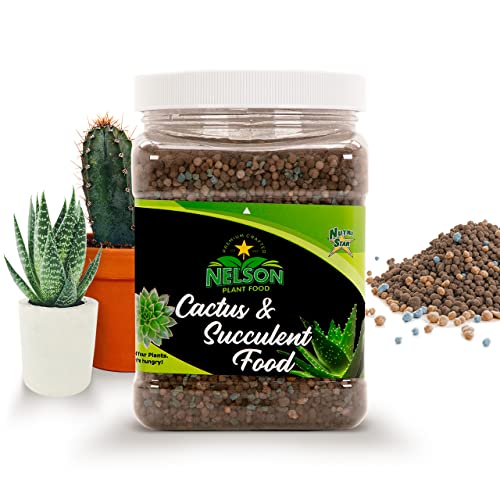
Sprinkle granules once every other month and let the soil biology do the rest — that is two months of easy feeding from one application.
If you travel often or simply hate measuring liquids, this granular feed is your low-maintenance answer. The Nelson NutriStar uses an 8:6:8 N-P-K ratio — balanced and moderate — and includes added magnesium for chlorophyll production and calcium to strengthen cell walls. You sprinkle the granules onto the soil surface, water them in, and they release nutrients slowly over the next two months. One reviewer even noted it revived cold-damaged plants within a week, and all of them bloomed that same season.
The granules work with soil biology rather than just dumping nutrients, so they improve the long-term health of the potting mix rather than temporarily spiking it. Owners mention reliable results on everything from azaleas in Houston to jasmine plants, which suggests the formula is flexible beyond just cacti.
The trade-off is that you cannot adjust the dose week-to-week like you can with a liquid. Once the granules are in the soil, they release at their own pace. If your plant shows signs of deficiency, you are stuck waiting for the next feeding window or using a liquid supplement alongside it.
Advantages
- Only needs application every other month
- Added magnesium and calcium for leaf color and cell strength
- Works with soil biology for longer-term soil health
Disadvantages
- Cannot adjust dosage week-to-week like a liquid
- Not OMRI certified organic like the Grow Queen
Reach for this if you want the least effort: One sprinkle every two months is as close to zero-maintenance as cactus feeding gets — the HiThrive needs fresh mixing every watering by comparison.
Look elsewhere if you need on-demand control: If you like to adjust your feed based on what your plant shows each week, stick with the HiThrive liquid.
Understanding the Specs
N-P-K Ratio
The three numbers on a fertilizer label stand for Nitrogen (N), Phosphorus (P), and Potassium (K). For succulents and cacti, the first number (nitrogen) should be low to moderate — around 8 or below — because too much nitrogen makes leaves grow long and weak instead of compact and plump. A balanced ratio like 8:6:8 (as in the Nelson NutriStar) or a low-nitrogen liquid formula works best.
Liquid vs. Granular vs. Powder
Liquid fertilizers (like the HiThrive and Espoma) enter the soil fast and show results within days, but require mixing and frequent application. Granular fertilizers (like the Nelson NutriStar) release slowly over weeks or months, needing only occasional sprinkling. Powders (like the Grow Queen) sit in between — you mix a single dose into the soil, and it releases over 2 to 8 months while also feeding the soil microbes.
FAQ
How often should I fertilize my cactus?
Can I use regular houseplant fertilizer on succulents?
Is organic fertilizer better for succulents?
What does pH buffered mean in fertilizer?
How do I mix liquid cactus fertilizer?
Can I fertilize succulents in winter?
Will granular fertilizer burn my cactus?
What is the difference between a spray and a concentrate?
Can I use cactus fertilizer on other houseplants?
How long does a bottle of liquid cactus fertilizer last?
Final Thoughts: The Verdict
Across the board, the cactus and succulent fertilizer winner is the HiThrive 16oz because it delivers the best balance of volume, balanced nutrition, and straightforward mixing at a friendly price point. If you want organic slow-release that takes the thinking out of feeding, grab the Grow Queen 11-Pack. And for precision growers who care about pH and mineral availability, nothing matches the GT Succulent Focus.
How We Picked
We do not accept paid placement. Every pick is matched to a real buyer and a real use-case; we do not hands-on test units.
Sources & Methodology
Specifications: manufacturer listings and product documentation. Review insights: verified customer reviews, as of July 2026. Pricing: not shown on this page (it changes often); check the current price via the retailer link.
As an Amazon Associate, Lawn Gear Lab earns from qualifying purchases. This does not affect which products we feature.