
Indoor gardening hinges on one critical decision: the bulb. A weak or incorrect spectrum leaves plants leggy and pale, while the right light drives compact growth, deep green foliage, and successful flowering or fruiting — even in a windowless room. The difference comes down to measurable specs like PPFD (photosynthetic photon flux density), spectral range, and actual wattage draw, not marketing claims.
I’m Rikta — the co-founder and writer behind Lawn Gear Lab. I spend my time cross-referencing spectral analysis charts, comparing PPFD maps at varied hanging heights, and parsing hundreds of owner reports to isolate which indoor grow bulbs actually deliver on their labelled photosynthetically active radiation (PAR) values without overheating or failing prematurely.
Whether you are starting seeds under a shelf, coaxing an orchid into bloom, or running a small propagation tent, the market offers dramatically different solutions. This guide breaks down spectrum modes, dimming ranges, coverage zones, and timer logic so you can match the right fixture to your specific setup and find the best bulb for indoor growing that fits your space.
How To Choose The Best Bulb For Indoor Growing
Selecting a grow bulb is not simply about brightness. The standard lumens metric used for household lighting does not capture a bulb’s ability to drive photosynthesis. You need to evaluate spectral composition, energy efficiency, physical form factor, and control features against your specific plant stages and available vertical space.
Spectral Range: Full-Spectrum vs. Narrow-Band
A bulb labelled “full spectrum” should emit wavelengths from roughly 380nm to 800nm, covering blue (for vegetative structure), red (for flowering), and far-red (for extension responses). Products that only pump out deep red and royal blue — commonly called blurple — can be effective in enclosed tents but look harsh and make it hard to spot pests or nutrient issues. Modern white-light full-spectrum LEDs, by contrast, produce a natural daylight colour that is easier to live with while delivering the same or better PAR output.
PPFD and Coverage Area
PPFD measures the number of photosynthetically active photons landing on a square meter per second (µmol/m²/s). Seedlings need roughly 200–400 µmol/m²/s, vegetative growth requires 400–600, and flowering demands 600–900+. A bulb’s datasheet should include a PPFD map at specific hanging heights — if it only lists wattage or lumens, you are guessing. Match the fixture’s recommended coverage dimensions (e.g., 2×2 ft for veg, 1.5×1.5 ft for flower) to your actual growing area.
Form Factor: Bulb vs. Panel vs. Strip
Standard E26 bulbs screw into any household lamp or socket, making them the easiest entry point for small pots or single plants. Strip lights and bar fixtures mount to shelves or tent frames, spreading light evenly across a wider area. Panel-style lights offer the highest PPFD per square foot and are best for tents because they include built-in heat sinks and dimmers. The trade-off is that panels are heavier and require hanging hardware, while bulbs are plug-and-play but struggle to cover multiple plants.
Timer and Dimming
A consistent photoperiod — the number of hours your plant receives light each day — is non-negotiable. An integrated timer that automatically cycles on and off saves you from forgetting to switch the lights. Adjustable dimming lets you dial intensity down for seedlings or young clones and ramp it up for mature plants without altering the hanging height. Stepless (0–100 percent) dimmers provide the most flexibility, while stepped modes (4/8/12 hours) are simpler but adequate for basic setups.
Quick Comparison
On smaller screens, swipe sideways to see the full table.
| Model | Category | Best For | Key Spec | Amazon |
|---|---|---|---|---|
| SAYHON SH2000 | Premium Panel | 4×4 ft Tent / High-Yield | 208W draw, 2.7 µmol/J, UV+IR | Amazon |
| HMVPL Tall Stand | Freestanding | Medium-to-Large Floor Plants | 20W COB, CRI 98+, 75″ height | Amazon |
| Gerylove SP1000 | Mid-Range Panel | 3×3 ft Veg / Seedling Tent | 120W, passive cooling, stepless dim | Amazon |
| Briignite A19 2-Pack | E26 Bulbs | Seed Starting / Single Pots | 11W, 4 spectrum modes, remote | Amazon |
| SANSI 3-Head Clip | Multi-Head Clip | Desk / Shelf / Plant Stand | 30W total, 3000LM, timer 4/8/12H | Amazon |
| SANSI Single Clip | Entry Clip | Small Desk / Single Pot | 10W, 1000LM, gooseneck | Amazon |
| SDOVUERC 6-Bar Strip | Strip Kit | Multiple Shelves / Wide Coverage | 3600LM, 6 bars, dimmable timer | Amazon |
In‑Depth Reviews
1. SAYHON SH2000

The SAYHON SH2000 delivers a powerful 208-watt draw with an efficiency of 2.7 µmol/J, making it one of the most light-per-watt efficient panel fixtures available. Its full-spectrum main-board covers 400–760nm with dedicated deep-red 660nm diodes, and the separate UV (390nm) and IR (730nm) supplement bar — controlled by its own switch — targets the wavelengths known to boost resin production and crop density in flowering phases.
Owner measurements report a center-point PPFD reading above 900 µmol/m²/s at 18 inches in a 4×4-foot tent, which comfortably covers flowering requirements for medium-light plants. The fanless design relies on a thick 3A+ aluminum heat sink that stays quiet and cool; owners note that intensity remains above 95 percent after three years of continuous use. The dimmer adjusts from 0 to 100 percent, though the fixture cannot be fully switched off through the dimmer alone.
One owner experienced a blue strip failure after roughly a year, but customer service responded with a replacement after initial contact issues. The 36-month local warranty and plug-and-play setup reduce risk for serious growers. For anyone running a dedicated 4×4-foot tent who wants commercial-grade PAR without the industrial noise, this is the clear performance champion.
What works
- Exceptional 2.7 µmol/J efficiency with high PPFD output
- Separate UV+IR bar for targeted spectrum manipulation
- Fanless passive cooling means zero operational noise
- 36-month warranty with responsive support team
What doesn’t
- Dimmer cannot fully turn off the fixture; requires unplugging
- Heavy unit at 8.8 pounds demands sturdy hanging hardware
- A few units have reported blue strip failure within the first year
2. HMVPL Tall Stand
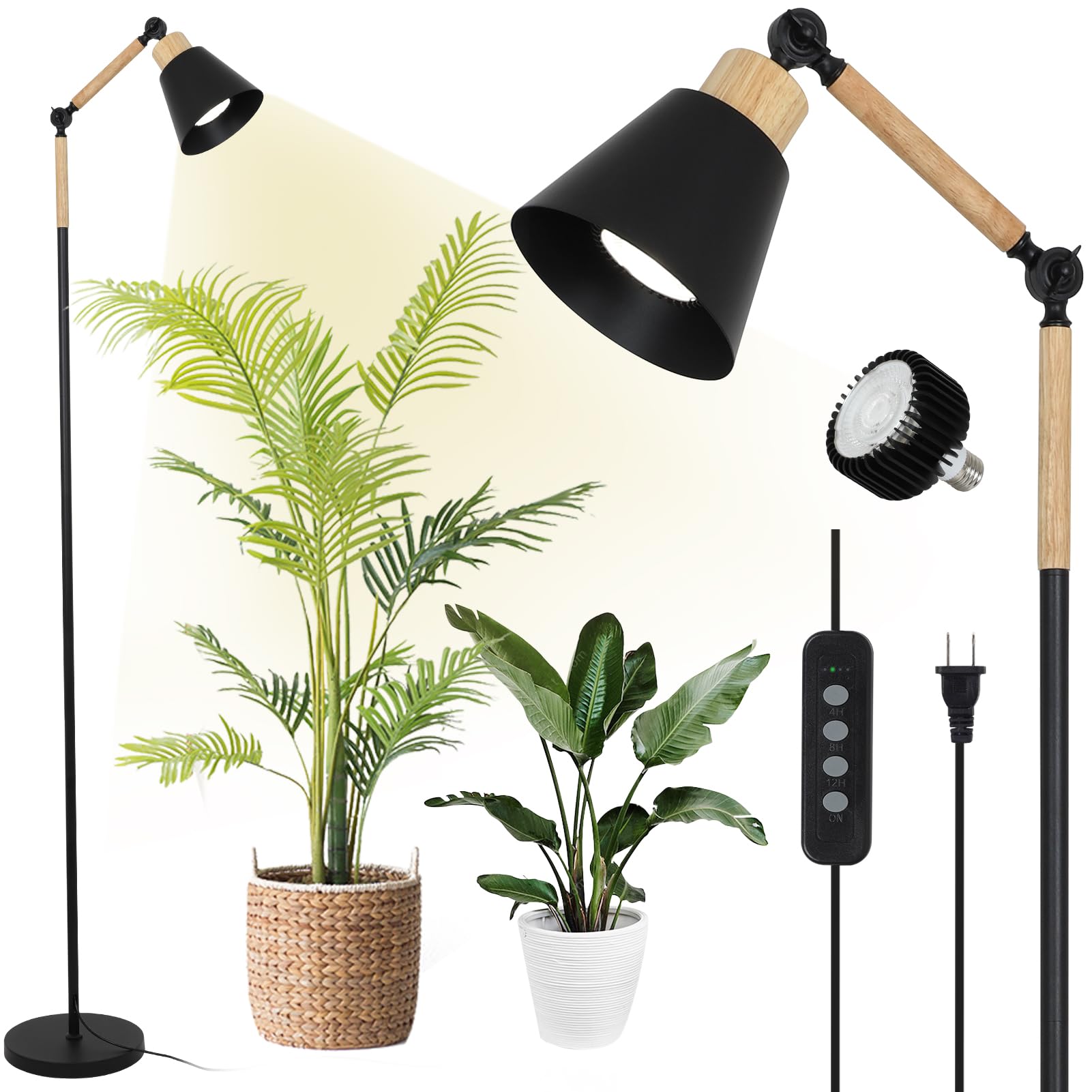
The HMVPL standing lamp solves a specific problem that panel lights cannot: it brings a high-CRI, nearly-sunlike spectrum to large floor plants without looking like a piece of hydroponic equipment. The COB (Chip on Board) bulb runs at 20 watts with a color rendering index of 98+, outputting 1628 lumens at 4000K. The shade prevents direct glare, and the overall silhouette blends into a living room or office naturally.
Height adjusts in six steps up to 75 inches, and the two-knuckle gooseneck lets you aim the bulb head at any angle — critical for hitting the canopy of a tall Monstera or Bird of Paradise while leaving lower leaves in the shade. The built-in cycle timer offers 4, 8, or 12-hour on periods based on a 24-hour loop. Owners report that the timer resets after a power cut, but the push-button interface is simple enough to reset in seconds.
The base is weighted and wide enough to prevent tipping on hard floors, though one owner noted a slight lean on thick carpet. After a year of use, Monstera and Bird of Paradise plants showed visibly denser foliage and less stretching. This is not a fixture for a high-density tent grow — the 20-watt output limits coverage to one or two medium plants within 12 inches — but it excels as a discrete, furniture-grade light for the home.
What works
- Furniture-friendly design that does not look like a grow light
- COB bulb produces CRI 98+ for true-to-life plant appearance
- 75-inch max height with adjustable head for tall plants
- Easy assembly with pre-threaded cord and sturdy build
What doesn’t
- 20W output limits effective range to roughly 12 inches
- Timer resets after any power interruption
- Base can lean on thick carpet; best on hard flooring
3. Gerylove SP1000

The SP1000 from Gerylove is a 120-watt full-spectrum panel built for the 2×2 to 3×3-foot tent range. Its 234 Samsung-style LED diodes span 380–780nm with enhanced 660nm reds, and the manufacturer rates vegetative coverage at 3.5×3.5 feet and flowering coverage at 3×3 feet. The passive-cooled aluminum heat sink eliminates fan noise entirely, which owners consistently highlight as a major advantage over cheaper units with whiny fans.
The stepless dimmer lets you dial from 0 to 100 percent intensity — a genuine advantage for hardening off seedlings or adjusting light stress without moving the fixture. One owner running a 2×4-foot tent found that 100 percent intensity caused wilting in young plants; dropping to 50 percent solved the issue. The light runs notably cool: in an ambient 68°F basement, the tent interior stayed just under 71°F at full power, reducing heat-management overhead.
Multiple owners report that the included ratcheting hangers make height adjustment effortless, and the bundled thermometer/hygrometer adds real utility for monitoring VPD (vapor pressure deficit). The most common long-term observation is that the plastic top cover can dry-rot from heat after several years of continuous use, and one unit began emitting a low glow when switched off after four years. For a mid-range panel that punches near premium efficiency, the SP1000 offers excellent value.
What works
- Stepless 0-100% dimming for precise light control
- Fanless passive cooling — dead silent operation
- Includes ratcheting hangers and thermometer/hygrometer
- Runs cool, keeping tent temperatures manageable
What doesn’t
- Plastic top cover can degrade from heat over years
- Dimmer cannot fully cut power; fixture glows dimly when off after extended use
- Coverage for flowering is tight at 3×3 ft — best for 2×2 ft
4. Briignite A19 2-Pack

The Briignite A19 two-pack offers a degree of spectral control rarely seen in screw-in bulbs. Each 11-watt E26 bulb includes four selectable spectrum modes: 420–470nm blue for seedlings, 610–680nm red for vegetative growth, 360–420nm near-UV for blooming, and a 6000K daylight white for fruiting. A single remote controls every bulb on the same circuit, and the 5-level brightness dimmer provides further adjustment without swapping bulbs.
At 1000 lumens and a 180-degree beam angle, a single bulb covers a small pot or a 12-inch seedling tray adequately. The auto-timer offers 3, 9, 12, or 18-hour cycles — a wider selection than the standard 4/8/12 pattern, which helps for long-day plants like lettuce or cannabis clones staying in veg. The manufacturer claims a 25,000-hour lifespan, and the aluminum-and-plastic hybrid housing keeps surface temperatures manageable.
One owner noted that the red spectrum mode appears as magenta or light pink rather than deep red, which may matter if you need specific wavelengths for flowering morphogenesis. Another owner reported an intermittent high-pitch whine from a replacement unit. These are minor quibbles given the feature density per dollar: you get four spectrum modes, dimming, timer, and a remote in a standard screw-in form factor. For anyone starting seeds or running a small plant shelf, this is the most versatile bulb-type option available.
What works
- Four distinct spectrum modes cover seedling through fruiting
- Remote control and 5-level brightness dimming
- Wider timer range (3/9/12/18H) than many competitors
- Screws into any standard E26 socket — no fixture needed
What doesn’t
- Red spectrum renders as magenta/pink rather than true red
- Some units produce an audible high-pitch hum
- Single-bulb coverage is limited to small pots or one tray
5. SANSI 3-Head Clip

This SANSI model scales the single-head clip design into a three-head array that delivers a combined 3000 lumens from 30 watts of draw. Each 10-watt PAR20 bulb fits a standard E26 socket in the clip housing, and SANSI’s lifetime-free-replacement policy removes the long-term risk of LED burnout — a real advantage given that these bulbs run warm and can degrade faster than larger passive-cooled panels.
The full spectrum spans 380–800nm, and the white-light diodes produce a clean 4000K daylight appearance that avoids the disorienting purple glow. Each gooseneck adjusts independently, so you can aim one head at a tall Monstera crown and direct the other two toward side pots. The integrated timer cycles 4, 8, or 12 hours. Owners confirm the goosenecks hold their position reliably, even with the 1.1-pound bulb weight at the end of the neck.
A recurring note from longer-term users is that the clip itself can feel under-engineered for the combined weight; clamping onto a thin desk edge may result in slippage. Additionally, the bulbs can get hot enough to burn leaves or skin on contact, so a minimum distance of 6–8 inches is advisable. For a multi-head fixture that covers a plant stand, a 2×2-foot shelf, or a desktop garden without breaking the bank, the SANSI 3-head is a strong mid-range pick.
What works
- Three independently adjustable goosenecks for targeted coverage
- Lifetime free bulb replacement removes LED failure worry
- Clean 4000K white light — no purple glow
- High combined output of 3000 lumens at 30W
What doesn’t
- Clip strength can struggle with the combined weight of three bulbs
- Bulbs run hot and can scorch leaves or skin within 6 inches
- Timer resets after power interruption
6. SANSI Single Clip

The single-head SANSI clip is the entry point into the brand’s lifetime-replacement ecosystem. It runs at 10 watts, produces 1000 lumens (equivalent to a 150W incandescent), and covers a single small pot or a 6-inch seedling cup comfortably. The 380–800nm full spectrum and 4000K colour temperature make it a drop-in upgrade for a desk lamp aimed at a succulent or pothos.
Owners consistently praise the bright, clean light and the effective auto-timer (4/8/12H). The gooseneck holds position well for a single bulb, and the clip has been redesigned in newer iterations to feel stronger than earlier versions. The cord length is generous enough to reach from a floor outlet to a desktop, and the ETTL listing provides electrical safety assurance. The bulb can be unscrewed and replaced independently, so if the LED eventually dims, you swap only the bulb — not the entire fixture.
The main limitation is coverage: a single 10-watt PAR20 bulb cannot support more than one small plant or a cluster of tiny succulents at close range. The clip, even in its improved form, is best suited to desks, shelves, or headboards with a clamp-friendly edge thickness of under an inch. For a budget-friendly way to keep a single houseplant happy through winter, this is a reliable, low-risk choice with the lifetime replacement backup.
What works
- Lifetime free bulb replacement for long-term value
- Bright 1000LM output with clean white full spectrum
- Easy gooseneck positioning and intuitive 4/8/12H timer
- ETL listed for electrical safety certification
What doesn’t
- Single 10W bulb only covers one small pot effectively
- Clamp strength is adequate but not heavy-duty
- Bulb runs warm; keep 6+ inches from foliage
7. SDOVUERC 6-Bar Strip
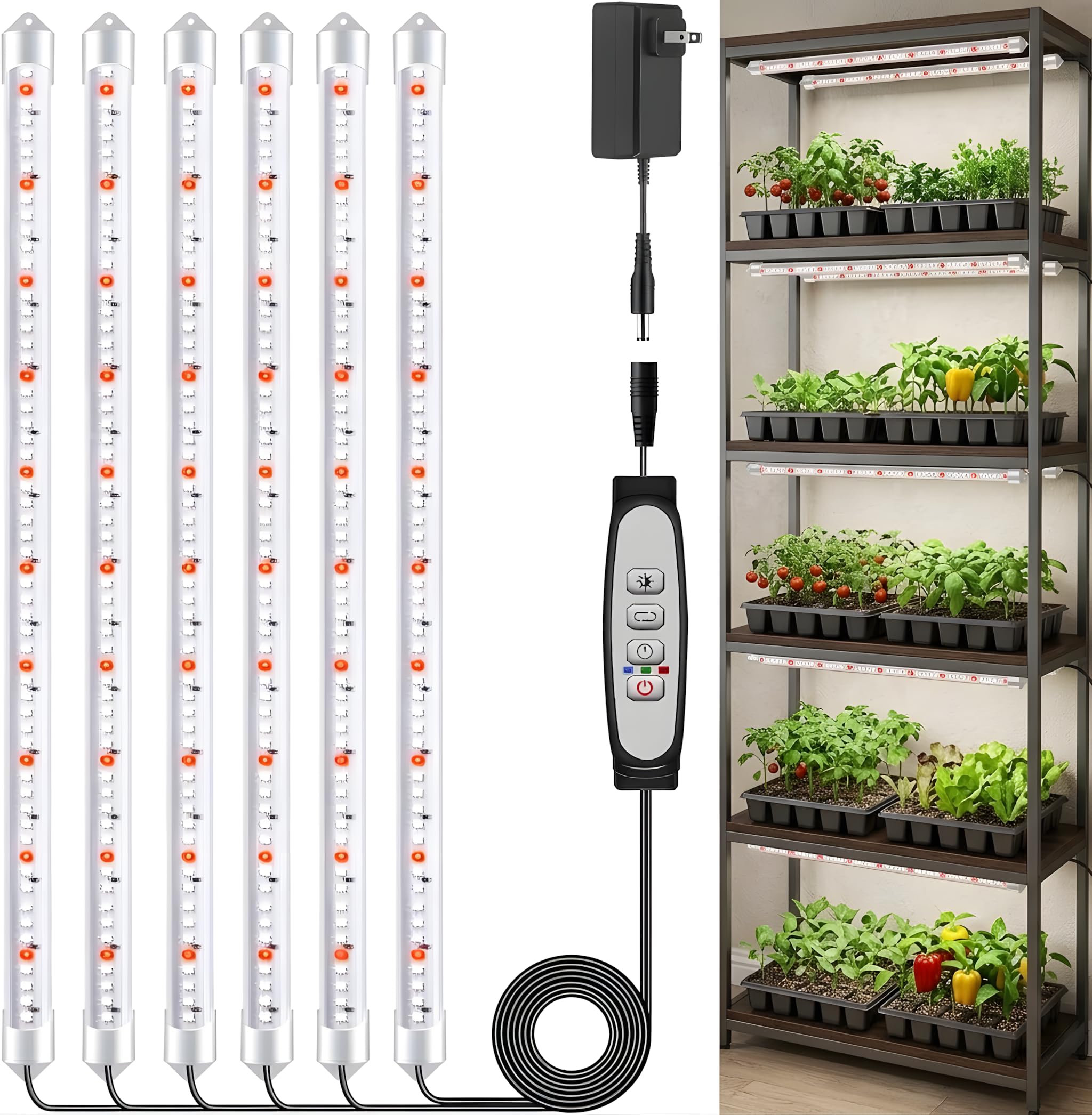
The SDOVUERC 6-bar strip kit solves a common frustration with shelf gardening: how to spread light evenly across multiple levels. Each of the six 16-inch bars contains 360 LED diodes mixing warm white, cool white, and 660nm red for a 380–800nm full spectrum. The total output reaches 3600 lumens, and the bars connect to a single 12V 3A adapter, meaning you power the entire array from one wall outlet.
Installation is genuinely flexible. The kit includes double-sided foam tape, screws, and zip ties, so you can attach the bars under shelves, inside a cabinet, or to the underside of a wire rack without permanent modification. Owners report that the sticky pads are the weakest link — they may fail over time on textured surfaces — but the zip ties and screws provide robust alternatives. The daisy-chain cable system keeps wiring tidy.
The circular memory timer offers 6, 12, or 18-hour cycles, and the 5-level brightness dimming lets you shade seedlings or blast mature plants. The 95-inch power cord gives placement freedom even in awkward corners. Spectral adjustability is limited — you cannot shift the red/blue ratio — but the preset mix works well for leafy greens, herbs, and vegetative growth. For anyone stacking plants on a multi-shelf rack who needs even, wide coverage without multiple plug-in points, this is the smartest approach.
What works
- Six bars spread light evenly across multiple shelf levels
- Flexible mounting with tape, screws, or zip ties
- 3600 lumens from a single 12V adapter — clean wiring
- Adjustable timer (6/12/18H) and 5-level brightness dimming
What doesn’t
- Adhesive pads lose grip on uneven or textured surfaces
- No discrete spectrum switching; fixed full-spectrum blend only
- Bars are only 16 inches long — may not fully cover 24-inch deep shelves
Hardware & Specs Guide
PPFD and Daily Light Integral
PPFD (µmol/m²/s) tells you the instantaneous photon flux at the canopy, while DLI (mol/m²/day) integrates PPFD over the photoperiod. A bulb rated at 500 µmol/m²/s run for 12 hours delivers a DLI of 21.6 mol/m²/day, which suits most high-light vegetable crops. Compare PPFD maps at your intended hanging height — far-field readings at 24 inches often drop below 200 µmol/m²/s, making the bulb useless beyond that distance.
Thermal Management and Lifespan
LED efficiency degrades with junction temperature. Passive-cooled fixtures using thick aluminum heat sinks (like the Gerylove SP1000 and SAYHON SH2000) maintain 95%+ lumen maintenance beyond 30,000 hours. Small screw-in bulbs such as the SANSI and Briignite units rely on hybrid aluminum-plastic housings, which can reach surface temperatures above 50°C — always keep foliage at a safe distance. Replaceable bulb designs mitigate the longevity risk because a dead diode costs only the bulb, not the whole fixture.
FAQ
What is the difference between lumens and PPFD for grow bulbs?
Can I use a standard LED bulb labelled “full spectrum” for growing?
How far should I hang a panel grow light from seedlings?
Do I need a bulb with a timer, or can I use a smart plug?
Final Thoughts: The Verdict
For most gardeners, the bulb for indoor growing winner is the SANSI 3-Head Clip because it combines independent positioning, a full white spectrum, high lumen output, and lifetime bulb replacement in a package that fits desktop, shelf, and plant-stand setups without requiring tent hardware. If you want serious yield from a 4×4-foot tent, grab the SAYHON SH2000 for its UV+IR supplement bar and fanless efficiency. And for a multi-shelf seed-starting station where even coverage matters more than peak PPFD, nothing beats the SDOVUERC 6-Bar Strip.