
Specs are compiled from manufacturer listings and verified buyer reviews and can change over time — please confirm the key details on the product page before buying.
You spot the first tiny holes in your tomato leaves, or a sticky film on your rosebuds, and you know the battle has begun. The real question is not *if* you need a spray — it is *which* one stops the invaders without turning your garden into a chemistry lab. This guide zeroes in on six ready-to-use sprays that target specific bugs while keeping your plants safe, so you can pick the right weapon for the war you are actually fighting.
I’m Rikta — the founder and writer behind Lawn Gear Lab. This guide is built by comparing the manufacturers’ published specifications and the patterns across verified customer reviews, so you get each pick’s real strengths and trade-offs instead of marketing spin.
You need a spray that matches the specific pest on your plant, whether that is aphids on indoor basil or caterpillars on a vegetable patch. Below you’ll find the best bug spray for plants broken down by active ingredient, coverage area, and real-world effectiveness.
Quick Picks
- Bonide Captain Jack’s Neem Oil — Best Overall
- Bonide Captain Jack’s Deadbug Brew — Best Organic
- Ortho Rose and Flower Insect Killer — Best Systemic
- Neudorff Garden Insecticide Spray — Best Broad Organic
- Ferti-lome Spinosad Soap Insecticide — Best for Chewing Bugs
- Grower’s Ally Crop Defender 3 — Best Indoor/Grow Room
How To Choose The Best Bug Spray For Plants
Picking a spray is not about grabbing the first bottle with a bug picture on it. You need to match the active ingredient to the pest and the plant, and decide if you want a fast knockdown or a longer-lasting protective barrier.
Active Ingredient: The Real Weapon
Spinosad (from a naturally occurring soil bacterium) targets caterpillars, thrips, and leaf miners without harming most beneficial insects once dry. Neem oil smothers soft-bodied insects like aphids and spider mites while also fighting fungal diseases like powdery mildew. Pyrethrins (from chrysanthemum flowers) deliver a fast, broad-spectrum knockdown on contact but break down quickly in sunlight. Your choice depends on if you need a narrow sniper or a broad spray.
Contact vs. Systemic Protection
A contact spray kills only the bugs it directly hits — good for a visible infestation right now. A systemic spray (like Ortho’s dual-action formula) gets absorbed into the plant’s tissue, so when a bug bites the plant, it dies. Systemic protection lasts longer — weeks rather than days — but you cannot eat the plant the same day you spray.
Ready-to-Use vs. Concentrate
All six picks here are ready-to-use — you pull the trigger and spray. That convenience costs a bit more per application than a concentrate you mix yourself, but for a small garden or a few houseplants, it eliminates mess and guesswork.
Quick Comparison
| Model | Best For | Active Ingredient | Volume | Weight | Amazon |
|---|---|---|---|---|---|
| Bonide Captain Jack’s Neem Oil | Largest Coverage & Multi-Disease | Clarified Hydrophobic Neem Oil | 128 oz | 8.98 lbs | Amazon |
| Bonide Captain Jack’s Deadbug Brew | Caterpillars & Leaf Miners (Organic) | Spinosad 0.5% | 32 oz | 2.36 lbs | Amazon |
| Ortho Rose and Flower Insect Killer | Long-lasting Systemic Protection | Dual-action (Contact + Systemic) | 24 oz | 1.5 lbs | Amazon |
| Neudorff Garden Insecticide Spray | Broad Organic Contact Killer | Pyrethrins + Canola Oil | 32 oz | — | Amazon |
| Ferti-lome Spinosad Soap | Chewing Insects & Bagworms | Potassium Salts + Spinosad 0.005% | 32 oz | 2 lbs | Amazon |
| Grower’s Ally Crop Defender 3 | Triple-action Indoor/Grow Room | Botanical Oils Blend | 24 oz | 1.7 lbs | Amazon |
In‑Depth Reviews
1. Bonide Captain Jack’s Neem Oil
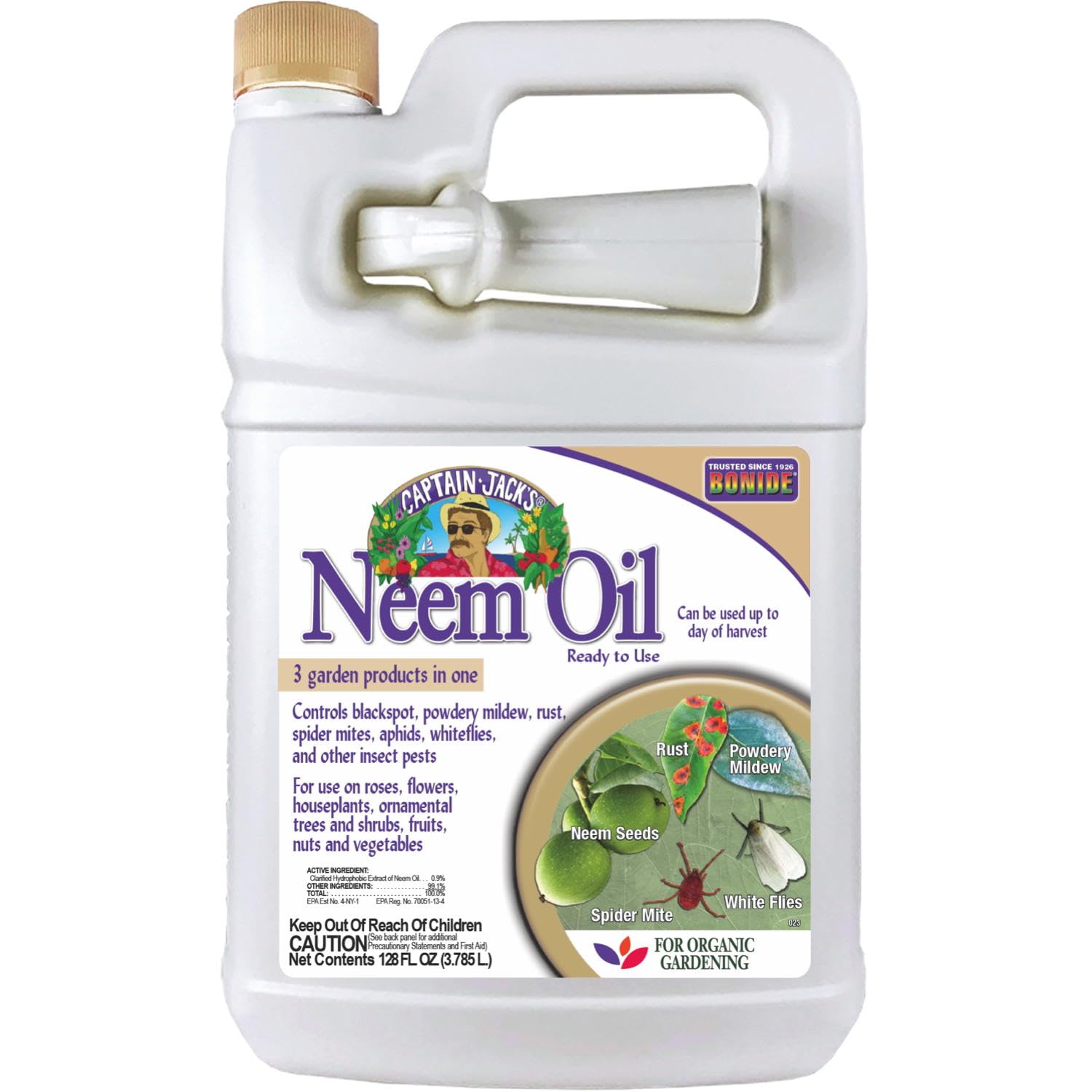
The one jug that fights fungus, bugs, and mites all season long.
This is the heavy lifter for anyone with a large garden or a lot of ornamentals. The active ingredient is Clarified Hydrophobic Extract of Neem Oil, which smothers soft-bodied insects like aphids, whiteflies, and spider mites while also tackling fungal diseases such as rust and powdery mildew. It kills eggs, larvae, and adult stages — meaning you catch the whole life cycle, not just the visible bugs.
At 128 fluid ounces, this bottle holds 128 oz; the Bonide Deadbug Brew is 32 oz — so you are not running to the store every other week. It weighs 8.98 pounds, ; the Ortho Rose and Flower spray weighs 1.5 pounds, but the refill value is undeniable for a big property. You can use it on houseplants, roses, trees, shrubs, fruits, nuts, and vegetables, and it is approved for organic gardening right up to the day of harvest.
Buyers report that shaking the bottle well before each use is critical because the neem oil can separate, and they recommend reapplying every 7 to 14 days for full coverage. The catch is that neem oil leaves a noticeable residue on leaves — fine for outdoor ornamentals but a bit messy for indoor houseplants.
The Big Coverage Win
- 128 oz covers a very large garden without needing to refill
- Three-in-one: fungicide, insecticide, and miticide in one spray
- Kills eggs through adults, breaking the pest lifecycle
- Organic-approved, harvest-same-day safe for vegetables
A Couple Trade-offs
- Heavy bottle at nearly 9 lbs — not a lightweight grab-and-go
- Neem oil residue can look oily on leaves, especially indoors
- Requires mixing or good shaking if it separates during storage
Best for big gardens: If you have vegetables, fruit trees, and ornamentals all suffering from both bugs and fungus, this one jug does both jobs better than any single-purpose spray. It is the biggest value per ounce in this list.
Skip for small indoor pots: The heavy bottle and residual oil make it awkward for a few houseplants. For that job, the smaller Grower’s Ally is tidier.
2. Bonide Captain Jack’s Deadbug Brew

A biological sniper that hits caterpillars and leaf miners without nuking the good bugs.
This spray uses Spinosad, a naturally occurring soil bacteria that is among the most selective organic pesticides you can buy. It is formulated to target bagworms, borers, beetles, caterpillars, codling moth, gypsy moth, spider mites, loopers, leaf miners, tent caterpillars, and thrips — a long list of chewing and boring insects. The key advantage: it does not significantly impact predatory beneficial insects, predatory mites, and spiders while controlling the target pests.
The 32 oz ready-to-use bottle weighs just 2.36 pounds, which is far easier to carry around a garden than the 8.98-pound neem oil jug. It protects a wide variety of foliage including fruiting vegetables, cucurbits, cole crops, leafy vegetables, tuberous vegetables, stone fruits, bushberries, and pome fruits. Owners mention that it works best when you catch an infestation early and spray the undersides of leaves where caterpillars hide — a good habit for any spray.
The trade-off is that Spinosad is a contact killer and needs to actually hit the bug; it has very little systemic movement inside the plant. So you need to be thorough with coverage, and reapply after rain.
Best for targeted pests: If you have a specific caterpillar, beetle, or leaf miner problem and you want to spare the ladybugs and spiders, this is your pick. It is lighter and easier to handle than the neem oil jug, and its organic profile is top-tier.
Not for general prevention: You need to identify the pest first. If you have no idea what is eating your plants, a broader spray like Neudorff is a better starting point.
3. Ortho Rose and Flower Insect Killer

Spray it once and let the plant defend itself for up to four weeks.
This is the only spray on this list with a systemic action — meaning the plant absorbs the active ingredient into its tissue, so when an insect bites the plant, it dies. It also works by contact on the bugs it directly hits. Ortho claims it kills over 100 listed insects fast and protects for up to four weeks. That is a huge advantage if you are tired of spraying every few days.
The 24 oz bottle weighs just 1.5 pounds — the lightest option here — making it the easiest to carry around a flower bed. It won’t harm plants or blooms, so you can spray your roses and flowers without worrying about cosmetic damage. And it is approved for both indoor and outdoor ornamental plants.
Customers note that it handles aphids, whiteflies, and Japanese beetles very well, but note that the systemic action means you should not use it on plants you plan to eat — this is for ornamentals only. The catch is that the protective duration depends on the plant’s growth rate and rain; fast-growing new shoots may need a re-spray sooner than four weeks.
The Long-Haul Advantage
- Systemic protection lasts up to 4 weeks between sprays
- Kills 100+ insects by contact and ingestion
- Lightest bottle in the list at 1.5 lbs — very portable
- Won’t burn or discolor flowers and blooms
The Catch
- Not for edible plants — only ornamentals and flowers
- Systemic action is slower than a pure contact killer
- May need reapplication on fast-growing new growth
Best for flower beds: If you have roses, annuals, and shrubs and you want a low-maintenance spray that keeps working for weeks, this is the one. It is the lightest, easiest option for weekly maintenance.
Not for vegetable gardens: Skip this if you grow food — the systemic pesticide stays inside the plant tissue. Use the Bonide neem oil or Deadbug Brew for edibles.
4. Neudorff Garden Insecticide Spray

A broad-spectrum organic spray that kills everything from fungus gnats to Japanese beetles on contact.
Neudorff combines pyrethrins (from chrysanthemums) and canola oil to create a contact insecticide and ovicide — meaning it kills the eggs, larvae, and adults of over 100 listed insects. It targets fungus gnats, aphids, beetles, caterpillars, moths, mites, fruit flies, stink bugs, grasshoppers, earwigs, and ants (except fire, harvester, carpenter, and pharaoh ants). That is a very wide net, and it is approved for organic gardening, usable up to and including the day of harvest.
The 32 oz bottle has the same volume as the Bonide Deadbug Brew but uses a completely different chemistry — pyrethrins break down quickly in sunlight, so you may need to spray more often, but they deliver a fast knockdown. It works on vegetables like tomatoes, potatoes, cucumber, fruits, ornamentals, shrubs, trees, houseplants, roses, and flowers. Reviewers mention it is excellent for indoor fungus gnats and for a quick spray on aphid-covered plants before the sun gets hot.
The trade-off is that because pyrethrins are broad-spectrum, they can also harm beneficial insects like bees if you spray directly on them. Best practice is to spray at dusk when bees have gone to bed.
Best for quick organic knockdown: If you need to clear a heavy infestation of mixed bugs and you want an organic option you can use on vegetables the same day, this is your tool. It covers more insect types than the Spinosad-based sprays.
Not for bee-friendly gardens: The broad spectrum means you need to time your spray carefully — avoid open flowers during the day when pollinators are active.
5. Ferti-lome Spinosad Soap Insecticide

Combines organic Spinosad with insecticidal soap to smother and poison chewing pests.
Ferti-lome takes the Spinosad approach and adds Potassium Salts of Fatty Acids (insecticidal soap) at 0.940%, with Spinosad at 0.005%. The soap helps break down the insect’s waxy outer layer and improve coverage, while the Spinosad does the biological work. The combination is designed to control a wide range of pests: adelgids, ants, aphids, armyworms, beetles including Colorado potato beetle, borers, caterpillars, chinch bugs, codling moth, earwigs, fruit flies, gypsy moth, lace bugs, and leafhoppers.
This spray is intended for outdoor use on vegetables, trees, shrubs, flowers, fruits, and citrus. It is OMRI Listed for organic gardening, so it is suitable for certified organic production. The 32 oz bottle weighs about 2 lbs — similar to the Bonide Deadbug Brew — and is ready to use with a spray bottle. The manufacturer advises spraying all plant parts to wetting, including the undersides of leaves.
Reviewers report that the soap element helps the spray stick to leaves better than plain Spinosad, which can be a real advantage on waxy or hairy plant surfaces. The catch is that the soap can sometimes cause leaf burn on very sensitive plants in direct sun — apply in the evening to be safe.
The Stick Advantage
- Insecticidal soap improves coverage and sticking on waxy leaves
- OMRI Listed for certified organic production
- Controls a very broad list of outdoor garden pests
- Ready-to-use, no mixing required
Watch For
- Can cause leaf burn on sensitive plants in direct sun
- Soap may leave a visible residue on leaves
- Same contact limitations as other Spinosad sprays — thorough coverage needed
Best for tough-to-cover plants: If you grow cole crops, leafy vegetables, or plants with hairy/waxy leaves where plain Spinosad runs off, the soap in this formula helps it stick. It is a great organic option for caterpillars and beetles.
Not for indoor use: The soap can leave a heavy residue on houseplant leaves. Stick with a neem oil or plain Spinosad spray for indoor pots.
6. Grower’s Ally Crop Defender 3
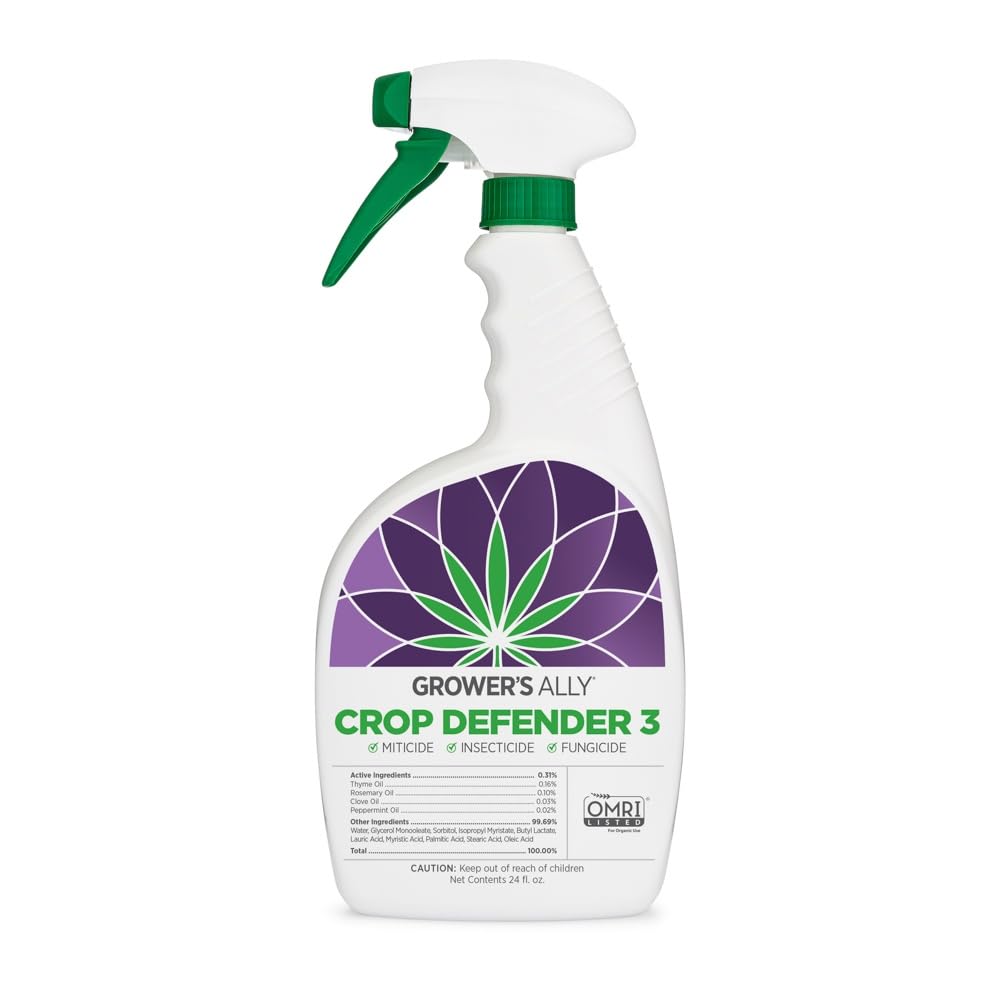
A clean, residue-free triple-action spray designed for the grow room and indoor garden.
This is a highly effective triple-action formula formulated with a synergistic blend of botanical oils and a surfactant. It serves as a miticide, insecticide, and fungicide — meaning it kills spider mites, russet mites, thrips, and aphids while also controlling powdery mildew. It tests clean: no residual solvents, no synthetic pesticides, and no heavy metals. It is FIFRA 25(b) exempt and OMRI Listed for organic gardening.
The key differentiator is that it is designed to be safe to apply through all stages of plant growth, including the flowering cycle, and you can harvest the same day. Grower’s Ally claims it is bee-safe and suitable for use around kids and pets. The 24 oz bottle weighs 1.7 pounds, making it very portable. It is recommended by cultivators for indoor, outdoor, greenhouse, and hydroponic facilities.
Reviewers point out that it is excellent for preventing powdery mildew on indoor cannabis and tomatoes, and that the surfactant ensures good leaf coverage without dripping. The trade-off is that because it uses botanical oils, it can still cause some leaf burn under intense grow lights if the lights are too close — keep your lights at the recommended distance after spraying.
Best for clean indoor grows: If you have a small indoor garden, a grow tent, or houseplants with persistent spider mites or powdery mildew, this spray is purpose-built for that environment. It leaves no synthetic residue and is safe for flowering plants.
Not for large outdoor vegetable patches: The 24 oz bottle goes fast on a big garden. For large outdoor areas, the 128 oz Bonide neem oil jug is more economical.
Understanding the Specs
Spinosad
A naturally occurring bacteria (Saccharopolyspora spinosa) that is toxic to insects when they eat it. It targets caterpillars, thrips, leaf miners, and beetles while being relatively harmless to beneficial insects once the spray dries. It is among the most widely used organic pesticides globally.
Neem Oil
Extracted from the seeds of the neem tree. It works by smothering insects and disrupting their feeding and reproduction. It also acts as a fungicide against powdery mildew and rust. It is slow-acting compared to pyrethrins but has very low toxicity to mammals and bees once dry.
Pyrethrins
Derived from chrysanthemum flowers. These deliver a very fast knockdown on a broad range of insects by attacking their nervous systems. They break down rapidly in sunlight (a few hours to a day), which limits their residual protection but also makes them less persistent in the environment.
Contact vs. Systemic
Contact sprays kill only the bugs they hit directly — you must spray every surface of the plant. Systemic sprays are absorbed into the plant’s vascular system, so when a bug bites any part, it dies. Systemic protection lasts much longer (weeks vs. days) but cannot be used on edible crops because the pesticide stays inside the plant tissue.
OMRI Listed
The Organic Materials Review Institute (OMRI) certifies that a product is suitable for use in certified organic production. An OMRI Listed spray has been reviewed and approved for use in organic gardening without synthetic chemicals. It does not mean the spray is harmless — only that the ingredients are allowed under organic standards.
Ready-to-Use vs. Concentrate
Ready-to-use sprays come already mixed in a bottle with a spray nozzle — just pull the trigger. Concentrates require you to mix the liquid with water in a sprayer. Ready-to-use is more expensive per gallon but eliminates the risk of mixing too strong and burning your plants.
FAQ
What is the difference between Spinosad and neem oil?
Can I use these sprays on my vegetable garden right up to harvest?
Will bug spray for plants harm bees or ladybugs?
How often should I reapply these sprays?
Can I mix different bug sprays together?
What is a dual-action spray?
Why does my spray leave white residue on leaves?
What is the difference between a miticide and an insecticide?
How do I apply these sprays effectively?
Can I use these on houseplants?
Final Thoughts: The Verdict
For most buyers, the bug spray for plants winner is the Bonide Captain Jack’s Neem Oil because it handles bugs, mites, and fungal diseases with one jug, and its 128 oz volume is the best value for large gardens. If you want a lightweight, targeted organic spray for caterpillars and leaf miners, grab the Bonide Captain Jack’s Deadbug Brew. And for long-lasting systemic protection on your flowers without re-spraying every week, the standout is the Ortho Rose and Flower Insect Killer.
How We Picked
We do not accept paid placement. Every pick is matched to a real buyer and a real use-case; we do not hands-on test units.
Sources & Methodology
Specifications: manufacturer listings and product documentation. Review insights: verified customer reviews, as of July 2026. Pricing: not shown on this page (it changes often); check the current price via the retailer link.
As an Amazon Associate, Lawn Gear Lab earns from qualifying purchases. This does not affect which products we feature.