
You walk out to your garden to check your roses or tomatoes, and find leaves chewed full of holes or covered in tiny bugs. The right bug spray for gardens stops that damage fast, but the wrong one can burn your plants, miss the pest entirely, or leave toxic residues on your vegetables. This guide breaks down six top-rated sprays — from organic oils to concentrated systemics — so you can pick one that actually solves your problem without hurting your garden.
I’m Rikta — the co-founder and writer behind Lawn Gear Lab. This guide is built by comparing the manufacturers’ published specifications and the patterns across verified customer reviews, so you get each pick’s real strengths and trade-offs instead of marketing spin.
Whether you are battling aphids on your roses, caterpillars on your broccoli, or powdery mildew on your ornamentals, the right solution is here. Read on for our honest look at the bug spray for gardens that works best for different situations and budgets.
How To Choose The Best Bug Spray For Gardens
Choosing a garden bug spray comes down to matching the product to your pest, your plants, and your garden’s purpose. Here are the three most important things to get right.
Match the Pest to the Active Ingredient
Sprays work in distinct ways. A smothering oil like mineral oil (found in Bonide All Seasons) coats insects and suffocates them — great for soft-bodied pests like aphids, mites, and scale. A biological option like B.t. (Bacillus thuringiensis — a naturally occurring bacteria found in Monterey B.t.) targets only caterpillars and worms by paralyzing their digestive system. A systemic like acephate (Bonide Systemic Insect Control) gets absorbed into the plant’s tissues so insects die when they feed — ideal for hard-to-reach pests like thrips or bagworms. Pick the active ingredient that matches what you see on your leaves.
Check for Edible Crop Safety and Pet Safety
If you are spraying vegetables, fruit, or herbs, you need a product labeled for use on edibles. Organic options like neem oil (Garden Safe Fungicide3) or mineral oil are usually safe when you follow the label’s harvest interval — the number of days you must wait between spraying and picking. Some systemics (Bonide Systemic Insect Control) specifically forbid use on vegetables and fruit. Always read the label’s “crops” list before spraying anything you plan to eat. Also look for “safe around people and pets” notes if your garden is near a play area.
Decide Between Ready-to-Use and Concentrate
A ready-to-use (RTU) spray comes pre-mixed in a bottle you attach to a hose or trigger-spray directly onto plants. This is the easiest, fastest option for treating a few rose bushes or a small raised bed — no mixing, no measuring. A concentrate requires you to mix a small amount (say, 1–2 tablespoons per gallon of water) in a pump sprayer. The catch: concentrates cost less per application and let you treat a much larger area, but they take a little more effort up front. If you have a large vegetable patch or many flower beds, a concentrate is the smarter value.
Quick Comparison
On smaller screens, swipe sideways to see the full table.
| Model | Category | Best For | Key Spec | Amazon |
|---|---|---|---|---|
| Bonide All Seasons Horticultural Oil | Organic Oil | Aphids, mites, scale & disease | 32 oz RTU | Amazon |
| Ortho Rose and Flower Insect Killer | Contact/Systemic | Japanese beetles & rose pests | 24 oz RTU | Amazon |
| Monterey B.t. (Bundled) | Biological | Caterpillars & worms on veggies | 8 oz concentrate | Amazon |
| Garden Safe Fungicide3 | 3-in-1 Neem | Fungus, insects & mites | 128 oz RTU (1 gal) | Amazon |
| Monterey Take Down RTU | Natural Contact | Aphids, spider mites & caterpillars | 32 oz RTU | Amazon |
| Bonide Systemic Insect Control | Systemic | Bagworms, thrips & hard-to-reach pests | 16 oz concentrate | Amazon |
In‑Depth Reviews
1. Bonide All Seasons Horticultural & Dormant Spray Oil (32 oz RTU)

You get one bottle that handles the most pests and diseases without harsh chemicals. Bonide All Seasons uses mineral oil (a refined petroleum oil that smothers insects) at 32 fluid ounces as a ready-to-use concentrate that attaches to your hose. It suffocates aphids, mites, scale, and fungal spores like powdery mildew, so your leaves stay clean and edible. It is approved for organic gardening and safe around people and pets, meaning you can use it on vegetables, roses, fruit trees, and ornamentals. Buyers report it “took care of the black bean aphids on my Spanish Broom” overnight and even shined up leaves after treating a rose disease. It works in four stages — dormant (before buds swell), green tip, delayed dormant, and full growing season — giving you protection from early spring through fall. Unlike synthetic poisons that pests eventually adapt to, this mineral oil coats the insect and suffocates it, making resistance nearly impossible. The honest catch: the hose-end sprayer it comes with is poorly calibrated and can waste product. Several reviewers recommend using a separate pump sprayer for better control and to avoid the messy drip. If you already have a good sprayer, this is the safest, most effective all-around choice. skip it if you only have a small windowsill herb pot and want a pre-mixed trigger bottle — the hose attachment is awkward for tiny spaces. The verdict: buy it for its wide pest range, organic safety, and seasonal flexibility.
Why it’s great
- Year-round use — dormant to growing season
- Organic mineral oil, safe for edibles and pets
- Smothers insects and prevents fungal disease
Good to know
- Hose-end sprayer is poorly calibrated
- Requires thorough wetting for absorption
2. Ortho Rose and Flower Insect Killer (24 oz RTU)

If you grow prize roses or flowering ornamentals, this spray beats the Bonide All Seasons in one crucial way: a dual-action formula that kills over 100 listed insects both on contact and through systemic action (the plant absorbs the chemical, so insects die when they feed), and it keeps protecting for up to 4 weeks after a single spray. The Bonide oil only smothers on contact and washes off more easily, so this is the quicker fix for a sudden Japanese beetle explosion on your roses. One reviewer sums it up: “I bought this because I had Japanese Beetles on my roses. It sure did the trick!” The 24-ounce ready-to-use bottle is trigger-spray simple — no mixing, no measuring — ideal for spot-treating a few bushes. Choose this over the Bonide All Seasons if your main problem is fast-moving, leaf-chewing pests on your flowering ornamentals and you want the longest possible protection between applications. It is less suited for vegetable gardens or for early-season dormant spraying, so keep the Bonide for your broader garden use if you grow edibles too.
Where it shines
- Kills over 100 insect types fast
- Systemic action protects up to 4 weeks
- Safe for blooms and ornamental plants
Worth noting
- Weak systemic effect against large infestations
- Not suitable for edible vegetables or fruit
3. Monterey B.t. Bundled with Measuring Spoon (8 oz Concentrate)
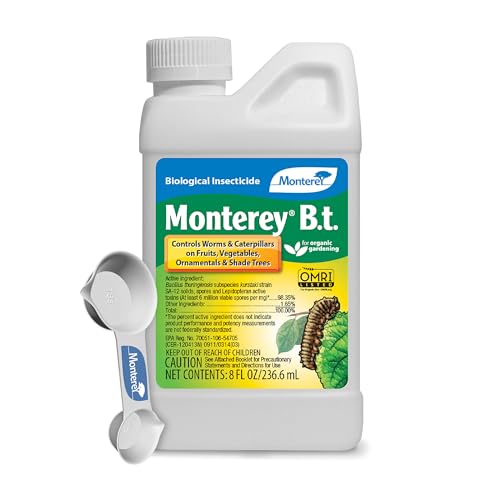
Picture this: you planted broccoli, cabbage, and cilantro in your spring garden, only to find cabbage looper worms shredding every leaf overnight. That is the exact scenario Monterey B.t. (Bacillus thuringiensis — a natural soil bacteria that paralyzes the gut of caterpillars and worms) was made for. One reviewer reports it “effectively killed cabbage looper worms that destroyed flower seedlings last year” and that their “flower seedlings and cilantro are thriving in Southern California” this year after using it. This 8-fluid-ounce concentrate makes up to 16 gallons of spray when mixed with water — that is twice the coverage per ounce compared to the Bonide concentrate (which makes 16 ounces total). It is OMRI Listed for Organic Gardening, meaning it complies with USDA organic standards, and it has no effect on earthworms, honeybees, or beneficial insects when used as directed. That specificity is huge: you can nuke the cabbage loopers without worrying about killing the ladybugs or bees pollinating your tomatoes. The stand-out spec here is the safety profile: it targets only caterpillars and worm-type insects (like bagworm, gypsy moth, and elm spanworm), so it leaves your entire beneficial insect population untouched — something no broad-spectrum spray can offer. Pick this if you grow a vegetable patch and have seen caterpillars. pass on it if you have aphids, mites, or beetles — it will not touch them.
What stands out
- Targets only caterpillars and worms — safe for bees
- OMRI certified for organic vegetable gardening
- 8 oz concentrate makes up to 16 gallons
The trade-offs
- Only kills caterpillars and worms, not other pests
- Must be mixed and applied with a sprayer
4. Garden Safe Fungicide3 (128 oz RTU, 1 Gallon)
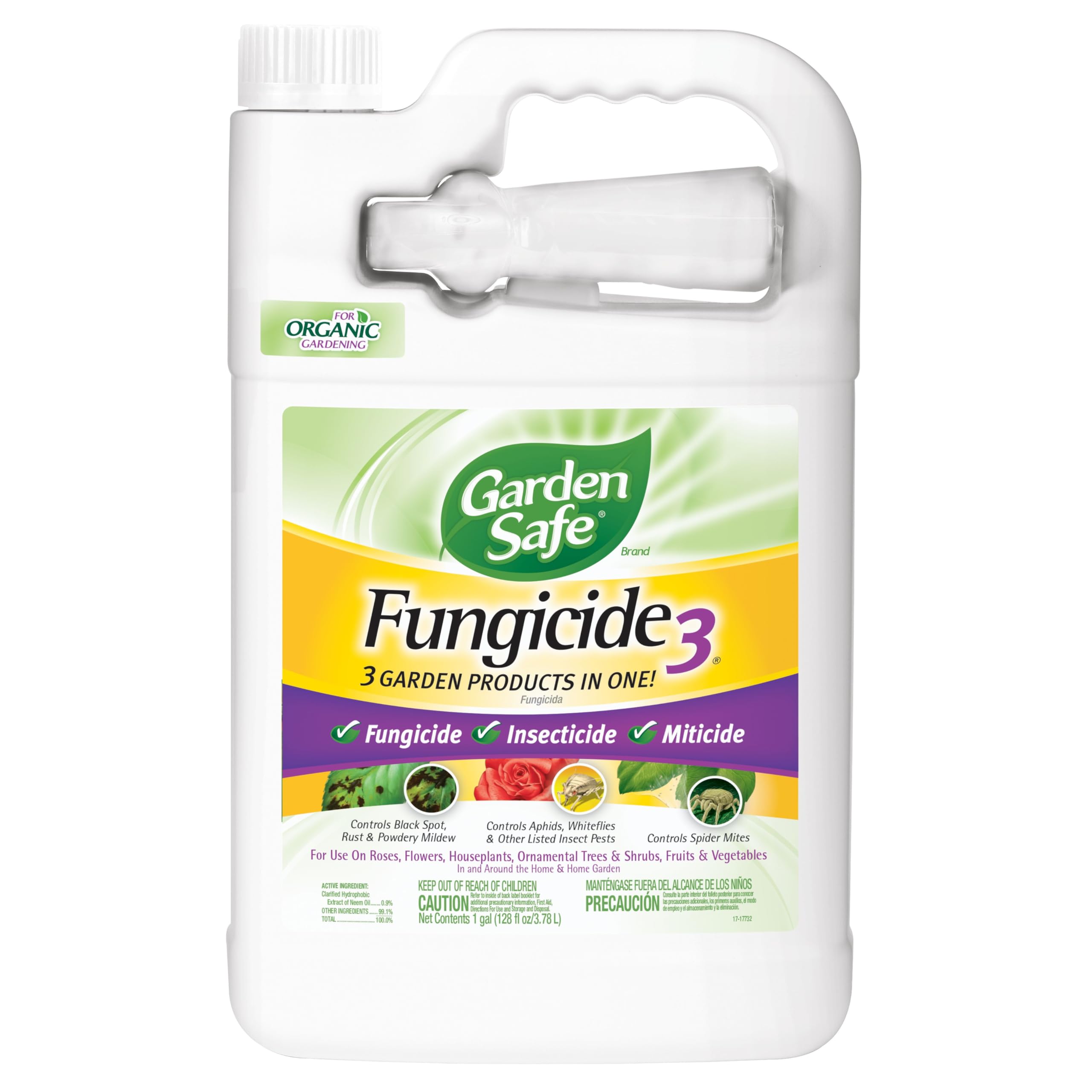
You get a 1-gallon (128-fluid-ounce) ready-to-use bottle that tackles three problems at once because it uses clarified hydrophobic extract of neem oil (a plant-based oil that disrupts insect feeding and fungal growth) as its active ingredient. This means it fights black spot, rust, and powdery mildew as a fungicide, smothers aphids and whiteflies as an insecticide, and kills spider mites as a miticide — all from one spray. The per-gallon cost makes it the best value for a big garden with mixed issues. The downside you accept is precision. Owners mention the product “works too well; use less than half recommended dose, avoid daytime use” to prevent leaf burn, and the attached sprayer has only a short 4-inch hose that is awkward to reach across a bush. Several reviewers recommend decanting into a better sprayer for even distribution. If you have a big garden with a wide range of issues — mildew on your hibiscus, aphids on your tomatoes, mites on your roses — the per-gallon cost and triple-action make this the smartest value option, but plan to use its own sprayer sparingly or replace it.
The upsides
- 1 gallon RTU covers a very large garden area
- Controls fungus, insects, and mites with one product
- Neem oil extract is organic and safe for edibles
Keep in mind
- Can burn plants if used in direct sunlight
- Included sprayer has a very short reach
5. Monterey Take Down Garden Spray RTU (32 oz)
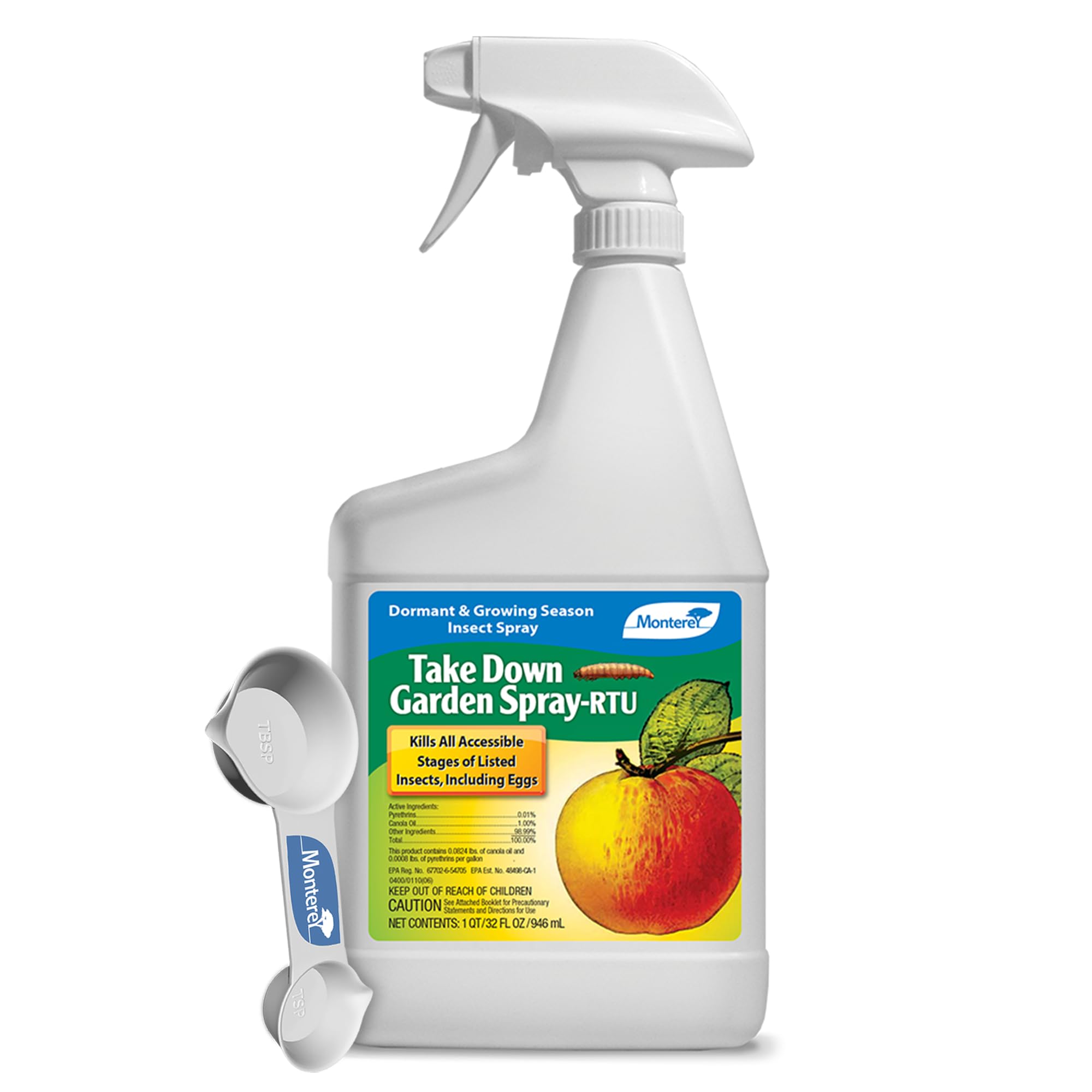
If you need a natural contact killer that works fast without a lingering chemical smell, this 32-ounce RTU spray uses 0.01% pyrethrins (a plant-derived insecticide from chrysanthemum flowers) and 1.00% canola oil to kill all accessible life stages of insects — including eggs — on contact. “Two treatments killed aphids within a day; repotting helped,” one buyer reports after using it on their carnivorous plants, and another says it “killed spider mites after organic options failed.” What you give up is persistence. This is a contact-only spray with low residual activity, meaning it only kills bugs you actually hit with the spray — it will not provide systemic, long-lasting protection like the Ortho or Bonide Systemic. Sunlight naturally degrades the pyrethrins, so you must spray at dusk or in the shade for best results. It is non-persistent and safe for beneficial insects once dry, but you may need to reapply every 3–4 days until the infestation is gone. This is perfect for the gardener who wants an effective natural option for houseplants, tender ornamentals, or small raised beds — especially if you dislike the strong smell of neem oil and need to target aphids, spider mites, or caterpillars without damaging sensitive plants like sundews or other carnivorous species. Choose this over the Garden Safe if smell bothers you, but plan to reapply often.
Why we’d pick it
- Natural pyrethrins + canola oil — minimal smell
- Kills all insect stages including eggs
- Safe for beneficial insects once dry
A few caveats
- Contact-only; no long-lasting residual protection
- Degrades in sunlight, so spray at dusk or in shade
6. Bonide Systemic Insect Control (16 oz Concentrate)

This is the strongest weapon here for landscape ornamentals. A 16-ounce bottle of this acephate-based concentrate makes 16 gallons of finished spray — 2.0x the volume of the Monterey B.t. concentrate — but the real difference is that acephate is a true systemic: the plant absorbs it into its sap stream, so insects like bagworms, thrips, mealybugs, and scale die when they feed, even if you never spray them directly. One reviewer says “we use this on our arborvitae trees” and “looks like we’ve stopped the damage” from bagworms after a local nursery recommended it. It works against 2-spotted spider mites, whiteflies, and more. The trade-off that every single reviewer mentions: “the smell is just unbelievably strong, it’s like a dumpster that’s been baking in the sun for a week.” This stuff has a powerful, unpleasant odor that persists even after watering. It is also not intended for vegetables or fruit plants — only ornamental flowers, shrubs, and trees. The one reason to choose it: if you have a pest that has defied every other spray (bagworms on your arborvitae, thrips on your roses, scale on your shrubs), this systemic acephate will reach every leaf and kill the infestation from the inside out. Just keep the bottle away from edible crops and spray in a well-ventilated area. Buy this only for ornamentals; for edibles, pick the Bonide All Seasons or Monterey B.t. instead.
Strong points
- True systemic — plant absorbs it to kill feeding pests
- 16 oz concentrate treats up to 16 gallons of spray
- Controls hard-to-kill pests like bagworms and scale
Before you buy
- Extremely strong odor that lingers after watering
- Not safe for edible vegetables or fruit
Understanding the Specs
Active Ingredient: Smothering Oil vs. Biological vs. Systemic Poison
The active ingredient is the engine of the spray — it determines what the spray kills and how. Mineral oil (Bonide All Seasons) smothers insects by coating their breathing holes; it is safe for most plants and beneficial bugs after it dries, but it needs direct contact with every bug. B.t. (Monterey B.t.) is a bacteria that only hurts caterpillars and worms when they eat treated leaves, so it leaves bees and ladybugs alone. Acephate (Bonide Systemic Insect Control) is a chemical poison that the plant absorbs and circulates — anything biting the plant dies, even if you missed a spot — but it is not safe for vegetables and has a strong smell.
Contact Killer vs. Systemic: Speed vs. Duration
A contact killer (Monterey Take Down, Bonide All Seasons, Garden Safe Fungicide3) kills insects only when the spray directly hits them. It works immediately but washes off with rain or degrades in sunlight, so you may need to reapply often. A systemic (Ortho Rose and Flower, Bonide Systemic Insect Control) is absorbed into the plant’s tissue and keeps killing for weeks as bugs feed — but it also means the chemical is inside the plant, which is why many systemics are banned for use on edible crops. For vegetable gardens, stick with contact killers. For tough ornamental pests, a systemic is usually the better choice.
FAQ
Can I use a garden bug spray on my vegetables and then eat them the same day?
Why did my spray burn the leaves of my plants even though I followed the directions?
Will a bug spray for gardens kill the bees in my yard?
How often should I spray my garden with bug spray?
Final Thoughts: The Verdict
If you want one dependable pick, the bug spray for gardens winner is the Bonide All Seasons Horticultural & Dormant Spray Oil because it covers the widest range of pests and diseases, is certified organic, and works year-round without harsh chemicals. If you need a fast-acting systemic for Japanese beetles on your roses, grab the Ortho Rose and Flower Insect Killer. And for caterpillar-specific destruction on your vegetable patch that is safe for bees, the standout is the Monterey B.t.