
Specs are compiled from manufacturer listings and verified buyer reviews and can change over time — please confirm the key details on the product page before buying.
You spot a single ant on your kitchen counter. You spray it, it dies, and you feel a small victory. Twenty minutes later, a trail of them marches in from behind the toaster. That is because you killed the scout, not the source, and you are now staring at the single most frustrating truth about ants: the colony is still alive, and the queen is still laying eggs. The real question is if you want a product that creates a brief mess of dead bodies or one that shuts down the entire operation for good — and that distinction is exactly what separates a useless spray from a genuinely effective one.
I’m Rikta — the founder and writer behind Lawn Gear Lab. This guide is built by comparing the manufacturers’ published specifications and the patterns across verified customer reviews, so you get each pick’s real strengths and trade-offs instead of marketing spin.
The good news is that you do not have to guess which route works. Whether you prefer a bait system that hits the nest or a barrier spray that locks them out, this roundup of the best bug spray for ants covers every major approach and price point so you can find the one that actually matches your particular ant problem.
Quick Picks
- Terro T300B Liquid Ant Bait Stations (12 Count) — Best Overall
- TERRO T200-3SR Liquid Ant Killer 3-Pack — Best Value
- Hot Shot Ant, Roach & Spider Killer 17.5 oz — Fast Action
- BASF PT Phantom II Pressurized Insecticide Spray — Professional Grade
- Ortho Home Defense Insect Killer — Perimeter Pro
- Talstar One Insecticide 1 Gallon Concentrate — Large Property
How To Choose The Best Bug Spray For Ants
Ant sprays are not all the same. Some kill on contact but leave the nest untouched, while others trick the colony into poisoning itself. To pick the right one, you need to match the product type to your specific ant behavior and the location of the infestation. Here are the three things to think through before buying.
Bait vs. Barrier vs. Contact Spray
This is the biggest decision you will make. A bait station (like the Terro liquid baits) lures worker ants in with a sweet borax-based liquid. The workers carry the poison back to the nest, where it kills the queen and the entire colony. This is the only method that truly eliminates the source. A contact spray (like the Hot Shot) kills ants instantly when you spray them, but it does nothing to the ants hiding in the walls. A barrier spray (like Ortho Home Defense) creates a chemical wall on floors and foundations that ants must cross to die, but it works best as a preventative, not as a cure for an active nest.
Active Ingredient and What It Does
The ingredient name on the label tells you how the spray works. Sodium Tetraborate Decahydrate (commonly called borax) is a stomach poison that ants must eat and share with the colony — it is slow but thorough. Bifenthrin and Zeta-Cypermethrin are synthetic pyrethroids that attack the nervous system on contact and leave a long-lasting residue. Chlorfenapyr (in the BASF Phantom II) is a pro-insecticide that becomes more toxic after the ant’s body processes it, which helps prevent the ants from developing resistance. If you are fighting a persistent strain that survived other sprays, chlorfenapyr is a strong choice.
Indoor vs. Outdoor and Residue Longevity
Where you plan to spray matters a lot. Indoor sprays should leave a low-odor, clear-drying residue that does not stain your baseboards or counters. Outdoor sprays need to hold up against rain and sun. Check the listed residual protection time: some sprays claim up to 12 months of protection on indoor non-porous surfaces (like the Ortho Home Defense), while others last 2-4 months. A concentrate like Talstar One lets you mix your own spray and cover a much larger perimeter than any ready-to-use can, but it requires a separate pump sprayer and careful mixing.
Quick Comparison
| Model | Best For | Type | Active Ingredient | Total Volume | Amazon |
|---|---|---|---|---|---|
| Terro T300B | Colony elimination indoors | Liquid Bait Stations | Borax 5.40% | 4.32 fl. oz. | Amazon |
| Terro T200-3SR | Multiple bait spots on a budget | Liquid Drops + Cardboard Tiles | Borax 5.40% | 6 fl. oz. (3 x 2 oz) | Amazon |
| Hot Shot Ant, Roach & Spider Killer | Instant kill on contact | Contact Spray | Imiprothrin + Lambda-Cyhalothrin | 52.5 oz (3 pack) | Amazon |
| BASF Phantom II | Resistant or commercial-grade pests | Non-Repellent Spray | Chlorfenapyr 0.5% | 14 oz | Amazon |
| Ortho Home Defense | Perimeter barrier protection | Barrier Spray (Ready-to-Use) | Bifenthrin + Zeta-Cypermethrin | 281.6 fl. oz. (2-pack) | Amazon |
| Talstar One | Large property perimeter control | Concentrate | Bifenthrin | 1 Gallon | Amazon |
In‑Depth Reviews
1. Terro T300B Liquid Ant Bait Stations (12 Count)
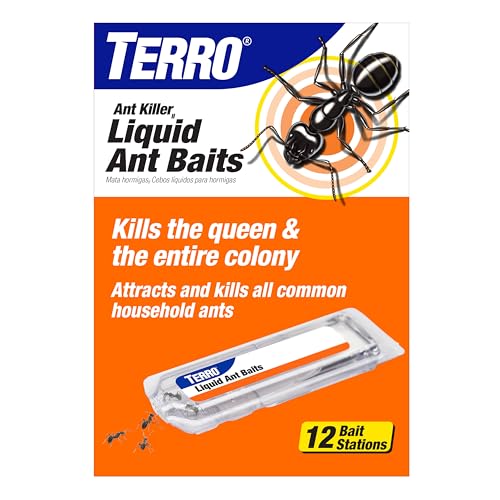
The bait that lets ants do your dirty work — and takes down the queen in the process.
This is the gold standard for indoor ant control, and for one simple reason: it does not stop at killing the ants you see. Each station is pre-filled with a liquid bait containing 5.40% Sodium Tetraborate Decahydrate, which is plain-English borax. Worker ants are drawn to the sweet liquid, drink it, and carry it back to the nest, where the poison spreads through the colony and eventually kills the queen. Buyers report that their ant problem was gone within a few hours of placing these stations, and the 12-count box gives you enough bait to cover every baseboard, corner, and countertop in your home. Unlike a spray that wipes out a trail in one spot, this product targets the hidden nest you never see.
The bait targets a wide range of species — acrobat, crazy, ghost, little black, odorous house, and pavement ants — so it is not a one-trick solution. Each station is ready to use: you just twist off the tab and set it down. The manufacturer notes that complete control may take 2-4 weeks depending on the size of the infestation, so patience is part of the process. Reviewers confirm that the ants swarm the stations aggressively at first, which can look alarming, but that means the bait is working exactly as designed.
Keep in mind that the liquid inside is a borax-water solution, so it can evaporate or get dusty if left out too long. If you see a station drying out after a few weeks, replace it with a fresh one to keep the colony exposed. This is a bait, not a barrier — it does not keep new ants from entering, but it kills the ones that do.
Colony killer at a fair price: The Terro T300B is the most reliable entry point into real colony elimination. It is cheap enough to use liberally, effective against a dozen ant types, and takes zero setup skill. The only real catch is that it works slowly over days rather than instantly, and you have to tolerate a swarm of ants at the stations for the first day or two.
Reach for this if: you have an active indoor ant trail and you want the colony gone for good rather than a temporary cleanup.
Look elsewhere if: you need something that kills on contact right now or you are dealing with ants that ignore sweet baits.
2. TERRO T200-3SR Liquid Ant Killer 3-Pack

The same borax bait in a bottle — so you can place the drops exactly where the ants march.
This is the liquid-in-a-bottle version of the Terro bait system, and it works on the exact same principle: 5.40% borax formula that worker ants share with the colony. The difference is that you control the placement. Each bottle holds 2 fluid ounces of liquid, and you squeeze a few drops onto the included cardboard tiles and set them near the ant trail. This gives you more flexibility than a pre-sealed station, especially if the ants are trailing along a narrow crack or behind an appliance where a station will not fit. Buyers in the Pacific Northwest note that the product eradicates ants within a few days, though they warn that the ant population gets worse right after you put it down — a sign that the bait is pulling in workers from the whole nest.
The three-bottle pack gives you six total fluid ounces of bait, which is enough for multiple rooms or a larger kitchen. The active ingredient is the same borax formula used in the T300B stations, so the elimination mechanics are identical. One experienced reviewer recommends skipping the included cardboard tiles and using a water bottle cap or a piece of foil instead — the cardboard can absorb the liquid after a few days, drying out the bait before the colony gets a full dose.
Be prepared for the initial ant surge. Do not panic and do not spray the ants near the bait — they need to survive long enough to carry the liquid home. If you kill them at the feeding site, you break the chain. This is the classic trade-off: the bait is more effective than any contact spray, but it takes more trust in the process.
Flexible bait delivery at a great price: The T200-3SR gives you the same colony-killing borax bait as the T300B stations but in a manual-drop format that you can aim precisely. It is ideal for tight spaces and for people who want to control the amount of bait at each spot. The catch is that the cardboard tiles absorb the liquid over time, so you may want to swap them for plastic lids or foil.
Choose this if: you want the full colony-killing power of a borax bait but need to place drops in tight spaces like behind the fridge or along a baseboard crack.
skip it if: you prefer the mess-free convenience of pre-sealed bait stations like the T300B.
3. Hot Shot Ant, Roach & Spider Killer 17.5 oz (3 Pack)
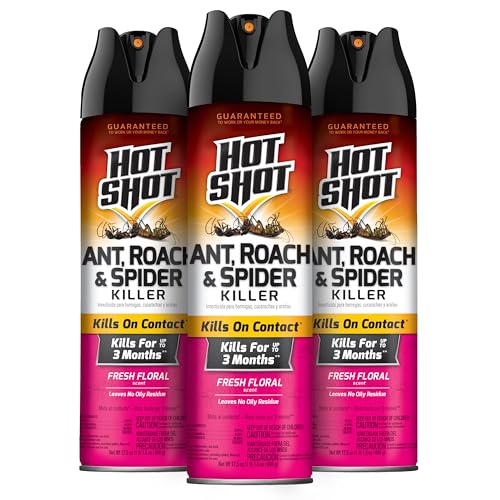
The instant-hit spray that kills on contact and keeps a residue working for months.
If you see a line of ants marching across your kitchen counter and you want them dead now, this is the can you grab. The Hot Shot spray contains two active ingredients — Imiprothrin at 0.075% and Lambda-Cyhalothrin at 0.025% — that attack the nervous system on contact. It kills ants, roaches, spiders, fleas, and crickets, and the label claims the residue keeps killing for up to 3 months after application. One reviewer noted that after spraying the threshold and door casing, they saw dead ants for the first three days and then had no ants for 2-3 weeks. The spray comes in a 3-pack, giving you 52.5 total ounces, which is a lot of coverage for the price.
The product leaves no oily residue and has a fresh floral scent that reviewers compare to perfume rather than a harsh chemical smell. You spray the surface until damp, and it dries clear. It works indoors and outdoors, making it good for spot-treating the foundation or the edges of a door frame. The “on contact” language is important here — the spray kills only the insects it directly hits or the ones that walk across the dried residue. It does not eliminate the nest, so it works best as a quick cleanup or a perimeter barrier rather than a standalone solution for a serious infestation.
Be aware that contact sprays like this can scatter the colony. If you spray a trail, the surviving ants may scatter and create multiple new trails, making the problem harder to track. Use it for spot kills and as part of a larger plan, not as your only defense against a deep nest.
What works well
- Kills ants, roaches, and spiders instantly on contact
- Residue keeps working for up to 3 months where you spray
- Fresh floral scent smells much better than typical bug spray
- No oily residue — dries clear on surfaces
Know the limits
- Does not kill the colony or the queen — ants from the nest keep coming
- Can scatter the trail and make the infestation harder to follow
- Only a spot treatment, not a full-coverage solution for large areas
Perfect for spot kills and quick perimeter touch-ups: If you need ants dead now and you like the idea of a protective residue that lasts for months, this is your go-to. Just do not expect it to wipe out a whole colony — it is a backup, not the main event.
Not the pick if: you are tired of ants returning and want a bait that goes after the nest; this spray only stops the ones you catch.
4. BASF PT Phantom II Pressurized Insecticide Spray (14 oz)
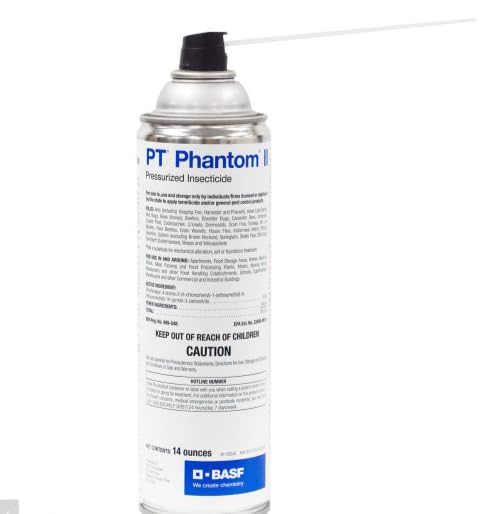
The invisible killer that ants cannot smell, taste, or avoid — and it works on resistant strains.
This is the spray you reach for when standard baits and contact sprays have failed. The active ingredient is Chlorfenapyr at 0.5% — a pro-insecticide that enters the ant’s body in a relatively mild form and then transforms into a much more toxic compound. Because the ants do not detect it as a threat, they walk right through the treated area without avoiding it. One licensed applicator reviewer notes that Phantom II is undetectable, contagious among the nest, and can deter ants for up to a year in certain conditions. That “contagious” piece is what makes it powerful: ants that contact the spray spread it to others through normal grooming and contact, killing the colony from the inside.
It is suitable for restaurants, hospitals, schools, and homes — the label specifically includes food handling establishments, which tells you the residual profile is low-risk when used correctly. The spray targets a wide range: cockroaches, ants, bed bugs, Asian lady beetles, and termites. But it is non-repellent, which means you will not see piles of dead ants immediately. You spray the surface, let it dry, and the ants continue their normal behavior for a few days before dying. A buyer in Florida who tested it on various bugs confirmed it works silently with minimal smell.
The product requires you to wear a long-sleeved shirt, long pants, shoes, and socks during application, and you must read the full label for safety, storage, and disposal instructions. This is not a casual spray-and-go product — it is a serious tool for serious pest problems.
Professional-level advantages
- Non-repellent formula means ants do not avoid the treated area
- Chlorfenapyr works on strains resistant to pyrethroid sprays
- Contagious among the colony — kills through contact and grooming
- Approved for food-handling establishments like restaurants
What to watch out for
- Requires protective gear (long sleeves, long pants, gloves, socks)
- Death is delayed — you will not see immediate results like a contact spray
- Higher price point than standard retail sprays
Choose this if: you have tried everything else and the ants keep coming, or you are dealing with hard-to-kill species like pharaoh ants or pyrethroid-resistant cockroaches.
Look elsewhere if: you want a simple spray that kills ants on sight — this is a strategic tool, not a quick fix.
5. Ortho Home Defense Insect Killer for Indoor & Perimeter2 (1.1 gal. 2-pack)
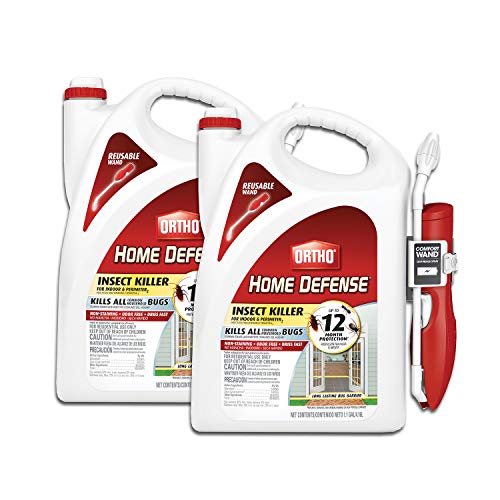
The shield you spray around your home to stop ants before they ever cross the threshold.
If you have a recurring ant problem that starts at the foundation and works its way inside, this is the product that builds a chemical wall. The formula uses two active ingredients — Bifenthrin and Zeta-Cypermethrin — that create a barrier on non-porous surfaces that kills ants, roaches, spiders, fleas, ticks, scorpions, earwigs, and silverfish. The big claim here is up to 12 months of protection when applied indoors on non-porous surfaces, which means you can treat your baseboards once and effectively ignore ants for a year. The 2-pack comes with two battery-powered Comfort Wand sprayers, each holding 1.1 gallons of ready-to-use spray, for a total of 281.6 fluid ounces.
Reviewers report that it works best as a preventative perimeter treatment — you spray the outside foundation, the indoor baseboards, and around windows and doors. One buyer mentioned that after two weekly treatments followed by monthly applications, their ant problem was solved, though they also reported that the battery sprayer failed after two uses. The customer service response was excellent, but note that the wand may not hold up for years of heavy use. Another experienced reviewer explains that it prevents insect entry rather than curing an active infestation — you spray it, let it dry, and it leaves an invisible residue that kills bugs that walk across it.
The spray dries clear and has a relatively mild scent compared to older insecticides. But it is a barrier, not a bait or a nest killer. If you already have a colony living in your wall, spraying the perimeter will not reach the queen. Use this as a front door defense, not as a surgical strike.
Long-term perimeter protection with an easy sprayer: The Ortho Home Defense is the easiest way to create a months-long barrier around your entire home. The 12-month indoor residual claim is tough to top, and the battery wand makes the job much less tedious than pump-spraying. The catch is that the sprayer can fail after a couple of uses, and the product does nothing for a nest already living inside.
Best for: homeowners who want to stop ants from entering in the first place and prefer a one-and-done perimeter treatment that lasts.
Not for: heavy infestations where the colony is already established indoors — you need a bait or a professional-grade spray for that.
6. Talstar One Insecticide 1 Gallon Concentrate
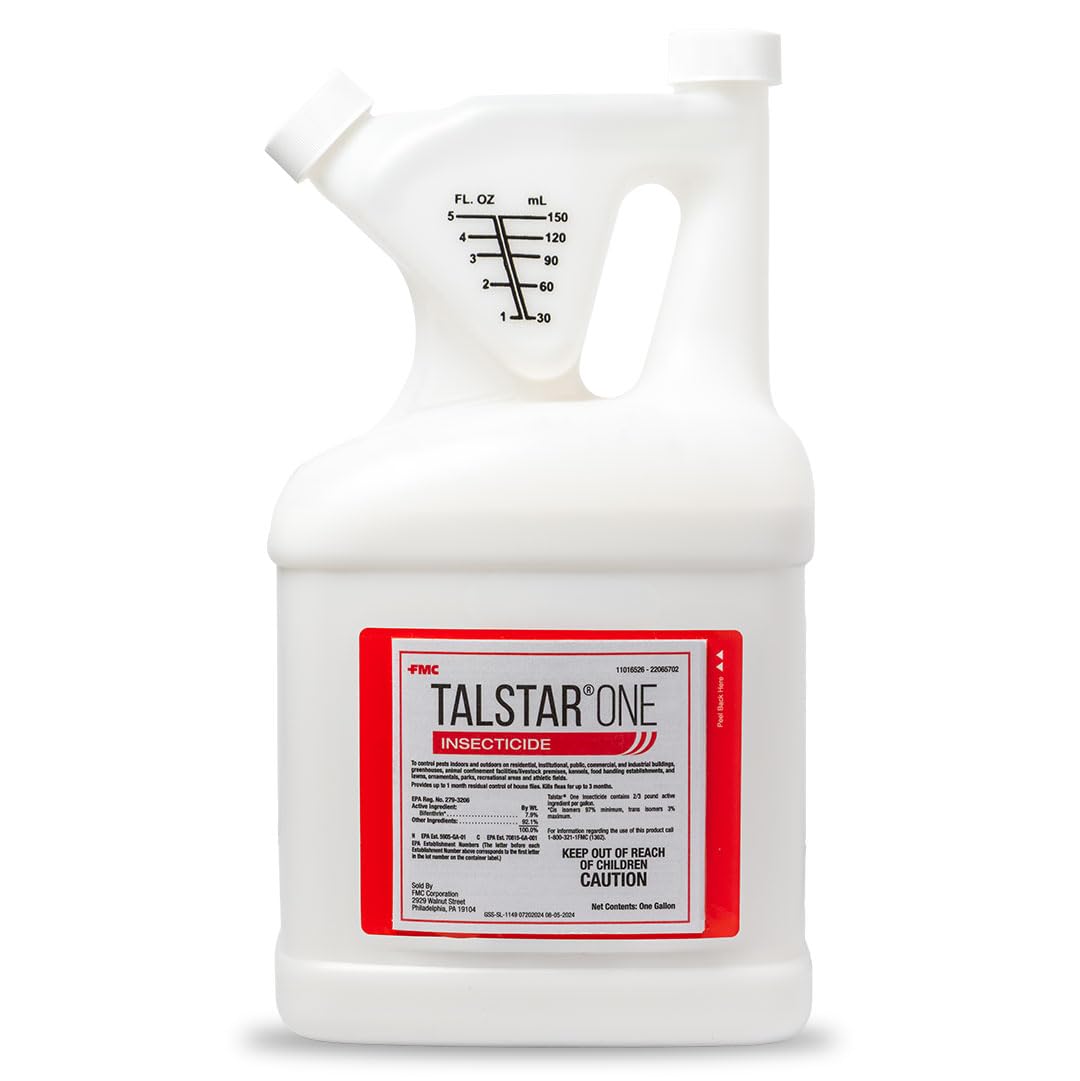
The gallon jug that turns one bottle into dozens of sprayer loads for big yards and thick perimeters.
Talstar One is a concentrate, which means it is not ready to spray straight from the bottle — you mix it with water and apply it with a pump sprayer or backpack fogger. A single gallon of concentrate goes a very long way, making it the most economical choice for anyone with a large property, multiple outbuildings, or a serious perimeter that needs regular treatment. The active ingredient is Bifenthrin, a synthetic pyrethroid that targets over 75 pests, including ants, spiders, mosquitoes, fleas, ticks, and roaches. It is water-based and dries clear with minimal odor, so it will not leave white stains on your foundation or patio furniture.
One reviewer who switched to Talstar One reported that it all but eliminated mosquitoes and ticks on their property — before using it, they could not go outside at night without being swarmed. The product is designed for both indoor and outdoor use, though the most common application is spraying the perimeter around foundations, doors, windows, and exterior walls. Because it is a concentrate, you control the strength of the mix, which lets you adjust the treatment for different surfaces and pest pressures.
The trade-off is that you need to own a sprayer (a simple 1-gallon pump sprayer works fine), and you must mix the concentrate exactly according to the label instructions. The manufacturer is Envu (formerly Bayer Environmental Science), so the quality is backed by a well-known professional-grade brand. If you only need to spray a small apartment or a single door frame, this is far more than you need — but if you have an acre of land and a fence line to defend, it is the smartest dollar-per-coverage option available.
Big-yard benefits
- Concentrate format stretches a long way — covers large perimeters affordably
- Controls over 75 pests, including ants, mosquitoes, ticks, and spiders
- Dries clear with very little odor after application
- Professional-grade Bifenthrin formulation from a trusted manufacturer
Setup requirements
- Requires a separate pump sprayer — not ready-to-use
- Must mix concentrate to label instructions every time
- Overkill for small apartments or single-room infestations
Best for: homeowners with large yards, multiple buildings, or heavy perimeter pest pressure who want to mix their own spray and save money per gallon.
Not for: renters or people dealing with a small indoor infestation — the concentrate format requires more equipment and effort than a can or a bait.
Understanding the Specs
Borax (Sodium Tetraborate Decahydrate)
This is the active ingredient in most ant baits, including the Terro products. It works as a stomach poison — the ant eats the sweet liquid, and the borax interferes with its digestive system and metabolism. It is slow-acting by design, giving the worker ant enough time to return to the nest and share the bait with the colony, including the queen. The concentration in these products is 5.40%, which is carefully calibrated to kill without being so bitter that ants avoid it. Higher concentrations actually work worse because the ants detect the taste and stop feeding.
Bifenthrin and Zeta-Cypermethrin
These are synthetic pyrethroids, which are lab-made versions of a natural insecticide found in chrysanthemum flowers. They attack the nervous system of insects on contact and leave a long-lasting residue that continues to kill for weeks or months. Bifenthrin is the active ingredient in Talstar One and Ortho Home Defense. It is very stable in sunlight and resists breakdown from rain better than many natural alternatives. The trade-off is that some insect populations have developed resistance to pyrethroids, which is why products like BASF Phantom II use a different chemistry (Chlorfenapyr) for tough cases.
FAQ
Will ant bait stations kill the queen or only the worker ants I see?
Is it safe to use ant spray around kids and pets?
Why do more ants appear right after I put down bait?
Can I use a contact spray and a bait station at the same time?
How long does a perimeter spray barrier last?
What types of ants do these products actually kill?
Which is better — liquid bait drops or pre-filled bait stations?
Can I use Talstar One concentrate indoors?
What should I do if ants keep coming back after using a bait?
Does the Hot Shot spray really last up to 3 months?
Final Thoughts: The Verdict
For most buyers, the bug spray for ants winner is the Terro T300B Liquid Ant Bait Stations because it targets the colony and the queen through a simple, mess-free bait system that works on the most common household ant species. If you want a flexible, easy-to-place bait you can aim into tight corners, grab the TERRO T200-3SR Liquid Ant Killer 3-Pack. And for large-property owners who need a concentrated perimeter defense that covers multiple acres, the standout is the Talstar One Insecticide 1 Gallon Concentrate.
How We Picked
We do not accept paid placement. Every pick is matched to a real buyer and a real use-case; we do not hands-on test units.
Sources & Methodology
Specifications: manufacturer listings and product documentation. Review insights: verified customer reviews, as of July 2026. Pricing: not shown on this page (it changes often); check the current price via the retailer link.
As an Amazon Associate, Lawn Gear Lab earns from qualifying purchases. This does not affect which products we feature.