
Specs are compiled from manufacturer listings and verified buyer reviews and can change over time — please confirm the key details on the product page before buying.
Every time you yank a gas starter cord or wrestle a heavy mower through wet grass, you wonder if there is a better way to spend your Saturday. A brushless mower removes the pull-cord ritual, the stale fuel smell, and most of the weight — but picking the right one means matching its motor and battery to your actual lawn size, not its decibel level or the brand name on the deck.
I’m Rikta — the founder and writer behind Lawn Gear Lab. This guide is built by comparing the manufacturers’ published specifications and the patterns across verified customer reviews, so you get each pick’s real strengths and trade-offs instead of marketing spin.
The challenge is that a 40V mower can handle a quarter-acre just fine, while a half-acre lot demands either a bigger battery pack or a more efficient cutting deck. We break down five distinct models to help you find the best brushless lawn mower for your property, your storage space, and your tolerance for fiddling with settings.
Quick Picks
- WORX Nitro Cordless Lawn Mower (WG752) — Best Overall
- WORX Nitro Self-Propelled Cordless Lawn Mower — Top Performer
- SKIL PWR CORE 40 20-Inch Self-Propelled Mower — Best Value
- CAT DG670 60V 21-Inch Brushless Push Mower — Premium Pick
- Greenworks 80V 21-Inch Self-Propelled Mower — Most Powerful
How To Choose The Best Brushless Lawn Mower
Before you look at any model, define your lawn’s actual size and terrain. The wrong mower either runs out of juice before you finish or feels like you are pushing a shopping cart through sand. Three specs separate the winners from the also-rans.
Battery Voltage and Capacity
Voltage (40V, 60V, 80V) is the rough measure of muscle — higher voltage generally powers the motor through thicker grass without bogging down. Capacity, measured in amp-hours (Ah), tells you how long the battery lasts. A 40V 5.0Ah pack holds exactly the same amount of energy as a 60V 3.3Ah pack (200 watt-hours), but the higher-voltage system delivers that power more efficiently under load. For lawns under a quarter-acre, 40V paired with a 4.0Ah or 5.0Ah battery is usually enough. For a half-acre or hillier terrain, stepping up to 60V or 80V gives you the buffer you won’t regret.
Cutting Deck Design and Width
The deck is where the air flow happens. A wide 21-inch cut mows faster than a 20-inch because you cover more ground per pass — over a half-acre that difference shaves off about four or five trips across the yard. Look for decks with aerodynamic features like vents or a deeper draw that lifts grass upright before the blade hits it. This prevents clumps in wet grass and fills the bag more completely. The number of height positions (seven is the common balance) matters if you overseed in spring and want a taller cut for shade.
Self-Propelled Drive and Weight
Self-propelled mowers use a drive system (usually rear-wheel for traction) to pull themselves forward, letting you guide rather than push. The catch is weight — a self-propelled mower with batteries can hit 63 to 75 pounds. If your yard has slopes or your garage is up a step, check the actual weight. Variable-speed control, where you adjust the ground speed with a lever or dial, makes a real difference on uneven terrain where you want to slow down around trees and speed up on straight runs.
Quick Comparison
| Model | Best For | Cutting Width | Battery & Voltage | Weight | Amazon |
|---|---|---|---|---|---|
| WORX WG752 | Push & light storage | 21 in. | 40V (2× 5.0Ah) | 55.6 lb | Amazon |
| WORX WG760 | Self-propelled ½ acre | 21 in. | 40V (2× 5.0Ah) | 63.1 lb | Amazon |
| SKIL SM4910C-11 | Long battery runtime | 20 in. | 40V (1× 6.0Ah) | — | Amazon |
| CAT DG670 | Power on dense grass | 21 in. | 60V (1× 5.0Ah) | 68.3 lb | Amazon |
| Greenworks MO80L416 | Large yards & hills | 21 in. | 80V (1× 4.0Ah) | 74.95 lb | Amazon |
In‑Depth Reviews
1. WORX Nitro Cordless Lawn Mower (WG752)

A featherlight push mower that still finishes a half-acre with charge to spare.
At 55.6 pounds this is the lightest mower in the lineup — 7.5 pounds less than its self-propelled sibling, the WG760 — and that matters if you carry the mower up steps or lift it for upright storage. The 21-inch cutting width matches the premium picks in this list, meaning you cover ground faster than the 20-inch SKIL, which buyers report offers about a 55-minute runtime on a single charge. The WORX delivers a 50-minute average runtime, but owners mention the 40V system (two 20V 5.0Ah batteries) provides excellent performance, leaving a half-acre with 60%+ charge remaining.
The Aerodeck vented design helps prevent wet grass clumps, and IntelliCut sensors automatically adjust the cutting speed — revving up in thick patches and backing off on thin areas to conserve runtime. The 7-position height lever spans 1.5 to 4 inches, and the handle collapses fully for vertical storage. One trade-off: fixed front wheels reduce maneuverability compared to swivel-wheel designs, though the light weight offsets that limitation for most users.
Customers note the batteries are compatible with over 140 WORX PowerShare tools, so if you already own WORX gear this is a smooth addition. The mower handles standard mulching, bagging, and rear side-discharge via a twist-in mulch plug and chute, and the onboard charge-level indicator removes the guesswork during a mowing session.
Why it leads the pack
- 55.6 lb — easiest to lift and store upright
- 21-inch cut paired with 40V (2× 5.0Ah) batteries handles a half-acre easily
- Aerodeck deck reduces clogs; auto-sensing IntelliCut preserves battery in sparse areas
Consider before buying
- Fixed front wheels feel less nimble in tight corners
- No self-propelled drive — you push the full 55.6 lb yourself
Your best bet if: You want the lightest, most storage-friendly push mower that still cuts a half-acre on one battery charge.
Look elsewhere if: Your yard has slopes or you want a mower that pulls itself forward — the WG752 is push-only.
2. WORX Nitro Self-Propelled Cordless Lawn Mower (WG760)

Self-propelled variable speed that lets you match the mower’s pace to your stride.
Take everything that works in the WG752 and add a rear-wheel drive system with continuously variable speed up to 3.7 MPH, plus a beefier 63.1-pound frame. The motor is the same Brushless 2.0 design, and the battery setup is identical (two 20V 5.0Ah PowerShare Pro batteries). Where this model differs is in the feel: reviewers point out a half-acre lot uses the full charge, compared to the WG752 which leaves 60% remaining on the same size — the self-propelled system draws more power, but the trade-off is you guide the mower rather than push it.
The variable-speed dial, mounted on the handle, lets you slow to a crawl around flower beds and speed up on straight runs. The steel cutting deck carries the same 21-inch width and 7-position height adjustment (1.5 to 4 inches) as the push version, plus the same 3-in-1 bagging, mulching, and side-discharge flexibility. Buyers who moved from premium gas brands (mowers from SCAG and John Deere) report being surprised at how well this electric unit cuts. Shoppers say the batteries improve after the first 2-3 charge cycles — one reviewer noted mowing a full yard with 80% remaining after the pack broke in.
The 3-year limited warranty adds confidence, and the collapsible handle still allows vertical storage. One catch: at 63.1 pounds it is 7.5 pounds heavier than the WG752, so lifting it onto a wall hook is less convenient. The dual charger tops both batteries simultaneously in about an hour, though one buyer cautions against leaving it on the charger past full charge.
What makes it a top performer
- Variable-speed self-propel up to 3.7 MPH for hands-free forward motion
- Same 21-inch cut and 40V battery system as the WG752, but with drive assist
- Buyers report cut quality equals gas mowers from premium brands
Trade-offs to know
- 63.1 lb — noticeably heavier than the push version; less portable
- Full half-acre mow uses the entire battery charge, unlike the push model which reserves 60%
Reach for this if: Your yard is flat or gently sloped and you want self-propulsion without buying a separate battery platform.
Consider the WG752 instead if: You need to carry the mower up stairs or you prefer the lighter weight of a push model.
3. SKIL PWR CORE 40 20-Inch Self-Propelled Mower (SM4910C-11)

Fifty-five minutes of runtime from a single 6.0Ah battery — five more minutes than the WORX twins.
The SKIL edges the WORX mowers on battery endurance: a 55-minute average runtime versus 50 minutes for the WORX WG752 and WG760. This extra runtime comes from a single 40V 6.0Ah battery rather than two separate packs. The hitch is the cutting width — 20 inches versus 21 inches on the WORX, CAT, and Greenworks picks — so you add about a half-dozen passes on a quarter-acre lot. Owners mention the battery lasts roughly an hour, enough for a typical front-and-back yard.
The self-propelled drive offers variable speed, and the push-button start eliminates any pull-cord frustration. The telescoping handle folds for vertical storage, and the weather-resistant construction holds up to occasional rain. Height adjustment covers the standard 1.5- to 4-inch range with 7 positions via a single lever, same as the WORX mowers. Buyers with physical restrictions particularly praise this mower — one 62-year-old reviewer calls it a perfect fit, noting it transforms mowing from a chore into an enjoyable task. An elderly user with limited strength reported it was powerful enough on long, wet grass when using realistic expectations.
The Auto PWR JUMP charger is noticeably faster than standard chargers, and the battery is compatible with the broader SKIL PWR CORE 40 tool ecosystem. Customers note the self-propelled drive is louder than the cutting motor itself, but the overall noise level still beats any gas mower. One minor complaint: on mossy sections of a lawn, the mower performs better at a higher cut setting.
Where it wins
- 55-minute runtime from a single 6.0Ah battery — longest in this lineup
- Self-propelled and easy for users with limited strength, per several buyer accounts
- Fast auto PWR JUMP charger included
Things to watch
- 20-inch cut means more passes than the 21-inch models
- Self-propelled drive noise is louder than the motor
Grab this if: Maximum runtime per charge is your priority and you don’t mind slightly narrower passes.
Pass on it if: You want the widest cut to finish your yard fastest — the 21-inch models are better there.
4. CAT DG670 60V 21-Inch Brushless Push Mower
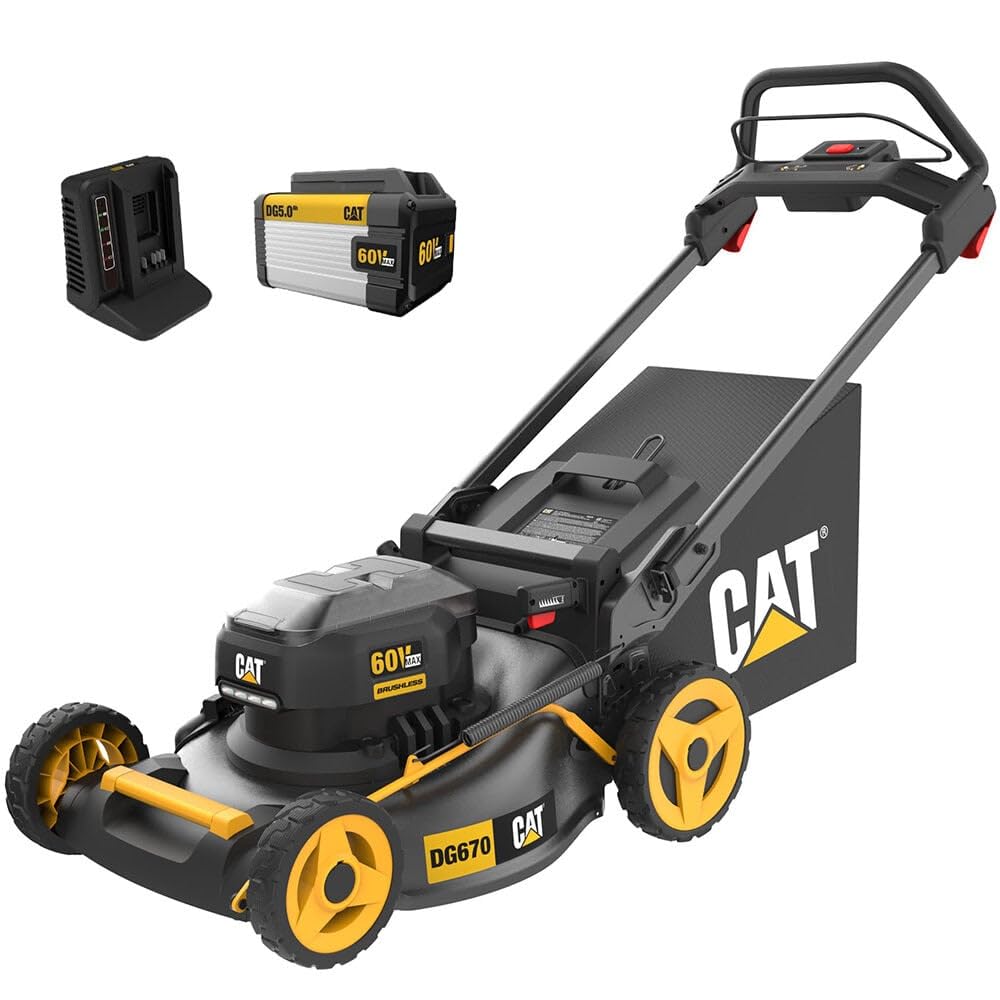
Gas-level torque from a 60V system that auto-adjusts power as the grass thickness changes.
While the WORX and SKIL mowers run on 40V, the CAT DG670 steps up to 60V for denser grass and hills. The TorqLogic technology continuously adjusts motor torque to match cutting conditions — increasing power in thick patches and dialing it back in thin areas to save battery. At 68.3 pounds, it is the second heaviest mower here, partly because of the larger battery pack and a deep-draw deck design that produces finer mulch clippings. The dual battery port lets you carry a second 60V battery onboard so you can hot-swap without returning to the garage.
The 21-inch cutting width equals the WORX and Greenworks picks, but the DG670 uses only a 3-position height lever (1.5 to 4 inches), which is less granular than the 7-position systems found on every other mower in this list. The included Cat 60V 5.0Ah battery and 3A charger are compatible across Cat’s 60V outdoor equipment line. Reviewers point out mowing a third of an acre on a single battery with half charge remaining, and the integrated LED headlight improves visibility at dusk. A folding handle makes upright storage possible.
Buyer reviews are split: some praise the build quality and “design masterpiece” feel, while others report reliability issues — one returned two units with power drive and blade-start failures within one day. Several shoppers say the cut quality is clean but not as crisp as gas mowers, and one switched to an 80V Greenworks for a sharper cut. The 3-in-1 mode switching (bag, mulch, side-discharge) uses a single lever that is faster than swapping plugs.
Highlights
- 60V power (5.0Ah battery) with TorqLogic auto-torque for dense turf
- Dual battery port lets you carry a spare on board for hot-swap
- Deep deck produces fine mulch and fills the bag completely
Watch out for
- Only 3 height-adjustment positions vs. 7 on all other picks
- Mixed buyer reports on reliability — some units experienced early failures
- Cut quality described as okay, not as crisp as top gas mowers
Choose this for: A dense St. Augustine or Bermuda grass lawn where 60V torque makes a visible difference in cut consistency.
skip it if: You want precise height control (3 positions is limiting) or you prefer a track record of trouble-free units.
5. Greenworks 80V 21-Inch Self-Propelled Mower (MO80L416)

Eighty volts of rear-wheel drive torque that climbs hills without bogging down.
The highest voltage in this lineup, the Greenworks 80V system pairs a 4.0Ah battery with a brushless motor and a durable steel deck. The manufacturer rates it to cut up to a half-acre per charge, and buyers confirm it handles a city-sized lot using about half the battery. Rear-wheel drive with variable speed gives it superior traction on slopes compared to front-wheel drive alternatives. At 74.95 pounds, this is the heaviest mower here — the price of the torque and steel construction.
The 21-inch cutting width matches the WORX and CAT models, and the 7-position height adjustment gives you the same granular control as the SKIL and WORX mowers. The 4-in-1 system adds a turbo leaf pickup mode alongside the standard bagging, mulching, and side-discharge functions. LED headlights are built into the deck, a feature shared only with the CAT DG670. Buyers who previously used gas mowers report this electric mower is much quieter (noted as 3x quieter than gas), easy to assemble, and folds for storage without tools. One buyer with St. Augustine grass found the mulch quality adequate but not exceptional, and the self-propel system can lock the rear wheels during tight turns.
The 80V battery platform is compatible with over 75 Greenworks tools, making this a solid investment if you plan to expand your cordless outdoor equipment. Buyers report the batteries hold charge for six months or more off-season, and the rapid charger brings the pack back to full in about an hour. A few reviewers mention the mower works best at slower speeds for elderly users, but the self-propel makes it manageable for anyone who does not want to push 75 pounds.
Why it earns the power crown
- 80V system with rear-wheel drive for top-tier traction on slopes
- Steel deck construction for durability; cuts up to a half-acre per charge
- Compatible with 75+ Greenworks 80V tools
Downsides to weigh
- 74.95 lb — the heaviest mower here; less portable for storage/transport
- Mulch quality described as adequate but not top-tier in buyer feedback
Best for: A sloping half-acre where rear-wheel drive and 80V torque prevent stalling on inclines.
Think twice if: You need to lift the mower for overhead storage — 75 pounds is a two-person job.
Understanding the Specs
Voltage vs. Amp-hours
Voltage (V) is the “push” behind the motor — higher voltage lets the mower maintain cutting speed through thick, wet grass without the blade stalling. Amp-hours (Ah) is the fuel tank size. A 40V 5.0Ah battery (200 watt-hours) and a 60V 5.0Ah battery (300 watt-hours) both last about the same clock time if the 60V mower works harder, but the 60V system delivers consistent torque longer under load. For a quarter-acre flat lawn, 40V is usually plenty. For slopes or dense turf, 60V or 80V gives a noticeable margin.
Cutting Width and Passes
The difference between a 20-inch and 21-inch deck is just one inch, but over a half-acre (roughly 21,780 square feet) that inch adds up to about 8% fewer passes. A 21-inch mower finishes a standard property about three to five minutes faster than a 20-inch model. More important than the raw width is deck design — aerodynamically vented decks (like WORX’s Aerodeck) lift grass upright before the blade cuts, reducing clumps and improving bag fill. Deeper-draw decks (like the CAT’s) produce finer mulch that decomposes faster.
FAQ
Do brushless lawn mowers need any maintenance?
How long does a brushless mower battery actually last per charge?
Can a brushless mower handle thick St. Augustine or Bermuda grass?
Is a self-propelled mower worth the extra weight?
How do I store a brushless mower with upright storage?
Can I use third-party batteries with these mowers?
What does the 3-in-1 or 4-in-1 cutting mode actually let me do?
Are brushless mowers really quieter than gas mowers?
How do I know when the battery is about to die?
What is the difference between brushed and brushless motors in lawn mowers?
Final Thoughts: The Verdict
Across the board, the brushless lawn mower winner is the WORX WG752 because it combines a light 55.6-pound frame, a 21-inch cut, and a 40V battery system that leaves most half-acre lawns with 60% charge remaining — all while folding flat for the tightest garage spots. If you want self-propulsion without leaving the WORX battery platform, grab the WG760. And for steep hills or dense southern turf, the standout is the Greenworks 80V with its rear-wheel drive and torquey 80V motor.
How We Picked
We do not accept paid placement. Every pick is matched to a real buyer and a real use-case; we do not hands-on test units.
Sources & Methodology
Specifications: manufacturer listings and product documentation. Review insights: verified customer reviews, as of July 2026. Pricing: not shown on this page (it changes often); check the current price via the retailer link.
As an Amazon Associate, Lawn Gear Lab earns from qualifying purchases. This does not affect which products we feature.