
Specs are compiled from manufacturer listings and verified buyer reviews and can change over time — please confirm the key details on the product page before buying.
Cutting down brush and stumps is only half the battle. The roots left in the ground will send up new shoots, turning one afternoon of work into a season-long chore. A brush and stump killer that moves deep into the root system stops that regrowth at the source, saving you the hassle of re-cutting and re-spraying all summer long.
I’m Rikta — the founder and writer behind Lawn Gear Lab. This guide is built by comparing the manufacturers’ published specifications and the patterns across verified customer reviews, so you get each pick’s real strengths and trade-offs instead of marketing spin.
Whether you are clearing a fence line, reclaiming a pasture, or finally tackling that patch of poison ivy by the back shed, the right herbicide makes the difference between a permanent fix and a repeat job. This roundup of the best brush and stump killer options lays out the specs, coverage areas, and real-world results you need to pick the one that matches your property’s scale.
Quick Picks
- Southern Ag Brush Killer 8.8% Triclopyr, 1 Gallon — Best Overall
- ALLIGARE Triumph RTU Herbicide Weed Killer — Cut Stump Specialist
- Roundup Poison Ivy Plus Tough Brush Killer₂ Concentrate — Fast Action
- Monterey Brush and Vine Control, 1 Quart — Vine Specialist
- Southern AG 01113 Brush Weed Killer, 1 Quart — Pasture Pick
How To Choose The Best Brush And Stump Killer
You choose a stump killer based on how you will apply it. A ready-to-use squirt bottle works well for a dozen cut stumps. A gallon of concentrate (a liquid you mix with water) is the smarter buy for acres of brush. These three specs guide your choice.
Active Ingredient and Concentration (Triclopyr)
Triclopyr is the main active ingredient in most effective brush killers because it penetrates the bark and moves through the plant’s vascular system to the roots. Higher concentrations, like 8.8% Triclopyr, work faster on tough species like poison ivy and blackberry.
Coverage Area Per Unit
A product’s coverage specs tell you the total area a single container can treat. A bottle rated for 1,500 square feet works for a few small stumps, but a 1-gallon jug covering 4,096 square feet is far more economical for clearing a large fence line or overgrown lot.
Application Method and Form
You have two main choices: a ready-to-use (RTU) liquid that you squirt directly onto a fresh cut stump, or a concentrate that you mix with water in a sprayer. RTU formulas trade higher convenience for a higher price per ounce, while concentrates give you the most value for large-scale jobs.
Quick Comparison
| Model | Best For | Active Ingredient | Size (Oz) | Coverage (Sq Ft) | Amazon |
|---|---|---|---|---|---|
| Southern Ag Brush Killer 8.8% | Large Acreage | 8.8% Triclopyr | 128 | 4,096 | Amazon |
| ALLIGARE Triumph RTU | Cut Stumps | Triclopyr (dual-active) | 32 | RTU cut-stump treatment | Amazon |
| Roundup Poison Ivy Plus | Poison Ivy | 2.5% Triclopyr | 32 | 1,500 | Amazon |
| Monterey Brush & Vine Control | Vines | Triclopyr | 32 | — | Amazon |
| Southern AG 01113 | Rangeland | Triclopyr | 32 | 512-1,024 | Amazon |
In‑Depth Reviews
1. Southern Ag Brush Killer 8.8% Triclopyr, 1 Gallon

The high-concentration gallon jug built for serious acreage and long-term root kill.
You get the largest volume you can buy without going commercial: a full 128 fluid ounces of 8.8% Triclopyr concentrate (Triclopyr is the active chemical that kills woody plants). Because the concentration is high, you need very little product per gallon of water, so coverage reaches 4,096 square feet, versus 1,500 square feet for the Roundup concentrate above. That means one jug covers a whole property rather than one jug per section.
Buyers report that it “outperformed other brands” and saw “no regrowth after 8 months” on tough species like poison ivy, oak, sumac, and briars. The trade-off is mixing: it is a concentrate, so you need to mix it with water in a sprayer (the label suggests 4 to 9 ounces per gallon depending on the plant). One reviewer with a negative experience claimed a recent bottle seemed diluted and ineffective, which underscores the importance of shaking it well and verifying the mixing ratio.
The Acreage Advantage
- Highest concentration of Triclopyr in this lineup at 8.8%
- Massive coverage of 4,096 square feet per gallon
- Owners mention no regrowth for months after a single application
The Mixing Catch
- Requires careful measuring and mixing with water
- Some batches have arrived without labeling or directions
- Heavy at 128 oz compared to the smaller 0.5 lb bottles
One-Gallon Job: Pick this if you have a large property, fenceline, or overgrown field that needs serious coverage — one jug replaces many smaller bottles.
Skip for Spot Treatments: Its bulk size and mixing requirement make it overkill for a single stump in a backyard; a ready-to-use formula will be more convenient.
2. ALLIGARE Triumph RTU Herbicide Weed Killer
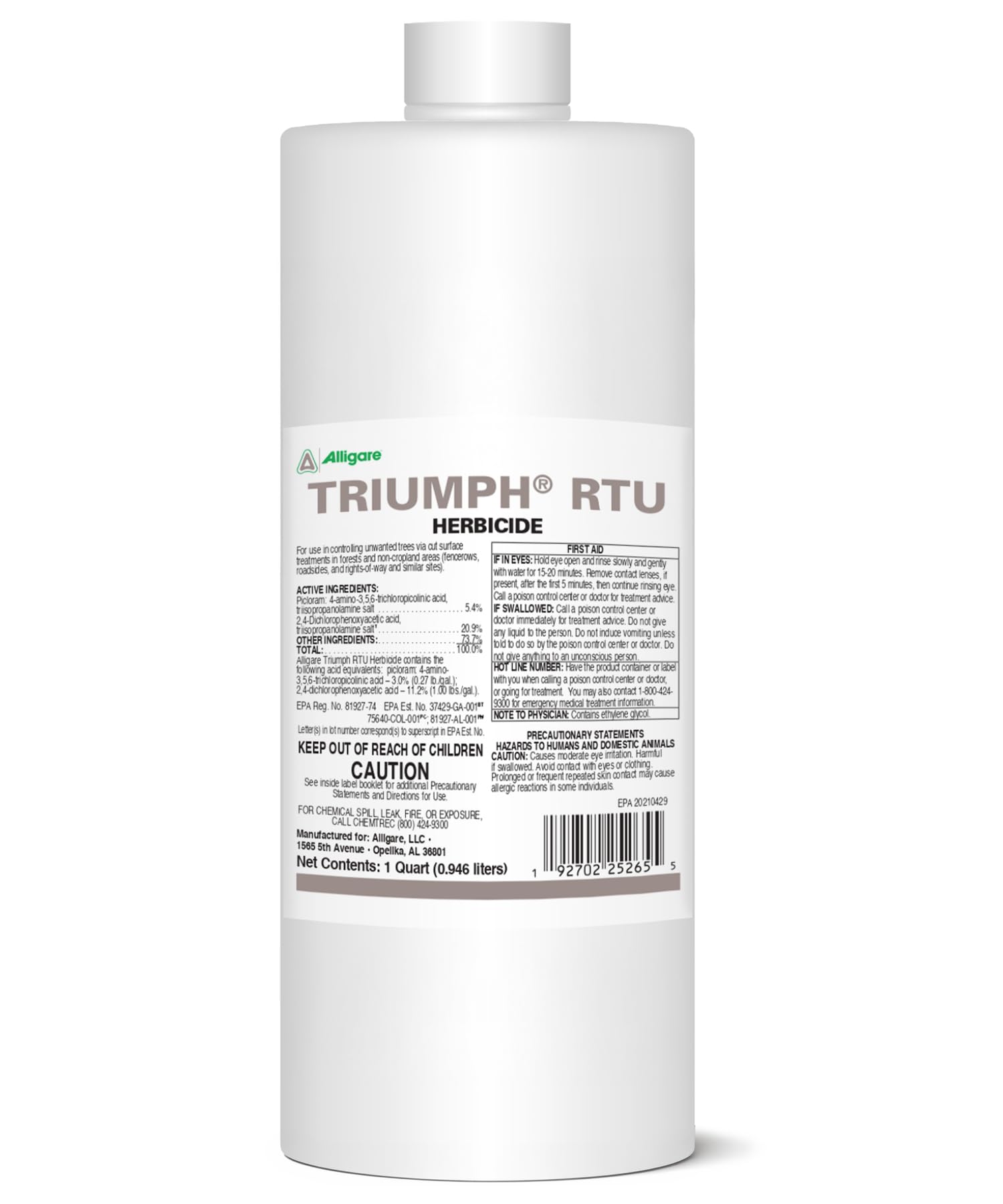
The no-mix, squirt-bottle stump killer designed to kill roots in any season.
This 1-quart bottle is pre-mixed and ready to use right out of the package — no measuring, no mixing, no sprayer needed. You simply cut the stump flat and squirt the liquid directly onto the cut surface. The built-in blue dye shows you exactly where the product has been applied, a simple feature that prevents missed spots and over-application.
Buyers confirm the root-killing power: one owner reported stumps were “easily kicked away after one year” after applying the product to the cut cross-sections. The real advantage over the Roundup concentrate is convenience — this is the fastest tool in the list for treating a dozen or so stumps along a fence line.
Instant Application
- Zero mixing required — just squirt and go
- Blue dye provides clear visual confirmation of coverage
- Works year-round with no seasonal restrictions
Limited Per Bottle
- At 32 fluid ounces, you will run out fast on large brush jobs
- Higher per-ounce cost than a concentrate like the Southern Ag 8.8%
- Some buyers noticed the cap can loosen during shipping
Stump-Only Jobs: Reach for this when you have a set number of cut stumps to treat — no mess, no math, just direct application.
Not for Spraying: If you are spraying acres of poison ivy vines, you want the Southern Ag gallon concentrate instead, as it works out cheaper per treated area.
3. Roundup Poison Ivy Plus Tough Brush Killer₂ Concentrate

The ivy-specific concentrate that claims visible results within hours, not weeks.
Roundup’s formula is a triple-active mix: 2.50% Triclopyr, 2.00% Fluazifop-P-Butyl, and 1.50% Diquat Dibromide. That combination targets a broader range of tough plants including poison ivy, poison oak, kudzu, and wild blackberry. It is rainproof in just 30 minutes and you can plant in the treated area after 1 to 30 days, depending on what is listed in the booklet.
This 32-ounce bottle covers 1,500 square feet when mixed, versus 4,096 square feet for the Southern Ag 8.8% gallon, but still ample for a suburban lot. Customers note that “most die with 1 application” while “tough plants need a few.” A common complaint is that the concentrate does not come in a larger size, forcing repeat purchases if you have a large property.
Quick Results
- Visible results in hours after application
- Rainproof in only 30 minutes, so weather is less of a concern
- Convenient 0.5 pound bottle
Smaller Volume
- At 32 fluid ounces, you may need multiple bottles for fence-line jobs
- Lower Triclopyr concentration (2.5%) compared to the Southern Ag’s 8.8%
- Coverage is 1,500 sq ft, versus 4,096 sq ft for the gallon jug
Poison Ivy Patrol: This is the best pick if poison ivy or poison oak is your main enemy around the house and you want to see results the same day.
Not for Bulk Work: If you need to clear a whole field of blackberry brambles, the Southern Ag gallon jug will save you money and trips to the store.
4. Monterey Brush and Vine Control, 1 Quart

A Triclopyr concentrate that comes bundled with a measuring spoon for easy mixing.
This 1-quart bottle is a concentrate, but Monterey makes it slightly easier to mix by including a measuring spoon in the box. The formula is built specifically for woody plants and vines, with poison ivy, poison oak, blackberry, and honeysuckle all listed on the label. It is designed for outdoor residential use only — not for edible crops or in areas where food grows.
Reviewers point out that it is “very effective after a second application on poison ivy,” while another reviewer simply says “pour on anything that you don’t want to grow and it will kill it.” The catch is that it requires rainfall-free conditions for 24 hours after application, which is more restrictive than the Roundup’s 30-minute rainfast window (the time before rain can wash it off). Since the Monterey has a slightly lower concentration of Triclopyr than the 8.8% Southern Ag product, you may need to use a higher mix rate for the same result on very thick brush.
User-Friendly Kit
- Comes with a measuring spoon so you don’t need to buy one
- Highly effective on poison ivy and honeysuckle after a second application
- Concentrate formula lets you adjust the strength per plant type
Longer Dry Time
- Needs 24 hours of dry weather after spraying — less flexible than Roundup’s 30-minute rainfast window
- Undiluted application needed for the strongest effect on cut stumps
- Avoid spraying in windy conditions to prevent drift onto desirable plants
Mixed Vine Battles: Grab this if you have a mix of poison ivy, honeysuckle, and blackberry that needs selective treatment — the included spoon simplifies the mixing step.
Speed vs. Convenience: If unpredictable rain is common in your area, the Roundup concentrate’s 30-minute rainfast time is more forgiving than the Monterey’s 24-hour dry window.
5. Southern AG 01113 Brush Weed Killer, 1 Quart

The Triclopyr spray that targets vines and stump sprouts along fencelines and pastures.
This 1-quart bottle of Triclopyr concentrate covers 512 to 1,024 square feet per gallon, depending on the brush density. It is labeled for use on non-crop areas like roadsides, rangeland, pastures, and fences — not for landscaping around your house. The main job here is to prevent resprouting after you cut brush, and to kill vines that climb fences.
Unlike the other Southern Ag product in this review (the 8.8% gallon jug), this quart-sized bottle has a lower concentration and a tighter coverage range. The absence of customer reviews in the product data makes it harder to gauge field performance, so you are relying on the manufacturer’s label. If you already own the Southern Ag 8.8% gallon, this smaller bottle offers a cheaper alternative for smaller follow-up treatments without dragging out the big jug.
Targeted Application
- Specifically formulated for non-crop areas like pastures and fence lines
- Easy to measure and spray from a tank sprayer
- Prevents stump sprouting after you cut
Limited Data
- Coverage is 512-1,024 sq ft per gallon, versus 4,096 sq ft for the 8.8% gallon
- No customer reviews available to verify real-world effectiveness
- Lower concentration than the 8.8% Triclopyr alternative from the same brand
Light Duty on Rangeland: This is useful for small pasture touch-ups where you only need to treat a few stumps or a short stretch of fence line.
Better Value Elsewhere: For anything beyond light work, the Southern Ag 8.8% gallon covers 4,096 sq ft, while this quart covers 512-1,024 sq ft per gallon, making the larger option the more economical choice per square foot.
Understanding the Specs
Triclopyr Concentration
Triclopyr is the active ingredient that penetrates the bark of woody plants and translocates to the root system, killing the entire plant. A higher percentage, such as 8.8%, means the chemical is more concentrated, so you need less product per gallon of water to achieve a lethal dose. Lower concentrations like 2.5% are effective on seedlings and small weeds but may require multiple applications on tough vines or large stumps.
Coverage Area
The coverage rating tells you how many square feet a single container treats when mixed at the label rate. A product covering 1,500 square feet is suitable for a typical suburban lot of 0.1 to 0.2 acres. A product covering 4,096 square feet is closer to 0.1 acre of dense brush. The larger the coverage number, the fewer bottles you need to buy for a big property.
Concentrate vs. Ready-to-Use (RTU)
A concentrate (like the Southern Ag 8.8%) must be mixed with water in a sprayer before use, giving you more control over the strength and more volume per dollar. A ready-to-use formula (like the ALLIGARE Triumph) is pre-mixed and applied straight from the bottle, which is more convenient for spot-treating a single stump but much more expensive per ounce. For dozens of stumps, a concentrate pays for itself quickly.
Rainfast Time
Rainfast time is the minimum amount of time the product needs to dry on the plant before rain washes it off. A 30-minute rainfast time (like Roundup) is very forgiving on a cloudy day, while a 24-hour rainfast time (like Monterey) requires a clear weather forecast. If you live in a rainy climate, a shorter rainfast window is a big practical advantage.
FAQ
How do I apply a brush killer to a cut stump?
Can I use a brush and stump killer in my vegetable garden?
What is the difference between a brush killer and a general weed killer?
How long does it take to see results from a brush killer?
Can I mix brush killer with water and spray it?
Will brush killer harm the grass around my stumps?
How long does a brush killer need to stay on before it rains?
How does the coverage of the 1-gallon Southern Ag compare to the 1-quart bottle?
Is it safe to use brush killer around pets?
Final Thoughts: The Verdict
For most buyers, the best brush and stump killer winner is the Southern Ag Brush Killer 8.8% Triclopyr because the one-gallon size and high concentration give you the most coverage per dollar, with buyers confirming no regrowth for months. If you need a fast, no-mix stump killer, grab the ALLIGARE Triumph RTU. And for poison ivy around the house with fast results, the Roundup Poison Ivy Plus Concentrate is designed to work quickly, though it requires mixing before use.
How We Picked
We do not accept paid placement. Every pick is matched to a real buyer and a real use-case; we do not hands-on test units.
Sources & Methodology
Specifications: manufacturer listings and product documentation. Review insights: verified customer reviews, as of July 2026. Pricing: not shown on this page (it changes often); check the current price via the retailer link.
As an Amazon Associate, Lawn Gear Lab earns from qualifying purchases. This does not affect which products we feature.