
Specs are compiled from manufacturer listings and verified buyer reviews and can change over time — please confirm the key details on the product page before buying.
Finding solar landscape lights that actually throw enough light to make a difference at night is the real challenge. Most sets look promising in the box but end up casting a weak glow that fades a few hours after dusk. This guide is built around the handful of models that deliver genuine brightness — measured in real lumens — and hold it long enough to matter.
I’m Rikta — the founder and writer behind Lawn Gear Lab. This guide is built by comparing the manufacturers’ published specifications and the patterns across verified customer reviews, so you get each pick’s real strengths and trade-offs instead of marketing spin.
Below, you’ll find the top contenders for the brightest solar landscape lights, ranked by real-world performance, build quality, and the honest feedback from people who have installed them in their own yards.
Quick Picks
- JACKYLED 84-LED Solar Spotlights — Best Overall
- AOUNQ Solar Spot Lights (1000 Lumens) — Top Performer
- Linkind Solar Spot Lights (60 LED) — Best Value
- ALFIOT Solar Pathway Lights — Premium Pick
- WTGEGF Solar Pathway Lights — Bright Path Pick
How To Choose The Best Brightest Solar Landscape Lights
The market is packed with solar lights that claim “super bright” but deliver a dim glow. To cut through the noise, you need to focus on a few specific specs that actually translate to real-world performance in your yard.
Focus on Verified Lumens, Not Marketing Claims
The single most important number is the lumen output. A light rated at 1000 lumens is significantly brighter than one rated at 200 lumens. However, be skeptical of brands that don’t provide a lumen rating at all. A true spotlight, like the JACKYLED model with 84 LEDs, uses a lens to focus that light into a tight beam, so it travels farther. A floodlight-style light, like the Linkind 60 LED, spreads the same light over a wider area, which feels less intense at a distance.
Check the Battery and Panel Size
A large solar panel (measured in inches or by its watt/amp rating) means faster charging in less-than-perfect sun. A bigger battery (measured in mAh or mWh) means the light will stay on longer after the sun goes down. The ALFIOT pathway lights, for example, use a 3.2 x 3.2-inch panel and a 4400mWh battery to deliver up to 28 hours of illumination. Without a big battery and panel, even a very bright LED will die out by midnight.
Be Realistic About Color Temperature
Color temperature, measured in Kelvin (K), affects how “bright” a light feels to your eye. A light at 6000K (cool white/bluish) appears much brighter than a light at 2700K (warm white/yellowish), even if they have the same lumen output. The AOUNQ 1000 Lumen spotlights use a 6000K light for maximum visibility, while the Linkind lights use a 2700K light for a more natural, cozy glow. Choose based on if you want to illuminate a security area or create ambiance.
Quick Comparison
| Model | Best For | Brightness (Lumens) | Light Color (Kelvin) | Waterproof Rating | Amazon |
|---|---|---|---|---|---|
| JACKYLED 84-LED Solar Spotlights | Focused Long-Throw Spotlights | 1000 | Warm/Cool/Neutral White | IP65 | Amazon |
| AOUNQ Solar Spot Lights | Maximum Raw Brightness | 1000 | 6000K | IP67 | Amazon |
| Linkind Solar Spot Lights | Value & All-Night Warm Glow | 800 | 2700K | IP67 | Amazon |
| ALFIOT Solar Pathway Lights | Premium Pathway & Walkway Lighting | 200 | 3000K (Switchable) | IP65 | Amazon |
| WTGEGF Solar Pathway Lights | Budget Pathway with High Output | 200 | 6500K | IP65 | Amazon |
In‑Depth Reviews
1. JACKYLED 84-LED Solar Spotlights

The spotlight that throws a tight beam and actually stays lit past midnight.
The defining feature here is the lens system. While most solar spotlights scatter light in a 120° angle that fades quickly with distance, the JACKYLED uses a convex lens over each of its 84 LEDs to focus the output into a sharp 60° beam. This makes it the best pick for illuminating a specific tree, flag, or sculpture from a distance, as the light holds its intensity rather than washing out.
Buyers report that on the bright setting, the light runs for more than 12 hours, and on the low setting, it can stretch to an impressive 48 hours. The “Y” stake design means you can independently rotate the solar panel and the light head a full 360°, so you can angle the panel toward the sun while pointing the beam exactly where you want it. This combination of focused power and flexible positioning makes it a clear winner over models like the AOUNQ, which users note can sometimes require manual intervention to turn on.
The Strengths of a Tight Beam
- Focused 60° beam throws light much farther than standard flood lights.
- Smart brightness control gives over 12 hours on high and up to 48 hours on low.
- Solar panel and light head both adjust 360° independently.
The Real-World Durability Concern
- Some owners mention water ingress around the lens after several months, potentially overstating the IP65 rating.
- One reviewer with 34 lights reported a 15% failure rate after 6 months of use.
Best suited for: Homeowners who need a true directional spotlight to highlight a landscape feature from a distance, and who prioritize beam focus and runtime over sheer spread of light.
Consider the trade-off: The long-term durability is a question mark, with multiple reports of individual units failing after 5-6 months, though the warranty is responsive.
2. AOUNQ Solar Spot Lights (1000 Lumens)

The brute-force choice for maximum raw brightness in a small package.
If your only goal is the highest possible lumen count, this AOUNQ set delivers 1000 lumens at a crisp 6000 Kelvin color temperature. That cool white light is much brighter to the human eye than the warm 2700 Kelvin of the Linkind lights, which makes this pick ideal for security-adjacent tasks like lighting up a house number or a dark side yard. The head measures 5.7 inches long by 4.13 inches wide, making it a distinctly more compact unit than the taller JACKYLED.
The 2000mAh battery supports USB charging as a backup, which is a smart feature for cloudy winter weeks. However, the trade-off is reliability. Multiple customers note a specific pattern: the lights work great for a week, then fail to auto-turn on at dusk, requiring you to press the button manually. As one reviewer put it, “Solar lights worked for a week, then 3-4 failed to auto-turn on at dusk, requiring manual activation.” This sensor issue is a recurring complaint, even though the brightness itself is praised.
When Pure Lumens Win
- Packs 1000 lumens into a more compact housing compared to the larger JACKYLED.
- USB charging backup ensures operation even after cloudy days.
- IP67 waterproof rating offers excellent protection against heavy rain and snow.
The Auto-On Frustration
- A significant number of reviewers point out a dusk-to-dawn sensor failure, requiring manual button presses to re-activate.
- Reports of units failing completely within a few months of installation.
Reach for this if: You want the brightest possible light for a specific area, you have easy access to the lights to manually override them, and you value USB charging as a backup.
Look elsewhere if: You need a “low-maintenance” solution; the sensor reliability issues are a genuine frustration for many owners.
3. Linkind Solar Spot Lights (60 LED)
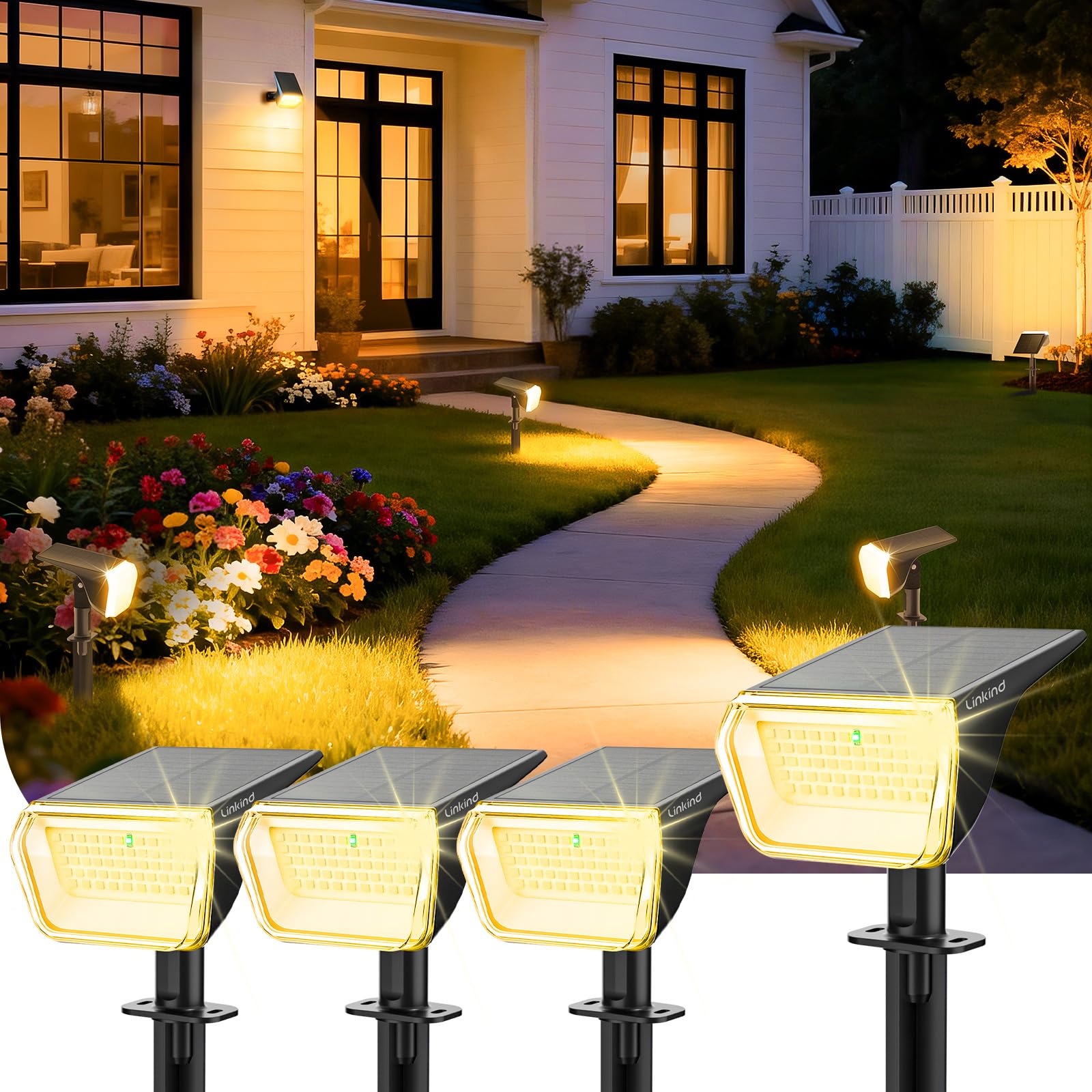
A reliable warm glow that runs all night while staying affordable.
At 800 lumens, this model is less bright than the JACKYLED and AOUNQ 1000-lumen units, but it uses a warm 2700K color temperature. This makes it a better fit for creating a cozy, inviting atmosphere in a garden rather than a stark security zone. It also means the light is easier on the eyes. The unit features a 110° wide beam with a frosted shell, which spreads the light evenly and reduces glare, solving the “blinding the neighbors” problem some spotlights create.
The real star here is the consistency. Shoppers say that the “brightest setting lasts ~7.5 hours; lowest lasts sunset to sunrise.” For a 4-pack at a budget-friendly price point, that all-night performance on the lowest setting is impressive. The aluminum and ABS construction feels sturdy, and the IP67 rating means it can handle being submerged in water, which is a step up in protection from the IP65 rating of the JACKYLED. The main compromise is the lower raw lumen output compared to the top two picks.
Value That Actually Lasts
- Excellent runtime, with buyers noting the lowest setting lasts from sunset to sunrise.
- Frosted shell and 110° beam provide an even, anti-glare light that doesn’t blind passersby.
- IP67 waterproof rating offers superior protection against the elements.
The Brightness Trade-Off
- At 800 lumens and 2700K, it is significantly dimmer and yellower than the 1000-lumen, 6000K AOUNQ model.
- Some buyers reported a single faulty unit in a pack, though customer service was responsive in replacement.
A smart pick for: The budget-conscious buyer who wants reliable, attractive, all-night lighting for a garden path or flower bed, and who prefers a warm, non-glaring light over maximum brightness.
skip it if: You need to light up a large area or a house number from a distance; the warm light and lower lumens won’t cut it for security purposes.
4. ALFIOT Solar Pathway Lights
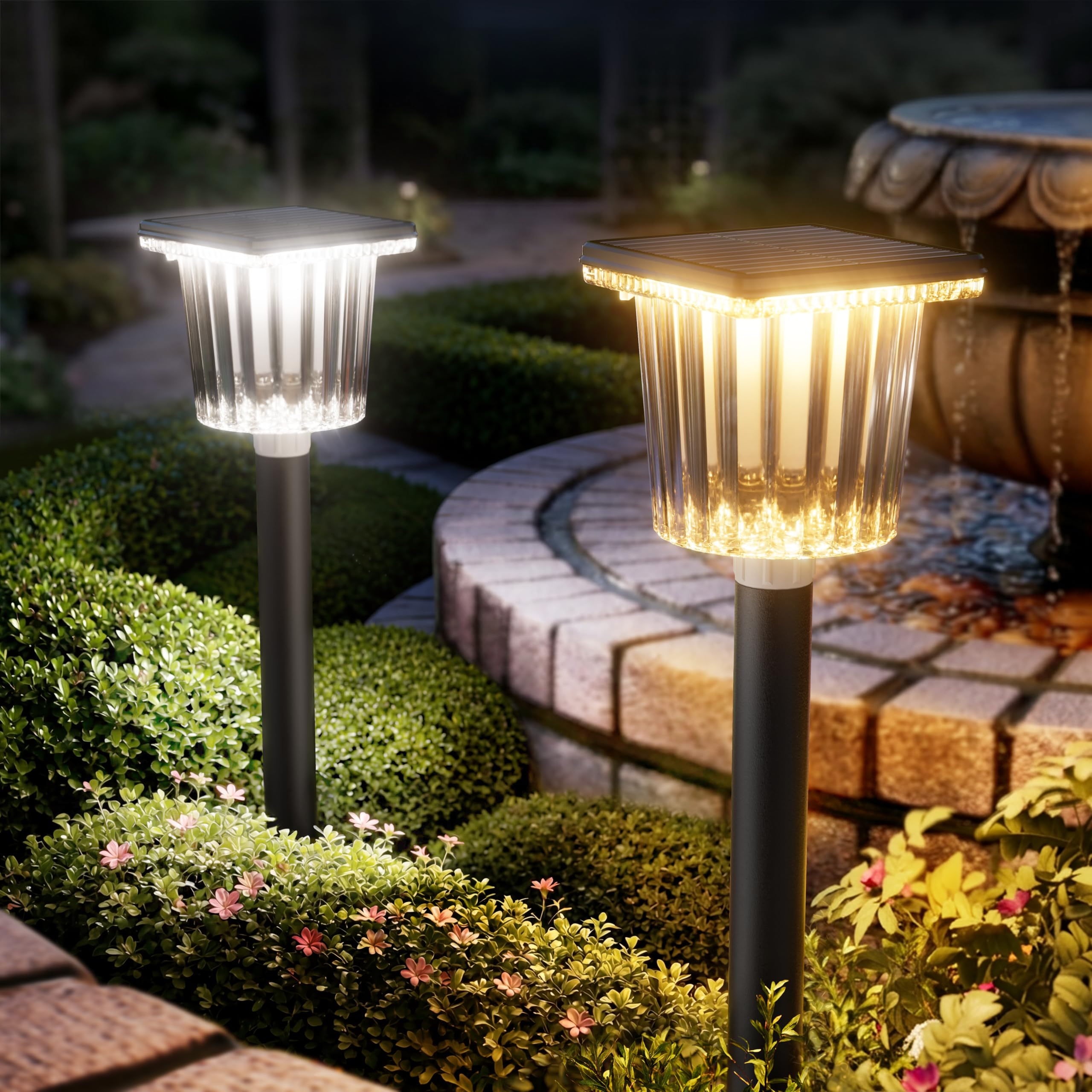
The premium path light that outshines its peers with a massive battery.
While the JACKYLED and AOUNQ are for spotlights, the ALFIOT is for a different job: lighting a walkway. It’s a different form factor, and its 200-lumen output is perfectly matched for that task. What makes it special is the 4400mWh battery (that’s 4400 milliwatt-hours), which is massive for a solar path light. This allows it to run for up to 28 hours on a single charge, meaning it can power through a string of cloudy days without dimming.
Another standout feature is the 2-in-1 color switching between cool white and warm white. This is not just a gimmick; buyers report the “cool mode [is] brighter than warm,” giving you a practical choice for different seasons or moods. The large 3.2 x 3.2-inch monocrystalline solar panel is designed to charge efficiently even in less direct sun. While the 200-lumen output is far lower than the 1000-lumen spotlights, it is brighter than most standard path lights, which often struggle to hit 50 lumens.
Built for All-Night Path Lighting
- Massive 4400mWh battery provides up to 28 hours of run time, far exceeding standard path lights.
- Switchable between cool white and warm white to adjust the mood and perceived brightness.
- Reviewers consistently praise it as the best path light among 3-4 different brands they tried.
Not a Security Light
- At 200 lumens, it is not a replacement for a 1000-lumen spotlight for area illumination.
- Some reports of individual units failing after a few months, though the seller’s warranty is noted as reliable.
The color-switching feature is a genuine bonus.
The catch: If you need to illuminate a yard or a distant object, this is the wrong tool; it’s tune for close-up, decorative path lighting.
5. WTGEGF Solar Pathway Lights

A path light that claims “6-8 times brighter” than standard options.
The WTGEGF lights are in the same 200-lumen range as the ALFIOT, but they take a different approach to brightness. The marketing claims they produce 200 lumens, compared to other solar path lights that typically produce 10-40 lumens. The key feature is the large 4.35 x 4.35-inch monocrystalline silicon panel with a claimed 35% conversion rate, helping it charge faster and illuminate a 2-meter radius.
A unique feature is the detachable refractor cup. Without it, the light spreads in a wide, bright wash. With the cup attached, it projects a crystal-like pattern onto the ground, which can be a nice decorative touch. Owners mention the lights work great straight from the start, with one noting they performed perfectly the same night even with just a few hours of assembly time. Another reviewer noted the lights “lasted all night with consistent intensity” and have been working well for over 2 years, which is an encouraging sign for longevity in this category.
Versatile and Efficient
- Large, high-efficiency solar panel for faster charging in partial sun.
- Detachable refractor cup offers both a bright wash and a decorative patterned light.
- Can be staked or hung like a lantern, offering flexible installation options.
Mid-Range Reliability
- Some units have been reported to stop working after 6-8 months, though the seller’s customer service is noted as responsive with replacements.
- The 200-lumen output, while bright for a path light, is not comparable to dedicated spotlights.
Ideal for: Someone who wants a very bright, versatile path light with a decorative option. The ability to hang it like a lantern is a unique plus.
Think twice if: You want a single-function unit with long-term proven durability; reports of failures around the 6-month mark are a concern.
Understanding the Specs
Lumens and Color Temperature
Lumens measure the total amount of visible light emitted. A higher number means a brighter light. For landscape lighting, 200 lumens is plenty for a pathway, while 800-1000 lumens is needed for a true spotlight effect. Color temperature, measured in Kelvin (K), affects the “feel” of the light. Lower numbers (2700K-3000K) give a warm, yellowish glow similar to a classic incandescent bulb. Higher numbers (6000K-6500K) produce a cool, bluish-white light that appears brighter to the human eye but can feel more clinical.
IP Rating and Battery Capacity
The IP (Ingress Protection) rating tells you how well the light is sealed against water and dust. An IP65 rating means it’s protected against water jets from any direction, which is fine for rain. An IP67 rating means it can be immersed in up to 1 meter of water for 30 minutes, offering better protection in storms or snow. Battery capacity is measured in milliamp-hours (mAh) or milliwatt-hours (mWh) — the higher the number, the more energy the battery stores, which translates directly into how long the light can stay on after the sun sets.
FAQ
How long will a 2000mAh battery last in a solar light?
Should I choose warm white or cool white for my garden?
Will these lights work in winter or on cloudy days?
What is the difference between IP65 and IP67 waterproofing?
Why do some of my solar lights stop turning on at night?
How long should I charge solar lights before first use?
Are 200 lumens bright enough for a solar pathway light?
What does “convex lens” do in a solar spotlight?
Final Thoughts: The Verdict
For most buyers, the brightest solar landscape lights winner is the JACKYLED 84-LED Solar Spotlights because it combines the highest raw brightness (1000 lumens) with a focused beam that actually throws light across a yard, plus smart brightness control for exceptional runtime. If you want a reliable set of spotlights for a warm, all-night glow without the risk of sensor issues, grab the Linkind 60 LED set. And for premium, long-running pathway lighting, the ALFIOT Solar Pathway Lights stand out with their massive battery that customers note keeps them lit all night.
How We Picked
We do not accept paid placement. Every pick is matched to a real buyer and a real use-case; we do not hands-on test units.
Sources & Methodology
Specifications: manufacturer listings and product documentation. Review insights: verified customer reviews, as of July 2026. Pricing: not shown on this page (it changes often); check the current price via the retailer link.
As an Amazon Associate, Lawn Gear Lab earns from qualifying purchases. This does not affect which products we feature.