
Specs are compiled from manufacturer listings and verified buyer reviews and can change over time — please confirm the key details on the product page before buying.
A muddy garden path after rain turns a simple walk into a mess. You want a stable, dry surface that keeps your shoes clean and your garden looking sharp, without spending a weekend digging and laying mortar (a cement-like adhesive used to stick bricks together). The best bricks for garden paths today come in two main forms—wooden roll-out walkways and cement stepping stones—and each solves that problem in a very different way.
I’m Rikta — the founder and writer behind Lawn Gear Lab. This guide is built by comparing the manufacturers’ published specifications and the patterns across verified customer reviews, so you get each pick’s real strengths and trade-offs instead of marketing spin.
You will see exactly what to look for when choosing bricks for garden paths, including the key differences between a portable wooden pathway and a set of decorative cement pavers (flat stones used for walkways), so you can match the right material to how you actually use your yard.
Quick Picks
- Amazer Wooden Garden Pathway Pavers for Outside — Best Overall
- LINSHRY 10FT Wooden Garden Pathway — Best Flexibility
- PINPON 4 Pack Sunflower Stepping Stones — Best Décor
How To Choose The Best Bricks For Garden Paths
The choice depends on how permanent you want your path to be and what kind of look you prefer. A wooden roll-out walkway is a solid, continuous surface you can lay in minutes and roll back up for storage, making it great for temporary use or seasonal events. A set of cement stepping stones is heavier, more permanent, and adds a decorative focal point to your garden, but requires more effort to install and stays put once placed.
Material and Durability
Cedar wood with a waterproof coating resists cracking and fading from sun and rain, so your path stays intact through a wet season. Cement with a protective coating handles heavy foot traffic and extreme weather without breaking, so you get a solid surface that lasts for years with no upkeep.
Coverage and Layout
A continuous 10-foot wooden path gives you a straight, connected walkway that covers the ground fully, so you never step on mud. A set of 4 cement pavers, each 10 inches across, creates a spaced-out stepping stone path where grass or gravel shows between each stone. The total covered area is very different, so think about if you want a solid strip or a dotted line.
Grip and Safety
Both options offer non-slip surfaces, but in different ways. Wooden planks use textured stripes or patterns cut into the surface, so your foot won’t slide on damp wood. Cement pavers have a textured finish that provides grip even when wet, so you feel secure on a splashy day. If your path is in a shady area that stays damp, the textured cement surface typically offers a more stable feel.
Quick Comparison
| Model | Best For | Material | Coverage Length | Number of Items | Amazon |
|---|---|---|---|---|---|
| Amazer Wooden Garden Pathway | Durable permanent path | Wood + Steel Wire Cord | 8.5 ft | 1 | Amazon |
| LINSHRY Wooden Garden Pathway | Flexible roll-out walkway | Cedar Wood | 10 ft | 1 | Amazon |
| PINPON Sunflower Stepping Stones | Decorative spaced path | Cement | — | 4 | Amazon |
In‑Depth Reviews
1. Amazer Wooden Garden Pathway Pavers for Outside
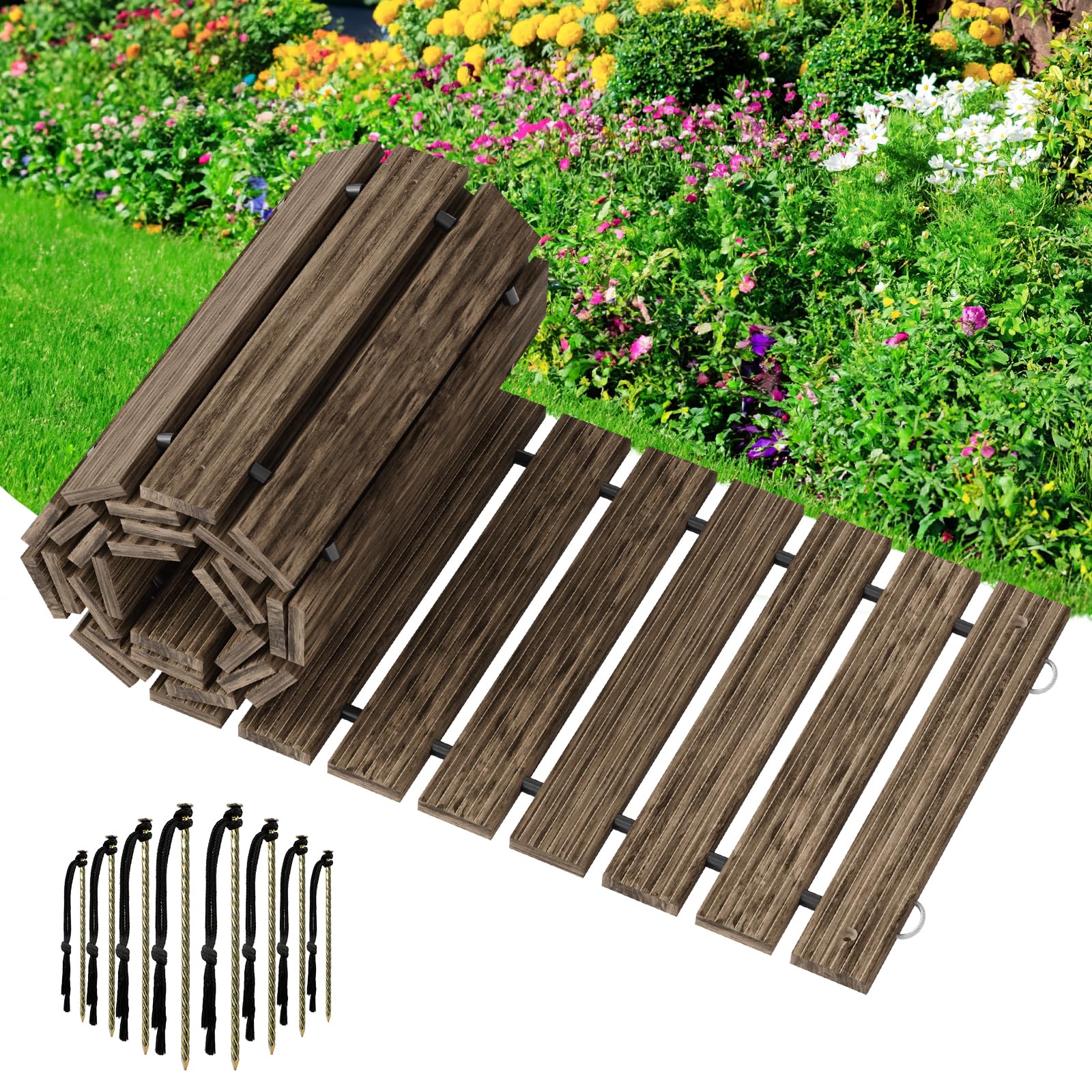
The roll‑out path that stays put with steel wire and ground stakes.
This pick gives you a permanent feel without the permanent installation work. The Amazer wooden walkway is 8.5 feet long and 16.7 inches wide, made from natural wood with a transparent lacquer coating and carbonized treatment that resists sunlight, wind, and rain without cracking or discoloring so your path stays intact season after season. what separates it from the LINSHRY walkway is the connection system—each plank is reinforced with 5mm-diameter steel wire cords, which are far more durable than the rubber cords used on the LINSHRY, and the set includes 8 ground stakes to anchor the path firmly into the grass or soil so it won’t slide around.
The surface has multiple stripe designs cut into the widened planks, which boosts the anti-slip performance and makes for a more comfortable, stable step — you won’t slide on a dewy morning. Buyers report that the path stays flat and doesn’t shift underfoot, even on uneven ground. You can roll it up for storage just like a portable walkway, but the steel wire and stakes mean you can treat it as a semi-permanent garden feature.
Compared to the 4-pack of cement pavers from PINPON, this gives you a single continuous surface that covers the entire walking line with no gaps, so grass and mud never creep up between stones. While the LINSHRY path is 10 feet long, this Amazer path is 8.5 feet and uses a stronger steel-wire connection instead of rubber cords alone.
Why it wins: The steel wire cord reinforcement and included ground stakes make this the most secure roll-out walkway for a path you want to last season after season — it won’t bunch up or slide like rubber-cord models can.
Best for: Anyone who wants a sturdy, semi-permanent garden path that won’t shift underfoot and can stay out all season without maintenance.
One trade-off: At 8.5 feet it is 1.5 feet shorter than the LINSHRY path, so you get less total coverage length — not enough for a long driveway, but fine for a patio landing or a shortcut to the shed.
2. LINSHRY 10FT Wooden Garden Pathway

The lightweight cedar path that flexes over any surface.
This LINSHRY path is the longest of the three picks at 10 feet, with a width of 17 inches and a thickness of 0.6 inches. It is made from cedar wood with waterproof paint, making it all-weather, fade-resistant, and anti-cracking so it holds up to rain without splitting. The standout feature here is the reinforced slat connection using 2 rows of heavy-duty rubber cords, which the manufacturer says are more aging-resistant than nylon spacers (plastic spacers that separate slats). This gives the path a flexible feel that conforms to uneven ground like sandy beaches, gravel roads, or grassy lawns — helping you keep your feet clean and dry away from dirt and sand by letting the path settle into bumps.
Unlike the cement pavers which come as 4 individual stones, this is a single 10-foot sheet that rolls out in seconds. The surface has anti-slip patterns for safety, and the planks have no nails or screws to maintain. Buyers appreciate how easy it is to clean — just spray it with a high-pressure hose — and roll it back into a small size for storage when not in use.
Compared to the Amazer path, this one is 1.5 feet longer but uses rubber cords instead of steel wire, and it does not come with ground stakes. That means it is lighter to carry and more portable, but may shift more on a windy day or on very slick grass without extra anchoring — owners mention it needs flat, stable ground to stay put.
Why choose it
- Longest continuous path at 10 feet — enough to span from a gate to a shed
- Lightweight cedar wood with waterproof coating resists weather
- Rolls up small for easy storage and transport
Keep in mind
- No stakes or ground anchors included for securing to grass
- Rubber cords may not hold as firmly as steel wire on uneven terrain
Reach for this if you: Need a long, lightweight, and portable path that you can roll out for a weekend event or seasonal use and easily store away afterward.
Look elsewhere if you: Want a path that stays locked in place permanently on grass without shifting — the lack of stakes means it is best on flatter, more stable ground like patios or packed gravel.
3. PINPON 4 Pack Sunflower Stepping Stones

The hand-painted cement paver that makes your path a garden art piece.
This set of 4 stepping stones takes a very different approach from the wooden roll-out paths. Each stone is 10 inches in diameter, made from weather-resistant cement with a protective coating that the maker says is crack-resistant and built to withstand heavy foot traffic, sun, rain, and snow so you can leave them out year-round. The hand-painted sunflower center is surrounded by a border of colorful pebbles, so every step becomes a visual feature rather than just a walking surface. The textured cement finish provides a non-slip surface even when wet, so safety is built into the design — you won’t slip on a rain-soaked morning.
The key difference here is coverage — these are 4 individual stones, so you space them out along your path, leaving gaps where grass, gravel, or mulch shows through. That means you do not get a continuous 10-foot solid surface like you would from the LINSHRY or Amazer walkways; you still step on ground between them. For a decorative garden path where you want stepping stones to accent your flower beds, this works beautifully. The cement construction is also far heavier than a rolled wood path, so once placed, they do not move unless you pick them up — perfect for a permanent layout.
Customers note that the hand-painted design stays vibrant outdoors and the pebble border adds a texture difference they enjoy. At 4 items in one pack, compared to the single-piece LINSHRY path, the item count is 4 versus 1, but the trade-off is that you need to decide your spacing and layout beforehand — plan where each stone goes to keep the path even.
What stands out: The hand-painted sunflower with colorful pebble border turns a practical path into garden décor, while the textured cement gives you solid grip in wet weather — you get art and safety in one stone.
Choose this if you want: A decorative, spaced-out stepping stone path that adds color and character to your garden and stays fixed in place permanently — no rolling up or adjusting needed.
skip it if you: Need a continuous mud-free walkway — the spaced stones leave gaps where grass and soil show through, so you still step on ground between them, which means muddy shoes on wet days.
Understanding the Specs
Roll‑Out Length
The total length of a continuous wooden garden path tells you how much straight ground it covers. A 10-foot path stretches further than an 8.5-foot path, so it reaches from the gate to the shed in one piece, giving you dry steps the whole way. Shorter paths can still work if you just need a dry landing spot off the patio, like a 4-foot strip to a hose.
Number of Items
For wooden walkways, this is usually 1 — a single rolled sheet you unroll all at once. For stepping stone sets, the count tells you how many individual pavers you get. A 4-pack gives you 4 stones to space out, so you need to plan the layout yourself by measuring gaps between them. More items mean more coverage but also more installation work to get them evenly spaced.
Material Type
Cedar wood with a waterproof coating resists cracking and fading from weather, so your path stays flexible and portable. Cement with a protective layer is crack-resistant and handles heavy foot traffic without flexing, so you get a rock-solid surface that won’t bend over time. Wood is lighter and portable; cement is heavier and permanent. The surface finish matters too — textured stripes on wood and textured cement both provide grip when wet, but cement tends to feel more stable on sloped or damp ground because it doesn’t shift.
Connection System
Wooden walkways use rubber cords or steel wire cords to link the planks together. Steel wire (like the 5mm-diameter cords on the Amazer path) is stronger and less likely to break or stretch over time than rubber cords, especially on uneven ground, so the path stays flat. Rubber cords are more flexible and work well on flat surfaces, but may wear out faster with heavy use — they stretch and snap eventually.
FAQ
Will a wooden roll-out garden path stay flat on grass?
How long do cement stepping stones last outdoors?
Can I cut a wooden garden path to a shorter length?
Are stepping stones or a roll-out path better for uneven ground?
Do these paths require any tools for installation?
How do I clean a wooden garden walkway?
What does the number of items mean for a garden path?
Can I leave a wooden roll-out path outside all winter?
Are these paths safe for elderly people or children to walk on?
Will the hand-painted design on the sunflower stones fade in the sun?
Final Thoughts: The Verdict
If you want one dependable pick, the bricks for garden paths winner is the Amazer Wooden Garden Pathway because it combines a steel-wire-reinforced connection with ground stakes for a secure, semi-permanent path that stays flat and won’t shift — the best choice for a path you want to feel solid underfoot all season. If you want a longer, lighter, and more portable path for seasonal or event use, grab the LINSHRY 10FT Wooden Garden Pathway — it rolls up small and weighs less. And for a decorative, artistic path that makes every step a visual feature, the PINPON Sunflower Stepping Stones with their hand-painted design and weather-resistant cement build add color to any flower bed.
How We Picked
We do not accept paid placement. Every pick is matched to a real buyer and a real use-case; we do not hands-on test units.
Sources & Methodology
Specifications: manufacturer listings and product documentation. Review insights: verified customer reviews, as of July 2026. Pricing: not shown on this page (it changes often); check the current price via the retailer link.
As an Amazon Associate, Lawn Gear Lab earns from qualifying purchases. This does not affect which products we feature.