
Specs are compiled from manufacturer listings and verified buyer reviews and can change over time — please confirm the key details on the product page before buying.
Your seedlings and leafy greens need a specific 400-500nm wavelength (a narrow band of blue light) to drive photosynthesis and stay short and sturdy instead of stretching thin. Most “blue” lights are either too weak to help or so single-purpose they won’t carry you into flowering. This guide sorts nine genuinely blue-capable grow lights, from a 100W tent powerhouse down to clip-on desk helpers, so you can match the spectrum to the stage your plants are actually in.
I’m Rikta — the founder and writer behind Lawn Gear Lab. This guide is built by comparing the manufacturers’ published specifications and the patterns across verified customer reviews, so you get each pick’s real strengths and trade-offs instead of marketing spin.
Whether you are sprouting seeds on a windowsill or running a 2×2 grow tent, the blue light for plants below is ranked by real grower lessons and honest specs, not hype.
Our Picks at a Glance


How To Choose The Best Blue Light For Plants
Blue light in the 450-470nm range signals seedlings to grow compact and leafy instead of stretching tall. If your seedlings are getting leggy — stretching tall and pale — they are almost certainly begging for more blue. A light’s blue wavelength and wattage determine whether it actually drives photosynthesis or just glows.
Wavelength: the 450-470nm balance
The most effective blue range for vegetative growth sits around 450-470nm. A light that lists its blue diodes at 460nm is tuned to the chlorophyll absorption peak, which means more of the energy goes into plant growth rather than just glowing. Some lamps blend blue with red (620-660nm) and white to cover the whole cycle from sprout to flower.
Wattage vs. coverage area
A 18W clip lamp is perfect for a couple of pots on a desk, but it won’t do anything for a 2×2 grow tent. For tents and serious shelves, you want a panel in the 75-100W range with a dimmer so you can dial intensity down for delicate sprouts and up for hungry vegetables. Match wattage to your grow area: 18W for a desk, 75-100W for a tent or shelf.
Timers and dimmers are the real quality markers
An auto timer with 6/12/16-hour presets keeps light/dark cycles consistent even when you’re away. A 5- or 10-level dimmer lets you ease seedlings in without scorching them.
Quick Comparison
| Model | Best For | Wattage | Blue Wavelength | Timer | Amazon |
|---|---|---|---|---|---|
| Spider Farmer SF1000★ Best Overall | Grow tents & serious yields | 100W | Full spec w/ blue | Dimmable | Amazon |
| AGLEX K1000Premium Pick | Daisy-chain setups | 100W | 460nm blue | 0-100% dim | Amazon |
| Diboys 75WSeedling Star | Seed starting | 75W | 460-470nm blue | No | Amazon |
| SERWING B1000 | Whole-stage growing | 1000W equiv. | Blue diodes | VEG/BLOOM | Amazon |
| wolezek Floor Light | Tall floor plants | — | 460nm blue | 6/12/16H | Amazon |
| HIGROW 18W Bulb | Aquarium & flowering | 18W | 450-460nm blue | No | Amazon |
| wolezek 5-Head Stand | Tall pots & shelves | — | 460-465nm blue | 6/12/16H | Amazon |
| LEOTER 80 LED | Desk & small pots | 18W | 460nm blue | 3/9/12H | Amazon |
| GooingTop Clip | Clip-on & countertop | 18W | 8 blue chips | 4/8/12H | Amazon |
In-Depth Reviews
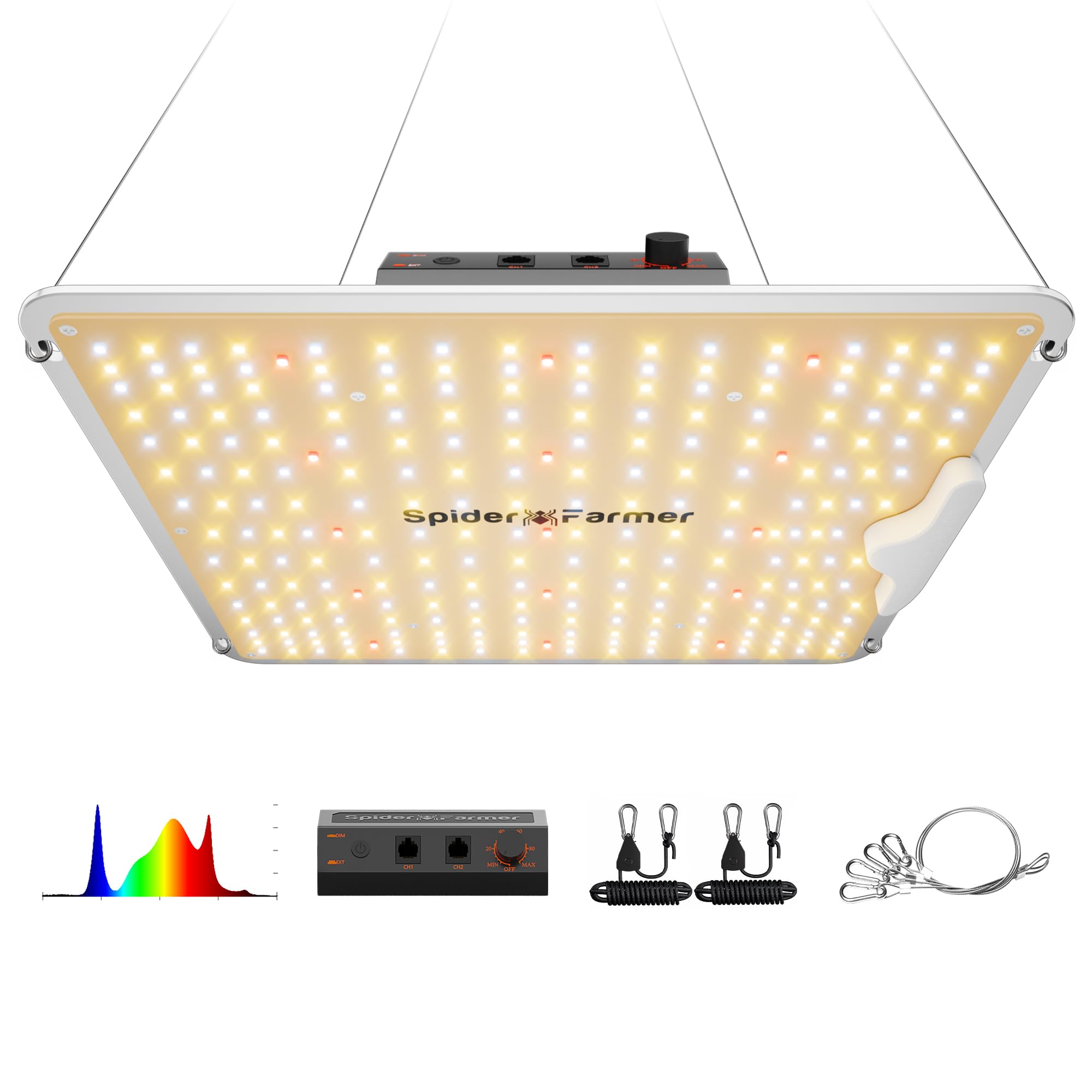
1. Spider Farmer SF1000 LED Grow Light
Our pick — over 4.5★ from 12,000+ verified ratings; the strongest balance of quality and price.
The tent-grade panel that replaces a 400W HPS while sipping 177W less.
If you are lighting an actual grow tent or a serious shelf of vegetables, the Spider Farmer SF1000 is the one that earns its spot. It pulls 100W and pushes up to 10,000 lumens compared to a typical 18W desk lamp, with a potent blue spectrum tuned for healthy vegetative growth and root development. The fanless body means no hum, and the dimming knob lets you ease seedlings in before cranking to full blast.
Buyers report swapping out a 400W HPS system in a bloom box for this panel and getting more light with far less heat — at 100W versus the 400W HPS. The build draws real praise too: a thick aluminum heat sink, protective cable covers, and a 5-year warranty backed by local maintenance centers in the US, CA, UK, EU, and AU. The 3000K and 5000K diodes plus 660nm red and 760nm IR mean it does not just veg — it carries plants through flowering and yield-boosting bloom.
The one honest trade-off is heat. While the LEDs run cooler than HPS, enough owners note the panel itself gets pretty hot that a clip-on fan aimed at the driver is a smart add-on. It’s also built for coverage, not portability, so it stays put in a tent rather than traveling around the house — and that is exactly where it shines.
balanced full-spectrum output
- Lighting quality is the single most-praised trait, with over a thousand owners calling it out
- Dimming + 5-year warranty makes it a buy-once proposition
- Fanless design keeps your grow room silent
small coverage area
- Panel runs warm enough that some add a clip-on fan
- Overkill for a single desk plant — this one wants a tent or a big shelf
budget-friendly pick: For anyone running a 2×2 or 3×3 tent who wants one light that handles veg and bloom, this is the anchor pick — the rating and review volume both back it.
limited canopy reach: Your plants live in a dedicated grow space and you want dimming, durability, and a warranty that outlasts your hobby.
2. AGLEX K1000 LED Grow Light
A 100W panel that chains up to 100 lights for serious vertical farms.
The AGLEX K1000 is the pick when you outgrow a single tent and start thinking in multiples. It runs 100W with a daisy-chain feature that lets you connect up to 100 units and control them all at once — a commercial-scale trick most panels in this price band simply don’t offer. Inside, 264 SMD LEDs mix 3000K warm, 5000K cool, 460nm blue, 660nm red, 730nm IR, and 405nm UV to mirror sunlight through every stage.
The dimmer runs from 0 to 100% in clean steps, and the fanless aluminum body sheds heat quietly while focusing energy onto your plants instead of the walls. Owners mention it pushes serious PPFD at full power — one measured around 1100 µmol/m²/s — and call the build “rock solid” with a premium, non-plastic feel. It draws just 100W while performing like a 250W HPS/MH, so the energy savings stack up fast.
The minor grumbles are about the plug and the size. It needs a three-prong plug that doesn’t accept a second three-prong pass-through, which differs from some other brands’ chains, and it’s physically smaller than the photos suggest. For seed starting and cloning, though, customers note the best germination success they’ve ever had — onions, tomatoes, and peppers all coming up strong on a 13-hour timer.
value option: If you plan to grow beyond one tent or want a panel that talks to a controller, this is the daisy-chain king and the brightness is the most-praised trait.
no dimmer control: It runs warm (not hot), so give it breathing room, and budget for a proper grounded outlet.
3. Diboys LED Grow Light Bulb
The screw-in bulb that turned “almost every seed sprouted” into a recurring review line.
The Diboys 75W bulb is what you want when your plant game is seed starting and you want results without a panel-and-driver setup. It packs 225 high-intensity LEDs — 165 red at 620-630nm and 60 blue at 460-470nm — into a standard E27 base that screws into a normal lamp socket. The blue-heavy mix is exactly what tender seedlings need to stay short and stocky instead of reaching for weak winter sun.
What earns this bulb its reputation is the seedling success rate. Owners repeatedly report that nearly every seed they put under it sprouted, and that tender seedlings didn’t burn even with the bulb just 4-6 inches away. The reflecting-cup design focuses light straight down onto the plants, and a thick aluminum board plus ABS case keeps heat low enough that it’s safe to leave close to fragile growth.
The catch is in the plastic housing and the occasional quality-control slip. A few units arrived with dead rows or a detached wire, though the brand’s customer service stepped up with free replacements. It’s also a bulb, not a fixture, so you need a socket and a way to hang or aim it — but for winter windowsill growers replacing costly short-lived bulbs, it’s a proven, cost-effective swap.
seed-starting aid: If your goal is germination and sturdy seedlings, this bulb delivers in a way that has owners buying multiples.
weak for flowering: You want a one-piece fixture with a built-in timer — this is a bare bulb that needs your own socket and schedule.
4. SERWING B1000 LED Grow Light

A VEG/BLOOM panel that decides the spectrum for you, switch by switch.
The SERWING B1000 takes the guesswork out of growth-stage lighting with two dedicated switches. Flip ‘VEG’ for the blue-heavy mix that drives leafy growth, flip ‘BLOOM’ for the red wavelengths that push flowers and fruit, or run both for a full-spectrum blast. Inside sit 204 red, 72 blue, 24 white 6500K, plus smaller counts of IR, purple, and orange diodes — a ratio built around the whole plant life cycle.
It’s rated IP65 water- and dust-proof, which is rare in this category and means a splash from your watering can won’t end its life. The SMD 2835 LEDs deliver 30-40 lumens per watt. At 2.4 pounds and 16.34 inches wide, it’s a lightweight hanging panel that’s easy to rig over a shelf.
The honesty check: brightness and reliability get genuinely mixed feedback in owner experience. Some call it “bright as hell” and love how vibrant their plants turned, while a notable few report the veg lights or the whole panel dying within a few weeks. It’s a value play — the quality is good for the money — but if you need a light with a long, proven track record, this is the one to research further before committing.
small tent fit: Budget-minded growers who like the simplicity of a VEG/BLOOM toggle and don’t need a timer built in.
narrow spread: Long-term reliability is your top concern — a minority of owners hit early failures, so buy from a seller with good returns.
5. wolezek Floor Grow Light
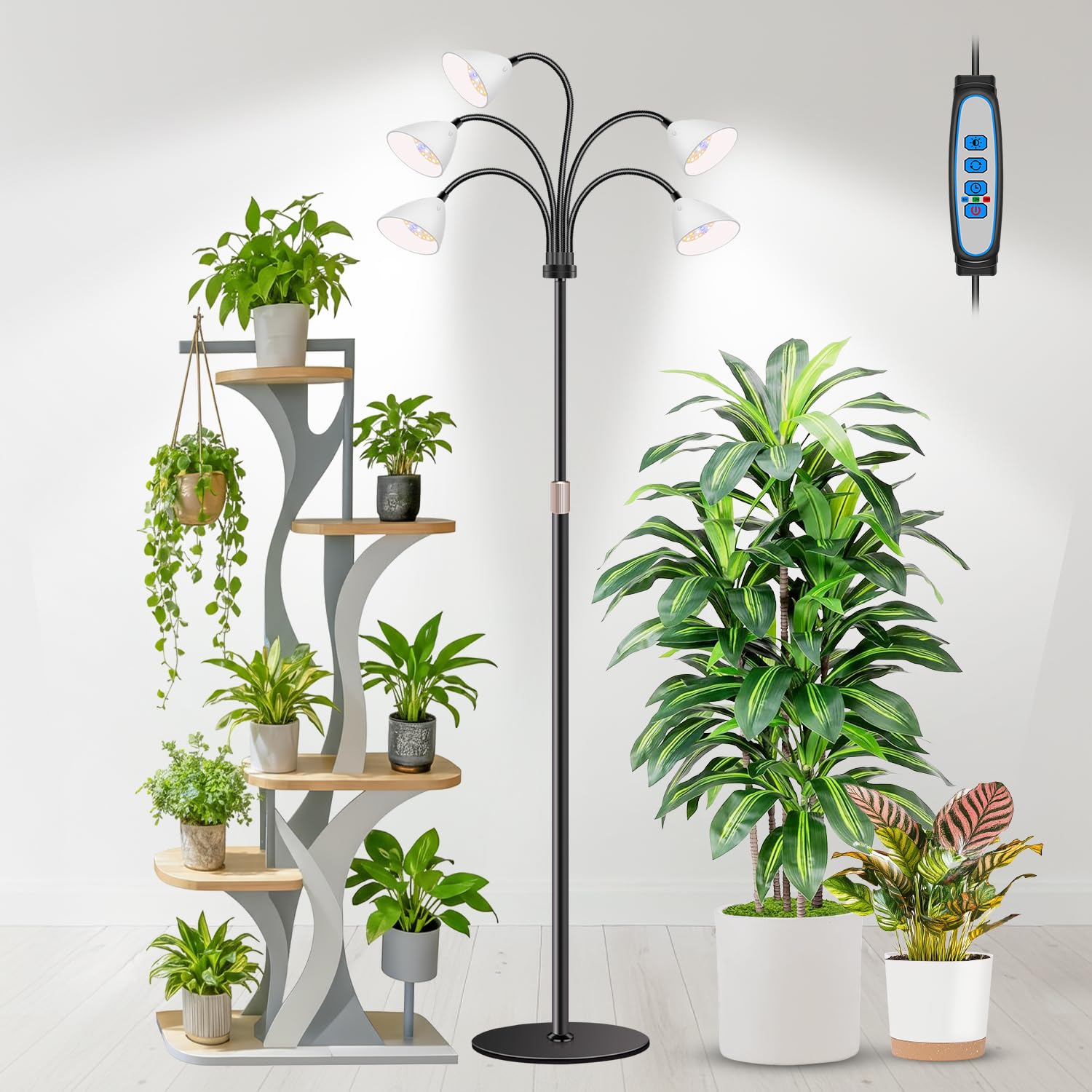
A floor lamp that stretches from 16.5 to 61 inches to tower over your tallest fiddle leaf.
Tall houseplants are the reason the wolezek floor grow light exists. Its detachable, telescopic pole adjusts from 16.5 to 61 inches, so a low pile of cuttings and a ceiling-scraping monstera can both get proper light from the same unit. Five 2.3-inch spotlight-style heads on 11.8-inch flexible goosenecks aim precisely where leaves need coverage, and a heavy-duty anti-slip base beats a flimsy tripod for keeping things upright.
The spectrum blends 3000K warm white, 6000K cool white, 460nm blue, and 660nm red across 120 LEDs, covering the full 380-800nm range. That blue is the key for the vegetative growth your leafy houseplants need year-round, while the red carries flowering if you ever push something to bloom. A 9.8-foot power cord means you can park it in a plant corner without hunting for an outlet, and the sleek black finish doesn’t scream “grow equipment.”
The fair warning: the base divides opinion. Some owners call it “very sturdy,” but others report the bottom doesn’t stay fully secure and the whole lamp can wobble or tip if bumped. It’s also a floor unit, so it takes up floor space — that’s the trade for handling tall plants. Set it on a level surface and it’s a handsome, effective addition to a living room plant collection.
floor-plant helper: If your plants live on the floor and outgrew desk lamps, this telescopic 5-head unit with a 6/12/16-hour timer is the fit.
takes up space: The stand’s stability is the recurring discussion point — place it on flat ground and don’t lean on it.
6. HIGROW 18W Blue LED Bulb

The screw-in 18W bulb built for aquariums and flowering orchids alike.
Some blue grow lights are for shelves; this HIGROW bulb is for tanks and bloomers. It packs 18 super-bright 2-watt LEDs, all pure blue at 450-460nm, behind a 90-degree optical lens that delivers higher PAR (photosynthetically active radiation) than most grow bulbs its size. Screw it into a standard E26/E27 socket over an aquarium or a flowering orchid, and you get the exact spectrum that drives vegetative growth and bud development.
Owners have used it to get pink-leafed plants to bloom for the first time and to push flower and bud growth in orchids, tomatoes, and bulbs. It also pulls double duty — a few buyers use it for red light therapy. The upgraded 0603 aluminum cooling fins keep the bulb at a good temperature even after 24 hours of continuous use, which supports a longer lifespan than cheap blue bulbs.
The limits are real if you’re expecting a main light. At 4 feet away, it’s only visible when the main grow light is off, and it works best as a supplement rather than a sole source for bigger blooms. One owner compared it side-by-side with an 18W BlueX bulb and found this one “significantly brighter” at the same distance — but for a full tent, you’ll still want a panel. It’s a tool for targeted blue, not whole-room power.
supplemental light: You need a simple, reliable blue boost over an aquarium, a small veg space, or flowering plants in a standard socket.
not a main source: It’s a supplement, not a primary light — use it to add blue where your main spectrum is weak.
7. wolezek 5-Head Gooseneck Stand
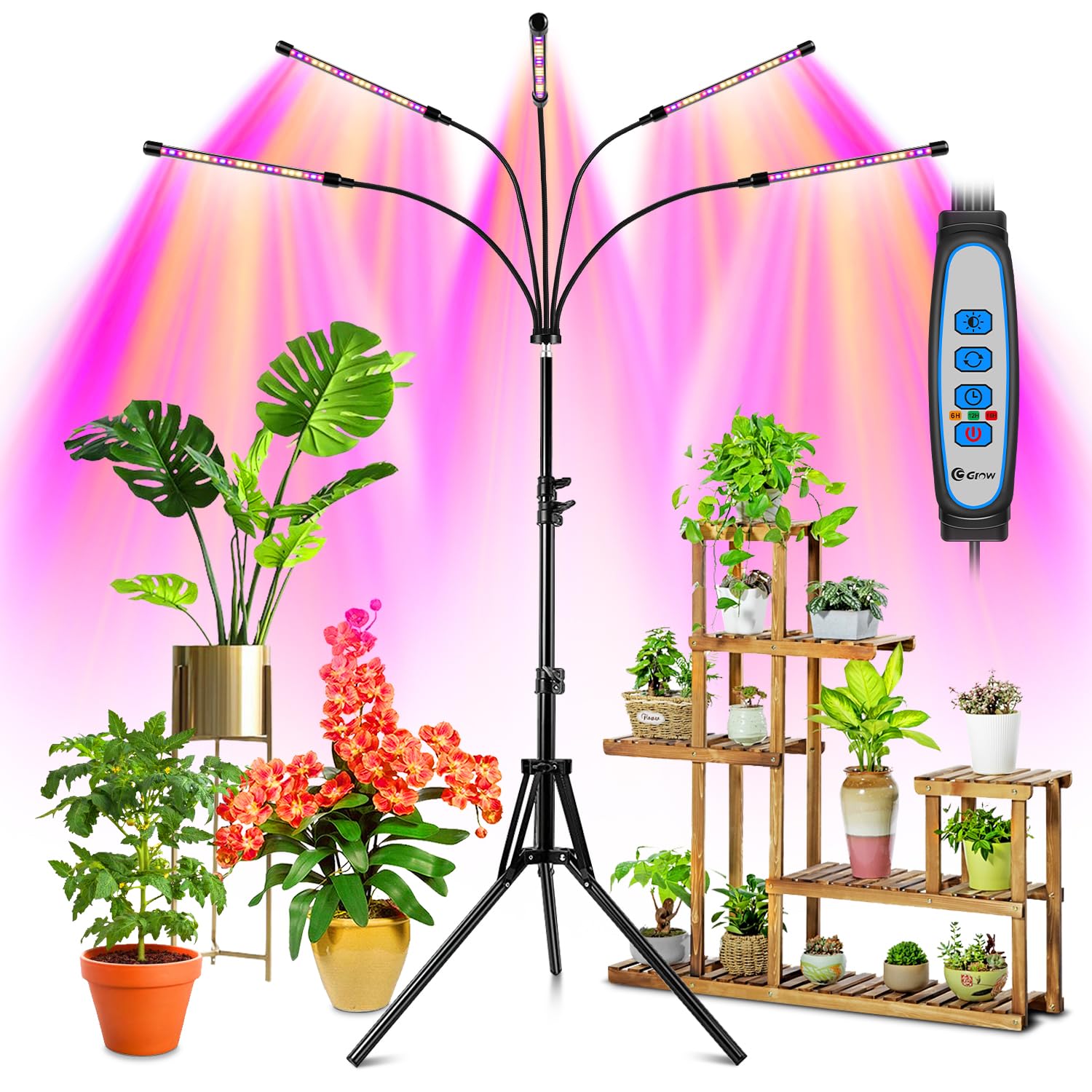
Five independently aimable heads on a tripod that grow with your collection.
When your plant shelf outgrew a single gooseneck lamp, the wolezek 5-head stand is the natural upgrade. Its adjustable tripod extends from 15 to 61 inches, and five flexible goosenecks each bend independently so you can point one head at a succulent, another at a spider plant, and a third at that cutting you’re rooting — all from one unit. The 100 red, blue, and white LEDs cover a wider area than a 3- or 4-head light.
The spectrum is the science here: blue at 460-465nm for germination and seedling growth, red at 600-660nm for flowering and fruiting, and white at 3000-3500K to boost overall intensity — spanning a true 380-800nm full spectrum. The auto memory timer sets 6/12/16-hour cycles so your plants get consistent light even when you’re traveling, and 5 brightness levels let you ease new sprouts in.
Two honest notes: this version has no clip, so it’s a floor-standing unit only — check that before buying if you wanted to attach it to a shelf. And the stand itself is on the lightweight side, with one owner noting the top doesn’t screw in perfectly. It’s easy to move around, low-heat, and reviewers point out consistently healthier plants through the dark months.
desk setup pick: Growers with tall pots and mixed plant collections who want one light to cover a whole corner with adjustable arms.
check stability: It stands alone — no clip included — and the lightweight base rewards a careful push, not a shove.
8. LEOTER 80 LED Grow Light
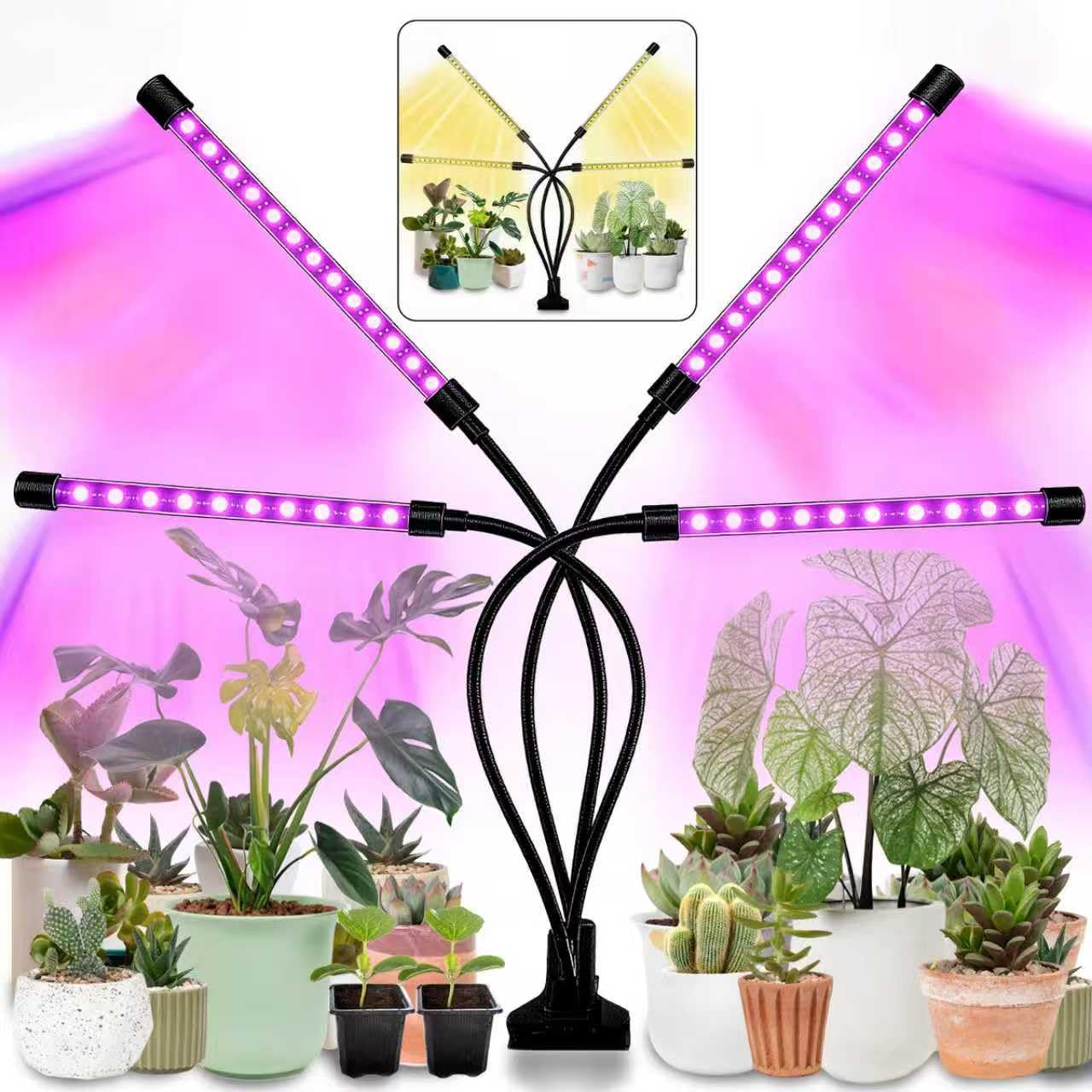
A bendy, clip-on 80-LED lamp with a 3/9/12H timer that babysits your desk plants.
The LEOTER 80 LED is the desk-friendly pick that keeps a couple of pots thriving without taking over your workspace. It combines 32 red, 12 blue, 20 yellow, and 16 white LEDs across three spectrum modes — full spectrum for rooting and sprouting, red-plus-460nm blue for blooming and fruit, and a warm-white mix for general growth. A 360-degree flexible gooseneck and metal clamp attach it to a desk edge, shelf, or stand in seconds.
What pulls it above basic clip lamps is the control suite. The circular memory timer runs 3, 9, or 12-hour cycles automatically, and 10 dimmable levels let you match intensity to the growth stage. The aviation-grade heat sink keeps it cool enough for long daily use, and the USB connector means you can power it from a laptop or the included AC adapter. Owners love the sturdy clip and how much space it saves, calling it durable and well-made.
The honest limit is output. It’s a low-wattage light — powered by USB — so it won’t drive heavy fruiting or a full shelf. Shoppers say seedlings can underperform compared to bigger panels; one called it “not the brightest.” For everyday houseplants and small propagation, it’s excellent value, but if you’re starting tomatoes for a garden, you’ll want something with more muscle.
multi-plant use: You want a space-saving, multi-spectrum clip light for desk plants or small propagation with an auto timer you can set and ignore.
heat concerns: You need serious seedling power — this is a supplement for houseplants, not a seed-starting workhorse.
9. GooingTop Clip Grow Light
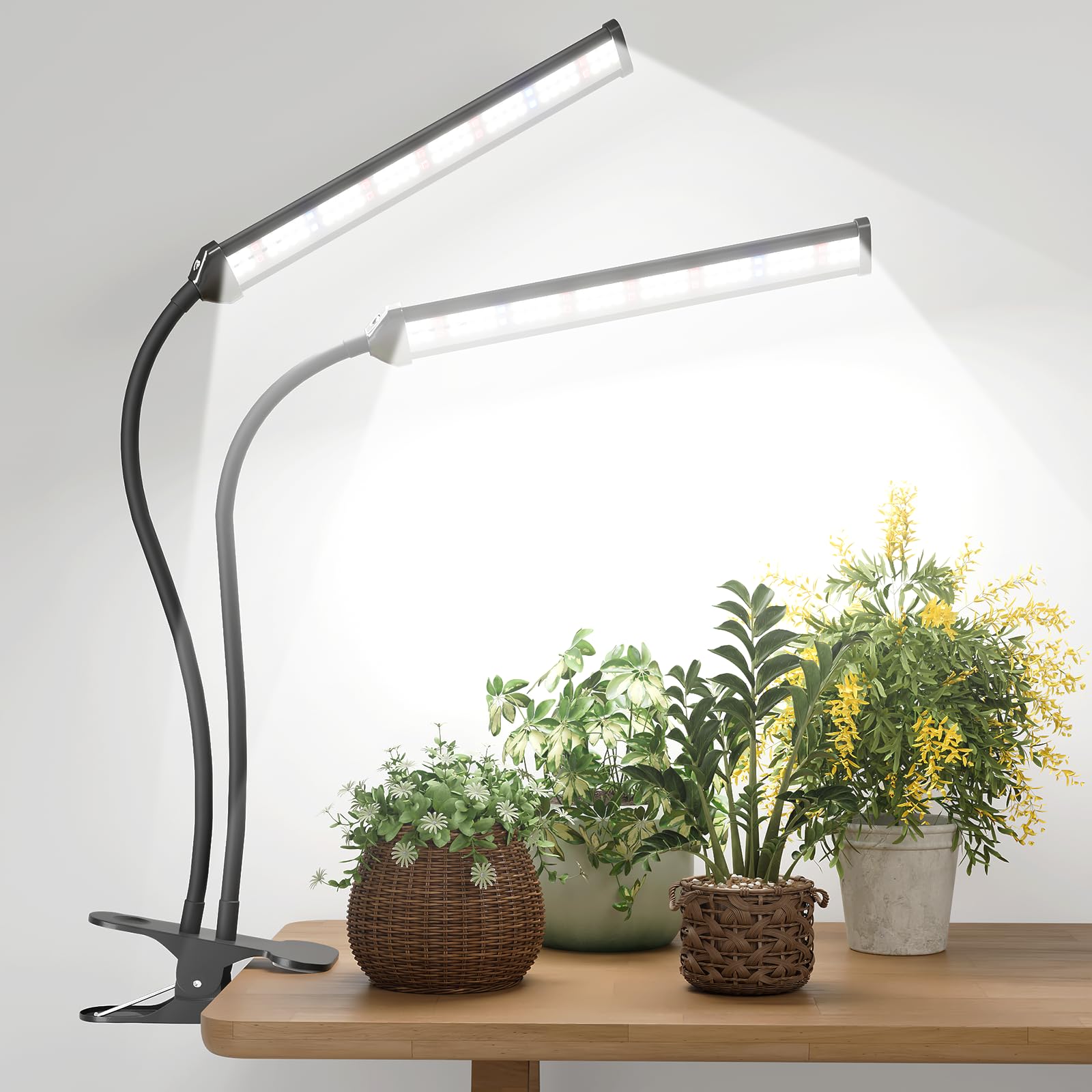
A gentle 18W clip light with a color-rendering index of 95 that blends into your living space.
The GooingTop clip lamp is proof that a grow light doesn’t have to look like grow equipment. It packs 120 white, 20 red, and 8 blue LED chips into a compact head with a color-rendering index of 95 — meaning the light is soft, flicker-free, and pleasant enough to sit on a desk without distracting. At just 18W, it’s equivalent in output to a 75W halogen bulb, which is plenty for small pot plants and seedlings.
Owners love how effective it is for the size, with several buying a second unit within a month and a half because their plants were thriving. The flexible gooseneck and strong iron clamp make it a “clip and click” setup — attach it to a stand or shelf, plug in, and you’re done. The 4/8/12-hour timer based on a 24-hour cycle plus a 50%/100% dimmer keeps the schedule simple.
Two fair caveats: the light gets genuinely hot, so some owners only run it during the day while monitoring, and the clip can slip under the weight of the lamp when the neck is bent at an angle. It’s a great entry-level pick with an honest price-to-value read, but treat the heat as a real consideration near delicate foliage.
small shelf light: First-time growers and small pot-plant enthusiasts who want an easy, attractive, effective light for a few pots.
watch heat build: It runs hot and the clip can slide on heavy bends — keep an eye on placement and consider daytime use.
Understanding the Specs
Blue Wavelength (nm)
The “460nm” or “450-470nm” you see on a grow light label is the actual color of light the diodes emit. Blue in the 450-470nm range lands right on the chlorophyll absorption peak, so it’s the most efficient for driving vegetative growth. A light that lists a specific blue wavelength is telling you it was engineered for plants — a generic “blue” with no number may just be a colored LED with weak output.
Wattage and Coverage
Wattage tells you how much power the light draws, which correlates with how much area it can cover. An 18W clip lamp handles a desk or a couple of pots, while a 100W panel like the Spider Farmer or AGLEX covers a 2×2 or 3×3 grow tent. Match the wattage to your square footage — too little light and plants stretch; too much and you waste electricity and risk heat.
Timers and Dimmers
A timer automates on/off cycles with presets like 3/9/12H or 6/12/16H for consistent light and dark. A dimmer controls intensity, easing seedlings in and adjusting as plants grow. Timers and dimmers turn a grow light into a set-and-forget tool.
Full Spectrum vs. Pure Blue
Pure-blue lights (like the HIGROW bulb) deliver only the 450-460nm range, ideal for targeted vegetative growth over an aquarium or a specific plant. Full-spectrum lights blend blue, red, white, and sometimes IR/UV to cover the entire plant life cycle from germination to flowering. If you only grow leafy greens, pure blue is efficient; if you want one light that does everything, full spectrum is the safer bet.
FAQ
What does blue light actually do for my plants?
What’s the difference between blue light and full-spectrum grow lights?
How many watts do I need for my grow space?
Is blue light safe to use near my regular houseplants?
Can I leave a blue grow light on 24/7?
Will a blue grow light help my seedlings stop stretching?
Can I use a blue grow light for an aquarium?
What’s the best height to hang a blue grow light?
Do I need both red and blue light, or is blue enough?
Final Thoughts: The Verdict
Across the board, the blue light for plants winner is the Spider Farmer SF1000 because it pairs 100W of dimmable full-spectrum power with a 5-year warranty and the strongest owner satisfaction in the lineup — the crowd favorite at 4.6 stars across over 12,000 owners. If you want a daisy-chainable panel that scales to a bigger grow room and talks to a controller, grab the AGLEX K1000. And for budget-friendly desk plants or a couple of pots, the LEOTER 80 LED gives you timers and 10 brightness levels in a compact clip-on that saves space.
How We Picked
We do not accept paid placement. Every pick is matched to a real buyer and a real use-case; we do not hands-on test units.
Sources & Methodology
Specifications: manufacturer listings and product documentation. Review insights: verified customer reviews, as of August 2026. Pricing: not shown on this page (it changes often); check the current price via the retailer link.
As an Amazon Associate, Lawn Gear Lab earns from qualifying purchases. This does not affect which products we feature.