
Specs are compiled from manufacturer listings and verified buyer reviews and can change over time — please confirm the key details on the product page before buying.
Blackberry brambles don’t just take over your fence line — they send underground runners that pop up twenty feet away, laughing at the weed whacker you just swung at the main bush. You need a chemical solution that hits the root system hard, and the wrong spray means you’ll be fighting the same patch next season. This guide breaks down the concentrates and ready-to-use formulas that actually deliver on the label.
I’m Rikta — the founder and writer behind Lawn Gear Lab. This guide is built by comparing the manufacturers’ published specifications and the patterns across verified customer reviews, so you get each pick’s real strengths and trade-offs instead of marketing spin.
Whether you are protecting a pasture or clearing a weekend cabin lot, the right best blackberry killer spray depends on your patch size, your patience for mixing, and how deep you want the root kill to go.
Quick Picks
- Hi-Yield (32170) Killzall 365 (32 oz) — Bare-Ground Boss
- Roundup Poison Ivy Plus Tough Brush Killer₂ Concentrate, 32 fl. oz. — Best Value Concentrate
- Ortho 0475010 MAX Poison Ivy & Tough Brush Killer Ready-To-Use, 24-Ounce — Top Performer RTU
- Southern AG 01113 Brush Weed Killer, 1 Quart (32 oz) — Fast Wilt Specialist
- Tordon RTU Brush Killer (1 qt, Ready to Use) — Stump Killer
- Remedy Specialty Herbicide Weed Killer & Brush Control, 1 Gallon — Pasture Power
- Southern AG Crossbow Specialty Herbicide, 128 oz (1 Gallon) — Acreage Champion
How To Choose The Best Blackberry Killer Spray
You need a different strategy for a small blackberry patch behind the garage than for a half-acre of regrowth along a pasture fence. Your choice depends on three things: how big the area is, how fast you need results, and if you want to stop regrowth for good.
Active Ingredient — Triclopyr Is Your Friend
The most effective blackberry killers share one thing: triclopyr. This woody-plant herbicide penetrates the bark of canes and travels to the root system. Formulas that pair triclopyr with a second active (like 2,4-D or diquat) give a faster top-kill plus the deep root control blackberries need.
Concentrate vs. Ready-to-Use
Ready-to-use (RTU) bottles cost more per ounce but save you from mixing mistakes — perfect for a one-time patch under 300 square feet. Concentrates stretch your dollar when you have repeated invasions or large acreage, but you must measure carefully and own a sprayer.
Coverage and Rainfast Time
Check the square feet a bottle covers and how soon the spray becomes rainproof. A 30-minute rainfast claim (like the Roundup concentrate) helps if you live in an afternoon-thunderstorm area. A 2-hour rainfast (like the Ortho RTU) means you need a dry window.
Quick Comparison
On smaller screens, swipe sideways to see the full table.
| Model | Best For | Liquid Volume | Active Ingredient | Coverage | Amazon |
|---|---|---|---|---|---|
| Hi-Yield Killzall 365 | Total bare-ground control | 32 oz | Pink concentrate | 4,300 sq ft | Amazon |
| Roundup Poison Ivy Plus | Quick results, mixed brush | 32 oz | Triclopyr / Fluazifop / Diquat | 1500 sq ft | Amazon |
| Ortho MAX Poison Ivy | Ready-to-use convenience | 24 oz | Triclopyr-based | Non-selective | Amazon |
| Southern AG Brush Killer | Fast wilt on blackberry | 32 oz | Triclopyr | 512-1024 sq ft/gal | Amazon |
| Tordon RTU Brush Killer | Fresh-cut stump control | 32 oz | Triclopyr-based | Non-selective | Amazon |
| Remedy Specialty | Pasture & fence-line restoration | 128 oz | Triclopyr | Selective for brush | Amazon |
| Southern AG Crossbow | Large-acreage broad brush | 128 oz | Garlon (triclopyr) / 2,4-D | 2.23 acres | Amazon |
In‑Depth Reviews
1. Hi-Yield (32170) Killzall 365 (32 oz)

The total-vegetation concentrate that turns blackberry patches into bare dirt for months.
If you want the ground behind the shed to stay empty — no brambles, no grass, no anything — this is the spray that delivers. The Hi-Yield Killzall 365 is a 32 oz bottle of concentrated liquid that treats up to 4,300 square feet when mixed. That is nearly three times the coverage of the Roundup concentrate below, making it the budget-friendly choice for large patches where you want zero regrowth.
Buyers report that “this stuff is amazing in the battle of blackberry intrusion,” specifically when fighting regrowth from an abandoned neighboring property. One reviewer noted it took three or four sprays over a season to keep the ground clear, which matches the honest expectation for a non-sterilizing formula. Unlike the mixed-active Roundup, this is a total vegetation killer — do not spray anywhere near plants you want to keep.
The catch is weight: at 2 Pounds, the bottle is four times heavier than the Roundup concentrate, so you feel the difference when carrying it to the fence line. Mix 6 oz per gallon of water for brush spot control, or 7.4 oz per 1 to 10 gallons for bare-ground spraying according to the label instructions.
What it crushes
- Treats 4,300 sq ft — triple the coverage of the 32 oz Roundup (1500 sq ft).
- Rain-resistant even if rain falls the day after application, according to buyers.
- Cost-effective when compared per-square-foot against big-box store brands.
What it doesn’t do
- Total vegetation killer — no selectivity at all; kills grass you want to keep.
- Does not kill moss, buyer reports note, despite the “total vegetation control” label.
- At 2 lbs it is 1.5 lbs heavier than the Southern AG Brush Killer (9.6 oz) — a real weight penalty for backpack carry.
Reach for this if: you need bare-ground control on a large non-lawn area and want to stretch your dollar across thousands of square feet.
Look elsewhere if: you need a selective spray that spares grass around fence lines or flowerbeds.
2. Roundup Poison Ivy Plus Tough Brush Killer₂ Concentrate, 32 fl. oz.

The fast-acting three-active concentrate built for mixed brush including wild blackberry.
This Roundup formula is an exclusive blend of three active ingredients: triclopyr (2.50%), fluazifop-P-butyl (2.00%), and diquat dibromide (1.50%). The diquat provides visible results in hours — leaves start wilting the same day — while the triclopyr works deeper into the root system. That speed matters when you are watching the clock on a weekend project and want to know something happened before you pack up the sprayer.
Owners mention that the mix “kills plants with leaves; most die in 1 application, tough ones need a few,” and it earns praise from habitat restoration volunteers for use on poison oak, kudzu, and blackberry. The rainproof window is tight at 30 minutes, so a sudden shower won’t wash your work away — unlike the Ortho RTU which needs 2 hours dry.
One mixed gallon covers 1500 square feet — that is a decent area, but only about a third of what the Hi-Yield concentrate covers. The bottle weighs just 0.5 pounds (compared to 2 pounds for Hi-Yield), so it is easy to carry for spot treatment along trails.
What it nails
- Visible results in hours — you see the leaves change the same day you spray.
- Rainproof after just 30 minutes — the fastest rainfast window in this comparison.
- Light bottle (0.5 lbs) is easy to carry on long fence-line walks.
What it doesn’t
- 500 sq ft per mixed gallon is less ground coverage than the Hi-Yield concentrate for the same bottle size.
- Tough blackberry regrowth may need a second application, as customers note.
- Allows planting only 1 to 30 days after application — a delay if you want to replant immediately.
The right pick when: you want fast visible kill and 30-minute rainproof protection for a medium-sized patch of mixed brush including blackberry, poison ivy, and kudzu.
Skip it for: total vegetation control on bare ground — the diquat and triclopyr target woody plants and broad leaves, not all grasses equally.
3. Ortho 0475010 MAX Poison Ivy & Tough Brush Killer Ready-To-Use, 24-Ounce

The no-mix, no-measure solution that kills wild blackberries in one spray — if you can wait.
For the buyer who wants the easiest possible path to dead blackberries, this ready-to-use Ortho bottle removes all the guesswork. You pull the trigger and spray directly on the leaves — no measuring cups, no sprayer calibration, no concentrate left in the garage. It kills over 60 types of tough brush and weeds including poison ivy, poison oak, kudzu, and wild blackberries.
One buyer calls it “highly effective on wild berry plants; kills in 4-5 weeks with one spray,” noting that Roundup had previously failed on the same patch. That 4-5 week timeline is slower than the Roundup concentrate, but you only apply once. Unlike the Roundup’s 30-minute rainfast window, this formula needs 2 hours of dry weather after spraying, so check the forecast before you work.
The catch is volume: at 24 fluid ounces, this bottle covers a smaller area than any concentrate — you are paying for convenience, not raw chemical coverage. It is the smallest liquid volume in this comparison, so budget for multiple bottles if your blackberry patch covers a large area.
Ease of use wins
- No mixing required — spray directly from the bottle onto leaves and stems.
- Kills a broad range — 60+ types of brush and woody weeds including wild blackberry.
- One application reported effective on established berry weeds where prior sprays failed.
Trade-offs
- Needs 2 hours rain-free — four times longer than the Roundup concentrate’s 30-minute window.
- 24 oz bottle is the smallest volume here; large patches require multiple purchases.
- Slow-acting kill — reviewers point out 4-5 weeks before the plant is fully dead.
Grab this when: you have a small-to-medium patch of blackberry or poison ivy and want a no-mix product that works with a single spray, even if it takes a month to finish the job.
Skip this if: your blackberry patch covers more than a few hundred square feet — the concentrate options stretch much further for your money.
4. Southern AG 01113 Brush Weed Killer, 1 Quart (32 oz)

The triclopyr concentrate that wilts blackberry leaves by sundown and kills the root within a week.
Southern AG keeps it simple: triclopyr as the single active ingredient, at a high enough concentration to match the performance of the more expensive Crossbow product (according to buyers). Applied in the morning with full sun, one buyer mentioned that blackberry and cherry tree leaves wilted by the end of the same day. After a week, the plants were clearly dead.
This is a selective brush killer designed for non-crop areas like roadsides, rangeland, pastures and fences. Unlike the Hi-Yield total vegetation killer, this one targets woody plants and vines while leaving grass relatively unharmed when used correctly. The coverage is modest — 512-1024 square feet per gallon — which is less ground coverage than the Roundup concentrate (1500 sq ft), but the single active ingredient means fewer odds of collateral damage.
At 9.6 ounces, the bottle itself is light enough to carry in a backpack, but the quart size means you’ll mix carefully to stretch it. One buyer in Oregon noted that larger blackberry shrubs took about two weeks to fully dry and turn brown, so patience is part of the success.
Why it stands out
- Fast visible wilt — leaves droop by day’s end when applied in full morning sun.
- Triclopyr hits woody plants hard while being more selective than total-kill formulas.
- Buyers confirm it works as well as Crossbow at a lower price per bottle.
Keep in mind
- Coverage of 512-1024 sq ft per gallon is roughly half the Roundup concentrate’s reach.
- Not effective on strangler fig or every tough perennial, as one buyer found.
- Larger shrubs need patience — full browning can take two weeks.
Choose this for: fence-line blackberry and brush where you want fast visual feedback and triclopyr’s selective woody-plant targeting.
Pass on it for: large-scale bare-ground sterilization — the Hi-Yield or Crossbow options cover more square feet per dollar.
5. Tordon RTU Brush Killer (1 qt, Ready to Use)

The brush killer that stops a blackberry stump from ever sending up another cane.
Tordon RTU is not a spray-and-walk-away product — it is made for fresh-cut stump treatment and works brutally well when used correctly. Shoppers say you should “apply sparingly to fresh-cut stump within minutes to kill entire root system.” The method: cut the blackberry cane or woody stem at the base, then paint or spray the cut surface right away, before the plant seals itself.
Unlike the Ortho RTU which you spray on leaves, this Tordon formula works through the cut stump down into the root. One reviewer who battles invasive species calls it “the only thing that works to kill a hydra” — referencing the way blackberry and buckthorn send up new shoots faster than you can cut them. It prevents the stump from healing, and the entire root system dies without resprouting.
The bottle is 32 fluid ounces of ready-to-use liquid, so you do not mix anything. It goes a long way because you are only wetting the cut surface, not drenching leaves. Wear nitrile gloves — this is potent chemistry designed for invasive species control, and you do not want it on your skin.
How it wins
- 100% root kill on cut stumps — stops regrowth that leaf sprays often miss.
- Ready-to-use, no mixing required, and a single quart treats many stumps.
- Highly effective on invasive brush like buckthorn, honeysuckle, and blackberry.
How to use it right
- Must be applied to a fresh cut within minutes — not a general foliage spray.
- Use a squeeze bottle or foam brush; avoid dripping onto the ground to protect nearby plants.
- Stump may bleed sap as it dies — wear gloves and keep children/pets away from treated cuts.
Reach for this when: you have cut blackberry canes or brush stumps that keep resprouting and you want a one-and-done root kill.
Skip this if: you need to spray large areas of leafy blackberry growth — the Ortho or Roundup leaf sprays are faster for that job.
6. Remedy Specialty Herbicide Weed Killer & Brush Control, 1 Gallon
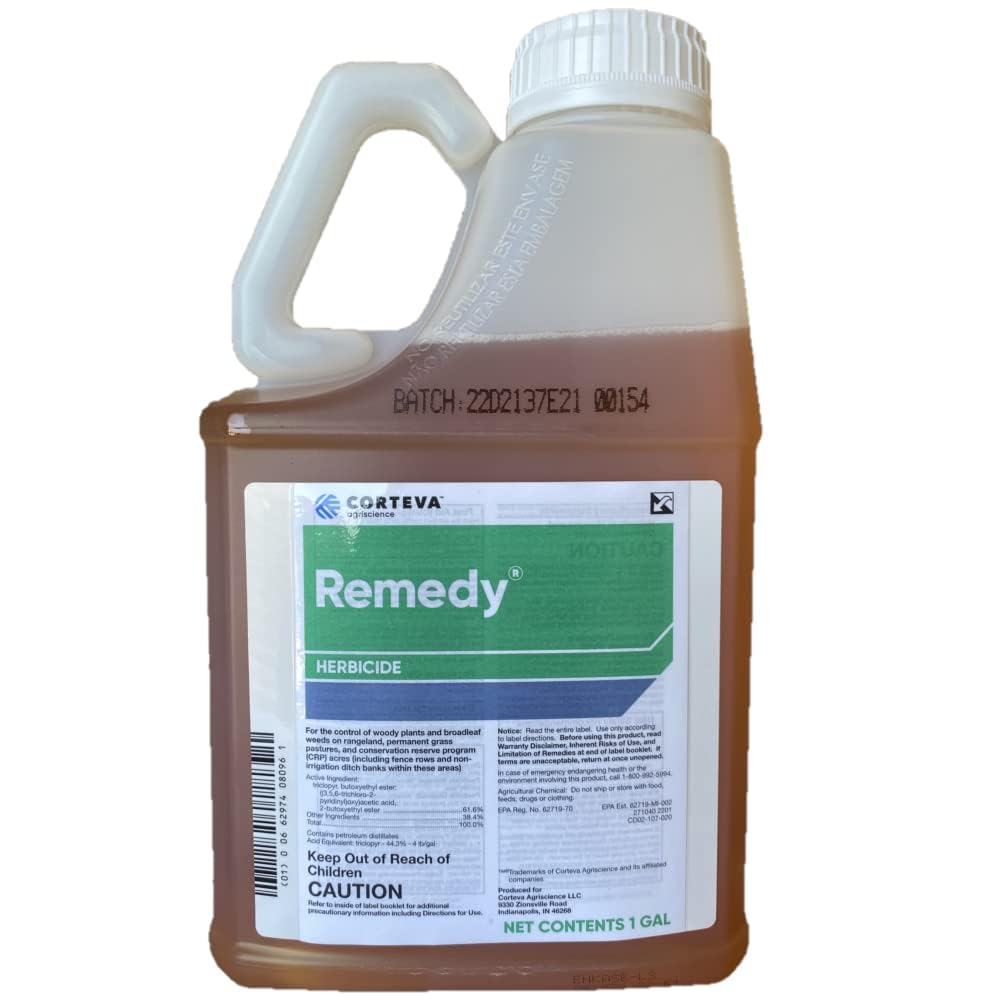
The heavy-duty gallon built for fence-line brush control, pasture restoration, and deep root kill on blackberry.
At 128 fluid ounces, this Remedy gallon holds five times the liquid volume of the Ortho RTU (24 fluid ounces) — a 5.3x gap that matters when you are clearing miles of fence line. The triclopyr formula is low-odor and works on the entire plant, from top growth down through the root system. It is designed for selective brush control in pastures, meaning it can target blackberry bushes and mid-size trees without killing the grass around them when applied correctly.
Buyers report that this product “absolutely annihilated my cogon grass problem” and is effective on multiflora rose, locust thorns, wild pears, and invasive trees. For blackberry, the recommended basal bark application (mixing 1 part Remedy to 3 parts diesel and painting the lower stem or fresh-cut stump) delivers near 100% success preventing resprouting. One buyer notes it is “expensive but lasts for 100+ weekly lawns” when used as a professional-grade tool.
The catch is price — this is the most expensive bottle on the list, though the concentration means it stretches further than any RTU. It requires careful mixing and application, and it is not the right tool for a casual homeowner with a single bush behind the garage.
Why it owns the pasture
- 128 oz volume is 5.3x larger than the Ortho RTU’s 24 oz — built for serious acreage.
- Selective triclopyr formula spares grass when directed at brush and trees.
- Low-odor formula is ideal for fence-line work near occupied spaces.
What holds it back
- Highest upfront cost in this guide — only worth it if you have significant brush to clear.
- Requires mixing with diesel or water at the correct ratio; not a grab-and-spray product.
- Ineffective on unwanted grass and common weeds, as one reviewer found — it is a brush specialist.
This is your pick if: you manage pasture land, fence lines, or large rural property and need a gallon of triclopyr concentrate that kills deep-rooted brush while sparing your grass.
Think twice if: you just need to kill a few blackberry canes in the backyard — the smaller concentrates or RTUs are more practical and cost-effective.
7. Southern AG Crossbow Specialty Herbicide, 128 oz (1 Gallon)

The two-active gallon that covers over two acres and kills everything from vines to small trees.
Southern AG Crossbow pairs triclopyr (as Garlon) with 2,4-D for a broad-spectrum brush killer that covers 2.23 acres per gallon bottle. The formula makes up to 96 gallons of spray solution when mixed according to label directions, which puts it in a completely different league than the 24-ounce Ortho RTU.
Buyers are emphatic: “this is the best weed killer I have ever used,” with one reporting that it killed all vegetation including ivy, vines, 8-foot weeds, and small trees within 48 hours. The 1% solution (roughly 2.5 ounces per gallon of water) works in about one week on most brush, and the 2,4-D component speeds the top-kill while the triclopyr works the root system. One reviewer notes that spider lilies survived while everything else died, showing some selective limits.
At 1 pound, the bottle itself is light for its volume, but the gallon size takes up real shelf space. The 3-day soil half-life (mentioned by a buyer as a safety advantage over glyphosate) means it breaks down relatively quickly in the environment.
The big wins
- 2.23 acres of treatment per gallon — the widest coverage in this guide.
- Two-active formula (triclopyr + 2,4-D) for faster top-kill on tough woody brush.
- Owners mention 48-hour visible results and near-total kill on mixed vegetation.
The trade-offs
- Strong odor reported by buyers — wear protective gear during mixing and application.
- Rain within 2 days of application reduces efficacy; need a dry window.
- Ineffective on wild violets, according to one buyer, and results vary by soil type.
Choose Crossbow when: you need to clear blackberry, vines, and brush from multiple acres or long fence lines and want a gallon that mixes into 96 gallons of spray solution.
Pass if: you only have a small suburban patch — the upfront cost and bottle size are overkill for less than a quarter-acre.
Understanding the Specs
Liquid Volume and Coverage
The amount of chemical you get in the bottle is measured in fluid ounces (fl oz) or gallons. A 32 oz bottle of concentrate treats a smaller or larger area depending on how much water you mix in — always check the label’s “square feet per gallon” number, not just the bottle size. Larger bottles like the 128 oz Remedy and Crossbow are built for acreage, while the 24 oz Ortho RTU is best for a targeted patch.
Active Ingredients (Triclopyr, 2,4-D, Diquat)
Triclopyr is the key performer against woody plants like blackberry — it travels to the root system through the bark and leaves. 2,4-D adds speed to the top-kill. Diquat (found in the Roundup concentrate) produces visible wilting within hours but works on leaves only; the triclopyr does the deep root work. A formula with a single active ingredient (like Southern AG Brush Killer) is more selective than a multi-active mix.
FAQ
Will blackberry killer spray kill the grass around the brambles?
How long does it take for the spray to kill blackberry roots?
Can I use blackberry killer spray in my vegetable garden?
How soon after spraying can it rain without ruining the treatment?
Is concentrate better than ready-to-use for blackberry?
Will this spray work if I apply it in late fall?
Can I mix blackberry killer with diesel for stump treatment?
How do I choose between Southern AG Brush Killer and Southern AG Crossbow?
How long does the spray bottle last if I store it?
Will one application be enough for established blackberry brambles?
Final Thoughts: The Verdict
For most homeowners, the best blackberry killer spray is the Roundup Poison Ivy Plus Tough Brush Killer₂ Concentrate because it blends three active ingredients for visible results in hours, a 30-minute rainfast window (rain after that won’t wash it off), and 1500 square feet of coverage per mixed gallon — the best speed, convenience, and value for medium patches. If you want ready-to-use simplicity for a small area, choose the Ortho MAX Poison Ivy & Tough Brush Killer. And for stump control that stops regrowth permanently, the Tordon RTU Brush Killer applied to fresh cuts is the most effective option.
How We Picked
We do not accept paid placement, and we did not hands-on test every unit. Instead, we match each pick to a real buyer and use-case by comparing the manufacturers’ published specifications against the patterns in verified customer reviews — so you get each pick’s real strengths and trade-offs instead of marketing copy.
Sources & Methodology
Specifications: manufacturer listings and product documentation. Review insights: verified customer reviews, as of July 2026. Pricing: not shown on this page (it changes often); check the current price via the retailer link.
As an Amazon Associate, Lawn Gear Lab earns from qualifying purchases. This does not affect which products we feature.