
Specs are compiled from manufacturer listings and verified buyer reviews and can change over time — please confirm the key details on the product page before buying.
If you want to watch birds in your backyard without paying a monthly fee for the camera to work, the search for a self-contained feeder-camera is now simpler than ever. These devices blend a seed hopper with a live-streaming camera and free AI bird identification, so you can name every visitor from your phone.
I’m Rikta — the founder and writer behind Lawn Gear Lab. This guide is built by comparing the manufacturers’ published specifications and the patterns across verified customer reviews, so you get each pick’s real strengths and trade-offs instead of marketing spin.
Below, you will find a direct breakdown of the top models that keep video recording and bird identification free forever, helping you pick the right bird feeder with camera no subscription for your yard.
Quick Picks
- Humbirdy SH66 — Best Overall
- RichBird Revive Plus — Best Value
- Kiwibit BW512 — Premium Power
- NETVUE by Birdfy N12 — Proven Classic
How To Choose The Best Bird Feeder With Camera No Subscription
The core promise of a no-subscription feeder camera is that you own the whole experience from day one. No monthly cloud fees, no hidden trial periods — the AI that identifies birds is free, and video storage is either local or includes a limited-time free cloud trial (the NETVUE offers 3 months, and the Kiwibit offers 60 days). The choices come down to video sharpness, power management, and app reliability.
Video Quality: 1080p vs 2.5K vs 4K
A 1080p camera (the standard) gives you a clear enough view to tell a finch from a sparrow, but 4K models capture individual feather textures and subtle color differences. Higher resolution also matters for zooming into a recorded clip after the bird has flown away. At 4K, you are getting about four times the detail of 1080p.
AI Bird Identification
These feeders use onboard or app-based AI (artificial intelligence) to match a bird’s shape and color against a database of thousands of species. The best models recognize 10,000 or more species without asking you to pay a subscription fee. Expect occasional wrong IDs for hybrid birds or unusual angles, but the core feature is a strong learning companion for any birder.
Power Source and Battery Life
A solar panel atop the feeder keeps the internal battery topped up during daylight hours. Battery capacity — measured in mAh (milliampere-hours) — tells you how long the camera can run when clouds block the sun. A 4400mAh battery is considered solid, while a 5200mAh battery gives you a bigger buffer for extended cloudy stretches or heavy recording.
Quick Comparison
| Model | Best For | Video Resolution | Capacity | Battery | Amazon |
|---|---|---|---|---|---|
| Humbirdy SH66 | Sharpest Video Quality | 4K Ultra HD | 1.8 liters | Solar (3W panel) | Amazon |
| RichBird Revive Plus | Best Value & Solar Battery Life | 2.5K HD | 2 liters | 4400mAh + Solar | Amazon |
| Kiwibit BW512 | Premium Power & Cloud Storage | 4K Ultra HD | 1.5 liters | 5200mAh + Dual Solar | Amazon |
| NETVUE Birdfy N12 | Community & Proven Track Record | 1080p | 1.5 liters | Solar (panel) | Amazon |
In‑Depth Reviews
1. Humbirdy SH66
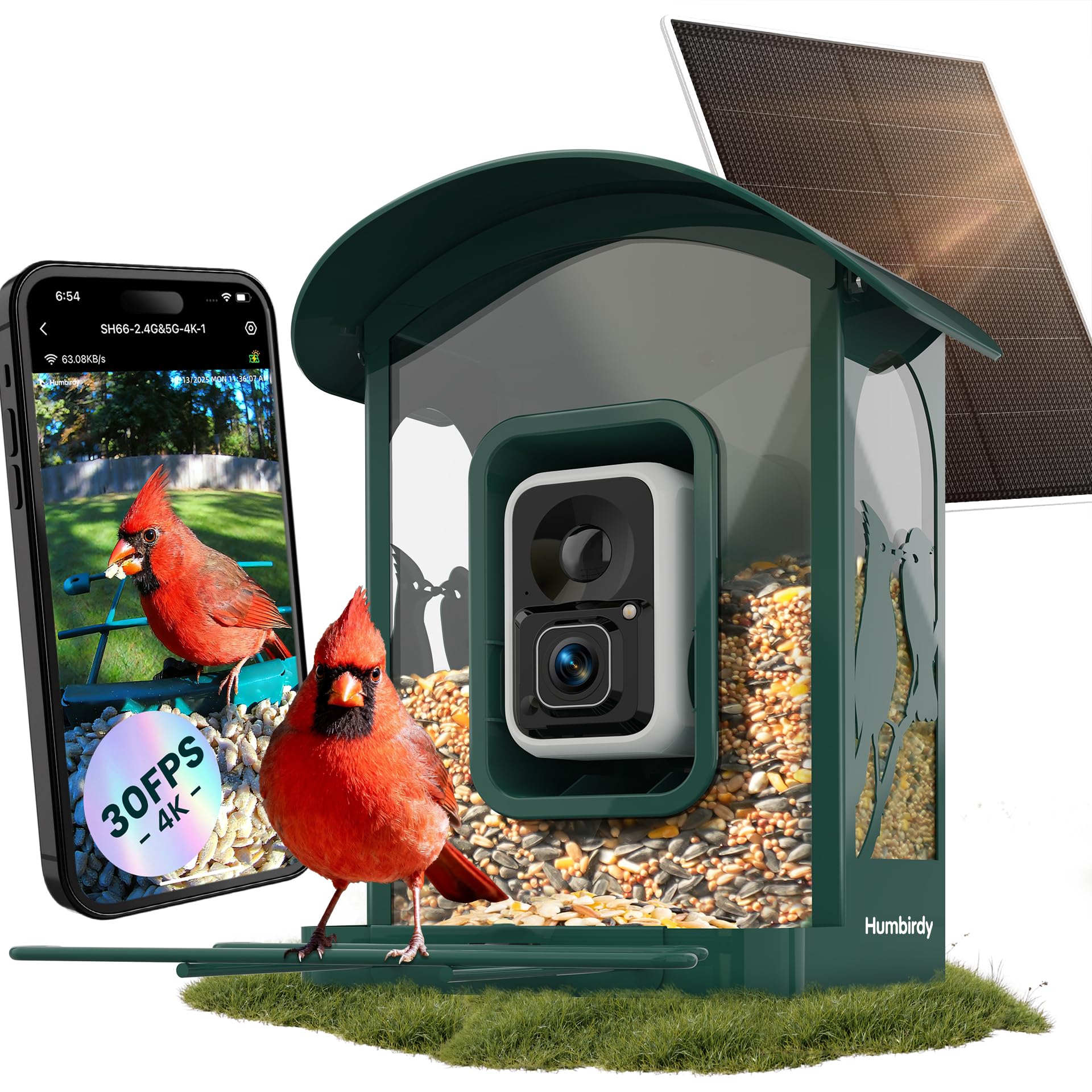
You get smooth 4K video at 30fps (frames per second) from a metal feeder, and you never pay a monthly fee.
The Humbirdy SH66 is built for those who want to see every feather in sharp detail. You get true 4K Ultra HD live view at 30fps (frames per second) with an 8MP (megapixel) HDR sensor, meaning a cardinal’s red is vivid and a wren’s wing texture is clear even in lower light. Unlike the 1080p NETVUE Birdfy, this model handles close-ups with noticeably more clarity thanks to the higher pixel count.
Storage is handled entirely on a built-in 32GB card, so you never need a cloud plan. Buyers report that the 10x slow-motion feature at 1080p 120fps is a fun addition, allowing you to watch a hummingbird’s wingbeat frame by frame. The body is made from sturdy metal (unlike the plastic builds of the RichBird and NETVUE), and the detachable camera lifts out for easy cleaning and USB-C charging. The 1.8-liter seed capacity gives it a slight edge over the 1.5-liter NETVUE and Kiwibit models, meaning fewer refills during a busy week.
One trade-off: the Humbirdy uses a triple-sensor system and M-Guard port design to keep birds outside the seed container, which works well, but the advanced sensitivity means some users will need to tweak the app’s alert settings to avoid notifications from wind or rain. The 3W solar panel generally keeps the camera charged with minimal downtime, though the battery is not replaceable as easily as the RichBird’s 4400mAh unit.
Standout Specs
- True 4K at 30fps for sharp feather detail
- 32GB local storage built in — no cloud fees ever
- Sturdy metal housing resists wind and weather
Real-World Consideration
- Triple-sensor system can trigger false alerts from wind or rain if sensitivity is not adjusted
- Battery is internal and not user-replaceable
Sharpest Feathers: If the highest video quality is your priority, the Humbirdy’s 4K and metal build make it the top choice for dedicated backyard birders.
One Caveat: You will want to spend a few minutes in the app dialing down the motion sensitivity to avoid false alerts on breezy days.
2. RichBird Revive Plus
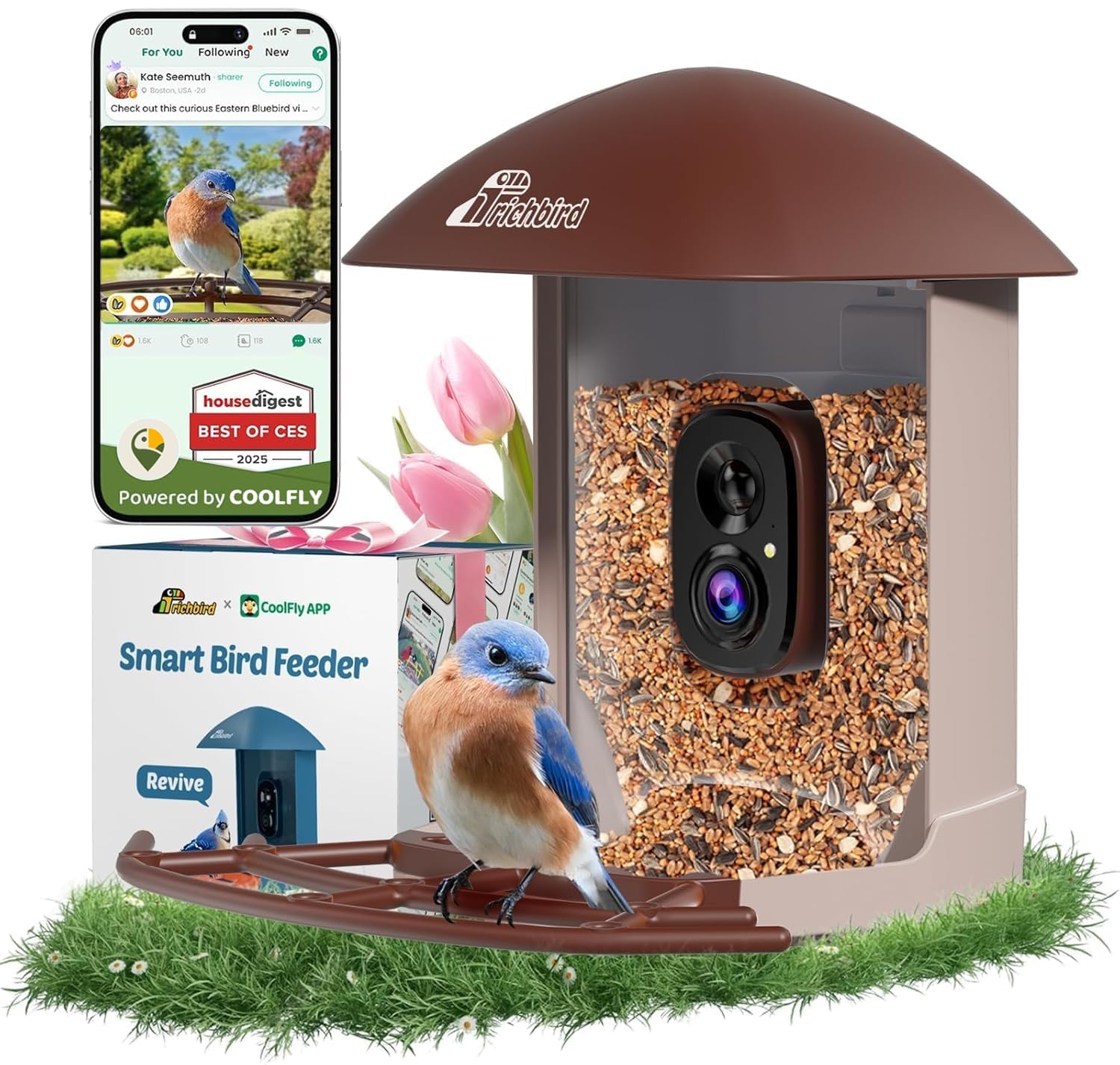
A budget-friendly feeder with a 2-liter seed capacity, larger than the 1.5-liter capacity of comparable models, and a solid solar battery.
The RichBird Revive Plus is an entry-level pick that does not skimp on the essentials. It streams in 2.5K HD resolution — sharper than the 1080p NETVUE Birdfy — and packs a 4400mAh battery paired with a solar panel, so you rarely need to take it inside for a charge.
Owners mention, “I bought this for a family member and I definitely got my money’s worth,” praising the clear recordings and the free AI identification that recognizes over 10,000 bird species. Assembly takes about four steps: attach the roof and perch, fill the hopper, install the app, and mount it to a pole, tree, or wall. Squirrel lovers will appreciate the two-way audio feature — you can talk to a squirrel or play an alert sound to chase it away.
The catch is that the app can feel clunky, as one reviewer noted, “The app is clunky but works if you have patience.” If you are less tech-savvy, you might need help from a family member to get the Wi-Fi connected and camera angle set. The 4MP (megapixel) camera is decent, but it does not match the 4K detail of the Humbirdy or Kiwibit — you will see the bird clearly, but fine feather textures may blur in motion.
What You Get
- 2-liter capacity — holds 2 liters of seed, compared to 1.5 liters for the NETVUE and Kiwibit
- 4400mAh battery with solar panel for reliable outdoor use
- Two-way audio to scare off squirrels with voice or sound
Heads Up
- App interface is not the smoothest; patience required during setup
- 2.5K video is a step below 4K models for fine feather detail
Smart Value Bet: Get the RichBird if you want a large seed capacity, free AI identification, and a solar battery that runs without monthly fees — all at a price that will not break your budget.
skip it if: You demand 4K video or need a perfectly polished app experience from the moment you unbox it.
3. Kiwibit BW512
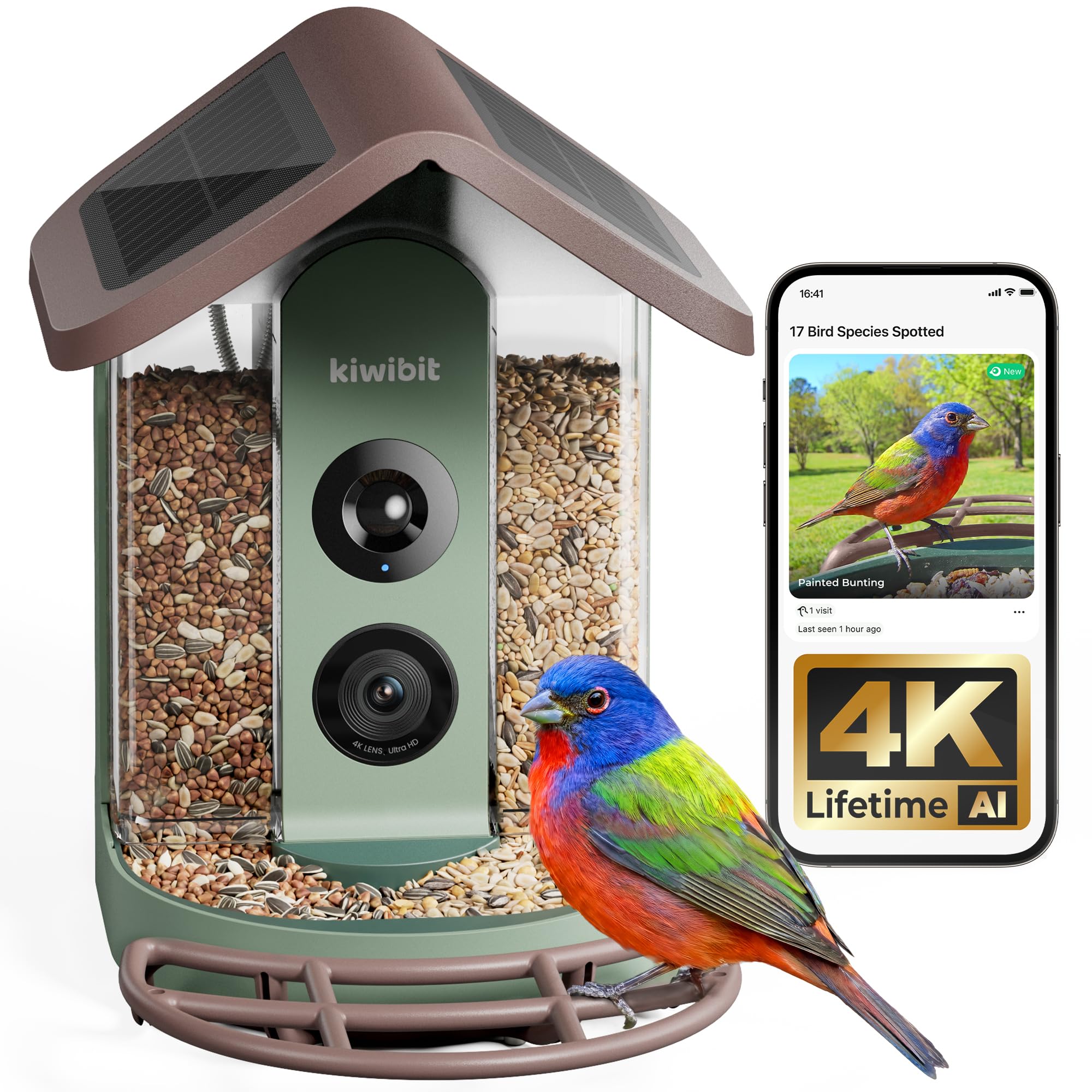
A feature-heavy feeder with the largest battery and dual solar panels for nonstop operation.
The Kiwibit BW512 is built for the birder who wants every premium feature and is willing to invest more upfront. It records in true 4K UHD with an 8MP sensor, an F2.8 aperture (a wide lens opening that lets in more light), and a 132° ultra-wide lens that captures a broad view of the feeder. The dual solar panels pair with a 5200mAh rechargeable battery — the largest capacity in this lineup — making it the most forgiving option in cloudy weather or during heavy recording sessions.
One unique perk is the generous cloud storage: recordings up to 3 minutes long are stored for up to 60 days without a subscription fee. That is a notable advantage over the Humbirdy’s local-only storage and the NETVUE’s 3-month free cloud trial. You can also insert a micro SD card up to 512GB if you prefer to keep everything offline. The feeder is fully detachable for cleaning, and it has an IP65 weatherproof rating (the “6” means it is dust-tight, and the “5” means it can handle low-pressure water jets from any direction).
Compared to the plastic NETVUE Birdfy, the Kiwibit uses ABS and polycarbonate materials (stronger and more impact-resistant) and weighs 6.3 pounds, which is noticeably heavier. That weight helps it stand firm in wind but means you need a solid pole or bracket. Buyers have not yet posted reviews, so the real-world app experience is unverified, but the spec sheet promises a polished experience with automatic highlights and visit summaries.
Why It Stands Out
- 5200mAh battery plus dual solar panels — longest runtime in this group
- 60 days of free cloud storage for 3-minute clips
- 4K UHD at 8MP with a 132° ultra-wide lens
Trade-Off
- At 6.3 pounds, it is the heaviest model and requires a sturdy mount
- No published customer reviews yet to confirm app reliability
For the Power User: Pick the Kiwibit if you want the largest battery, dual solar charging, and the ability to store clips in the cloud without paying a cent.
One Warning: Its weight and price are higher than the others, so it works best for a dedicated, permanent mounting spot.
4. NETVUE by Birdfy N12

A community-tested bird feeder with a massive fan base and well-documented real-world performance.
With over 650,000 users, the NETVUE Birdfy N12 is the most proven camera feeder in this list. It records in 1080p color vision with night vision (infrared LEDs for dark viewing), and the 5dBi antenna (a higher-gain antenna for better Wi-Fi range) helps keep the live stream stable even when the feeder is placed far from the house. The solar panel generally keeps the battery charged through spring, summer, and fall — one buyer in a cloudy area reported the indicator stayed at 90-100% after a month.
The AI identifies 99% of common bird species, and customers note it is “mostly accurate,” though one buyer mentioned that hybrid birds like tufted/black-crested titmice are sometimes mislabeled — a common limitation for AI in crossover regions. The app auto-creates “Recap & Highlights” clips, making it easy to share a hummingbird’s flight video with family. A notable feature is the free 3-month cloud storage for clips, so you can see if cloud storage suits you before relying on the 1.5-liter feeder’s SD card slot.
The main real-world feedback is about the roof: it has minimal overhang, so heavy rain can soak the seed tray. One Texas buyer mentioned, “even mild drizzles will soak the seed tray and I have to scrape the rotting seeds out frequently.” If you live in a rainy area, plan to mount it under some overhead cover. The plastic body is durable but not as tough as the metal Humbirdy or the heavier Kiwibit.
What Owners Love
- Proven by 650,000+ users with strong support community
- 1080p color vision plus night vision for after-dark activity
- Free 3-month cloud storage included to test the service
What to Watch For
- Roof has minimal overhang — rain can spoil the seed tray
- 1080p video is noticeably less sharp than 4K alternatives
Trusted Choice: Choose the NETVUE if you want a well-documented product with a huge user base and a strong app, and you value community-verified performance over maximum video sharpness.
Consider Otherwise: If you live in a very rainy climate or need 4K video, the roof design and lower resolution may make you prefer the Humbirdy or Kiwibit.
Understanding the Specs
Video Resolution (1080p vs 2.5K vs 4K)
This number tells you how much detail the camera captures. 1080p is standard sharpness — you will see the bird clearly. 2.5K (about 2560×1440 pixels) is roughly 78% more pixels than 1080p, giving you clearer feather edges. 4K (3840×2160 pixels) is about four times the detail of 1080p, so you can zoom into a clip and still see individual textures. The trade-off is that higher-resolution files take longer to download over a slow Wi-Fi connection.
Battery Capacity (mAh)
Measured in milliampere-hours, this spec tells you how much energy the battery holds. A 4400mAh battery in the RichBird can typically run a solar camera through a few overcast days without needing a charge, while a 5200mAh battery (like the Kiwibit) offers even more buffer. The solar panel on top recharges the battery during daylight, so you rarely need to bring the feeder inside — unless you have extended rainy stretches in your region.
FAQ
Do these bird feeder cameras really have no subscription fees at all?
Which model has the sharpest video quality?
Will a feeder camera work if my Wi-Fi signal is weak in the backyard?
How long does the battery last on solar power alone?
Can I share the live feed with family members?
Are these feeders safe for birds?
Can I use an SD card instead of cloud storage?
How does AI bird identification work?
Which model is easiest to set up for a non-tech-savvy person?
Do these cameras work at night?
Final Thoughts: The Verdict
Across the board, the bird feeder with camera no subscription winner is the Humbirdy SH66 because it delivers razor-sharp 4K video at 30fps, a metal build, and 32GB of local storage — all without a single monthly fee. If you want the best value with the largest seed capacity and a proven solar battery, grab the RichBird Revive Plus. And for the premium buyer who demands the biggest battery, dual solar panels, and free cloud storage, the standout is the Kiwibit BW512.
How We Picked
We do not accept paid placement. Every pick is matched to a real buyer and a real use-case; we do not hands-on test units.
Sources & Methodology
Specifications: manufacturer listings and product documentation. Review insights: verified customer reviews, as of July 2026. Pricing: not shown on this page (it changes often); check the current price via the retailer link.
As an Amazon Associate, Lawn Gear Lab earns from qualifying purchases. This does not affect which products we feature.